REVISTA
BRASILEIRA
DE
ANESTESIOLOGIA
OfficialPublicationoftheBrazilianSocietyofAnesthesiologywww.sba.com.br
SPECIAL
ARTICLE
Survey
of
postoperative
residual
curarization,
acute
respiratory
events
and
approach
of
anesthesiologists
Ismail
Aytac
a,
Aysun
Postaci
b,∗,
Betul
Aytac
b,
Ozlem
Sacan
b,
Gulcin
Hilal
Alay
b,
Bulent
Celik
c,
Kadriye
Kahveci
d,
Bayazit
Dikmen
baDepartmentofAnesthesiologyandReanimation,SamiUlusChildren’sHospital,Ankara,Turkey
bDepartmentofAnesthesiologyandReanimation,NumuneEducationandResearchHospital,Ankara,Turkey cDepartmentofBiostatistics,FacultyofHealthSciences,GaziUniversity,Ankara,Turkey
dDepartmentofAnesthesiologyandReanimation,MinistryofHealthEtlikEducationandResearchHospital,Ankara,Turkey
Received16April2012;accepted19June2012 Availableonline4April2014
KEYWORDS
Complications; Postoperative; Residualcurarization; Monitoring;
Neuromuscularblock; Acuterespiratory events
Abstract
Backgroundandobjectives: residual paralysis following the use of neuromuscular blocking drugs(NMBDs)withoutneuromuscularmonitoringremainsaclinicalproblem,evenwhenNMBDs areused.Thisstudysurveyspostoperativeresidualcurarizationandcriticalrespiratoryevents in therecovery room, as wellas theclinical approach to PORCof anesthesiologistsin our institution.
Methods:Thisobservationalstudyincluded415patientswhoreceivedgeneralanesthesiawith intermediate-actingNMBDs.Anesthesiawasmaintainedbynon-participatinganesthesiologists whowereblindedtothestudy.Neuromuscularmonitoringwasperformeduponarrivalinthe recovery room. A CRE was defined as requiring airway support, peripheral oxygen satura-tion <90%and90---93% despitereceiving3L/min nasalO2,respiratoryrate>20breaths/min, accessory muscle usage,difficulty withswallowing orspeaking, andrequiring reintubation. Theclinicalapproachofouranesthesiologiststowardreversalagentswasexaminedusingan 8-questionmini-surveyshortlyafterthestudy.
Results:TheincidenceofPORCwas43%(n=179)forTOFR<0.9,and15%(n=61)forTOFR<0.7. TheincidenceofTOFR<0.9wassignificantlyhigherinwomen,inthosewithASAphysicalstatus 3,andwithanesthesiaofshortduration(p<0.05).Inaddition,66%(n=272)ofthe415patients arrivingattherecoveryroomhadreceivedneostigmine.ATOFR<0.9wasfoundin46%(n=126) ofthepatientsreceivingneostigmine.
Conclusions: Whenroutineobjectiveneuromuscularmonitoringisnotavailable,PORCremains a clinical problem despite the use of NMBDs. The timing and optimal antagonism of the
∗Correspondingauthor.
E-mail:[email protected](A.Postaci). http://dx.doi.org/10.1016/j.bjane.2012.06.011
neuromuscularblockade,androutineobjectiveneuromuscularmonitoringisrecommendedto enhancepatientsafety.
©2014SociedadeBrasileiradeAnestesiologia.PublishedbyElsevier EditoraLtda.Allrights reserved.
PALAVRAS-CHAVE
Complicac¸ões; Pós-operatório; Curarizac¸ãoresidual; Monitorac¸ão; Bloqueio neuromuscular; Eventosrespiratórias agudos
Pesquisadecurarizac¸ãoresidualnopós-operatório,eventosrespiratóriosagudose
abordagemdeanestesiologistas
Resumo
Justificativaeobjetivos: A paralisia residual após o uso de bloqueadores neuromusculares (BNMs)semmonitorac¸ãoneuromuscularcontinuasendoumproblemaclínico,mesmoquando BNMssãousados.Esteestudopesquisouacurarizac¸ãoresidualpós-operatóriaeoseventos res-piratórioscríticosemsaladerecuperac¸ão,bemcomoaabordagemclínicadaCRPOfeitapelos anestesiologistasemnossainstituic¸ão.
Métodos: Esteestudoobservacionalincluiu415pacientesquereceberamanestesiageralcom BNMsdeac¸ãointermediária.Amanutenc¸ãodaanestesiafoifeitaporanestesiologistasnão par-ticipantes,‘‘cegos’’paraoestudo.Amonitorac¸ãoneuromuscularfoirealizadanomomentoda chegadaàsaladerecuperac¸ão.UmERCfoidefinidocomonecessidadedesuporteventilatório; saturac¸ãoperiféricadeoxigênio<90%e90-93%,adespeitodereceber3L/mindeO2viacânula nasal;frequênciarespiratória>20bpm; usodemusculaturaacessória;dificuldadedeengolir oufalarenecessidadedereintubac¸ão.Aabordagemclínicadenossosanestesiologistas, em relac¸ãoaosagentesdereversão,foi avaliadausandoum miniquestionáriodeoitoperguntas logoapósoestudo.
Resultados: AincidênciadeCRPOfoide43%(n=179)paraaSQE<0e15%(n=61)paraaSQE <0,7.AincidênciadeSQE<0,9foisignificativamentemaioremmulheres,pacientescomestado físicoASA IIIecomanestesiadecurtadurac¸ão(p<0,05). Alémdisso,66%(n=272)dos415 pacientesquechegamàsaladerecuperac¸ãohaviamrecebidoneostigmina.UmaSQE<0,9foi encontradaem46%(n=126)dospacientesquereceberamneostigmina.
Conclusão:Quandoamonitorac¸ãoneuromuscularobjetivaderotinanãoestádisponível,aCRPO continua sendo um problema clínico, adespeitodo uso de BNMs. Omomentoe o antago-nismoideaisdobloqueioneuromusculareamonitorac¸ãoneuromuscularobjetivaderotinasão recomendadosparaaumentaraseguranc¸adopaciente.
©2014SociedadeBrasileiradeAnestesiologia.PublicadoporElsevierEditoraLtda.Todosos direitosreservados.
Introduction
Neuromuscularblockingdrugs(NMBDs)areusedtofacilitate endotracheal intubation during induction of anesthesia. Residual postoperative paralysis following the use of musclerelaxants agents, knownas postoperative residual curarization(PORC),mayincreasepostoperativepulmonary complications, morbidityand mortality.1,2 For many years
atrain-of-fourratio(TOFR)of0.7wasconsideredsufficient toexcludePORC;nowadays,however,toexcludeclinically significant PORC it is considered that the TOFR should be ≥0.9.3,4 PORC is associated with weakness of upper
airway muscles, airway obstruction, impaired pharyngeal functionleadingtoincreasedriskforaspiration,inadequate recoveryofpulmonaryfunction,andimpairedhypoxic ven-tilatoryresponse.2,5TheincidenceofPORCintherecovery
room/post-anesthesiacareunit(PACU)varies widely,with reported frequencies ranging from 9 to 47%.2,6---9 Critical
respiratory events (CREs) during early recovery from general anesthesia are not uncommon and their etiology is multifactorial. Anesthetic variables associated with
postoperative CREsinclude the use of opioids andNMBDs duringgeneralanesthesia.2,10
This prospective observational study aimed to deter-minethe incidenceof PORC inthe early recoveryperiod, anticholinesterase application ratios and doses, adverse respiratory events of PORC, and the current approach of anesthesiologiststoPORCwithoutroutinemonitorizationin ourinstitution.
Materials
and
methods
Patientsandstudyprotocol
neuromuscular diseases, severe kidney or liver diseases, thoseundergoingtotalintravenousanesthesia,andpatients withabodytemperature≤35◦C.Premedicationandchoice
ofanesthetic protocol,givinganticholinesterase wereleft to the discretionof the anesthesiologist in charge of the patient, who was unaware that the patient was to be includedinthisstudy.
Datacollection
Patients were subject to routine monitoring immediately after arrival at the recovery room. Patients’ electrocar-diogram,peripheraloxygensaturation(SpO2),non-invasive bloodpressure,andbodytemperature(GeniusTM2IR Tym-panicThermometerLtd.,Gosport,UK)weremeasured,and supplementaloxygen(3L/min)wasprovidedtoallpatients. PORCwasassessedintherecoveryroombyan anesthesi-ologistunaware of thestudy.The neuromuscular function of the Adductor pollicis muscle was monitored using the TOF-Watch SX® acceleromyograph. The skin was washed withalcohol, and an acceleromyograph probewas placed onthedistalventralpartofthethumb.Theremaining fin-gertips weretightly fixed withtape. The ulnar nervewas stimulated. TheTOF tracing wasstabilizedby administer-ing1min of repetitiveTOF stimulationfollowed by a5-s, 50-Hztetanicstimulation,andthenanother3---4minperiod of repetitive TOF stimulation. The CAL 2 mode was used todeterminethesupramaximalthresholdandtocalibrate thetransducer oftheacceleromyograph. Aftercalibration ofthedevice,theratioofthreevalueswasrecordedhaving assessed thethree TOFR at 15-s intervals in each patient and we use mean of these three values. Patients with a TOFR of <0.7, 0.7---0.9, and >0.9 were regarded as hav-ing severe PORC, mild to moderate PORC, and sufficient neuromuscularrecovery,respectively.Thefollowing param-eters were assessed and recorded in the intraoperative anesthesiarecords:age,bodyweight(BW),typeofsurgery, duration of anesthesia (i.e. period between induction of anesthesiaandarrival at therecovery room), thetypeof intermediate-actingNMBDsused,durationofthelastNMBD (periodbetweenthelastNMBDandtheTOFRrecordinginthe recoveryroom), neostigminedose andtimeadministered, andreversaltime(periodbetweenneostigmine administra-tion and TOF recording in the recovery room). Moreover, thefollowingparameterswereexamined/recordedtoassess respiratory status:need for airwaysupport, upper airway obstruction, respiratory rate, accessory muscle use, diffi-cultywithswallowingorspeaking,andreintubation.
Patientswithaperipheraloxygensaturation(SpO2)<90% despite 3L/min O2 nasal cannula were regarded as hav-ing severe hypoxia, those with90---93% as having mild to moderate hypoxia, and those with SpO2 > 93% as having normoxia.2,11 Approach to treatment of PORC left choice
of anesthesia unaware of the study. For the survey part ofthisstudy,theclinicalapproachofouranesthesiologists (n=21) toward neostigmine was explored using a mini-survey(8questions)shortlyaftertheclinicalstudy.12These
(anonymous) questionnaires were collected in enclosed envelopes.
Statisticalanalysis
AllstatisticalanalyseswereperformedusingSPSS(the sta-tistical package for social sciences) Version 15.0 (SPSS, Inc.,Chicago,IL,USA).Forcontinuousvariables,meanand standard deviation were presented; for categorical varia-bles, frequency and percentage values were presented. Chi-squaretestandFischer’sexacttestwereusedto com-pare categorical variables. To compare the two groups, Student’s t test was used for parametric conditions, and Mann---WhitneyUtest wasused for non-parametric condi-tions.Inordertocomparethreeormoregroups, one-way analysisofvariancewasusedforparametricconditions,and Kruskal---WallisH test was usedfor non-parametric condi-tions.Predictorfactorsof PORCwere determinedthrough univariatelogisticregression. Allparameterswithp<0.05 inunivariateanalyseswereincludedinamultivariate logis-tic regression model. A p-value of ≤0.05 was considered statisticallysignificant.
Results
Atotalof415patientsmettheinclusioncriteriaandwere evaluated.Ofthese,255underwentnon-abdominal proce-dures and 160 underwent abdominal procedures. Table 1 presentsthedemographicdataandclinical characteristics ofthe415patients.
Postoperativeresidualcurarization
Theincidenceof PORCwas43% (n=179)for aTOFR<0.9, and15%(n=61)foraTOFR<0.7.TheTOFRwas≥0.9in56% (n=236)oftheallpatients.
Table1 Demographicandanesthesiologydataofthestudygroup(n=415).
Gender (M/F)n/(%)
Age (years)
Weight (kg)
ASA 1/2/3 n(%)
Durationof anesthesia (min)
Typeofsurgery Abdominal/ non-abdominal (n)
Sevo/Des/Iso n
202(48.7)/213 (51.3)
43.87±14.14 73.24±13.06 159(38.3)/201 (48.4)/55(13.3)
106.10±45.98 160/255 300/84/31
Dataaremean±SD,ornumberofpatients(n)andpercent(%).
Table2 Train-of-fourratioinrelationtodemographic/clinicaldata.
Characteristic TOFratio Pvalue
<0.7 (n=61)
0.7---0.8 (n=43)
0.8---0.9 (n=75)
>0.9 (n=236)
Age(year) 49.9±11.7a 46.5±13.2a 46.6±12.2a 41.0±14.8 <0.001
Gendern(%)
Male 24(11.9) 21(10.4) 30(14.8) 127(62.9) 0.038
Female 37(17.4) 22(10.3) 45(21.1) 109(51.2)
Weight(kg) 75.5±14.8 72.8±14.5 73.0±13.0 72.8±12.3 NS
ASAn(%)
1 17(10.7) 11(6.9) 24(15.1) 107(67.3) 0.003
2 34(16.9) 25(12.4) 39(19.4) 103(51.2)
3 10(18.2) 7(12.7) 12(21.8) 26(47.3)
Durationofanesthesia(min) 83.9±37.1a 95.6±41.0a 95.9±41.9a 116.9±47.1 <0.001
TFLTOF(min) 67.4±27.3a 73.6±28.4a 88.0±37.7a,b 109.4±43.0 <0.001
Reversaltime(min) 10.5±4.4a,c 10.7±4.2a,c 12.3±4.8 12.4±4.3b 0.040
Neosigmine(mg) 1.3±0.5 1.1±0.3 1.3±0.4 1.2±0.4 >0.05
Bodytemp.(OC) 35.7(0.4) 35.7(0.3) 35.8(0.3) 35.7(0.4) >0.05
ASA,AmericanSocietyofAnesthesiologists;TOF,train-of-four;TFLTOF,timefromlastNMBDtoTOFrecordinginrecoveryroom(min); reversaltime,timebetweenreversalandassessmentofTOFratioinrecoveryroom(min).
ap<0.001versusTOF>0.9. b p<0.001versusTOF<0.7. c p<0.05versusTOF0.8---0.9.
Mostofthepatientsshowinginsufficientrecovery(TOFR <0.7 and <0.9) were female, ASA physical status 3, had anesthesiaofshortduration,andhadahigherthanaverage age(p<0.05)(Tables2and3).
NMBDmanagement
Inthepresentstudy,themoderatemusclerelaxantagents usedwerevecuronium,rocuroniumandatracurium,which
Table3 LogisticregressionanalysisofriskfactorsforPORC.
OR %95CI p
Univariatelogisticregression
Age(year) 1.036 1.021---1.051 <0.001
Gender(malea/female) 1.616 1.092---2.391 0.016
Weight(kg) 1.006 0.991---1.021 0.430
ASA
I* 1
II 1.958 1.272---3.014 0.002
III 2.295 1.229---4.286 0.009
DurationofAnesthesia(min) 0.987 0.982---0.991 <0.001
Neuromuscularblockingdrug
Atracuriuma 1
---Vecuronium 1.744 0.601---5.063 0.306
Rocuronium 2.640 0.832---8.375 0.099
TFLTOF(min) 0.978 0.972---0.984 <0.001
Neostigmineadministration(noa/yes) 1.465 0.968---2.219 0.071
Reversaltime(min) 1.008 0.979---1.037 0.602
Neostigminedose(mg) 1.271 0.951---1.697 0.105
Multivariatelogisticregression
Age(year) 1.039 1.022---1.056 <0.001
Gender(male/female) 1.568 1.010---2.433 0.045
TFLTOF(min) 0.980 0.973---0.987 <0.001
R-Sup-NMBDs,ReceivingsupplementaryNMBDs;TFLTOF,TimefromlastNMBDtoTOFrecordinginrecoveryroom(min);OR,Odd’sratio; 95%CI,95%Confidenceinterval.
Table4 Administrationofneostigminrelateddemographicdata.
Characteristic Neostigmineadministration? pvalue
Yes(n:272) No(n:143)
Age(year) 45.06±14.14 41.60±13.90 0.017
ASAn(%)
I(n=159) 92(57.9) 67(42.1) 0.020
II(n=201) 138(68.7) 63(31.3)
III(n=55) 42(76.4) 13(23.6)
Durationofanesthesia(min) 95.61±41.80 126.05±47.09 <0.001
TFLTOF(min) 83.42±34.08 118.92±46.34 <0.001
ASA,AmericanSocietyofAnesthesiologists;TFLTOF,timefromlastNMBDtoTOFrecordinginrecoveryroom(min).
wereappliedin335,63and17patients,respectively.TOFR <0.9was42.1%forvecuronium,52.4%for rocuroniumand 29.4%foratracurium.
ReversalofNMBagents
Onarrivalintherecoveryroom,65.5%(n=272)ofthe415 patientshadreceivedneostigmine,whereastheremainder 34.5%(n=143)hadnot.ATOFR<0.9wasestimatedin46.3% (n=126)ofthepatientsreceivingneostigmine,andin14.7% (n=40)of thisgroupthe TOFRwas<0.7.Table4 presents data on neostigmine administration in relation to demo-graphiccharacteristics.Patientsreceivingneostigminewere ofhigheraverageage,hadanesthesiaofshorterduration, andtheperiodbetween administrationofthe lastmuscle relaxant and TOFR assessment wasshorter. Another find-ingwasthattheneostigminedosedidnotchangeaccording totheTOFR;anaveragedoseof20±10g/kgneostigmine
wasapplied.Inpatientsnotreceivingneostigmine,the aver-agetimeafterthelastNMBDdosewas118.92±46.34min, compared with 83.42±34.08min in those who received neostigmine(p<0.001).Theperiodbetweenthe administra-tionofneostigmineandTOFRassessmentwas10.5±4.4min
inpatientswithaTOFR<0.7and12.4±4.3mininthosewith aTOFR>0.9min(Table2).
Respiratorystatus
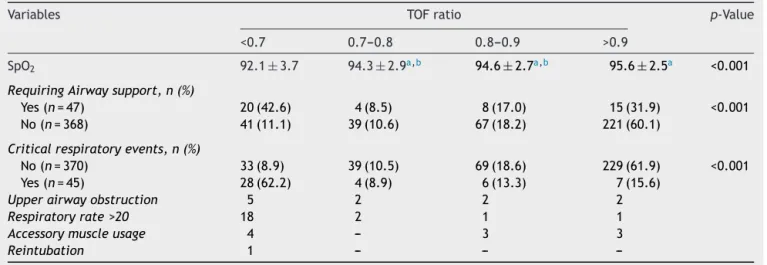
Table5 presents data on the relation between PORC and CREs.Accordingly,inpatientswithaTOFR≥0.7theSpO2was proportionallyhigh,whileinthosewithaTOFR<0.7itwas proportionally low.Use of airway supportand respiratory complicationswerehigherinpatientswithTOFR<0.7.Inour 415patients,14of17patients(82.4%)withan SpO2≤90% hadaTOFR≤0.9.Only3patients(17.6%)hadanSpO2≤90% despiteaTOFR>0.9.SpO2was≥93%in307patients.Airway supportwasappliedin42.6% of thepatients withaTOFR <0.7,andin31.9%ofthosewithaTOFR>0.9(Table6).
ApproachestoPORCbyanesthesiologists
Table7presentstheresultsofourmini-surveyamongour21 anesthesiologistsshortly after theclinical study. Ofthese anesthesiologists,71%(n=15)thoughtthattheincidenceof PORCwas0---10%,andonly1anesthesiologist(5%)mentioned itcouldbe30---50%.Eightanesthesiologists(38%)alwaysuse
Table5 CriticalrespiratoryeventsratioinrelationtotheTOFratio.
Variables TOFratio p-Value
<0.7 0.7---0.8 0.8---0.9 >0.9
SpO2 92.1±3.7 94.3±2.9a,b 94.6±2.7a,b 95.6±2.5a <0.001
RequiringAirwaysupport,n(%)
Yes(n=47) 20(42.6) 4(8.5) 8(17.0) 15(31.9) <0.001
No(n=368) 41(11.1) 39(10.6) 67(18.2) 221(60.1)
Criticalrespiratoryevents,n(%)
No(n=370) 33(8.9) 39(10.5) 69(18.6) 229(61.9) <0.001
Yes(n=45) 28(62.2) 4(8.9) 6(13.3) 7(15.6)
Upperairwayobstruction 5 2 2 2
Respiratoryrate>20 18 2 1 1
Accessorymuscleusage 4 --- 3 3
Reintubation 1 --- ---
---Dataaremean±SD,ornumberofpatientsandpercent(%). a p<0.001vs.TOF<0.7.
Table6 Peripheraloxygensaturation(SpO2)inrelationtoadequaterecoveryofTOF(>0.9)andinadequaterecoveryofTOF
(<0.7).
Peripheralsaturation TOF<0.9 (n=179)
TOF>0.9 (n=236)
p-Value
SpO2n(%)
<90%(n=17) 14(82.4) 3(17.6)
90---93%(n=96) 60(62.5) 36(37.5) <0.001
>93%(n=302) 105(34.8) 197(65.2)
Dataarenumberofpatientsandpercent(%).
Table7 AttitudesregardingmanagementofPORCinourinstitution(n=21anesthesiologists).
Question Options n %
WhatdoyouestimatetheincidenceofPORCtobeinyourclinic? 0---10.0% 15 71
10.1---20.0% 3 14
20.1---30.0% 2 10
30.1---50.0% 1 5
50.1---70.0% ---
---WhenanNMBDhasbeengiven,doyoualwaysadminister neostigmineattheendofsurgery?
Yes 8 38
No 13 62
Ifanswertotheabovequestionwas‘No’inwhat percentageofcasesdoyouomitneostigmine?
1---25% 2 15
26---50% 5 39
51---75% 4 31
76---100% 2 15
Howlongafteradministrationofneostigminedoyou extubateyourpatiens?
AfterextubationIadminister neostigmine
1 5
5---10min 18 86
11---15min 2 10
Whatdoseofneostigminedoyouusuallyadminister? 2.5mg 1 5
<0.05mg/kg 10 48
0.05mg/kg 5 24
>0.05mg/kg ---
---<2.5mg 5 24
Doyouhaveanyconcernsregardingtheadverseeffectsassociated withadministrationofneostigmine/antimuscarinicdrugs?
Yes 17 81
No 4 19
If‘Yes’totheprecedingquestion,whatarethey? -Hemodynamiceffects 14 67 -Respiratoryeffects 8 38 -Increasednauseaandvomiting 10 48 -Inadequaterecoveryof
neuromuscularfunction
4 19
-Other 1 5
PriortotrachealextubationtheTOFmonitorsshouldbe: <50---60% ---
---61---70% 2 10
71---80% 4 19
80---90% 4 19
91---100% 11 53
neostigmineattheendofsurgery.Fiveof13 anesthesiolo-gistswhodonotalwaysuseneostigminereportedthatthey useitat arateof26%and50%.Eighteen anesthesiologists (86%)administerneostigmine5---10minbeforeextubation,2 administerit10---15minbeforeextubation,and1mentioned thatheadministereditafterextubation.Ofthese21 anes-thesiologists,17(81%)hadconcernsabout theside-effects by the use of reversal agents, 14 (67%) about hemo-dynamic side-effects, 10 (59%) about nausea/vomiting, and 8 (38%) had concerns about respiratory side-effects.
Eleven anesthesiologists (53%) believed that the TOFR shouldbe0.9orhigherbeforeextubation(Table7).
Discussion
thesepatientshadreceivedneostigmineatanaveragedose of20±10g/kg,generallyadministered10---12minbefore
extubation.
A TOFR<0.9wasestimated in46% ofthe patientswho receivedneostigmine(n=126),and14%(n=40)ofthisgroup hadaTOFR<0.7.However,amongour21anesthesiologists, 71%(n=15)believedthattheincidenceofPORCinour insti-tute was 0---10%. The study alsoshows that patients with insufficient recovery (TOFR<0.7 to<0.9) were older than average, more often female, had an ASA score 3, and a shorterdurationofanesthesia.
Of our415patients,in therecovery room45hadCREs symptomsand62%ofthese45patientshadaTOFR<0.7.Of thetotalgroup,84%hadaTOFR≤0.9.
The incidence of PORC did not decrease over time. Inother randomizedprospectivestudies, theincidenceof PORC wasreportedto havechanged in relation to differ-encesbetweenthestudydesigns.2,6---9Forexample,Debaene
etal.8 determinedthepercentageofpatientsinthePACU
with a TOFR <0.7 and <0.9 after receiving a single intu-batingdose of anintermediate-actingNMBD (vecuronium, rocuronium, or atracurium). Muscular paralysis was not antagonizedintraoperatively.ATOFR<0.7in16%ofpatients (15.9% received rocuronium, 16.9% received atracurium, 17%receivedvecuronium)and<0.9in45%ofpatients(45% received rocuronium, 41.6% received atracurium, 46.8% received vecuronium) were observed postoperatively and TOFR >0.9 was observed in only 55% of patients in the recoveryroom.8InourstudywefoundthatTOFR<0.9was
42% withvecuronium, 52% with rocuroniumand 30% with atracurium.
Cammu et al.7 assessed the occurrence of PORC in
patientsundergoingoutpatientandinpatientsurgical pro-cedures.Neuromuscularmonitoringandreversalagentwas usedinonly12%and25%ofpatients,respectively.ATOFR <0.9wasfound in47%of theinpatientsandin 38%of the outpatients.
In their observational study, Butterly et al.1 reported
that reversal agents are frequently used; 78% of their study population receivedneostigmine at a meandose of 2.5 (±1.2)mg. Basic nerve stimulators were applied rou-tinelyin operatingrooms andanesthetizinglocations,and the incidence of PORC was 22%. The higher incidence of PORC in our institution might be attributable to a lower anticholinesterase application rate (66%), a lower mean neostigminedose(20g/kg),lackofroutineneuromuscular
monitoring,andmaydependonlowawarenessforPORC. Antagonism of neuromuscular blockade with cholinesteraseinhibitorsattheendofthesurgeryreduces theincidenceof PORC, thelengthof stay intherecovery room, and pulmonary complications.1,2,5,6,9,13 However,
the moment of antagonism plays an important role in these patients. Ifantagonism is performed shortly before extubation,theneuromuscularblockisofteninsufficiently antagonized, thus increasing the risk of PORC.14 If
intra-operative objective neuromuscular monitoring can not be applied, it is recommended that the patient be con-stantlyantagonized longbeforeextubation toavoidPORC associated with the depth of neuromuscular blockade.5,8
Muphy et al.9 investigated the incidence of PORC in the
recoveryroomandinthepre-extubationperiodamong120 patients (ASA 1---2) usingrocuronium underintraoperative
neuromuscularmonitoring;allsubjectswerereversedwith neostigmine at a TOF count of 2---4. The average period fromtheinjectionofneostigminetotherecordingofTOFR atthetimeofextubationregardingtheclinicalcriteriawas 8±6min. During extubation, the percentage of patients with a TOFR <0.7 was 58% and that of patients with a TOFR <0.9 was 88%. They also reported that the period from injecting neostigmine to the TOFR assessment in therecovery roomwas 19±7min; theincidence of PORC was8% and 32% for patients with a TOFR ≤0.7 and 0.9, respectively.9
AnotherstudybyMcCauletal.14 included40patientsof
ASAIusingatracurium.Duringneuromuscularblock antag-onism,theTOFR<0.7patientswerefoundtobe70%,while thesameratiowasfoundin65%ofthepatientsduring extu-bation. Compared with patients with a PORC TOFR >0.7, patients with a TOFR <0.7 during extubation had shorter procedures,anddeeperneuromuscularblockatthetimeof neostigmineadministration.Inthatstudy,itwasestablished thattheperiodfromthemomentthemusclerelaxantwas appliedtotherecordingTOFRwas6±1minforpatientswith TOFR<0.7,and15±4minforthosewithaTOFR>0.7.14 In
thepresentstudy,theperiodfromanticholinesterase appli-cationtoTOFR measurementwas10.5±4.4min forthose withaTOFR<0.7and12.4±4.3minforthosewithqTOFR >0.9,whichsupports theresults ofMcCauletal. Further-more,Baillardetal.6investigating435patientsin1995,130
in2000,and101in2002,studiedthefactorsaffectingPORC withearlychangesinclinicalanesthesiaapplications.Within thisperiod, concomitant with an increase in the average ageofthepatients,their weight,durationof surgery,use ofintraoperativeneuromuscularmonitoringandreversalof residualparalysis,theincidenceofPORCshowedamarked decreasefrom60%to5%.
Postoperative respiratory events are the most com-mon adverse outcomes associated with residual paralysis reported in both observational and randomized clinical studies. In 1994, Rose et al.10 prospectively examined
patient (age >60 yr, male gender, diabetic, and obese), surgical (emergenciesand cases >4h) and anesthetic fac-tors (premedication, induction with thiopental, fentanyl >2.0gkg−1, fentanyl and morphine combination, and
atracurium >0.25mgkg−1h−1) associated withCREsin the PACU.Murphyetal.2 assessedandquantified theseverity
ofneuromuscularblockadein patientswithsignsor symp-tomsofCREsinthePACU.Atotalof7459patientsreceived a general anesthetic during the 1-year study period, of whom61(1%)developedaCRE.Forty-twoofthesepatients werematchedwithcontrolsandconstitutedthestudygroup forstatisticalanalysis.Ahighincidenceofseveralresidual blockades wasobservedin patients withCREs, which was absentincontrolpatientswithoutCREs.2
In another randomized, prospective and placebo-controlledtrial, Sauer etal.15 studied the effect of CREs
onthe incidence of PORC by dividing 114 patients into a neostigmineandplacebogroupaftergeneralanesthesiain thePACU.Amongpatientsreceivingrocuronium,39%were discoveredto have CREsand the incidence of hypoxemia (SpO2)wassignificantlyhigherintheplacebogroupthanin theneostigminegroup.
intheUSA.12Theincidenceofneuromuscularmonitoringin
theoperating room was22.7% in the USA compared with 70.2%inEurope.InEurope,54%oftheparticipantsapplied neostigmine3---5minbeforeextubationandonly5%ofthem waited≥10min;intheUSAthesefigureswere39%waited 3---5min,46%waited6---10min,and13%waited10minbefore extubation.Withrespect totheneostigmine dose,60% of theparticipantsfromEuropeadministeredadoseof2.5mg, whereas49%oftheparticipantsintheUSAadministeredthis drugonamilligramper kilogrambasisratherthanafixed dose.Mostparticipants frombothEurope (83.7%)andthe USA(86%)reportedconcerns about theadverse effectsof anticholinesterasesandantimuscarinicdrugs.12Inour
insti-tution,routineuseofareversalagentissimilartothatused intheUSA(i.e.38%).Amongouranesthesiologists,alower awarenessofPORCandahigherincidenceof meuromuscu-larblockadeisprobablyassociatedwiththelackofroutine neuromuscularmonitoringinourinstitute.
The present study hassome limitations. First, because itis difficult toestablisha cause-effectrelation in obser-vational studies, we maynot have revealed other factors affecting PORC. Second, we were unabletoestablish the incidenceofPORCorthedepthofneuromuscularblock dur-ingextubationsinceobjectiveneuromuscularmonitoringis notappliedinanyofouroperatingrooms.Third,theCREs mighthavebeeninfluencedbyunknownclinicalvariables; inaddition,theirlong-termeffectsremainunknownasCREs couldonlybemonitoredbeforedeparturefromtherecovery room.Fourth,becausethepatientsstayedintherecovery roomforvaryinglengthsoftime,wewereunabletocheck theeffectsoftheTOFRinrelationtothedurationofstayin therecoveryroom.
In summary, when routine objective neuromuscular monitoringis notavailable,PORC remains aclinical prob-lem despite the use of intermediate-acting NMBDs. Older patients, female patients, ASA physical status 3, shorter anesthesiaprocedures, patients witha short timeto the lastNMBDdose, andearly extubationafterantagonismof aneuromuscularblockademaybeatriskofPORCandCREs. The timing and optimalantagonism of the neuromuscular blockade,androutineobjectiveneuromuscularmonitoring isrecommendedtoenhancepatientsafety.
Conflicts
of
interest
Theauthorsdeclarenoconflictsofinterest.
References
1.ButterlyA,BittnerEA,GeorgeE,etal.Postoperativeresidual curarization from intermediate-acting neuromuscular block-ing agents delays recovery room discharge. Br J Anaesth. 2010;105:304---9.
2.Murphy GS, Szokol JW, Marymont JH, et al. Intraoperative accelermyographicmonitoringreducestheriskofresidual neu-romuscular blockade and adverse respiatory events in the postanesthesiacareunit.Anesthesiology.2008;109:389---98. 3.Claudius C, Garvey LH, Viby-Mogensen J. The
undesir-able effects of neuromuscular blocking drugs. Anaesthesia. 2009;64:10---21.
4.Eriksson LI. Evidence-based practice and neuromuscular monitoring:It’stimeforroutinequantitativeassessment. Anes-thesiology.2003;98:1037---9.
5.MurphyGS,BrullSJ.Residualneuromuscularblock:PartI: def-initions,incidence,andadversephysiologiceffectsofresidual neuromuscularblock.AnesthAnalg.2010;111:120---8.
6.BaillardC,Clec’hC,CatineauJ,etal.Postoperativeresidual neuromuscularblock:asurveyofmanagement.BrJAnaesth. 2005;95:622---6.
7.CammuG,DeWitteJ,DeVeylderJ,etal.Postoperative resid-ual paralysis in outpatients versus inpatients. Anesth Analg. 2006;102:426---9.
8.DebaeneB,PlaudB,DillyMP,et al.Residualparalysisinthe PACUafterasingleintubatingdoseofnondepolarizingmuscle relaxantwithanintermediatedurationofaction. Anesthesiol-ogy.2003;98:1042---8.
9.Murphy GS, Szokol JW, Marymont JH, et al. Residual paral-ysis at the time of tracheal extubation. Anesth Analg. 2005;100:1840---5.
10.RoseDK,CohenMM,WigglesworthDF,etal.Criticalrespiratory eventsinthepostanesthesiacareunit,patient,surgical,and anestheticfactors.Anesthesiology.1994;81:410---8.
11.RozeH,LafargueM,QuattaraA.Casescenario:management ofintraoperativehypoxemiaduringone-lungventilation. Anes-thesiology.2011;114:167---74.
12.Naguib M, Kopman AF, Lien CA, et al. A survey of current managementofneuromuscularblockintheUnitedStatesand Europe.AnesthAnalg.2010;111:110---9.
13.BaillardC,GehanG,reboul-MartyJ,etal.M.Residual curariza-tion in the recovery room after vecuronium. Br J Anaesth. 2000;84:394---5.
14.McCaul C, Tobin E, Boylan JF, et al. Atracurium is associ-ated withpostoperativeresidual curarization.Br J Anaesth. 2002;89:766---9.