https://doi.org/10.1590/0004-282X20180016
ARTICLE
Analysis of direct costs of decompressive
craniectomy in victims of traumatic brain injury
Análise dos custos diretos da craniectomia descompressiva em vítimas de traumatismo
cranioencefálico
Guilherme Lellis Badke1, João Luiz Vitorino Araujo1,2,3, Flávio Key Miura1, Vinicius Monteiro de Paula
Guirado1, Nelson Saade1, Aline Lariessy Campos Paiva1, Tiago Marques Avelar1, Charles Alfred Grander
Pedrozo1, José Carlos Esteves Veiga1
INTRODUCTION
Decompressive craniectomy is a common neurosurgical procedure in which a skullcap portion of bone is removed
and an opening is made in the underlying dura mater1,
aiming to relieve raised intracranial pressure. Because of the skull rigidity, brain swelling or focal lesions lead to increased intracranial pressure and so decrease cerebral
perfusion pressure, cerebral blood flow and oxygenation2.
As well, with these brain hemodynamic changes, cerebral
edema increases and could finally evolve into herniation
and death3.
This procedure is used in several conditions in which this
cascade occurs, such as in stroke and in traumatic brain injury
(TBI) with cerebral edema4. Decompressive craniectomy is a
method capable of disrupting this cycle and restoring brain
1Santa Casa de São Paulo, Faculdade de Ciências Médicas, Disciplina de Neurocirurgia, São Paulo SP, Brasil;
2Hospital Israelista Albert Einstein, São Paulo SP, Brasil;
3Instituto do Câncer Arnaldo Vieira de Carvalho, São Paulo SP, Brasil;
Correspondence: Aline Lariessy Campos Paiva; Disciplina de Neurocirurgia da Faculdade de Ciências Médicas da Santa Casa de São Paulo (FCMSCSP); Rua Dr. Cesário Motta Júnior, 112; 01221-020 São Paulo SP, Brasil; E-mail: [email protected]
Conflict of interest: All authors certify that they have no affiliationswith or involvement in any organization or entity with any financial interest (such as honoraria; educational grants; participation in speakers’ bureaus; membership, employment, consultancies, stock ownership, or other equity interest; and expert testimony or patent-licensing arrangements), or non-financial interest (such as personal or professional relationships, affiliations, knowledge or beliefs) in the subject matter or materials discussed in this manuscript.
Received 17 April 2017; Received in final form 07 December 2017; Accepted 19 December 2017.
ABSTRACT
Background: Decompressive craniectomy is a procedure required in some cases of traumatic brain injury (TBI). This manuscript evaluates the direct costs and outcomes of decompressive craniectomy for TBI in a developing country and describes the epidemiological profile.
Methods: A retrospective study was performed using a five-year neurosurgical database, taking a sample of patients with TBI who underwent decompressive craniectomy. Several variables were considered and a formula was developed for calculating the total cost.
Results: Most patients had multiple brain lesions and the majority (69.0%) developed an infectious complication. The general mortality index was 68.8%. The total cost was R$ 2,116,960.22 (US$ 661,550.06) and the mean patient cost was R$ 66,155.00 (US$ 20,673.44).
Conclusions: Decompressive craniectomy for TBI is an expensive procedure that is also associated with high morbidity and mortality. This was the first study performed in a developing country that aimed to evaluate the direct costs. Prevention measures should be a priority.
Keywords: decompressive craniectomy; brain injuries; cost and cost analysis; intracranial pressure.
RESUMO
Introdução: A craniectomia descompressiva (CD) é procedimento necessário em alguns casos de trauma cranioencefálico (TCE). Este manuscrito objetiva avaliar os custos diretos e desfechos da CD no TCE em um país em desenvolvimento e descrever o perfil epidemiológico.
Métodos: Estudo retrospectivo foi realizado usando banco de dados neurocirúrgico de cinco anos, considerando amostra de pacientes com TCE que realizaram CD. Algumas variáveis foram analisadas e foi desenvolvida uma fórmula para cálculo do custo total. Resultados:
A maioria dos pacientes teve múltiplas lesões intracranianas, sendo que 69.0% evoluíram com algum tipo de complicação infecciosa. A taxa de mortalidade foi de 68,8%. O custo total foi R$ 2.116.960,22 (US$ 653,216.00) e o custo médio por paciente foi R$ 66.155,00 (US$ 20,415.00). Conclusões: CD no TCE é um procedimento caro e associado á alta morbidade e mortalidade. Este foi o primeiro estudo realizado em um país em desenvolvimento com o objetivo de avaliar os custos diretos. Medidas de prevenção devem ser priorizadas.
functionality1 when it is properly indicated and performed
within a few hours of evaluation.
Despite several studies having described this topic, the indication for decompressive craniectomy remains under dis-cussion, as well as the appropriate time within which this
sur-gery could bring about a benefit. The effect of this procedure
on long-term functional prognosis and costs is also a concern5.
Decompressive craniectomy has been used for raised intra-cranial pressure from several etiologies, such as aneurysmal subarachnoid hemorrhage, encephalitis, acute demyelinated encephalomyelitis, cerebral venous thrombosis and parenchy-mal hemorrhagic stroke. However, the most important studies and evidences are greater for its use in TBI and stroke1.
Because TBI is a significant cause of morbidity and mor
-tality globally, accurate research on this theme is very rele-vant for the public health system. However, most reported studies have described technical features, prognosis and life
quality6,7, whereas the direct costs and economic evaluation
of TBI are variables that have been less studied but nonethe-less are essential for resource allocation and improvement of patient management.
An example of the economic impact of this situation was
demonstrated by 2012 data from the Brazilian public health system, which estimated that, in that year, about one
mil-lion patients were admitted in hospitals because of external
causes (TBI included) and the mean hospitalization cost was
R$ 1,079.60 (US$ 337.38). This represented more than one bil
-lion Brazilian Reais for the public health system’s account8.
Severe TBI presents a poor outcome in most cases9.
Aggressive and expensive treatment for severe TBI is there
-fore a controversial topic because, besides being an opti-mal therapeutic, it has a high morbidity and mortality
rate5. Prevention is essential to decrease the number of
trauma patients and should be encouraged as therapeutic approaches are very limited in improving outcomes in severe
cases. Controlling traffic speed limits, alcohol ingestion and seatbelt use help to reduce traffic accidents that are a major
cause of severe TBI.
This study aimed to evaluate the direct costs of decom-pressive craniectomy in patients with TBI in a develop-ing country and to describe the epidemiological profile of these patients.
METHODS
An observational and retrospective study was performed using the Neurosurgical Department database of Santa Casa de São Paulo, Brazil in the period between February 2010 and February 2015.
All study procedures were in accordance with the ethical standards of the institutional and/or national research com-mittee and with the 1964 Helsinki declaration and its later
amendments or comparable ethical standards. The local
institution’s Human Ethics Research Committee had previ-ously approved this project.
An extensive literature review using the Pubmed data
-base was also performed, with the terms: decompressive cra-niectomy, brain trauma injury, costs. All patients with
doubt-ful and conflicting information were excluded.
All the patients who had undergone decompressive cra-niectomy after TBI had cerebral hemisphere edema (with or without focal lesions, especially subdural hematoma) with a major midline shift (greater than 5mm). A standard decom-pressive hemicraniectomy was performed through a ques-tion mark or a T- (Becker) incision. A craniectomy, including the removal of the temporal tip, was performed, followed by the dural opening. A dura replacement was not used. In some cases, the pericranium was sutured to the dura and, in others, a rapid closure technique was performed.
Cost calculation of the entire procedure was determined through a detailed evaluation of surgical material, human labor, drugs, blood products, parenteral nutrition, imaging
examinations, laboratory tests, days of hospitalization and deaths. The value was initially calculated in Brazilian Reais
and later converted to US Dollars (this conversion was
per-formed using the January 13, 2017 exchange rate in which
US$ 1 corresponds to R$ 3.2).
After the data collection, statistical analysis was per-formed using a free R software program (3.3.0 version) and IBM
SPSS 20 version software. The following parameters were used: mean, median, standard deviation, minimum and maximum
for summarizing the quantitative variables. For categorical variables, absolute and relative frequencies (%) were applied.
Fisher’s exact test was used to evaluate the association among
categorical variables. For comparing two groups considering quantitative variables, the unpaired Mann-Whitney U-test was used and for comparing more than two groups, the non-parametric Kruskal-Wallis test was chosen.
Spearman’s correlation coefficient was used to evaluate
the linear correlation between two quantitative variables.
The Kaplan-Meier survival index was used for estimating the
hospitalization time until discharge. In addition, the log-rank test was performed for comparing time until discharge.
RESULTS
During this period, the neurosurgical department per-formed 5,223 surgeries, of which 1,030 were TBI and, when considering only the decompressive craniectomies for trauma, a total of 133 surgeries were performed (Table 1). A random selection of 32 patients with a TBI diagnosis, who underwent decompressive craniectomy, were selected.
The male gender predominated in this survey, totaling 84.4%, whereas only five patients (15.6%) were female. The
Of the comorbidities, 22.0% of patients were alcoholics, 18.7% had hypertension and 6.2% had diabetes. No other associated pathologies were described.
Most of the patients had multiple brain lesions and the most frequent were acute subdural hematoma (68.7%), dif-fuse brain edema (56.3%) and contusion (50.0%). Besides these, at a lower frequency, traumatic subarachnoid hem-orrhage (18.7%), epidural hematoma (9.4%) and cranial gunshot wounds (9.4%) were described. Considering the topography, the majority presented with a left hemisphere lesion (62.5%).
Regarding infectious complications, 69.0% developed some type of infection, such as pneumonia, meningitis, uri-nary tract infection and sepsis.
Most of the patients arrived at hospital in a severe general status. On admission, 21 of the 32 (65.6%)
patients presented with a Glasgow Coma Scale (GCS) ≤
8; 21.9% with a GCS varying between 9 and 13; and only 12.5% had mild TBI. The mean time between arrival at the hospital and the surgical procedure was eight hours; however, with great variability (standard deviation (SD) of 39.2 hours and variation of 2–144 hours). The mean hospitalization time was 40.3 days with a SD of 48.9 days and variation of 2–230 days.
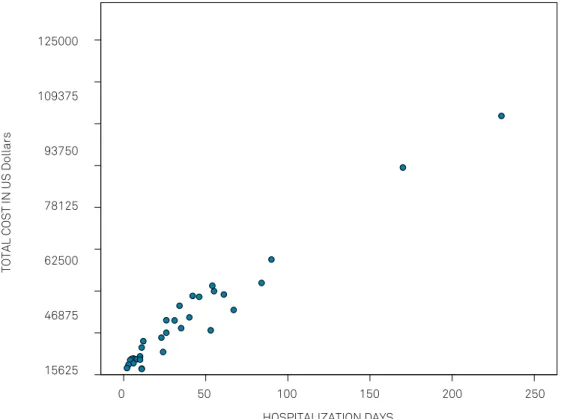
The economic impact of decompressive craniectomy for TBI was measured by calculating the whole cost. A linear and positive correlation between days of hospital-ization and the cost can be seen in Figure 1. Considering the other variables in relation to the cost, after a linear regression model analysis, none demonstrated a signifi-cant correlation.
Therefore, knowing what affects the cost, an equation
was proposed considering the surgical procedure cost and days of hospitalization for calculating of the whole cost.
The expected cost formula in Brazilian Reais (R$) is below:
Expected cost (R$) = 3,858.921 + 1,334.78 x Time of
Hospitalization*
* Time of hospitalization in days; R$ 3,858.921 refers to the inherent procedure cost.
For example, a patient hospitalized for 60 days has an estimated cost of R$ 92,435.35 (US$ 28,886.05) (Figure 2). This
is a high value considering that the minimum Brazilian wage is US$ 292.81 per month (this conversion was performed using the January 13, 2017 quotation in which US$ 1 corre-sponded to R$ 3.2).
The variables correlating with a greater time of hospi
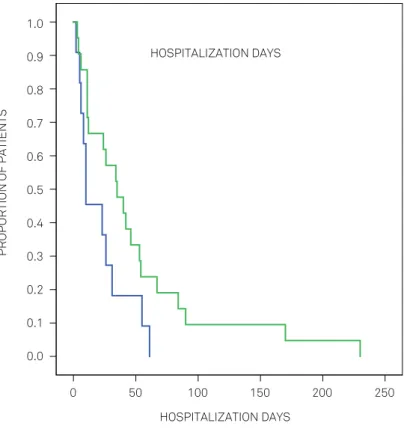
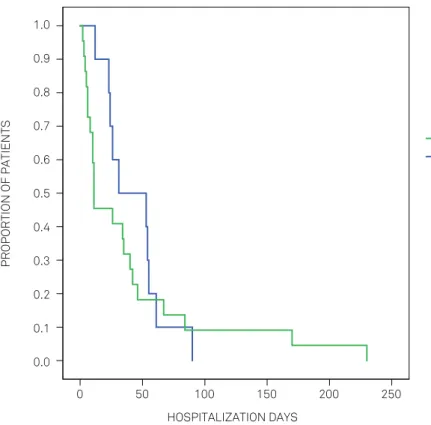
-talization were the severity of the trauma – patients with severe TBI had a positive correlation with increased costs (Figure 3) and infectious complications led to longer hospi-talization times (Figure 4).
Comparing hospitalization days with the outcomes, it can be seen that survivors had a longer period of hospital-ization (Figure 5)
Table 1. Description of all neurosurgical procedures performed during the period of February 2010 to February 2015 at Santa Casa de São Paulo, Brazil.
Year Number of surgeries
Traumatic brain injury surgeries
Decompressive craniectomy due to traumatic
brain injury
2010 687 107 30
2011 866 164 14
2012 980 209 20
2013 987 196 25
2014 847 182 15
2015 856 172 29
Total 5223 1030 133
Table 2. General characteristics of the patients.
Variable Number of patients
Gender
Male 27 (84.4%)
Female 5 (15.6%)
Age
15–30 years 5 (15.0%)
31–45 years 13 (41.0%)
> 45 years 14 (44.0%)
Admission Glasgow Coma Scale scores
Severe (≤ 8) 21 (65.6%)
Moderate (9–12) 7 (21.9%)
Mild (13–15) 4 (12.5%)
Time until the surgery
< 6h 9 (28.0%)
6–12h 12 (37.0%)
13–24h 5 (16.0%)
> 24h 6 (19.0%)
Operated side
Right 11 (34.4%)
Left 20 (62.5%)
Both 1 (3.1%)
Discharge Glasgow Outcome Score (GOS)
Mortality (GOS = 1) 22 (68.8%)
Poor outcome (GOS = 2 and 3) 5 (15.6%)
Considering outcomes and costs, the general mortality
index was 68.7%. Only 10 patients survived and among them five (15.6% of the initial group of 32) had a good outcome (Glasgow Outcome Scale (GOS) score of 4 or 5). The total cost
was R$ 2,116,960.22 (US$ 661,550.06) and the mean patient cost was R$ 66,155.00 (US$ 20,673.44) (SD ± R$ 66,766.10 (US$ 22,255.37)), and the minimum value was R$ 6,883.84 (US$
2,151.20) and the maximum of R$ 309,119.80 (US$ 96,599.94). Figure 1. Positive and linear relation between days of hospitalization and cost (Spearman Correlation coefficient of 0.925)
109375 125000
93750
78125
62500
46875
15625
HOSPITALIZATION DAYS
TOTAL COST IN US Dollars
0 50 100 150 200 250
Figure 2. Linear model of the cost in Brazilian reals.
HOSPITALIZATION DAYS
EXPECTED COSTS IN R$
30 60 90 120
625 8437 16250 24062 31875 39687 63125
55312
DISCUSSION
Decompressive craniectomy is a common neurosur-gical procedure that aims to relieve raised intracranial
pressure. Several situations could require this surgery for
restoring encephalic hemodynamics1. TBI could require
this procedure and, because of its global importance and socioeconomic impact, mainly in developing countries,
Figure 3. Proportion of patients for each hospitalization time according to TBI severity.
Severe Non Severe
HOSPITALIZATION DAYS HOSPITALIZATION DAYS
Admission GCS
PROPORTION OF PATIENTS
0 50 100 150 200 250
0.0 0.1 0.2 0.3 0.4 0.5 0.6 0.7 0.8 0.9 1.0
Figure 4. Proportion of patients for each hospitalization time according to the presence of infectious complications. Infectious complication
No
Yes
PROPORTION OF PATIENTS
HOSPITALIZATION DAYS
0 50 100 150 200 250
knowing the costs and outcomes makes a difference in the public health system.
Removal of the skullcap, as a type of therapeutic approach, has been used since 10,000 BC10. Hippocrates initially described
the types of brain trauma injuries that could be treated with burr holes11. However, only in 1901, did Theodor Kocher estab
-lish the theory that a skull opening could relieve raised intra-cranial pressure12. Some years later, in 1908, Harvey Cushing
described his own statistics of several patients with TBI treated
with subtemporal decompressive craniectomy13. In the
follow-ing decades, the use of decompressive craniectomy declined
and few studies were undertaken to improve the technique12.
However, in the 1990s, with the development of neurological
intensive care and neuroimaging advances, a more extensive
study of decompressive craniectomy returned and
random-ized analyses were performed to evaluate its effectiveness13.
Therefore, from this moment on, guidelines describe decom
-pressive craniectomy for strokes and TBI as an important and systematic therapeutic approach12.
In the treatment of raised intracranial pressure in TBI, decompressive craniectomy could be performed as a primary
or secondary therapy. The former is performed during surger
-ies for hematomas (usually acute subdural hematoma) due to cerebral edema associated with transcalvarial herniation visualized intraoperatively, or for edema that may get worse in the postoperative period14,15,16. On the other hand,
second-ary therapies are those performed as a rescue measure, when all nonsurgical treatments for raised intracranial pressure control have not succeeded17,18.
In fact, the most common technique for unilateral decom-pressive craniectomy is a fronto-temporo-parietal incision
with removal of the bone flap and dural opening (usually with
a “starry” incision)19,20. This technique was used in the present
study. Most of these patients were in poor general condition and, therefore, neurological intensive care is very important for improving prognosis and increased survival.
The technique and indications have already been discussed
extensively in several articles13,20,21. Nevertheless, this study has
a different focus and uncommon approach, namely, the cost of
decompressive craniectomy, a procedure that represents the
most severe and expensive treatment option for patients with
TBI. The main indications for decompressive hemicraniec
-tomy are edema after spontaneous subarachnoid hemorrhage, malignant middle cerebral artery infarct and post-traumatic edema related, or not, to adjacent focal lesions.
Several variables were determined and compared to the
patient outcome (evaluated through the GOS). They included
gender, age, type of brain lesion, associated pathologies, the operated hemisphere side, infectious complications and
admission GCS. However, none of these had a significant
correlation with the patient outcome. Another cost analy-sis study involving 54 patients also did not show an associa-tion between age and GCS admission with the patient’s out-come22, despite these variables typically being considered as
prognostic factors21.
When the time until surgery was considered, there have
been some divergent studies with conflicting data concern
-ing outcomes. Therefore, despite this study not indicat-ing a Figure 5. Proportion of patients for each hospitalization time according to outcome.
No death
HOSPITALIZATION DAYS
PROPORTION OF PATIENTS
Death
0 50 100 150 200 250
significant association between these variables, others have
shown better outcomes with early surgery3,23 and some have
also described a decrease in mortality22,24. In this context, it is
valuable to note that our mortality rate was 68.7%, a value
greater than many other studies, in which the mortality index
was 28–41%22,25 with aggressive treatment, and about 41–51%
with nonsurgical treatments (such as hypothermia and hyperosmolar solutions)9,25. Our high mortality rate could be
because this research was performed in a large center that
receives patients from an extensive geographic area, many of
whom arrive several hours after the injury, in a non-optimal time and, therefore, in a severe health status, contributing to increased mortality.
Thus, hospitalization days have a direct impact on TBI
decompressive craniectomy patient costs and, therefore, an analysis was performed to describe which factors are
corre-lated with days of hospitalization and have an influence over the final cost.
Infections could be correlated with greater costs because these patients require broad-spectrum antibiotics for longer periods and, as well, several procedures such as gastrostomy and tracheostomy may be performed in chronic patient care. It has previously been described in some studies that an increase in antibiotic use in hospitalized patients, mainly broad-spectrum, generally have higher costs26. In most cases,
multi-drug resistant bacteria were isolated. Therefore, these multi-drugs
have significant impact on costs during hospitalization27,28.
Comparing hospitalization days with the outcomes, it can be seen that survivors had a longer period of hospi-talization (Figure 5). A large trial published in 2011, known
as DECRA17, revealed that patients undergoing craniectomy
had worse scores on the Extended GOS than those receiv
-ing standard care. As well, in a randomized study in 2016, Hutchinson et al. observed that decompressive craniectomy could reduce mortality; however, several of the survivors were in a vegetative state with a low functional status18.
This study has some limitations inherent in its model.
Because it was a retrospective analysis, data was obtained through medical records and patients could not be followed up. Another limitation is the absence of a controlled group.
However, in this context, conservative treatment for critical neurological patients is a difficult choice, considering that a
neurosurgical procedure17 is a rescue measure and usually
indicated when no other therapy has succeeded. A nonsurgi-cal approach is seen as an ethinonsurgi-cal dilemma.
Only the direct costs of decompressive craniectomy were described. Rehabilitation, homecare support, social security and loss of productivity were considered as indirect costs and not evaluated in this study.
Patients who do survive generate greater hospitalization costs and the majority will require future hospitalizations for treatment of clinical complications and other procedures, such as ventricular shunts and cranioplasty. Some stud-ies have demonstrated that the real cost of these patients is about 10-15 times greater than the cost of the treatment in acute phase29,30.
This was the first Latin-American study aimed at deter
-mining the direct cost of decompressive craniectomy in the public health system and the main factors related to the
cost of this procedure. An epidemiological profile was also
described, which helps to guide educational strategies for reduction and prevention of this socioeconomic impact.
New techniques have recently been studied to replace the
decompressive craniectomy in TBI patients. Cherian et al.31
described a patient series in which he defends the use of microsurgical cisternostomy in TBI patients who had a clas-sic indication for decompressive craniectomy, revealing a
better outcome. This was a pioneer study and more research
is required to validate this technique.
In conclusion, decompressive craniectomy is a procedure that aims to relieve raised intracranial pressure in seriously injured patients; however, it has a high mortality rate (68%) and poor outcomes (15%). Despite the high costs in
devel-oped countries, this was the first study that aimed to per
-form an analysis in developing countries. The mean cost per
patient was about R$66,000 (US$20,625) during hospitaliza-tion, with infectious complications having a greater impact on the total cost.
The knowledge of the costs of decompressive craniec
-tomy in developing countries in which TBIs are very common and have a huge socioeconomic impact is important to guide public health policies and resource allocation. Based on this study, results that determine the high costs associated with decompressive craniectomy for TBI, lead us to believe that prevention policies must be improved and other therapeutic modalities should be considered in this situation.
References
1. Kolias AG, Kirkpatrick PJ, Hutchinson PJ. Decompressive
craniectomy: past, present and future. Nat Rev Neurol. 2013 Jul;9(7):405-15. https://doi.org/10.1038/nrneurol.2013.106
2. Hutchinson P, Timofeev I, Kirkpatrick P. Surgery for
brain edema. Neurosurg Focus. 2007 May;22(5):E14. https://doi.org/10.3171/foc.2007.22.5.15
3. Marmarou A. A review of progress in understanding the
pathophysiology and treatment of brain edema. Neurosurg Focus. 2007 May;22(5):E1. https://doi.org/10.3171/foc.2007.22.5.2
4. Unterberg AW, Stover J, Kress B,
Kiening KL. Edema and brain trauma. Neuroscience. 2004;129(4):1021-9.
https://doi.org/10.1016/j.neuroscience.2004.06.046
5. Whitmore RG, Thawani JP, Grady MS, Levine JM,
6. Danish SF, Barone D, Lega BC, Stein SC. Quality of life after hemicraniectomy for traumatic brain injury in adults. A review of the literature. Neurosurg Focus. 2009 Jun;26(6):E2. https://doi.org/10.3171/2009.3.FOCUS945
7. Lemcke J, Ahmadi S, Meier U. Outcome of patients with severe head
injury after decompressive craniectomy. Acta Neurochir Suppl (Wien). 2010;106:231-3. https://doi.org/10.1007/978-3-211-98811-4_43
8. Jorge MHPM, Koizumi MS. [Current direct costs of hospital
admissions due to external causes: analysis in the State of São Paulo, 2000]. Rev Bras Epidemiol. 2004;7(2):228-38. Portuguese. https://doi.org/10.1590/S1415-790X2004000200012
9. Jennett B, Teasdale G, Galbraith S, Pickard J, Grant H, Braakman R et al.
Severe head injuries in three countries. J Neurol Neurosurg Psychiatry. 1977 Mar;40(3):291-8. https://doi.org/10.1136/jnnp.40.3.291
10. Kshettry VR, Mindea SA, Batjer HH. The management of cranial
injuries in antiquity and beyond. Neurosurg Focus. 2007;23(1):E8. https://doi.org/10.3171/FOC-07/07/E8
11. Panourias IG, Skiadas PK, Sakas DE, Marketos SG. Hippocrates:
a pioneer in the treatment of head injuries. Neurosurgery. 2005 Jul;57(1):181-9. https://doi.org/10.1227/01.NEU.0000163416.66374.48
12. Münch E, Horn P, Schürer L, Piepgras A, Paul T, Schmiedek P.
Management of severe traumatic brain injury by decompressive craniectomy. Neurosurgery. 2000 Aug;47(2):315-22.
https://doi.org/10.1097/00006123-200008000-00009
13. Hutchinson PJ, Corteen E, Czosnyka M, Mendelow AD, Menon
DK, Mitchell P et al. Decompressive craniectomy in traumatic brain injury: the randomized multicenter RESCUEicp study (www. RESCUEicp.com). Acta Neurochir Suppl (Wien). 2006;96:17-20. https://doi.org/10.1007/3-211-30714-1_4
14. Bullock MR, Chesnut R, Ghajar J, Gordon D, Hartl R,
Newell DW et al. Surgical management of acute subdural hematomas. Neurosurgery. 2006 Mar;58(3 Suppl):S16-24. https://doi.org/10.1227/01.NEU.0000210364.29290.C9
15. Compagnone C, Murray GD, Teasdale GM, Maas AI, Esposito D, Princi
P et al. The management of patients with intradural post-traumatic mass lesions: a multicenter survey of current approaches to surgical management in 729 patients coordinated by the European Brain Injury Consortium. Neurosurgery. 2005 Dec;57(6):1183-92. https://doi.org/10.1227/01.NEU.0000186239.10915.09
16. Coplin WM, Cullen NK, Policherla PN, Vinas FC, Wilseck JM,
Zafonte RD et al. Safety and feasibility of craniectomy with duraplasty as the initial surgical intervention for severe traumatic brain injury. J Trauma. 2001 Jun;50(6):1050-9.
https://doi.org/10.1097/00005373-200106000-00013PMID:11426120
17. Cooper DJ, Rosenfeld JV, Murray L, Arabi YM, Davies AR,
D’Urso P et al.; DECRA Trial Investigators; Australian and New Zealand Intensive Care Society Clinical Trials Group. Decompressive craniectomy in diffuse traumatic brain injury. N Engl J Med. 2011 Apr;364(16):1493-502. https://doi.org/10.1056/NEJMoa1102077
18. Hutchinson PJ, Kolias AG, Timofeev IS, Corteen EA, Czosnyka M,
Timothy J et al.; RESCUEicp Trial Collaborators. Trial of Decompressive Craniectomy for Traumatic Intracranial Hypertension. N Engl J Med. 2016 Sep;375(12):1119-30. https://doi.org/10.1056/NEJMoa1605215
19. Park J, Kim E, Kim GJ, Hur YK, Guthikonda M. External decompressive
craniectomy including resection of temporal muscle and fascia in malignant hemispheric infarction. J Neurosurg. 2009 Jan;110(1):101-5. https://doi.org/10.3171/2008.4.17540
20. Timofeev I, Santarius T, Kolias AG, Hutchinson PJ.
Decompressive craniectomy: operative technique and perioperative care. Adv Tech Stand Neurosurg. 2012;38:115-36. https://doi.org/10.1007/978-3-7091-0676-1_6
21. Kakar V, Nagaria J, John Kirkpatrick P. The current status of
decompressive craniectomy. Br J Neurosurg. 2009 Apr;23(2):147-57. https://doi.org/10.1080/02688690902756702
22. Malmivaara K, Kivisaari R, Hernesniemi J, Siironen J.
Cost-effectiveness of decompressive craniectomy in traumatic brain injuries. Eur J Neurol. 2011 Apr;18(4):656-62. https://doi.org/10.1111/j.1468-1331.2010.03294.x
23. Polin RS, Shaffrey ME, Bogaev CA, Tisdale N, Germanson T,
Bocchicchio B et al. Decompressive bifrontal craniectomy in the treatment of severe refractory posttraumatic cerebral edema. Neurosurgery. 1997 Jul;41(1):84-92. https://doi.org/10.1097/00006123-199707000-00018
24. Morgalla MH, Will BE, Roser F, Tatagiba M. Do long-term
results justify decompressive craniectomy after severe traumatic brain injury? J Neurosurg. 2008 Oct;109(4):685-90. https://doi.org/10.3171/JNS/2008/109/10/0685
25. Stein SC, Georgoff P, Meghan S, Mizra K, Sonnad SS. 150 years
of treating severe traumatic brain injury: a systematic review of progress in mortality. J Neurotrauma. 2010 Jul;27(7):1343-53. https://doi.org/10.1089/neu.2009.1206
26. Pestotnik SL, Classen DC, Evans RS, Burke JP.
Implementing antibiotic practice guidelines through computer-assisted decision support: clinical and financial outcomes. Ann Intern Med. 1996 May;124(10):884-90. https://doi.org/10.7326/0003-4819-124-10-199605150-00004
27. Mauldin PD, Salgado CD, Hansen IS, Durup DT, Bosso JA.
Attributable hospital cost and length of stay associated with health care-associated infections caused by antibiotic-resistant gram-negative bacteria. Antimicrob Agents Chemother. 2010 Jan;54(1):109-15. https://doi.org/10.1128/AAC.01041-09
28. Ng E, Earnest A, Lye DC, Ling ML, Ding Y, Hsu LY. The excess
financial burden of multidrug resistance in severe gram-negative infections in Singaporean hospitals. Ann Acad Med Singapore. 2012 May;41(5):189-93.
29. Murray CJL, Lopez AD. The global burden of disease:
a comprehensive assessment of mortality and disability from diseases, injuries, and risk factors in 1990 and projected to 2020. Geneva: The Harvard School of Public Health; 1996.
30. Pickard JD, Bailey S, Sanderson H, Rees M, Garfield JS. Steps towards
cost-benefit analysis of regional neurosurgical care. BMJ. 1990 Sep;301(6753):629-35. https://doi.org/10.1136/bmj.301.6753.629
31. Cherian I, Bernardo A, Grasso G. Cisternostomy for traumatic