ISSN 0001-3765 www.scielo.br/aabc
A supramolecular proposal of lignin structure and its relation
with the wood properties
HEBER S. ABREU, JOÃO V.F. LATORRACA, REGINA P.W. PEREIRA, MARIA BEATRIZ O. MONTEIRO, FÁBIO A. ABREU and KELYSSON F. AMPARADO
Departamento de Produtos Florestais, Instituto de Florestas, Universidade Federal Rural do Rio de Janeiro, BR 465, km 7 23851-070 Seropédica, RJ, Brasil
Manuscript received on June 11, 2007; accepted for publication on July 25, 2008; presented byELIBIOL. RECH
ABSTRACT
In spite of the great importance of cellulose the lignin is considered the second most abundant substance of the wood. However, little attention has been given it, mainly to wood properties. The lignin as well as other structural compounds (cellulose and hemicelluloses), has obviously an important role on the wood properties, probably due its composition and existent bonds. In general lignins haveβ-O-4 (Alkyl Aril Ether) as majoritary bond. This bond in a continued structure form big molecules with spiral conformation as virtual model. Based on this idea, lignins that have high/low β-O-4 content may have differentiated spiraled structures, suggesting different behaviors on the wood properties, which shows that the lignins (Guaicyl:Syringyl (GS)) of angiosperms, for example, which have higherβ-O-4 content would present higher spiral conformation than gymnosperms lignins (HG). On the other hand HG lignins have chance of being more anchored on the matrix compound than GS lignins. In this context, theβ-O-4 bonds of lignins possibly affect the wood properties, therefore, it is considered relevant for wood technology science discussion.
Key words:lignin, molecular conformation, wood properties, structure.
INTRODUCTION
The use of wood by human beings began in the pre-history. Currently, wood has been considered a precious raw material whose technological properties contribute to an enormous variety of products. In the civil con-struction and for other purposes, wood brings comfort, practicality, workability and psychological attenuating properties, as required in a modern society.
Some fast growth trees, such asEucalyptus, planted in tropical countries, play a certain difficulty for maxi-mize their utilization. Such difficulty justifies the enor-mous investment in research to optimize wood proper-ties, in order to increase beneficial properties and lower production costs.
Most of the studies on wood properties have been
Correspondence to: Heber dos Santos Abreu E-mail: [email protected]
based on the cellulose deposition, microfiber orienta-tion, grain angle, cellulose polymerization and crystal-linity degree (Conrad et al. 2003). Larger microfiber an-gle, for example, is associated with low tensile strength resulting in reduced strength of wood and spiral grain occurrence with degree of longitudinal shrinkage. As-pects of growth have also been shown to be important, as can be noticed on mature woods that are better and have a greater acceptance than juvenile woods (Haygreen and Bowyer 1982).
fail-ure and box-heart split have also been reported. Such problems can be attenuated by special drying in opti-mized schedules. The problems of growth tension, for example, have also been the target of a large number of studies (Rasps et al. 2000, Latorraca and Albuquerque
2000, Donaldson 1995), especially withEucalyptusspp,
though mostly with an exclusively physical focus. It is our basic premise that a number of physical and me-chanical properties may be driven by lignin, rather than cellulose. So, what would demonstrate that lignin has a significant role in the wood properties? This issue has been poorly reported in the literature, which forced us to reflect on the importance of the fragility and rigid-ity of lignin molecules regarding the wood properties. It is known that lignin is responsible for the reinforce-ment of cell walls and the middle layer in all woody plants, and that its absence would make tree life impos-sible under gravity force. The composition, molecular structure and spatial orientation of lignin surely con-tribute to wood properties more than we have previously supposed (Bidlack et al. 1992).
As reported previously, the lignins of different
neighbor cells between Fiber × Fiber, Ray × Ray,
Vessel × Vessel and Fiber × Ray, Fiber × Vessel,
Vessel ×Ray border regions of the cell middle layer
(Middle Layer (ML) and Cell Corner (CC)) sustained different basic composition ratios (Table I). The higher
p-Hydroxyphenylpropane (H) and Guaiacylpropane (G)
units content can take a certain molecular complexity, therefore these lignins play different behaviors related to the number of inter bonds and cross-linkages with the matrix compound (Fig. 1). The MLcc lignin of the
Fiber × Ray region, for example, has been shown to
maintain the highest rigidity levels. This region is al-ways working under compression and tension forces.
According to Plomion et al. (2000) inEucalyptus
andPinusthere are strong relationships between growth strain and wood characteristics, such as wood dens-ity, longitudinal and tangential shrinkages, longitudinal modulus of elasticity, anatomical characteristics (micro-fiber angle), and chemical composition (lignin content, ratio of lignin monomerics units, hemicellulose, and cellulose content). Study of the lignin model compound have been carried out by near-field scanning optical and atomic force microscopy, revealing that Dehydrogenase
Polymer (DHP) synthesizes present globule supramol-elecular assembly supporting the idea that layered supramolecular assemblies patched from the regions of different rheological properties (Micic et al. 2004). The construct oligomers for different diasteroisomers (Alkyl Aril Ether), has taken to several hypotheses of structural conformational shape (Langer et al. 2007).
LIGNINSTRUCTURE
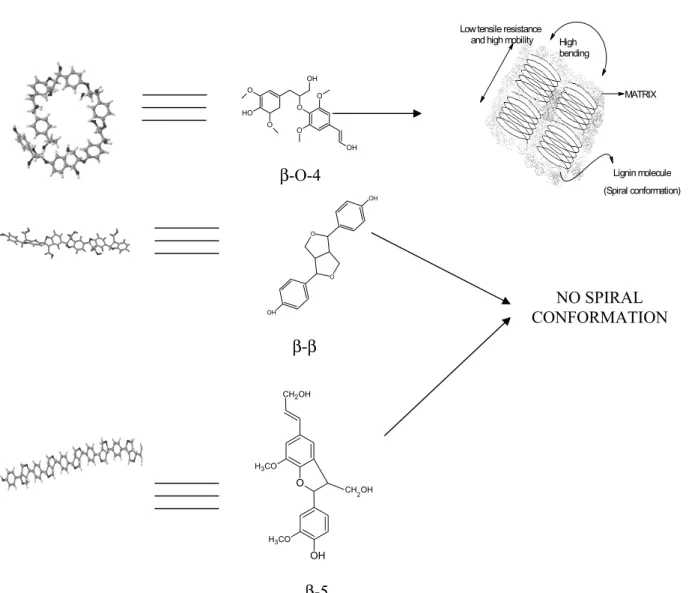
The variation of the number of intermonomeric bonds is in agreement with the hypothesis that the combina-tion among precursors gives rise to different molecules structures (Fig. 2).
The estimation of higher syringyl unit as in Guaia-cyl:Syringyl (GS) lignin for example, favor a direct
re-lation with β-O-4 (Alkil Aril Ether) content,
indicat-ing a lignin molecule with a high structural simplic-ity (Table II). This type of lignin is normally found in hardwood, revealing a small number of intermonomeric bonds as well as a small number of cross-linkages with the matrix compound as hypothesis. This fact can be conditioned by the structural profile, on the hypothesis of that the higher molecular linearity as in GS lignin, could contribute to rupture of the middle lamella among cell wall more than the HG lignin.
To clear the understanding about the behavior of lignin on wood properties, we design a virtual molecule
with the β-O-4 composition only. Analyzing on this
point of view this molecule would present a chain with a higher spiral conformation, while molecules with a
composition of the β-β and β-5 alone, would play a
low spiral conformation. Thus a molecule rich in β
TABLE I
Guaiacyl/Syringyl ratio in the lignins of birch cells (Higuchi 1984, Abreu et al. 1999) and their structural and rigidity level, respectively.
Morphological Guaiacyl:Syringyl Probable types of Molecular rigidity regions ratio lignin structures level Fiber S2 (F) 12:88 No condensed Low rigidity Vessel S2 (V) 88:12 Condensed Rigid Ray parenchyma 49:51 Semi-condensed Moderated rigidity
MLcc (F/F) 91:9 Condensed Rigid
MLcc (F/V) 80:20 Condensed Rigid
MLcc (F/R) 100:0 Condensed High rigidity
MLcc (R/R) 88:12 Condensed Rigid
Fig. 1 – Syringyl and Guaiacyl lignins biosynthesis (pre-polymerization). PAL-Phenylalanine Amonia-lyase,
C3H-4-Hydroxycinnamate-3-hydroxylase, 5H-Ferulate-5-hydroxylase, OMT -5-Adenosyl-methyonine:caffeate/5-Hydroxyferulate-O-ethyltransferase,4CL-Hydroxycinnamoyl:CoA ligase,CCR-Hydroxycinnamyl:CoA reductase,
β
-O-4
β β
OOH O
O H
O
O O OH
MATRIX Low tensile resistance
and high mobility High bending
Lignin molecule
(Spiral conformation)
O O
OH
OH
NO SPIRAL
CONFORMATION
β
-5
OHCH2OH
O
H3CO
H3CO
CH2OH
SPIRAL CONFORMATION
Fig. 2 – Proposal of a structural profile of lignin molecule withβ-O-4,β-β,β-5, respectively (first figure) and (second figure).
different types of lignins (Bao et al. 1992, Plomion et al. 2000). A computer-assisted structure elucidation and molecular simulation suggested that the lignin biopoly-mers have an helical structure characteristic of many nat-urally synthesized molecules (Faulon and Hatcher 1994), on the other approaches a syntheticβ-O-4 type artificial lignin was consider a linear polymer with well-defined structure (Kishimoto at al. 2006). Cellulose and hemi-cellulose have also a spiraled conformation, which con-tribute to the high stability of the cell wall. Examples of spiral deposition are also observed in the microfiber orientation in the wall as well as the thickness in the
in-ner layer of the cell. It may contribute to understand the lignin conformation according to our suggestion, how-ever, it is common to say that the anatomical characteris-tics and cellulose microfiber orientation are responsible for most of the wood properties.
TABLE II
IFM estimated values of Björkman lignins from softwood and hardwood (Abreu et al. 1999).
Plant β-O-4 IMF Type of Rigidity Structural
(%) average lignin profile
Softwood (tree) 40.20 0.67 HG Moderated Branching Hardwood (tree) 71.04 2.45 GS Low Branching
IFM – Index of Molecular Flexibility.
(g/cm3) and 96.52/(g/cm3) and 159.68/(g/cm3), 19.84/
(g/cm3) and 81.61(g/cm3) (Wood Handbook 1999). The
data were adjusted dividing the Modulus values by Spe-cific Gravity, in order to make comparison possible. The MOR, MOE and Compression parallel to grain were higher for softwood (gymnosperm) than hardwood (angiosperm). Of course, several characteristics may also be working together, (anatomical, physical, chemi-cal characteristics). In this case, what would be the lignin contribution? If the softwood lignin (HG) plays low spiraled conformation, probably there will be a higher number of cross links, lower longitudinal expansion and higher bend level than (GS) lignin (Fig. 2). If it is true as we imagine, this hypothesis can open new perspec-tives in the fields of the wood technology science.
CONCLUSION
The spiral conformation hypothesis allows us to pro-pose ideas regarding special tissues, like wood tension and compression, on wood properties, as well as on the
wood as a whole, correlatingβ-O-4 bonds content with
gymnosperm and angiosperm woody plants. Therefore, softwood species produce stable HG lignin. It means that this group of trees forms a net of inter and intra-molecular bonds in the cell wall larger than angiosperm. Above all, further evidence may provide new tools towards under-standing wood properties at a molecular level, so that possible defects and other problems may be corrected, causing less waste and damage after tree harvest. The application of this hypothesis mentioned above, stimu-lates new fields in the forest science. The alterations of lignin composition from GS to HG, for example, would reinforce the border region among the walls of xylem cells, resulting in a greater resistance to the forces of growth tension and cell wall rupture.
ACKNOWLEDGMENTS
The authors thank Fundação Carlos Chagas Filho de Amparo a Pesquisa do Estado do Rio de Janeiro (FAPERJ) and Coordenação de Aperfeiçoamento de Pessoal de Nível Superior (CAPES) for financial support.
RESUMO
Apesar da grande importância da celulose a lignina é consi-derada a segunda substância mais abundante da madeira. Entretanto, pouca atenção tem sido dada a ela, principalmen-te com relação às propriedades da madeira. A lignina assim como outras substâncias (celulose e hemicelulose), tem obvia-mente um papel importante sobre as propriedades da madeira, provavelmente devido a sua composição e a existências de ligações. Geralmente as ligninas possuem majoritariamente ligaçõesβ-O-4 (Éter Alquil-Arílico), esta ligação em uma es-trutura contínua forma grandes moléculas com conformação em espiral, como visto em modelo virtual. Com base nesta idéia, ligninas que possuem alto/baixo teor deβ-O-4, podem ter estruturas espiraladas diferenciadas, sugerindo comportamen-tos diferentes sobre as propriedades da madeira. Isto mostra que as ligninas de angiospermas ((Guaicílica:Siringilica) (GS)), que possuem mais alto teor deβ-O-4, por exemplo, apresen-tariam uma conformação mais espiralar do que as ligninas de gimnospermas (HG). Por outro lado, as ligninas HG possuem mais chances de serem ancoradas sobre a substância matriz do que as ligninas GS. Neste contexto, ligaçõesβ-O-4 das ligni-nas afetam as propriedades da madeira, portanto, isto pode ser considerado relevante para discussão em ciência e tecnologia da madeira.
REFERENCES
ABREUHS, MIGUELAMANDMARIAMA. 1999. Lignin and Structure. Wood and Fiber Sci 4: 426–433.
BAOW, OMALLEYDMANDSEDEROFFRR. 1992. Wood contain a cell-wall structural protein. Proc Natl Acad Sci 89: 6604–6608.
BIDLACKJ, MALONEMANDBENSONR. 1992. Molecu-lar structure and component integration of secondary cell wall in plants. Proc Okla Acad Sci 72: 51–56.
CARPITA NCAND GIBEAUT DM. 1993. Structural mod-els of primary cell walls in flowering plants: consistency of molecular structure with the physical properties of the walls during growth. Plant J 1: 1–30.
CASSABGI. 1998. Plant cell wall protein. Annu Rev Plant Physiol Plant Mol Biol 49: 281–309.
CONRADMPC, SMITHGDANDFERLUNDG. 2003. Frac-ture of solid wood: A review of strucFrac-ture and properties at different length scales. Wood and Fiber Sci 4: 570–584. DEY PM AND HARBONE JB. 1997. Plant Biochemistry,
Academic Press, NY.
DONALDSONLA. 1995. Cell wall fracture properties in rela-tion to lignin distriburela-tion and cell dimensions among three genetic groups of radiate pine. Wood Sci Technol 1: 29: 51–63.
FAULONJ-LANDHATCHERPG. 1994. Is there any order in the structure of lignin? Energy and Fuel 8: 402–407. HAYGREENJJANDBOWYERJL. 1982. Forest products and
wood science (an introduction). The Iowa State University Press, Iowa.
HIGUCHIT. 1984. Biosynthesis and biodegradation of wood components. Academic Press, New York, USA. KISHIMOTOT, URAKIYANDUBUKATAM. 2006.
Chemi-cal synthesis ofβ-O-4 type artificial lignin. Org Biomol Chem 4: 1343–1347.
LANGERV, LUNDQUISTKANDPARKASJ. 2007. Stereo-chemistry of guaiacyl lignin. Bio Res 2: 590–597. LATORRACAJVFANDALBUQUERQUECEC. 2000. Efeito
do rápido crescimento sobre as propriedades da Madeira. Floresta e Ambient 7: 279–291.
MICICM, RADOTICK, JEREMICM, DJIKANOVICDAND KÄMMER SB. 2004. Study of the lignin model com-pound supramolecular structure by combination of near-field scaning microscopy and atomic force microscopy. Colloids and Surfaces B: Bionterfaces 34: 33–40. PLOMIONC, PIONNEAUC, BRACHJ, COSTAPANDBAIL
-LÈRESH. 2000. Compression wood-responsive proteins in developing xylem of maritime pine (Pinus pinasterAit) American Society of Plant Physiologists. Plant Physiol 3: 959–970.
RASPSIL, GARCIAJNANDWALNUTMCS. 2000. Influ-ence of the it thin in the tensions of growth ofEucalyptus grandisHill former-maiden. Sci For 58: 111–125. WOOD HANDBOOK. 1999. Wood engineering material.