Nonextensivity in a memory network access mechanism
Roseli S. Wedemann∗
Instituto de Matem´atica e Estat´ıstica, Universidade do Estado do Rio de Janeiro, Rua S˜ao Francisco Xavier 524, 20550-900, Rio de Janeiro, Brazil.
Raul Donangelo†
Instituto de F´ısica, Universidade Federal do Rio de Janeiro, Caixa Postal 68528, 21941-972, Rio de Janeiro, Brazil.
Lu´ıs A. V. de Carvalho‡
Programa de Engenharia de Sistemas e Computac¸˜ao, Universidade Federal do Rio de Janeiro, Caixa Postal 68511, 21945-970, Rio de Janeiro, Brazil.
(Received on 26 January, 2009)
We have previously described neurotic psychopathology andpsychoanalytic working-throughby an
associa-tive memory mechanism, based on a neural network. Memory was initially modelled by a Boltzmann machine (BM). We simulated known microscopic mechanisms that control synaptic properties and showed that the net-work self-organizes to a hierarchical, clustered structure. Some properties of the complex netnet-works which result from this self-organization indicate that a generalization of the BM may be necessary to model memory. We have thus generalized the memory model, using Generalized Simulated Annealing, derived from the nonexten-sive formalism, and show some properties of the resulting memory access mechanism.
Keywords: Consciousness-unconsciousness, Neuroses, Self-organized neural networks, Boltzmann machine, Generalized simulated annealing, Hierarchical memory model
1. INTRODUCTION
Early psychoanalytic research regarding the neuroses found that traumatic and repressed memories are knowledge which is present in the subject, but which is symbolically inaccessible to him. It is therefore consideredunconscious knowledge [1, 2]. Freud observed that neurotic patients sys-tematically repeated symptoms in the form of ideas and im-pulses, and called this tendency acompulsion to repeat [3], which he related to repressed or traumatic memory traces [1]. Neurotic analysands have obtained relief and cure of pain-ful symptoms through a mechanism calledworking-through. This procedure aims at developing knowledge regarding the causes of symptoms by accessing unconscious memories, and understanding and changing the analysand’s compulsion to repeat [3]. The technique involves mainly free associative talking and the interpretation of dreams during analytic ses-sions, among other processes.
We have proposed a functional and computational model which describes neurotic behavior as an associative memory process [4, 5], where the network returns a stored pattern when it is shown another input pattern sufficiently similar to the stored one [6]. We modelled thecompulsion to repeat neurotic symptoms [1], by supposing that such a symptom is acted when the subject is presented with a stimulus which re-sembles a repressed or traumatic memory trace. The stimulus causes a stabilization of the neural net onto a minimal energy state, corresponding to the trace that synthesizes the original repressed experience, which in turn generates a neurotic
re-∗Electronic address:[email protected]
†Electronic address:[email protected] ‡Electronic address:[email protected]
sponse (anact). The neurotic act is not a result of the stimu-lus as a new situation but a response to the repressed memory. We mapped the symbolic associative process involved in psy-choanalyticworking-throughonto a corresponding process of reinforcing synapses among memory traces in the brain.
In our model, memory functioning was originally modelled by a Boltzmann machine (BM). However, the power-law and generalized q-exponential behavior we have found, for the node-degree distributions of the network topologies gener-ated by our model, indicate that they may not be well de-scribed by Boltzmann-Gibbs (BG) statistical mechanics, but rather by nonextensive statistical mechanics [7–9]. We have therefore modelled memory by a generalization of the BM called Generalized Simulated Annealing (GSA) [8]. In GSA, the probability distribution of the system’s microscopic con-figurations is not the BG distribution, assumed in the BM, and this should affect the chain of associations of ideas which we are modelling.
In this paper, we review in Section 2 our associative mem-ory model for neurosis and the self-organizing mechanism for generating hierarchically clustered memory modules, repre-senting sensorial and symbolic memories. In Section 3, we discuss the use of GSA as a memory access mechanism, as compared to the BM. We then show results from computer simulations with some properties of these complex networks’ memory access mechanisms. In the last section, we draw some conclusions and perspectives for future work.
2. ASSOCIATIVE MEMORY MODEL FOR NEUROSIS
sen-sorial memory represent mental images of stimuli received by sensory receptors. Symbolic memory stores higher level representations of traces in sensorial memory,i.e. symbols, and represents brain structures associated with symbolic pro-cessing, language and consciousness. Sensorial and sym-bolic memories interact, producing unconscious and con-scious mental activity [4].
Memory functioning was initially modelled by a BM with Nneurons, where node states take binary values and connec-tions have symmetrical weightswi j=wji. The statesSi of
the units take binary output values in{0,1}. Because of the symmetry of the connections, there is an energy functional
H({Si}) =−
1
2
∑
i j wi jSiSj, (1)which allows us to define the BG distribution function for network states
PBG({Si}) =exp
−H({Si})
T
/
∑
{Si}exp
−H({Si})
T
, (2)
whereT is the network temperature parameter. In the BM, pattern retrieval on the net is achieved by a standard simu-lated annealing process, in which the network temperatureT is gradually lowered by a factorα, according to the BG dis-tribution given by Eq. 2. A detailed treatment of the BM may be found in [6, 10].
Brain neural topology is structured by cooperative and competitive mechanisms, controlled by neurosubstances, where neurons interact mainly with spatially close neighbors, having fewer long-range synaptic connections to more distant neurons [11, 12]. This is started and controlled by mental stimulation and is the process whereby the environ-ment represents itself in the brain.
We summarize the clustering algorithm developed based on these biological mechanisms [4] to model the self-organizing process which results in a structured, clustered topology of each memory as follows. In Step 1, neurons are uniformly distributed in a bi-dimensional square sheet.
In Step 2, we assume a Gaussian approximation for the
numerical solution of the diffusion equation of neural sub-stances that control neural competition and cooperation. A synapse is thus allocated to connect two neuronsni andnj,
according to a Gaussian probability distribution Pi j of the
distance that separates the pair, with standard deviation σ. A synapse connecting ni tonj has strength proportional to
Pi j and weights are symmetrical. Step 3 clusterizes
neu-rons in the memory sheets, based on mechanisms for form-ing cortical maps [4, 6, 13], where a group of neurons spa-tially close to each other represents a sensorial stimulus or an idea. Step 4regulates synaptic intensities by strengthen-ing synapses within a cluster and reducstrengthen-ing synaptic strength between clusters, disconnecting them. Neurons, which have received stronger sensorial stimulation and are more strongly connected, stimulate their neighborhoods and promote even stronger connections.
Long-range synaptic growth is energetically more costly than short-range, and consequently the former is less frequent in the brain than the latter. We represent association of ideas or symbols (such as in culture and language) by long-range
synapses, which should connect clusters by considering the basic Hebbian learning mechanism [6, 11, 12], where synap-tic growth between two neurons is promoted by simultaneous stimulation of the pair. Since we are still unaware of synaptic distributions which result in such topologies, as a first approx-imation, we allocated synapses randomly among clusters. A full description of the algorithm, with memory storage and re-trieval and working-through simulation, can be found in [4].
3. NETWORK TOPOLOGY AND ASSOCIATIVITY
We have generated 10000 different initial topologies with the clustering algorithm, for different values ofN, such that Nsens =Nsymb=N/2 of them belong to sensorial and
sym-bolic memories respectively andσ=0.58. In [4], we explain how we represent and interpret these asneurotictopologies, by linking neurons between sensorial and symbolic memo-ries more weakly. Other model parameters are also described in [4]. We then measured the average node degree (k) distri-butions of these topologies.
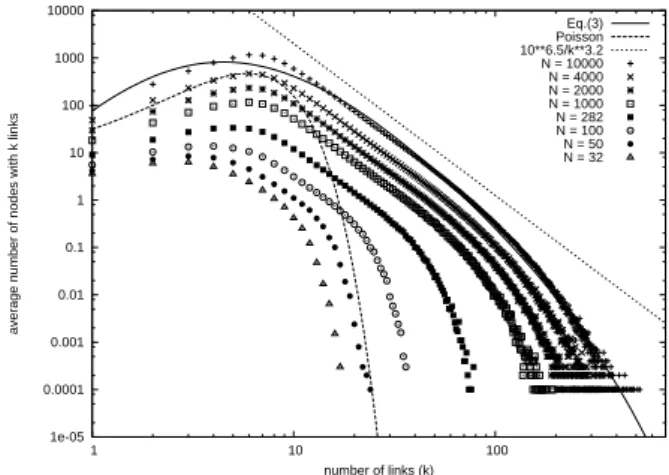
Figure 1 [14] shows an asymptotic power law behav-ior with exponentγ≈ −3.2, which indicates scale indepen-dence [9]. ForN=4000, the deviation from the fit by the Poisson distribution, Pλ(k) =λkexp(−λ)/k!, fork>10 is
quite evident. The deviation from Poisson for higher values ofkmay be attributed to the cooperative-competitive biologi-cal mechanisms mentioned earlier, which introduce structure. Smaller values of kcorrespond to neurons that did not sig-nificantly participate in the competition-cooperation process and, hence, distributions for smallkare approximately fitted by Poisson forms.
Figure 1 also shows a fit by a generalization of the q -exponential function [9, 17] given by
Pq(k) =p0kδ
1 h
1−τµ+τµe(q−1)µki
1 q−1
, (3)
where p0,δ,τ,µ andq are additional adjustable parameters. The curves indicate that, asymptotically, the power-law and generalizedq-exponential fits are appropriate, withq≈1.113. This is a common feature of many biological systems and in-dicates that they may not be well described by BG statistical mechanics.
There is no theoretical indication of the exact relation be-tween network topology and memory dynamics. There have been some indications that complex systems which present a power-law behavior, i.e. which are asymptotically scale in-variant, may be better described by the Nonextensive Statis-tical Mechanics formalism [8, 9, 15, 16]. Since the neural systems we are studying do not have only local interactions and present the scale-free topology characteristic, we have begun to investigate memory dynamics with a generalized ac-ceptance probability distribution function [8] for a transition from stateS≡ {Si}toS′, ifH(S′)≥H(S), given by
PT(S→S′) =
1
[1+ (qA−1)(H(S′)−H(S))/T]1/(qA−1)
, (4)
whereqA is a model parameter and other variables and
1e-05 0.0001 0.001 0.01 0.1 1 10 100 1000 10000
1 10 100
average number of nodes with k links
number of links (k)
Eq.(3) Poisson 10**6.5/k**3.2 N = 10000 N = 4000 N = 2000 N = 1000 N = 282 N = 100 N = 50 N = 32
FIG. 1: Average node degree distributions for variousN. The fit by
Eq. 3 corresponds toq=1.113,p0=610,δ=4.82,τ=2.34 and
µ=0.014. The Poisson fit corresponds toN=2950 andλ=6.4.
For largek, there is an exponential finite size effect.
The memory access mechanism is thus modelled by a gen-eralization of the BM, called Generalized Simulated Anneal-ing (GSA) [8], derived from the nonextensive formalism, based on the generalized acceptance probability, given by Eq. 4. In GSA, the probability distribution of the system’s mi-croscopic configurations is not the BG distribution given by Eq. 2, assumed in the BM, and this should affect the chain of associations of ideas which we are modelling. In the BM, depending on temperature, there is a tendency of reaching one of the energy minima closer to the initial configuration presented to the network. The probability distribution given by Eq. 4 should allow reaching more distant minima of the energy functional H, from an initial configuration, than the BM for the same temperature values, which corresponds to more associativity among memory traces. This implies that the GSA machine will tend to make many local associations and, more often than the BM, will also make looser, more distant associations. This would correspond to a more flexi-ble and creative memory dynamics in the brain.
To illustrate this, we compare the energies of the pat-terns accessed by the BM and GSA for an initial tempera-tureT =0.2. Since we are searching for local minima, we use lower initial temperature values and higher values of the annealing scheduleα. In the following simulations, we have analyzed smaller networks withN=32,Nsens=Nsymb=16,
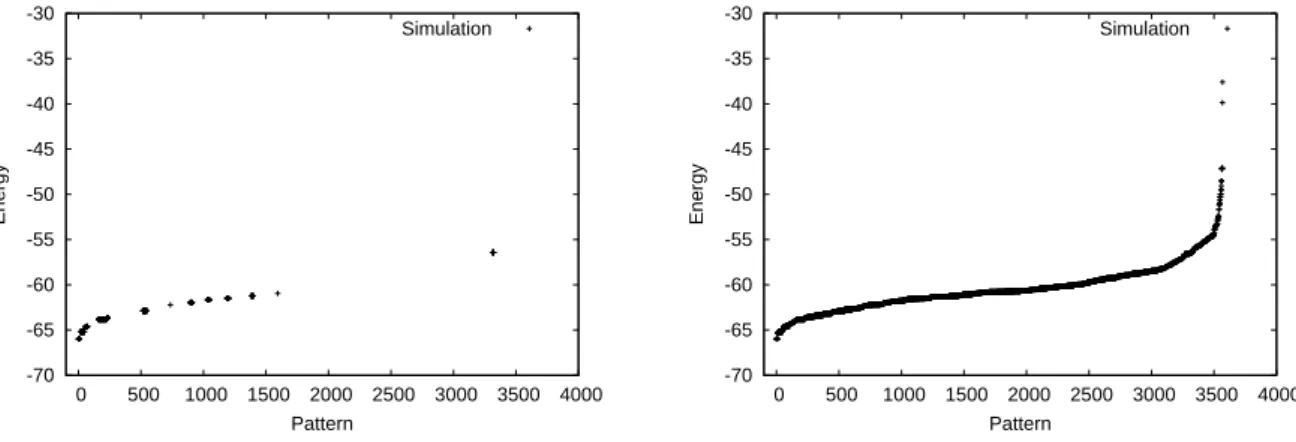
since simulation of memory access is very time consuming. Memory sheets have size 1.5 X 1.5 andσ=0.58. The simu-lation experiment followed was to perform up to 10000 min-imization procedures, each one starting from a different ran-dom network configuration. When a new pattern is found, it is stored and the procedure is repeated from other random starting configurations, otherwise the search stops. We note in Fig. 2 that, forT =0.2, there are many patterns found by GSA that are not found using the BM. In these simulations, GSA appears to visit state space more loosely, while the tra-ditional BM visits state space more uniformly. For very low temperatures, the BM functions more like a gradient descent method and, when presented with randomly generated pat-terns, the network will stabilize at the closest local minima.
We compare, in Fig. 3 the frequency with which different patterns, corresponding to minimum energy states, are found with the BM and with the GSA forqA=1.4, for the same
sim-ulations of Fig. 2. We observe there is degeneracy in network states. We notice that, in the case of GSA, the frequency with which the hardest to detect patterns are found is much larger than the corresponding ones in the BM. In particular, many patterns that are not found by the BM are detected employing GSA. This corresponds to the gaps encountered in the spec-trum shown in Fig. 2(a). GSA tends to prefer the lower energy states, but will also find, with low probability, higher energy states. One can observe an exponential upper limit for the frequency of visits, as a function of energy for GSA. The BM tends to visit states with a more uniform distribution of fre-quencies, as is expected from the characteristic of the locality of visits of state space, which we mentioned before.
4. CONCLUSIONS
We have proposed a memory organization, where two hier-archically structured modules corresponding to sensorial and symbolic memories interact, producing sensorial and sym-bolic activity, representing unconscious and conscious men-tal processes. This memory structure and functioning, along with an adaptive learning process, is used to explain a pos-sible mechanism for neurotic behavior and psychoanalytical working-through.
The complex network topologies which result from the self-organizing processes, based on biological mechanisms, which we have proposed, have properties that are common features of many biological systems and indicate that they may not be well described by BG statistical mechanics, but rather by Nonextensive Statistical Mechanics. These mecha-nisms are very characteristic of much of the brain’s function-ing and suggest the use of a GSA algorithm to model memory functioning and the way we associate ideas in thought. The study of network quantities such as node degree distributions and clustering coefficients may indicate possible experiments, which would validate models such as the one presented here. We are proceeding in further model refinement and analy-sis. It is necessary to verify more thoroughly the dependence of model behavior on its various parameters such asT and σ. These parameters represent, at least partially, the effects of neurosubstances such as neural growth factors, neurotrans-mitters and neuromodulators. Although we do not have ex-perimental indications of their absolute values, the tuning of their relative values is fundamental for model stability and functioning. This may give some insight to basic mechanisms in real neural networks and the emergence of behavioral as-pects. We are also interested in trying to map language struc-ture and processing into network topology and dynamics, al-though we are not yet sure whether this is possible.
-70 -65 -60 -55 -50 -45 -40 -35 -30
0 500 1000 1500 2000 2500 3000 3500 4000
Energy
Pattern
Simulation
-70 -65 -60 -55 -50 -45 -40 -35 -30
0 500 1000 1500 2000 2500 3000 3500 4000
Energy
Pattern
Simulation
FIG. 2: The numbers taken as abcissas in (a) and in (b) identify the same patterns. In both figuresT=0.2. (a) Left, energy of stored patterns
visited by the BM. (b) Right, energy of stored patterns visited by the GSA forqA=1.4, for the same initial configurations as in (a).
1e-06 1e-05 0.0001 0.001 0.01 0.1
-66 -64 -62 -60 -58 -56
Frequency of visits
Energy
Simulation
1e-06 1e-05 0.0001 0.001 0.01 0.1
-66 -64 -62 -60 -58 -56
Frequency of visits
Energy
Simulation
FIG. 3: (a) On the left, visiting frequency to stored patterns by the BM forT=0.2. (b) On the right, similar to (a) for the GSA atqA=1.4
and the same temperature.
biologically plausible, in accordance with many aspects de-scribed by psychodynamic and psychoanalytic clinical expe-rience, and experimentally based on simulations, the model is very schematic. It nevertheless seems to be a good metaphor-ical view of facets of mental phenomena, for which we seek a neuronal substratum, and suggests directions of search.
Acknowledgements
We are grateful for fruitful discussions regarding basic con-cepts of psychoanalytic theory, with psychoanalysts and pro-fessors Romildo do Rˆego Barros, Paulo Vidal and Angela
Bernardes of the Escola Brasileira de Psican´alise of Rio de Janeiro and the Department of Psychology of the Universi-dade Federal Fluminense. We also thank the members of the Escola Brasileira de Psican´alise of Rio de Janeiro for their warm reception of the author R. S. Wedemann in some of their seminars. Suggestions and discussions with Sumiyoshi Abe, Evaldo M. F. Curado and Constantino Tsallis regard-ing complex networks and nonextensive statistical mechan-ics were also helpful and enlightening. We acknowledge the Brazilian National Research Council (CNPq) and the Rio de Janeiro State Research Foundation (FAPERJ) for partial fi-nancial support.
[1] S. Freud,Introductory Lectures on Psycho-Analysis, Standard
Edition, New York - London: W. W. Norton and Company (1966). First German edition in 1917.
[2] S. Freud,The Unconscious, Standard Edition ofThe Complete
Psychological Works of Sigmund Freud, Volume XIV, London: The Hogarth Press (1957). First German edition in 1915.
[3] S. Freud,Beyond the Pleasure Principle, Standard Edition of
The Complete Psychological Works of Sigmund Freud, Volume XI, London: The Hogarth Press (1974). First German edition
in 1920.
[4] R. S. Wedemann, L. A. V. Carvalho and R. Donangelo,A
Com-plex Neural Network Model for Memory Functioning in Psy-chopathology, Lecture Notes in Computer Science4131, 543– 552 (2006).
[5] R. S. Wedemann, L. A. V. Carvalho and R. Donangelo,
Net-work properties of a model for conscious and unconscious mental processes, Neurocomputing71, 3367 (2008).
the Theory of Neural Computation, Lecture Notes, Vol. I, Santa Fe Institute, Studies in the Science of Complexity, Cambridge, MA: Perseus Books (1991).
[7] S. Abe and Y. Okamoto, eds.,Nonextensive Statistical
Mechan-ics and Its Applications, Lecture Notes in Physics, Springer-Verlag (2001).
[8] C. Tsallis and D.A. Stariolo,Generalized simulated annealing,
Physica A,233 395–406 (1996).
[9] S. Thurner, Nonextensive statistical mechanics and complex
scale-free networks, Europhysicsnews,36, 6, 218–220 (2005).
[10] W. C. Barbosa, Massively Parallel Models of Computation,
England: Ellis Horwood Limited (1993).
[11] G.M. Edelman,Wider than the Sky, a Revolutionary View of
Consciousness, Penguin Books, London (2005).
[12] E. R. Kandel, J. H. Schwartz and T. M. Jessel, eds.,Principles
of Neural Science, MacGraw Hill, USA (2000).
[13] L. A. V. Carvalho, D. Q. Mendes and R. S. Wedemann,
Cre-ativity and Delusions: The Dopaminergic Modulation of Cor-tical Maps, Lecture Notes in Computer Science2657 511–520 (2003).
[14] R. S. Wedemann, R. Donangelo, and L. A. V. Carvalho,
Prop-erties of a memory network in psychology, CP965, Complex-ity, Metastability and Nonextensivity-CTNEXT 07, S. Abe, H. Herrmann, P. Quarati, A. Rapisarda, and C. Tsallis, eds.,
Amer-ican Institute of PhysicsCP965, 342 (2007).
[15] J. P. Boon and C. Tsallis, Europhysics News,36(6), 185 (2005).
[16] C. Tsallis, M. Gell-Mann and Y. Sato, Europhysics News,
36(6), 186 (2005).
[17] C. Tsallis, G. Bemski and R. S. Mendes, Physics Letters A257,