*e-mail: [email protected], [email protected]
Alternative Castor Oil-Based Polyurethane Adhesive
Used in the Production of Plywood
Fabricio Moura Diasa*, Francisco Antonio Rocco Lahrb*
a
Materials Science and Engineering, University of São Paulo - USP, Av. Trabalhador Sãocarlense, 400, 13566-590 São Carlos - SP, Brazil b
Department of Structural Engineering, São Carlos School of Engineering - EESC, University of São Paulo - USP
Received: September 11, 2003; Revised: May 3, 2004
Plywood is normally produced with urea-formaldehyde and/or phenol-formaldehyde adhesives. However, the former is considerably toxic and environmentally damaging, while the latter is expen-sive, thus motivating the search for alternative raw materials in plywood production. The castor oil-based polyurethane adhesive developed at the São Carlos Institute of Chemistry, University of São Paulo, is an environmentally friendly vegetal oil-based polymer that is harmless to humans. The wood species Eucalyptus grandis offers favorable properties for plywood the manufacture. The study reported on here involved the use of castor oil-based polyurethane adhesive to produce plywood with Eucalyptus grandis layers. The plywood’s performance was evaluated based on the results of physical and mechanical tests recommended by the Brazilian code, ABNT. Tests results showed higher values than those reported in the literature and recommended by the ABNT, indicating that the castor oil-based polyurethane adhesive is a promising glue for the manufacture of plywood.
Keywords:plywood, polyurethane adhesive based on castor oil, properties
1. Introduction
The advantage of wood-based products is that the wood’s properties can be improved through the applica-tion of science and technology. These products include wood panels, or plywood, whose consumption around the world and in Brazil has grown steadily.
These panels are produced with adhesives, and the ones available in Brazil, i.e., urea-formaldehyde and/or phenol-formaldehyde adhesives, involve negative factors such as high energy consumption due to the high temperatures re-quired for curing (130 to 160 °C), the high cost of phenol, which is petroleum-based, and their toxicity for humans and the environment.
An alternative adhesive deriving from a natural and re-newable source, castor oil-based polyurethane adhesive is classified as impermeable and non-aggressive to the envi-ronment and to humans, besides representing a Brazilian tech-nology. This adhesive is cured at ambient temperature, but curing can be accelerated using temperatures of 60 to 90 °C, and it is believed that its large scale availability on the market
will bring its price down to a very reasonable level. The wood panel industry represents an important seg-ment of the country’s economy, not only because it gener-ates revenue and jobs but also due to its increasing dyna-mism, particularly in the furniture and civil construction sectors. However, for this dynamism to continue, techno-logical investments are required to expand and improve the production of panels.
Some of the practical factors the justify the preferential use of wood-based panels are the reliability of the material, stability of the pieces, possibility of producing pieces with dimensions not found in solid wood, use in modern and complex applications with low cost-efficiency ratio, and utilization of most of the log1.
Today, the glues traditionally available on the market represent the most expensive components of these panels, and their toxicity poses health risks. These two factors per se justify the search for alternative adhesives of compara-ble quality and performance, based on raw materials deriv-ing from natural and renewable sources. In this context, castor oil-based polyurethane adhesive possesses satisfac-tory properties2. This adhesive was developed at the
Insti-tute of Chemistry of São Carlos, of the University of São Paulo.
The purpose of this study, therefore, was to evaluate the performance of plywood produced with the wood spe-cies Eucalyptus grandis based on its physical and mechani-cal properties and the performance of the castor oil-based polyurethane adhesive, comparing the results with the properties of plywood reported in the literature.
2. Plywood
Plywood, as explained earlier, is produced by super-posing and gluing together several layers of wood with their fibers crossed perpendicularly. This procedure, called cross lamination (Fig. 1), confers good rigidity, mechani-cal strength and dimensional stability on the product. Ply-wood can be made from either softPly-woods or hardPly-woods3,4.
The layers in plywood are aligned according to a pre-determined arrangement so as to obtain equivalence of its properties of stiffness and strength in the main directions of the board. Crossed lamination and gluing of plywood further capitalize on the wood’s most desirable physical and mechanical properties4.
Plywood has well-established applications in several market segments, such as furniture, boatbuilding, special weather-resistant packaging, musical instruments and
sports equipment, and in civil construction. In the latter industry, it is applied in external walls, roof closures, floor-ing, wall panels, internal dividing walls, fronts, compos-ite beams, truss connections, floor panels, concrete molds, arch-shaped roofs, etc.
2.1. Plywood specifications
The Brazilian code - ABNT - contains norms specify-ing the dimensions, tolerances and conditions to be fol-lowed for the classification of plywood, as listed below.
ABNT - NBR 9531 (1986)5 standard: “Plywood -
clas-sification” qualifies boards according to the place they are used, based on three basic types: IR (interiors), IM (inter-mediates) and EX (exteriors).
IR plywood is produced with non-water resistant adhe-sive, and is applied in places away from water or high rela-tive moisture content. The IM type plywood is destined for internal use, but in environments with high moisture content which may be subject to water splashes. EX plywood is des-tined for external use or in closed environments, where it is subjected to repeated wet and dry cycles or to the action of water.
ABNT - NBR 9532, (1986)6 states: “Plywood -
speci-fications” establishes the geometric characteristics, such as assembly, dimensions, shape, thickness and tolerances, as well as other conditions that must be adhered to for each type of board. According to this standard, plywood is divided into the following specifications:
• General use plywood – GER: plywood boards classi-fied generically as IR.
• Mold for reinforced concrete – FOR: plywood boards classified generically as EX. This type of plywood should present a modulus of elasticity of at least 4000 N/mm2.
• Decorative - DEC: plywood boards classified generi-cally as IM.
• Industrial - IND: plywood boards classified generi-cally as EX.
• Marine applications - NAV: plywood boards classi-fied generically as EX. This type of plywood should present a modulus of elasticity of at least 6000 N/mm2.
• Slatted - SAR: plywood boards classified generically as IR, whose internal portion consists of wood slats with a maximum width of 40 mm.
2.2. Plywood production
The description given below is based on Zugman8, who
describe the production stages of plywood.
Before they are cut in a laminator, the logs are debarked and placed in tanks containing steam or hot water to soften the wood and increase its plasticity, making it easier to ob-tain smoother and less breakable layers.
The wood layers are then produced by cutting, sawing or cutting on a rotating lathe. The next stage consists of
drying the layers to reduce their moisture to a preestab-lished content and produce a flat, flexible material. Drying is done very quickly (a few min) and the final moisture content is about 4 to 6%. The dry layers are stored in piles according to their width and class. They should be visually classified by type and size of defects, as well as by the number and characteristics of the grain of the various lay-ers.
In small operations, the adhesive is applied with a brush, but large scale operations use roll spreaders. Another method often used is the curtain method, whereby a machine with a reservoir, having a pair of parallel steel blades with a slit be-tween them mounted underneath the reservoir, spreads a thin curtain, or film, of adhesive over the surface of the layers.
Two important factors are directly correlated with the strength, density and quality of the end product, i.e., the amount of adhesive applied per area and its uniform distri-bution over the layers7,8.
Immediately after the adhesive is applied on the layers, they should be assembled to form the plywood board, which is then pressed under a load. It is advisable to exert a slight initial pressure before applying the total load. If a heated press is used, its loading should be performed as quickly as possi-ble to prevent the adhesive from drying out before the board is properly compressed7,8. Compression time depends
basi-cally on the temperature of the press and the type of adhesive used. For compression temperatures of 100 to 160 °C, com-pression should be limited to a few min. The gluing pressure by hot pressure may vary from 1.2 to 2.0 MPa.
2.3. Potential of the genus Eucalyptus for the manufac-ture of plywood
Approximately 70% of the wood used to produce ply-wood in Brazil comes from native forests and 30% from refor-ested Pinus spp. However, the stock of Pinus spp forests has shrunk and the enormous variability of the characteristics of native species makes their use as raw material difficult10.
The search for new sources of raw materials for the pro-duction of plywood and the favorable characteristics of Eu-calyptus spp wood are strong arguments in favor of research to identify the potential of new species of the genus, its hy-brids and clones, the quality of the products derived from them, and the determination of alternative sources of wood. One the most commonly used species of eucalyptus used in southern Brazil is the E. grandis grown in the state of São Paulo10. The genus Eucalyptus can be considered one
of the most promising for producing alternative products to replace native species. Its wood can be used for various pur-poses, among them the production of panels.
Jankowsky11 evaluated Eucalyptus grandis wood for
the production of layers and plywood panels, concluding that this wood is technologically viable for use in the manu-facture of plywood.
3. Adhesives
Adhesives are one of the main components in the pro-duction of wood-based panels.
Plywood is produced according to two main specifications: a) for indoor use, glued with urea-formaldehyde resin, which is employed chiefly in the furniture industry, and b) for out-door use, glued with phenol-formaldehyde resin, employed in civil construction9-12.
Urea-formaldehyde adhesives have a serious drawback, which is the emanation of formaldehyde fumes and its use is limited in countries with strict environmental control. Phe-nol-formaldehyde adhesive is produced from synthetic phe-nolic resins. One of its negative factors is the cost of phenol, whose raw material is petroleum. This adhesive required high curing temperatures that vary from 130 to 160 °C 13,14.
3.1. Alternative adhesive: castor oil-based polyurethane
In the early 1980’s, the Department of Chemistry and Molecular Physics of São Carlos made an important na-tional contribution through its studies on polyurethane resin-based adhesives. The researchers of the Analytical Chemis-try and Polymer Technology Group developed a castor oil-based polyurethane resin that offers several advantages, such as handling at ambient temperature, strong resistance to water and UV rays, strong mechanical strength and the fact that it derives from a natural and renewable source easily found in most of the country15.
The castor-oil plant (Rícinos communis) is a plant of the Euphorbiaceae family from which castor oil is extracted. This plant is known internationally as Castor-Oil Plant and in Brazil as Caturra16.
Polyols and prepolymers with different characteristics can be synthesized from this natural and renewable source, which, when mixed, result in a polyurethane. Its competi-tiveness in relation to other polymers is basically tied to three factors: it derives from a natural and renewable raw material, its mechanical properties are superior to those of petroleum-derived polymers, and the cost of the di-isocyanates in Brazil is reasonable15.
Claro Neto15 characterized the physical and
mechani-cal properties of a castor oil-based polyurethane poly-mer. The study of the chemical properties aimed to char-acterize the functional organic groups present in the polyol/prepolymer components that react during prepa-ration of the polyurethane. The castor oil-based poly-urethane was developed for use in medical applications as a bone implant material.
To expand the application of this product, Jesus2 and
Azambuja17 studied of the behavior of castor oil-based
tests of shearing strength parallel to the grain, tensile strength perpendicular and tensile strength parallel to the grain. The results reported by these authors demonstrated that castor oil-based polyurethane adhesive is a good alternative for the tech-nological use of GLT.
4. Materials and Methods
4.1. Production of plywood boards
An experimental model of plywood was fabricated in the Wood and Timber Structures Laboratory of the Depart-ment of Structural Engineering, School of Engineering of São Carlos, University of São Paulo.
The adhesive, made of the Institute of Chemistry of São Carlos of the University of São Carlos, which was applied with a brush, was castor oil-based polyurethane resin of the bicomponent type, B1640 polyol and A249 prepolymer, in a 2:1 ratio. The adhesive was applied in simple lines, with a layer of glue applied to the layers on only one of the sur-faces. The gluing parameters are given in Table 1.
The plywood panels were manufactured with seven lay-ers of the species Eucalytus grandis having a nominal thick-ness of 0.2 cm. Four panels were produced with a nominal thickness and area of 50 × 50 cm, from which the test speci-mens (14 for each test) were taken for characterization of their physical and mechanical properties.
The wood layers were supplied by the Wood based Pan-els and Peeling Laboratory, Department of Forest science, of the Superior School of Agriculture “Luiz de Queiroz”, of the university of São Paulo. These layers were classified according to the Brazilian Code NBR 9531 (1986)5, in the
classes: N, B, C and D, from the best to the worst quality. Plywood panels were manufactured with class C layers.
4.2. Experiments
The tests involved in the characterization of the plywood were: moisture content, specific gravity, modulus of elas-ticity (MOE) and modulus of rupture (MOR) obtained from the static bending test and glue-shear strength.
To identify the moisture content, NBR 9584 (1986)18, each
test specimen was weighed and then oven dried at 103 + 2 °C to a constant mass. The moisture content was obtained through Eq. 1.
(1)
where: TU = moisture content in %; Mu and Ms = the test speci-men’s moist and dry mass in g.
Equation 2 was used to obtain the specific gravity, NBR 9485 (1986)19. The nominal dimensions of these specimens
were (100 × 50 × 14) mm.
(2)
where: Mea = specific gravity in g/cm3; M = the specimen’s mass in g; C, l, e = length, width and thickness of the specimen in cm.
For the static bending test, according to the NBR 9533 (1986)20, the specimen is supported at both ends and a load
is applied at mid-span (Fig. 2), using a chopper continu-ously at a constant velocity. The nominal dimensions of these specimens were: length of 400 mm; width of 70 mm and thickness of 14 mm.
The loading velocitywas calculated using Eq. 3.
(3)
where: K = 0.00005, fiber deformation rate; and V = Loading veloc-ity in mm/s.
The loads and the corresponding vertical displacements were recorded (minimum of 12 readings) in order to deter-mine the modulus of elasticity (MOE) based on Eq. 4, and the modulus of rupture (MOR) based on Eq. 5.
(4)
(5)
where: Eb = modulus of elasticity, in N/mm2; L= distance between the centers of the supports, in mm; l.e = width and thickness of the specimen, in mm; F2 – F1 = load increment in the straight portion of the load-strain curve, in N; S2 - S1 = vertical displacement increment at mid-span, corresponding to F2 – F1, in mm; Tr = modulus of rupture, in N/mm2 and F
max = rupture load, in N.
The procedure for the glue-shear strength test is de-scribed in the NBR 9534 (1986)21 code. This standard
es-tablishes that at least five test specimens should be taken from each plywood board.
This test served as the basis to evaluate the quality of the glue line and the plywood was classified according to the place where it would be utilized. The plywood boards
Table 1. Gluing parameters for plywood manufactured with cas-tor-oil polyurethane adhesive.
Gluing parameters
Moisture content of sheets 4 a 6%
Viscosity of adhesive 6 min
Gluing pressure 1.2 MPa
Time of pressure 10 min
Time curing total 4 days
Temperature of pressure 60 °C
Amount of adhesive used 250 g/m2
destined for indoor use were evaluated through a dry test, intermediate plywood was evaluated in a damp test, and the exterior plywood was evaluated in a post-boiling test, based on their tensile strength values. These tests also yielded the wood’s failure percentage, evaluated subjectively, whose value complements the results of the shear tests.
The dry test involves applying the load until complete rupture of the test specimen is achieved, with moisture con-tent in equilibrium with the environment (approximately 12%). In the humid test, the specimen is completely sub-merged in water (15 ± 5) °C for 24 h and tested without prior drying. For the boiling state test, the specimen is sub-merged in boiling water for 4 h and dried for 20 h at a tem-perature of 62 ± 3 °C. The test specimen is then again sub-merged in boiling water for 4 h, cooled on cold water and tested while still damp. The tensile strength is calculated using Eq. 6.
(6)
where: tr = tensile strength, in N/mm2; F
máx = rupture load, in N; a = distance between grooves, in; b = width of the specimen, in mm.
5. Results and Discussion
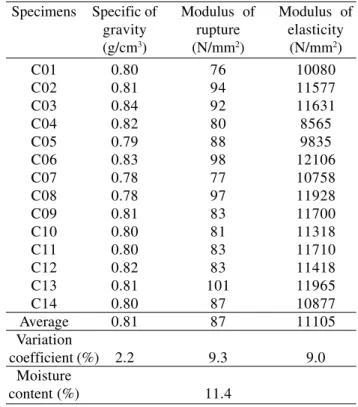
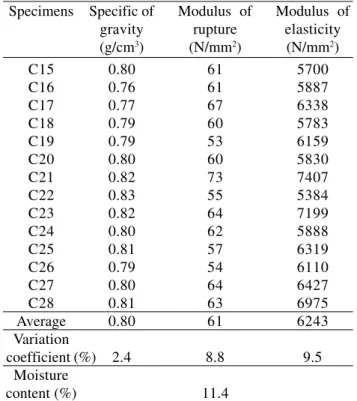
Tables 2 and 3 list the results obtained for moisture content, specific gravity, modulus of rupture and modulus of elasticity for plywood manufactured with castor oil-based polyurethane adhesive, considering the parallel and per-pendicular direction of the grain of the external layers.
Rocco Lahr22 and Sales23 demonstrated that the values
of the variation coefficients for the properties of wood are in the order of 18%, for wood with a moisture content of 12%. Tables 2 and 3 indicate that lower variation
coeffi-cients were obtained than those listed for wood. The Bra-zilian standards do not stipulate values for the variation co-efficients of plywood. We have therefore adopted the stand-ards listed for solid wood as a reference.
Table 4 lists the results of the wood’s tensile strength and failure tests obtained in the glue-shear strength test carried out under dry, wet and boiling conditions.
The Brazilian NBR 9534 (1986)24 code does not specify a Figure 2. Mechanical test for determination of static bending properties.
Table 2. Results in the tests for direction parallel to the grain of the external layers.
Specimens Specific of Modulus of Modulus of
gravity rupture elasticity
(g/cm3) (N/mm2) (N/mm2)
C01 0.80 76 10080
C02 0.81 94 11577
C03 0.84 92 11631
C04 0.82 80 8565
C05 0.79 88 9835
C06 0.83 98 12106
C07 0.78 77 10758
C08 0.78 97 11928
C09 0.81 83 11700
C10 0.80 81 11318
C11 0.80 83 11710
C12 0.82 83 11418
C13 0.81 101 11965
C14 0.80 87 10877
Average 0.81 87 11105
Variation
coefficient (%) 2.2 9.3 9.0
Moisture
reference value for tensile strength in the shear test and re-quires a minimum wood failure percentage of 60, 60 and 80%, respectively, to classify plywood for indoor, intermediate and outdoor use. This standard is currently under review, and there is a tendency for adopting the requirements of the European Standard - EN 314-2 (1993)24 presented in Table 5.
The European standard correlates the average tensile strength value with the average value of the failure percent-age of wood. The requirements in terms of wood failure decrease as the tensile strength increases, and for values equal to or higher than 1.0 MPa there is no longer any failure percentage requirement.
The average tensile strength values listed in Table 4 ex-ceeded 1.0 MPa under all the conditions tested here (dry, wet and boiling). Based on the European standard’s require-ments, it can be stated that plywood manufactured with cas-tor oil-based polyurethane adhesive is suitable for indoor, intermediate and outdoor applications.
The low variation coefficient values indicate homoge-neity in the manufacturing process and good distribution of the glue over all the layers.
5.1. Comparison of the mechanical properties of plywood found in the literature with those of plywood manufac-tured with castor oil-based polyurethane adhesive
Table 6 lists the values of some physical and mechanical
properties reported in the literature for plywood made of Euca-lyptus grandis and phenol-formaldehyde glue. This plywood was produced with seven layers and pressed for 13 min at 130 °C.
A comparison of the values listed in Tables 2 and 3 against those of Table 6 indicates that the plywood pro-duced with the alternative castor oil-based polyurethane adhesive displays properties superior to those of commer-cial plywood. These values were higher in the direction perpendicular to the grain of the outside layers.
The Brazilian code NBR 9532 (1986)6 determines
mini-mum MOE values for plywood for outdoor and structural applications. A comparison of those values and those ob-tained for the plywood produced with castor oil-based poly The MOE values are higher than those required by the
Table 3. Results in the tests for direction perpendicular to the grain of the external layers.
Specimens Specific of Modulus of Modulus of
gravity rupture elasticity
(g/cm3) (N/mm2) (N/mm2)
C15 0.80 61 5700
C16 0.76 61 5887
C17 0.77 67 6338
C18 0.79 60 5783
C19 0.79 53 6159
C20 0.80 60 5830
C21 0.82 73 7407
C22 0.83 55 5384
C23 0.82 64 7199
C24 0.80 62 5888
C25 0.81 57 6319
C26 0.79 54 6110
C27 0.80 64 6427
C28 0.81 63 6975
Average 0.80 61 6243
Variation
coefficient (%) 2.4 8.8 9.5
Moisture
content (%) 11.4
Table 4. Results of the plywood’s glue-shear strength.
Average values of Glue-shear strength
Condition Tensile strength (tr) Wood’s
of test tr N/mm2 Variation failure (%)
(Mpa) coefficient (%) Dry (Moisture
content: 11,4%) 3.1 13 78
Wet 2.7 12 32
Boiling 1.9 6 16
Number of
specimens 14
Table 5. Requirements of the European Standard for the plywood’s glue-shear strength.
Glue-shear strength
Tensile strength - tr (MPa) Wood’s failure (%)
0.2 ≤ TR < 0.4 ≥ 80
0.4 ≤ TR < 0.6 ≥ 60
0.6 ≤ TR < 1.0 ≥ 40
1.0 ≤ TR no exigency
Source: EN 314-2 (1993)24.
Table 6. Mean values of physical and mechanical properties for ply-wood made of Eucalyptus grandis and phenol-formaldehyde glue.
Static bending
Direction Parallel to Perpendicular
the grain to the grain
Modulus of
rupture (N/mm2) 10830 4902
Modulus of
elasticity (N/mm2) 80 49
Moisture content (%) 10.5
NBR 9532 (1986)6 code for plywood with satisfactory
charac-teristics for outdoor application in molds for reinforced con-crete and for marine applications. The values stipulated by the code correspond to the direction parallel to the fibers of the outside layers. According to Olin 5, the MOR and MOE values
in static flexure in the parallel direction are always superior to those obtained in the direction along the fibers of the outside layers.
6. Conclusions
The plywood panels produced with castor oil-based poly-urethane adhesive showed highly satisfactory results. The values of the properties of strength and stiffness obtained in the static bending test were higher than those reported in the literature for plywood made of the same species (Eucalytus grandis), using traditional glue (phenol-formaldehyde).
The MOEs exceeded those required by the NBR 95326
standard for plywood, showing characteristics suitable for out-door applications. It should be noted that the MOE of plywood manufactured with castor oil-based polyurethane glue in the parallel direction to the grain exceeded the standard value listed in the code for the direction parallel to the external layers.
The results obtained in the glue-shear strength tests indi-cate the suitability of using the plywood studied here in in-door, intermediate and outdoor applications. The tests showed little variability, indicating the good quality of the glue line. Low variation coefficients were obtained for all the physi-cal and mechaniphysi-cal properties of the panels, which is a good indicator of the product’s homogeneity and of the good per-formance in the production and tests of the plywood.
It is important to note that, in the manufacture of the ply-wood with castor oil-based polyurethane adhesive, the tempera-ture of compression was 60 °C. This represents a significant reduction in energy consumption, considering that the curing of phenol-formaldehyde resin is processed at temperatures of 130 to 160 °C. Thus, the castor oil-based polyurethane adhesive is a promising alternative for use in plywood production.
Acknowledgments
The authors thank CNPq and FAPESP (Brazilian agencies) for their financial support of this research.
References
1. Guss, L.M. Engineered wood products: the future is bright,
Forest Products Journal, v. 45, n. 7, p.17-24, 1995. 2. Jesus, J.M.H. Estudo do adesivo poliuretano à base de
mamona em madeira laminada colada, Tese
(Doutorado), Escola de Engenharia de São Carlos, USP, São Carlos, p. 106, 2000.
3. Maloney, T.M. The family of wood composite materials, Forest Products Journal, v. 10, n. 2, p. 19-26, 1996. 4. Youngquist, A.J. Wood-based Composites and Panel
Prod-ucts, Wood handbook. Gen. Tech. Rep. FPL. Madison, WI: U.S. Department of Agriculture, FPL, v. 10, p. 6-12, 1999. 5. Associação Brasileira de Normas Técnicas. NBR 9531, Chapas de madeira compensada: Classificação, Rio de Janeiro, p. 3, 1986.
6. Associação Brasileira de Normas Técnicas. NBR 9532, Chapas de madeira compensada: Especificação, Rio de Janeiro, p. 3, 1986.
7. Cerliani, C.; Baggenstos, T.S. Engineered wood prod-ucts: The future is bright, Forest Prod. Suise. J. v. 47, p. 17-24, 1997.
8. Zugman, I.C. Painel geral sobre a produção de compensados. Silvicultura, v. 15, n. 55, p. 12-18, 1994. 9. Nock, H.P.; Richter, H.G. Adesão e adesivos, Curitiba,
Universidade Federal do Paraná, p. 93, 1978.
10. Golfari, L.; Pinheiro Neto, F. A. Escolha de espécies de Eucalipto potencialmente aptas para as diferentes regiões do Brasil, Brasil Florestal, p. 3-23, 1970. 11. Jankowsky, I.P. Manufatura de painéis compensados com
madeira de Eucalyptus spp: resultados preliminares. Piracicaba: ESALQ. IPEF, n. 82, p. 4, 1979.
12. Keinert Jr. Produção de compensado, Revista da Ma-deira, n. 24. p. 42-45, 1996.
13. Peterson, R.W. Wood adhesives, Forest Products Re-search Branch. Otawa, n. 1055, 1964.
14. Samlaic, J. Os atuais problemas e as possibilidades dos adesivos para madeira, Revista da Madeira, n. 374, p. 7-10, 1983.
15. Claro Neto, S. Caracterizações físico-químicas de um poliuretano derivado de óleo de mamona utilizado para implantes ósseos, Tese (Doutorado), Instituto de Química de São Carlos, USP, São Carlos, p. 123, 1997.
16. Araújo, L.C.R. Caracterização química e mecânica de poliuretanas elastoméricas baseadas em materiais oleoquímicos, Dissertação (Mestrado).
Table 7. Comparison between values of the alternative plywood properties with specified by ABNT.
Plywood specification Módulus of elasticity (N/mm2)
ABNT NBR 9532 (1986)6 4000 - Mold for reinforced concrete
6000 - marine applications plywood Manufactured with castor-oil-based polyurethane adhesive 11105 – parallel direction
Instituto de Física e Química de São Carlos, Universidade de São Paulo, São Carlos, 1992. 17. Azambuja, M. A. Avaliação do adesivo poliuretano
à base de mamona para fabricação de MLC,
Dissertação (Mestrado), Escola de Engenharia de São Carlos, USP, São Carlos.
18. Associação Brasileira de Normas Técnicas. NBR 9584, Chapas de madeira compensada: Determinação do teor de umidade, Rio de Janeiro, p. 3, 1985. 19. Associação Brasileira de Normas Técnicas. NBR 9485,
Chapas de madeira compensada: Determinação da massa específica aparente, Rio de Janeiro, p. 3, 1985. 20. Associação Brasileira de Normas Técnicas. NBR 9533, Compensado: Determinação da resistência à flexão estática, Rio de Janeiro, p. 3, 1986.
21. Associação Brasileira de Normas Técnicas. NBR 9534, Compensado: Determinação da resistência da colagem ao esforço de cisalhamento, Rio de Janeiro, p. 4, 1986.
22. Rocco Lahr, F.A. Considerações a respeito da variabilidade de propriedades de resistência e elasticidade da madeira, Tese (Livre Docência), Escola de Engenharia de São Carlos, USP, São Paulo, p. 109 1990.
23. Sales, A. Proposição de classes de resistência para madeira, Tese (Doutorado), Escola de Engenharia de São Carlos, Universidade de São Paulo, São Paulo, p. 223, 1996. 24. European Standard (versão portuguesa), 2001 - NP/EN