o
T
HEO
EDIPUSM
YTH ASM
ATHEMATICALA
LLEGORY John A. FossaUFRN – Brasil Glenn W. Erickson
UFRN – Brasil
(aceito para publicação em agosto de 2014) Abstract
We posit that, for many ancient thinkers, mathematical allegory was a fundamental theoretical construct in their understanding of the universe. The procedure is to establish a noteworthy mathematical structure which suggests certain physical or social applications (interpretations). We illustrate the method in regard to the Oedipus myth. Thus, we use the practice of measuring with stretched ropes to elaborate, via Pythagorean number theory, an alternative classification of triangles to that of Euclid and show how to make a perspicuous geometric representation of triangles so classified. The representation obtained is seen to be a primitive astral map, whose salient features, especially when considered in light of the macrocosm/microcosm analogy, suggest to the poetic imagination details of the Oedipus myth. Oedipus’ destiny would have been determined by casting lots on the astral map. Apparently his lot fell where “three roads meet,” which can then be interpreted as showing that the Oedipus myth (as well as Sophocles play Oedipus Rex) was understood to be a version of the Green Child myth.
Keywords: Ancient Philosophy, Ancient Mathematics, Mathematical Allegory, Oedipus, pre-astrology.
[OMITO DE ÉDIPO COMO UMA ALEGORIA MATEMÁTICA]
Resumo
Sugerimos que muitos pensadores antigos adotaram a alegoria matemática como peça teórica fundamental para entender o universo. O procedimento consiste em estabelecer uma
Publicação Oficial da Sociedade Brasileira de História da Matemática ISSN 1519-955X
o
estrutura matemática notável que poderá sugerir aplicações físicas ou sociais. Ilustramos o procedimento em relação ao mito de Édipo. Assim, usamos a prática de medir com cordões esticados, em conjunção com a aritmética pitagórica, para elaborar uma classificação de triângulos e mostramos como a classificação pode ser representada geometricamente de forma perspícua. A referida representação é vista como um mapa astral primitivo que, quando considerado à luz da analogia do microcosmo/macrocosmo, sugere à imaginação poética os detalhes do mito de Édipo. O destino de Édipo teria sido determinado por lançar sortes sobre o mapa astral. A sorte de Édipo, aparentemente, caíu sobre o “cruzamento de três estradas”, o que pode ser interpretado como evidência de que o referido mito (bem como a peça Édipo Rei de Sófocles) foi concebido como uma versão do mito do Homem Verde.
Palavras-chave: Filosofia Antiga, Matemática Antiga; Alegoria Matemática, Édipo, Pré-Astrologia.
Introduction
The Myth of Oedipus is well known and can be quickly told in outline. It is prophesized to King Laius and Queen Jocasta of Thebes that their newly born son will kill Laius and marry Jocasta. Hoping to sidestep fate, Laius orders baby Oedipus, whose name means “swollen foot,” to be exposed to the elements, but Jocasta arranges it so that the infant is spirited away to Corinth, where it grows into a promising and beloved prince. Rumors reach him about his illegitimacy, however, and thus he goes to Delphi to determine the truth of the matter. The prophet, however, only tells him that he will murder his father and marry his mother. Still taking his adopted parents for his birth parents and hoping to sidestep fate, he avoids returning to Corinth and instead sets out for Thebes. On the way, at a place where three roads meet, he becomes involved in an altercation with a stranger, who in reality is Laius traveling incognito, and ends up slaying him. A bit further on, he meets with a sphinx that is tormenting the Thebans with draught and plague. She will only let him pass if he can solve the following riddle: “What goes by fours in the morning, by twos at midday and by threes in the evening?” Oedipus solves the riddle: man crawls on his hands and knees as an infant, walks on two legs as an adult, and hobbles about with the help of a cane in old age. In consequence, the sphinx dashes herself to the ground, Thebes is freed and Oedipus marries Jocasta and becomes king. Eventually, however, the truth comes out. Thereupon Jocasta hangs herself, and Oedipus blinds himself and becomes a wandering beggar, dependent on his daughter Antigone. After his demise, Oedipus’ tomb becomes a sacred place, or, in other versions, the gods find a place for Oedipus in the stars.
It is often pointed out that the crucial action takes place at a crossroads, which is supposedly symbolic of fateful decisions. That this cannot be the intended interpretation of the myth, however, is clearly demonstrated by the fact that both Laius and Oedipus take conscious steps to avoid their fate, but neither can escape his destiny. What then determines man’s inescapable fate? We suggest herein that one’s fate is determined by the casting of
o
lots against the background of a primitive astral map, which map is itself a perspicuous representation of a certain classification of triangles. We suggest further that the mathematical structure of the procedure furnishes the salient features for an artistic representation of the underlying motif of Oedipus as the Green Child (the god of vegetation whose death and rebirth constitute the cycle of organic life). We use the term mathematical allegory to refer to the process whereby interesting mathematical structures are regarded as touchstones for understanding the world and our place in it. We will elaborate on this concept of mathematical allegory in Part 1 of the present paper. In Part 2 we will present the specific mathematical structure that may be relevant to the Oedipus myth and, in Part 3, apply that structure to the myth in question.
Part 1: Mathematical Allegory
Many ancient thinkers, amongst whom the best known are perhaps the Pythagoreans, considered mathematics to be fundamental for our understanding of the universe. Due to the sacred nature of this knowledge, however, it was never formally expounded in systematic treatises, but only alluded to by writers who assumed that their allusions would be clue enough for the initiated. Thus, the modern interpreter is forced into trying to recreate this mathematics-based philosophy as best as can be done. On the one hand, the recreation is facilitated by the aforementioned allusions, by the stated goals of the theory under investigation and by the fact that the mathematics is rational and can thus be investigated in a rational manner. On the other hand, the recreation is inhibited by the fact that the historical record is littered with “red herrings,” such as facile number mysticisms that obviously have little explanatory power, and by the fact that the link between the mathematics and the philosophical doctrine are somewhat arbitrary.
We would like to suggest, however, that a promising tool for investigating this kind of ancient thought is that of mathematical allegory. According to our view, one starts with an a priori mathematical structure, which is interesting in its own right, generally because it treats of some mathematical concept in a complete and/or striking way. The structure is then interpreted according to (ad hoc) heuristic principles which bridge the mathematical structure and its worldly applications. The most compelling of the mathematical allegories that we have unearthed either contain generative principles or establish a stylized model for astronomical/astrological lore. We will briefly describe an example of each, both taken from Plato’s Republic.
The Divided Line
In Book VII of the Republic, Plato sets out the Myth of the Cave and, right after recounting it, discusses it in terms of the Divided Line. If we inquire into the relative lengths of its segments and impose the (Pythagorean) condition that they be given by positive whole numbers, it is not too difficult (for details, see Erickson and Fossa, 2006) to arrive at the following general form of the Divided Line: , where k, a and b are positive whole numbers and a and b are coprime. The middle terms are equal,
o
each being the geometric mean of the extremes. Further, the length of the whole Line is .
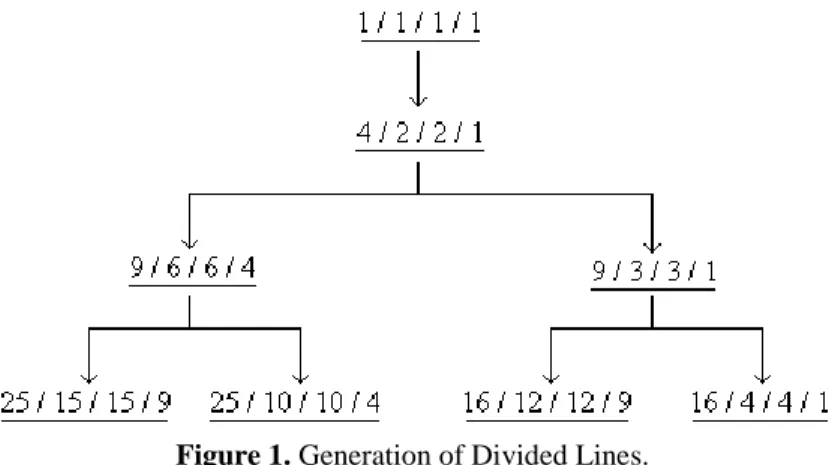
When k = 1, we say that the Line is primitive. Given that a and b are coprime, there is only one primitive Line in which the extremes are equal, to wit, the Line , which may be called the Monadic Line. Now all primitive Lines can be generated from the Monadic Line by using the following rule:
.
Since a and b are coprime, a+b and a will be coprime, as will a+b and b. Thus, both results are indeed primitive Divided Lines. Figure 1 shows the first few stages in the generation of all primitive Divided Lines.
Figure 1. Generation of Divided Lines.
The mathematical structure pictured in Figure 1 is interesting in that all and only primitive Divided Lines are obtained. Each primitive Line generates an infinite family of non-primitive Lines by multiplying successively by 2, 3, 4, 5, … The mathematical allegory that results from this structure is Plato’s philosophy, as is explained in Erickson and Fossa (2006). We forego further explanations here, since our purpose was merely to illustrate how the generative principles work.
The Nuptial Number
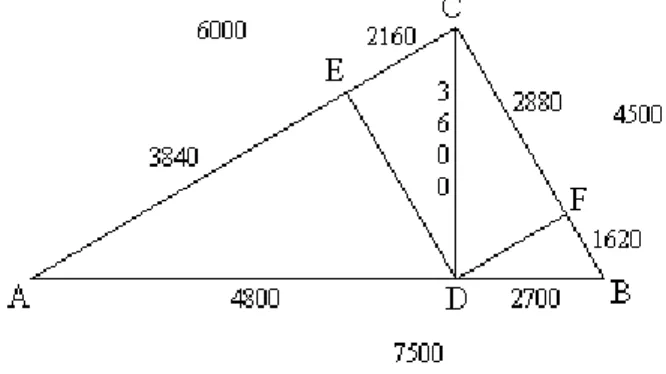
We will now give an example of the second type of mathematical allegory, a stylized model for astronomical/astrological lore. In Book VIII of the Republic, Plato gives an enigmatic description of what would come to be known as the Nuptial Number, but which Plato himself refers to as the geometrical number. By piecing together various hints
o
from ancient authors, Fossa and Erickson (1994)1 reconstructed this number, which is shown in Figure 2. As a mathematical structure it is interesting in that all its component (triangular) parts are similar. This is so because ABC is a right triangle, while is the altitude on the hypotenuse. Further, is the altitude on the hypotenuse of ACD, while
is the altitude on the hypotenuse of BCD. In fact, as is easily verified, all the triangles in the Figure are similar to the (3, 4, 5) triangle, which is the smallest right triangle having whole number sides.2
Figure 2. The Nuptial Number.
The most important heuristic principles that connect this interesting mathematical structure with the problem that it is designed to solve (the determination of which partners should be allowed to procreate in order to maintain the correct proportion among the three social classes) are as follows:
1. Each divided right triangle represents a newborn child.
2. The child’s father is represented by the larger component and its mother by the smaller component.
3. The numbers represent days. 4. A year consists of 360 days.
5. The perimeters of components represent ages at time of procreation. 6. The perimeter of compound triangle represents social class.
The whole triangle, ABC, for example, has a perimeter of 50 years and therefore (due to a direct statement of Plato in the Republic) represents the ruling class. Other statements of Plato imply that a man reaches his full physical prowess at age 40, while a woman does so at age 30. These are exactly the perimeters of, respectively, the father component, ACD, and the mother component, BCD. Both of these latter triangles can be
1 See also Fossa and Erickson (2001).
2 Although we will not make use of the fact herein, it is interesting to observe that, because the altitude is the
geometric mean of the parts into which it divides the hypotenuse, each altitude defines a Divided Line. They are 16k/12k/12k/9k, where k is, respectively 5×60, 4×60 and 3×60; also 60 = 3×4×5.
o
analyzed in the same way, which shows that procreation at an earlier age changes the social class of the child procreated.
That there is still more behind Figure 2, however, is only revealed after a passage from the Timaeus is analyzed, resulting in the identification of some of the numbers in the Figure with the Material Elements. Specifically, 3840, 2160, 2880 and 1620 represent, respectively, Fire, Water, Air and Earth. But the only place that these elements are listed in this order (with Air and Water permuted) is in traditional astrology. This indicates that these numbers are connected with the Fire signs, Water signs, Air signs and Earth signs of the zodiac and, hence, Figure 2 is a stylized astral map and astrological considerations were to be included in Plato’s proposed direction of the Republic’s population planning policy. Again, we abstain from supplying full details (for which the cited publications may be referred to), since we only desire to provide an example of how an interesting mathematical structure may be considered as a stylized model for astrological lore.
This second type of mathematical allegory – that in which the generative aspect is largely (but not completely) absent – is in many respects simpler and, thus, probably older. Indeed, it will be this type of allegory that will be of importance in the Oedipus Myth. In Part 2, to which we now turn, we present the mathematical structure that we propose as the basis for this myth.
Part 2: A Theory of Triangles
In the present part of this paper, we will present an alternative to Euclid’s classification of triangles. We will thereupon exhibit a perspicacious way of presenting the Universe of Triangles, in which all3 triangles, up to similarity, are represented in a unique manner. We start by presenting the motivation for devising the alternative classification. Motivation
At the beginning of Book I of his The Elements, Euclid gives a series of definitions, which, especially when taken together with the subsequent investigations in his work, seem to demarcate clearly the notion of ‘triangle’ and the classification of its principle subtypes. Stated in modern terms, this notion is that of a plane figure consisting of three line segments inclosing a finite space. The subdivisions are made with regard to the relative size of the sides and of the angles, resulting in, as Proclus remarked4 seven distinct types of triangles, to wit: (1) equilateral, (2) acute isosceles, (3) right isosceles, (4) obtuse isosceles, (5) acute scalene, (6) right scalene and (7) obtuse scalene.
Accepting the account proffered in the foregoing paragraph as unproblematic, however, tends to close off fruitful historical investigations regarding (i) the subtleties and ambiguities in Euclid’s definitions, (ii) the differing points of view of some of his contemporaries, with which he had to contend, and (iii) possible prior accounts, which may be quite different from that of Euclid. For purposes of illustration, (i) and (ii) may be taken
3 All, that is, except for those having infinite sides. See below. 4 See Heath’s commentary in Euclid (1956).
o
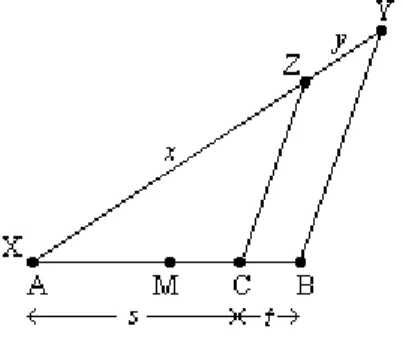
together. Thus, Euclid defines trilateral (rectilineal) figures as those contained by three lines; from this, the seven aforementioned kinds of triangles fall out in the manner already explained (Def. 19, 20 and 21). Nevertheless, he does not identify trilateral figures and triangles, for, according to some of his contemporaries5, some triangles, such as that pictured in Figure 3, have four sides.
Figure 3. A “barb triangle”.
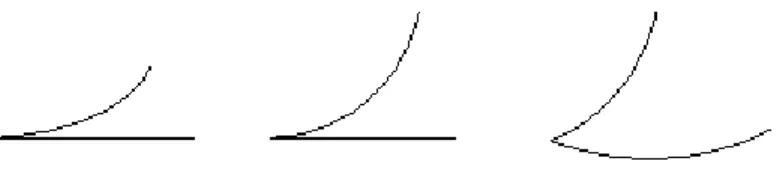
Again, we should take care to understand Euclid’s concept of angle, for our common notion of angle is, for Euclid, but one species of angle. This kind of angle, formed by the inclination of one straight line to another, is called (Def. 9) a “rectilineal angle”. But Euclid also allows for other kinds of angles (Def. 8); these are formed by the inclination, one to another, of two lines, at least one of which is not straight (see Figure 4) and are called “horn angles” or “horn-like angles”. They occasioned considerable controversy in Euclid’s time.
Figure 4. Horn angles.
For our purposes, however, items (i) and (ii) are not as relevant as (iii). In this regard, it is interesting to observe how Euclid’s definition of ‘angle’ differs from earlier definitions. According to Heath’s commentary in Euclid (1956, v. I, p. 176, emphasis in the original),
I think all our evidence suggests that Euclid’s definition of an angle as inclination (κλίσις) was a new departure. The word does not occur in Aristotle; and we should gather from him that the idea generally associated with an angle in his time was rather deflection or breaking of lines (κλάσις): cf. his common use of (κεκλάσθαι) and other parts of the verb ( ),
and also his reference to one bent line forming an angle (
, Metaph. 1016 a 13).
o
Aristotle, in the passage cited by Heath, while discussing the “oneness” of things, refers to the shin and the thigh, which naturally leads us to think of the leg, when bent at the knee, as forming an angle and, indeed, in the very next sentence he says that the bent line forms an angle. The mathematical angle arising from a bent line, however, is unlikely to have originated in human locomotion, but rather in the practice of measuring (for purposes related to surveying and architecture) by means of stretched cords or ropes.
The use of cords by the ancient Egyptians for this purpose is attested by the Church Father Clement of Alexandria (c. 150 - c. 215), who, in his Stromata, cites a letter of Democritus (c. 460 - c. 370 BC) in which he boasts of being a better mathematician than the ancient Egyptian harpedonaptae (“rope-stretchers”). The reception of this account makes it seem as if rope-stretching were a practice peculiar to the Egyptians. That this was not the case is shown, for example, by Dauben (1992), where it is shown that the practice was a common one in the ancient world, including ancient Greece. Indeed the setting out of architectural blueprints through the use of stretched cords was still used by, e.g. Palladio (1516-1580).
It is clearly the case that stretched cords satisfy the restrictions of Euclid’s postulates, according to which geometrical constructions are to consist of line segments and circular arcs. In paper and pencil constructions, these restrictions are embodied by the use of the straightedge (unmarked ruler) and the (collapsible) compass. In larger scale constructions, such as those employed in architecture, a straight line6 connecting two points is given by a cord stretched tightly between those two points. Likewise, a circular arc is given by swinging one of the cord’s endpoints about the other while maintaining the cord tightly stretched. It is, therefore, entirely possible that the restrictions on geometric constructions arose from the practice of using stretched ropes in the construction of (sacred?) edifices.7
However this may be, we will now limit ourselves to investigating rectilinear constructions, that is boxes (rectangular parallelepipeds), by stretching ropes. The limitation corresponds to the Pythagorean subdivisions of solid numbers – those that have three factors (be these factors prime or composite) –, which may be set out in the following manner:
Cube – three equal factors
Brick – two equal factors and a smaller one Plinth – two equal factors and a bigger one Altar – three unequal factors.
In Pythagorean number theory, these subdivisions are collectively exhaustive, but not, due to the presence of composite factors, mutually exclusive. Nevertheless, it is patent that, in the geometrical case, the subdivisions are both collectively exhaustive and mutually exclusive. That is, every rectangular parallelepiped falls under one, and only one, of these
6 That is, in modern terms, a line segment.
7 This seems to have been first noticed by Seidenberg (1959). Fossa (to appear) interprets Euclidean geometry as a
o
headings, according to whether it has three equal sides, two equal sides with the third side either longer or shorter than these, or three unequal sides.
In consequence of the stated limitation, we can forget about horn angles. Further, since, as we will see presently, triangles will be formed from boxes, we may also disregard barb triangles.
Boxes and Triangles
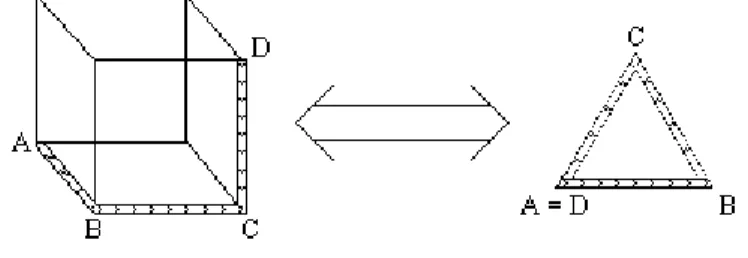
Since a box is completely determined by its length, width and height, it will be delineated by stretching a cord along these sides in an appropriate fashion. Specifically, the cord is first stretched from point A to point B, whereupon a right angle8 is made as the cord is continued from point B to point C; finally, another right angle is made, this time to the plane containing A, B and C, as the cord is stretched from point C to point D. The result is that is the length, the width and the height of the box.
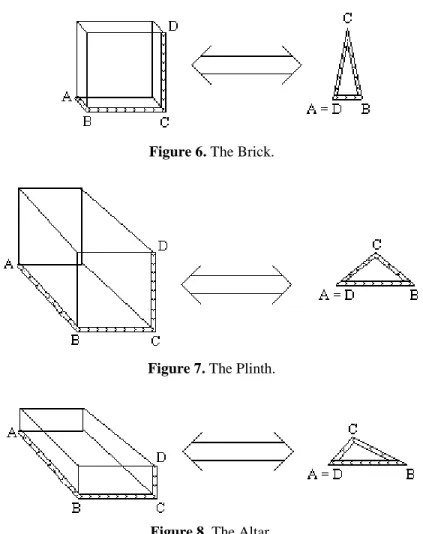
Once we have constructed a box in this fashion, we may disregard the construction in order to concentrate on the cord that generated the given box. As a physical entity the cord can be manipulated in space in various ways. In particular, we may allow the section representing the height of the box to rotate onto the plane of the box’s base and bring the two endpoints (A and D) together, without, however, changing the lengths of the three sections of the cord ( , and ). Whenever this can be done (see below), we will obtain a triangle which corresponds to the box in the sense that it is generated by the same cord layout as that which generated the box. Further, distinct kinds of boxes will correspond to distinct kinds of triangles: the Cube corresponds to the equilateral triangle (Figure 5), the Brick to the isosceles triangle with a short base (Figure 6), the Plinth to the isosceles triangle with a large base (Figure 7) and the Altar to the scalene triangle (Figure 8).
Figure 5. The Cube.
o Figure 6. The Brick.
Figure 7. The Plinth.
Figure 8. The Altar.
Since the traditional terminology does not distinguish between triangles corresponding to the Brick and those corresponding to the Plinth, we will apply the names of the boxes to the types of triangles corresponding to them. Thus, we have found four distinct types of triangles: cubes, bricks, plinths and altars.
An interesting theoretical question about two or three dimensional figures is that of comparing their relative sizes. Since each kind may come in a variety of sizes, something must be held constant to effectuate the comparison. For regular figures, we may require that the side be equal to a unit of measure. Alternatively, for two dimensional figures, we may inscribe each in a unit circle and, for three dimensional figures, in a unit sphere. The process of generating boxes and triangles also affords us another way of comparing their relative sizes. We may hold the entire length of the cord ( ) constant. When we do so, we
o
find that the Cube (be it a box or a triangle) is unique, since we must have
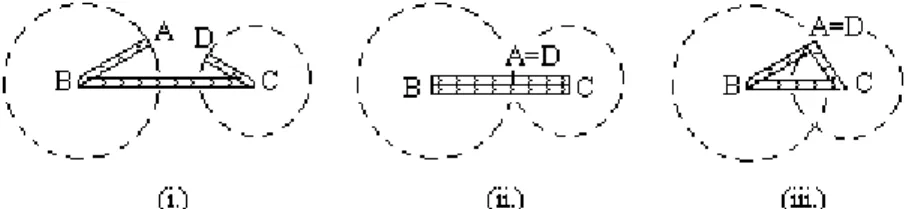
. The other three boxes (triangles) come in an infinite number of varieties. It may also be the case, however, that for a given box, no corresponding triangle is generated. This happens whenever two of the sections of the cord are so small relative to the third side that we cannot make the endpoints meet. In fact, there are three cases, illustrated in Figure 9. In part (i.) of this figure, , which is precisely the case in which we cannot make A and D come together and, thus, no triangle is formed. In Figure 9, part (ii), . From the Euclidean viewpoint, or that of modern mathematics, the result just appears to be a line segment, not a triangle. From the point of view of cord constructions, however, we clearly see three distinct sections of the cord, corresponding to the three sides of the triangle, as well as three distinct points, corresponding to the triangle’s three vertices. We will call triangles of this kind “Collapsed Triangles”. Finally, in part (iii.) of Figure 9, and we obtain the usual Euclidean type of triangle.
Figure 9. Criterion for being a triangle.
Triangular Boxes
The results obtained in the preceding paragraph indicate that we can make a finer analysis of boxes (and, thereby, of triangles). From the universe of all possible boxes (rectangular parallelepipeds), we designate as “Triangular Boxes” those that correspond to some triangle in the sense already specified (with regard to the generating cord). Any box will be given by an ordered triple (l, s, t), where l, s and t correspond to the three sections of the cord generating the box (and, hence, to the dimensions of the box and the sides of the corresponding triangle). The triple is ordered according to the magnitude of its elements, so that we have l s t. As a mnemonic device we will call l “the long side”, s “the small side” and t “the tiny side”. Nevertheless, it should be born in mind that, when equality obtains, the long side, for example, will be equal to the small side. Given these conventions, the criterion for a box to be triangular is that l s+t. In contrast to the principle just stated, in what follows, the notation (l, s, t) will be understood to mean that l > s > t. When, for example, in the triangle (x, y, z), the long side is equal to the short side, we will write (l, l, t)
o
and will continue to speak of “the long side”, specifying thereby ambiguously either of the two equal sides.9
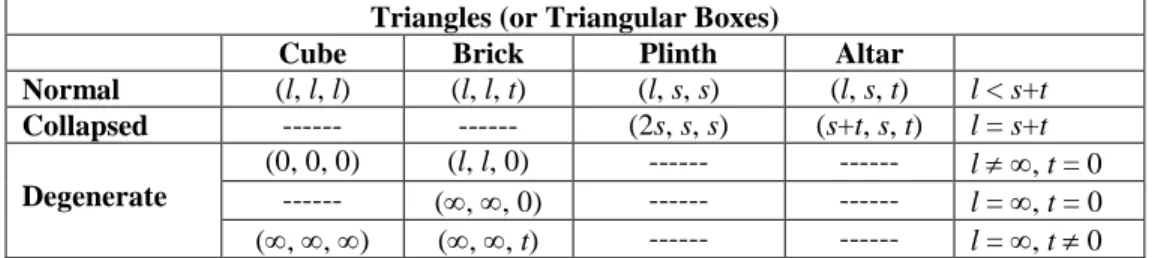
We can now use the ordered triple notation to distinguish among the various types of boxes and, a foriori, triangles. Thus, the Cube has the form10 (l, l, l), whereas the Brick will have (l, l, t), the Plinth (l, s, s) and the Altar (l, s, t). We will call those triangles (and the corresponding boxes) in which l < s+t “Normal Triangles” and, as already mentioned, those in which l = s+t “Collapsed Triangles”; moreover, in both of these two types l, s and t are restricted to be positive real numbers. We also wish to consider triangles whose sides may be zero or infinity. Those containing zero, especially, are quite natural from the point of view of stretched cords. In fact, the triangle (0, 0, 0) would be generated by not stretching the cord at all, but just leaving it in a pile at the point A. It corresponds to the geometric point, which is the geometric correlate of the Pythagorean One, from which all number is generated. It is, therefore, an important triangle and should be taken into account in any systematic account of triangles. Those triangles having infinite sides, in contrast, would be abstract possibilities that may or may not have been countenanced by ancient thinkers. We will include them in our typology for completeness, but disregard them in its application to the Oedipus myth. Thus, triangles having zero or infinite sides will be called “Degenerate Triangles”. Table 1 systematizes these relations.
Triangles (or Triangular Boxes)
Cube Brick Plinth Altar
Normal (l, l, l) (l, l, t) (l, s, s) (l, s, t) l < s+t Collapsed --- --- (2s, s, s) (s+t, s, t) l = s+t Degenerate (0, 0, 0) (l, l, 0) --- --- l , t = 0 --- (, , 0) --- --- l = , t = 0 (, , ) (, , t) --- --- l = , t 0 Table 1. Kinds of Triangles.
As can be seen from Table 1, not all of the logical possibilities are realizable. The Collapsed Cube would be (l, l, l) with l = l+l. But this is impossible since l 2l for any positive real number. There is also no Collapsed Brick since l = l+s is impossible, given that l and s are positive real numbers. Various degenerate triangles are also impossible. Such is the case with the second kind of Degenerate Cube since we would have to have = l = t = 0. It is evident that there can be no Degenerate Plinths, since for each possibility, to wit (l, 0, 0), (, 0, 0) and (, s, s), the criterion of triangularity is not satisfied (l > 0+0, > 0+0 and > s+s). The same thing happens with the putative Degenerate Altars, since, for (l, s, 0), (, s, 0) and (, s, t), we have l > s+0, > s+0 and > s+t.
Systematic Analysis of Triangles
9 This is because, whenever it will not engender confusion, we will use the same symbol, for example l or AB , to
speak of the side itself or of the length of the side.
o
In the previous section, we found eleven distinct kinds of triangles, as detailed in Table 1, distinguished by the relative lengths of their sides. Each of these types can also be considered with respect to their angles in the following manner: a triangle will be obtuse, right, or acute as the angle opposite the long side (l) is greater than, equal to or less than a right angle. Since we will not be using triangles with infinite sides, we will also leave them out of the present analysis. Hence, we have but eight triangles to consider, which would give us 24 possible subdivisions. As we will see, however, only half of the logical possibilities are realizable.
Although, in general, the exact measurement of angles seems to have been problematic for the ancients, the three aforementioned categories immediately fall out of the Pythagorean Theorem in the following way:
The triangle (l, s, t) will be
(1) acute if , (2) right if , (3) obtuse if .
For convenience of presentation, we will tabulate the kinds of triangles in two stages, considering first the normal triangles and then the collapsed and degenerate triangles. Thus, the normal triangles are given in Table 2. When a category is possible, an example is specified in the table.
Normal Triangles
Cube Brick Plinth Altar
Acute (1, 1, 1) 12 < 12+12 (2, 2, 1) 22 < 22+12 (4, 3, 3) 42 < 32+32 (6, 5, 4) 62 < 52+42 Right --- --- ( , 1, 1) )2 = 12+12 (5, 4, 3) 52 = 42+32 Obtuse --- --- (3, 2, 2) 32 > 22+22 (4, 3, 2) 42 > 32+22 Table 2. Normal Triangles.
Of the eight realizable triangles listed in Table 2, only the Right Plinth cannot be given in positive integers (nor in positive rational numbers). This is because we have, for this triangle, , which reduces to . Further, for the Normal Cube (l, l, l), it is necessary that ; similarly, for the Normal Brick (l, l, s), it is necessary that . Consequently, Normal Cubes and Normal Bricks can be neither right, nor obtuse.
There remain four triangles from Table 2 still to be considered, namely, the Degenerate Cube (0, 0, 0), the Degenerate Brick (l, l, 0), the Collapsed Plinth and the Collapsed Altar (s+t, s, t). Since there is but one of each of the four categories from Table 2, we can unify the terminology by referring to these as Flat Triangles. They are systematized in Table 3, which, again, lists an example whenever possible.
o Flat Triangles Flat Cube Flat Brick Flat Plinth Flat Altar Acute --- --- --- --- Right (0, 0, 0) 02 = 02+02 (1, 1, 0) 12 = 12+02 --- --- Obtuse --- --- (2, 1, 1) 22 > 12+12 (3, 2, 1) 32 > 22+1 Table 3. Flat Triangles.
The Flat Cube is unique and, clearly, must be right. There are an infinite number of Flat Bricks, but no matter what l may be, and, thus, they are all right. Analogously, the Flat Plinth must always be obtuse since . Finally, the Flat Altar (s+t, s, t) is also always obtuse, because for all positive real numbers.
A Perspicuous Representation of the Universe of Triangles
We will now exhibit an interesting way of representing the universe of triangles up to similarity. Before doing so, however, we make a few remarks about the twelve kinds of triangles that we have found.
As we have already observed, the Flat Cube is unique. Moreover, both the Flat Brick and the Flat Plinth are unique up to similarity. That is, given any Flat Brick (l, l, 0), we have (l, l, 0) = l(1, 1, 0), so that all Flat Bricks are similar to the triangle (1, 1, 0) with l being the similarity constant. Another way of saying this is that all Flat Bricks are similar to each other. Analogously, since (2s, s, s) = s(2, 1, 1), all Flat Plinths are similar to each other.
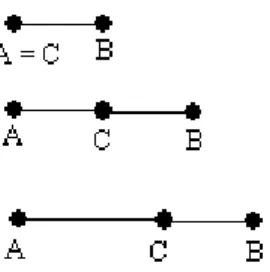
It might appear that the Flat Brick, the Flat Plinth and the Flat Altar are also similar to each other, since, from the geometric point of view, they are all line segments. The analysis according to stretched cords, however, suggests otherwise. As can be seen in Figure 10, this analysis indicates that the correct geometric model is not a simple line segment, but a line segment with a distinguished point C, which serves to differentiate the three types.
o
Figure 10. Geometric model of Flat Bricks, Plinths and Altars.
An arithmetical analysis also confirms this result, since the equation x(1, 1, 0) = y(2, 1, 1) = z(3, 2, 1) cannot be satisfied for any positive real numbers x, y, z.
As we already mentioned, in order to compare triangles it is interesting to hold some aspect of the triangle fixed. We chose to construct all our triangles, with the obvious exception of the Flat Cube, on the same constant base . Further, we stipulate that be the long side of all the triangles. Thus, given the base , the location of the point C in the plane will determine the triangle . Clearly, however, since is the long side of the triangle, C must fall within, or upon, the circle with center A and radius . As it turns out, however, we will not need the whole circle.
Our construction, then, will be as follows. Given the line segment , situated vertically in the plane (see Figure 11), we describe the circle with center A and radius . Next, we bisect at M and construct the segment perpendicular to so that it meets the circle at point P. Finally, we describe the circular arc with center M and radius such that it meets the line at point N. We will now show that the universe of triangles, with the aforementioned exception, is given by the set of triangles , where C is constrained to lay upon or within the closed figure (the shaded portion of Figure 11).
o Figure 11. The basic construction.
We will place the Flat Cube (0, 0, 0) at point A. The other flat triangles will be along the radius as C goes from M to B (see Figure 12). At C = M, the triangle is the Flat Plinth (2, 1, 1). When C is at any of the infinite points between M and B, is a Flat Altar. Finally, when C = B, is the Flat Brick (1, 1, 0).
Figure 12. Flat Triangles.
Figure 12 is not to be conceived of as a metric space, but as the logical space of triangles11. Thus, we naturally identify the point M with the Flat Plinth because, when C = M, the triangle is the Flat Plinth. Since all Flat Plinths are similar to one another, any Flat Plinth can be used to represent the class of these triangles. It is natural to use, when possible, the triangle whose sides are given by the smallest whole numbers compatible with the type, which may be called the Eminent Mode of the class, since it exhibits most clearly the structure of the class. For the Flat Plinths, the Eminent Mode is (2, 1, 1). We should also observe that there is no other point in the area to which C is constrained (see Figure
o
11) which would give us a Flat Plinth. Hence, the whole class of Flat Plinths is concentrated at the point M of the diagram. Analogous remarks apply to the Flat Brick: (i.) the Eminent Mode of this class is (1, 1, 0), (ii.) the only allowable point for C that forms a Flat Brick is the point B and, thus, (iii.) the whole class of Flat Bricks is concentrated at point B.
In contrast to the other flat triangles, there are an infinite number of dissimilar Flat Altars (s+t, s, t). The Eminent Mode of this class is (3, 2, 1), but it cannot be used to define the whole class, as was done for the other classes, precisely because not all the Flat Altars are similar to (3, 2, 1). Nevertheless, all the distinct Flat Altars in Figure 12 are dissimilar and, moreover, given any Flat Altar, it is similar to a Flat Altar given in Figure 12. To see the first claim, let C and C be two distinct points on the open segment . We will show that the triangles = (s+t, s, t) and = (s+t, s, t) are not similar. Indeed, if they were similar, we would have (s+t, s, t) = k(s+t, s, t). But, s+t = = s+t, so that k = 1. Consequently, = , contradicting our hypotheses.
To see the second claim, let = (x+y, x, y) be any Flat Altar. Thus x and y are positive real numbers. We can then use Proposition VI.10 of Euclid’s Elements to find the point C that will cut the segment in the same proportion as the segment is cut by point Z (see Figure 13). We are given the point Z on the segment , as well as the segment
. Thus, we make any convenient angle between the two segments, draw and construct a parallel to through Z. The point at which this parallel meets is the point C which divides in the same ratio as Z divides . Consequently, and . Therefore, (x+y, x, y) = k(s+t, s, t) and we have found the Flat Altar in Figure 10 which is similar to .
Figure 13. Construction of Flat Altar similar to .
Turning to normal triangles, the cube is unique up to similarity. Indeed, we have (l, l, l) = l(1, 1, 1) and thus (1, 1, 1) is the Eminent Mode of all Normal Cubes. The only place that C can be put in our diagram to make a Normal Cube is at point P (see Figure 14(ii.)). Whenever C is on the circular arc and strictly between B and P, as in Figure 14(i.), triangle will be a Normal Brick, for = , both being radii of the big circle, whereas, clearly, > = .
o Figure 14. (i.) Normal Bricks and (ii.) the Normal Cube.
No two of the infinite number of Bricks in Figure 12 can be similar since, as happened in the case of the Flat Altars, the constant of similarity would be 1 (since their long sides must be equal). Hence, similarity would imply congruency. Now, consider any Normal Brick . The angles opposite the equal sides are equal (see Figure 15); thus, the third angle must be less than 60°, since, for = 60°, = = and, for > 60°,
> = . Thus, would not be a Brick, but a Cube, in the first case, or a Plinth, in the second. Consequently, by constructing the segment at an angle congruent to angle
YXZ on , must fall strictly between and Thus, letting C be the point at which the segment meets the circular arc , we find the Normal Brick in our diagram that is similar to the given Brick .
Figure 15. An arbitrary Normal Brick.
Whenever C is on the segment (the perpendicular bisector of ) and strictly between M and P, triangle will be a Normal Plinth. When C = N, we have = = (radii of the small circle) and will be a right Plinth. In this case, as we’ve already seen, so that = . Hence, all Right Plinths are similar. Moreover, the point C = N is the only allowable point for C that generates a Right Plinth. When C is strictly between M and N, it is manifestly the case that <
o
(see Figure 16). Hence, 2 < 2 = and triangle is an Obtuse Plinth. In contrast, when C is strictly between N and P, we have < . Thus, = < and triangle is an Acute Plinth.
Figure 16. The Normal Plinths.
Once again, no two distinct Plinths in the diagram are similar since they all share the common long side , but have distinct short sides. To see that there does not exist any Normal Plinth for which we cannot find a similar Plinth in the diagram, we return to Figure 15, where we considered the triangle , stipulating that = < . Referring now to the same figure, but stipulating that = > , we have an arbitrary Normal Plinth. In this case we must have that the angle < 60° since, if = 60°, = 60° and triangle is a Cube, whereas, if > 60°, < 60° and is a Brick. Hence, by constructing angle
ABC congruent to angle , C falls strictly between M and P, resulting in a Normal Plinth in our diagram that is similar to the given Plinth .
Finally, the Normal Altars occur whenever C is in the interior of the region . In the case that C is on the circular arc , strictly between the points B and N, the triangle is inscribed in the semicircle (only half of which is shown in Figure 17) and, therefore, is a Right Altar. Now consider any point D in the interior of the region . Comparing it with the point C on the circular arc and on the same horizontal line as D (see Figure 17), it is clear that < and < . Hence, + <
+ = and triangle is an Obtuse Altar. Analogously, if the point E is in the interior of the region , we have that < and < , so that = + <
o Figure 17. The Normal Altars.
Once again it is clear that no two Normal Altars in the diagram (with allowable C) can be similar without being congruent, given that the long sides of each is the segment . So consider an arbitrary Normal Altar = ( , , ) and let it be similar to the Altar = ( , , ). We will show that the point C must fall in the interior of the region 12. Clearly, C must fall within the circle of radius since, otherwise, side would be equal to the long side (if C were to be on said circle) or longer than (if C were to be beyond this circle), contrary to hypothesis. Further, C must be above the segment since, otherwise, would be equal to (if C were to be on said segment) or longer than
(if C were to be below this segment), again contrary to the hypothesis. Finally, C cannot be on the segment , because then triangle would be Flat, not Normal. By process of elimination, C must be in the interior of the region . Consequently, given any Normal Altar, there is a normal Altar in our diagram which is similar to the given Altar. The Universe of Triangles
Our analysis of triangles, albeit at times rather informal,13 was undertaken from a point of view that is, at minimum, consonant with that of the ancient Pythagoreans and the practice of using stretched cords for making geometric diagrams in surveying and architecture. We believe that it would be not only comprehensible, but also compelling, to educated men of fifth century BC Athens. Specifically, discounting the abstract possibility of triangles with sides of infinite length, we classified all triangles into twelve categories which are collectively exhaustive and mutually exclusive. Further, we exhibited a perspicuous way of representing these categories in a geometric diagram (Figure 18), which
12 We assume that the existence of ABC would not be questioned. We further assume that C is to be placed to the
right of the segment AB in the diagram; in doing so we discount the handedness (chirality) of the triangles, since from the point of view of stretched cords, the limitation to rotation in the plane does not seem pertinent.
13 At certain points in the argument, for example, we deduced certain relations from the evidence present in the
figures. This would not be allowable in modern mathematical practice, but would not have been objectionable to the ancients. Since we are trying to reconstruct an ancient scheme, it seems preferable to eschew modern mathematical rigor for arguments more akin to the thought of the ancients.
o
we may call the Universe of Triangles, since it contains all triangles in a unique manner up to similarity. That is, given any triangle, we can find one, and only one, triangle similar to the given triangle and contained in the diagram. By “triangle contained in the diagram” we understand that the triangle is either the point A or is formed on the base AB by placing the third vertex C either in the interior of region MBPM of Figure 18 or on the boarder thereof.
Figure 18. The Universe of Triangles.
In the next part of the present paper, we will show how the Universe of Triangles can be seen as a primitive astral map and then be related to the Oedipus myth through the concept of mathematical allegory.
Part Three: The Myth of Oedipus as Mathematical Allegory
We now return to our question about the determination of Oedipus’ fate. The fact that we have identified twelve distinct types of triangles might lead us to suspect that they were identified with the twelve signs of the zodiac and that, therefore, we should be looking for Oedipus’ horoscope. The geometry of Figure 18, however, makes this unlikely because it does not provide, in a natural way, a circuit along which the sun’s movement could be plotted. It is also unlikely from a historical point of view since at the time the myth was framed horoscope astrology, according to B. L. van der Waerden (1974), had yet come into existence. Nevertheless, this author attests to the existence of a primitive zodiacal astrology related to Orphism, a movement closely akin to the Pythagoreans. Since the Oedipus myth is also related to Orphism, we may expect that the Universe of Triangles is connected, in some manner, to astrological observations.
o
The Astral Map
That the Universe of Triangles is indeed a primitive astral map can be seen by identifying the nodal points of Figure 18 by the Eminent Modes of the relevant triangles. In Figure 19 we make this identification and also make certain correlations suggested by the riddle of the sphinx and Oedipus’ solution thereof. Thus, point M represents the Flat Brick, the Eminent Mode of which is the triangle (2, 1, 1). The sides of this triangle sum to 4, which corresponds to the morning in the riddle of the sphinx, when the object of the riddle goes by fours. Point B, representing the Flat Altar with the Eminent Mode (1, 1, 0), corresponds to noon, the time of going by twos. Point P represents the Acute Cube and has the Eminent Mode (1, 1, 1); thus, it corresponds to the evening, the time when the object of the riddle goes by threes. Finally (we will return to point A later), by continuing the analogy, point N must correspond to death. This is indeed appropriate, not only because this point represents the Right Plinth with its inherent irrationality, but also because the Right Plinth is the half-square. The square is traditionally conceived of, in the doctrine of the four material elements, as the form of the element Earth, the mundane element, opposed to the divine element of Fire and linked to earthly mortality.
Oedipus’ solution to the riddle of the sphinx is interesting in that it correlates temporal periods in a single day with periods in man’s life. We can express this very conveniently as an extended analogy in the following way:
morning : youth :: noon : adult :: evening : old age.
These correlations strongly suggest that they are indicative of a macrocosm/microcosm analogy, which induces us to extend the analogy further:
morning : youth : spring :: noon : adult : summer :: evening : old age : autumn. This extended analogy, in its turn, suggests the identification of the nodal points N, B, P and N in Figure 19 with, respectively, the Spring Equinox, the Summer Solstice, the Fall Equinox and the Winter Solstice.
o
Once these correlations are made, Figure 19 can be seen as a primitive astral map, in which the year’s turning points are demarcated by the aforementioned nodal points of the figure.
The Green Child
Since the Oedipus myth speaks to Oedipus’ own destiny, the answer that he gives to the riddle of the sphinx is, strictly speaking, inaccurate. It is not man in general that is the object of this riddle, but Oedipus himself. This may go some way in helping to clarify some aspects about the sphinx that have always seemed rather puzzling. Why, for example, couldn’t any of the Thebans solve what is a fairly simple conundrum? Why didn’t they just go out and shoot the sphinx with arrows14? Why, finally, does the sphinx dash herself to the ground when Oedipus solves the riddle? Such questions, however, are only troublesome when the sphinx is seen as a run-of-the-mill reality monster. As a mythical monster, however, the sphinx is the symbol of that desolation which threatens to destroy Thebes and which can only be averted by Oedipus’ fulfilling of his destiny. It is also a foreshadowing of the new desolation which is to befall Thebes in consequence of his heinous crimes and which, again, is only to be averted by his acceptance of his fate.
We can gain a better perspective on all this by contemplating the temporal correlations set out in Figure 19. Since both the day and the year are cyclic periods, these correlations suggest that Oedipus does not merely live a linear life, from birth to death, but that his existence is also cyclic. Thus, Oedipus not only fulfills his early promise by becoming the savior of and the accomplished king of Thebes, but he also must weaken, wither and die, only to be reborn to new cycles of growth, glory, decline and death. This pattern of seasonal cycles of death and rebirth is characteristic of myths of the Green Child, the god of vegetation, and the Great Earth Mother, which reaches back to at least Neolithic times. According to this myth the Green Child is nurtured by the Earth Mother and his bounty averts the desolation of famine. Nevertheless, in order to perpetuate his bounty, he must suffer, wither and die so that he may become the seed that will reinitiate the process anew. In fact, this is exactly what happens in the Oedipus myth, for Oedipus first rids Thebes of the desolation due to the sphinx, becomes a glorious and prosperous king, who ages, becoming thereby less bountiful, and finally dies in order to renew his creative powers.
Figure 19 corroborates the Oedipus as the Green Child interpretation, for, in addition to the temporal correlations already set out, the point N, the mundane and mortal half-square, can be interpreted as the entrance to the underworld. In fact, Oedipus is, in the myth, actually brought down into the underworld, as is attested by Sophocles in his play Oedipus at Colonus. Further, the point A, situated outside of and below the astral map may be conceived of as the underworld, or perhaps better, the Earth Mother herself. In any case, we recall that this point represents the Flat Cube, that is, the point triangle, corresponding to
o
the unstretched cord coiled up at the origin. Thus, it is the seed, nestled in the nutritive earth after the demise of the spent plant, from which the plant will be reborn.
Some minor details also support the identification of Oedipus with the Green Child. We mention only15 the name Oedipus, which, as we already recounted, means “swollen foot”. In terms of the fanciful story, this name is due to a permanent disfiguration of his foot that was incurred by the pinioning of his feet when he was to be exposed to the elements as an infant. In terms of its symbolic meaning in the myth, however, Oedipus is the grain swollen with ripeness at full maturity (point B in Figure 19), presaging however the soon to come bursting of the seed, withering of the plant and germination of the seed to start a new cycle.
Casting of Lots
If we are not to turn to traditional astrology for the determination of Oedipus’ fate, it seems that we must go back to earlier methods. One of the most widespread of these earlier methods is that of the casting of lots, which is mentioned, for example, in various places in the Old Testament. It is also attested to in Classical Greece. In fact, it is used by Plato in the Myth of Er at the end of the Republic. Therein Plato describes a group of souls about to be reincarnated who must choose from a set of available lives. The choice itself is left to each soul, but the order of the choosing is determined by lot. This is clearly a philosophical reinterpretation of an older belief in the determination of one’s fate by the casting of lots.
The casting of lots can be done in various ways. The lots themselves may be marked, as in the Myth of Er, so that each lot has its own import. A very simple version of this is the drawing of straws: the short straw is the fateful one. Alternatively, lots may be cast out, in which case one’s fate is determined by how or where they fall.
If then the Orphics or an Orphic-like group were, as van der Waerden attests, involved in the development of a primitive zodiacal astrology, it would be natural for them to combine their traditional practice of the casting of lots with their new astrological lore. Once the full zodiacal representation was in place, the lots would soon fall into disuse because the positions of the planets in the zodiac would bear the whole burden of astrological predestination. In the transitional phase, however, primitive astral maps like Figure 19 would not be sufficient in themselves to fix destiny. By casting lots onto the backdrop of an astral map, however, this traditional practice would be combined with the emerging celestial lore of primitive astrology and it would thus certainly have been regarded as a powerful tool in determining one’s fate.
Nevertheless, since a primitive astral map could be drawn in various ways, these primitive astrologers would still have to face an outstanding problem: how to choose among the various possibilities and, perhaps, even what information to include in the proposed map? In the case of Figure 19, however, the problem is solved in a truly extraordinary
15 Actually other details of many versions of the Green Child myth, such as regicide and/or the rape of the queen,
find parallels in the Oedipus myth. To follow out all the details here, however, would lead us too far from our intent to explain mathematical allegory. The interested reader can find most of these details in Frazer (1963).
o
manner since the a posteriori human element of repeated observation is forsaken in favor of the a priori divine, or at least divine-like, realm of mathematical cognition. Indeed, the fact that the figure is both complete, in the sense that it contains all triangles, and just, in the sense that each triangle is represented in only one way, makes it eminently appropriate for the task at hand of fixing of one’s destiny.
Oedipus’ Lot
Once the, so to speak, machinery of the primitive astrologer has been worked out in the specification of the astral map and the casting of lots upon it, it is still necessary to reconstruct the heuristic principles by which the diviner would be able to translate the mathematics into human destiny. Fortunately, we are able, in the case of Oedipus, to dispense with a full heuristic analysis since the myth contains an important element that reveals Oedipus’ lot.
Recall that the fateful happenstance, the murder of Laius, which triggers Oedipus’ entire career, occurs in the Myth of Oedipus at a place where three roads meet. At the time, Oedipus is in the prime of life. So too, in the Myth of the Green Child, the suffering god is cut down in the prime of life, just as the ripe grain bursts with seed and begins to wither. But there is, in Figure 19, but one point that clearly corresponds to the conjunction of three separate lines (roads). This is point B, which is indeed appropriately situated at the summer solstice and, thus, correlated with adulthood. Thus, Oedipus’s lot must have fallen on point B. In the fanciful story, Oedipus raises to the highest glory by saving Thebes from the famine and pestilence caused by the sphinx. This may be symbolized by the fact that point B is the highest point of Figure 19. Nevertheless, due to his heinous crimes, he also falls to the lowest degradation in his blindness and dependence on Antigone. We may conceive of this as his fall to point P, the farthest point from the upright AB axis. Yet, Oedipus is not a simple criminal. In fact, the gods accord him the distinct honor of a visit to the underworld and a hero’s place in the stars after his death. This can only be understood in symbolic terms, for the Green Child too reaches the highest of splendors in the full bounty of the ripened grain, only to subsequently fall to degradation and death, just as the plant withers, dies and returns to the Earth in preparation for rebirth.
The primitive astrologer, perhaps associated with an Orphic poet, would presumably have contemplated the Universe of Triangles and recognized it as an astral map. That would lead him to something like Figure 20, in which the top part of the figure would represent the Heavens, with the solstices and equinoxes demarcated, and in which the point A would represent the Earth. Since N is the half-square, the Material Element Earth, an immediate mystical connection would be made between N and A, suggesting that N is the entrance to the underworld. This, in turn, would recall the Myth of the Green Child; in fact, Figure 20 would probably be considered a spectacular mathematical demonstration of the veracity of this myth.
o Figure 20.
Since the mathematical details would not have been amenable to all, the astrologer, or again his poetical associate, would have to transform the erudite explanations into a fanciful story, or as Plato would say, although in another (but related) context, a “plausible story”. Thus, the outline of the Myth of Oedipus would be framed on Figure 20, without, naturally, straying too far from the basic story of the Green Child as being a king who guarantees prosperity for a while, but who must suffer and die to make way for a new king with renewed powers. The specifics of the Oedipus Myth, however, would grow out of the salient features of Figure 20. In particular, the riddle of the sphinx would have been generated by the Eminent Modes of triangles M, B and P, the fateful happenstance occurring at a point where three roads meet would have been suggested by the fact that the two circular arcs and the base of the triangles meet at point B and the descent to the underworld would be occasioned by the mystical connection between points N and A. Finally, the fact that the gods give Oedipus a place among the stars, which is of course symbolic of the Green Child’s rebirth, would have been suggested by the opposition of the Heavens and the Earth in Figure 20.
Conclusion
Many Ancient Greek thinkers, amongst whom the Pythagoreans are, in this regard, the most well known, held, explicitly or implicitly, that mathematics was the key to the understanding of the universe. Although these thinkers are generally considered to be quite sophisticated both mathematically and philosophically, they are nevertheless portrayed as espousing anemic, if not downright silly, ideas about how this doctrine is to be understood in practice. Even sympathetic interpreters tend to offer unsatisfactory explanations. Plato’s Nuptial Number, for example, has been the object of numerous interpretations, which purport to have puzzled out just what this Number is supposed to be, but that are utterly incapable of explaining how it answers Plato’s stated aim of determining better and worse births.
o
One of the principle reasons for this state of affairs is, as we have already mentioned, that the sacred nature of mathematical knowledge, when applied to philosophical questions, precluded its publication. This means that we have but few reliable historical resources to guide us and, thus, are forced to try to recreate the doctrine. Since it does seem clear that mathematical structures were seen as indicative of the structure of the universe, it would seem reasonable to look for mathematical models.
That being said, however, we cannot equate the mathematical models with the type of mathematical modeling done in modern science. Indeed, the scientist attends to a certain physical situation and attempts to formulate mathematical equations that embody salient aspects of the given situation through the processes of simplification, generalization and quantification. The “truth” of the equations is thus parasitic on the empirical reality and the resulting science, despite its mathematical components, is contingent and fallible.
The Ancient Greek attitude is exactly the contrary to that of the modern scientist, in that it posits the search for absolutely true and indubitable knowledge and, in consequence, it is rather misleading to talk about “mathematical models”. We propose the alternative term of “mathematical allegory.” In mathematical allegory the point of departure is not an empirical situation, but mathematical theory. Given a mathematical structure that is seen to be striking in some respect, it is invested with special meaning beyond its strictly mathematical properties and is supposed to reveal occult structures of the universe. In this sense, the “truth” of the empirical reality is parasitic on the mathematics.
In the example that we’ve presented in the present paper, one of the most cosmologically significant (for the Ancient Greeks) figures, the triangle, is the focus of attention. The question of how to classify triangles into different kinds was one that was problematic for these thinkers. The solution given herein is compelling in that it ties in nicely with the basic technique of triangle formation by the stretching of cords. The really striking aspect of the theory, however, is that it can be given a perspicacious geometrical representation that is complete and contains no repetitions.16 Once the mathematical structure is in place and deemed to be significant, however, there is still a leap that has to be made from the formalism to some empirical context. The leap is negotiated by poetic imagination (which is indicated by our terminology “mathematical allegory”). Presumably, the Eminent Modes of points M, B and P of the diagram suggested the riddle of the sphinx, while the macrocosm/microcosm analogy suggested the myth of the Green Child, which would have been known from, at least, Orphism. By combining these motifs with the practice of casting lots on the backdrop of an astral map, the Oedipus myth would have developed in a Pythagorean/Orphic context.
Another possibility is that the riddle of the sphinx was known from another context and there also existed, independently, a rudimentary story about Oedipus. In this case the “poet”, on contemplating the mathematical structure of the aforementioned triangle classification, would have melded these disparate elements into a new powerful myth in a version resembling that which has come down to us in Sophocles’ plays. In either case, we
16 The fact that other triangle classifications may also have similar representations does not lessen the purported
meaningfulness of the present classification. It may be that they too can be fitted to other empirical situations or it may be that they were not deemed suitable for allegorical treatment. At present, we can only pose this question as an open problem.
o
have an example of how the Ancient Greeks would have articulated their doctrine that mathematics reveals the structure of the universe; moreover, it is an example that is consonant with the sophistication of these ancient thinkers.
References
DAUBEN, Joseph W. 1992. The ‘Pythagorean Theorem’ and Chinese Mathematics. In: Amphora: Festschrift für Hans Wussing zu seinem 65. Gebertstag, edited by Sergei Demidov, David Rowe, Menso Folkerts & Christoph Scriba, 133-156. Basel: Birkhäuser. ERICKSON, Glenn W. & John A. FOSSA. 2006. A Linha Dividida: Uma Abordagem Matemática à Filosofia Platônica. Rio de Janeiro: Relume Dumará.
EUCLID. [1908] 1956. The Elements. Translation and commentary by Thomas L. Heath. New York: Dover.
FOSSA, John A. (2013). A Note on Euclid’s First Three Postulates. Revista Brasileira de História da Matemática v.13, n. 26.
FOSSA, John A. & Glenn W. ERICKSON. 1994. O Número Nupcial no Livro VIII da República. Cadernos de História e Filosofia da Ciência (Campinas, SP) 3: 9-23.
FOSSA, John A. & Glenn W. ERICKSON. 2001. The Lord over Better and Worse Births. The College Mathematics Journal 32.3: 185-193.
FRAZER, James G. [1890] 1963. The Golden Bough. New York: Macmillan.
SEIDENBERG, A. 1959. Peg and Cord in Ancient Greek Geometry. Scripta Mathematica 24: 107-122.
VAN DER WAERDEN, B. L. Science Awakening II. New York: Oxford UP, 1974.
WILSON, Andrew. The Classics Pages. (s.d.) 02 April 2013
<www.users.globalnet.co.uk/~loxias/sphinx.htm>.
John A. Fossa
Departamento de Matemática, UFRN. E-mail: [email protected]
Glenn W. Erickson
Departamento de Filosofia, UFRN. E-mail: [email protected]