Mercator, Fortaleza, v. 15, n.1, p. 73-86, jan./mar 2016.
THE TERRITORIALIZATION OF AGRIBUSINESS
AND PEASANT RESISTANCE
territorialização do agronegócio e resistência camponesa
Francisco Valdenir Lima *
Resumo
O Projeto de Irrigação Várzeas de Sousa – PIVAS, localizado no alto sertão da Paraíba é considerado um dos novos espaços produtivos regionais. Idealizado pelo Governo Federal na década de 1950, somente em 1998 o projeto toma forma e, a partir de 2007, tem início a produção de grãos e de fruticultura irrigada para a exportação. O novo modelo produtivo implantado na área, contudo, provocou a expropriação e expulsão de centenas de famílias camponesas de suas terras, o que tem gerado uma conlitualidade manifesta, pro -movida por essa classe que luta contra o agronegócio e contra o modelo capitalista de produção. Com base nas transformações que se operam naquele espaço, este artigo procura analisar a luta camponesa para seu retorno a terra, suas formas de articulação e estratégias utilizadas para superar as adversidades cotidianas, bem como a tentativa de manutenção de suas raízes e do modo de vida camponês.
Palavras-chave: Várzeas de Sousa; Agronegócio; Campesinato; Conlitualidade.
Abstract
The Várzeas de Sousa Irrigation Project - PIVAS, located in the upper sertão of Paraiba State is considered one of the new regional productive spaces. Conceived by the Federal Government in the 1950s, the project only began to take shape in 1998 and since 2007 it has been producing irrigated grain and horticulture for export. However, the new production model installed in the area, has led to the expulsion and dispossession of hundreds of peasant families from their land, which has generated a manifest conlict, waged by the stru -ggle of this class against agribusiness and the capitalist model of production. Based on the transformations operating in that space, this article analyzes the peasants’ struggle to return to their land, their forms of articulation and the strategies they use to overcome daily adversity, as well as attempting to maintain their roots and the peasant way of life.
Key words: Floodplains of Sousa; Agribusiness; Peasantry. Conlict.
Resumen
El Proyecto de Riego Humedales de Sousa - PIVAS, que se encuentra en el interior de Paraíba se considera una producción regional de nuevos espacios. Concebido por el Gobierno Federal en la década de 1950, sólo en 1998, el proyecto va tomando forma y, desde 2007, se ha iniciado la producción de cereales y la horticul-tura de regadío para la exportación. El nuevo modelo de producción desplegados en la zona, sin embargo, llevó a la expulsión y desposesión de cientos de familias campesinas de sus tierras, lo que ha generado un conlicto maniiesto, promovido por la lucha de clases contra los agronegocios y contra el modelo capitalista. Basado en las transformaciones que se operan en ese espacio, este artículo analiza la lucha campesina por su regreso a la tierra, sus formas de articulación y estrategias utilizadas para superar la adversidad diarias, así como tratar de mantener sus raíces y la forma de vida campesina.
Palabras claves: Humedales de Sousa; Agronegocios; Campesinado; Conlicto.
74
INTRODUCTION
From its very beginnings, agricultural activity has been of great importance to humanity. Emerging in the Neolithic period as the main subsistence activity, it developed mainly on the hu-mid plains in various locations around the world, breaking with the nomadic processes that had previously characterized human groupings.
This activity gained further momentum with the expansion of the global population, based on the improvement of medical and sanitary conditions, which reduced mortality, and technological development, which increased man’s productive capacity and the exploitation of the natural envi-ronment.
Society’s growing demand became structured around products beyond those initially intended for the population’s direct and immediate consumption, that is, food, to include those related to the manufacture of ibers and fuels. The constant growth in the pattern of consumption gave rise to the appropriation of new areas and techniques to meet the demand for raw materials, and above all, the accumulation of capital.
This process that opened up frontiers also occurred, with a greater or lesser degree of intensity in various locations of the Northeast. In this sense, the advance of agricultural capital in the region has enabled the formation of agricultural spaces inserted in the productive circuits of globalized agriculture.
This whole dynamic has occurred due to favorable natural conditions, combined with public and private investments that have equipped the territory, giving it a scientiic and technological apparatus capable of vitalizing and transforming places previously considered unproductive, in new loci of opportunities. This has been engineered for the actions of large corporate groups willing to set up in the region and invest with a view to its development.
However, taking as a basis experiences implemented in diferent areas of the Northeast, such as the irrigated fruit growing developed in the Valley of the São Francisco River (PE-BA), and extension of land that runs from the Lower Açu Valley (RN) to the Lower Jaguaribe (CE), and the production of soya in the Cerrado in the Northeast, in the municipalities of Barreiras and Luís Eduardo Magalhães (western Bahia), Balsas (Southern Maranhão) and Uruçui (Southwest Piauí), it has been veriied that not all the modernization processes are positive. They have acted to the detriment of peasant agriculture and consequently promoted its weakening / disappearance. In contrast, there has been a constant struggle on the part of the peasants, who are seeking spaces in the territory occupied by business activity.
This article highlights the struggle of the peasant class against the expansion of agribusiness in the area where the Várzeas de Sousa Irrigation Project (PIVAS) is located. It focuses on the enhan-cement and maintenance of the peasants’ autonomy and identity, enabling these social subjects in their search for self-airmation and in their actions as protagonists and not just mere spectators or coadjutants in the process that directs the formation of the irrigated area.
THE PEASANT’S RESISTANCE AND THE ATTEMPT TO MAINTAIN THEIR IDENTITY AMID THE TERRITORIALIZATION OF AGRIBUSINESS IN THE FLOODPLAINS OF SOUSA-PB
The ideological and material bases on which current agriculture is developing relect the chan -ges that alter and redeine the rural world and also constitute important mechanisms for thinking about the reality of our country. In this sense, understanding how productive restructuring, based on the advance of capital, has implications for the process of appropriation and territorialization of space, allows us to comprehend the spatial dynamics and survival strategies of peasants facing this new moment in time.
75
have to land and the consequent process of expropriation and submission or expulsion of rural actors, whose spaces have their territories promoted by a restructuring that is paradoxically beneicial and exclusionary at the same time.
The maintenance of the conditions of domination is something that still perpetuates itself in time and space. The old discourse preached as a way of maintaining the conditions favorable to the survival and perpetuation of the power of a traditional agrarian elite, reshapes itself in order to adapt to a new form of domination of space, based on the territorialization of agribusiness.
Although the systemization of the concept of territory, in the geographic sphere, has been developed since the end of the nineteenth century, the diferent approaches to this category (clas -sical, cultural[ist], economic and juridical-political) present links of complementarity that make it possible to explore it in the light of its “conceptual multi-functionality” (HAESBAERT, 1997), or its “multidimensionality” (FERNANDES, 2009). However, after analyzing the issue in question, it is considered that the context that deals with the relations of power and domination that take place in space (legal and policy design), is the most precise to deine the multi-territoriality that has been produced as a result of the restructuring of various locations, as in the case of the Várzeas de Sousa Irrigation Project, in the state of Pernambuco.
In the process of constituting the PIVAS, it became evident that the State had acted in favor of the dominant class, encouraging, inancing and even managing the aforementioned project and, at the same time, contradicting its discourse on reducing inequality and giving access to the means of survival to the peasant class. In this sense, as stated by Scott (2002, p. 11), “To a large extent, it can be said that the history of the class struggle has been systematically distorted in favor of a position centered on the state”.
The territorialization of capital has been promoting signiicant economic changes where the Várzeas de Sousa Irrigated Area is located. Acting as the maestro structuring the project, the State, through the inclusion of agricultural activities with business connotations, has promoted not only the development of a new productive dynamic, but also the emergence of a territorialization marked by the subtraction of space for the peasants by agribusiness (FARIAS, 2010), and the struggle of the dispossessed for the construction of a territory able to ensure them a decent life, a stable future and consequently preserve their roots and their identity.
The Sousa loodplains constitutes a territory that has two antagonistic ideological strands: the rural business community, representatives of agribusiness and business owners who establish the-mselves in the area, hungry for production on a commercial scale and the quest for proitability; and the peasant groups, formed by hundreds of families, expropriated and expelled from their lands, who now try their luck, demanding their participation in the project.
In this “kingdom of struggles” (SCOTT, op. cit.), or this battleield over land, the opposition of ideologies has revealed itself in the formation of territorialities, as evidenced by the divergence in the actions of the realization of capital and the peasants’ quest to attain citizenship. As asserted by Fernandes (2009, p. 7):
The contradictions produced by the social relations create heterogeneous spaces and territories, generating conlicts. The social classes, their institutions and the State produce diverging trajectories and diferent strategies for socio-territorial reproduction. [...] at the core of the conlict is the dispute over the development models in which the territories are marked by the exclusionary nature of neoliberal policies, which produce inequalities, threatening the consolidation of democracy.
76
expansion of commercial agriculture, has promoted the suppression of the old forms of extensive production, and as a result has removed the peasant from the land or forced them to remain, often as hired labor.
However, the loss of space in the rural environment has aroused the action of the peasant class, who not accepting the conditions imposed by the business model, which deprives them of the possibility of living and producing on their own land, have organized themselves in the struggle to prevent agribusiness from suppressing the peasantry once and for all.
The (re)cognition of their rights and their power to transform the reality in which they live, has led the peasants “to relect on the conditions of exclusion and the need to ight against it through organization, solidarity and changing the forms of production [...]” (GHIZELINI, 2007, p. 80). Thus, in many cases the resistance to domination has manifested itself through organizations that by means of collective actions ight for the freedom of the social actors and against the working of the economy dominated by proit and the political will of domination.
In this context, the peasants are well known for their greater involvement in the political life of the region and for their defense of their class interests. Through political representation on the City Council of the town of Aparecida (a municipality adjacent to Sousa-PB), participation in radio stations, the discussion of problems related to their activities, talks with class representatives (on Political Education, Land Reform), internal meetings to direct actions and meeting oicials in order to dialogue in the search for the satisfaction of their demands, among others. The training of young people in the community has also been extended, ofering technical or diploma courses in the ield of agriculture, to give them knowledge so they can develop practices that will ofer sustainability of the productive models and the coexistence of the peasants with drought.
In the same way, the manifestations organized by the peasant class have been expressed as the search for the construction of a “Land of Hope”. This expression has been used by Moreira and Targino (2007), to refer to the territory conquered by the peasant struggle. The “land of hope” represents the materialization of the peasants’ desire to conquer their own land and is diametri-cally opposed to the “territory of exploitation/exclusion”, that is forged from the emergence of new economic dynamics in the region that, generally, have coincided with the loss of territory and exclusion of the peasant class.
The “Land of Hope” is conquered and constructed: by the struggle of the peasants’ resistance to remain on the land; by the struggle to occupy land, promoted by landless peasants; by the struggle to consolidate the diferent types of peasant agriculture. These diferent strategies symbolize forms of “rupture” with the hegemonic system, that is, with the preexisting social, economic and political organization in rural Brazil. In fact, this is new territory, constructed on a foundation of utopia and hope, “Land of Hope”, “Land of Solidarity” and, to paraphrase Félix Guattari, “Land of Desire”, full of contradictions but also signs of an experienced form of social organization unlike that marked by subordination, domination, and the bestiality of exploitation. Thus, the “Land of Hope” represents overcoming the “Land of Exploitation”, conceived in the semi-arid since the colonial period, and with the main hallmarks being the concentration of land ownership, the subordination of work, the cultural and political dependence of the workers and small farmers on the “coronels, [...]”(MOREIRA e TARGINO, op. cit., p. 76).
The ight to build a “Land of Hope” in the Sousa loodplains (PB) began in 2004. Although the Redenção Canal was completed in 1998, the stages of expropriation, carrying out infrastructure works, the selection of the beneiciaries of irrigation and the tendering for business lots only ended in 2006.
77
the margins of the BR-230 highway, in the southern sector of the project, which subsequently, in 2006, would be auctioned to companies willing to invest in industrial agriculture.
The initial pressures placed on the occupiers of the camp, and later, the promises to insert the peasants into the project have marked the history of this class’ struggle and, at the same time, are evidence of the indiference and lack of political will the of the public authorities over the past nine years to end the conlict that still burns in the area.
Successive governments in Paraíba have promoted exorbitant spending and have not been efective in the sense of resolving the issue of peasant farming in the PIVAS. What has been ob -served, especially in election years, is the use of dissembling speeches on the part of the political class to gain time and wear the peasants down. The use of this artiice was evidenced when a series of promises were made by the government to remove the peasants from the southern sector project (business lots). They were promised an area of over 1,000 hectares, located in the northern sector, for the construction of a settlement for peasant families and the subsequent provision of infrastruc-ture, transforming it into an irrigated area.
In 2007, Francinete Longuinho de Sousa (aka Neta), one of the former leaders of the camp, highlighted that the change of its geographical position (it was located on the right-hand side of the BR-230 highway, in the Sousa-Aparecida direction, and was transferred to the left side), took place due to the promises from INCRA (National Institute for Colonization and Agrarian Reform), represented at the time by its superintendant Friar Anastácio. Lured by the promise that they would have part of the irrigated area ceded to the camp members, to allocate a total of 141 families and the later legalization of the ownership of the land, farmers were motivated to transfer the camp to the other side of the highway.
Once this issue had been resolved, after a few months occupying the northern sector of the project, the peasants still awaited a solution to the impasse regarding their deinitive settlement in that area of the project.
After several meetings between representatives from INCRA, the Ministry for National Inte-gration, the Government of the State of Paraíba and its respective Secretariat of the Development of Farming and Fishing and representatives from the camp, CPT-Sertão (Pastoral Land Commission) and the MST (Movement of Landless Rural Workers), which discussed the legalization of the transfer of the occupied land to INCRA, an agreement was inally reached. Through the signing of A Term for the Adjustment of Conduct - TAC, the State of Paraíba agreed to transfer to INCRA the use of an area of 1,007 hectares for the purpose of promoting agrarian reform on the Sousa loodplains and settling the peasants.
However, for the TAC to be signed, the MIN demanded from INCRA a technical project on the use and development of land designated to the settlers, a timetable of work stages with a view to the organization of the area and a term accepting responsibility for compliance with irrigation (payment of water charges) and environmental legislation. Therefore, guarantees were required from INCRA regarding the forms of occupation and use of the area, action plans and strategies for putting them into place and penalties to be applied in cases of breaches of the norms established.
The delay in the parties involved reaching a consensus, aiming to solve the demarcation of the area, seems to indicate an obvious pretermission on the part of the state government with regards to the peasantry. On the other hand, the State’s eforts inside PIVAS are directly channeled towards the functioning of the business lots. This stance restricting the attention and investments aimed at solving the problems of the peasant class has generated a feeling of deep dissatisfaction in the group, which began to resist through manifestations like marches, the occupation of land and public buildings and the blocking of highways.
78
transferred to the occupying farmers.
The period that followed, in which the promises should, without further ado, have materia-lized into concrete actions, was no more than a fallacy, as although the peasants had been in the settlement for almost a decade, the lack of infrastructure in the area (housing conditions, access to water and basic sanitation, viable roads, etc.) has caused weariness and anguish to these families. This contrasts with the new name given to the irst camp: “Nova Vida I (New Life I)”. This camp (now a settlement), formerly known as “Várzeas de Sousa”, had its name changed to relect the collective hope for conquests in this new phase, after the location of the camp was changed to the northern sector of the PIVAS (igure 1).
Figura 1 – Settlement Nova Vida I Source: LIMA, F. V., 2012.
Amid the hope, there is a feeling of indignation and frustration regarding the precarious living conditions of many of the settled families. This is evident in the words of Manoel Gouveia de Lima (Artur), the coordinator of the Nova Vida I settlement, who showed his dissatisfaction when talking about the subject:
What we’re waiting for, our hope is that someone does something for the community, because we’re all here, thrown here, surviving by our own hands, our work. Any government department that would come here and do something for us, we’d be grateful, because we think INCRA should solve this problem, but INCRA says they don’t have any money. The State passed these 1,007 hectares to INCRA to solve our problem and now the problem isn’t solved. They divided up the lots, we already have the lots divided, but there aren’t any houses, there isn’t any water, there’s not even a street. How can we survive on a piece of land that doesn’t have anything? Then the rainy season comes, for us to get to the lots from here, we don’t have access to the lot. (Interview with Manoel Gouveia de Lima – Artur, coordinator of the Nova Vida I settlement, on 25/05/12).
As to the name designating the place where the peasants have settled and territorialize their actions, it is important to note that there are changes in how the peasants perceive and envision their future, given that in the camp they are in constant fear of being thrown of the land. Whereas in organizing a settlement, the struggle for land – often already guaranteed - gives way to the search for better conditions of production and a digniied life.
79 Heredia apud Lima (2009, p. 81) also addresses this process, by airming that “the settlements
enable access to land ownership on the part of a population that historically has been excluded and who, despite maintaining some type of insertion in the labor market, do so in very unstable and precarious conditions.”
The government’s dilatoriness appears to denote a strategy to disarticulate the settlers - who are living under canvas or in mud huts in positions of resistance – through the state bureaucracy, the fatigue caused by the endless wait and the marginalization caused by the elites and the mass media, which manipulated by groups lobbying the government, instills a prejudiced and distorted view of the peasant class in the popular imagination. Labeled as troublemakers subverting the current social order, the peasant is seldom viewed as a social actor, as a person ighting for the rights to farm the land, to make a digniied living and as a subject who can also contribute to the country’s development.
BETWEEN STRUGGLES, PROMISES AND WEARINESS. A NEW PEASANT EMERGES, A NEW DREAMER EMERGES...
The problems faced in the settlement are part of a daily struggle, in which a utopia and life together often represent the renewal of the peasants’ hope for a better future.
This way of resisting the impositions and pressures of a system that tries, every moment, to destabilize the rural social movements, is viewed in the following way by Fabrini (2002):
The collective demonstrations in the settlements arise as a form of resistance to the capitalist social order and have implications for power relations. Collective actions among the peasants are activities developed from discovery and political revelations. The political revelations built in the settlements point to new understanding of the order of social and spatial (sic), indicating the content of the peasant territory (FABRINI, op. cit., p. 84-5).
The conquests are part of a collective and reiterated efort in search of the materialization of an ideal. As Scott airms (2002, p. 11) “for workers who operate, by deinition, at a structural disadvantage and are subject to repression, the forms of the daily struggle may be the only option available.”
The resistance of the landless in their ight for access to land manifests itself in diferent actions, such as reassembling the camp, resuming crop production and reorganizing the group so that, despite any disagreements, they can remain united and strong in the ight against the large latifundia (LIMA, 2009, p. 86).
By means of on-site research, it appears that the process of installing irrigation in the settlers’ area is dragging on and causes uncertainty and questions about its future. After all, what vested interests lie behind the government’s undisputed inactivity? Is it to wear down the group of settlers and encourage them to abandon the project, which would make it possible to auction that area to the other companies interested in exploring the agribusiness?
The intensiication of the dispute involving farmers versus agricultural entrepreneurs in the Sousa loodplains, has gained a new chapter with the denouncement of pesticide use by the company Santana Agroindustrial, which has led to continuous demonstrations by the peasants.
80
Faced with the record of the words and actions of the actors who make up the PIVAS, one can see a further demonstration of the opposition of ideologies and discourse that have added fuel to the dispute about the rural development projects for the area. As stated by Farias (2010, p. 61):
Therefore, conlict arises between the capitalist points of view of export-based agribusiness and the need to achieve citizenship through the airmation of peasant identity. The victors or losers of this clash will result directly from the resistance of one group and the exhaustion of the other.
Based on these developments involving the materialization of PIVAS, it is inferred that the peasant struggle is the struggle against the current model of rural development, rooted, with rare exceptions, in the capitalization and modernization of large agricultural holdings, geared towards monoculture. This model prioritizes the use of technological components in the production and (re) production of agribusiness, and is “nothing more than a sociological model that deines the use of large land holdings, pesticides and mechanization” (FONSECA and LIMA, 2009, p. 13), which at times excludes and at times selects rural workers.
In the face of the tireless ight of the rural social movements, the actions aimed at creating a space that beneits the peasant class is slowly coming to fruition in the loodplains of Sousa-PB. However, the implantation of an irrigated area goes against the precepts of the peasant struggle, as the determinations of the Ministry for National Integration that an area of commercial irrigation should be established, clash with the peasant ideology of the ight against land concentration and agribusiness.
The area of 1,007 ha ceded to INCRA, at the end of 2007 for the organization and formaliza-tion of the settlement of the encamped families, does not it the convenformaliza-tional model administered by that body; it is assisted by the MST and the CPT. The model proposing the creation of irrigation for the settled peasants resembles the model created for 178 small farmers (irrigated), who are part of the project, working, on the whole, with irrigated fruit growing.
Thus, the government’s proposal aims to create a new model of producer: the “irrigated pea-sant” a igure forged amid the interplay of forces that is embodied in the creation of PIVAS.
The peasant families, perhaps tired by the long wait, decided to accept the impositions deter-mined by the ratiication granting the right to use the land. The terms agreed between the state go -vernment, INCRA and the leaders of the settlements, established the farmers’ obligation to produce three types of crops: melon, watermelon and guava, destined for the foreign market. As initially the settlers would only have possession of the lots, it was determined that families who did not produce these crops or those that were not productive would lose the right to stay in the irrigated district and therefore would be replaced.
The imposition of conditions on the peasants regarding the use of the land, in a productive model that resembles a type of “mini-agribusiness”, is seen as an afront to their ideology, as it puts the peasant in a straightjacket, distant from their search for independence and freedom.
These considerations are in line with the thinking of many peasants who are afraid of the way they are being integrated into the Várzeas de Sousa project. The way it has been established, means the struggle to build a “territory of hope” has not secured anything more than achieving a “territory of imprisonment”, as conditions are imposed on the peasants regarding where they should go and what they should produce, as well as the destination of their production.
The impositions that have limited the peasants’ decision making power, imprison them to so-mething that they consider relects the business ideology that has installed itself in the area of the Várzeas de Sousa Project, and are viewed with misgiving by the leaders of the settlement. This is clear in the words of “Célia”, monitor of the Nova Vida I settlement, who states:
81 for a better sustainable life, for our families and to solve our problems. We have to work with varieties.
We ight for freedom, if it was to ight to be trapped, plant this, plant that, we would still be in a prison. And if this is how it starts... (Interview with Maria Célia Alves da Silva Oliveira, monitor of the Nova Vida I settlement, on 05/25/12).
The implantation of the irrigated area in the settlements, in accordance with the provisions of the government and INCRA, opens the way for the proposal of another category of analysis for geography and other sciences that work in the countryside: the “Territory of Imprisonment”. This category refers to the territory that is born once the peasants have accepted the impositions of the state bodies that plan and structure the territories to insert them into to the irrigation projects. These determinations modify their productive proile, removing them from their roots and distancing them from their life project, which is the struggle for the airmation of their identity, the conquest of their citizenship and against the various forms of expropriation and exploitation that have historically been promoted by the ruling classes, the latifundia and agribusiness.
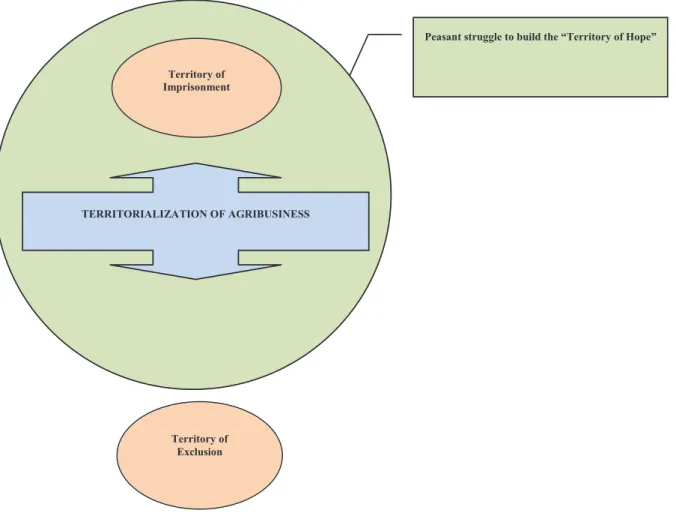
The theoretical construction of Moreira and Targino regarding the category “Territory of Hope”, and the reference to the emergence of the “Territory of Exclusion” and the “Territory of Imprisonment”, allows us to idealize and trace the process of the materialization of capital in the space occupied by PIVAS and their ramiications for the production of a multi-territorialization in that area (igure 2).
Accordingly, there is an advance of the territorialization process of capital in space, which with help from the state, creates and recreates territories of imprisonment, submitting the social actors to their demands and fatalities. Giving the impression that besides the existence of a contradiction in the forced change in the peasants’ ideology, there is a manifest risk in not continuing with the reproduction process of the peasant class. Subjecting them to the logic of the market, removing their productive autonomy and the recreation of these conditions may result, in the view of many, in the total remodeling of the peasantry, distancing it from its original format, as we know it today.
In view of the facts presented above, it appears that the obverse side of this apparent contra-diction lies in the knowledge that the acceptance of the impositions by some of the peasant families on the Souza loodplains is part of the group’s internal strategy to remain on the land. It is as they say: at irst we fought to get the land; now, we are ighting to remain and produce what we deem necessary for our survival.
The irst proposal that we received to settle in Várzeas de Sousa was for us to work for agribusiness, but we’re against agribusiness, so we would become small businesses, we thought this was barbarous. We’re from Sousa, from our region, and instead of producing our food, which could be of use to our region, it would only be for export, outside. Then they were clear: ‘or you accept the “Várzeas de Sousa” project for agribusinesses and become small businesses, or you’re banished from the whole Várzeas de Sousa’. There wasn’t any more chance to go to the side of the BR [highway], because it would be the Federal Police from Brasilia and João Pessoa who would come for us, so we chose the alternative and said “we’ll accept”. Once we get the house and the land we’ll start a new ight to get us out of agribusiness. (Francinete Longuinho de Sousa – Neta, on 3rd March 2009 at the Nova Vida I settlement, apud FARIAS, 2010, p. 79-80).
82
Peasant struggle to build the “Territory of Hope”
TERRITORIALIZATION OF AGRIBUSINESS Territory of
Imprisonment
Territory of Exclusion
Figure 2 – The territorialization of agribusiness, the formation of the “Territories of Exclusion” and the “Territory of Imprisonment” and the peasant struggle for the construction of the “Territory of Hope” in Várzeas de Sousa-PB.
Source: Created by LIMA, F. V., 2012.
The alternation of the peasants’ arguments and objectives, regarding the strategy for permanen-ce on the lots can be noted in the following testimony from “Artur”, who is a leader in the “Nova Vida I” settlement.
In the beginning we said we accepted, but we could see this. We already have our strategy for the future. We want the land; we’ll ight to get the land. It’s like today; today we have the land, now we want the house, we want water; now we’ve got the trump card in our hand. At irst, that’s what it was like: we grow what you want, we want the land! We couldn’t say no, because they could say: this guy doesn’t want to produce, he doesn’t want to work. If he’s saying that he doesn’t want to grow what we want... With the land over there, that’s what we do, but not afterwards. (Interview with Manoel Gouveia de Lima – “Artur”, coordinator of the Nova Vida I settlement, on 25/05/12). (Our emphasis).
83
This understanding is important because there are many risks involved in the peasantry’s in-sertion into a production process akin to agribusiness, which depends on many conditions, such as the economic situation (expansion / contraction of the consumer market), access to credit, ability to work with certain crops, the increasing technical complexity of production and the rigidity in the production process (production control). Basically, it is understood that it is diicult for the peasant class to it the proile required for activities that require greater specialization. However, forcing them to it this model, will cause a decline in the supply of basic products on the market (and consequently an increase in prices) and increased rural unemployment, as the increased technical complexity suppresses superluous labor in the production process.
While the peasants’ desires do not materialize, they seek to overcome the daily hardships of the settlement. Although agriculture is the main form of subsistence for this class, due to the clima-tic circumstances that prevent them from producing “beyond the rainy season”, the peasants have organized themselves by developing other non-farming activities (painting, craftwork, baking and making candy, ofering services, etc.), which in addition to guaranteeing an income for the more diicult times of the year, also strengthens the fraternal bonds among the members of the settlement. In the view of Marques, apud Farias (2010, p. 69), all the types of diversiication of the peasant class’ activities are:
a creative way to circumvent the shortage of resources, of the means of production and inclement weather through the collectivization of activities, also showing a way to counter their subordinate position in the capitalist system (by the extraction of surplus and labor exploitation).
Regarding the strategies and the intentionality of their actions in achieving the objectives outlined, including the ight against the construction of a “territory of imprisonment” with great lucidity, Lima (2009, p. 18) emphasizes that:
The intentionality of each political actor materializes in space through behaviors and strategies that are carried out with the intention of attaining their desires. Observing the intentions or intentionality of the actors can give an empirical visualization of the contradictions in their social actions. It is necessary to take into consideration the cultural references inherent in the space where the phenomenon takes place, as some questions may be answered if this aspect is taken into consideration.
The existence of peasant agriculture relects its enormous capacity of adaptation and the stru -ggle of the peasants when faced with economic and political adversities that hamper their existence and persistently act for their extinction. In this process of constructing a territory that corresponds to the aspirations of the peasant class, at stake is the preservation of their material and subjective values that incorporate the daily political struggles for land, water and more egalitarian social conditions. Thus,
[...] the formation of peasants’ territorialities in the struggle for land is not just a factor of demands from citizens. It is a space for the reproduction of an ideal life and the desire for social transformation; it is the spatialization of a utopian life and also the hope of being seen not at the margins of society, and instead among the citizens who form the State. The conquest of the demanded land becomes not a dream, but the embodiment of the desire and hope of the peasantry (FARIAS,op. cit., p. 53).
84
It is noteworthy that the struggle of the peasants in PIVAS goes beyond an economic or territo-rial issue. It transcends these spheres, expanding into a larger universe that makes them feel valued for who they are and for their social importance. This is Abromovay’s (1995) understanding when he airms that the peasants’ actions do not only aim to conquer their patch of earth, but above all, the pursuit of citizenship, as evidenced in their greater participation in the decisions that inluence agrarian development policies, access to education and health, in short, in actions that enable their integration into the political, social and economic life of the country.
This ight for better days for the peasant class certainly remains undeined in time and may never achieve the expected results, given that the speeches preached in its favor often lack genuinely concrete actions. However, the peasants can not waver in their pursuit of this ideal. Their aspirations also represent the aspirations of an entire society that has increasingly recognized the need to break up the old structures of power and domination that have historically dictated the relationships in rural areas and contributed to the worsening of the alarming social inequality that still prevails.
FINAL CONSIDERATIONS
The debate on the future of agriculture and the public policies that support it seems to continue in the spotlight of geographical studies and other sciences that analyze the countryside, in view of the importance that this activity has on the national and international scene, with strong implications for the economies of those countries where it is the main source of revenue.
Technical-scientiic advances ofer new interpretations of landscapes and express the ex -pansion of capital, on an unprecedented scale, promoting the productive rearrangement of spaces through a selective valuation and public and private investments aimed at disseminating irrigated agricultural projects.
However, the use of science and technology to transform these spaces has promoted the disarticulation of traditional forms of land use and occupation, with severe implications for their productive agents, as modernity has its nefarious side embodied in the subordination and submission of indigenous peoples to the monopolization of capital, land and resources.
The Sousa loodplains, located in the high sertão of Paraiba, emerge as a productive space conditioned by the impositions of the agricultural model growing in our country. The new economic dynamics of the regions have promoted a process of the multi-territorialization of space, in which confrontations are the keynote of a set of social forces that become apparent in the course of the creation of the Várzeas de Sousa Irrigation Project.
The PIVAS had as a backdrop bringing to the sertão of Paraiba an agro-industrial activity on a transnational scale, by developing irrigated agriculture. However, the project took shape amid a pro-blematic implementation, the result of disagreements, complaints and investigations, and conlicting interests between the actors, represented on the one hand, by economic groups of the agribusiness sector, and on the other, hundreds of peasant families seeking active participation in the project.
It was not unusual for the project to make the news. From its conception until its realization, various changes were made to the plan to make it a better it to the political and business interests until it reached its inal version, established and in place today. Corroborating the project’s politi -cal and business bias, the government efectively targeted its actions to beneit the companies that settled in the area by transferring much of the project’s land to them, to the detriment of hundreds of peasant families who were forced from their land and tossed into settlements with promises for a future when they would be integrated into the productive process.
85 solution to the problems that afect it could be centered, as Abramovay (1995, p. 21) argues, on
promoting a Doubly Green Revolution, that would be based on “enhancing the agricultural potential of the regions and rural people who are on the margins of the dominant forms of technical progress.”
To this end, it is essential that the struggle of rural social movements continues, resisting the pressures from the process of rural modernization and promoting the strengthening of the peasant class, so they can maintain the access to their life plans and not continue as mere hostages to a system whose metamorphosis only satisies its own needs. Also because the peasant class, even when threatened by the “dominant power that fragments and decharacterizes their values, beliefs and cultural identity” (GHIZELINI, 2007, p. 65), should focus their resistance on the preservation of their culture and not consider the market as their reason or ideal world.
The peasants’ resistance is a daily struggle to maintain their identity and, in the case of PI-VAS, in keeping their strategies lexible as a way of adapting to the local political and economic impositions without giving up on their freedom, principles and objectives.
While they wait for the sun to shine on them, the peasants’ dream of a new era… the conquest of a “territory of hope”, signals the creation of a new territoriality and a new type of peasant, ho-wever, it does not signal the end of the struggle between the forces of command and domination. After all, the beast called capitalism continues to act impetuously on peoples and territories and their real combatants should always be on guard so that they are not taken by surprise in the trenches.
BIBLIOGRAPHIC REFERENCES
ABRAMOVAY, Ricardo. De volta para o futuro: mudanças recentes na agricultura familiar. In: I° Seminário
Nacional do Programa de Pesquisa em Agricultura Familiar da EMBRAPA. Anais... Petrolina/PE, 1995,
p. 17-27.
BRITO, Celestino de O. Limites para a adequação da agroindústria artesanal familiar aos mecanismos de mercado. In: BRANDEBURG, Alio, [et. al.] Ruralidade e questões ambientais: Estudo sobre estratégias, projetos e políticas. Brasília: MDA, 2007, pp. 143-171.
FABRINI, João Edmilson. O projeto do MST de desenvolvimento territorial dos assentamentos e campesi-nato. Terra livre. Ano 18, n.° 19, jul./dez. 2002. São Paulo, 2002, p. 75-93.
FARIAS, Arethusa E. M. de. Os incomodados que resistem: contradições e territorialidades camponesas
no Projeto de Irrigação Várzeas de Sousa na Paraíba. (Dissertação de Mestrado). João Pessoa: UFPB/CCEN, 2010.
FERNANDES, Bernardo M. Sobre a Tipologia de Territórios. In: SAQUET, Marco A.; SPOSITO, Eliseu S. (Orgs.). Territórios e territorialidades: teorias, processos e conlitos. São Paulo: Expressão Popular, 2009.
FONSECA, Helen N. C. da; LIMA, Edvaldo C. de. Espaço agrário paraibano no contexto dos movimentos de luta pela terra e Reforma Agrária: MST. In: XIX ENGA, São Paulo, 2 a 7 de fevereiro de 2009. Anais...
São Paulo, 2009, p. 01-16. Disponível em: http://www.geograia. lch.usp.br/inferior/laboratorios/agraria/ Anais%20XIXENGA/artigos/Fonseca_HNC.pdf>. Acesso em: 11/07/12.
GHIZELINI, André M. O assessoramento técnico-organizativo como base para a organização social e polí-tica na agricultura familiar. In: BRANDEBURG, Alio, [et. al.] Ruralidade e questões ambientais: Estudo sobre estratégias, projetos e políticas. Brasília: MDA, 2007, pp. 63-86.
HAESBAERT, Rogério. Des-territorialização e identidade: a rede “gaúcha” no Nordeste. Niterói: EDUFF, 1997, 293 p.
LIMA, Valéria R. P. de. Gestão dos recursos hídricos: conlito e negociação da água do Canal da Re
86
SCOTT, James C. Formas cotidianas da resistência camponesa. Revista Raízes. Vol. 21, n°. 01, jan.-jul./2002. Campina Grande: UFCG/PPGS, 2002, p. 10-31.