*Correspondence: T. P. Souza. Faculdade de Ciências Farmacêuticas, Uni-versidade Federal do Amazonas, 69010-300 – Manaus – AM, Brasil. E-mail: [email protected] or [email protected]
A
rti
Pharmaceutical Sciences vol. 45, n. 4, oct./dec., 2009
Development of granules from
Phyllanthus niruri
spray-dried extract
Tatiane Pereira de Souza
1,3*, José Luiz Gómez–Amoza
2,
Ramón Martínez Pacheco
2, Pedro Ros Petrovick
31Faculdade de Ciências Farmacêuticas, Universidade Federal do Amazonas, 2Departamento de Tecnologia Farmacéutica, Universidad de Santiago de Compostela,
3Faculdade de Farmácia, Universidade Federal do Rio Grande do Sul
The aim of this study was to develop granules from Phyllanthus niruri spray-dried extract using dry and wet granulation and to assess techniques to enable the production of granules with improved technological characteristics and yields. Granules were characterized by granulometry, reological parameters, compression and hygroscopic behavior. Independent of the granulation technique, technologically developed granules presented particle diameter, bulk and tapped densities and compressibility indexes suitable for a solid dosage form. The compression behavior showed plastic and fragmentary deformation for granules produced by the dry granulation technique and predominantly plastic deformation for wet granulation. Concerning the humidity sorption, the study showed that granules absorb less humidity than the spray-dried extract. However, granules with Eudragit® E 100 were the least hygroscopic.
Uniterms: Phyllantus nururi/pharmacotechnics. Granules/production. Spray-dried extract. Wet granulation. Dry granulation.
O objetivo deste estudo foi desenvolver grânulos de extrato Phyllantus niruri seco por aspersão e por granulação úmida e avaliar técnicas que possibilitem a produção de grânulos com características tecnológicas e rendimentos aperfeiçoados. Os grânulos foram caracterizados por granulometria, parâmetros reológicos, compressão e comportamento higroscópico. Independentemente da técnica de granulação, os grânulos tecnologicamente desenvolvidos apresentaram diâmetro de partículas, densidades aparente e compactada e índices de compressibilidade adequados para a formulação sólida. O comportamento de compressão mostrou deformação plástica e elástica para os grânulos produzidos por técnicas de granulação seca e, predominantemente, deformação plástica para a granulação úmida. Com relação à absorção da umidade, o estudo mostrou que os grânulos absorvem menos umidade do que o extrato seco por aspersão. Entretanto, os grânulos com Eudragit E 100 foram os menos higroscópicos.
Unitermos:Phyllantus nururi/farmacotécnica. Grânulos/produção. Aspersão. Granulação úmida. Granulação seca.
INTRODUCTION
Development of medications containing vegetable extracts involves technological and stability problems due to dificulties with the extracts during pharmaceuti-cal processing. Active substances are generally present in the extracts at low concentrations and therefore a large quantity of extract is necessary to produce an active dose. (Crippa, 1978; Bonati, 1980).
Spray-dried extracts are intermediate products with improved stability and easy handling in spite of their
characteristics as a ine powder with low density and high hygroscopy. These latter properties make transformation into a solid dosage form more dificult (List, Shimdt, 1989; Souza et al., 2000; Soares et al., 2005; Souza et al., 2006). However, granulation is a technique which is used: to improve physical properties of powders such as lowage, dispersion and bulk density; to improve dosage uniformity by avoiding particle segregation; and to improve the me-chanical properties of the inal solid dosage form, such as compressibility and strength of tablets (Soares et al., 2005; Souza et al., 2007).
Souza et al., 2007). However, the addition of pharmaceuti-cal excipients aids the granulation process and decreases the hygroscopicity of the extract (e.g. use of colloidal silicon dioxide or acrylate resins such as Eudragit® for
granule coating) (Díaz et al., 1996; Soares et al., 2005;
Souza et al., 2007).
Dry extracts generally present high water solubility; water is therefore not a good solvent for wet granulation. Organic solvents must be carefully selected in order to avoid degradation upon extraction.
Against this background, the aim of this study was
to develop granules from a Phyllanthus niruri spray-dried
extract and verify techniques used to produce granules with improved characteristics.
MATERIAL AND METHODS
Raw material
The Phyllanthus niruri spray-dried extracts (SDE) were produced on a semi-industrial scale based on the methodology described by Soares (1997). The solution extract was obtained by vegetable drug decoction of aerial
parts, using water as an extractive solvent at 100 °C for
15 minutes of extraction. The spray-dried extracts were produced in a spray-dryer (Production Minor with rotary disc atomizer) using 30% colloidal silicon dioxide
(Ae-rosil® 200) as a drying agent based on the dry residue of
the extracted solution.
The pharmaceutical excipients microcrystalline cellulose – MCC (Avicel pH 101, FMC corp.), magne-sium stearate – ST (gift of C. Bacia S.A), colloidal silicon dioxide (Aerosil® 200, Degussa) and Eudragit® E100 (RÖHM) were used as inert agents.
Granule production
The formulations of the granules are described in
Ta-ble I, where F1, F2, F3 and F4 formulations were obtained by dry granulation and F5 formulation by wet granulation.
Dry Granulation (GRN)
The SDE and excipients were blended in a V-blender at 36 rpm adjusted on a drive motor (Erweka AR 400). The F1 formulation was prepared by blending SDE with iller/ binder (MCC) for 15 min with addition of lubricant (ST) and glidant (CSD) and blending for a further 5 minutes. For the F2, F3 and F4 formulations the SDE was blended with excipients for 5 minutes.
Each formulation was compacted by direct com-pression using an eccentric comcom-pression machine (Korsch EK-0) equipped with lat-faced 15 mm punch. Granulation was performed in a dry granulator (Erweka type TGIIS) followed by size reduction in an oscillatory granulator (Erweka type FG). Granules were screened to obtain a granulometry range of 1.0 mm to 0.25 mm. Granules below 0.25 mm were re-compacted following the same methodology as described above. The compression and screening cycles were repeated until less than 10% of inal particle was obtained.
The granule yield was calculated in the irst granula-tion cycle considering the percentage of screened granules in the total mass of the formulation.
Characterization of compacts
Friability was determined with a Roche friability test apparatus, hardness with a Scheleuniger hardness test apparatus, and disintegration time with a Pharma Test apparatus. All assays were performed according to the Farmacopéia Brasileira IV (1988).
Wet granulation (GRU)
Wet granules were obtained with 10% (w/w) of
Eudragit® E100 as a binder.The SDE was weighed and
granulated with Eudragit E in an acetone solution at 12.5 w/v percentage. This mixture was thoroughly blended, un-til the adequate consistency for granulation was achieved, and strained through a sieve with a nominal aperture of 1 mm. The prepared granules were dried in a circulating air
oven at 25 oC for 2 hours, screened and stored.
Characterization of granules
Particle size analysis
The granules sizes were determined in an automatic sieve shaker (Orto Alresa HZ50) using 850, 710, 600, 500,
TABLE I - Composition of granule formulations
Formulations SDE
(%) (%)ST CSD(%) MCC(%) Eudragit
®
E100 (%)
F1 69.23 1.00 2.20 27.57
-F2 99 1.00 - -
-F3 97 1.00 2.00 -
-F4 98 1.00 1.00 -
-F5 90 - - - 10
355 and 250 µm sieves. The particle mean diameter (Ø) was determined by arithmetic method using equation 1 (Lantz, 1989).
(Equation 1)
Where: d–m = mean particle diameter (µm);
x
– = mean class diameter (µm);
n = distribution frequency.
Reological behavior
Bulk and tapped density, and compressibility inde-xes were determined on apparent density test apparatus (J. Engelsmann) following the methodology described by Guyot et al. (1995).
Analysis of gallic acid by high pressure liquid chromatography (HPLC)
The assay of gallic acid in granules was performed
following the methodology described by Souza et al.
(2002). The analysis was carried out in a Shimadzu liquid chromatograph (LC-10 AD) equipped with an automated gradient controller (FCV-10 AL) and a Shimadzu UV/VIS detector (SPD-10 A). The analytical column was a RP-18 LiChrospher 250 x 4 mm id., 5 µm particle diameter (Merck) protected with a pre-column of the same material.
Compression behavior
Evaluation of SDE and granule compression beha-vior was performed in an instrumented single punch ta-blet machine (J. Bonals BMT), equipped with lat-faced 9 mm punches and data acquisition system described by
Martínez-Pacheco et al. (1985). The tablets were prepared
by individual hand-weighed powder. The volume of solid in the die was adjusted to a constant content of 250 mg of SDE for all tablets. The compression was performed by automatic display with a speed ixed at 8 tablets/min.
The compression behavior of spray-dried extract and granules was determined through the Heckel model (Equation 2), used to calculate the mean yield pressure – Py (Equation 3) and through a force-time curve model used to calculated plasticity (P%) and elastic recovery (RE%) (Equations 4 and 5, respectively)(Hubert-Droz et al., 1982). Calculations were performed using a Microsoft Excel® 97 program. The compression force was measured on the upper punch using a maximum compression force of 6000 N to SDE and for dry granules and 2500 N for wet granules.
(Equation 2)
Where e = porosity of the compact at pressure P;
P = pressure applied;
k and A = slope and intercept, respectively, of the straight line obtained by linear regression from the Heckel plot.
(Equation 3)
Where Py = mean yield pressure;
k = slope of straight line obtained by linear regression from the Heckel plot.
(Equation 4)
Where P = plasticity (%)
E2 = energy used for production of compacts;
E3 = energy lost in elastic deformation.
RE = 100 – P (Equation 5)
Where RE = elasticity (%);
P = plasticity (%)
Humidity sorption
The SDE and granules were stocked for 15 days in a controlled environment of 69% relative humidity. This atmosphere was obtained with a potassium iodide (KI) saturated solution containing dry residue (Nyqvist, 1983)
and a controlled temperature of 25 °C. The humidity
sorp-tion was evaluated by weight increase of products, which was performed by weighing the samples in the irst 24 and 48 hours, followed by consecutive weighing at every 72 hours for a period of 15 days.
Statistical analysis
The results were evaluated using analysis of va-riance (ANOVA), Tukey and Student “t” tests, performed
with the SigmaStat® for Windows (version.1.0) statistical
program.
RESULTS AND DISCUSSION
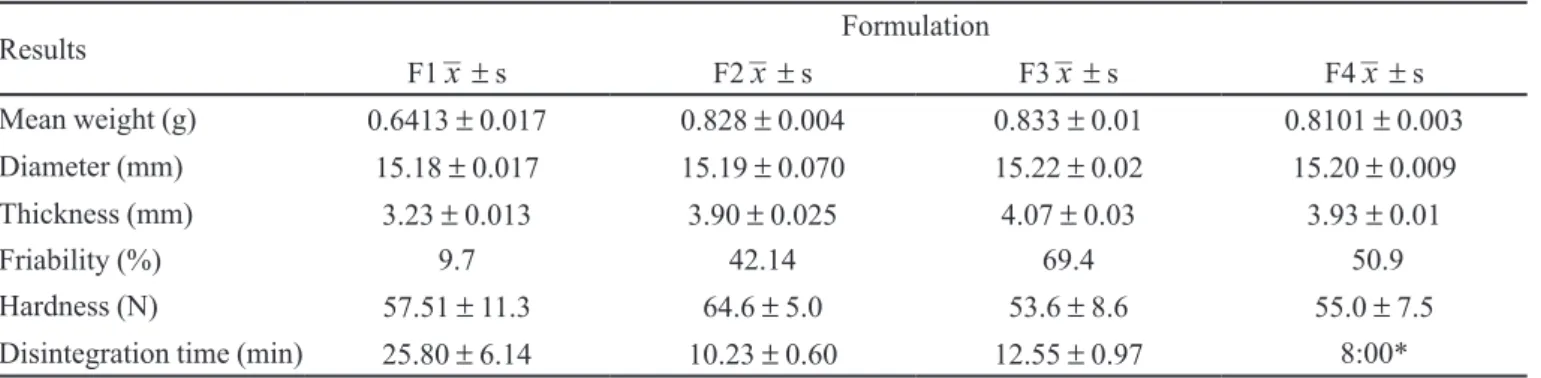
The results of technological characterization of compacts are described in Table II. In general with the exception of F1, all formulations presented mean weight with coeficient variation below 1.5%, which could be explained by the smooth low of SDE which enabled a homogeneous illing in the die.
Compact hardness of different formulations did not
show any statistically signiicant difference (p = 0.43):
however, the same compacts presented different friability values. Among the formulations studied, F1 produced compacts with higher resistance, probably due to the pre-sence of microcrystalline cellulose binder which improved cohesion of the particles (Herting, Kleinebudde, 2007).
All compacts presented disintegration times (DT) within the maximum limit (30 min) established by Farma-copéia Brasileira (1988). F1 presented a higher TD with a value close to the pharmacopeia limit and a high variation coeficient, while other formulations had smooth and fast disintegration.
F1 yielded less in the granulation process, while other granules obtained by dry granulation showed a similar yield around 60%. Wet granulation was the technique which provided the best yield (98%), Table III. Technically, the higher the granulation yield the less operational cycles and less mechanical stress needed to produce the product.
The high friability of the compacts may be the reason for the ine particle produced from the dry granulation process. However, the experiments showed that compacts with less friability (F1) produced higher fine particles (above 50%). Granules developed by Couto (2000),
obtai-ned from a formulation similar to F1, showed a granulation yield similar to the one presented in the present study. The low yield of granulation could be the result of uncompres-sed residue materials, inherent to its own formulation, due to the presence of microcrystalline cellulose that, in the compressive force used to obtain the compact, can serve as a buffer reducing the aggregation among particles of other components of the formulation. Thus, the ibrous form of microcrystalline cellulose and its provision permeating the whole compact mass may explain the low friability of the compacts formed, since it is conducive to the mechanical strength of the compacted mass. However, reducing the aggregation among the particles within the mass, results in a higher production of ine particles during the granulation
of the compact (Souza et al., 2000; Souza et al., 2006;
Bozic et al., 2008).
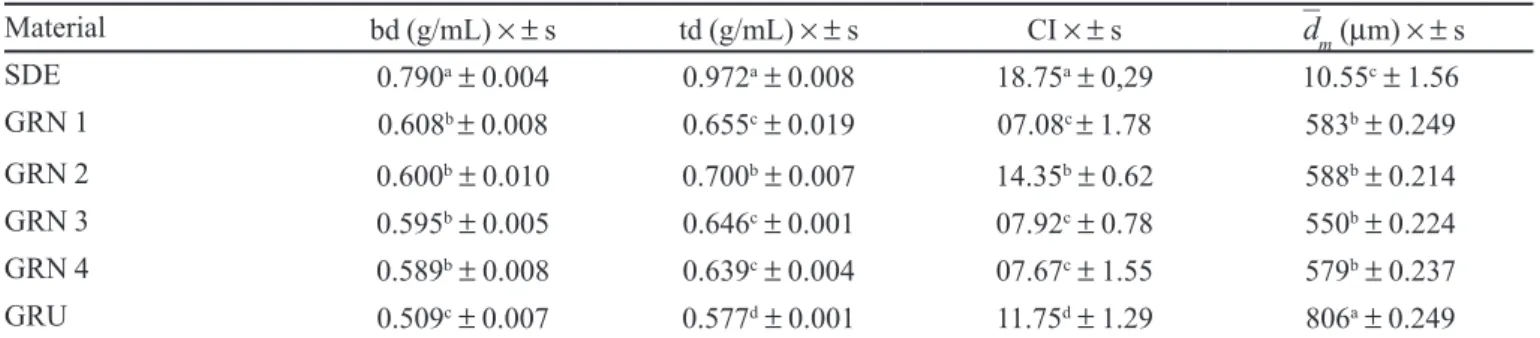
As regards the technological parameters (Table IV), the granules generally had better characteristics of compac-tion and low than the SDE, and the granules obtained by dry granulation (GRN 1, 3 and 4) presented better packing characteristics with the lowest compressibility indexes.
Although the statistical analysis indicates values of tapped density and compressibility index of GRN 2 and a GRU which is different from the other granules, these values are very similar, due to the similar size distribution of the various granules. The average diameter of particle size and the variation of distribution of particles conirm that the formulations produced granules with similar size distributions. Granules obtained by wet granulation, which yielded a considerably larger particle size than those obtai-ned by dry granulation, were the exception; however, this did not negatively inluence the rheological characteristics of the granules obtained by this method.
The characterization tests showed that there were no major technological differences among the granules produ-ced, making it dificult to choose which of the formulations may provide the best properties for tablet development.
TABLE II - Compacts characterization
Results Formulation
F1 –x ± s F2 –x ± s F3 –x ± s F4 –x ± s Mean weight (g) 0.6413 ± 0.017 0.828 ± 0.004 0.833 ± 0.01 0.8101 ± 0.003 Diameter (mm) 15.18 ± 0.017 15.19 ± 0.070 15.22 ± 0.02 15.20 ± 0.009 Thickness (mm) 3.23 ± 0.013 3.90 ± 0.025 4.07 ± 0.03 3.93 ± 0.01
Friability (%) 9.7 42.14 69.4 50.9
Hardness (N) 57.51 ± 11.3 64.6 ± 5.0 53.6 ± 8.6 55.0 ± 7.5
Disintegration time (min) 25.80 ± 6.14 10.23 ± 0.60 12.55 ± 0.97 8:00* * All these compacts presented the same length of disintegration time
TABLE III -Yield (R %) of granulation process
Formulation F1* F2* F3* F4* F5**
R % 45.82 61.2 62.8 62.4 98
However, based on the yield of the granulation process, F1 was excluded since it had a yield below 50%, and therefore granule determination was performed only with granules obtained from formulations F2, F3, F4 and F5.
Gallic acid marker quantitative analysis (Table V) was performed to verify the homogeneity of distribution of SDE within the granules. Levels of gallic acid present in the granules were compared to those of SDE. The ANOVA showed no statistically significant difference (α = 0.01) between the levels of polyphenols in granules and the SDE, independent of the granulation technique used.
Compression behavior analysis was performed with the spray-dried extract, dried and wet granules. Among the dry granules, only the GRN 4 was chosen for the trial because of the technological similarity with the other granules (Table IV)
The Heckel graph (Figure 1) shows that the products had different compression behavior. In the studied system, the maximum compression for the granules obtained by wet granulation was considerably lower (2500 N), es-pecially when compared to SDE and granules obtained by dry granulation, which allowed the application of a compression force of 6000 N. This may be explained by
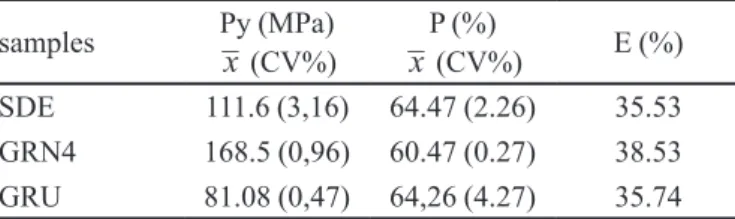
differences in density and porosity of the granules. The properties of compression (Table VI) revealed a high elastic recovery for all the studied products. The mean yield pressure (Py) suggests that the SDE and the granules obtained by wet granulation have a predominantly plastic behavior, while the granules obtained by dry granulation have both a plastic and fragmentary behavior. Materials that are lia-ble to plastically deform are capalia-ble of generating compacts with high mechanical strength using relatively low pressure. Furthermore, materials that deform in a fragmented man-ner need more pressure, therefore, during the compression process there is particle fragmentation, generating cleaner points of contact and reducing cohesion (Eriksson, Alderborn, 1995). Thus, the major advantage of materials that deform in a plastic manner upon fragmentative compression is their capability to produce compacts under low pressure, reducing load on the equipment and increasing their working lifespan. Exposure of the SDE and the granules to a relative humidity of 69% showed that all products were sensitive to moisture (Figure 2). However, comparing SDE with the granules, the granules showed a signiicantly lower
TABLE IV - Compression parameters of the SDE and granules obtained by dry (GRN) and wet (GRU) granulation
Material bd (g/mL) ×± s td (g/mL) ×± s CI ×± s d–m(mm) ×± s
SDE 0.790a± 0.004 0.972a± 0.008 18.75a± 0,29 10.55c± 1.56
GRN 1 0.608b ± 0.008 0.655c± 0.019 07.08c ± 1.78 583b± 0.249
GRN 2 0.600b± 0.010 0.700b± 0.007 14.35b± 0.62 588b± 0.214
GRN 3 0.595b± 0.005 0.646c± 0.001 07.92c± 0.78 550b± 0.224
GRN 4 0.589b± 0.008 0.639c± 0.004 07.67c± 1.55 579b± 0.237
GRU 0.509c± 0.007 0.577d± 0.001 11.75d± 1.29 806a± 0.249
bd = bulk density; td = tapped density; CI = compressibility indexes;d–m= particle mean diameter. Means followed by same letter do not differ on the Tukey test (a =0.05)
TABLE V - Content of gallic acid present in one gram of
spray-dried extract (SDE) and granules obtained by dry (GRN) and wet (GRU)granulation
material gallic acid (mg) –x (CV%)
SDE 12.02 (1.27)
GRN 2 11.84 (0.28)
GRN 3 11.80 (0.60)
GRN 4 11.74 (0.87)
GRU 11.57 (0.45)
moisture sorption, which may be due to the smaller surface area of the granules and also to the presence of adjuvants in the formulation.
The presence of Eudragit E 100 in a proportion of 10% resulted in granules with signiicantly lower hygro-scopy than the others, demonstrating the protective prop-erty of the polymer and suggesting greater stability of the
granules (Petereit, Weisbrod, 1999; Souza et al., 2007).
These results are consistent with those described by Díaz
et al. (1996) where, by studying the wet granulation of
dry plant extracts using Eudragit® E 100 as a binder, the
products were found to be considerably less hygroscopic than the dry extract.
CONCLUSION
The results showed the feasibility of obtaining
granule products from spray-dried extract of Phyllanthus
niruri. Both dry and wet granulation techniques produced granules with appropriate technological characteristics and
good operational performance. The presence of Eudragit E 100 in the proportion of 10% in the granules obtained by wet granulation was eficient in producing granules with lower sensitivity to moisture. The dry granules required a higher compressive force and demonstrated plastic defor-mation, but with some degree of fragmentation, while the granules obtained by wet granulation presented an entirely plastic behavior.
ACKNOWLEDGEMENTS
The authors are grateful for the inancial support provided by CAPES and CNPq.
REFERENCES
AULTON, M. E. Pharmaceutics, the science of dosage form design. 2.ed. London: Churcill Livingstone, 2002. 675 p.
BONATI, A. Problems relating to the preparation and use of extracts from medicinal plants. Fitoterapia, v.1, n.1, p.5-12, 1980.
BOZIC, D. Z.; DREU, R.; VRECER, F. Influence of dry granulation on compactibility and capping tendency of macrolide antibiotic formulation. Int. J. Pharm., v.357, n.1, p.44-54, 2008.
COUTO, A. G. Desenvolvimento e avaliação tecnológica de granulados contendo produto seco nebulizado de Phyllanthus niruri L. – Euphorbiaceae (quebra-pedra). Porto Alegre, 2000. 179p. [Dissertação de Mestrado. Faculdade de Farmácia. Universidade Federal do Rio Grande do Sul].
CRIPPA, F. Problems of pharmaceutical technics with plant extracts. Fitoterapia, v.49, n.2, p.257-263, 1978.
DÍAZ, L. M.; SOUTO, C.; CONCHEIRO, A.; GÓMEZ-AMOZA, J. L.; MARTÍNEZ-PACHECO. Evaluation of Eudragit E as major excipient in tablets of dry plant extracts. S.T.P. Pharma Sci., v.6, n.1, p.105-109, 1996.
ERIKSSON, M.; ALDERBORN, G. The effect of particle fragmentation and deformation on the interparticulate bond formation process during powder compaction. Pharm. Res., v.12, n.7, p.1031-1039, 1995.
FARMACOPÉIA Brasileira. 4.ed. São Paulo: Atheneu, 1988. p.V.1.3.1,V.1.3.2,V.1.4.1
TABLE VI - Physical compression parameters calculated for spray-dried extract (SDE), dried granules (GRN - F4) and wet granules (GRU - F5)
samples Py (MPa)–x (CV%) –xP (%) (CV%) E (%)
SDE 111.6 (3,16) 64.47 (2.26) 35.53
GRN4 168.5 (0,96) 60.47 (0.27) 38.53
GRU 81.08 (0,47) 64,26 (4.27) 35.74
Py = mean yield pressure, P = plasticity, E = elastic recovery
FIGURE 2 - Increase in the weight of products when stored in
GUYOT, J. C.; ARNAUD, P.; BECOURT, P.; CASSIERE, J. P.; CHULIA, D.; DUCHÊNE, D.; FERRAND, D.; GOUAIHARDOU, J.; LANGLOIS, C.; LEQUIEN, C.; MALFROID, F.; POURCELOT, Y.; RENOUX, R.; SERGOT, S.; TOURE, P. Commentaires relatifs aux méthodes générales d’analyse des formes orales solides récemment introduites dans les pharmacopées française et européenne. Rapport d’une commission SFSTP. S.T.P. Pharm. Prat., v.5, n.6, p.482-494, 1995.
HERTING, M. G.; KLEINEBUDDE, P. Roll compaction/dry granulation: Effect of raw material particle size on granule and tablet properties. Int. J. Pharm., v.338, n.1/2, p.110-118, 2007.
HUBERT-DROZ, P.; MORDIER, D.; DOELKER, E. Rapid method of determination of compression behavior for preformulations studies. Pharm. Acta Helv., v.57, p.136-143, 1982.
LANTZ Jr., R. J. Size Reduction In: LIBERMAN, H.A.; LACHMAN, I.; SCHWARTZ, J.B. (Eds.). Pharmaceutical dosage forms: tablets. 2.ed. New York: Marcel Dekker, 1989. v.2, cap.3, p.107-199.
LIST, P. H.; SCHIMDT, P. C. Phytopharmaceutical technology. Boca Raton: CRC, 1989. 552 p.
MARTÍNEZ-PACHECO, R.; GÓMEZ-AMOZA, J. L.;VILA JATO, J. L. Diseño de un sistema de registro de presión en máquinas de comprimir excéntrica. Cienc. Ind. Farm., v.4, n.2, p.207-211, 1985.
NYQVIST, H. Saturated salt solutions for maintaining speciied relative humidities. Int. J. Pharm. Tech. Prod. Manuf., v.4, n.2, p.47-78, 1983.
ONUNKWO, G. C.; UDEALA, O. K. Studies on Rauwolia vomitoria root III. flow properties of R. vomitora Granulations. S.T.P. Pharm. Sci., v.5, n.4, p.296-301, 1995.
PETEREIT, H. U.; WEIBSBROD, W. Formulation and process considerations affecting the stability of solid dosage forms formulated with methacrylate copolymers. Eur. J. Pharm. Biopharm., v.47, n.2, p.15-25, 1999.
SOARES, L. A. L. Padronização de extrato aquoso e desenvolvimento de produto seco por aspersão de Phyllantus niruri L. Euphorbiaceae (Quebra-pedra). Porto Alegre, 1997. 169p. [Dissertação de Mestrado. Faculdade de Farmácia, Universidade Federal do Rio Grande do Sul.].
SOARES, L. A. L.; GEORGE GONZÁLEZ, O.; PETROVICK, P. R.; SCHMIDT, P. C. Dry granulation and compression of spray-dried plant extracts. AAPS Pharm. Sci. Tech., v.6, n.3, p.E359-E366, 2005.
SOUZA, K. C. B.; PETROVICK, P. R.; BASSANI, V. L.; GONZÁLEZ ORTEGA, G. The adjuvants aerosil 200 and Gelita-Sol-P inluence on the technological characteristics of spray-dried powders from Passilora edulis var. lavicarpa. Drug Dev. Ind. Pharm., v.26, n.3, p.331-336, 2000.
SOUZA, T. P.; GÓMEZ-AMOZA, J. L.; MARTÍNEZ-PACHECO, R.; PETROVICK, P. R. Compression behavior of formulations from Phyllanthus niruri spray dried extract. Pharmazie, v.61, n.3, p.213-217, 2006.
SOUZA, T. P.; MARTÍNEZ-PACHECO, R.; GÓMEZ-AMOZA, J. L.; PETROVICK, P. R. Eudragit E as excipient for production of granules and tablets from Phyllanthus niruri L spray-dried extract. AAPS Pharm. Sci. Tech., v.8, n.2, p.E1-E7, 2007.
SOUZA, T. P.; GONZÁLEZ ORTEGA, G.; BASSANI, V. L.; PETROVICK, P. R. Avaliação da viabilidade de compressão direta de formulações contendo alto teor de produto seco nebulizado de Maytenus ilicifolia. Acta. Farm. Bonaer., v.19, n.1, p.53-60, 2000.
SOUZA, T. P.; HOLZSCHUH, M. H.; LIONÇO, M. I.; GONZÁLEZ ORTEGA, G.; PETROVICK, P. R. Validation of a LC method for the analysis of phenolic compounds from aqueous extract of Phyllanthus niruri aerial parts. J. Pharm. Biom. Anal., v.30, n.2, p.351-356, 2002.
Received for publication on 26th February 2008.