*Correspondence: V. O. Consiglieri. Departamento de Farmácia, Faculdade de Ciências Farmacêuticas, Universidade de São Paulo. Av. Prof. Lineu Prestes, 580 - 05508-900 - São Paulo - SP, Brazil. E-mail: [email protected]
A
rti
Pharmaceutical Sciences vol. 46, n. 1, jan./mar., 2010
Improvement of luconazole lowability and its effect on
dissolution from tablets and capsules
Vladi Olga Consiglieri
1,*, Samanta Mourão
1,2, Mauricio Sampaio
1, Patricia Granizo
1, Pedro Garcia
1,
Valeska Martinello
1, Rodrigo Spricigo
1, Humberto Gomes Ferraz
11Pharmacy Department, Faculty of Pharmaceutical Sciences, University of São Paulo, 2Faculty of Pharmacy,
University of Vale do Itajaí
The aim of this work was to improve luconazole lowability by wet granulation and to study the effect of granulation on drug dissolution from tablets and capsules. Fluconazole was submitted to a process of wet granulation in a high-speed granulator using Plasdone K29/32 or K90. Flow properties of granules and dissolution proiles for tablets and capsules produced with them were determined. Fluconazole granules demonstrated better lowability, calculated by angle of repose and compressibility index data, compared with powder. Additionally, it was observed that the granulation process improved the dissolution eficiency (ED) of luconazole from tablets and capsules, which could also suggest an increase in bioavailability. Higher dissolution eficiencies were achieved with Plasdone® K29/32.
Uniterms: Fluconazole/lowability. Tablets/dissolution. Capsules/dissolution. Plasdone
O objetivo deste trabalho foi melhorar as características de luxo do luconazol com o emprego da granulação úmida e estudar o efeito desse processo na dissolução do fármaco em cápsulas e comprimidos. O luconazol foi submetido ao processo de granulação úmida num granulador de alta velocidade empregando Plasdone K29/32 e K90. Foram determinadas as propriedades de luxo dos grânulos e obtidos os peris de dissolução de cápsulas e comprimidos obtidos com os granulados em estudo. Os grânulos de luconazol apresentaram melhores características de luxo após o processamento, demonstradas por meio das determinações do ângulo de repouso e do índice de compressibilidade, comparativamente à matéria-prima. Adicionalmente, observou-se que o processo de granulação melhorou a eiciência de dissolução (ED) do luconazol nos comprimidos e cápsulas.
Unitermos: Fluconazol/capacidade de luxo. Comprimidos/dissolução. Cápsulas/dissolução. Plasdone .
INTRODUCTION
Fluconazole is a broad-spectrum antifungal agent, active by both oral and intravenous routes, for the treat-ment of supericial and systemic infections (Richardson et al., 1990). FCZ is a triazole that has established an excep-tional therapeutic record for Candida infections including oropharyngeal and esophageal candidiasis, vulvovaginal candidiasis, candidemia and disseminated candidiasis (Cha, Sobel, 2004).
This drug presents a reasonable solubility and is more hydrophilic than other azole derivatives used as
antifungals where this leads to better absorption from the gastrointestinal tract (Kowalsky, Dixon, 1991). Porta, Chang, Storpirtis, (2005) and Pereira et al., (2004) have evaluated the bioavailability and bioequivalence of com-mercial capsule formulations of fluconazole available on the Brazilian market. In both studies, the commercial capsules were considered bioequivalent to the reference product.
Granu-lation in a high shear mixer is a common method used in the production of granules. The main reasons for this are that high shear granulation produces spherical and well-compacted granules in a relatively short time and that the equipment is of relatively simple construction and easily cleaned (Albertini et al., 2003).
There are many excipients that can be used as bin-der agents. Amongst them, cellulose bin-derivatives, starch paste andPVP are the most usually applied (Lachman, Lieberman, Kanig, 2001). Wet granulation with binders can improve the lowability of the drug but can also affect its dissolution behavior. Except for bioequivalence studies, there is a lack of studies evaluating the effect of excipients in luconazole dissolution from tablets. Studying the su-ppository form, Nair and Barghava (1999) evaluated the dissolution of luconazole from hydrophilic, lipophilic, and amphiphilic bases. Additionally, the drug is only commer-cially available in Brazil as capsules in an oral dosage form. For this reason, the aim of the present work was to produce granules of luconazole with improved lowabi-lity, and to evaluate the effect of this process on the drug dissolution from tablets and capsules. Granules were prepared by wet granulation in a high shear mixer using PVP with different viscosities.
MATERIAL AND METHODS
Material
Fluconazole (SP Farma, FLP 0040102, India), Polyvinylpyrrolidone (Plasdone® K29/32 and K90/D, International Specialty Products, USA), Microcrystalline cellulose (Microcel® MC-101, Blanver, USA), Sodium Croscarmellose (Explocel®, Blanver, USA), Magnesium stearate (Natural Pharma, Brazil) were all of pharmaceutical grade. Hydrochloric acid (HCl 37% Merck, USA) and other reagents were of analytical grade. Fluconazole (>99%) was used as standard in quantitative determinations.
Granulation process
FCZ was submitted to a process of wet granulation in a high-speed granulator (Diosna High Shear Granulation. Dierks & Söhne GmbH) under the following operating conditions: initial and inal speed of the chopper were 350 and 500 rpm, respectively; initial and inal speed of the impeller were 500 and 700 rpm, respectively. A solution of 20% Plasdone® K29/32 or 10% Plasdone® K90 was employed as the binder agent. Both granulates (FCZPK30 and FCZPK90, with PVP K30 and PVP K90, respectively) were selected in a conical screen cone mill (Quadro
Comil-I Square Engineering Comil-Inc., Comil-I Model U3-005, Waterloo-Canada) with a sieve of 4.0 mm. Granules were led into a luid bed dryer (Diosna Minilab Fluid Bed Dryer) with operating temperatures of 99 ºC for the entrance air and 60 ºC for the exit air, until a loss on drying value of less than 5% was obtained. Granules were then sieved through a 1.4 -1.5 mm mesh.
Flowability studies and assay of FCZ in granules
The low speed was observed by the drainage time of 100 g of luconazole and of luconazole granules through a perforated disk measuring 10.0 mm in diameter, in an Erweka GT Flow Analyser. The angle of repose and the low were calculated by the equipment.
For the determination of bulk and tap densities, a volume of approximately 50 mL of fluconazole (FCZ) and luconazole granules (FCZ K30 and FCZ K90) was individually transferred to a 100 mL test tube. The volume was then read directly to calculate the bulk density (rbulk) according to the mass/volume ratio. For tap density (rtap), the test tube was tapped about 3000 times, until volume was constant, using a Logan TAP-2 tap density analyzer. Compressibility was calculated using the equation (Lach-man, Lieber(Lach-man, Kanig, 2001):
The amount of luconazole in granules was spectro-photometrically determined at 260 nm (Bechmam Coulter, DU640) in water, using the analytical curve (r2 = 0.9974) from an in house pre-validated method (Equation 2).
Preparation of the formulations as capsules or tablets
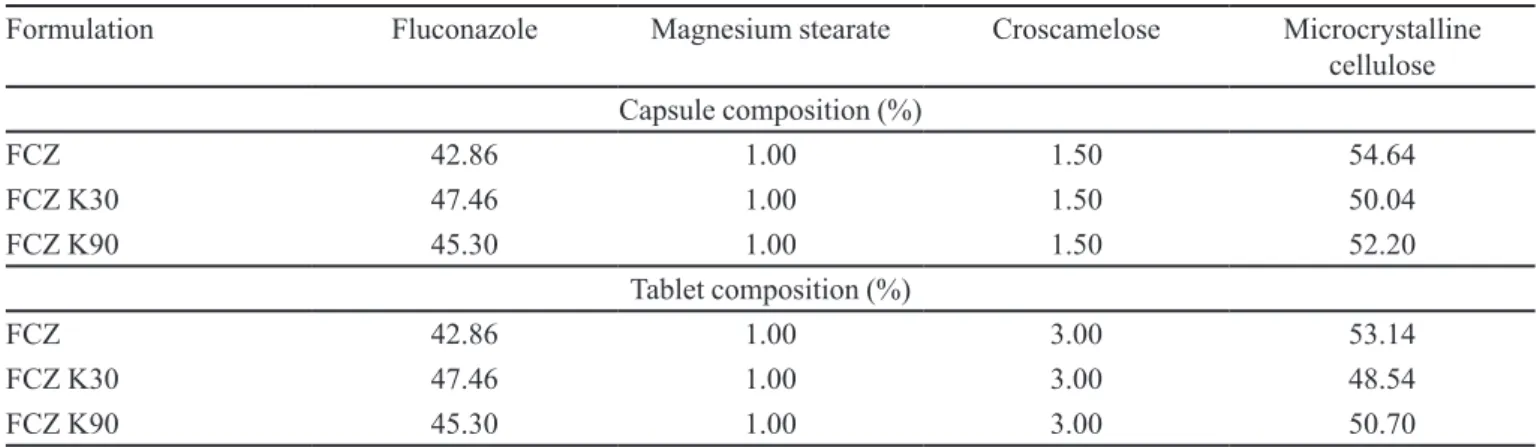
Tablets were produced in a 10 mm single-punch tablet press (Fabbe), with a compression force of 3000 kg, after mixing powders and luconazole granules in an Apex-Multipex biconical mixer. Capsules (n°1) with the same compositions were prepared by manual illing. The compositions of capsules and tablets are shown in Table I.
EQUATION 1 - Percent compressibility (%); bulk density, rbulk
(g∕mL); tap density, rtap (g∕mL).
y = 0.0021x + 0.0012
EQUATION 2 - Analytical curve of the validated
The average weight was obtained over 20 units, according to United States Pharmacopoeia (2008) and Farmacopéia Bra-sileira (1988) methods. The coeficients of variation (CV) were calculated. For each formulation, the friability was evaluated over a sample of 20 tablets. According to oficial speciications, hardness could not be less than 5 Kgf, and for friability, the acceptance criterion was a maximum loss of 1.5% of the initial weight (Farmacopéia Brasileira, 1988).
Dissolution test
The dissolution tests were accomplished in a dis-solution tester (Logan instruments corp., I Model D-800) applying the following conditions (Porta, Chang, Storpirtis, 2005): apparatus 1 (basket), speed of 75 rpm, 900 mL of 0.01 N HCl solution at 37 ± 0.5oC. The iltered aliquots of 10 mL were removed from each vessel at 5, 10, 15, 20, 25 and 30 minutes, with immediate replacement of fresh medium. The percentages of drug dissolved were determined by re-cording each sample in a spectrophotometer at 260 nm, and dissolution proiles of FCZ during the test were obtained.
The dissolution eficiencies (DE%) were determi-ned for the ratio among the area under the dissolution curves, between the times zero and 30 minutes (ASC0-30) calculated applying the trapezoidal method, and the total area of the rectangle (ASCTR) defined for the ordinate (100% of dissolution) and for the abscissa (t=30 minutes) (Khan, Rhodes, 1975). Dissolution eficiency values were submitted to analysis of variance (ANOVA) to evaluate signiicant differences among the dissolution proiles.
RESULTS AND DISCUSSION
Fluconazole granules and lowability studies
Among the many particles properties required in the production of solid dosage form, lowability is essential to
ensure a successful tabletting process. Powder lowability is inluenced by many factors such as particle size, size dis-tribution, shape, surface texture, surface energy, chemical composition, moisture content, vessel geometry and other factors. A common and easy method widely employed in the pharmaceutical industry for lowability measurement is the tapping test (Li et al., 2004; Nokhodchi et al., 2007).
According to Zatloukal and Sklubalová (2007), in order to evaluate the low rate of a layer of material lowing uniformly from the outlet of a cylindrical hopper, the rela-tionship to the bulk density of the powder is more useful than the tapped density which represents the properties of the stagnant layer of non-lowing material at the periphery of the hopper.
The lowability was evaluated for luconazole and granules by the angle of repose, percentage compressibili-ty and also by direct determination of the low through a 10 mm diameter hole. Bulk and tap densities of powder and granules were used to calculate the compressibility index (%). The lowability data are shown in Table II. The com-pressibility and angle of repose were indirect measures of the low and lower values for these parameters indicate better lowability.
The production of granules of fluconazole with PVP (Plasdone® K29/32 and Plasdone®K90) improved
TABLE I - Compositions of capsules and tablets produced with luconazole (FCZ), and luconazole granules (FCZ K30 and FCZ K90).
Formulation Fluconazole Magnesium stearate Croscamelose Microcrystalline cellulose Capsule composition (%)
FCZ 42.86 1.00 1.50 54.64
FCZ K30 47.46 1.00 1.50 50.04
FCZ K90 45.30 1.00 1.50 52.20
Tablet composition (%)
FCZ 42.86 1.00 3.00 53.14
FCZ K30 47.46 1.00 3.00 48.54
FCZ K90 45.30 1.00 3.00 50.70
TABLE II - Flowability characteristics of luconazole (FCZ) and
luconazole granules produced with Plasdone® K29/32 (FCZ
K30) or Plasdone® K90/D (FCZ K90). N=3
Flow (g/s) Angle of repose (a)
Compressibility (%)
FCZ nd nd 38.78
FCZ K30 12.10 39.8 11.54
FCZ K90 13.29 39.9 12.96
angle of repose, low and compressibility of luconazole. No signiicant difference between the two binder agents was observed based on these characteristics. However, different amounts of binder agents were used to produce granules: about 10% PVP K29/32 and approximately 5% PVP K90. Therefore, as expected, PlasdoneK90 presented a more eficient binder capacity than K29/32, because of its viscosity.
Wan et al. (1996), using PVP K29/32 and K90 as binder agents in the production of propranolol granules, observed that PVP of higher molecular weight such as Plasdone® K90, provided stronger bonds to the granules and thus enabled them to better withstand the effects of attritive forces generated during luidized bed granulation.
The amount of luconazole was determined in the granules by an in-house validated spectrophotometric procedure using the equation obtained by the analytical curve. Granules produced with Plasdone® K29/32 (FCZ K30) presented 90.26% FCZ, and the content of lucona-zole in granules produced with Plasdone® K90 (FCZ K90) was 94.62%.
Dosage forms and dissolution studies
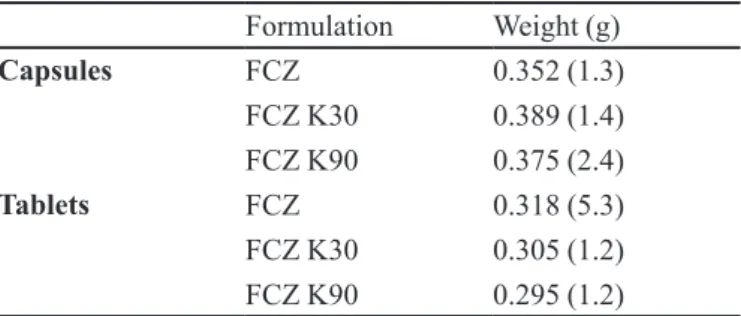
Capsules and tablets were prepared taking into ac-count the luconazole content in the granules. The average weight, hardness, and friability of tablets were obtained according to USP 31 ed. (2008) and Farmacopéia Brasi-leira (1988) as shown in Tables III and IV.
The friability of tablets met the requirements (no greater than 1.5% mass loss). The values for hardness and average weight of the tablets obtained for the luconazole and granules were also within the requirements. However, the coeficient of variation (CV) of FCZ tablets was very high, while values obtained for the luconazole granules
were lower. This indicates that besides poor lowability, which led to uniform filling of the matrix, fluconazole presented reduced compressing capability.
Dissolution profiles of FCZ from capsules and tablets produced with FCZ and FCZ granules (FCZ K30 and FCZ K90) were obtained according to Porta, Chang, Storpirtis(2005). The drug concentrations of each sample were determined by spectrophotometry at 260 nm and the percentages of FCZ dissolved are shown in Table V.
The dissolution eficiencies (DE) were calculated from zero to 30 minutes (ASC 0-30), and these results
TABLE III - Average weight data of capsules and tablets produced
with luconazole (FCZ) and granules (FCZ K30 and FCZ K90). N=20
Formulation Weight (g)
Capsules FCZ 0.352 (1.3)
FCZ K30 0.389 (1.4) FCZ K90 0.375 (2.4)
Tablets FCZ 0.318 (5.3)
FCZ K30 0.305 (1.2) FCZ K90 0.295 (1.2) Coeficients of variations (%) are between parentheses.
TABLE IV – Hardness and friability data of tablets produced with
luconazole (FCZ) and granules (FCZ K30 and FCZ K90). N=20
Tablets Hardness (Kgf) Friability (%)
FCZ 7.10 (87.1) 0.39
FCZ K30 6.41 (10.2) 0.20
FCZ K90 6.50 (9.3) 0.16
Coeficients of variations (%) are between parentheses.
TABLE V – Percentages of drug dissolved for capsules and tablets produced with luconazole (FCZ) and granules (FCZ K30 and
FCZ K90). N=4
Time (min) % luconazole dissolved
Capsules Tablets
FCZ FCZ K30 FCZ K90 FCZ FCZ K30 FCZ K90
were submitted to analysis of variance (ANOVA) which expressed signiicant differences among them (Table VI).
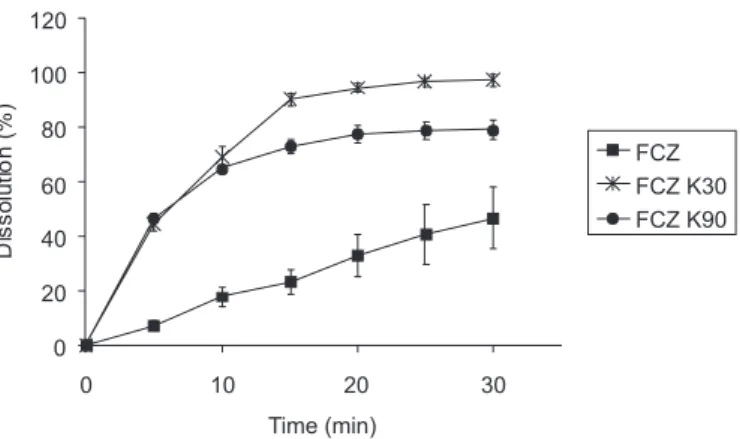
The dissolution proiles of the drug are summarized in Figures 1 and 2. The releases of luconazol from tablets produced with the granules (FCZ P30 and FCZ P90) were much faster than releases from tablets produced with FCZ. Similar results were found for capsules. All tablets and capsules disintegrated rapidly at the beginning of the dissolution process, offering more surface area available for dissolution. More than 60% of the drug was released within 10 min for all formulations produced with granules, in contrast to those obtained with FCZ, which released only 17.7% (capsules) and 10.6% (tablets). Dissolution eficiency data (Table VI) shows that capsules and tablets produced with FCZ presented similar dissolution behavior to that of an extended-release formulation. This inding is in accordance with the studies of Orelli and Leuenberger (2004) who found similar results in a study on release from tablets produced with granules of proquazone. These au-thors considered this dissolution behavior a characteristic of poorly wettable drugs. Therefore, luconazole can be characterized as a poorly wettable drug and consequently, the increased dissolution rate seen in the granule form can be explained by the higher wettability achieved by the addition of the hydrophilic excipient.
Greater improvement in dissolution eficiency was observed when PVP K29/32 was used. Similar results were observed by Albertini et al. (2003) in piroxicam granules or physical mixtures with PVP K12 and PVP K90, where the improvement of dissolution was more signiicant with the use of PVP of lesser molecular weight. This could be explained by the higher viscosity of PVP K90 leading to stronger bonds in granules. Additionally, the drug probably had to pass through a more viscous layer to be released, when PVP K90 was used.
No studies were available on the lowability pro-perties of luconazole, but the results from low, angle of repose and compressibility clearly indicated that direct
TABLE VI - Dissolution eficiency of luconazole from capsules
and tablets produced with FCZ and granules (FCZ K30 and FCZ K90). N=4
Formulation Dissolution eficiency (%) Capsules Tablets FCZ 34.33 (26.7) 12.61 (4.7) FCZ K30 74.24 (1.9) 73.99 (4.4) FCZ K90 63.35 (3.9) 64.96 (7.0) Coeficients of variation (%) are between parentheses.
FIGURE 2 - Drug dissolution proile of tablets produced with
luconazole (FCZ) and granules (FCZ K30 and FCZ K90).
FIGURE 1 - Drug dissolution profile from capsules with
fluconazole (FCZ) and fluconazole granules (FCZ K30 and FCZ K 90).
compression is not possible with this drug. The powder did not low through the hole in the equipment and repose angle and low were not determined. Taking into account that direct compression presents many advantages over other techniques, especially by decreasing the number of stages in the manufacturing process, it would be advanta-geous to use pre co-processed powder containing a large amount of drug for direct compression.
ACKNOWLEDGEMENTS
The authors would like to extend their thanks to International Specialty Products - ISP and Colorcon do Brasil for their technical support and for supplying some equipment and materials.
REFERENCES
ALBERTINI, B.; CAVALLARI, C.; PASSERINI, N.; GONZALES-RODRÍGUEZ, M. L.; RODRIGUEZ, L. Evaluation of B-lactose, PVP K12 and PVP K90 as excipients to prepare piroxicam granules using two granulation techniques. Eur. J. Pharm. Biopharm., v.56, n.3, p.479-487, 2003.
CHA, R.; SOBEL, J. D. Fluconazole for the treatment of candidiasis: 15 years experience. Expert. Rev. Anti. Infect. Ther., v.2, n.3, p.357-366, 2004.
FARMACOPÉIA Brasileira. 4.ed. São Paulo: Atheneu, 1988. p.V.1.1 – V.1.4.
KHAN, K. A.; RHODES, C. T. The concept of dissolution eficiency. J. Pharm. Pharmacol., v.27, n.1, p.48-49, 1975.
KOWALSKY, S. F.; DIXON, D. M. Fluconazole: a new antifungal agent. Clin. Pharm., v.10, n.3, p.179-194, 1991.
LACHMAN, L. H.; LIEBERMAN, A.; KANIG, J. In: Teoria e prática na indústria farmacêutica. Lisboa: Fundação Galouste, 2001. v.2, 899 p.
LI, Q.; RUDOLPH, V.; WEIGL, B.; EARL, A. Interparticle van der Waals force in powder lowability and compactibility. Int. J. Pharm., v.6, n.280, p.77-93, 2004.
MARTINELLO, T.; KANEKO, T. M.; VELASCO, M. V. R.; TAQUEDA, M. E. S.; CONSIGLIERI, V. O. Optimization of poorly compactable drug tablets manufactured by direct compression using the experimental mixture design. Int. J. Pharm., v.322, n.1-2, p.87-95, 2006.
NAIR, L.; BHARGAVA, H. N. Comparison of in vitro dissolution and permeation of luconazole from different suppository bases. Drug Dev. Ind. Pharm., v.25, n.5, p.691-694, 1999.
NOKHODCHI, A.; MAGHSOODI, M.; HASSAN-ZADEH, D.; BARZEGAR-JALALI, M. Preparation of agglomerated crystals for improving lowability and compactibility of poorly flowable and compactible drugs and excipients. Powder Technol., v.175, n.2, p.73-81, 2007.
ORELLI, J.; LEUENBERGER, H. Search for technological reasons to develop a capsule or a tablet formulation with respect with a wettability and dissolution. Int. J. Pharm., v.287, n.1-2, p.135-145, 2004.
PEREIRA, R.; FIDELIS, S.; VANUNCI, M. L.; OLIVEIRA, C. H.; MENDES, G. D.; ABIB, E.; MORENO, R. A. Bioequivalence study of two fluconazole capsule formulations in healthy volunteers. Int. J. Clin. Pharmacol. Ther,.v.42, n.1, p.39-42, 2004.
PORTA, V.; CHANG, K. H.; STORPIRTIS, S. Evaluation of the bioequivalence of capsules containing 150 mg of luconazole. Int. J. Pharm., v.288, n.1, p.81-86, 2005.
RICHARDSON, K.; COOPER, K.; MARRIOTT, M. S.; TARBIT, M. H.; TROKE, P. F.; WHITTLE, P. J. Discovery of luconazole, a novel antifungal agent. Rev. Infect. Dis., v.12, supl.3, p.S267-271, 1990.
UNITED STATES PHARMACOPEIA. 31.ed. Rockville: Pharmacopeial Convention, 2008. p.19, 2412, 2745.
WAN, L. S. C.; HENG, P. W. S.; LING, B. L. Effect of polyvinyl pyrrolidone solutions containing dissolved drug on characteristics of lactose luidized bed granules. Int. J. Pharm., v.141, n.1-2, p.161-170, 1996.
ZATLOUKAL, Z.; SKLUBALOVÁ, Z. Penetrometry and estimation of the low rate of powder excipients. Pharmazie, v.62, n.3, p.185-189, 2007.
Received for publication on 20th October 2008