Arq Neuropsiquiatr 2006;64(3-B):865-868
1Department of Neurological Disorders and Senses, Hospital Geral de Santo António, Porto, Portugal; 2Department of Medicine, Hospital Geral de Santo António, Porto, Portugal; 3Hospital de Barcelos, Barcelos, Portugal.
Received 16 January 2006, received in final form 17 April 2006. Accepted 6 June 2006.
Dr. Luís Monteiro Department of Neurological Disorders and Senses Hospital Geral Santo António Largo Prof. Abel Salazar -4099-001 Porto - Portugal. E-mail: [email protected]
HYPERSOMNIA IN WHIPPLE DISEASE
Case report
Luís F. Maia
1, Mónica Marta
1, Vitor Lopes
2, Nelson Rocha
2,
Carlos Lopes
3, Antônio Martins-da-Silva
1, Luís Monteiro
1ABSTRACT - Whipple disease (WD) is a rare systemic infection caused by Tropheryma whippelii. Neurological involvement has been recognised in 40% of patients, either as initial manifestations or during the course of the disease. We report on a 45 years-old man with WD with initial, persistent and irresistible episodes of daytime somnolence. The patient was HLA-DQB1*0602 positive (genetic marker for narcolepsy). WD diagnosis was suspected on clinical and MRI basis and confirmed by histological and immunohistochemi-cal study of duodenal biopsy. Forty months later all cliniimmunohistochemi-cal features improved, narcoleptic-like episodes disappeared and cerebral MRI and CSF normalised. Longitudinal neurophysiological studies revealed per-sistent sleep pattern abnormalities with sleep fragmentation, paucity of slow wave and of REM sleep. The disruption of the hypocretin circuitry in the hypothalamic - diencephalic region triggered by the infection was the probable cause of the hypersomnia and narcopleptic symptoms. WD should be added to the list of causes of secondary hypersomnia.
KEY WORDS: Whipple disease, hypersomnia, multiple sleep latency test, HLA (DQB1*0602).
Hipersónia na doença de Whipple: relato de caso
RESUMO - A doença de Whipple (DW) é infecção sistémica rara causada pelo Tropheryma whippelii. Cerca de 40% dos doentes apresentam envolvimento neurológico, seja como manifestação inicial da doença, seja durante o seu curso. Apresentamos o caso de um homem de 45 anos com doença de DW com episó-dios iniciais, persistentes e irresistíveis de sonolência durante a actividade diurna. O doente era positivo para o HLA-DQB1*0602 (marcador genético de narcolepsia). A suspeita do diagnóstico de DW foi levan-tada com base na clínica e RM e confirmada por estudo imunocitoquímico do material de biópsia jejunal. Quarenta meses mais tarde, todas as manifestações clínicas melhoraram, os episódios narcolépticos desa-pareceram, e a RM e o LCR normalizaram. Os estudos neurofisiológicos seriados do sono revelaram alter-ações persistentes caracterizadas por fragmentação do sono, escassez de ondas lentas e sono REM. A per-turbação do circuito da hipocretina na região hipotálamo-diencefálica, causada pela infecção, foi a causa provável da hipersónia num doente geneticamente susceptível. A DW deve ser incluída nas causas de hiper-sónia secundária.
PALAVRAS-CHAVE: doença de Whipple, hipersónia, teste de latências múltiplas, HLA (DQB1*0602).
When George H Whipple first described in 1907
the autopsy findings of a case of “intestinal
lipody-strophy” no neurological manifestations were
report-ed and pathology of central nervous system (CNS)
was not described. Whipple disease (WD) was born.
It is now believed that the CNS is the major
extra-in-testinal site of involvement
1,2. Data in the literature
report a variable frequency of neurological
sympto-matology of 5-40% with only 5% with exclusive CNS
involvement
1-4. WD is caused by
Tropheryma
whip-pelii
(TW) and it is generally accepted that both the
presence of the bacillus and the host response are
responsible for the clinical manifestations of WD
1,2.
Classic symptoms and signs of neurological
involve-ment are: vertical ophthalmoplegia, seginvolve-mental
myo-rhythmia, myoclonus, dementia and hypothalamic
manifestations such as hyperphagia and changes in
libido
3,4. Sleep disturbances mimicking narcolepsy are
exceptional
5.
imag-866 Arq Neuropsiquiatr 2006;64(3-B)
ing, HLA genetic characterization,
polysomnograph-ic findings and outcome of a patient with sudden
episodes of hypersomnia, in whom WD was
diagnos-ed by duodenal biopsy. To the best of our knowldiagnos-edge,
this the first description of a case in which frequent
episodes of irresistible daytime somnolence
(resem-bling narcolepsy) are the initial, predominant, and the
most disturbing presenting feature of cerebral WD.
CASE
A 45 year-old man, stone-mason, previously healthy, was admitted with a 6 months history of frequent episodes of sudden daytime sleepiness occurring while working, eat-ing meals or even dureat-ing showereat-ing. It would be difficult to wake him up and the irresistible urge to sleep was be-coming increasingly frequent. Night time sleep was rest-less, with periods of sleepwalking, witnessed in several occa-sions by relatives. After daytime sleep periods a frontal hea-dache was reported, lasting for about two hours. In the course of the disease, the headache became generalized and permanent. During this period the patient ate more than usual and gained 10 kg, exhibiting decreased libido and psychomotor slowness. He also reported in the past, on direct inquiry, short periods of polyarthralgias. Neither diarrhoea or other gastrointestinal symptoms were referred. In the course of hospitalization the patient neurologic status was characterized by: 1- hypothalamic-diencephalic syndrome with frequent irresistible episodes of daytime somnolence, hyperphagia, decreased libido and mild per-sistent hyponatremia; 2- neuro-ophthalmologic syndrome with apraxia of lateral gaze and supranuclear ophthalmo-paresis; 3- myoclonic syndrome with neck and right arm segmental myoclonus, perioral and left laterocervical myo-rhythmia; 4- frontal lobe syndrome with apathy, lack of ini-tiative and psychomotor slowness. Other medical systems examination was normal.
Cerebrospinal fluid (CSF) analysis showed lymphocytic pleocytosis (20 cells/µL; 77% lymphocytes, 10% monocytes, 13% polymorphonuclear leukocytes), normal glucose (0.60 g/L) and protein (0.27 g/L). His complete blood count,
ery-throcyte sedimentation rate, electrolytes, renal, hepatic and thyroid function, B12 vitamin and folic acid level and serum angiotensin conversion enzyme were normal. The serological tests for HIV 1 and 2, syphilis, borrelia, herpes I and II, Epstein Barr virus, cytomegalovirus, Mycoplasma and legionella were negative for acute infection.
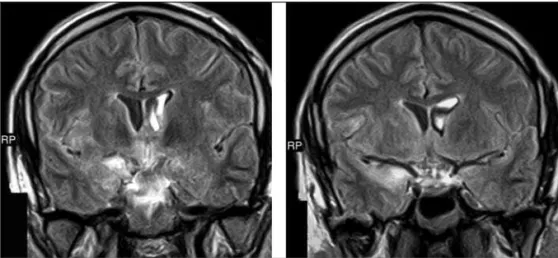
Brain MR imaging showed hyperintense signal on T2 weighted images on the caudate head, frontal operculum, insula, hipocampus, right amygdalo-hipocampal transition and hypothalamo-diencephalic region. All these areas enhanced after gadolinium injection (Fig 1).
Based on the presence of supranuclear ophthalmople-gia, segmental myoclonus and sub-cortical dementia cere-bral, WD was suspected, in spite of the absence of gastroin-testinal symptoms. Histology of duodenal tissue showed a lymphoplasmacytic inflammatory infiltrate with PAS posi-tive staining histiocytes on optic microscopy and the iden-tification of the characteristic rod-shape intracellular organ-ism by electron microscopy (Fig 2). The same tissue tested positive for anti-TWi antibodies by immuno-histochemical Fig 1. MRI images after gadolinium contrast injection: patchy contrast enhanced lesions in
the insula and hippocampus in the right and in the hypothalamic-diencephalic region.
Arq Neuropsiquiatr 2006;64(3-B) 867
analysis. Polymerase chain reaction (PCR) CSF analysis was negative. All these data confirmed the clinical diagnosis of WD. HLA studies reveal the presence of the DBQ1*0602 ha-plotype. Hypocretin studies were not available. Antibiotic treatment started with ceftriaxone IV and streptomycin IM during 4 weeks followed by oral cotrimoxazole the follow-ing 18 months
During hospitalization and follow-up, sleep was stud-ied seven times (summary of the results are on Table). Ini-tially a daytime registration was unsuccessful because the patient did not fall asleep. Only myoclonic jerks were re-corded (Record 1, or R1, on Table). Three MSLT were per-formed, two out of them followed the APSS Committee Guidelines6. On first MSLT (R2) an irresistible sleep episode occurred on Nap 3 (patient fall asleep on Sleep SII and re-mains asleep until the end of MLST; no REM period was present). Four weeks after started treatment a nocturnal recording was performed preceded by a routine EEG at waking period. On night sleep recording (R3) a marked dis-ruption of sleep structure was evident: sleep SII predomi-nant and loss of SWS with limited efficiency (46%). No REM sleep was present. The MSLT on the following morning/day (R4) did not record sleep. Thirty months later myoclonus resolved and very significant regression of the dementia, ocular apraxia and vertical ophthalmoparesis. Although attenuated, rare episodes of hypersomnia still persisted. At that time CSF and brain MRI studies were normal. In spite of the clinical and laboratorial improvement, night sleep recording (R5) showed almost total insomnia with only short periods of SI-SII. Studies performed at 40 months after disease beginning (R6 and 7) showed initial insomnia (Sleep Latency 161 minutes) partial improvement of sleep structure with very short SIV, better sleep efficiency (50%) and incipient REM sleep. A new sleep feature was the
recording of more than 100 obstructive sleep apnoeas, with RDI surpassing 16/hour without significant decrease on O2 saturation. The MSLT did not record sleep. The initial promi-nent sleep features were the extended sleep latency, the paucity of slow wave sleep and the sleep fragmentation and absence of significant REM. Sleep improvement was noted in the last and more recent nocturnal sleep study, in which obstructive sleep apnoeas were recorded.
The patient give informed consent for publication of the case.
DISCUSSION
Whipple disease is a rare systemic infectious
dis-order with prominent but not invariable
gastrointes-tinal involvement. In the present study the patient
with cerebral WD had a clinical picture of myoclonus,
segmental myorhythmias, supranuclear
ophthalmo-paresis, and sudden episodes of hypersomnia
1,3,4. This
CNS multifocal involvement translated into signs and
symptoms suggesting WD prompted us to carry out
a duodenal biopsy which confirmed the clinical
diag-nosis. The peculiarity of this case is the diurnal
irre-sistible episodes of sleep resembling narcolepsy (but
without REM sleep episodes recorded in MSLT), as
the prominent and initial clinical feature. This is, to
our knowledge, for the first time described in detail
by longitudinal PSG records. In previous descriptions,
sleep disturbances in WD patients are just
men-tioned
5,7,8. A case of persistent and prolonged
insom-nia, however, was recently studied in detail
9.
In our patient the episodes of irresistible sleep
Table. Main characteristics of all sleep (night and day recordings). Sleep time, sleep latency and total sleep time are in minutes.
Recording type Sleep Total sleep Sleep Sleep REM sleep and Respiratory Notes
(Record #) latency time efficiency structure REM latency dysfunction
Day recording nsr 0 0 nsr nsr No No sleep recorded
(R 1)
MSLT 13’ Nap 3 na na na No REM No Continuous sleep SII
(R 2) on Nap 3 – Nap 4
Night sleep 344 300 46% SII and No REM No
(R 3) occasionally SIII
MSLT (R4), nsr 0 0 nsr nsr No No sleep recorded
affter R3
Night sleep nsr 0 0 Short periods No REM No Night Insomnia
(R 5) SI- SII (short epochs of SI-SII)
Night sleep 161 328 50.2% SII-SIII, Few REM Yes: Sleep apnoea Total 100 apnoeas
(R 6) occasionally SIV (RDI : Mean 16/H) (mean 02 Sat =95%)
MSLT (R 7) nsr 0 0 nsr nsr No No sleep recorded
after R6
were confirmed by witness (including video by
authors) and on MSLT, although without recording
of REM episodes, pointed to the diagnosis of
“pos-sible” narcolepsy
10. However, REM episodes as seen
in classical forms could be absent in secondary
narco-lepsy
11. Secondary narcolepsy is rare but is known to
occur in cerebral sarcoidosis, pituitary lesions,
cran-iopharyngiomas, strokes, multiple sclerosis, HIV
ence-phalopathy, arteriovenous malformations and
tumo-urs involving the posterior hypothalamus
11,12. An
ex-ception is the anti-Ma2 associated encephalitis where
narcolepsy is frequent
13. The fact that our patient is
HLA DQB1*0602-positive, a strong genetic marker
for narcolepy, suggests that, in an appropriate
set-ting, promoting the disruption of the hypocretin
cir-cuitry an unnoticed subclinical disease may be
reve-aled
10,14. The clinical picture improved significantly
after antibiotic treatment. However, the last PSG (40
months later) showed a disturbed sleep structure
with sleep apnoea.
It is generally accepted that the hypothalamus is
involved in the control of the circadian rhythm, via
the suprachiasmatic nucleus and their connections
including hypothalamic and diencephalic areas is
rel-evant to the wake-sleep cycle generation
15,16. In our
patient the mechanism through which these sleep
disturbances occurred is speculative. However the
association of an genetic marker for narcolepsy
(HLA-DBQ1*0602 haplotype) and a disease involving the
hypothalamic diencephalic region may have triggered
the disruption of the neurobiological control of
sleep-wakefulness in a highly susceptible narcoleptic type
patient. After a follow-up period of more than three
years, the therapy induced a progressive and
sus-tained clinical improvement with disappearance of
all cerebral lesions seen on the first MRI. A
satisfac-tory evolution like that observed with our patient is
rare in CNS involvement of WD
3,4.
In conclusion, clinical suspicion, confirmed by
duo-denal biopsy or PCR studies in the CSF, is the hallmark
of the diagnosis of cerebral WD, which should be
considered on the investigation of sleep disturbances,
particularly when associated to daytime somnolence
and narcolepsy-like attacks.
Acknowledgements – 1. Prof. Didier Raoult, Unité
des Rickettsies, Faculté de Medecine, Marseille, France, for anti-Tropheryma whippelii antibodies testing of duodenal tissue and PCR study of CSF; 2. Prof. Berta Martins da Silva, Immunogenetics Laboratory, Department of Pathology and Molecular Immunology, Instituto Ciências Biomédicas Abel Salazar, University of Porto, for molecular HLA typing; 3. Prof. Manuel Melo Pires, Neuropathology Unit, Department of Pathology, Hospital Geral de Santo António, Porto, for electronic microscopy work.
REFERENCES
1. Marth T, Raoult D. Whipple´s disease. Lancet 2003;361:239-246. 2. Scheld WM. Whipple disease of the central nervous system. J Infect
Dis 2003;188:797-800.
3. Gerard A, Sarrot-Reynauld F, Liozon E, et al. Neurologic presentation of Whipple disease: report of 12 cases and review of the literature. Medicine (Baltimore) 2002;81:443-457.
4. Anderson M. Neurology of Whipple's disease. J Neurol Neurosurg Psychiatry 2000;68:2-5.
5. Mendel E, Khoo L, Go JL, Hinton D, Zee C-S, Apuzzo MLJ. Intracerebral Whipple´s disease diagnosed by stereotactic biopsy: a case report and review of the literature. Neurosurgery 1999;44:203-209.
6. Carskadon MA, Dement WC, Mitler MM, Roth T, Westbrook PR, Kee-nan S. Guidelines for the multiple latency test: a standard measure of sleepiness. Sleep 1986;9:519-524.
7. Silbert SW, Parker E, Horenstein S. Whipple´s disease of the central nervous system. Acta Neuropathol (Berl) 1976;36:31-38.
8. Kremer S, Besson G, Bonaz B, Pasquier B, Le Bas JF, Grand S. Diffuse lesions in the CNS revealed by MR imaging in a case of Whipple dis-ease. Am J Neuroradiol 2001;22:493-495.
9. Voderholzer U, Riemann D, Gann H, et al. Transient total sleep loss in cerebral Whipple's disease: a longitudinal study. J Sleep Res 2002;11: 321-329.
10. Silber MH, Krahn LE, Olson EJ. Diagnosing narcolepsy: validity and reliability of new diagnostic criteria. Sleep Med 2002;3:109-113. 11. Bassetti C, Gugger M, Bischof M, et al. The narcoleptic borderland: a
multimodal approach including cerebrospinal fluid levels of hypocre-tin-1 (orexin A). Sleep Med 2003;4:7-12.
12. Wise MS. Narcolepsy and other disorders of excessive sleepiness. Med Clin N Am 2004;88:597-610.
13. Dalmau J, Graus F, Villarejo A, et al. Clinical analysis of anti-Ma2-asso-ciated encephalitis. Brain 2004;127:1831-1844.
14. Chabas D, Taheri S, Renier C, Mignot E. The genetics of narcolepsy. Annu Rev Genomics Hum Genet 2003;4:459-483.
15. Dauvilliers Y, Billiard M, Montplaisir J. Clinical aspects and pathophys-iology of narcolepsy. Clin Neurophysiol 2003;114:2000-2017. 16. Scammell TE. The neurobiology, diagnosis, and treatment of
narcolep-sy. Ann Neurol 2003;53:154-166.