Arq Neuropsiquiatr 2006;64(2-B):534-537
1Associate Professor of Neuro l o g y, Universidade Federal do Paraná (UFPR), Coordinator of the Residency in Neurology Pro g r a m ,
Hospital de Clínicas, Curitiba PR, Brazil (UFPR);2N e u rologist, PhD, Head of the Cere b rospinal Fluid Laboratory and Unit of
Neuroinfection, Hospital de Clínicas, UFPR; 3Professor of Neurology, Head of the Neurology Service, Hospital de Clínicas, UFPR.
Recebido 13 Abril 2005, recebido na forma final 17 Janeiro 2006. Aceito 8 Março 2006.
Dr. Hélio A.G. Teive - Rua General Carneiro 1103/102 - 80060-150 Curitiba PR- Brasil. E-mail: [email protected]
THE BRAZILIAN CONTRIBUTION TO
THE STUDY OF NEUROCYSTICERCOSIS
Moses and Lange’s role in cerebrospinal fluid diagnosis
Hélio A.G. Teive
1, Sérgio M. de Almeida
2, Lineu César Werneck
3ABSTRACT - We re p o rt the seminal contributions of both Dr. Arthur Moses (Instituto Oswaldo Cruz, Rio de J a n e i ro), in 1911, and Dr. Oswaldo Lange (Faculdade de Medicina da USP, São Paulo), in 1940, to the diag-nosis of neuro c y s t i c e rcosis (NC). Moses was the first person to re p o rt an immunologically based method for the diagnosis of NC, whereas Lange reported the cerebrospinal features of NC.
KEY WORDS: Arthur Moses, immunological diagnosis of neuro c y s t i c e rcosis, Oswaldo Lange, CSF diagnosis of neurocysticercosis, cerebrospinal fluid, neurocysticercosis.
A contribuição brasileira para o estudo da neuro c i s t i c e rcose: o papel de Moses e Lange no diagós-tico liquórico
RESUMO - Descrevemos as contribuições pioneiras de Arthur Moses (Instituto Oswaldo Cruz, Rio de Janeiro ) em 1911 e de Oswaldo Lange (Faculdade de Medicina da USP, São Paulo) em 1940, para o diagnóstico da n e u ro c i s t i c e rcose (NC). Moses fez a primeira descrição mundial de um método para o diagnóstico imunológi-co da NC e Lange fez a descrição da síndrome liquórica da NC.
PA L AV R A S - C H AVE: Arthur Moses, diagnóstico imunológico da neuro c i s t i c e rcose, Oswaldo Lange, diagnós-tico liquórico da neurocisticercose, líquido cefalorraquidiano, neurocisticercose.
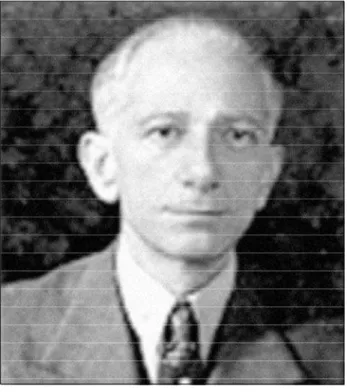
Rio de Janeiro in 1886 and graduated as a physician in 1908. He pursued a career as re s e a rcher of the Ins-tituto Oswaldo Cruz for many years, working in seve-ral diff e rent basic re s e a rch areas of Medicine, such as histology and microbiology; as well as some re s e-a rch in Ve t e r i n e-a ry Medicine, including the descrip-tion of a specific type of myxoma in rabbits8.
As a result of his prolific scientific output, mostly in micro b i o l o g y, Dr. Moses was awarded in 1927 the golden medal of the Kumel award from the Univer-sity of Hamburg in Germ a n y. In 1932 he received ano-ther award from the German Red Cross, personally given by the president of that time8.
Moses also occupied the post of President of the Brazilian Academy of Sciences for years and died in the 23rdNovember 19678.
In 1911, Moses published an article titled “Dos mé-todos biolojicos de diagnóstico nas cisticercozes”, “Bi-ological methods for the diagnosis of cysticercosis”, in C u rrent criteria used for the diagnosis of
neuro-c y s t i neuro-c e rneuro-cosis (NC) inneuro-clude, among others, a positive immuno-assay test (ELISA) used to detect anticysticer-ci antibodies in the cere b rospinal fluid (CSF)1. The
c e re b rospinal syndrome induced by NC has been de-fined by several authors as a combination of pleocy-tosis, demonstration of eosinophils in CSF, high pro-tein content in the CSF and a positive immunologi-cal test in CSF2-5.
Among all the main contributions to CSF diagno-sis of NC are included the works of two Brazilian re-s e a rcherre-s: Dr. Arthur More-sere-s, from Rio de Janeiro, and Dr. Oswaldo Lange, from São Paulo3,5-8.
The aim of our study is to re p o rt how the semi-nal works of Drs. Moses and Lange aided in the CSF diagnosis of NC.
ARTHUR MOSES´CONTRIBUTION
Arq Neuropsiquiatr 2006;64(2-B) 535
a Brazilian periodical “Memórias do Instituto Oswal-do Cru z ”9. In his re s e a rch he used an “aqueous extract”
derived from “Cysticercus celulosae” and obtained pos-itive results when testing it in the serum of thre e patients who had cutaneous cysticercosis and in CSF of another patient who had encephalic cysticerc o s i s3 , 9 - 1 1.
Thus, Moses´work was the first unequivocal demon-stration worldwide of the existence of anticysticerc i antibodies in the CSF of a patient, a diagnosis which was late confirmed through autopsy (Fig 2)3 , 9 - 1 1.
One should remember that We i n b e rg, in 1909, first published the results of his research on the use of porcine serum from pigs infected with “Cysticerc u s
celulosae”, using the liquid material found within the vesicles as an antigen1 1 , 1 2. Ever since, this
immuno-logical test has been known as We i n b e rg ’s re a c t i o n , or We i n b e rg ’s test3 , 1 0 - 1 2. However, We i n b e rg only used
the serum of infected pigs and never tested the re a c-tion in CSF samples11,12.
If we take that into account, the first tests perf o r-med with human serum and human CSF, for the diag-nosis of human cysticercosis and neuro c y s t i c e rc o s i s , re s p e c t i v e l y, were first perf o rmed by Moses in 19119.
The immunological reaction described by Moses was then used by other re s e a rchers, in his original a rticle on the liquoric syndrome found in NC, re p o rt s that Moses´reaction was indeed safe: “...in Brazil, on the other hand, our data demonstrates that comple-ment fixation reaction for cysticercosis merits confi-d e n c e ”1 1. Lange also stresses in his article that
Mo-ses´own work antedated those of several fore i g n researchers11.
Reis and col. suggest that Arthur Moses should be honoured, and the reaction first described by him should be known as “Moses reaction”, instead of “Weinberg’s reaction”, as it is widely known3.
F i n a l l y, the fact that Moses made published his own experience in a Brazilian periodical with low in-t e rnain-tional re p e rcussion, even in-though iin-t was boin-th published in Portuguese and in German, might have been the main reason why his discovery had so little scientific impact at the time.
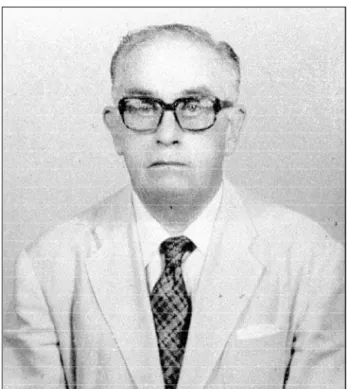
OSWALDO LANGE´S A CONTRIBUTION D r. Oswaldo Lange (Fig 3) was born in São Paulo, S P, on the 28t hAugust 1903. He graduate in Medicine
at the Faculdade de Medicina (Faculty of Medicine) which would later become part of the Universidade de São Paulo (University of São Paulo) in 19276,7. He
was a member of the group of collaborators work-ing with Dr. Enjolras Vampré, the founder of the school of Neurology in São Paulo, and for several ye-ars was the Chief of the Neurologic Clinic of Facul-dade de Medicina da UniversiFacul-dade de São Paulo6 , 7.
In 1938 he was awarded the title “livre docente” in N e u ro l o g y, after succeeding in a written examina-tion and in an evaluaexamina-tion of his curriculum vitae6,7.
Lange was among the founders of many medical societies, such as the Associação Paulista de Medicina, w h e re he acted also as the editor of the Revista Pau-lista de Medicina, and the Academia Brasileira de Neu-rologia (Brazilian Academy of Neurology), working as a delegate for the World Federation of N e u ro l o g y6 , 7.
Also of extreme importance is the fact that Os-waldo Lange was the founder of the official journ a l
Fig 1. Dr. Arthur Moses (1886-1967).
536 Arq Neuropsiquiatr 2006;64(2-B)
of de Brazilian Academy of Neuro l o g y, the “Arq u i v o s de Neuro-Psiquiatria” in 1943, working as it’s editor for 44 years in a row. Lange passes away on the 29th
August 1986, exactly one day after he had turned 83 years-old6,7.
F rom very early in his care e r, Lange had a gre a t i n t e rest in the study of the cere b rospinal fluid and how it could be used in clinical practice, which made him the first neurologist devoted to the study of CSF in our country. Through his academic life he pub-lished several studies on CSF findings, mostly re l a t-ed either to NC or neurosyphilis6.
In 1936 published his first paper on CSF abnorm a l-ities in Central Nervous System Cysticercosis and in 1940 described in minute detail the cere b rospinal fluid syn-d rome founsyn-d in NC, inclusyn-ding the complement-fixa-tion test, the occurrence of pleocytosis with eosinophils and the elevated protein content (Fig 4)1 0 , 1 1.
After studying the CSF abnormalities in 24 cases of NC, he came to the following conclusions: “...1-high CSF pre s s u re, elevated cell count, elevated albu-min and globulin content are not sufficient for the diagnosis of encephalic cysticercosis; 2- colloidal floc-culations of the parenchymatous type and a negati-ve Wa s s e rman reaction are indicators of pro b a b i l i t y ; 3- the presence of eosinophils in the CSF is an excel-lent tool in the investigation of encephalic parasito-sis; 4- We i n b e rg ’s reaction with total alcoholic extract of “Cysticercus celulosae” is the only tool that gives certainty to the diagnosis“11.
L a n g e ’s studies clearly stated that despite the fact that the finding of eosinophils in the CSF is very impor-tant in supporting the obligatory for the diagnosis of N C1 0 , 1 1. Lange established that: “the demonstration of
eosinophils in the CSF is not constant in meningoaxial c y s t i c e rcosis and cannot be used as a substitute for We i n b e rg ’s reaction, which is the only test that can be c o n s i d e red specific amid the other CSF changes”1 1.
The published studies of Lange were even cited by Del Bruto, Sotelo and Román in 19981 3, when
writ-ing on the use of the complement fixation test (CFT): “initially developed to determine the presence of a n t i c y s t i c e rcal antibodies in serum, Lange (1949) used the CFT in CSF with better results; the author consid-e rconsid-ed that a positivconsid-e CFT was part of a charactconsid-eristic “CSF syndrome” of neuro c y s t i c e rcosis that also includ-ed the presence of eosinophils and increasinclud-ed pro t e i n levels”13.
CONCLUSION
Two Brazilian re s e a rchers, Dr. Arthur Moses, in Rio de Janeiro (Instituto Oswaldo Cruz) in 1911, and Dr. Oswaldo Lange, in São Paulo (Faculdade de Medicina da Universidade de São Paulo) in 1940, contributed immensely to the cere b rospinal fluid diagnosis of n e u ro c y s t i c e rcosis. The former was the creator of the reaction used in both blood and CSF samples for the immunological diagnosis of cysticercosis, whereas the latter described in detail the CSF findings of what he termed CSF syndrome in NC.
Aknowledgments- The authors would like to thank P rofessor Antonio Spina-França for providing us with a pho-tograph of Dr. Oswaldo Lange, as well as many important bibliographic re f e rences. We would also like to tha nk Dr.
Fig 3. Dr. Oswaldo Lange (1903-1986)
Arq Neuropsiquiatr 2006;64(2-B) 537
Francisco M.B. Germiniani for the translation of this man-uscript. Extended thanks got to the Academia Brasileira de Ciências (Brazilian Academy of Sciences) for the biograph-ic data of Dr. Arthur Moses.
REFERENCES
1. Del Brutto OH, Rajshekkar V, White AC Jr, et al. Proposed diagnostic criteria for neurocysticercosis. Neurology 2001;57:177-183.
2. Spina-França A. Cerebrospinal fluid syndrome induced by neurocys-ticercosis. Arq Neuropsiquiatr 1961;19:307-314.
3. dos Reis JB, Bei A, dos Reis Filho JB. Líquido cefalorraquidiano, São Paulo: Sarvier, 1980:196-202.
4. Spina-França A, Livramento JA, Machado JR. Cysticercosis of the cen-tral nervous system and cere b rospinal fluid: immunodiagnosis of 1573 patients in 63 years. Arq Neuropsiquiatr 1993;51:16-20.
5. M o n t e i ro Sales F. Sôbre o diagnóstico da cisticercose humana. A rq Inst Penido Burnier (Campinas) 1934;3:183-196.
6. Spina-França A. Homenagem a Dr. Oswaldo Lange. A rq. Neuro p s i-quiatr 1986;44:321-324.
7. Spina-França A. Editorial. O Centenário do Dr. Oswaldo Lange. A rq Neuropsiquiatr 2003;61:1-6.
8. h t t p : / / w w w. a b c . o rg.br/historia/a_mosest7.html.(Academia Brasileira de Ciências, Site Oficial, 2004)..
9. Moses A. Dos métodos biolójicos de diagnóstico nas cisticercozes. Mem Inst Oswaldo Cruz, 1911;3:322-326.
10. Lange O. O líquido cephalo-rachidiano na cysticercose do sistema nervoso central. Revista de Neurologia e Psychiatria de S. Paulo. 1936;2: 52-60.
11. Lange O. O síndromo liquórico da cisticercose encéfalo-meningéia. Revista de Neurologia e Psiquiatria de São Paulo, 1940;2:35-54. 12. Trelles JO, Trelles L. Cysticercosis of the nervous system. In: Vinken PJ,
B ruyn GW (eds). Handbook of clinical neuro l o g y, Volume 35 (Infections of the Nervous System). A m s t e rdam: North-Holland Publishing Com-pany, 1978:291-320.