Short Report
Potentiometric and Conductometric Studies on the Formation
of Thorium Molybdates as a Function of pH
Shiva Prasad* and Sílvia B. Gonçalves
Departamento de Engenharia Química, CCT, Universidade Federal da Paraíba, CP 10108, 58109-970, Campina Grande - PB, Brazil.
A formação de molibdatos de tório obtidos pela interação de nitrato de tório com molibdato de sódio a níveis específicos de pH 7,8; 5,5 e 4,1 foi estudada por técnicas eletrométricas envolvendo titulações condutométricas e pH-métricas. As inflexões e degraus bem definidos nas curvas de titulações fornecem evidências incontestáveis sobre a formação de molibdatos normal-ThO2.2MoO3
e para-3ThO2.14MoO3 de tório nas vizinhanças dos pH’s 5,3 e 4,4, respectivamente. As
investigações analíticas sobre os precipitados de molibdatos de tório também foram realizadas, as quais confirmaram os resultados eletrométricos.
The formation of thorium molybdates obtained by interaction of thorium nitrate and sodium molybdate at specific pH levels 7.8, 5.5 and 4.1 have been studied by electrometric techniques involving pH and conductometric titrations. The well-defined inflections and breaks in titration curves provide cogent evidence for the formation of thorium normal-ThO2.2MoO3 and para-3ThO2.14MoO3
molybdates in the vicinity of pH 5.3 and 4.4, respectively. Analytical investigations on the precipitates of thorium molybdates have also been carried out, which support the electrometric results.
Keywords: molybdates, thorium molybdates, electrometry
J. Braz. Chem. Soc., Vol. 11, No. 2, 199-202, 2000. Printed in Brazil
c 2000 Soc. Bras. Química 0103 - 5053 $6.00+0.00
Presented at the XI Simpósio Brasileiro de Eletroquímica e Eletroana-lítica, Maragogi - AL, Brazil, April 5-9, 1999. Guest editor: Luis Alberto Avaca.
Introduction
The chemistry of molybdenum is very prominent in both biological and industrial systems1,2. Recent studies have
shown that certain molybdates have antiviral, including anti-AIDS and antitumor activity3. Although a large number of
studies have been done in the field of molybdate chemistry, the chemical state of isopolymolybdates, obtained on acidification of a molybdate solution, is not well understood because of the complexity in polymerization. Numerous species such as HMoO4-, H2MoO4, Mo2O77-, Mo3O114-,
HMo3O113-, Mo6O192-, HMo6O215-, H2Mo6O214-,
H3Mo6O213-, Mo7O246-, HMo7O245-, H2Mo7O244-,
H3Mo7O243-, Mo8O264-, HMo8O263-, Mo12O372-,
H7Mo12O413-, H7Mo24O785-, H9Mo24O783-, Mo36O1128-,
etc. have been proposed4-11.
In earlier publication12 one of us reported the effect of
pH change on a solution of sodium molybdate and composition of mercuric molybdates. In view of the
interesting results obtained, it was considered worthwhile to investigate the composition of thorium molybdates obtained by the action of Th4+ on various molybdate species
at different pH levels by means of electrometric techniques, which have pr ovided more conclusive evidence on condensation processes of vanadate, antimona te, thiotungstate and tungstate anions13. There is, however, no
reference available in the literature on the formation of thorium molybdates as a function of pH.
Experimental
Th(NO3)4, Na2MoO4.2H2O, oxine and different acids of
extra-pure grade were used and their solutions were prepared in deionized distilled water. Concentration of sodium molybdate solutions was further verified by determining molybdenum with oxine as MoO2(C9H6ON)214ª.
200 Prasad et.al J. Braz. Chem. Soc
a series of pH and conductometric titrations was performed both by direct and reverse methods, i.e. when thorium nitrate solution from the microburette was added to the alkali molybdate solution and vice-versa. The observed pH changes were plotted as a function of volume of the titrant added. The inflections obtained by the curves were confirmed by the pronounced maxima in dpH/dV graphs. The breaks in the conductometric titrations are located by plotting corrected conductance as a function of volume of titrant added. The same concentrations of reactants were employed in the two techniques for the sake of comparison of results. The pH and conductometric titration curves are plotted together in the same figure for similar reasons and also for the sake of brevity. The electrometric titration results are summarized in Table 1.
The precipitates obtained at the end-points were also analyzed to substantiate the electrometric results. The different thorium molybdates were prepared by mixing stoichiometric amounts of thorium nitrate solution with the respective sodium molybdate solutions. The precipitates obtained were washed several times with 20% ethanolic solution and dried in a vacuum desiccator for 40 h. An amount exactly known (ca. 2.0 g) of each of the above precipitates was dissolved in minimum quantity of hydrochloric acid and then analyzed quantitatively for molybdenum by oxine14a and thorium as oxalate14b. The
results of analysis are given in Table 2.
Results and Discussion
When hydrochloric acid is gradually added to Na2MoO4, it changes to para-molybdate Mo7O246- and
Table 1. Summary of results of electrometric study. Volume of titre solution taken in the cell = 25 mL
Solutions concentrations Equivalence points (mL) Formula supported
×103 mol L-1 Calcd. Observed from
pH Cond.
Th(NO3)4 Na2MoO4 Direct titrations. Fig. 1, curves 1 and 2
50.00 10.00 2.50 2.50 2.50 ThO2.2MoO3
25.00 4.00 2.00 2.00 2.00
12.50 2.22 2.22 2.20 2.20
Reverse titrations. Fig. 1, curves 3 and 4
4.00 100.00 2.00 2.00 2.00 ThO2.2MoO3
2.22 50.00 2.22 2.25 2.20
1.25 25.00 2.50 2.55 2.55
Th(NO3)4 Na6Mo7O24 Direct titrations. Fig. 2, curves 1 and 2
25.00 1.33 2.00 2.00 2.00 3ThO214MoO3
14.29 0.80 2.10 2.10 2.10
10.00 0.57 2.14 2.15 2.15
Reverse titrations. Fig. 2, curves 3 and 4
1.67 12.50 2.22 2.25 2.25 3ThO2.14MoO3
1.00 6.67 2.50 2.50 2.55
0.50 4.00 2.08 2.10 2.10
octa-molybdate Mo8O264- polyanions around pH 5.5 and
4.1, respectively12. The formation of the polyanions may
be represented as follows:
8H+ + 7MoO
42- = Mo7O246- + 4H2O
12H+ + 8MoO
42- = Mo8O264- + 6H2O
Normal-molybdate titrations
Using different concentrations of Na2MoO4 (pH 7.8)
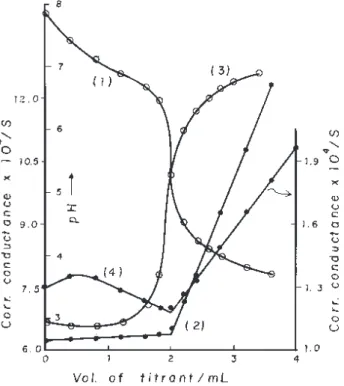
and thorium nitrate (pH 2.9) solutions, a series of pH titrations was carried out. In direct titrations (Figure 1, curve 1), when Na2MoO4 solution was used as titre, a gradual
decrease in pH value was observed till at the stoichiometric end-point (the stage at which the reaction ends if simple double decomposition takes place), a sharp downward jump in pH was observed when the molar ratio of Th4+:MoO4
2-is 1:2, corresponding to the formation of white colored precipitate of thorium normal-molybdate, ThO2.2MoO3,
in the neighborhood of pH 5.3. In case of inverse titrations (Figure 1, curve 3) the pH at first gradually changes till in the vicinity of the stoichiometric end-point, when the last traces of thorium ions have been removed by precipitation, further addition of alkali molybdate causes a marked upward jump in pH and the inflection corresponds to the molar ratio for the formation of ThO2.2MoO3 according
to the reaction:
Th(NO3)4 + 2Na2MoO4 = ThO2.2MoO3 + 4NaNO3
Vol. 11 No. 2, 2000 Studies on the Formation of Thorium Molybates as a Function of pH 201
Table 2. Summary of analytical results of the precipitates
Proposed formula of Mode of synthesis Analysis % Found (Calculated)
the compound T h M o
Analysis of the normal molybdate precipitates
ThO2.2MoO3 Direct* 41.98(42.04) 34.82(34.77)
Reverse* 42.07 34.74
Analysis of the paramolybdate precipitates
3ThO2.14MoO3 Direct 24.75(24.80) 47.91(47.85)
Reverse 24.84 47.80
*Direct – Thorium nitrate solution added to sodium molybdate solution. Reverse – Sodium Molybdate solution added to thorium nitrate solution.
Figure 1. Normal-molybdate titrations. (1 and 2) M/40 Th(NO3)4
added to 25 mL of M/250 Na2MoO4. (3 and 4) M/10 Na2MoO4
added to 25 mL of M/250 Th(NO3)4.
nitrate and sodium molybdate gave well-defined breaks at 1:2 molar ratio of Th4+:MoO
42- confirming the formation
of thorium normal-molybdate.
Para-molybdate titrations
Sodium para-molybdate solution was prepared by addition of hydrochloric acid to Na2MoO4 in the molar
ratio 8H:7Mo. Using different concentrations of Th(NO3)4 and Na6Mo7O24, a series of pH and conductometric
titrations was carried out. The slope and nature of these titration curves (Figure 2) are similar to those of the normal-molybdate. The curves provide well-defined inflections at molar ratio 3:2 of Th4+:Mo7O246- corresponding to the
stoichiometry for the formation of para-molybdate of thorium 3ThO2.14MoO3 in the neighborhood of pH 4.4.
The reaction can be represented as follows:
3Th(NO3)4 + 2Na6Mo7O24 =
Figure 2. Para-molybdate titrations. (1 and 2) M/40 Th(NO3)4
added to 25 mL of M/750 Na6Mo7O24. (3 and 4) M/80 Na6Mo7O24 added to 25 mL of M/600 Th(NO3)4.
(3ThO2.14MoO3) + 12NaNO3
An interesting phenomenon was observed, in both pH and conductometric reverse titrations, i.e., when thorium nitrate solution was taken as titre in the cell. In the initial part of the titration the pH slightly decreases (curve 3) and conductance value increases (curve 4). This may be ascribed to the liberation of the strong acid by hydrolysis of thorium nitrate under experimental conditions. This phenomenon may further be clarified by the fact that the white turbid precipitate of thorium molybdates, which starts from the very beginning in the case of direct titrations, starts only at the stoichiometric end-point in these reverse titrations. After passing the end-point the white precipitate gets flocculated.
202 Prasad et.al J. Braz. Chem. Soc
appreciable inflections. This may be ascribed to the small difference in pH value of the reactants; and the presence of sodium nitrate in appreciable amounts preventing the occurrence of breaks in the conductometric titration curves.
It was noted that after each addition of the titrant, it takes a little time for the pH and conductance values to become steady. A thorough stirring in the neighborhood of the equivalence point has a favorable effect. The presence of ethanol (20%) improves the position of the end-point and increases the magnitude of the jump in pH cur ves, as it decr eases the solubility of the precipitates formed and minimizes hydrolysis and adsorption.
Analytical results
The results of the quantitative elemental analyses of the precipitates were used to calculate the proportions of the elements present in the compounds. From these proportions, the compositions of the compounds were established which were found to be the same as obtained by the electrometric techniques (see Table 2).
The present electrometric and analytical investigations confirm the formation and precipitation of two thorium molybdates, viz. nor mal-ThO2.2MoO3 and par a -3ThO2.14MoO3 in the vicinity of pH 5.3 and 4.4, respectively.
As structure of these compounds is not known they are represented as double oxides, the manner which is usually adopted for such compounds15,16.
Acknowledgement
The authors are indebted to the CNPq for financial assistance.
References
1. Haber, J. The Role of Molybdenum in Catalysis;
Climax Molybdenum; London, 1981.
2. Simpson, C. H. Amer. Paint. Coating J. 1992, 66. 3. Kopf-Maier, P.; Klopotke, T. J. Cancer Res. Clin.
Oncol. 1992, 118, 216.
4. Jander, G.; Jahr, K. F.; Henkesheshoven, W. Z. Anorg. Chem. 1930, 194, 383.
5. Bye, J. Bull. Soc. Chim. Fr. 1957,1023.
6. Sasaki, Y.; Lindeqvist, I.; Sillen, L. G. J. Inorg. Nucl. Chem.1959, 9, 93.
7. Sasaki, Y.; Sillen, L. G. Acta Chem. Scand. 1964, 18, 1014. 8. Sasaki, Y.; Sillen, L. G. Ark. Khemi. 1967, 29, 253. 9. Aveston, J.; Anacker, E. W.; Johanson, J. S. Inorg.
Chem.1964, 3, 735.
10. Pope, M. T. Molybdenum Oxygen Chemistry: Oxides, Oxo Complexes and Polyanions, in: Progress in Inorganic Chemistry,
Lippard, S.J., Ed.; Interscience; New York, 1991, v. 39. 11. Ozeki, T.; Adachi, H.; Ikeda, S Bull. Chem. Soc. Jpn.,
1996, 69, 619.
12. Prasad, S.; Guimarães, T. L. M. J. Bras. Chem. Soc., 1998, 9, 253.
13. (a) Prasad, S. An. Acad. Bras. Ci. 1981, 53, 471. (b) Prasad, S. Bull. Electrochem. 1990, 6, 163. (c) Prasad, S. Can. J. Chem. 1981, 59, 563. (d) Prasad, S. Quím. Nova. 1994, 17, 31.
14. Vogel, A. I. A. Textbook of Quantitative Inorganic Analysis; 3rd. Edition; Longmans; London, 1968, p. (a) 508, (b) 541. 15. Standen, A.; Ex. Ed., Kirk-Othmer Encyclopedia of Chemical Technology, 2nd. Edition; Interscience Publishers; New York, 1967, v. 13, p. 782.
16. Brauer, G., Ed. Handbook of Preparative Inorganic Chemistry, 2nd. Edition, Academic Press; New York, 1965, v. 2, p. 1705.