Cobalt(II) Hematoporphyrin IX Immobilized in a Cellulose Acetate
Niobium(V) Oxide Composite Membrane: Preparation and Oxygen
Reduction Study
Yoshitaka Gushikem*, and Elvio A. Campos
Instituto de Química, Unicamp, C.P. 6154, 13083-970 Campinas - SP, Brasil
November 27, 1997
A Hematoporfirina IX [ácido (8,13,-bis(1-hidroxietil)-3,7,12,17-tetrametil-21-H-porfirina-2,18-dipropionico)] foi absorvida na superfície da membrana composta orgânica/inorgânica Cel/Nb2O5. A porfirina é fortemente aderida à superfície do Nb2O5 pela interação com o grupo
carboxílico --COOH da porfirina e formação da ligação --COO--Nb. A metalação do anel porfirínico é feita mergulhando-se a membrana na solução de Co(II) por algumas horas. As bandas de absorção eletrônica Q indicaram a mudança de simetria de D2h para D4h pela metalação do anel porfirínico.
A análise química demonstrou que a metalação ocorreu com rendimento de práticamente 100%. O oxigênio foi reduzido na superfície do eletrodo feito com o material a um potential de pico de -390 mV em solução de KCl 1 M a pH 1, a uma temperatura de 298 K à pressão ambiente. Supõe-se que o processo de redução ocorre segundo o mecanismo de transferência de dois elétrons. Foi obtida uma resposta linear da corrente de pico catódico para concentrações do oxigenio dissolvido entre 1,5 e 15 ppm.
Hematoporphyrin IX [8,13,-bis(1-hydroxyethyl)-3,7,12,17-tetramethyl-21H-porphyrin-2,18-dipropionic acid] was adsorbed on the organic-inorganic composite membrane Cel/Nb2O5 surface.
The porphyrin is strongly adhered on the Nb2O5 surface by reaction of the porphyrin CO2H groups
with Nb2O5 forming the --COO--Nb chemical bond. Metallation of the porphyrine ring was made
very easily by immersing the membrane in Co(II) solution and allowing to rest for a few hours. The electronic absorption bands due to the Q bands indicated the symmetry change from D2h to D4h
upon metallation of the porphyrin ring. The chemical analyses of the material confirmed that the metallation yield was practically 100%. Oxygen was reduced on a electrode surface made with the material under a cathodic peak potential of -390 mV, in 1 M KCl solution at pH 1, temperature of 298 K and at ambient pressure. The oxygen reduction was proposed to occur by a two electron transfer mechanism. A linear cathodic peak current response was obtained for dissolved oxygen concentrations between 1.5 and 15 ppm.
Keywords: Co(II) hematoporphyrin IX, celullose acetate membrane, cellulose-niobium(V) oxide composite membrane, oxygen catalytic reduction
Introduction
Niobium pentoxide has been investigated with respect to its surface acid strength, ion exchange capacity, and use as specific sorbent for many metal ions1-3. Since the bulk
oxide is normally obtained as a fine untractable powder with poor mechanical resistance, it has been dispersed on a surface of silica gel4. However, the mineral matrix is rigid
and for some applications where molding of the material is required it is not convenient. In a recent work, the obtention
and characterization of the composite membrane celu-lose/oxide, Cel/Nb2O5, with high degree dispersion and
homogeinity of the oxide particles was described5. The Lewis acid sites of the dispersed oxide were shown to be reasonably stable. It is known that these Lewis acid sites can immobilize an organic acid enabling the chemical species be tightly anchored to the metal oxide by the --COO--Nb bond formation and thus, avoiding leaching from the surface as the material is immersed in a solvent6.
Article
In this work the immobilization procedures of he-matoporhyrin IX [8,13,-bis(1-hydroxyethyl)-3,7,12,17-tetramethyl-21H-porphyrin-2,28-dipropionic acid], H2(HMP), in cellulose/niobium(V) oxide composite
mem-brane and further metallation with cobalt (II) ion are de-scribed. The nature of the cobalt ion was firstly investigated, since it has been described that the metal is readily oxidized in air7. A membrane of the resulting ma-terial was adhered on a platinum electrode surface and the study of electrocatalytic reduction of dissolved oxygen by the electroactive species is also reported in this work.
Experimental
Preparations
About 10 g of cellulose acetate (Aldrich, 2.5 degree of acetylation) was added to a mixture containing 31 mL of glacial acetic acid and 71 mL of acetone. The mixture was vigorously stirred for 2 h and allowed to rest for 24 h after which a viscous syroup was formed. Freshly sublimed NbCl5 (2 g) was added into 10 g of the celullose acetate
syrup and the mixture stirred under a nitrogen atmosphere until complete dissolution of the metal halide which oc-cured with evolution of gaseous HCl. The reaction flask was purged with nitrogen until almost all entrapped HCl was eliminated and could not be detected in the syrup. The test for Cl- was carried out by adding AgNO3 solution into
a sample taken from the syrup and diluted with 0.1 M HNO3
solution. This viscous syroup is named as solution A. Films of the composite membranes were prepared by spreading the solution A over a glass plate and the thickness was controlled to 200 µm by using a spacer. The film was allowed to rest for 2 h open to room atmosphere in order to evaporate most of the solvents. To promote the metal hydrolysis, the glass plate was immersed in distilled water and the film was detached from the surface.
About 0.054 g (10-4 mol) of H
2(HMP) (Sigma) was
dissolved in 50 mL of ethanol/water solution (9:1 v/v). The membrane of Cel/Nb2O5 with approximately 3 cm2 was
immersed in this solution and after 4 h it was washed and stored in bidistilled water protected against light. To met-allate this membrane, it was immersed in 0.1 M CoCl2
aqueous solution for 5 h with occasional shaking. The membrane was washed with water and dried at 333 K.
Chemical analyses
The quantity of incorporated metal oxide in the matrix was determined by igniting the material to 1173 K for 1 h and weighing the residue as Nb2O5.
In order to determine the amount of metallated he-matoporphyrin incorporated in Cel/Nb2O5, 0.1 g of the
membrane was immersed in concentrated sulphuric acid and gently heated until dissolution. To analyze the metal, the solution was carefully diluted to 100 mL and
neutral-ized with sodium bicarbonate aqueous solution (10% m/v) and measured on a atomic absorption spectrometer. The amount of porphyrin molecule was determined by nitrogen determination using the Kjeldhal method. The results of the elemental analyses can be summarized as follow: N = 152 ± 3 µmol g-1 (corresponding to 38 µmol g-1of He-matoporhyrin); Co = 39.5 ± 0.8 µmol g-1. The results indicate that porphyrin ring metallation was 100%.
Spectra measurements
The UV-Visible spectra of Cel/Nb2O5/HMP thin films,
metallated and unmetallated, were obtained on a Beckman DU 640 spectrophotometer.
Electron spin resonance spectrum of the sample was obtained at 77 K, frequency modulated at 9.45 gHz. The equipment used was a Bruker 106 electron spin resonance spectrometer.
Electrochemical measurements
The electrode, consisting of a glass tube with a platinum disk fused at one end was immersed in the solution A, in which LiCl was previously dissolved (0.1 g per gram of solution A). The objective of adding this electrolyte in solution A was to obtain a porous membrane adhered on the platinum surface5. The solvent was evaporated in air and the film adhered electrode was washed with water. Adsorption of the porphyrin on the film was made by dipping the electrode in 10-4 M H2(HMP) ethanol/water
(9:1 v/v) solution, as described above. The metallation procedure was the same as that described above. The elec-trode was stored in a 1 M KCl solution.
Cyclic voltammetry study
The cyclic voltammetry studies were carried out in a cell with three electrodes: the saturated calomel electrode was the reference, the counter electrode was a platinum wire and the electrode prepared as above was the working electrode. The measurements were carried out on a PAR 273 A model instrument.
Dissolved oxygen
To measure the electrode response to dissolved oxygen, the cell was filled with 1 M KCl solution at pH 1 and saturated with pure oxygen at 298 ± 0.5 K. To change the concentration of the oxygen, argon was passed through the solution and the content of oxygen in each case determined by the Winkler method8.
Results and discussion
Organic compounds having carboxylate functional groups are immobilized on niobium oxide surface by a --COO--Nb bond formation6. Figure 1 illustrates the HMP and Co(HMP) immobilized on Cel/Nb2O5. The pKa of the
protonated imino nitrogens of the porphyrin ring are 3.0 and 6.1 in water9 and thus, insertion of the metal ion in the porphyrin ring is not difficult. The absorption spectra are shown in Fig. 2. The H2(HMP) absorbs intensely at λmax
350 nm (Soret band, corresponding to the strongly allowed transition from a1u to eg energy levels) and more weakly
between 470 and 630 nm (Q bands, correponding to the transition from a2u to eg energy levels10) (Fig. 2A). Upon
metallation of the porphyrin ring system, a change in the spectrum (Fig. 2B) is observed. For H2(HMP) the Q bands
(λmax in nm) are observed at 470, 530, 570 and 620 and, for
Co(HMP) at 520 and 560. The decrease in the number of bands is assigned to the symmetry increase of the
metal-lated complex relative to the free immobilized porhyrin (Fig. 1) i.e., the symmetry changed from D2h in
Cel/Nb2O5/HMP to D4h in Cel/Nb2O5/Co(HMP). As the
chemical analyses showed above, almost all porhyrin rings were metallated. The Soret band is broadened in the unmet-allated ring due to dimerization of the porphyrin rings and it becomes narrower upon metal incorporation9.
ESR spectrum
It has been reported that the complex of cobalt (II) with hematoporhyrin is readly oxidized in air7. In order to certify that in the present case such oxidation can also occur, the esr spectrum of the Cel/Nb2O5/Co(HMP) was obtained at
77 K. The spectrum is shown in Fig. 3.
Under magnetic field below 3000 gauss, the g values are 2.573 and 2.315 which correspond to a CoII species and
the signal observed between 3200 and 3500 gauss (inserted figure in detail) is an indication of the existence of molecu-lar oxygen from air coordinated to CoII 11,12. The calculated
parameters are: g|| = 1.973 and g⊥ = 2.042; hyperfine coupling constants A|| = 14.24 x 10⁻⁴ cm-1 and A
⊥ = 15.83 x 10⁻⁴ cm-1.
N N
N N
CH3
CH CH
H3C
CH3
OH H3C
CH3
OH
H3C
H H
C C O
O
Nb O
O
Nb
N N
N N
CH3
CH CH
H3C
CH3
OH H3C
CH3
OH
H3C
C C O
O
Nb O
O
Nb Co
+
CoCl2
-2 HCl
Figure 1. Metallation of the Hematoporphrin IX immobilized on Cel/Nb2O5 with Co(II). The symmetry of the ring changes from D2h to D4h on metallation.
Figure 2. UV-Visible spectra of the membranes: A) Cel/Nb2O5/HMP, B) Cel /Nb2O5/Co(HMP). Between 450 and 650 nm the spectra were ex-panded since the intesities of Q bands are very weak in relation to the Soret bands.
Electrochemical properties
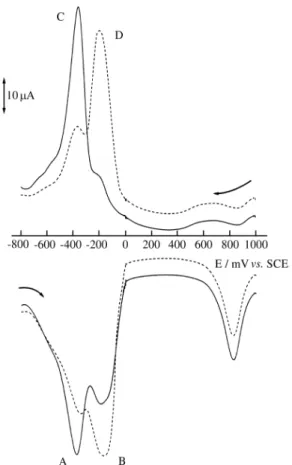
Figure 4 shows the pulse differential voltammetry of the metallated complex between -800 and 1000 mV under oxygen (Fig. 4A) and argon (Fig. 4B) atmospheres. Under oxygen atmosphere the anodic waves show the peak max-ima of higher intensity at -390 mV and of a weaker peak at -190 mV (Fig. 4A) and, under argon atmosphere the inten-sity of these peaks are reversed (Fig. 4B). The observed peaks correspond to the CoI→ CoII oxidation process of both complexes, the more negative peak being due to the oxygen axially coordinated complex species and the less negative peak to the uncoordinated complex species. Sweeping the potential to the more positive potential re-gion, a single peak with maximum at 823 mV due to CoII → CoIII oxidation process is observed. Reversing the
sweeping direction, from the more positive to more nega-tive potentials, similar results for CoII → CoI reduction process under oxygen (Fig. 4C) and argon (Fig. 4D) atmos-pheres are observed. The peak corresponding to CoIII→ CoII process was not observed.
The catalytic reduction of dissolved oxygen is very dependent on the solution pH in which the measurements
are carried out13-16. In the present case, the oxygen reduc-tion at the electrode surface was studied in 1 M KCl solution and pHs between 1 and 6 at temperature of 298 K. Figure 5 shows the plot of current peak maxima against the solution pH. The current intensities with the maximum value at pH 1 exponentially decreased as the pH of the solutions was increased up to pH 6.
In a typical cyclic voltammetry experiment, the cyclic voltammogram curves of Cel/Nb2O5/Co(HMP) in the
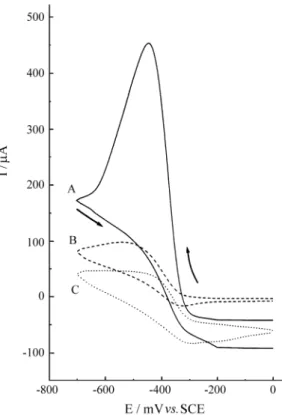
pres-ence of oxygen (Fig. 6A) and when the solution was purged with argon (Fig. 6B) are shown. The peak that remains at about -450 mV (Fig. 6B) is presumably due to the oxygen molecule coordinated to Co(II)11,12 which is difficult to eliminate during purging of the system with argon. Fig. 6C shows the curve obtained for the electrode made with Cel/Nb2O5 in the presence of oxygen (blank test). In this
case, a peak with small current intensity is observed at -400 mV, the origin of which has not clear explanation. However, it disappeared on purging the electrochemical cell with argon. Anyway, the observed peak at -390 mV (Fig. 6A) is considerably enhanced in the presence of O2
and it is assigned to the oxygen electrocatalytic reduction at the modified electrode surface. On the Pt electrode surface under similar conditions, oxygen is reduced at nearly -570 mV17.
The stability of the electrode was tested by cycling the potential between -200 and -500 mV many times. Leaching of the electroactive species was not observed and the inten-sity of the peak current remained constant during the ex-periment. In another experiment, in order to test electrode response to dissolved oxygen, the electrochemical cell was alternately purged with pure argon and pure oxygen at a fixed potential of -390 mV and constant temperature of 298 K and pH 1. Bubbling oxygen into the cell (O2in, Fig.
7) or argon (Arin, Fig. 7) the current intensities increased J. Braz. Chem. Soc.
Figure 4. Differential pulse voltammetry curves of Cel/Nb2O5/CoHMP electrode. Anodic sweeping: (A) under oxygen atmosphere, B) under argon atmosphere; cathodic sweeping: (C) under oxygen atmosphere, (D) under argon atmosphere.
for O2in and decreased for Arin alternately in five sucessive
cycles, the maxima and the minima remaining practically constant. Furthermore, the electrode response towards dis-solved oxygen concentrations was also tested. The experi-ment was carried out measuring the cathodic peak current of the cyclic voltammograms for a given dissolved oxygen concentration in the cell. Figure 8 shows the cathodic peak current intensity against dissolved oxygen concentration,
where a linear correlation between 1.5 and 15 ppm was observed.
Although the untreated cellulose acetate membranes normally present high rejection coefficient for electrolytes, the efficient electrochemical process at the electrode sur-face-solution interface is related with the facility under which the membrane is wet when immersed in the electro-lyte solution18 and also the presence of Nb2O5 in the matrix
which increases its hydrophilic character.
The probable mechanism of oxygen reduction is that of a two electron transfer process13 as described for a similar system in an homogeneous solution, according to the the following suggested mechanism14,15:
[Co(II)] + O2 [Co(II)O2] (1)
[Co(II)O2] + e- [Co(I)]O2 (2)
[Co(I)]O2 + 2H+ [Co(III)] + H2O2 (3)
The electroreduction of O2 by Co(II) porphyrin starts
with oxygen coordination to the metal ion (Eq. 1)19 fol-lowed by further electrochemical reduction at the electrode surface (Eq. 2). The transference of two electrons by co-balt(I) ion to O2 occurs at the third stage of the reaction (Eq.
3). As the last stage, Co(III) is electrochemically reduced to Co(II) and the cycle starts with coordenative adsorption of O2.
Conclusions
Cobalt(II) ion is quantitatively incorporated to the he-matoporphyrin IX ring immobilized on the Cel/Nb2O5
sur-face. The complex is not leached from the surface even at high supporting electrolyte solution since it is immobilized
Figure 8. Cathodic peak current intensities against concentration of dissolved oxygen concentration. Experimental conditions: 298 K, 1 M K C l s o l u t i o n a t p H 1 , a m b i e n t p r e s s u r e , a n d e l e c t r o d e o f Cel/Nb2O5/Co(HMP)
Figure 7. Cathodic peak currents in 1 M KCl solution at pH 1 for alternated cycles in presence of oxygen (O2in) and purged with argon (Arin) measured at -390 mV.
into the matrix surface by the --COO--Nb chemical bond. The cobalt-porphyrin acts as the active site oxygen reduc-tion, presumably by a two-electron transfer mechanism.
Considering the relatively good chemical stability, the linear response of the peak current against the dissolved oxygen concentration at atmospheric pressure and ambient temperature, this metalloporphyrin-modified electrode system appears to be potentially useful for developing a new oxygen sensor.
Acknowledgments
Y.G. is indebted to FAPESP for finacial support and E.A.C, to CAPES for a fellowship.
References
1. Inoue, Y.; Yamazaki, H.; Kimura, Y. Bull. Chem. Soc. Jpn.1985, 58, 2481.
2. Yamazaki, H.; Inoue, Y.; Okada, K.; Morita, K. Bull. Chem. Soc. Jpn.198558, 2955.
3. Yamazaki, H.; Inoue, Y.; Sahara, S. Bull. Chem. Soc. Jpn.1993, 66, 1127.
4. Denofre, S.; Gushikem, Y.; de Castro, S.C.; Kawano, Y. J. Chem. Soc. Faraday Trans.1993, 89, 1057. 5. Campos, E.A.; Gushikem, Y. J. Colloid Interface Sci.
1997, 193, 121.
6. Denofre, S.; Gushikem, Y.; Davanzo, C.U. Eur. J. Solid State Inorg. Chem.1991, 28, 1295.
7. Yatsmirskii, K.B.; Yakubovichi, T.N.; Bratushko, Y.I.; Kotlyar, S.S.; Yanishpol’ skii, V.V.; Tertykh,
V.A. Dokl. Akad. Nauk1985, 280, 83 translated to English.
8. Van, J.C. In Chemical Analysis of Inorganic Constitu-ents of Water, Robinson, J.W., Ed.; CRC Press Inc, Boca Raton, 1977, 191.
9. Pottier, R.H.; Kennedy, J.C.; Chow, Y.F.A.; Cheung, F. Can. J. Spectrosc.1988, 33, 57.
10. Corwin, A.H.; Chivvis, A.B.; Poor, Whitten, D.G.; Baker, E.W. J. Am. Chem. Soc. 1968, 90, 657. 11. de Bolfo, J.A.; Smith, T.D.; Boas, J.F.; Pilbrow, J.R.
J.Chem. Soc. Faraday II1976, 481.
12. de Bolfo, J.A.; Smith, T.D.; Boas, J.F.; Pilbrow, J.R. J. Chem. Soc. Dalton1976, 1495.
13. Yeager, E. J. Mol. Catal.1986, 38, 5.
14. Yuasa, M.; Nagaiwa, T.; Kato, M.; Sekine, I.; Hayashi, S. J. Electrochem. Soc.1995, 142, 2612. 15. D’Souza, F.; Deviprasad, R.G.; Hsieh, Y. J.
Elec-troanal. Chem.1996, 411, 167.
16. Gouérec, P.; Bilou, A.; Contamin, O.; Scarbeck, G.; Savy, M.; Barbe, J.M.; Guilard, R. J. Electroanal. Chem.1995, 398, 67.
17. Kuwana, T.; Fujihira, M.; Sunakawa, K.; Osa, T. J. Electroanal. Chem.1977, 88, 299.
18. Rodrigues Filho, U.P.; Gushikem, Y.; Gonçalves, M.C.; Cachichi, R.C.; de Castro, S.C. Chem. Mater.
1996, 8, 1375.
19. An alternative mechanism suggests that the reaction starts with the electroreduction, Co(II) → Co(I), and the molecular oxygen is coordenatively adsoberd on [Co(I)] species.