Ajaz 2013/14 : 3 (3) 243-249
Journal of Microbiology, Biotechnology and Food Sciences
...
International peer-reviewed scientific online journal
...
STATISTICAL OPTIMIZATION OF AQUEOUS LEAF EXTRACT OF
AERVA LANATA
FOR CITRININ AND FUNGAL
BIOMASS REDUCTION IN SUBMERGED FERMENTATION BY ASPERGILLUS NIGER USING RESPONSE SURFACE
METHODOLOGY
Ajaz Ahmad*
Address(es): Ajaz Ahmad,
College of Pharmacy, King Saud University, Riyadh, KSA, 11451
*Corresponding author: [email protected]
ABSTRACT
Keywords: Aspergillus niger, Aerva lanata, citrinin, fungal biomass, Box-Behnken design
INTRODUCTION
Mycotoxins, a group of structurally diverse secondary metabolites produced by various fungi, are toxic compounds. It contaminates various commodities of plant origin, cereals in particular, and is usually found together with another nephrotoxic mycotoxin, ochratoxin A (OTA). In addition to nephrotoxicity, citrinin is also embryocidal and fetotoxic (Flajs and Peraica, 2009). Citrinin, a secondary metabolite of fungal metabolism was first isolated by Hetherington and Raistrick from a culture of Penicillium citrinum Thom (Hetherington et al.,
1931). Several other fungal species within the three genera Penicillium
(Ei-Banna et al., 1987), Aspergillus(Kurata, 1990) and Monascus (Blanc et al., 1995; Li et al., 2003) were also found to produce citrinin (Cigler et al., 1977; Bragulat et al., 2008). Due to its antibacterial potential, citrinin was used as an antibiotic [9]. Citrinin contaminates maize (Nelson et al., 1985), wheat, rye, barley, oats (Scott et al., 1972), and rice (Tanaka et al., 2007). Strains of
Monascus are traditionally used in China to produce red and yellow pigments for food (Xu et al., 1999). Western countries limit the use of synthetic food colorants due to their toxicity and mutagenicity. Natural food pigments obtained from
Monascus were good candidates for their substitution because reports on their toxic effects had been scarce for more than 1000 years.
A lanata belongs to the family Amaranthaceae, is one of the important medicinal plant that grows in the various parts of India, Pakistan, China and Saudi Arabia. It has antimicrobial properties (Annie et al., 2004). The plant is used as a remedy for diabetes mellitus, urinary calculi, hematemesis, bronchitis, nasal bleeding, cough, scorpion stings, fractures, spermatorrhea, to clear uterus after delivery and al so to prevent the lactation (Siveen and Kuttan, 2011). A. lanata plant has many medicinal properties due to the presence of numerous secondary metabolites. Sitosteryl palmitate, hentria contane, β-sitosterol and its
D-glucoside, α-amyrin and betulin were isolated from the whole plant (Aiyar et al.,
1973; Chandra and Sastry, 1990). The glycosides like kaempferol 3-rhamnogalactoside and kaempferol 3-(6′′p-coumaryl) O-glucoside along with alkaloids, saponins and sugar like fructose, galactose, rhamnose and sucrose and also minerals are reported to occur in the plant (Afaq et al., 1991). A many
Chowdhary et al., 2002; Vetrichelvan and Jegadeesan, 2002; Selvam et al., 2001). But more work needs to be done regarding its medicinal importance, taxonomic and ecological aspects. As the plant of A. lanata has immense potential as an antimicrobial due to the rich source of phytochemicals it possesses, therefore, such studies on biological activities particularly anti-microbial are recommended in various parts of the countries of Asian subcontinent where it grows.
Response surface methodology (RSM) is a statistical technique used for the
development and optimization of complex processes (Ferreira et al., 2007;
Bezerra et al., 2008). It was selected and used to find the optimum conditions for
maximum inhibition of citrinin and dry cell weight produced by fungus A niger.
The technique has several advantages over conventional experimental or optimization methods in which one variable at a time is used. RSM provides a large amount of information and is more economical approach because; a small number of experiments are performed for monitoring the interaction of the independent variables on the response. In conventional optimization, the increase in the number of experiments necessary to carry out the research, leads to an increase in time and expenses as well as an increase in the utilization of reagents and materials for experiments. The equation of the model easily clarifies the effects for binary combinations of the independent variables. Box–Behnken design is advantageous because it does not contain any points at the extremes of the cubic region created by the two-level factorial level combinations that are prohibitively expensive or impossible to test because of physical constraints on experimentation (Mason et al., 2003). Medicinal plants represent an important health and economic component of biodiversity. In the present investigation the Box Behnken design was selected and used to optimize the aqueous extracts of tested medicinal plant from Saudi Arabia on growth of A niger on citrinin production and fungal dry cell weight.
MATERIAL AND METHODS
Microorganisms and culture conditions
Citrinin, a nephrotoxic mycotoxin produced by several fungal strains belonging to the genera Penicillium, Aspergillus, and Monascus. Generally found in stored grains and after their harvest. The objective of the present investigation was to study the antimicrobial activity
(anti-fungal) of aqueous leaf extract of Aerva lanata and to optimize its conditions for the maximum inhibition of citrinin and fungal
biomass by Aspergillus niger. Optimization of culture conditions was carried out using Box-Behnken method of response surface methodology. Extent of inhibition of citrinin was carried out using HPLC and reduction in fungal biomass was carried out using dry cell weight after comparing with controls. Optimized culture conditions as per the point prediction tool were found to be 11.27 mg/L for concentration of Aerva lanata extract, nine and half days of incubation period and temperature of 25.5 °C resulted in maximum inhibition of citrinin. These optimized values of tested parameters were and compared with control citrinin production (243.28 mg/L) and dry cell weight production (362.28mg).An average of 87.77±1.21% inhibition of citrinin and 80.02±1.42% of dry cell weight was obtained in an optimized medium at 9.5th d of fermentation with 97.82 % and 96.21% validity, respectively.
ARTICLE INFO
Received 8. 10. 2013 Revised 3. 11. 2013 Accepted 4. 11. 2013 Published 1. 12. 2013
maintained on slants of potato dextrose agar medium at 4°C. The spore was suspended by growing the fungi on Petri dishes for 7 days at 25°C with potato dextrose agar (PDA) containing 50 mg l-1 of streptomycin. PDA powder (39.0 g) was dissolved in 1 L of distilled water, according to the product recommendations. Later Spores were harvested by adding 10 ml of sterilized distilled water on each plate. The spore suspension hence obtained was filtered using cheesecloth, and spores were counted using a haemocytometer and brought to a final concentration of 105 conidia/ml.
Collection and preparation of aqueous plant extracts
Literature survey was done and taxonomic studies of the herbarium specimens of the medicinal plants available at the National Herbarium of Saudi Arabia (RIYADH), and the herbarium of King Saud University (Pharmacy), was done by using long arm stereomicroscope. Leaves of the A lanata were collected and washed under tap water. Then the leaves were dried at 60°C in hot air oven for 5 days and ground to make a powder and passed through 20 mesh sieve. Ten grams of powdered leaves were made soluble with 100 ml distilled water at 200 rpm for 5 h at room temperature (Razzak et al., 2009). The remaining insoluble material was filtered by Whattman No.1 filter paper and centrifuged at 10,000 rpm for 10 min. The supernatant was collected and again passed through 0.45 µm filter (Millipore) and stored at -20°C for further use.
Seed culture and fermentation
The culture of A niger was grown on potato dextrose agar (PDA) slants and spore suspension (4×10⁶ spores per mL) was made in glycerol water solution (15 g l–1). The seed culture media used in this study were glucose (20g l–1), glycerol (30 g l– 1
), peptone (8 g l–1), NaNO3 (2 g l–1) and MgSO4 (1 g l–1) were dissolved in water-soluble extract of soybean meal. All fermentation experiments were carried out in 250 ml Erlenmeyer flasks containing 50 ml of production media as per experimental design (Ahmad et al., 2011). Different concentrations of aqueous plant extract were added to liquid broth. 10 µl from suspension (4×10⁶
spores per ml of A niger) was inoculated in each flask and kept in rotary shaker at 200 rpm. The control contained production medium and 10 µl of A niger suspension. The fungal mycelium was harvested by filtration by muslin cheese cloth to separate from liquid culture. The filtered biomass was then dried at 60°C for 24h and the dry weight of mycelium was determined. Filtrates were stored in 4°C for carrying out citrinin extraction. All experiments consisted of three replicates, and the averages were determined.
Extraction and quantification of citrinin
The filtrates obtained from above experiment were used for extraction and estimation of citrinin. Briefly, the citrinin was extracted thrice with chloroform (1:1 v/v). All the three extractions were pooled and concentrated in vacuum at
40°C using a rotary evaporator. All the concentrates were then diluted in mobile
phase (2ml) and citrinin was estimated by HPLC. All the samples were filtered through a 0.22μm disposable syringe filter (Micro Filtration Systems®) prior to injection into the chromatograph. Aliquots (30 μl) were injected on HPLC column and analysis were carried out using a Shimadzu® Liquid Chromatograph, equipped with an LC-20AD pump, a Rheodine® injector, an SPD-20A UV detector, a CBM-20 A-Communications Bus Module, and a LC Solutions Workstation system. A reverse-phase Atlantis® dC 18 column (150 × 3.9 mm, 5 μm) was used, at room temperature. The mobile phase used was acetonitrile-water (75:25 v/v) and formic acid (2%) with a flow rate of 1.5 ml/min for an isocratic run of 10 min. Absorbance of samples and standard was detected at 360 nm (Abramson et al., 1999). Retention times and peak areas were calculated by LC Solutions software. Evaluation of sample retention times with that of the standard identified the presence of citrinin in the samples. The relationships between peak area and the amount injected were linear over the ranges 2.5 -50 µg.
OPTIMIZATION OF EXPERIMENTAL CONDITIONS (RESPONSE SURFACE METHODOLOGY)
Box–Behnken experimental design.
A response surface statistical experimental design was used to optimize the concentration of extract, incubation days and temperature. This design was based on a 33 factorial design, three replicates of the central run, leading to 15 sets of experiments, enabling each experimental response to be optimized. The responses were investigated using a Box–Behnken statistical experimental design. The optimization process involves evaluating the response of the statistically designed combinations, estimating the coefficients by fitting the experimental data to the response function, predicting the response of the fitted model, and checking the adequacy of the model. All experiments were performed in standard order to minimize the effects of uncontrolled factors that may introduce a bias in the response. Before starting an optimization procedure, it is important to identify the crucial factors affecting the quality of the derived outcomes. The levels of the three factors evaluated in this design are listed in (Tab 1). A three factor, three-Level Box–Behnken design was used for the optimization procedure, using the software Design Expert V 8.0.7.1. All other factors, for example volume of spore suspension, pH of the broth etc were maintained constant. The quality of the fitted model was expressed by the coefficient of determination R2, and its
statistical significance was checked by an F-test (analysis of variance) at the 5%
significance level. The optimum processing conditions were obtained by using graphical and numerical analysis based on the criteria of the desirability function and the response surface. The experiment was finally repeated under the optimum values as per the point prediction tool of response surface methodology for concentration of extract, incubation period and temperature which should result in maximum inhibition of citrinin and dry cell weight production. These optimized values of tested parameters were validated (n=6) and compared with control for citrinin and dry cell weight inhibition.
Table 1 Levels of tested parameter for Box-Behnken design
Independent factors Unit Symbol Levels
Low High
Extract Concentration mg/L A 2 16
Incubation Time Days B 8 24
Temperature °C C 20 30
RESULTS AND DISCUSSION
Design of the proposed assay and strategy for its development
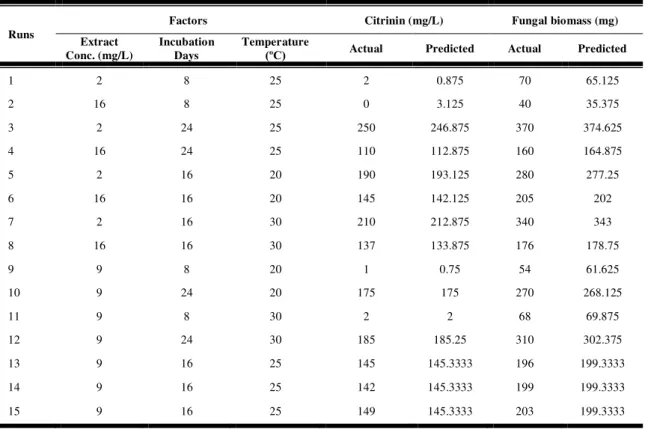
Table 2 The Box–Behnken Response surface design and corresponding response values
Runs
Factors Citrinin (mg/L) Fungal biomass (mg)
Extract Conc. (mg/L)
Incubation Days
Temperature
(ºC) Actual Predicted Actual Predicted
1 2 8 25 2 0.875 70 65.125
2 16 8 25 0 3.125 40 35.375
3 2 24 25 250 246.875 370 374.625
4 16 24 25 110 112.875 160 164.875
5 2 16 20 190 193.125 280 277.25
6 16 16 20 145 142.125 205 202
7 2 16 30 210 212.875 340 343
8 16 16 30 137 133.875 176 178.75
9 9 8 20 1 0.75 54 61.625
10 9 24 20 175 175 270 268.125
11 9 8 30 2 2 68 69.875
12 9 24 30 185 185.25 310 302.375
13 9 16 25 145 145.3333 196 199.3333
14 9 16 25 142 145.3333 199 199.3333
15 9 16 25 149 145.3333 203 199.3333
Figure 1 A typical HPLC chromatogram a) blank sample b) Standard citrinin
(RT=3.42) c) fermented sample (RT=3.42)
Optimization of fermentation medium
collected from experimental runs were analyzed by using the software Design Expert V 8.0.7.1 and fitted to nonlinear quadratic models for citrinin inhibition and fungal biomass analysis. The model was validated by analysis of variance (ANOVA). The statistical analysis showed that the model represents the phenomenon quite well and the variation of the response was correctly related to the variation of the factors (Tab 3). In general, exploration and optimization of a fitted response surface may produce poor or misleading results, unless the model exhibits a good fit, which makes checking of the model adequacy essential (Liyana-Pathirana and Shahidi, 2005). The F-ratio in this table is the ratio of the mean square error to the pure error obtained from the replicates at the design center. The significance of the F-value depends on the number of degrees of freedom (DF) in the model and is shown in the P-value column (95% confidence level). Thus, the effects lower than 0.05 are significant (Morelli et al., 2012). The
P-value is used as a tool to check the significance of each coefficient and the interaction strength between variables (Karacabey and Mazza, 2010). The higher the significance, the better the degree of correlation between the observed and predicted values (Ravikumar et al., 2006). Total extract concentration, incubation days and temperature content were significantly affected.
Table 3 Analysis of variance of calculated surface quadratic model for citrinin and fungal biomass
Parameters Citrinin Biomass
Model (Mean Square) 96302.81 154863.51
Residual 96.91 271.41
R2 0.999 0.999
F 552.03 316.98
p-value < 0.0001 <0.0001
± SD 4.40 7.36
RSD 3.58 3.75
*Adequate Precision 68.92 56.39
(*Adequate Precision measures the signal to noise ratio. A ratio greater than 4 is desirable. This model can be used to navigate the design space).
Citrinin inhibition (mg l-1) =48.0841 + 5.637A+ 48.95B 23.94C0.616AB -0.2AC + 0.05625BC +0.25A2-1.05B2+ 0.51C2.
Biomass (mg) = +441.250+13.69A + 45.4092B -61.170C -0.803 AB -0.63571AC + 0.16250BC +0.36139A2-0.89128B2+ 1.32833 C2
Table 4 Regression coefficients and their significance in the quadratic model
Terms
Citrinin Biomass
Coefficient Estimate P-value Coefficient
Estimate P-value
Intercept 145.33 < 0.0001 199.33 < 0.0001
A- Extract Conc. 32.5 < 0.0001 59.87 < 0.0001
B- Incubation Time 89.37 < 0.0001 109.75 < 0.0001
C- Temperature 2.87 0.1240 10.62 0.0096
AB 34.5 < 0.0001 45 < 0.0001
AC 7 0.0245 22.25 0.0018
BC 2.25 0.3536 6.5 0.1379
A2 12.45 0.0029 17.70 0.0057
B2 67.29 < 0.0001 57.04 < 0.0001
C2 12.70 0.0026 33.20 0.0003
This multiple nonlinear model resulted in three response surface graphs each for citrinin and dry cell weight. Point prediction tool of the software was used to calculate maximum inhibition of citrinin and dry cell weight. Finally the optimum values as per the point prediction tool were found to be 11.27 mg/L for concentration of extract, nine and half days of incubation period and temperature 25.5°C which resulted in maximum inhibition or minimum production of citrinin (33.51 mg/L) and dry cell weight production (72.36 gm). These optimized values of tested parameters were validated under similar conditions (n=6) as discussed in material and methods and compared with control citrinin production (243.28mg/L) and dry cell weight production (362.28mg). An average of 87.77±1.21% inhibition of citrinin and80.02±1.42% of dry cell weight was obtained in an optimized medium at 9.5thd of fermentation with97.82% and 96.21% validity, respectively.
The relationship between independent and dependent variables is illustrated in three-dimensional representation of the response surfaces and one factor plots
CONCLUSION
The present research study was carried out to identify the antimicrobial activity of natural products for inhibition of mycotoxins in food grains. The antifungal potential of the A lanata was studied for the first time for preservation of food grains from production of citrinin, a known mycotoxin. Citrinin is a proven hepato-nephrotoxic agent and hence need to be inhibited. The effect of individual variables on inhibition of citrinin and fungal dry cell weight was also studied using Box-Benkhen response surface methodology. Optimum conditions for maximum inhibition of mycotoxin citrinin were also developed. The results obtained using response surface predictions were in good agreement with the experimental results. Therefore, Box–Behnken statistical design used in determining the optimum experimental conditions such as extract concentration, incubation days and temperature was reliable and effective. Hence extract of A lanata can be used as a preservative in food grains for the management of pest control and prevention of any toxic fungal secondary metabolite because of its potential antimicrobial activity. Present investigation also offers the possibility of developing methods for monitoring citrinin production by fungi coupled to novel environmentally safe agrochemicals of plant origin.
Acknowledgments: The author would express his appreciation to the Deanship of Scientific Research at King Saud University for the provision of financial assistance to carry out this research work through the College of Pharmacy Research Center.
REFERENCES
ABRAMSON, D., HULASARE, R., WHITE, N.D.G., JAYAS, D.S., MARQUARDT, R.R. 1999. Mycotoxin formation in hulless barley during granary storage at 15 and 19% moisture content. Journal of Stored Products Research, 35, 297–305.
AFAQ, S.H., TAJUDDIN., AFRIDI, R. 1991. Bisehri booti (Aerva lanata Juss.): Some lesser known uses and Pharmacognosy. Ethnobotany, 3, 37-40.
AHMAD, A., MUJEEB, M., PANDA, B.P. 2011. Production and Optimization of Mevastatin by Penicillium citrinum MTCC 1256 and Effect of Citrinin on Growth of Actinomadura Strains. Latin American Journal of Pharmacy, 30, 496-501.
AIYAR, V.N., NARAYANAN, V., SESHADRI, T.R., VYDEESWARAN, S. Chemical components of some Indian medicinal plants. Indian Journal of Chemistry, 11, 89-90.
ANNIE, S., DEEPTI, I., MALINI, S. 2004. Effect of Aerva lanata on cisplatin and gentamic in models of acute renal failure. Journal of Ethnopharmacology, 90, 81–86.
BEZERRA, M.A., SANTELLI, R.E., OLIVEIRA, E.P., VILLAR, L.S., ESCALEIRA, L.A. 2008. Response surface methodology (RSM) as a tool for optimization in analytical chemistry. Talanta, 76, 965-977.
BLANC, P.J., LORET, M.O., GOMA, G. 1995. Production of citrinin by various species of Monascus. Biotechnology Letters, 17, 291-294.
BRAGULAT, M.R., MARTÍNEZ, E., CASTELLÁ, G., CABAÑES, F.J. 2008. Ochratoxin A and citrinin producing species of the genus Penicillium from feed stuffs. International Journal of Food Microbiology, 126, 43-48.
CHANDRA, S., SASTRY, M.S. 1990. Chemical constituents of Aerva lanata. Fitoterapia, 61, 188.
CHOWDHURY, D. - SAYEED, A. - ISLAM, A. - ALAM, S. - BHUIYAN, M. - ASTAQ MOHAL KHAN, G.R. 2002. Antimicrobial activity and cytotoxicity of
Aerva lanata. Fitoterapia, 73, 92-94.
CIEGLER, A., VESONDER, R.F., JACKSON, L.K.. 1977. Production and biological activity of patulin and citrinin from Penicillium expansum. Applied and Environmental Microbiology, 33, 1004-1006.
EI-BANNA, A.A., PITT, J.I., LEISTNER, L. 1987. Production of mycotoxins by
Penicillium species. Systematic and Applied Microbiology, 10, 42–46.
FERREIRA, S.L., BRUNS, R.E., FERREIRA, H.S., MATOS, G.D., DAVID, J.M., BRANDAO, G.C., da SILVA, E.G., PORTUGAL, L.A., dos REIS, P.S., SOUZA, A.S., dos SANTOS, W.N. 2007. Box-Behnken design: an alternative for the optimization of analytical methods. Analytica Chimica Acta, 597, 179-186.
FLAJS, D., PERAICA, M. 2009. Toxicological properties of citrinin. Archives of Industrial Hygiene and Toxicology, 60, 457-464.
HETHERINGTON, A.C., RAISTRICK, H. 1931. Studies on biochemistry of microorganisms. Part XIV. On the production and chemical constitution of a new yellow coloring matter, citrinin produced from glucose by Penicillium citrinum
Thom. Philosophical Transactions of the Royal Society of London. Series B, 220, 269-296.
KARACABEY, E., MAZZA, G. 2010. Optimization of antioxidant activity of grape cane extracts using response surface methodology. Food Chemistry, 119, 343–348.
KURATA, H. 1990. Mycotoxins and mycotoxicoses. In A. E. Pohland, V. R. Dowell, & J. L. Richards (Eds.), Microbial toxins in foods and feeds. New York,
LI, F., XU, G., LI, Y., Chen, Y. 2003. Study on the production of citrinin by Monascus strains used in food industry. Wei sheng Yan Jiu, 32, 602–605.
LIYANA-PATHIRANA, C., SHAHIDI, F. 2005. Optimization of extraction of phenolic compounds from wheat using response surface methodology. Food Chemistry, 93, 47–56.
MASON, R.L., GUNST, R.F., HESS, J.L. 2003. Statistical Design and Analysis of Experiments. Hoboken. NJ: Wiley, 586.
MORELLI, L.L.L., PRADO, M.A. 2012. Extraction Optimization for Antioxidant Phenolic Compounds in Red Grape Jam Using Ultrasound with a Response Surface Methodology. Ultrasonics Sonochemistry, 19, 1144–1149.
NELSON, T.S., KIRBY, L.K., BEASLEY, J.N., JOHNSON, Z.B., CIEGLER, A. 1985. The effect of drying method and storage time on citrinin activity in corn.
Poultry Science, 64, 464-468.
NEVIN, K.G., VIJAYAMMAL, P.L. 2003. Effect of Aerva lanata on solid tumor induced by DLA cells in mice. Fitoterapia, 74, 578–582.
NEVIN, K.G., VIJAYAMMAL, P.L. 2005. Effect of Aerva lantana against hepatotoxicity of carbon tetrachloride in rats. Environmental Toxicology and Pharmacology, 20, 471–477.
RAVIKUMAR, K.., RAMALINGAM, S., KRISHNAN, S., BALU, K. 2006. Application of response surface methodology to optimize the process variables for reactive red and acid brown dye removal using a novel adsorbent. Dyes and pigments, 70, 18–26.
RAZAK, M.F.A., AIDOO, K.E., CANDILISH, A.G.G. 2009. Mixed herbs drugs: Inhibitory effect on growth of the endogenous mycoflora and aflatoxin production. Myopathy, 167, 273- 286.
SCOTT, P.M., van WALBEEK, W., KENNEDY, B., ANYETI, B. 1972. Mycotoxins (ochratoxin A, citrinin and sterigmatocystin) and toxigenic fungi in grains and other agricultural products. Journal of Agricultural and Food Chemistry, 20, 1103-1109.
SELVAM, R., KALAISELVI, P., GOVINDARAJ, A., BALAMURUGAN, V., SATHISH KUMAR, A.S. 2001. Effect of A. lanata leaf extract and vediuppu chunnam on the urinary risk factors of calcium oxalate urolithiasis during experimental hyperoxaluria. Pharmacology Research, 43, 89-93.
SIVEEN, K.S., Kuttan, G. 2011. Immunomodulatory and antitumor activity of
Aerva lanata ethanolic extract. Immunopharmacology and Immunotoxicology,
33, 423–432.
TANAKA, K. - SAGO, Y. - ZHENG, Y. - NAKAGAWA, H. - KUSHIRO, M. 2007. Mycotoxins in rice. International Journal of Food Microbiology, 119, 59-66.
VETRICHELVAN, T., JEGADEESAN, M. 2002. Anti-diabetic activity of alcoholic extract of Aerva lanata (L.) Juss.ex Schultes in rats. Journal of Ethnopharmacology, 80, 103–107.
WONG, H.C., KOEHLER, P.E. 1981. Production and isolation of an antibiotic from Monascus purpureus and its relationship to pigment production, Journal of Food Science, 46, 589-592.
XU, G., LU, C., MU, X., CHEN, J., CHEN, Y., GU, Y., WU, Y., SHENG, F., WU, M. 1999. A study on the production of citrinin by Monascus spp. Archiv