Rev Saúde Pública 2005;39(6) www.fsp.usp.br/rsp
INTRODUCTION
There is a high prevalence of dental caries and its sequelae in Brazil. This creates a public health prob-lem with serious social and economic consequences.
The latest and most complete nationally-based epi-demiological study of oral health was conducted by
Received on 23/8/2004. Reviewed on 3/6/2005. Approved on 22/7/2005. Correspondence:
Liliane Simara Fernandes
Universidade do Oeste de Santa Catarina -Campus Joaçaba
Rua Getúlio Vargas, 2125 Bairro Flor da Serra 89670-000 Joaçaba, SC, Brasil
E-mail [email protected]
Association between primary dental care and
municipal socioeconomic indicators
Liliane Simara Fernandesa and M arco Aurélio Peresb
aÁrea de Ciências Biológicas e da Saúde. Universidade do Oeste de Santa Catarina. Joaçaba, SC,
Brasil. bDepartamento de Saúde Pública. Centro de Ciências da Saúde. Universidade Federal de Santa
Catarina. Florianópolis, SC, Brasil
Keywords
Service evaluation. Dental care. Oral health. Primary healthcare. Economic indices. Social indicators.
Abstract
Objective
To test associations between primary dental care indicators and municipal socioeconomic and dental service provision indicators.
Methods
An ecological study was carried out in the 293 municipalities of the state of Santa Catarina, Brazil, between 2000 and 2003. The primary dental care indicators utilized were: (1) coverage; (2) the ratio between preventive dental procedures and the size of the population aged zero to 14 years; and (3) the ratio between the numbers of extractions of permanent teeth and individual dental procedures within primary dental care. The variables investigated were: number of dentists per 1,000 inhabitants; number of dentists within the public health service per 1,000 inhabitants; fluoridation of the water supply; child development index; human development index; and the size of the population in the municipality. Analyses were performed using the Kruskall-Wallis and Chi-square tests. The Spearman test was used to evaluate correlations between the variables.
Results
The coverage was 21.8%, the ratio of preventive dental procedures among the population aged zero to 14 years was 0.37 and the proportion of tooth extractions in relation to the total number of individual dental procedures was 11.9 %. Lower rates of tooth extraction were associated with higher numbers of dentists within the public health service (p<0.01). Higher rates of tooth extraction were associated with lower human development indices for the municipalities (p<0.01).
Conclusions
Greater coverage was associated with higher numbers of dentists within the public health system. Municipalities with worse socioeconomic conditions were associated with greater tooth extraction rates. Oral health policies must target municipalities that present worse socioeconomic indicators.
Rev Saúde Pública 2005;39(6) www.fsp.usp.br/rsp Socioeconomic conditions and dental services
Fernandes LS & Peres MA
M ETH O D S
An exploratory ecological study was carried out in the 293 municipalities of the state of Santa Catarina, Brazil, between 2000 and 2003. Information relating to primary dental care services, socioeconomic indi-cators, dental service provision and demographics was utilized.
The dependent variables were the dental indicators from the primary care agreements for SUS. These were: a) The coverage of first dental consultations (COB), calculated by dividing the total number of first con-sultations carried out in the municipality during a given year by the total population of the municipality, and multiplying by 100. This indicated the level of access of the general population to individual dental care. Urgent and emergency consultations were not included in this indicator. b) The mean annual population aged zero to 14 years that was covered by preventive dental procedures (PCOL). Preventive dental procedures were defined as the conducting of annual epidemiological clinical examinations, health education, performing of fluoridated mouthwashes and supervised tooth cleaning. The numerator was calculated by dividing the sum of the month-by-month quantity of preven-tive procedures carried out in the municipality each year by the number of months in which this quantity was greater than zero. For the year 2003, only the means for the months of January to April were considered. The denominator was formed by the total size of the population aged zero to 14 years, living in the munici-pality. This indicator was presented in the form of a ratio, such that favorable values were those that were furthest from zero and closest to 1.0. c) The third indi-cator showed the proportion of tooth extractions (EXO) from the permanent dentition in relation to the total number of individual dental procedures. This indica-tor demonstrated the degree of mutilation caused by individual dental care within the municipality. The concepts and the analytical dimensions of each of these indicators were def ined in accordance with PROADESS.9
The variables relating to the dental services were obtained from the database of the SUS outpatient serv-ice information system for the state of Santa Catarina. This database is available in the form of electronic documents and is fed by data sent in from the munici-palities. It was made available by the State Health Department in relation to the years 2000 to 2003. With the aim of conferring greater stability on the data and minimizing the effects of possible
varia-*Ministério da Saúde do Brasil. Projeto SB Brasil 2003: Condições de Saúde bucal da população brasileira 2002-2003, resultados principais. Brasília-DF: Ministério da Saúde, Secretaria de Atenção à Saúde, Departamento de Atenção Básica, Coordenação Nacional de Saúde Bucal; 2004. Available at: http://dtr2001.saude.gov.br/sps/areastecnicas/bucal/ [October 21, 2005]
**Ministério da Saúde. Instituto Nacional do Câncer. Estimativa 2005: incidência de câncer no Brasil. Rio de Janeiro: INCA; 2004. p. 94. 74 years, the rate reached alarming levels, with
aver-age values of 20.1 and 27.8, respectively. Occlusal dis-orders of severe, very severe and incapacitating levels affected 36.6% of 12-year-old schoolchildren.
More than 28% of Brazilian adults present no func-tional teeth in at least one dental arch, and 15% of them do not have full prosthesis. Among elderly peo-ple, the situation is even more serious, since 75% do not present any functional teeth and 36% of them do not have full modified prosthesis.*For the year 2005, the National Cancer Institute (Instituto Nacional de Câncer) has estimated that there will be 13,880 new cases of oral cancer and more than 3,000 deaths caused by it.** This type of cancer is responsible for the sixth biggest cancer-related expenditure within hos-pitals in Brazilian public health system (Sistema Único de Saúde - SUS).
The seriousness of this epidemiological situation means that, not only is action required in relation to the causes of dental diseases, but also services are needed for mitigating the suffering and seeking to recuperate the state of oral health. However, access to dental services in Brazil is limited and unequal. Barros & Bertoldi2 revealed that there is a low level of utilization of dental services in Brazil, in an inves-tigation of the data from the National Home Sam-pling Survey (Pesquisa Nacional por Amostras de Domicílios - PNAD/IBGE, 1998). For example, 77% of the children aged up to six years old had never attended a dental consultation. These authors identi-fied an important social gradient regarding the utili-zation of services. Within the age group from 20 to 49 years old, the proportion that had never consulted a dentist was 16 times greater in the group formed by the poorest 20% of the population than in the richest 20%.2 Among the elderly population, the proportion that had never consulted a dentist was 6.3% for the whole country and reached 50.7% in the northeast-ern region.4
Studies that investigate the association between primary dental care indicators and social and eco-nomic conditions within municipalities are particu-larly important for formulating healthcare policies directed towards reducing inequalities in healthcare, especially with regard to access and utilization of services.
!
Rev Saúde Pública 2005;39(6) www.fsp.usp.br/rsp
Socioeconomic conditions and dental services Fernandes LS & Peres MA
tions, the arithmetic means for the period were calcu-lated for each indicator.
The exploratory variables were: the population of the municipality (POP) relating to the demographic census for the year 2000 and estimated for subse-quent years, obtained from the Brazilian Institute of Geography and Statistics (Instituto Brasileiro de Geografia e Estatística - IBGE);3 the child develop-ment index (CDI) relating to the year 2001, published by the United Nations Children’s Fund (Unicef);8 and the human development index (HDI) for the munici-pality relating to the year 2000, published by the United Nations Development Program (UNDP).7 The dental service provision indicators utilized were: the number of dentists in the municipality per 1,000 in-habitants (CD/POP), obtained for the month of March 2003 from the Regional Dental Council of Santa Catarina; the number of dentists registered with the public health service of the municipality per 1,000 inhabitants (CDSUS/POP), supplied by the State Health Department in accordance with the SIA/SUS register (outpatient information system for SUS) and fed with data sent in by the municipalities for the year 2002; and the presence or absence of fluoridated public water supply, which was ascertained from the responses to a reply-paid letter to the public supply companies and municipalities in the year 2000.5
A database was created within the SPSS software. The Spearman test was performed to verify correla-tions between all the variables. The Kruskall-Wallis test was utilized to verify any differences between the quartiles of the dependent variables, and the Chi-square test was utilized to verify any differences be-tween proportions. The correlations bebe-tween the three different primary dental care indicators were also calculated.
RESU LTS
Table 1 presents the descriptive statistics for all the
variables studies, according to their distribution into quartiles, central trend measurements and dispersion. Loss of information only occurred in relation to one municipality, concerning the number of dentists reg-istered with SUS, while all the other 292 municipali-ties presented at least one professional registered with the public health service. It was observed that 75% of the municipalities had populations of not more than 14,400 inhabitants, thus characterizing the majority of the municipalities in Santa Catarina as small-sized. The CDI and HDI for the municipalities presented values of more than 0.60 and 0.80, respectively, thus ranking the state of Santa Catarina in fifth and sec-ond places nationally. With regard to the primary dental care service indicators, a minimum value of zero was observed for all the variables. For COB, the mean value was 21.8%; for PCOL relating to the popu-lation of less than 14 years old, the mean value was 0.37; and for the proportion between EXO and the total number of individual dental procedures, the mean value was 11.9%.
In Table 2, the correlation matrix between all the variables shows a negative correlation between the proportion of tooth extractions and the coverage of dental consultations: the greater the coverage, the lower the proportion of tooth extractions in the municipal-ity. This pattern was repeated in comparing the ratio of preventive procedures among children aged under 14 years with the proportion of tooth extractions. The variable of the ratio between tooth extractions and the total number of individual procedures presented a nega-tive correlation (p<0.05) with the variables of cover-age, ratio of preventive procedures among children aged under 14 years and the ratio of dentists registered with the public health service.
Among the variables relating to the dental service, only the proportion of tooth extractions presented a negative correlation with the HDI for the municipality.
The descriptive statistics for the socioeconomic
vari-Table 1 - Descriptive statistics for the social, economic and municipal service indicators. Santa Catarina, 2000 to 2003.
CD SU S CD COB PCOL EXO H D I POP CDI
N 292 293 293 293 293 293 293 293
Minimum 1.00 0.00 0.00 0.00 0.00 0.68 1572.0 0.40
25th percentile 3.0 1.0 6.38 0.15 4.43 0.76 3508.0 0.509
M ean 10.1 18.1 21.8 0.37 11.9 0.79 18302.5 0.55
Standard deviation 21.3 86.8 29.0 0.28 11.1 0.03 41978.3 0.068
50th percentile 5.0 2.0 12.98 0.38 8.81 0.79 7080.0 0.559
75th percentile 8.75 7.0 25.35 0.53 16.36 0.81 14400.5 0.605
M aximum 236.0 1259.0 280.8 1.74 70.17 0.88 429604.0 0.75
CDSUS: Ratio of the number of dentists registered with the public health system (SUS) per thousand inhabitants CD: Ratio of the number of dentists living in the municipality per thousand inhabitants
COB: Ratio between the number of first dental consultations per year and the size of the population, multiplied by 100 PCOL: Ratio of the number of preventive dental procedures in relation to the population aged under 14 years
EXO: Ratio between the number of tooth extractions and the total number of individual dental procedures, multiplied by 100 HDI: Human development index for the municipality
POP: Population
" Rev Saúde Pública 2005;39(6) www.fsp.usp.br/rsp Socioeconomic conditions and dental services
Fernandes LS & Peres MA
Table 3 - Distribution of socioeconomic and dental service indicators according to coverage of first dental consultations. Santa Catarina, 2000 to 2003.
Kruskall-Wallis test
FLUOR: Proportion of municipalities with fluoridated public water supply *Chi-squared
Indicators 1º quartile 2º quartile 3º quartile 4º quartile p
H D I 0.78 0.79 0.80 0.79 0.125
CDI 0.55 0.56 0.57 0.55 0.213
CD/POP 0.29 0.47 0.53 0.34 0.001
CDSUS/POP 0.62 0.70 0.80 1.00 <0.001
POP 12.172 27.444 23.032 10.437 0.007
FLU O R 78.1% 77.0% 69.9% 71.2% 0.710*
PCOL 0.29 0.36 0.38 0.47 <0.001
EXO 17.2 14.0 9.7 6.9 <0.001
ables and SUS dental service variables, according to their distribution into quartiles of the coverage of first dental consultations can be seen in Table 3. With in-creasing numbers of professionals registered with SUS in relation to population size, the coverage of first con-sultations also increased (p<0.001). Likewise, with in-creasing ratio of preventive procedures, the proportion of tooth extractions decreased in relation to the total number of individual procedures (p<0.001). The CDI and HDI did not differ according to the quartiles of the variable of coverage of primary dental consultations.
The variable of the ratio of preventive procedures among children aged under 14 years was also distrib-uted into quartiles and analyzed in relation to the other variables, as shown in Table 4. With increasing ratio of dentists registered with SUS per inhabitant, the proportion of preventive procedures carried out increased (p<0.001). Decreasing proportion of tooth extractions was associated with increasing coverage of first consultations and increasing ratio of preven-tive procedures among children aged under 14 years. The socioeconomic indicators did not vary signifi-cantly in relation to the ratio of preventive proce-dures among children aged under 14 years.
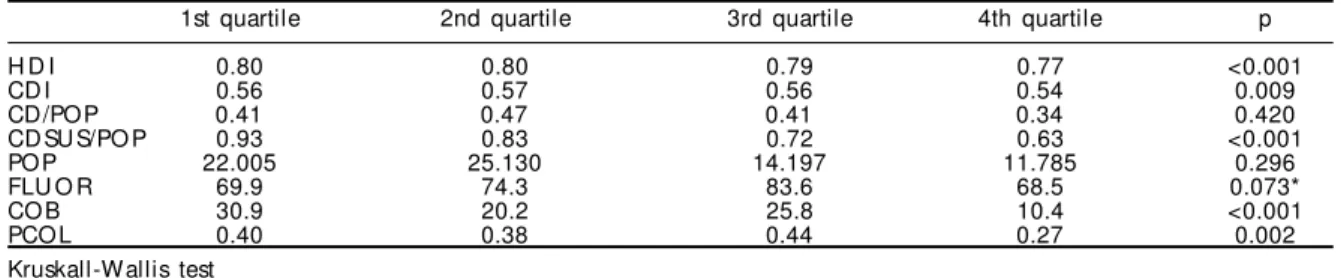
Table 5 shows the analysis of the variable of the proportion of tooth extractions in relation to indi-vidual primary dental actions, distributed into the different quartiles in relation to the socioeconomic variables and the other dental variables. The greater the ratio of dentists registered with SUS was, the
smaller the proportion of tooth extractions performed was (p<0.001). The HDI presented lower values for municipalities with greater proportions of tooth ex-tractions performed.
D ISCU SSIO N
The results from the present study are limited to information coming from SUS, thus only allowing inferences to be made for the population that is de-pendent on SUS. For the state of Santa Catarina, this proportion is estimated to be 75%.* The mean cover-age of dental care provided by SUS in the munici-palities of the state, excluding urgent and emergency consultations, was 21.8% over the period analyzed.
Information from PNAD 1998 regarding medical care for Santa Catarina indicated that 23.8% of the popula-tion in the state have at least one private healthcare plan. This corresponds to 28.7% of the population liv-ing in urban zones and 10.3% of rural zone tions. Thus, the information indicates that the popula-tion dependent on SUS is equivalent to around 75% of the whole population.* With regard to dental care, it was found that 13.7% of the population of Santa Catarina had never visited the dentist, a figure that is close to the 18.7% found for the country as a whole.2 The lowest rates of utilizing dental services in Santa Catarina were among children of less than four years old, among whom 80.2% had never been taken for den-tal consultations. The equivalent figure for men was 15.3%; for people living in rural zones, 15.9%; and
Table 2 - Correlation between socioeconomic and dental service indicators. Santa Catarina, 2000 to 2003.
Indicator coefficient COB PCOL EXO H D I POP CDI CDSUS/POP CD/POP
COB 1.00 0.228** -0.309** 0.054 -0.133* 0.001 0.296** 0.044
PCOL 0.228** 1.00 -0.152** 0.024 -0.166** 0.010 0.250** 0.021
EXO -0.309** -0.152** 1.00 -0.23** 0.087 -0.155** -0.309** -0.059
H D I 0.054 0.024 -0.231** 1.00 0.388** 0.643** -0.071 0.528**
POP -0.133* -0.166** 0.087 0.388** 1.00 0.491** -4.74** 0.587**
CDI 0.001 0.010 -0.155** 0.643** 0.491** 1.00 -0.133* 0.501**
CDSUS/POP 0.296** 0.250** -0.309** -0.071 -0.474** -0.133* 1.000 -0.130*
CD/POP 0.044 0.021 -0.059 0.528** 0.587** 0.501** -0.130* 1.000
Spearman test *p<0.05; **p<0.01
#
Rev Saúde Pública 2005;39(6) www.fsp.usp.br/rsp
Socioeconomic conditions and dental services Fernandes LS & Peres MA
for those receiving up to one minimum salary, 39%.*
Two dimensions of the performance of primary den-tal care within the sphere of SUS were analyzed: ac-cess and adequacy. Acac-cess is defined as people’s abil-ity to obtain the services they need, while adequacy is conceptualized as the degree to which care and intervention are based on the existing technical knowledge.9 In the present study, access was meas-ured by means of the indicator of the coverage of care and preventive procedures destined for the popula-tion of between zero and 14 years of age. Adequacy was related to the indicator of the proportion of tooth extractions in relation to the total number of indi-vidual dental procedures.
These indicators are determined from the political and economic organization, the structuring and the offer of the public health system. Thus, the offer of tooth extraction runs against the offer of preventive procedures and is directly related to the socioeco-nomic conditions of the population.9
The results indicate that the primary dental care in municipalities of the state is being organized. There are dentists registered with the outpatient system in 292 municipalities, and this pattern is not repeated in relation to professionals setting up because of free demand, given that many municipalities do not have any dentists living there. This suggests that many dentists come out from neighboring cities to provide dental care within the public health service.
When each of the primary dental care indicators was tested with the other socioeconomic and service pro-vision variables, it was observed that the numbers of professionals registered with SUS increased together with the coverage of dental consultations and preven-tive procedures for children. Hypothetically, the im-provement in the access to dental services and also the promotion of oral health is occurring with the profes-sionals contracted for the public health service. This is what was reported by Peres et al6 in the state of São Paulo and by Baldani et al1 in the state of Paraná.
Upon evaluating the indicator that measures the guidance for the dental service, it was found that there was a tendency towards conservative procedures within dental care organizations in municipalities with greater numbers of professionals acting within the public health service. The proportion of tooth extractions in relation to the numbers of individual dental procedures presented a negative association with the HDI for municipalities. Although all the municipalities were offering some access to dental services, the ones with the worst socioeconomic con-ditions were still offering services with mutilative characteristics, at least during the four-year period analyzed. This state also reveals the worse epidemio-logical conditions of oral health in these municipali-ties, since they present the worst coverage of access to fluoridated water5 and consequently the highest rates of caries.1,6
The research database presents several indicators
Table 4 - Distribution of socioeconomic and dental service indicators according to the ratio of preventive procedures in
relation to the child population. Santa Catarina, 2000 to 2003.
1st quartil 2nd quartil 3rd quartil 4th quartil p
H D I 0.79 0.79 0.79 0.79 0.846
CDI 0.55 0.56 0.56 0.56 0.880
CD/POP 0.40 0.41 0.43 0.40 0.623
CDSUS/POP 0.60 0.69 0.92 0.91 <0.001
POP 16.899 17.713 24.513 14.049 0.007
FLU O R 69.2% 71.8% 80.8% 74.6% 0.639*
EXO 14.89 13.4 10.42 8.80 0.058
COB 16.8 21.1 20.7 29.2 0.004
Kruskall-Wallis test *Chi-squared
Table 5 - Distribution of socioeconomic and dental service indicators according to the ratio between tooth extractions and the total number of individual primary dental procedures. Santa Catarina, 2000 to 2003.
1st quartile 2nd quartile 3rd quartile 4th quartile p
H D I 0.80 0.80 0.79 0.77 <0.001
CDI 0.56 0.57 0.56 0.54 0.009
CD/POP 0.41 0.47 0.41 0.34 0.420
CDSUS/POP 0.93 0.83 0.72 0.63 <0.001
POP 22.005 25.130 14.197 11.785 0.296
FLU O R 69.9 74.3 83.6 68.5 0.073*
COB 30.9 20.2 25.8 10.4 <0.001
PCOL 0.40 0.38 0.44 0.27 0.002
Kruskall-Wallis test *Chi-squared
$ Rev Saúde Pública 2005;39(6) www.fsp.usp.br/rsp Socioeconomic conditions and dental services
Fernandes LS & Peres MA
REFEREN CES
1. Baldani MH, Vasconcelos AGG, Antunes JLF. Associa-ção do índice CPO-D com indicadores sócio-econômicos e de provisão de serviços odontológicos no estado do Paraná, Brasil. Cad Saúde Pública 2004;20(1):143-52.
2. Barros AJD, Bertoldi AD. Desigualdades na utilização e no acesso a serviços odontológicos: uma avaliação em nível nacional. Ciênc Saúde Coletiva
2002;7(4):709-17.
3. Instituto Brasileiro de Geografia e Estatística (IBGE). Anuário estatístico do Brasil 2000. Rio de Janeiro; 2001.
4. Matos DL, Giatti L, Lima-Costa MF. Fatores sócio-demográficos associados ao uso de serviços odontoló-gicos entre idosos brasileiros: um estudo baseado na Pesquisa Nacional por Amostra de Domicílios. Cad Saúde Pública 2004;20(5):1290-7.
5. Peres MA, Fernandes LS, Peres KG. Inequality of water fluoridation in southern Brazil: the inverse equity hypothesis revisited. Soc Sci Med 2004;58(6):1181-9
6. Peres MA, Peres KG, Antunes JLF, Junqueira SR, Frazão P, Narvai PC. The association between socioeconomic development at the town level and the distribution of dental caries in brazilian children. Rev Panam Salud Publica 2003;14(3):149-57
7. Programa das Nações Unidas para o Desenvolvi-mento (PNUD), Instituto de Pesquisa Econômica Aplicada (IPEA), Fundação João Pinheiro; Instituto Brasileiro de Geografia e Estatística (IBGE). Atlas do Desenvolvimento Humano no Brasil [CD-ROM]. Brasília (DF): PNUD; 2000.
8. Unicef. Situação da criança brasileira 2001. Brasília (DF); 2001.
9. Viacava F, Almeida C, Caetano R, Fausto M, Macinko J, Martins M, et al. Uma metodologia de avaliação do desempenho do sistema de saúde brasileiro. Ciênc Saúde Coletiva 2004;9(3):711-24.
and, among them, the ones that were chosen for evalu-ating the performance of the municipalities of the state of Santa Catarina in their implementation of primary dental care. It was decided to observe the behavior of the indicators over a four-year period, from 2000 to 2003, thereby avoiding distortions that might have occurred in one particular period. Never-theless there may have been problems in the way the indicators were registered. For example, six munici-palities presented covered of more than 100%. Two hypotheses can be formulated to explain this find-ing. Since the registers refer to the place where the consultations take place, some municipalities were possibly providing care for more than their own popu-lations, such as for the populations of other munici-palities. Another possibility relates to the problems within the registers. This is the most likely hypoth-esis and it reinforces the need for improving the health information systems throughout Brazil.
No inequalities in the coverage of dental consulta-tions and the coverage of preventive procedures
di-rected towards the child population were observed in relation to the socioeconomic conditions of the mu-nicipality. This result is important because it shows that, at municipal level, the known inequalities in the utilization of dental services were not identified when the individual information was analyzed.2,4 Moreover, the pattern of inequality was not repeated in the form of implementation of water fluoridation in the municipalities of the state.5 The present eco-logical study did not allow the inequalities within municipalities to be identified, but it is useful for formulating and implementation of healthcare poli-cies. The higher proportions of tooth extractions in the municipalities with worse socioeconomic indica-tors probably indicates the burden of disease at an advanced stage, for which no other therapeutic pos-sibilities are offered.