Readmission from orthopedic surgical site infections: an integrative review
Received: 02/04/2015 Approved: 08/18/2015 Corresponding author:
Lilian Machado Torres
Hospital Governador Israel Pinheiro Alameda Ezequiel Dias, 225 - Centro CEP 30130-110 – Belo Horizonte, MG, Brazil [email protected]
1 Universidade de São Paulo, Escola de
Enfermagem, Programa de Pós-Graduação em Enfermagem na Saúde do Adulto, São Paulo, SP, Brazil.
2 Faculdade de Ciências Médicas, Curso de
Graduação em Enfermagem, Belo Horizonte, MG, Brazil.
3 Universidade de São Paulo, Escola de
Enfermagem, Departamento de Enfermagem Médico-Cirúrgica, São Paulo, SP, Brazil.
4 Universidade de São Paulo, Escola de
Enfermagem, Departamento de Enfermagem Materno-Infantil e Psiquiátrica, São Paulo, SP, Brazil.
5 Escola Superior de Enfermagem de Coimbra,
Coimbra, Portugal.
ABSTRACT
Objective: Characterizing readmissions from orthopedic surgical site infections.
Method: An integrative review of literature in the LILACS, IBECS, MEDLINE, Cochrane, SciELO and PUBMED databases, using the descriptors Patient readmission, Wound infection, Cross infection, Orthopedic procedures, Orthopedics. Results: 78 studies were identiied and 10 publications were selected. Surgical site infections are the most common cause of unplanned orthopedic readmissions, representing long periods of hospitalization, new surgical procedures and high costs, and greater possibility of subsequent hospitalizations. Most signiicant predictors have indicated average length of hospitalization, need for intensive care, emergency status at admission, risk of death, age > 65 years, males and higher body mass index. Conclusion: Readmission rates have increasingly become measures of quality and concerns about costs. New studies could involve issues related to indirect costs, speciically social and psychological costs.
DESCRIPTORS
Patient Readmission; Surgical Wound Infection; Cross Infection; Orthopedics Procedures; Orthopedics Nursing; Review.
Readmission from orthopedic surgical site
infections: an integrative review
Readmissão por infecção do sítio cirúrgico ortopédico: uma revisão integrativa Reingreso por infección del sitio quirúrgico ortopédico: una revisión integradora
Lilian Machado Torres1,2, Ruth Natália Teresa Turrini3, Miriam Aparecida Barbosa Merighi4, Arménio Guardado Cruz5
INTRODUCTION
Surgical site infections (SSI) are those resulting from invasive surgical procedures with important aspects related to quality in the provision of health care(1-3). Prevention and
control of this condition constitutes fundamental steps for safety and improvement of health services(4). he
identii-cation of risk factors related to patients and procedures is essential and should direct strategies to prevent this com-plication(5). here is also the possibility of validating a new
surgical site infection risk nursing diagnosis with the North American Diagnosis Association (NANDA), that may pos-itively impact clinical practice(6).
Due to the growing concern on the subject, the Centre for Diseases Control and Prevention (CDC) published a study in 2011 on the prevalence of health care associated infections in acute care hospitals in the United States, with results indicating that approximately one in every 25 hos-pitalized patients have at least one infection associated to health care, especially pneumonia and SSI(7).
SSI are associated with increased morbidity and mortal-ity(8), they contribute to the need of new surgical procedures,
increased hospital stay and use of antimicrobials, which means harm to patients and increased hospital costs(9-10).
In the orthopedic specialization, surgical site infections can compromise the proposed initial treatment(11),
consider-ing aggressive debridement, late and polymicrobial infec-tions, removal of implants, replantation and arthrodesis, in an attempt to avoid treatment failure(12).
his condition is relevant taking into consideration pro-jections on the volume of certain orthopedic procedures, for example, by 2030 in the United States, a signiicant increase is expected in the number of primary hip (174%) and knee (673%) arthroplasties and their reviews (in total, 601%). hese are numbers that could support political decisions related to training of specialized personnel, targeting re-sources and quality of care(13).
Post-operative infections in orthopedics are consid-ered serious and devastating complications which generate economic, clinical and social impacts(14), leading to
subse-quent hospitalizations and new surgical interventions. he whole multidisciplinary team should be involved in order to recognize conditions and risk factors already identiied in the literature in advance. Nurses assume a strategic role for closely monitoring infections related to health care and for leading the establishment of preventive measures aimed at patient safety(6).
Hospital readmissions have increasingly gotten the world's attention as a measure of quality, and one of the most important points in reducing associated costs(1,3).
Ac-cording to WHO, when readmissions occur after speciic hospital procedures, it is considered an undesirable result, and it must function as a starting point for analyzing care processes(15). However, the data collected must be
consis-tent enough for a more accurate analysis of planned and unplanned readmissions and to signify advantages in direct actions(2). In recent years, eforts have arisen to reduce
read-mission rates because of the growing increase in reported
numbers as well as the inancial implications that have been imposed on lenders(10).
Scientiic publications normally show unplanned re-admission for orthopedic surgery patients through studies that analyze causes, the number of additional hospitaliza-tion days, predominant microorganisms and associated costs(6,8,16-17). As research is presented and tends to relect
the quality of the irst treatment, it needs to analyze the complexity of factors related to readmission in order to ill this gap of knowledge(3). In addition, reinstatement is not
desired by patients(10).
herefore, it is relevant to suggest an expansion on the fo-cus of the approach, gathering and synthesizing of informa-tion to answer what characteristics are available in the litera-ture on readmissions from orthopedic surgical site infections. As a result, this integrative review aims to characterize readmissions from orthopedic surgical site infections in the last ive years.
METHOD
Integrative literature review enables searching/inding/ discovering the state of the art of a particular theme which has been presented empirically or theoretically. In this way, it becomes possible to identify trends or evidence underly-ing the proposed study. he steps for conductunderly-ing it include six phases: preparation of the research question; search and deinition of the sample through the selected descriptors; data collection; results analysis; discussion; and disclosure(18).
For this integrative literature review, the identiied de-scriptors from Medical Subject Headings (MeSH) were used, through the website http://www.nlm.nih.gov/mesh/ MBrowser.html, which also coincided with Health Sciences descriptors of the Virtual Health Library(VHL): “patient readmission,” “surgical wound infection,” “cross infection,” “orthopedics,” “orthopedics procedures.” he search for publications took place in December 2014 in the VHL Portal, through the site www.bvsalud.org, which includes the bibliographic index of Latin American and Caribbean Health Sciences (LILACS), Bibliographic Index on Health Sciences from Spain (IBECS), International Database for Medical Literature (MEDLINE), Cochrane Library and Scientiic Electronic Library Online (SciELO).
he Boolean term "AND" was used for the following de-scriptor crossings: patient readmission AND surgical wound infection AND orthopedics; patient readmission AND sur-gical wound infection AND orthopedics procedures; patient readmission AND cross infection AND orthopedics; patient readmission AND cross infection AND orthopedics proce-dures; patient readmission AND orthopedics; and patient readmission AND orthopedics procedures.
Readmission from orthopedic surgical site infections: an integrative review
year of publication, or those which did not address the proposed topic.
To assess the methodological quality of the studies, tools from Joanna Briggs Institute were used, which are JBI Critical Appraisal Checklist for Comparable Cohort/Case control, and JBI Critical Appraisal Checklist for Descrip-tive/CaseSeries(19).
RESULTS
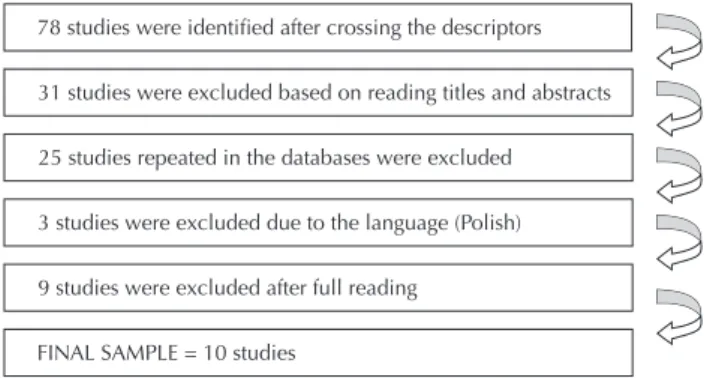
From crossing the descriptors in the selected research databases 78 queries meeting inclusion criteria were iden-tiied. Of these, 19 publications were read in full and nine were excluded for not presenting speciic data on readmis-sions from orthopedic surgical site infections; they only in-cluded the infections in the general data of the institutions that served as the stage for the various studies.
78 studies were identified after crossing the descriptors
31 studies were excluded based on reading titles and abstracts
25 studies repeated in the databases were excluded
3 studies were excluded due to the language (Polish)
9 studies were excluded after full reading
FINAL SAMPLE = 10 studies
Figure 1 shows the diagram of the inclusion and exclu-sion process of studies by crossing the descriptors.
Figure 1 – Diagram of the inclusion and exclusion process of studies in the review.
he search in the databases resulted in a sample of 10 scientiic articles. Data were descriptively analyzed and syn-thesized in order to reach the objective. For this purpose, a form was used to collect information on the variables related to the characteristics of publications (publication year, jour-nal, study objectives, research design) and on the variable of interest (aspects related to readmissions from orthopedic surgery site infections: incidence, predictors, more signii-cant comorbidities, length of hospital stay).
Most of the research was published in 2013 (60%) and 2014 (20%). The studies had a total of 60 authors,
averaging six per publication, one of which had 10 au-thors. Regarding the journals where the papers were published, more than half were related to the special-ization of orthopedics (70%), and retrospective cross-sectional descriptive design was the most used (80%). All of the studies (100%) were in English and most of the investigations were conducted in American hospi-tals (60%), two in New York, two in Pennsylvania, one in California and one in Washington. Four studies had no reference to the location where the research was conducted (Chart 1).
Chart 1 – Characterization of the analyzed publications – Coimbra, Portugal, 2014.
Authors, Year of publication and
Journal
Objectives Design Related aspects of readmission from orthopedic surgical site infections
McCormack, et al., 2012(20) Spine
Analyzing the causes of
unplanned readmissions within 30 days after
spinal surgeries.
Quantitative/ Descriptive/ Retrospective/
Cross
Most common cause of 45 unplanned early readmissions and reoperations was infection (32%), which occurred more frequently
after Laminectomy for decompression, cervical spine arthrodesis, thoracolumbar/posterior access, and lower back. In 15.5% of revisions,
the surgical infection was the second most common leading cause (76%).
Dailey, et al., 2013(21)
J Bone Joint Surg Am
Identifying incidence of
orthopedic readmissions within 30 days and identify risk factors among the
workers.
Quantitative/ Descriptive/ Retrospective/
Cohort
Cumulative incidence of unplanned readmissions was 4.2%. Of these, 73.9% are related to surgeries (34.3% due to SSI). Average time of permanence in the first hospitalization was higher for readmitted patients (5.9 days) in relation to non-readmitted (3.6 days). Need for intensive care (p=0.002) and longer average stay (p=0.002) significantly increased the likelihood of readmissions in 30 days (OR = 2.356 and OR
= 1.038, respectively).
McCormack, et al., 2013(22)
J Healthc Manag
Identifying causes of planned
and unplanned readmission within
30 days.
Quantitative/ Descriptive/ Retrospective/
Cross
Unplanned readmissions totaled 70.6%. Of these, 57.8% were related to surgical causes (SSI = 40.6%, being the majority). Average stay of 9.9 days, which was increased by four days due to unplanned readmissions.
Nacke et al., 2013(23)
Clin Orthop Relat Res
Characterizing readmissions for
infection within 30 days after spine surgeries and joint
arthroplasties.
Quantitative/ Descriptive/ Retrospective/
Cross
Readmission rates statistically higher in spine surgeries in relation to arthroplasties (p=0.045). There was no significant difference between readmissions after cervical and lumbar procedures (p=0.31). In 30 days,
80.4% of those undergoing spine surgery were readmitted and 62.2% after arthroplasty, with hips having a higher readmission rate compared
to knees (p=0.062). Preoperative characteristics were similar with respect to age, gender, and comorbidities.
...continuation
Authors, Year of publication and
Journal
Objectives Design Related aspects of readmission from orthopedic surgical site infections
Amin, et al., 2013(24)
J Neurosurg Spine
Evaluating the relevance of global
readmission rates in readmissions after spine surgery
and identifying their predictors. Quantitative/ Descriptive/ Retrospective/ Cross
Main reason for admission was infection (39.8%). Surgery cancellations and planned readmissions were excluded from the global calculations so as to not contaminate the data and rates of hospital readmission, indicating a reduction of 29% in the costs related to all readmissions. The predictors with statistical significance for readmission were elective
status or emergency admission (p < 0.0001), staying after five days (p <
0.0001), risk of death (p < 0.0001) and age > 65 years (p < 0.0021).
Zmistowski, et al., 2013(25)
J Bone Joint Surg Am
Identifying the incidence, causes
and risk factors for unplanned readmission in 90 days after total
arthroplasty.
Quantitative/ Descriptive/ Retrospective/
Cross
Unplanned readmissions in 90 days accounted for 84.7% of the total, and of these, 58.9% occurred within the first 30 days. The most common
cause was infection, with 35.9% of them within the first 30 days. Knee arthroplasty, male, greater body mass index and increased hospital stay
were significant predictors.
Kapadia, et al., 2014(26)
The J Athroplasty
Assessing the impact of post-arthroplasty infections in the
length of stay, readmissions and associated costs. Quantitative/ Descriptive/ Retrospective/ Case-control study
Average hospitalization stay of the infected group was significantly greater than in the control group (5.3 days/3 days, p = 0.0002), as well
as the average number of readmission events. Average number of hospitalization days of infected patients, post knee arthroplasty, in 1 year was 24 days, and in those undergoing general arthroplasty who
were not infected was 3.4 days (p<0.0001).
Total costs were significantly higher in the infected group (p < 0.0002).
Walid, et al., 2010(27)
J Clin Neurosci
Analyzing characteristics of spine surgery
patients, both outpatients and
hospitalized, in relation to demographic data, obesity, comorbidities and
rates of infection.
Quantitative/ Descriptive/ Retrospective/
Cross
Approximately 1% of outpatients were attended with SSI and 2.8% of those operated under hospitalization developed SSI, however there was no statistically significant difference. There were seven readmissions by
SSI and all were obese (BMI > = 30), considered a predicting factor for infection, and had higher prevalence of chronic diseases.
Kane, et al., 2014(28)
Orthopedics
Identifying correlation between seasonality and risk of infection in total
arthroplasties.
Quantitative/ Descriptive/ Retrospective/
Cross
Incidence of post-operative infection was 2.2% (17 patients) followed during the first hospitalization and on subsequent visits. There was statistical significant difference between the seasons separately (p = 0.031), and also with the infection rates between summer/fall (3.6%),
compared to winter/spring (1.0%), (p = 0.013).
Wang et al., 2013(29)
Comput Inform Nurs
Assessing impact of setting goals and
use of educational videos on patient
satisfaction, average time of stay
and readmission rates in 30 days.
Quantitative/ Descriptive/ Prospective/ Transverse
Families and patients discharged after spine surgery were divided into three groups in the same hospital unit. The first did not experience intervention, nor did they meet the program goals and educational video intended for discharge planning. The second group only received
the goals. The third received the goals and watched the educational videos. 32 unplanned readmissions occurred in all three groups and the
most common cause was SSI and there was no significant difference between them.
DISCUSSION
In analyzing the variable of interest of this review, mean-ing the readmission characteristics from orthopedic surgical site infection, it was found that the objectives of included publications varied between characterizing unplanned re-admissions within 30 days after discharge(20-23), identifying
predictors of surgical readmission within 30 days in overall readmission rates(24), assessing their impact on costs, average
stay and overall readmission rates, as well as its causes and risk factors(20-21,25-26) and associated comorbidities(27).
Stud-ies analyzing the impact of seasonality(28) and inluence of
goals and educational video programs on events that also included readmission(29) were also performed. here is
di-versity among generating motives for research, even if the
publications have been selected by the inclusion criteria deined in this review.
Readmission from orthopedic surgical site infections: an integrative review
and choosing appropriate statistical methods. here was no mention in this sample of one of the aforementioned check-list items, which refers to inclusion in the analysis results of people who withdrew from the study. It is believed that this was due to the fact that most studies are based on registries of medical records and institutional reports. he other in-strument, JBI Critical Appraisal Checklist for Descriptive/ Case Series, also considered clarity in the deinition of the inclusion criteria in addition to the above items, and exist-ing comparisons if there was suicient description of the groups. he criteria for evaluation of the results should be objective and reliable, to which all the articles met this issue by way of a detailed description of the analysis methodolo-gy(19). he evaluation of the quality of publications including
study sites, target, sampling methods, research tools, collec-tion and analysis procedures, among others, are transformed into important points for the readers’ evaluation as to the meaning of the study results(30).
In the global context of readmissions, there was a pre-dominance in readmissions related to surgical services observed when compared to clinical(21-22). his fact is
con-irmed by a study that analyzed the unplanned readmissions and compared their causes between medical and surgical discharges, where it found that postoperative complications accounted for 70.5% of readmissions related to surgical dis-charges(3). Surgical site infection was also the most common
type of infection, with a predominance of those classiied as deep(4); and events related to the orthopedic site were the
main reason for readmissions(20-22,24-25,29), ranging from 32.0
to 40.6% in the group of unplanned readmissions.
Among the statistically signiicant predictors are: the average length of stay when evaluating all readmissions for orthopedic SSI(21); those new admissions which
oc-curred after arthroplasty in general(25), or just the knee(26);
and, more speciically, when the stay is greater than ive days in SSI readmission after spinal surgeries(24). he need
for intensive care after the irst procedure was considered signiicant when deining risk factors for orthopedic re-admission in 30 days for infection(21). In spinal surgeries
with urgent admission status, the risk of death and age > 65 years were predictive factors for repeated hospitaliza-tions(24). Knee arthroplasty, male gender and higher body
mass index (BMI) are also among the predictors of re-hospitalization for unplanned causes, and also includes SSI when the infection is analyzed after arthroplasty in general(25). A multicenter prospective study in the context
of spinal injury obtained an incidence rate and identiica-tion of risk factors for SSI equivalent to those found in the literature for spinal surgery(16).
In an attempt to correlate between seasonality and risk of infection in total arthroplasties, there was a statistically signiicant diference between infections that occurred in the summer/fall compared to winter/spring. However, the authors point out limitations, especially with regard to clas-sifying the potential for surgery contamination(28).
Among the comorbidities, obesity is a possible predictor of readmissions for SSI when analyzing the characteristics of patients operated on an outpatient basis and inpatient
management. Although there was no signiicant diference in readmissions for infection related to the type of service, all readmitted patients had a BMI > 30(27). Diabetes also
emerged as a predictor of SSI in research that investigated the incidence and risk factors in the procedures related to spinal vertebrae injury(16).
Readmission rates were signiicantly more expressive in spinal surgery compared to arthroplasties(23,29). In the
re-ferred study, two types of surgeries were grouped into very low overall rates of infection in the institution, and therefore of readmissions for this reason(23). Educational videos and
goals in the planning of discharge evaluated the inluence on readmission rates for orthopedic SSI, so the study results show the comparison between spinal surgeries and arthro-plasties(29). With regard to arthroplasties, in order to identify
the incidence, causes and risk factors for readmission, the hip resulted in a higher percentage compared to the knee, but without statistical signiicance, despite similar preop-erative characteristics such as age, gender and comorbidi-ties(23). Also in relation to arthroplasties, SSI was the leading
cause of readmission after hip surgery, while knee surgery had a predominance of stifness in the joint(25). Regarding
spinal surgery, more readmissions occurred due to infec-tion after laminectomy for decompression, cervical spine fusion, thoracolumbar with posterior access and lumbar, in relation to the others(20). One study found no signiicant
diference between readmissions by SSI after cervical and lumbar procedures(23). Regardless, in order to assess whether
the preparation for discharge of elderly could reduce read-mission rates and hospital stay, the WHO emphasizes that planning is the key to ensuring safe and efective continuity of health care(15).
he average length of hospital stay increased by four days in comparing planned and unplanned readmis-sions, and between unplanned events, those resulting from surgical site infection presented an average of 9.9 days of stay(22). In another study that compared a group
of patients with postoperative infection and a group who did not develop infection in order to assess the impact of post-arthroplasty knee infections for length of stay, read-missions and associated costs, it was found that the aver-age hospitalization stay among those infected was signii-cantly higher than in the control group, being composed of individuals who were not infected after primary knee arthroplasties. he number of subsequent hospitalizations or readmissions within one year of follow-up was higher in the uninfected group(26).
Two publications pointed out the need for further surgery depending on SSI and subsequent readmis-sions(20,23). Secondary procedures were performed on most
SSI patients readmitted after spinal surgeries and arthro-plasties(23). In more than half of the unplanned
readmis-sions the patients returned to surgery, most as a result of postoperative infection, which also comes as second cause of readmission after surgical revisions(20). Research that
stay(9). Another study to identify risk factors associated
with treatment failures of SSI after spinal surgery indi-cates the prevalence of aggressive surgical debridement and prolonged antibiotic use(12).
For analyzing costs it becomes important to properly characterize readmissions as planned and unplanned, con-sidering that the actions or interventions in each group have diferent focuses. In addition, unplanned occurrences repre-sent higher cost, and at the same time, the greatest potential for improving quality of care(21-22,24), constituting an
organi-zational challenge. Researchers that have examined causes of unplanned readmission airm that interventions that improve the quality of care processes on the irst admission tend to be more efective in reducing subsequent events of clinically-related hospitalization(3). Other studies also
con-sider that there is an increase of infections due to costs(8-9);
that eforts should be concentrated on patients with higher risk of readmission(10); and that there would be a large
an-nual savings by reducing infection rates related to health care(8). he US Department of Health and Human Services
considers that the approach to readmission causes becomes a useful measure for the accountability of health plans in the sense that it assumes the coordination of efective care with institutions and health professionals(1).
Readmission rates when stratiied, and those unrelated to the assistance itself are eliminated (such as cancellations or suspension of surgeries), become more accurate for com-parison between institutions and may set real readmission event costs(22,24). Planned readmissions to perform surgical
steps, among other reasons, can mean 25% of all readmis-sions(24). hose decided early should be used as an indicator
of surgical care quality(20). In addition, one cannot fail to
point out that there is still need for more studies involv-ing surgery with implants, especially with regards to the safety of antibioilm strategies to treat infections involving bone tissue and biomaterials(11). his would also be a point
to consider in studies on readmission following orthope-dic surgery, considering that infections associated with the use of biomaterials difer in epidemiology, etiology and se-verity in relation to procedures which are not used(14). It is
noteworthy here that there was no mention in any of the studies about extrinsic factors for surgical site infections, namely: hospital stay prior to the procedure, processing of items and materials for care, surgical techniques, or operat-ing room environment. It is understood that these issues are already deined. hus, it is considered that the studies have advanced towards knowledge and interventions of the intrinsic factors, i.e. age, severity and associated comorbidi-ties, among others evaluated in the research that compose the sample for this review.
Finally, the administrative databases have been used frequently in comparative studies and setting improvement care goals(22,24). However, attention must be turned to the
quality of data available that sufer variations related to the type of record, speciic causes of readmissions and quanti-tative information(21-22,25,28). Otherwise, limitations are
im-posed on studies(24), such as those cited by the selected
au-thors: size and deinition of the sample(23) and data loss due
to inclusion criteria when patients are treated at other ser-vices other than those where the previous care occurred(20-22).
here is no doubt that measures or performance indicators from causes of readmission can be used in quality reports and accountability, given that their nature is multifactorial and responsibility must be shared(1).
his review also presents limitations due to the small number of selected publications, and in relation to the di-versity of them, of assessing costs, sometimes comparing types of surgery, and always in very diferent situations. However, it is a irst step in the multidisciplinary team of professionals that can provide the necessary importance to the data for better management and better qualiication of the care provided.
Nurses in particular play an important role in improving the safety and quality of care, overseeing the results of criti-cal managerial concepts throughout the historicriti-cal move-ment of care(31).
CONCLUSION
It is noted that readmission rates become an important reference for analyzing the quality of care, especially when stratiied by causes and time of occurrence is evaluated and compared with the previous hospitalization.
In relation to unplanned readmissions, SSI are the most frequent cause in more than half of the studies, although quite speciic actions and widely publicized for its preven-tion and control, as well as extrinsic factors or related to care processes. When orthopedic surgeries are done, new admis-sions represent long hospitalization, invariably associated with new surgical interventions, an increase in the number of subsequent hospitalizations, and new infections.
he study of predictive risk factors already known and a review of work processes can change readmission data for orthopedic surgical site infections, reducing costs and qualifying assistance. Nursing care, in particular their man-agement skills already established for critical care involving a multidisciplinary team, has a fundamental role in care, from comparative and analytical data of surgical procedures, to getting to know other dimensions with potential actions that contribute to minimize such occurrences.
his review has shown that research focuses on causes, risk factors and comparisons between institutions. However, there is the emergence of new elements, such as diferences in the incidence of SSI between the various types of surger-ies, which inluence the incidence of SSI in overall rates and their meanings in the same institutions.
Still, a higher volume of comparative studies and new research involving issues related to indirect costs are neces-sary, speciically the social and psychological costs, closer to patients who are the victims of readmissions.
Readmission from orthopedic surgical site infections: an integrative review
RESUMO
Objetivo: Caracterizar as readmissões por infecção do sítio cirúrgico ortopédico. Método: Revisão integrativa da literatura, nas bases de dados LILACS, IBECS, MEDLINE, Cochrane, SciELO e PUBMED, por meio dos descritores Readmissão do paciente, Infecção da ferida operatória, Infecção hospitalar, Procedimentos ortopédicos, Ortopedia. Resultados: Identiicados 78 estudos e selecionadas 10 publicações. A infecção do sítio cirúrgico é a causa mais frequente entre as readmissões ortopédicas não planejadas, que representam longos períodos de internação, novas intervenções cirúrgicas e custos elevados, além de maior possibilidade de internações subsequentes. Fatores preditivos mais signiicantes apontaram tempo médio de internação, necessidade de cuidados intensivos, status de urgência na admissão, risco de morte, idade > 65 anos, sexo masculino e maior índice de massa corporal. Conclusão: Taxas de readmissão tornam-se cada vez mais medidas de qualidade e preocupação em relação a custos. Novos estudos poderiam envolver questões relacionadas a custos indiretos, especiicamente os sociais e psicológicos.
DESCRITORES
Readmissão do Paciente; Infecção da Ferida Operatória; Infecção Hospitalar; Procedimentos Ortopédicos; Enfermagem Ortopédica; Revisão.
RESUMEN
Objetivo: Caracterizar los reingresos por infección del sitio quirúrgico ortopédico. Método: Revisión integradora de la literatura, en las bases de datos LILACS, IBECS, MEDLINE, Cochrane, SciELO y PUBMED, por medio de los descriptores Reingreso del paciente, Infección de la herida operatoria, Infección hospitalaria, Procedimientos ortopédicos, Ortopedia. Resultados: Fueron identiicados 78 estudios y seleccionadas 10 publicaciones. La infección del sitio quirúrgico es la causa más frecuente entre los reingresos ortopédicos no planiicados, que representan largas estancias hospitalarias, nuevas intervenciones quirúrgicas y costos elevados, además de mayor posibilidad de ingresos subsiguientes. Los factores predictivos más signiicativos señalaron tiempo de estancia media, necesidad de cuidados intensivos, status de urgencia en el ingreso, riesgo de muerte, edad > 65 años, sexo masculino y mayor índice de masa corpórea.
Conclusión: Las tasas de reingreso se hacen cada vez más medidas de cualidad y preocupación con relación a los costos. Nuevos estudios podrían involucrar cuestiones relacionadas con costos indirectos, especialmente los sociales y psicológicos.
DESCRIPTORES
Readmisión del Paciente; Infección de Herida Operatoria; Infección Hospitalaria; Procedimientos Ortopédicos; Enfermería Ortopédica; Revisión.
REFERENCES
1. Morgan A, Khan A, Amin T. Challenges in evaluating all-cause hospital readmission measures for use as national consensus standards. Perm J. 2013;17(4):14-8.
2. Sellers MM, Merkow RP, Halverson A, Hinami K, Kelz RR, Bentren DJ, et al. Validation of new readmission data in the American College of Surgeons National Surgical Quality Improvement Program. J Am Coll Surg. 2013;216(3):420-7.
3. Rosen AK, Chen Q, Shin MH, O’Brien W, Shwartz M, Mull HJ, et al. Medical and surgical readmissions in the Veterans Health Administration: what proportion are related to the index hospitalization? Med Care. 2014;52(3):243-9.
4. Dias-Agero-Pérez C, Pita-López MJ, Robustillo-Rodela A, Figuerola-Tejerina A, Monge-Jodrá V, Grupo de Trabajo INCLIMEDCC de La Comunidad de Madrid. Assessment of the surgical site infection in 14 hospitals of the Madrid Region: an incidence study. Enferm Infecc Microbiol Clin. 2011;29(4):257-62.
5. Ovaska MT, Mäkinen TJ, Madanat R, Huotari K, Vahlberg T, Hirvensalo E, et al. Risk Factors for deep surgical site infection following operative treatment of ankle fractures. J Bone Joint Surg Am. 2013;95(4):348-53.
6. Ercole FF, Chianca TC, Duarte D, Starling CE, Carneiro M. Surgical Site Infection in patients submitted to orthopedic surgery: the NNIS Risk Index and Risk Prediction. Rev Lat Am Enfermagem. 2011;19(6):1362-8.
7. Magill SS, Edwards JR, Bamberg W, Beldavs ZG, Dumyati G, Kainer MA, et al. Multistate point-prevalence survey of health care-associated infections. N Engl J Med. 2014;370(13):1198-208.
8. Schweizer ML, Cullen JJ, Perencevich EN, Vaughan Sarrazin MS. Costs associated with surgical site infections in Veterans Affairs Hospital. JAMA. Surg. 2014;149(6):575-81.
9. Harrop JS, Styliaras JC, Ooi YC, Radcliff KE, Vaccaro AR, Wu C. Contributing factors to surgical site infections. J Am Acad Orthop Surg. 2012;20(2):94-101.
10. Kripalani S, Theobald CN, Anctil B, Vasilevskis EE. Reducing hospital readmission rates: current strategies and future directions. Annu Rev Med. 2014;65:471-85.
11. Romanò CL, Toscano M, Romanò D, Drago L. Antibioilm agents and implant-related infections in orthopaedics: Where we are? J Chemother. 2013;25(2):67-80.
12. Maruo K, Berven SH. Outcome and treatment of postoperative spine surgical site infections: predictors of treatment success and failure. J Orthop Sci. 2014;19(3):398-404.
13. Kurtz S, Ong K, Lau E, Mowat F, Halpern M. Projections of primary and revision hip and knee arthroplasty in the United States from 2005 to 2030. J Bone Joint Surg Am. 2007;89(4):780-5.
14. Campoccia D, Montanaro L, Arciola CR. A review of the clinical implications of anti-infective biomaterials and infection-resistant surfaces. Biomaterials. 2013;34(33):8018-29.
16. Dubory A, Giorgi H, Walter A, Bouyer B, Vassal M, Dhenin A, et al. Surgical-site infection in spinal injury: incidence and risk factors in a prospective cohort of 518 patients. Eur Spine J. 2015;24(3):543-54.
17. Rasouli MR, Respreto C, Maltenfort MG, Purtill JJ, Parvizi J. Risk factors for surgical site infection following total joint arthroplasty. J Bone Joint Surg Am. 2014;96(18):e158.
18. Teixeira E, Medeiros HP, Nascimento MHM, Costa e Silva BA, Rodrigues C. Integrative literature review step-by-step & convergences with other methods of review. Rev Enferm UFPI. 2013;2 Suppl esp:3-7.
19. The Joanna Briggs Institute. Joanna Briggs Institute reviewers’ manual 2014 edition [Internet]. Adelaide: JBI; 2014 [cited 2015 May 15]. Available from: http://www.joannabriggs.org/assets/docs/sumari/ReviewersManual-2014.pdf
20. McCormack RA, Hunter T, Ramos N, Michels R, Hutzler L, Bosco JA. An analysis of causes of readmission after spine surgery. Spine (Phila Pa 1986). 2012;37(14):1260-6.
21. Dailey EA, Cizik A, Kasten J, Chapman JR, Lee MJ. Risk factors for readmission of orthopaedic surgical patients. J Bone Joint Surg Am. 2013;95(11):1012-9.
22. McCormack R, Michels R, Ramos N, Hutzler L, Slover JD, Bosco JA. Thirty-day readmission rates as a measure of quality: causes of readmission after orthopedic surgeries and accuracy of administrative data. J Healthc Manag. 2013;58(1):64-76.
23. Nacke E, Ramos N, Stein S, Hutzler L, Bosco JA 3rd. When do readmissions for infection occur after spine and total joint procedures? Clin Orthop Relat Res. 2013;471(2):569-73.
24. Amin BY, Tu TH, Schairer WW, Na L, Takemoto S, Berven S, et al. Pitfalls of calculating hospital readmission rates based on nonvalidated administrative data sets. J Neurosurg Spine. 2013;18(2):134-8.
25. Zmistowski B, Respreto C; Hess J, Adibi D, Cangoz S, Parvizi J. Unplanned readmission after total joint arthroplasty: rates, reasons, and risk factors. J Bone Joint Surg Am. 2013;95(20):1869-76.
26. Kapadia BH, McElroy MJ, Issa K, Johnson AJ, Bozic KJ, Mont MA. The economic impact of periprosthetic infections following total knee arthroplasty. J Arthroplasty. 2014;29(5):929-32.
27. Walid MS, Robinson JS 3rd, Robinson ER, Brannick BB, Ajjan M, Robinson JS Jr. Comparison of outpatient and inpatient spine surgery patients with regards to obesity, comorbidities and readmission for infection. J Clin Neurosci. 2010;17(12):1497-8.
28. Kane P, Chen C, Post Z, Radcliff K, Orozco F, Ong A. Sazonality of infection rates after total joint arthroplasty. Orthopedics. 2014;37(2):182-6.
29. Wang W, Dudjak LA, Larue EM, Ren D, Scholle C, Wolf GA. The inluence of goal setting and smart room patient education videos on readmission rate, length of stay, and patient satisfaction in orthopedic spine population. Comput Inform Nurs. 2013;31(9):450-6.
30. Ehlers V, Ethical responsibilities of authors. Int Nur Rev. 2014;61(2):159-61.
31. Owens LD, Koch RW. Understanding quality patient care and the role of the practicing nurse. Nurs Clin N Am. 2015;50(1):33-43.
Financial support: Coordenação de Aperfeiçoamento de Pessoal de Nível Superior - CAPES.
Process n. 99999.006522/2014-09
Acknowledgements: Associate Professor of EEAN/UFRJ, Ph.D Antonio José de Almeida