http://dx.doi.org/10.1590/0104-530X2245-17
Resumo: A falta de mão de obra qualiicada é uma das principais diiculdades do setor da construção civil. Pesquisas demonstram que, apesar do aumento de ações voltadas à qualiicação de funcionários nos últimos anos, muitas dessas ações foram consideradas insatisfatórias. Sendo assim, em função da alta demanda por qualiicação no setor, foi elaborado um programa de capacitação considerando a Andragogia, que trata da aprendizagem de adultos. A literatura sobre esse assunto apresenta vários estudos teóricos, buscando entender como os adultos aprendem. Porém, existe uma carência de pesquisas com aplicações desta teoria, principalmente na educação proissional. Dessa forma, foram acompanhados cursos voltados para trabalhadores da construção, com o objetivo de analisar se a Andragogia vem sendo atendida e, mediante a aplicação de questionários, avaliar a importância atribuída pelos alunos ao atendimento de cada princípio que norteia a educação de adultos. Depois disso, foi desenvolvido um programa de capacitação para alvenaria estrutural, que foi aplicado em dois cursos, procurando identiicar diiculdades e o atendimento da Andragogia por meio das ações propostas. Com isso, foi possível constatar a importância da consideração da referida teoria em cursos voltados para a construção civil, proporcionando resultados satisfatórios em termos de aprendizagem e motivação para participação no curso.
Palavras-chave: Andragogia; Capacitação; Construção civil.
Abstract: The lack of skilled labor is a major constraint within the civil construction sector. Major works on the subject show that despite the increasing efforts to improve the workforce in recent years, many have proven unsatisfactory. Given employers’ high demand for qualiied employees, we created a training program based on Andragogy, a theory for adult learning. There are numerous contributions to the ield literature seeking to understand how adults learn, but they fail to provide practical applications of Andragogy, mainly regarding continuous professional education. Thus, we followed training programs focused on construction workers in order to analyze whether andragogical assumptions have been employed. Questionnaires were applied to determine the degree to which students apply each principle of learning for adults. Next, we developed a training program for structural masonry, divided into two courses in order to identify dificulties and the application of Andragogy through the actions proposed. This enables us to endorse the importance of taking this theory into consideration in courses focused on civil construction, since satisfactory outcomes were reached in terms of learning and motivation for participation in the program.
Keywords: Andragogy; Capacitation; Civil construction.
The use of Andragogy in civil construction capacity
building courses
A utilização da Andragogia em cursos de capacitação na construção civil
Lucia Bressiani1
Humberto Ramos Roman2
1 Universidade Tecnológica Federal do Paraná – UTFPR, Câmpus Toledo, Rua Cristo Rei, 19, CEP 85902-490, Toledo, PR, Brazil, e-mail: [email protected]
2 Universidade Federal de Santa Catarina – UFSC, Câmpus Reitor João David Ferreira Lima, CEP 88040-900, Florianópolis, SC,
Brazil, e-mail: [email protected] Received Apr. 30, 2016 - Accepted Sept. 03, 2016 Financial support: None.
1 Introduction
The building and construction industry is still characterized by a low degree of mechanization and extensive use of manpower. Thus, interventions to improve the workforce have been seen as a strategic issue for companies, because with new construction technology, better quality products do not depend only
on techniques or equipment, but to a large measure on the way employees work .
A number of initiatives have been carried out in the
However, according to data presented by ABRAMAT (2007), these efforts still fall short of what is required.
In addition, despite the higher investments in
workforce skills since 2007, most companies still
rate the training programs as unsatisfactory.
The indings of the study developed by Oliveira (2010) clarify that, from the point of view of
employees, many aspects of courses or training do not encourage learning, and may be responsible for the lack of success of these workers. The main
negative points were: use of repetitive content, lack
of student participation in the discussion of themes,
theme deinition unrelated to the work environment,
and lack of a good relationship between instructor and students.
Therefore, it is essential to disseminate methodologies to improve training for the public in this sector.
Although the literature on Andragogy―the science of how adults learn―addresses various theoretical
studies, most do not have practical application. Few are focused on professional education, which needs a revision of current proposals, centering it on the subjects and their circumstances.
Therefore, this work seeks to contribute to the development of civil construction training programs,
using Andragogy as a means to better meet the training
needs of this public.
To that end, we irst sought to understand how
the process has been taking place in the sector by conducting case studies. The objective was to verify if the theory is being inserted into the programs, as well as to analyze how learners evaluate the contributions of this theory to the courses.
Next, a training proposal is presented, as well as its application in two situations. The objective was to understand how this theory can be applied in civil construction, in order to help in the development of the
new proile required by the current market scenario.
2 Concepts about Andragogy
Two models appear in education research to describe
how individuals learn: Andragogy and pedagogy. The term Andragogy is derived from the Greek
words “andros”, which means man, and “gogia”, which means to guide or lead. Thus, it means leading adults. The term pedagogy is derived from the Greek
words “paidós” (child) and “gogia”, that is, child learning (Draganov et al., 2011).
Andragogy differs from pedagogy in that it has a speciic methodology and is aimed at higher age
groups. The main difference is that the former takes into account the tacit knowledge and experience
accumulated by adults throughout life. Because it is strongly linked to qualiication for work, it considers
professional experience as a fundamental element of
its educational methods (Arroyo, 1996).
Henschke (1998) posited that Andragogy seeks
to identify how adults learn, and how to involve them in the learning process. Unlike pedagogy, it is centered on the idea that students are encouraged to bring their experiences to the class.
Wlodkowski (2008) and Moore (2010) comment
that adult learning tends to be more complex because of
the variables that inluence it, such as teaching styles, motivation to participate, cultural issues, self-esteem,
learning experiences, and personal problems.
Knowles (1995) based Andragogy on the following
six assumptions, which he considered essential
principles of adult learning:
1) The learners’ self-concept: adults take responsibility
for their own decisions and life, feeling the
need to be treated as self-directed. Thus, they
resist situations where they feel that others are
imposing their will on them;
2) The role of prior experiences: adults have a
pool of experience accumulated throughout their life, and would like to apply them in the classroom to help in understanding the subject
being studied;
3) Readiness to learn: adults are ready to learn
what they need to know to perform better in
real-life situations;
4) Orientation to learning: the interests of adults are
directed towards the development of the skills
they use in their social life or their profession; 5) The need for knowledge: adults need to know
why they need to learn something. They direct their life and learning interests and learn more
effectively if the subject matter is meaningful; 6) Motivation to learn: adults respond better to
internal motivations (self-esteem, higher quality of life, desire for greater job satisfaction), which
are more intense than external ones (better jobs,
promotions, pay increases). If the students are
not motivated to learn, they do not attend class and may drop out of the course.
Some researchers have seen Andragogy as a theory
of adult education, while others see it as an approach, a set of principles, a set of assumptions, or a guideline
for educational practice. Regardless of the deinition, it contributes greatly to adult education (Chan, 2010).
The andragogical model is procedural. Thus, the facilitator prepares in advance a set of procedures to involve learners, which according to Knowles et al.
(2011) should contain some speciic elements.
That is, the operationalization of the six principles
can be veriied through the elements of the process of Andragogy, which were studied and presented by Knowles (1995) in his work Designs for Adult Learning, and later explained by Damião (1996), Gitterman (2004), Nogueira (2004), and Illeris (2006). Chart 1 presents a summary of these authors’ descriptions of each of the elements.
The related literature presents various studies about professional formation, management by competences,
and Andragogy, but separately. In analyzing these
concepts, it is possible to see that the subjects supplement each other.
Goes & Pilatti (2012) emphasize the importance of
studying a system of vocational training that includes
competences (knowledge, skills, and attitudes) transmitted through Andragogy.
Ovando (1990), Levenson et al. (2006) and Antonello (2007) cite two reasons for studying Andragogy as a way of developing knowledge, skills, and attitudes. The irst is that professional training is more self-directed and must meet the objectives
of all the subjects involved in the process. Second, the current labor market situation requires a review
of current qualiication procedures and proposals,
focused on the subjects and their circumstances. There is a lack of studies on vocational training,
although the theory of Andragogy is fundamental to all adult learning situations (Wilson, 2005). Most of
the work is focused on formal education, presenting theoretical discussions about the importance of theory for the learning process, and few practical studies can be found that contribute to the understanding of how it can be operationalized.
Some studies in the area of formal education sought to identify typical adults’ preferences between the andragogical and pedagogical theories. In this area,
research with undergraduate students by Delahaye et al. (1994) and Zaidatun et al. (2008) can be highlighted.
Research developed with this same approach can be found in professional education, such as that
conducted by Ismail & Azman (2010). The results
show that some students may prefer both theories concomitantly because they require some kind of guidance from their teachers.
Wilson (2005) conducted a study of graduate students
with the objective of developing and validating an
instrument to measure the use of Andragogy in the
learning process. From this instrument, other research works examined the extent to which this theory has
been used in formal education. Along the same lines, the research of Shinoda et al. (2011) can be cited
Chart 1. Elements of the andragogical process.
Elements of the process Description
Preparing learners Adult learners should be prepared to be self-directed, as most may still be conditioned to depend on a teacher.
Setting the climate
The teaching environment should be pleasant and informal. While the physical climate must have adequate accessibility, toilets, comfortable chairs, good acoustics, and ventilation, the adequate psychological environment is achieved through the clear deinition of the objectives, openness to questions, and tolerance for errors.
Planning The student should be involved, in collaboration with the facilitator, in planning the course actions. People feel more involved when they participate in decision making.
Diagnosing learning
The learners’ perception of what they intend to achieve is the beginning of the construction of the competency model. This favors self-motivation, self-assessment, and relection. To that end, it is important to identify the points that must be worked out in concert with the students in the learning process.
Formulation of learning objectives
After identifying the needs, the learning objectives should be deined. This step consists in transforming the identiied needs into measurable objectives.
Designing learning plans The creation of the learning program should allow the students to decide on the learning goals they would like to achieve. The plans should include the activities to be carried out, the methodologies that will be used, and the duration of these activities.
Operating the program
This means carrying out the learning activities planned. A crucial factor in the operation of the program is the teacher. Teachers should be trained to adhere to the principles of andragogy. Techniques that employ the experience of adults are more effective than transmission techniques.
Evaluating learning outcomes
in postgraduate teaching in administration, which found that most andragogical process elements are not considered.
Similarly, studies by Scalabrin (2007) and Hopstock (2008) sought to verify compliance with the principles of Andragogy in professional training courses in various areas, noting non-compliance with
its principles.
Thus, from the analysis of the literature, it is possible to understand that the research focus was limited to
the identiication of preferences between theories, or compliance with the principles. And of the studies
cited, none refers to the construction sector. In this sense, the contribution of the proposal presented in this work is the discussion on ways to apply the
theory in courses for the ield of civil construction.
3 Research method
This study is part of a project entitled Integrative
System for Design and Execution of Building Systems in Modular Masonry Coordination (SISMOD), developed
in partnership between the federal universities of three
states (Alagoas, Ceará, and Santa Catarina) and the
intervening company S3ENG Inteligência Aplicada à
Engenharia, of Santa Catarina. This project, developed through Brazil’s research funding agency (FINEP), aims to develop an integrative system (software)
applied to the design and production of building systems in social interest masonry housing programs, based on modular coordination and connectivity of components in the context of open industrialization. It has several goals, notably the creation of a training model for the workforce, the methodology and results of which constitute the focus of this work.
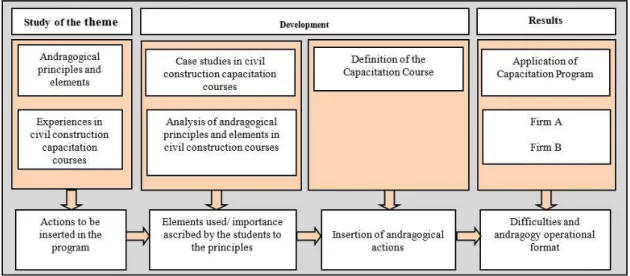
Thus, to deine the training program, the stages
presented in Figure 1 were deined.
According to Figure 1, this study contemplates the development of a training program, applied in two companies, as a way of discussing the inserted actions and their results. It was generated from the literature review and case studies in civil construction training courses.
4 Case studies
This stage had the objective of analyzing how
Andragogy is applied in some training experiences in civil construction. We tried to analyze the inluence
of each principle on the students’ satisfaction with the courses.
To this end, the case study was adopted as a
research method, since according to Yin (2001), it is
recommended for situations in which one tries to relate several aspects of the same phenomenon. It should
be used when a single- or multi-case depth analysis
is desired. Hence, we analyzed ten civil construction courses offered by an institution specializing in
training for the industry’s development. All courses
were offered in the western region of the state of
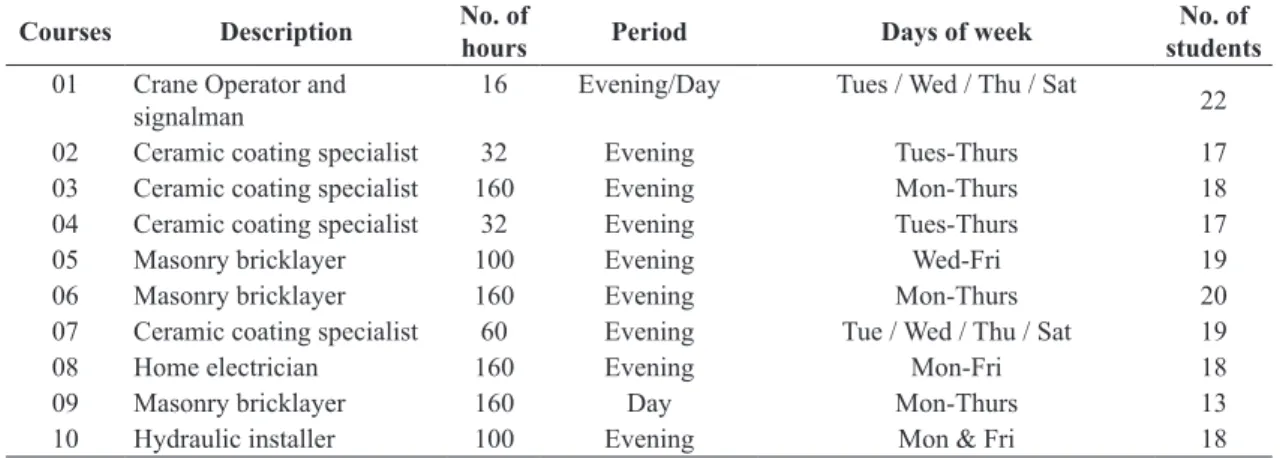
Paraná, in the cities of Cascavel, Toledo, Vera Cruz, and Catanduvas. Data collection took place between August of 2013 and August of 2014. Table 1 presents a characterization of each.
The courses were taught by eight different instructors, because one instructor taught courses
2 and 5, and another taught courses 4 and 9. Of the eight instructors, two have taught for more than ive
years, while the other six have less than three years
of experience. All of them work in the area related
to the course.
A total of 183 students participated in the program, of which 51% worked in civil construction. The predominant age group was 30 to 50 years
(56%), followed by 20 to 30 years (31%) and then 50 to 55 years.
4.1 Analysis of the andragogical elements in the courses
To identify how the elements of Andragogy were
contemplated in the courses examined, the technique of direct observation was used. This observation consists of a detailed analysis for the collection of
information (Martins, 2008). In an observational
study, the observer gathers data through direct contact
with the phenomena observed (Chizzotti, 2003), and describes them without interfering (Gonçalves, 2005).
The courses were analyzed in order to identify actions in relation to each andragogical elements (Chart 1). To that end, the researchers attended the classes, recording the actions in relation to each element.
The monitoring was carried out during several moments (beginning of the course, theoretical and
practical classes, and evaluations), to guarantee
the recording of all the steps. The following is a description of each observed element.
• Leaners’ preparation: no actions were identiied
to teach students to be self-directed. At the
beginning of each course the proposal was presented, and students were not allowed to
indicate how they would like it to be conducted;
• Climate: two courses did not meet this item satisfactorily because of poor lighting, uncomfortable chairs, and improvised rooms. Students were not always allowed to ask questions, and the content was transmitted continuously in
the theoretical classes. As positive points, coffee
was offered in a course before the presentation, an opportunity for the instructor and students
to talk informally;
• Program planning: the participation of the students in planning the actions, such as suggesting themes and ways of conducting the activities,
was not considered in any course;
• Diagnosis of needs, formulation of objectives,
and design of learning plans: no actions were
observed to identify the points to be covered with students, or to establish content based on their experiences and by identifying gaps in
their knowledge;
• Program operation: according to information obtained from instructors, none of them received
speciic training for working with adults. Of the
eight instructors, only two participated in
pedagogical meetings;
• Evaluation of the program: two types of evaluation were carried out, to measure students’ satisfaction with the course and evaluation of the knowledge obtained, through written tests and practical applications in the laboratory.
It was possible to verify that none of the andragogical elements were used correctly. It is worth mentioning that, in short courses, the initial stage (involving the
students in the planning or diagnosis of needs) can
be hampered by lack of time.
Likewise, engaging the student in program planning can be one of the most dificult steps to
operationalize, considering the need to have contact
with the audience before the course. During the courses
attended, the students registered, and the next contact with the instructor occurred at the beginning of the course. However, allowing the student to participate in the planning presented at the beginning, allowing changes, or choosing between some alternatives, can be a solution to make the process better conform to the indicated procedures for adult learning situations.
Table 1. Features of the courses.
Courses Description No. of
hours Period Days of week
No. of students 01 Crane Operator and
signalman
16 Evening/Day Tues / Wed / Thu / Sat 22
02 Ceramic coating specialist 32 Evening Tues-Thurs 17
03 Ceramic coating specialist 160 Evening Mon-Thurs 18
04 Ceramic coating specialist 32 Evening Tues-Thurs 17
05 Masonry bricklayer 100 Evening Wed-Fri 19
06 Masonry bricklayer 160 Evening Mon-Thurs 20
07 Ceramic coating specialist 60 Evening Tue / Wed / Thu / Sat 19
08 Home electrician 160 Evening Mon-Fri 18
09 Masonry bricklayer 160 Day Mon-Thurs 13
As a result, the analysis is presented below from
the point of view of the students participating in the courses.
4.2 Analysis of andragogical principles contemplated in the courses
To identify whether the andragogical principles were being satisfactorily used in the courses examined, a questionnaire was applied to the participants,
adapted from the study by Wilson (2005). Next, the
validation was performed to verify the analysis of the
understanding of items (semantic analysis), and the
relevance of the items to the construct they represent
(content analysis).
For the semantic analysis, the questionnaire was applied to a group of civil construction employees
to identify dificulties in understanding the items. After the reformulation, the content was validated
through evaluation by the judges. This stage was carried out by a group of eight researchers from the area of training and management of civil construction, with knowledge in human resources management,
and a group of eight professionals from the ield of
pedagogy, with experience in professional education.
According to Alexandre & Coluci (2011), there
is no consensus in the literature regarding the ideal number of judges, with between six and twenty variously suggested.
The judges’ task was to analyze the issues, verifying their association with the assessed principle,
indicating their agreement or non-agreement. In order
to consider the validity of the content, items that
reached at least 70% of concordance among the judges were used (Pasquali, 2004). Next, the questionnaire was reformulated, with 24 questions on a scale of 0 to 10:, never (0); little (1, 2, 3); medium (4, 5, 6); and very (7,8, 9, 10).
The questions were clustered into ive groups because, according to the judges’ analysis, principles 3 and 4
are complementary, and suggested the combination of the items to avoid repetition of concepts. Thus, the
instrument was divided into the following items: Principle 1 – Learners’ self-concept (5 questions); Principle 2 - The role of learners’ experience (4 questions); Principle 3 - Readiness to learn and orientation to learning (7 questions); Principle 4 - The need for knowledge (4 questions); Principle 5 - Motivation to learn (4 questions). The questionnaire is presented in the Appendix A to this paper.
The questionnaire was applied at the end of
each course. At that time, the reaction evaluation
(questionnaire used by the institution that was offering
the course) was also carried out on content, teacher, material, resources, and structure. Before each student
responded, the purpose and method of completion was
explained. The proile of the participants and of the instructor was also collected through a speciic form.
4.2.1 Inluence of principles on course satisfaction
To identify the inluence of the andragogical
principles on course satisfaction, the results of the questionnaires were subjected to a multiple linear
regression analysis―a statistical method that uses
the relationship between two or more variables, so that one variable can be estimated from the others
(Dancey & Reidy, 2006).
This model assesses the significance of an
independent variable through the P-Value Test,
comparing its value for each independent variable
with a given conidence level, which, in the case of this work, was 5%. Thus, the smaller the value of P is, the more signiicant is the variable for the model.
For the analysis conducted, the dependent variable was the reaction to the course, and the independent
variables were the principles of Andragogy.
Multicollinearity analysis was also performed, which is associated with the correlation between the
independent variables. A multiple linear regression
model assumes that the explanatory variables are
linearly independent (without multicollinearity). For this veriication, the Variance Inlation Factor (VIF) values were analyzed, considering that the
closer to zero they are, the lower the multicollinearity.
As acceptance criterion, values of FV to 10 are
considered. From these values, the existence of multicollinearity is considered (Pestana & Gageiro,
2000).
After the outlier detection procedures and checking
for normality of the variables, the sample remained
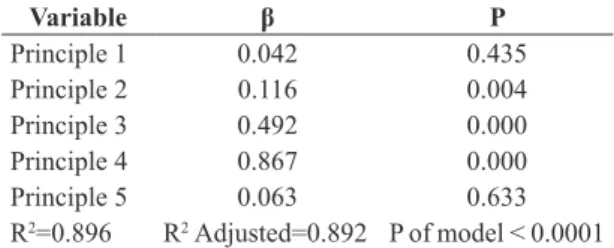
at 175 observations. Table 2 shows the results of the multiple linear regression analysis, considering the
ive variables.
It can be seen that principles 2, 3, and 4 were associated, and contributed signiicantly to course satisfaction (p value below 5%). The results indicate
that for each increase of one unit in principles
2, 3, and 4, there is an increase in satisfaction with the course of 0.116, 0.492, and 0.867, respectively.
Table 2. Multiple Linear Regression.
Variable β P
Principle 1 0.042 0.435
Principle 2 0.116 0.004
Principle 3 0.492 0.000
Principle 4 0.867 0.000
Principle 5 0.063 0.633
The results showed that the three principles were positively related to satisfaction with the course. In this sense, the more students’ experience is considered
(Principle 2), discussed, and respected, the more the students are satisied with the course.
Likewise, the more the course is associated with
situations that occur in practice, being important for
the correct performance of the function (Principle 3),
and the better the importance of what is being learned
is explained (Principle 4), the greater the satisfaction
with the course.
Principle 1, which refers to the need to be
self-directed, indicating how one would like to
learn or conduct one’s learning activities, was not
signiicant for course satisfaction (P = 0.435). Thus,
for students who participated in the research, it was
not important to be self-directed, to decide how to
learn in training courses.
Principle 5, which refers to motivation, was also
not associated with satisfaction with the course.
Students are more satisied with the way the course
is conducted, considering their experiences, helping
to solve day-to-day problems, and understanding
why the course is important, than with the results in
terms of the beneits they can obtain with the course.
4.2.2 Compliance with the principles
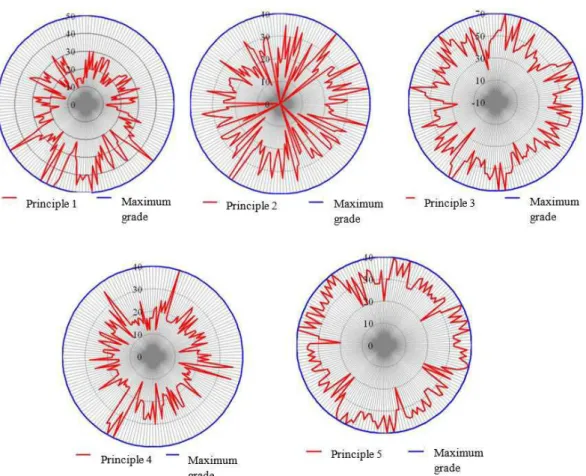
Figure 2 presents the results assigned by the students to each principle, analyzed individually. The outer line, in blue, represents the maximum score that the students could assign to the principle, and the red represents the assigned score.
It is possible to see that the principles were not
fulilled totally, from the point of view of the students. For principle 1, on average, 52% of the maximum
score that could be obtained was reached. In other words, students were not allowed to indicate how they would like to learn, present suggestions, and opinions.
Principle 2, which refers to the learner’s experience, reached 58.6% of the maximum score. Thus, in the
students’ opinion, their experiences were not always discussed to help in understanding the course.
Regarding principle 3, students responded that the
subjects were associated with situations they need
to know to perform the function, reaching 69.8% of
the maximum score.
Principle 4, which refers to the need for knowledge, reached just over 50% of the maximum score, indicating
that the courses did not make clear the importance of what was being studied.
Principle 5, which refers to motivation, was the
one that most approached the maximum scores. That is, the students were motivated to participate, depending on their internal or external motivations.
The case studies made it possible to verify that
the elements of Andragogy were not included in the
planning of the courses examined, as most of the principles were not satisfactorily met.
The courses are still developed with the pedagogical focus, with the content being transmitted in a continuous way by the teacher, without considering the needs
of the students. In this sense, this study conirms
the importance of teacher training to ensure that the elements and principles are met. This is because—with the exception of the motivation principle, which depends more on the student’s internal motivations
and personal interests—the concepts of Andragogy
depend on the instructor’s performance.
Next, we present the considerations used in the creation of the training course, using the adult learning theory .
5 Deinition of the capacity-building
course
Following the conduction of the case studies, as well as the literature analysis, a training program for
the civil construction ield was proposed. It was then
applied to two groups of employees from two structural masonry projects, seeking to gather information about
the operationalization of the program and dificulties
encountered.
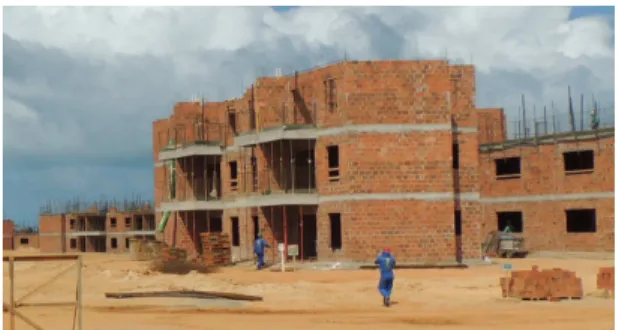
The selected projects are four-story structural
masonry buildings, one of which is built with ceramic blocks, under construction in the city of Fortaleza,
Ceará, shown in Figure 3, and the other with concrete
blocks, under construction in Maceió, Alagoas,
shown in Figure 4.
The courses were attended by 37 employees,
responsible for various stages of the project such as block setting, application of grout, framing, as well as master builders and contractors.
Next, the steps of the program are described, as
suggested by Ferreira (2012). Subsequently, the actions of Andragogy inserted in each one are presented.
5.1 Analysis
In this step, the characteristics of the proile to be trained were identiied, considering Brazil’s NBR 15968: 2011 (ABNT, 2011), which addresses the mason’s professional proile. Therefore, the
proposed program includes competencies 1 and 5,
which relate to planning and organizing one’s own workplace and performing structural masonry.
5.2 Planning
In this stage, the irst proposal was deined:
• Objectives: to train employees through the competences, abilities, and attitudes necessary
for the execution of structural masonry work;
• Needs: from an evaluation in the works, a survey was made on how the services were being executed. To that end, a form was developed that contemplates the steps for execution of the masonry work, considering knowledge, skills,
and attitudes, according to NBR 15968: 2011 (ABNT, 2011). Through this form, a group of
employees from each project was accompanied, for a period of a month and a half, before the course. For each item of the form it was noted whether the procedure was performed properly,
using the scale: meets (2), partially meets (1), and does not meet (0). Six measurements were
taken before each course, which were used to diagnose the initial needs of the training. It is worth mentioning that the employees were not
informed about this measurement, to prevent
their changing the form of execution;
• Duration: the duration of 16 hours over two
days was deined, each consisting of four hours
theoretical and four hours practical. The workload
was deined together with those responsible
for the company and the work teams (masters
and foremen), so as not to become a very
tiring course and to not interfere in the work schedule. It was proposed that the theoretical class would be in the morning, because the employees are rested, as indicated by Seewald
(2004);
• Methodology: two methods were deined: the conceptual, whose strategy is to learn by theory,
and the practical. According to Knowles et al. (2011), the basis of the methods must be that the
more active the learner’s role in their learning, the broader and deeper their learning will
be. Because of this, the technique of content
exposition should not be ignored, as long as the instructor uses the students’ experiences to construct new concepts. Thus, for the conceptual method, indicated for situations in which the assimilation of knowledge is sought, the oral explanation and the debate
techniques were deined. The explanation
technique was conducted so that the student could participate, considering the principles
of Andragogy, as will be presented in the following items. Audiovisual resources (data
presentations, videos, building materials, and
projects) were used to facilitate oral explanation
and debates. In the practical classes, activities were performed on real work situations, for
problem-solving as well as skills development;
• Infrastructure: for the theoretical classes, a setting with comfortable chairs and desks, good acoustics, adequate lighting, and ventilation
was proposed;
• Instructor: the instructor’s role was deined
based on the following principles: experience in training programs; motivation for the function; ability to transmit knowledge in a simple and organized manner; and knowledge
on the subject. In view of this, the instructor selected was a person who has worked in the structural masonry construction process
since 1992, developing training programs
for masonry production teams. The instructor
participated in the study of Andragogy, as well
as the preparation of the training proposal.
Although some instructors may have more
facility to teach according to adult education
theory, they need to undergo speciic training
to work with this audience.
5.3 Development
This stage consists of the development of the course modules, according to the competencies
and other items deined in the planning stage. Thus, the topics to be covered in the course were deined,
together with the printed material for the students
(manuals, projects, certiicates), and the methodologies,
which included the conceptual method, with oral explanatory and debates techniques, as well as the practical method composed of activities at the construction site.
5.4 Implementation
This refers to the implementation of the proposed
program. All employees were invited to attend the
course.
5.5 Evaluation
The evaluation was proposed through the application of the knowledge, skills, and attitudes
in the work developed in the day-to-day.
Next, we present the actions to contemplate the
principles and elements of Andragogy, as well as a
description of their application in the two courses.
6 Application of the
capacity-building program
This item presents the actions used to consider
Andragogy in the proposed program, during the
application of the courses in the two selected
projects. Likewise, the results obtained in each step
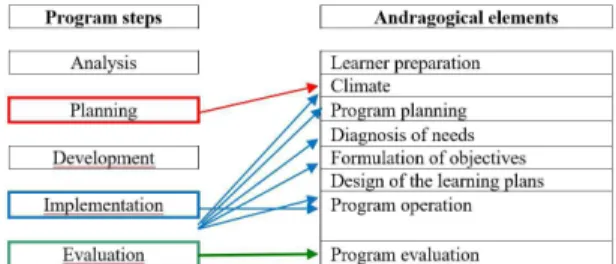
are presented. Figure 5 indicates the elements of
Andragogy and the steps in which they were inserted.
6.1 Learner preparation
For a person to be considered self-directed, he
or she must be proactive, in a state of readiness, awareness, and attitude that allows them to predict, recognize, and take responsibility for intervening and making things happen in a timely manner
Considering the proile of construction workers, with
their limitations and low level of education, preparing
them to be self-directed is a task that would require
a lot of time, and perhaps not lead to satisfactory results. The results of the survey conducted in the training courses showed that students do not consider
it important to be self-directed. They believe that
they do not need to have control of what they should learn, which can instead be directed by the instructor.
In this sense, no actions were developed to teach
the student to be self-directed. However, they were allowed to deine subjects and ways of carrying out
activities and evaluating the program. These are considered favorable actions, in which situations are not imposed, as advocated by the learner preparation element.
It was veriied, in the ten courses observed, that
the participation of the students was limited to the possibility of evaluating the program at the end of the course. However, this was not allowed to interfere in the manner of teaching the course, in order to meet the needs of the group.
During the two applications of the program, however, the students were able to participate in the deinition of subjects and activities. During these courses,
several students suggested subjects, showing their motivation to participate in what was being discussed once their views about what was important for them to learn were taken into consideration.
This enabled us to conclude that the students do
not necessarily need to deine the whole process
alone, but their participation makes the process more interesting for themselves.
6.2 Climate
The climate was contemplated in two moments, at the planning and implementation stage of the course. In the planning stage, it was considered in relation to the physical aspect, with a pleasant teaching environment, comfortable chairs, ventilation, and adequate acoustics.
In this sense, for Building A, which provided
adequate room (Figure 6), the course was intended for practical and theoretical application in the construction
site. For Building B, the relocation of the class to the Federal University of Alagoas was necessary for the
theoretical part Figure 7).
At the implementation stage, the proposal aimed
to provide a learning environment without pressure, in order to meet the psychological aspect of the principle of climate. Some actions were taken to
ensure this environment:
• Integration activity: coffee was offered at the beginning of the course, allowing the instructor to meet informally with the students in order
to make them feel at ease;
• Presentation: instructor and students introduced themselves at the beginning of the course, and
talked about their experiences and dificulties with the subject;
• Objectives: at the beginning of the course, the importance of what was being presented was explained, and participants were asked to express
their expectations regarding the program;
• Opening for questions: during the course, the participation of the students was requested, always respecting their contributions according to the professional experience of each one.
In the courses examined, the case studies observed anxiety on the part of the students, both at the beginning
and during each course. But in the courses conducted,
the instructor’s ability to convince students that the proposal would not be a transmission of knowledge, with them sitting listening passively, made the students feel that it would be a moment of conversation on subjects of their interest, in which they could speak openly and be respected.
The instructor’s presentation was focused on
his experience, and on the dificulties encountered
throughout his professional life. This allowed many
students relate to the same dificulties, and expose
theirs during their own presentations.
This is in contrast to what took place in the courses previously examined, where individual presentations,
when they occurred, were limited to the identiication
of name and function. The sense of the observers was that the students did not feel free to reveal their
dificulties or to speak more on the subject, since they
viewed the instructor as a master of all knowledge and were afraid to express their challenges.
6.3 Program planning
The principle called program planning, which refers to the student’s possibility to participate in all actions, was contemplated in the implementation stage.
Students were allowed to deine topics. This happened
mainly at the beginning of the course, when the
group’s dificulties were identiied. Hence, some themes initially planned based on the on-site survey were re-adapted. It was also proposed that the students
be involved in the organization of classrooms and in the selection of building materials and tools that they would like to use. For example, they requested to test s different mortar application tool, and this was provided for use on the second day of the course.
6.4 Diagnosis of needs, formulation of objectives, and design of learning plans
These elements were not considered in the planning stage, but in the implementation phase, since they
were to be deined together with the students.
Therefore, in the planning stage, the needs and objectives were outlined through the professional
proile and the needs found in the work. However, these actions aimed to deine durations and contents
to develop an initial proposal for discussion with
students. At the beginning of the course the proposal
was discussed with the students, with adaptations being made to include their considerations.
The following actions were deined to include the three elements in the implementation phase:
a) Diagnosis of needs: common problems in
structural masonry projects were presented,
and issues identiied in the monitoring of the
work (found through the application of a form
before the course). Also, images and videos with
adequate procedures of execution were shown, with the objective of making the participants
identify what could be improved. At that moment, several students participated, and identiied dificulties and points for improvement. For
example, it was found that the joints were showing variations above that allowed, and had
uneven illing. Through the group discussion, the possible causes were identiied, such as blocks
with dimensional variations, poor consistency of the mortar, lack of skill of the employee, or use of inadequate equipment. Thus, two strategies
were used to diagnose needs: through the form,
which served to elaborate the initial program of the course, and through the group discussion.
Although the instructor knew in advance what
the group needed to improve the professional
proile for the role, the group discussion served
to make the students aware of each need, as well
as to list other unidentiied ones in the follow-up to the work. All the needs listed were used to deine the items discussed during the course; b) Formulation of the objectives: after the needs
diagnosis, goals were listed up to the end of the course about what needed improvement. For example, reduce thickness variation and
improve joint illing;
c) Design of learning plans: at this point, after
identifying the points that could be improved, it
was deined how the activities would be carried
out. For example, for the need to improve the execution of the joints, the following activities
were deined:
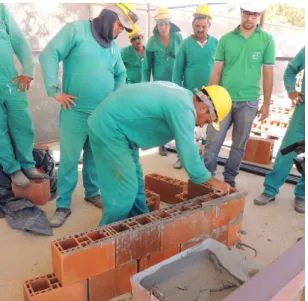
• Acceptance criteria for the blocks: a practical activity was performed to analyze the dimensional variations of the blocks that are used on site (Figure 8), with each student bringing a block to the course. With this, it was possible to perceive the importance of this control, which can lead to the replacement of the lot, and allow for execution of walls with smaller variations
• Other techniques of execution: theoretical and practical activities were performed to show
other techniques to reduce joint variation;
• New tools: a practical activity was carried out with the use of another mortar application
tool, aiming to improve the illing of the joints
(Figure 9).
During the discussions, it was possible to observe
that the students participated and remained attentive, since the subjects were being directed to situations that
the group had identiied as interesting for discussion.
6.5 Program implementation
The implementation of the program consisted of conducting the planned activities. These activities
had been pre-planned, based on needs identiied in the projects and re-planned with the students.
This activity depends greatly on the ability and experience of the instructor to improvise, so as
to insert needs identiied by the students into the
program. Thus, as the course proposal envisaged its completion in two days, some items could be added for the second day, so as to address the points suggested by the students.
During the operation of the program, experiential
techniques were used, through the presentation of videos of service execution and use of materials, and images projects and material handling to verify compliance with the standards.
Likewise, the activities were planned so that the
expository technique, in which the instructor presents
some deinitions, did not extend for a period of time greater than 15 minutes, since, according to Cavalcanti (1999), the information received in this interval is remembered best. After that time, the students cannot
concentrate because their attention becomes dispersed. Thus, activities such as videos and exercises were planned to intercalate with theoretical activities.
The principles of Andragogy were used during the
operation of the program. Thus, the three principles
that proved to be signiicant for the satisfaction
with the courses in the study carried out in civil construction training, were met, as explained in the following sections.
6.5.1 The role of learners’ experience
All themes were started by considering the students’
experiences. Students were then encouraged to think about other possibilities, and the standardized
procedure was presented. After that, a discussion was held about dificulties and results obtained through
both forms. Finally, solutions were studied to comply with the standard procedure, and negotiations were carried out (Figure 10).
As an example, the application of mortar may
be cited. The procedure used in one of the works was the partial application (Figure 11), whereas the standardized procedure involves the total application (Figure 12).
Videos were presented with both forms of application. The following information was presented:
Figure 8. Practical activity about block acceptance.
• A wall made with partial mortar application
has its resistance reduced by around 20%;
• If in the structural calculation of partial mortar application was considered, this information
would be indicated in the project. Otherwise,
the full application should be used.
Because the project used in the construction did
not specify the type of mortar application, the group understood that mortar should be applied to all
surfaces of the block. One of the dificulties presented
by the students was in relation to the tool used, so it was arranged that they would test another one in the practical activity.
Hence, the students’ experience was taken into consideration and discussions were carried out about the implications of the results. However, changes
were negotiated, taking into account their dificulties.
Often, students receive the information as if the
procedure they perform is inappropriate. However, it was found that the project also failed to present the information. Similarly, for this situation, they were not using a suitable tool. Thus, the way the students receive the information is different from the pedagogical approach, since they can intervene and use their experience to improve the process
6.5.2 Readiness to learn and orientation of learning
All the situations presented during the courses were
based on real situations, so that students could relate them to their current profession. The examples were
based on the dificulties identiied in the monitoring of the projects. An example that can be cited is about the
settlement of the blocks in places with reinforcement. In this case, it was found, on site, that the steel rebars
were ixed on the slab during concreting. Thus, it was
necessary to pass the blocks over the frame, as can be seen in Figure 13. Employees presented dificulties with regard to this issue, such as increased physical wear and decreased productivity.
At that moment a project was consulted which did not provide for the ixing of the steel bar on the slab. After this, the instructor presented the proposal to
leave only the transverse reinforcement on the slab. In this procedure, the wall is raised to the last row, and the steel rebar is then inserted through the top. The clamping of the steel on hold is done with wire, through the inspection hole shown in Figure 13.
Because this discussion was associated with a dificulty found on a daily basis, students’ interest
and participation were noted.
6.5.3 The need for knowledge
All the themes were presented according to their importance to the inal product. For example, one of
the needs diagnosed with the students was that the
joints were not illed with mortar. With respect to this
Figure 11. Partial application. Source: Selecta Blocos
(2013).
subject, results of tests were presented proving that
the resistance of the wall can decrease:
• By up to 30% if joints vary in thickness;
• By up to 33% if horizontal joints are poorly
illed;
• By around 20% if partial illing is performed (Figure 11).
The proposal contemplated the motivation to learn, presenting possibilities of professional growth from the training, although the motivation principle was
shown insigniicant to satisfaction with the course.
In this sense, a motivational video was presented about the importance of civil construction employees
to other sectors. Also presented was a video focusing
on the need for change, comparing the construction industry with others, making them realize that without
change there is no evolution. And that to evolve, it
is necessary to be willing to learn, in order to meet internal motivations (higher quality of life and job
satisfaction), besides the external ones (better salaries and promotions), as recommended by the motivation
principle.
Likewise, the learner’s self-concept principle was
not associated with satisfaction with the courses. However, some actions taken to address the elements
of Andragogy can be associated with this principle,
such as allowing students to suggest how they would like to learn (subject matter and manner of conducting
activities).
6.6 Evaluation
Students were allowed to identify subjects that were not clear at the end of each course module, as well as during informal conversations in intervals.
A course and learning evaluation was also carried out.
The course evaluation was carried out using the same questionnaire used in all ten courses studied. Through it, each student was able to evaluate contents, methodology, instructor, resources, and use of the andragogical principles.
All the participants completed the evaluation, reaching an average score of 115 out of a maximum of 120 points for each item, as shown in Figure 14.
In the case studies carried out in the 10 training courses, the average student response was 85 points, representing 70% of the maximum evaluation, while the proposal presented 95% of the maximum grade.
Figure 15 presents the scores obtained for each principle.
It is possible to verify that the principles
were met in more than 97% of responses, except
principle 1, regarding the need to be self-directed, which was met in 92%.
Hence, it is possible to observe that, according to the students, the principles were satisfactorily met with the actions proposed.
The evaluation of learning was carried out by comparing the application of knowledge, skills, and attitudes by the employees in practice, before and after the course. This evaluation was conducted using the same form used to identify the needs. The monitoring was carried out with a group of employees from each site for a period of a month and a half, before and after conducting the courses. Fifteen employees were selected to be followed, since the analysis consisted of a weekly evaluation of how the employees performed their activities, through a list of knowledge, skills, and attitudes. However, of the selected employees, only 11 remained in the same role after the course, to allow comparison before and after.
Figure 16 presents the results obtained for the employees analyzed. It shows the percentage of each employee’s activities that were conducted in an appropriate way.
The employees’ average score before the course
was 62%, while after the course this rose to 84%.
In some items, the necessary changes could not be observed immediately after the application of the course, because they depend on strategies of the
Figure 14. Scores for course evaluation.
It was possible to see a group discussing dificulties
and ways to solve them, not simply assimilating a
deinition about how the process should be happening. Consequently, the results in terms of commitment,
especially for behavior change, may be more effective. Having students learn about different ways of performing according to standardized procedures,
making them think about the dificulties and results
that can be obtained, and negotiating for changes, causes the students to participate in the process. This is contrary to what was observed in the courses analyzed, where the normalized theme is presented as a rule, and as the only proposal to be discussed.
Andragogy, with its elements and principles,
advocates involvement, and letting the students realize that they are the most important element of the
course; that they can deine, discuss, present opinions,
and also outline the goals they consider important.
Even though a proiciency proile for structural
masons was followed for preparation of the initial
proposal of the course, it was possible to re-adapt
according to the needs of the students. Similarly, some
proile items are required and cannot be disregarded in the execution process. Thus, Andragogy was used
to show the importance of considering each stage and
the consequences of non-compliance. However, the
consideration of their suggestions for implementing changes made the process more dynamic, which allowed us to verify in practice the satisfactory results of learning and the behavior change.
Regarding the students’ understanding, the principles were satisfactorily met using the proposed actions, and the satisfaction with the course reached close to the maximum possible marks.
In summary, as a result of this research, it was
possible to present a discussion about Andragogy
within the context of capacity building. The analysis
enabled the identiication of actions that can help
in the development of more effective programs, in which students can participate and propose solutions
to dificulties they encounter, thereby providing a
greater application of knowledge, skills, and attitudes in practice.
Acknowledgements
The authors would like to thank FINEP for its inancial support of this research.
References
Alexandre, N. M. C., & Coluci, M. Z. O. (2011). Validade de conteúdo nos processos de construção e adaptação de instrumentos de medidas. Ciência & Saúde Coletiva, 16(7), 3061-3068. PMid:21808894.http://dx.doi. org/10.1590/S1413-81232011000800006.
company, which must be adopted later. One such
example refers to the supply of defective blocks, which continued to be provided by the same company,
making it dificult to execute uniform joints, and
accounting for the fact that the employees’ scores did not reach the maximum.
7 Final considerations
The results presented throughout the work of the actions used to insert the elements and principles of
Andragogy, as well as the analysis of the applications
during the courses, allow us to conclude that the elements and principles of this theory do not present
complex concepts which are dificult to apply.
Professionals working with adults should understand and employ it. It was possible to verify that the theory is composed of simple concepts, but which contribute to the development of knowledge, skills, and attitudes, by placing the student at the center of the process, and addressing their experiences,
dificulties, and limitations.
The theory of teaching adults is not new, but as seen in the literature review, it has been questioned lately due to the lack of its application in adult learning situations.
The analysis of the courses examined allowed us to conclude that the use of pedagogical methods still predominates, which may occur due to the lack of knowledge of those responsible for conducting the courses (who for the most part do not receive training
for this), or to the ease of using the pedagogical approach. Although only ten courses were followed,
which may not represent the reality of all learning situations in civil construction, it was possible to verify
that practically none of the concepts of Andragogy
were used in the courses. Hence, the need to train the
instructors for this adult-oriented training is evident. Considering that an adult student can learn with
a pedagogical approach, what became clear is that motivation, involvement, and discussions took place more intensively in the two applications of the
Andragogy program than in the ten courses examined.
Henschke, J. A. (1998). Historical antecedents shaping conceptions of andragogy: a comparison of sources and roots. In Proceedings of the International Conference on Research in Comparative Andragogy. Radovljica: UMSL.
Hopstock, L. A. (2008). Motivation and adult learning: a survey among hospital personnel attending a CPR course. Resuscitation, 76(3), 425-430. PMid:18022752. http://dx.doi.org/10.1016/j.resuscitation.2007.09.011. Illeris, K. (2006). What is special about adult learning? In P. Sutherland & J. Crowther (Eds.), Lifelong learning: concepts and contexts (pp. 15-23). London: Routledge. Ismail, W. C. N., & Azman, N. (2010). Diverse learning
styles of non formal adult learners in community colleges in Malaysia. Procedia: Social and Behavioral Sciences, 7(1), 139-144. http://dx.doi.org/10.1016/j. sbspro.2010.10.020.
Knowles, M. (1995). Designs for adult learning. Alexandria: American Society for Training and Development. Knowles, M., Holton, E. F., & Swanson, R. A. (2011).
Aprendizagem de resultados: uma abordagem prática para aumentar a efetividade da educação corporativa (S. A. Holler, Trad.). Rio de Janeiro: Elsevier. Levenson, A. R., Van der Stede, W. A., & Cohen, S.
G. (2006). Measuring the Relationship Between Managerial Competencies and Performance.Journal of Management, 32(3), 360-380. http://dx.doi. org/10.1177/0149206305280789.
Martins, G. A. (2008). Estudo de caso: uma estratégia de pesquisa. São Paulo: Atlas.
Moore, K. (2010). The three-part harmony of adult learning, critical thinking, and decision-making. Journal of Adult Education, 39(1), 1-10.
Nogueira, S. M. (2004). A Andragogia: que contributos para a prática educativa? Linhas: Revista do Programa de Mestrado em Educação e Cultura, 5(2), 333-356. Oliveira, A. M. S. (2010). Construção e validação de
um modelo de transferência do conhecimento com base em treinamento de operários da construção civil (Tese de doutorado). Programa de Pós-graduação em Engenharia Civil, Universidade Federal de Santa Catarina, Florianópolis.
Ovando, M. N. (1990). competency based individualized learning modules: an approch to differentiated in-service education. Journal of International Education in Business, 7(3), 1-17.
Pasquali, L. (2004). Análise fatorial para pesquisadores. Petrópolis: Vozes.
Pestana, M. H., & Gageiro, J. N. (2000). Análise de dados para ciências sociais: a complementaridade do SPSS (2. ed.). Lisboa: Silabo.
Rodgers, J. (2000). Adult learning (4. ed.). Buckingham: Open University Press.
Antonello, C. S. (2007). Aprendizagem na ação revisitada e seu papel no desenvolvimento de competências. Aletheia, 26, 146-167. Recuperado em 15 de outubro de 2012, de http://pepsic.bvsalud.org/pdf/aletheia/n26/n26a13.pdf Arroyo, M. (1996). Educação básica, profissional e
sindical: um direito do trabalhador, um desafio para os sindicatos. In Secretária Municipal de Educação de Belo Horizonte. Educação de jovens e adultos: relatos de uma nova prática. Belo Horizonte: Secretaria Municipal de Educação.
Associação Brasileira da Indústria de Materiais da Construção – ABRAMAT. (2007). Capacitação e certiicação proissional na construção civil e mecanismos de mobilização da demanda. São Paulo: ABRAMAT. Associação Brasileira de Normas Técnicas – ABNT. (2011).
NBR 15968: qualiicação de pessoas no processo construtivo para ediicações: peril proissional do pedreiro de obras. Rio de Janeiro: ABNT.
Cavalcanti, R. A. (1999). Andragogia: a aprendizagem nos adultos. Revista de Clínica Cirúrgica da Paraíba, 6(4), 36-41.
Chan, S. (2010). Applications of Andragogy in multi-disciplined teaching and learning. Journal of Adult Education, 39(2), 25-35.
Chizzotti, A. (2003). Pesquisas em ciências humanas e sociais. São Paulo: Cortez.
Damião, H. (1996). Pré, inter e pós-acção: planiicação e avaliação em pedagogia. Coimbra: Minerva. Dancey, C. P., & Reidy, J. (2006). Estatística sem matemática
para psicologia: usando SPSS para Windows. Porto Alegre: Artmed.
Delahaye, B. L., Limerick, D. C., & Hearn, G. (1994). The relationship between andragogical and pedagogical orientations and the implications for adult learning. Adult Education Quarterly, 44(4), 187-200. http:// dx.doi.org/10.1177/074171369404400401.
Draganov, P. B., Friedländer, M. R., & Sanna, M. C. (2011). Andragogia na saúde: estudo bibliométrico. Escola Anna Nery Revista de Enfermagem, 15(1), 149-156. http://dx.doi.org/10.1590/S1414-81452011000100021. Ferreira, C. B., Jr. (2012). Diretrizes para capacitação proissional por competências de trabalhadores da construção civil (Dissertação de mestrado). Escola Politécnica, Universidade de São Paulo, São Paulo. Gitterman, A. (2004). Interactive Andragogy: principles,
methods, and skills. Journal of Teaching in Social Work, 24(3-4), 95-112. http://dx.doi.org/10.1300/ J067v24n03_07.
Goes, P. B., & Pilatti, L. A. (2012). Andragogia visando o mercado de trabalho. In Anais do Congresso Internacional de Administração. Ponta Grossa: ADM.
de Política e Administração da Educação (pp. 1-16). São Paulo: FEUSP.
Wilson, L. S. (2005). A test of andragogy in a post-secondary educational setting (Tese de doutorado). Agricultural and Mechanical College, Louisiana State University, Louisiana.
Wlodkowski, R. J. (2008).Enhancing adult motivation to learn. San Francisco: Jossey-Bass.
Yin, R. K. (2001). Estudo de caso: planejamento e métodos (2. ed.). São Paulo: Bookman.
Zaidatun, T., Norah, M. N., Jamaluddin, H., & Nurul, S. I. (2008). A survey on online teaching preference among preservice teachers in Malaysia: andragogy vs pedagogy. In Proceedings ascilite Melbourne 2008: Hello! Where are you in the landscape of educational technology? (pp. 1022-1027). Melbourne: Ascilite.
Scalabrin, A. C. (2007). Reflexões sobre aplicação de princípios da Andragogia a um programa de integração de empregados recém-contratados a ambientes organizacionais. In Anais do 9º Seminário em Administração. São Paulo: FEA-USP.
Seewald, S. (2004). A mão e a mente que fazem a obra: proposta de programa de treinamento de trabalhadores da construção civil em segurança no trabalho (Dissertação de mestrado). Escola de Engenharia, Universidade Federal do Rio Grande do Sul, Rio Grande do Sul. Selecta Blocos. (2013). Sequência de elevação da alvenaria.
Recuperado em 10 de julho de 2013, de http://www. selectablocos.com.br/alvenaria_estrutural_detalhes_ construtivos_23.html
Appendix A. Questionnaire - Evaluation.
PLEASE CIRCLE THE APPROPRIATE SCORE FOR EACH QUESTION
QUESTIONS NEVER LITTLE AVERAGE A LOT
1)At the beginning of the course was I allowed to indicate
what I would like to learn? 0 1 2 3 4 5 6 7 8 9 10
2) Did I realize that I could participate all the time by
presenting my opinions and suggestions? 0 1 2 3 4 5 6 7 8 9 10
3) Did I know that the course would help me do my job
better? 0 1 2 3 4 5 6 7 8 9 10
4) Was I allowed to indicate how I would like classes to
be? 0 1 2 3 4 5 6 7 8 9 10
5) Was I allowed to make an assessment of what I
learned? 0 1 2 3 4 5 6 7 8 9 10
6)Have my work experiences helped me to understand
what was presented in the course? 0 1 2 3 4 5 6 7 8 9 10
7) During the course was I allowed to talk about my
experience on the subject? 0 1 2 3 4 5 6 7 8 9 10
8) Have my experiences been respected in the course? 0 1 2 3 4 5 6 7 8 9 10
9) Have my experiences been discussed during the
course? 0 1 2 3 4 5 6 7 8 9 10
10) Was all the course material relevant to me performing
my function correctly? 0 1 2 3 4 5 6 7 8 9 10
11) Did I learn what I needed in the course to perform my
function? 0 1 2 3 4 5 6 7 8 9 10
12) Was I able to learn from examples of how things
happen in practice? 0 1 2 3 4 5 6 7 8 9 10
13) Will what I learned help me make fewer mistakes at
work? 0 1 2 3 4 5 6 7 8 9 10
14) Did the course help lessen the dificulties I have in my
work? 0 1 2 3 4 5 6 7 8 9 10
15) Can I employ all that was taught in my work ? 0 1 2 3 4 5 6 7 8 9 10
16) Can the knowledge acquired in this course be
immediately applied in my work? 0 1 2 3 4 5 6 7 8 9 10
17 Have I realized from the course that my work can be
improved? 0 1 2 3 4 5 6 7 8 9 10
18) Did I understand that participation in the course will
allow me to perform my work with more quality? 0 1 2 3 4 5 6 7 8 9 10
19) Did the course raise any doubts that I did not have
before? 0 1 2 3 4 5 6 7 8 9 10
20) Was it explained why it was important to learn the
contents of the course? 0 1 2 3 4 5 6 7 8 9 10
21) Did I have a personal interest in learning about the
subject of the course to better perform my work? 0 1 2 3 4 5 6 7 8 9 10
22) Did the course motivate me to learn more about it? 0 1 2 3 4 5 6 7 8 9 10
23 Will I be having an opportunity to grow in my job
because of this course? 0 1 2 3 4 5 6 7 8 9 10