*e-mail: [email protected]
Stability of an Amorphous Alloy of the Mm-Al-Ni-Cu System
Carlos Triveño Riosa*, Luis César Rodrígues Aliagab, Claudio Shyinti Kiminamib,
Claudemiro Bolfarinib, Walter José Botta Filhob
aCentro de Engenharia, Modelagem e Ciências Sociais Aplicadas, Universidade Federal do ABC – UFABC,
Rua Sta. Adélia, 166, CEP 09210-170, Santo André, SP, Brasil
bDepartamento de Engenharia de Materiais, Universidade Federal de São Carlos – UFSCar,
Rod. Washington Luiz, Km 235, CEP 13565-905, São Carlos, SP, Brazil
Received: October 12, 2011; Revised: March 05, 2012
An investigation was made of the stability of melt-spun ribbons of Mm55Al25Ni10Cu10
(Mm = Mischmetal) amorphous alloy. The structural transformations that occurred during heating were studied using a combination of X-ray diffraction (XRD) and differential scanning calorimetry (DSC). Crystallization took place through a multi-stage process. The first stage of transformation corresponded to the formation of a metastable phase followed by cfc-Al precipitation, while in the second stage, exothermic transformations led to the formation of complex and unidentified Mm(Cu, Ni) and MmAl(Cu, Ni) phases. The transformation curves recorded from isothermal treatments at 226 °C and 232 °C indicated that crystallization occurred through nucleation and growth, with diffusion-controlled growth occurring in the first crystallization stage. The supercooled liquid region,
∆Tx, at 40 K/min was ~80 K. This value was obtained by the substitution of Mm (=Ce + La + Nd + Pr)
for La or Ce, saving chemical element-related costs.
Keywords: mischmetal based glass alloys, crystallization, thermal stability
1. Introduction
Rare earth (RE) metals are the main alloying elements for glass formation in ternary and quaternary RE-Al-TM amorphous alloys. Many studies of RE-based alloys with
high glass forming ability (GFA), such as La-Al-Ni1,
La-Al-Cu2,3, La-Al-Ni-Cu2,3, La-Al-Cu-Ni-Co4, Nd-Fe-Al5
and Ce-Al-Ni-Cu6, have shown that they are promising
structural materials. La-based4, Ce-Al-M (M = Cu, Co, Ni)
and Mm-Al-Cu BMG7,8, in particular, have been prepared
in the form of bulk glass rods with diameters of 1 to 10 mm, using the high-pressure die casting method.
Bulk metallic glasses (BMGs) have attracted much attention due to their considerable scientific and technical
importance9-11. These alloys have a large supercooled liquid
region of up to 80 K before crystallization and a very low
glass transition temperature (>0.6)12. However, they may
present disadvantages such as catastrophic fracture due to localized shear band propagation during mechanical tests and relatively low ductility, which limit their engineering applications13,14.
In situ fabrication of RE-based BMGs such as the
La-Al–Ni–Cu system has been reported recently15,16,
showing plasticity allied to moderate strength at room temperature. Mm-based BMGs have also been examined as an alternative to RE-based BMGs, due to the latter’s
high cost17. However, the GFA of Mm-based BMGs require
further improvement, since it is still significantly lower than
that of La-based BMGs17.
It should be noted that mischmetal is an unpurified alloy whose composition normally contains Ce, La, Nd and Pr rare
earth elements. Mischmetal therefore has an obvious cost advantage compared to single purified rare earth metals. Therefore, the development of Mm-based BMGs with high GFA is particularly important for technological applications. Some researchers have reported the successful fabrication of Mm-based BMG matrix composite by substituting Mm
for La and Ce in La-Al-Ni-Cu and Ce-Al-Ni-Cu systems8.
Many technological applications of BMGs require that such materials should be thermally stable with time and temperature during use. The thermal stability of BMGs materials is an important factor related to crystallization, activated process of transition from disordered amorphous structure to ordered crystal structure. In order to determine the thermal stability of BMGs, the crystallization kinetics it is examined by means of differential thermal analysis techniques. On the other hand, Kissinger’s well-known method is usually employed to determine the crystallization activation energy, Ec4,8. According to this method, Ec can
be expressed as:
2
c
p p
E m
Ln A
n RT
T
β
= − +
(1)
where β is the heating rate in Kelvin per second (K/s),
Tp corresponds to the peak temperature in DSC curves in
2. Experimental Procedure
Ingots of Mm55Al25Ni10Cu10 alloy were prepared by
arc-melting from high-purity Al, Ni, Cu and Mm in a highly pure argon atmosphere and were then Ti-gettered. The nominal composition of Mm is 45.1 at.% Ce, 33.6 at.% La, 5.4 at.% Pr and 15.9 at.%Nd, plus a few impurities. The ingots were remelted several times to ensure their homogeneity. Amorphous ribbons were prepared using a single-roller melt-spinning technique under an argon atmosphere with a Cu wheel rotating at a speed of
∼40 m.−1. The resulting ribbons were 2.5 mm wide, 30-40 µm
thick and several meters long. The as-quenched ribbons presented 180º bending ductility. The amorphous structure
of the ribbon samples was examined by XRD, using CuKα
radiation (λ = 0.1542 nm) in a Rigaku diffractometer with
θ - 2θ geometry. Thermal analyses were performed in a
differential scanning calorimeter (DSC 200 F3 Maia), in a pure argon atmosphere. Continuous heating studies were performed at a heating rate of 5-40 K/min. Isothermal treatments were carried out by heating the samples continuously at a rate of 60 K/min up to the treatment temperature.
3. Results and Discussion
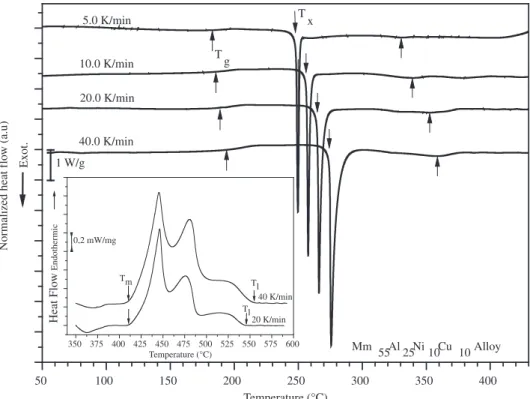
The normalized DSC curves of as-quenched amorphous ribbon treated at different heating rates (5-40 K/min)
are depicted in Figure 1. Increasing the heating rate (β)
caused all the exothermic peaks to shift to higher temperatures and broadened all the peaks. Table 1 summarizes the transformation temperatures obtained from
the thermograms. The alloy shows glassy characteristics with a clear glass transition temperature, Tg, preceding the
onset crystallization temperature, Tonset, thus exhibiting a
supercooled liquid region ∆TX (∆TX=TX1-Tg). The transition from the glassy to the supercooled liquid state, which is characterized by the endothermic reaction, takes place before crystallization, and its onset temperature increases from 183 °C to 275 °C with increasing heating rate. The supercooled liquid region of this alloy varies in the range of 65-80 °C, also as a function of increasing heating rate. The inset in Figure 1 shows typical melting curves for two heating rates (20 and 40 K/min). The curves reveal a sharp initial melting event at the onset of the melting temperature,
Tm, followed by two very broad melting peaks. Increasing
the heating rate caused the liquidus temperature, Tl, to
increase from 544 (20 K/min) to 555 °C (40 K/min), while the Tm remained stable at around 410 °C. However, there is a significant difference of 145 °C between Tm and Tl, indicating that the alloy’s composition is not eutectic.
The activation energy for crystallization of an amorphous structure subjected to a continuous heating condition was
Figure 1. Continuous heating DSC-curves obtained at different heating rates showing the glass transition for Mm55Al25Ni10Cu10 alloy. The inset shows melting curves for heating rates of 20 and 40 K/min.
Table 1. Transformation parameters obtained from the continuous heating experiments at different cooling rates.
β K/min
Enthalpy ∆HP1 (J.g–1)
Tg (°C)
TP1/ Tonset (°C)
∆TX (°C)
TP2/Tonset (°C)
5.0 10.0 20.0 40.0
–33.8 –38.9 –39.9 –45.5
183.2 185.9 189.2 195.5
249.6/247.7 257.9/256.1 266.4/264.6 275.6/274.6
64.6 71.5 76.0 79.5
deduced from the Kissinger model (Equation 1)18. Figure 2
shows that the Kissinger plot Rln(β/Tp,g) vs. (1/Tp,g) yields an approximately straight line. The activation energy can be determined from the slope of the line for both the
crystallization stages and the glass transition. Here, Tp,g
is the glass transition temperature or peak crystallization temperature. The activation energies for both glass transition and crystallization events are evaluated from the slope of the Kissinger straight line and the heat released during continuous heating. Note that the activation energy for devitrification (Eag) is high, i.e., 331 kJ .mol–1, suggesting a
higher thermal stability of the amorphous structure, which would lead to more sluggish nucleation and subsequent
crystal growth upon heating19. On the other hand, the
activation energies of the first and second exothermic peaks
are 182 and 189 kJ.mol–1 and correspond, as suggested by the
XRD pattern, to polyphasic crystallization, which involves metastable and intermetallic phases.
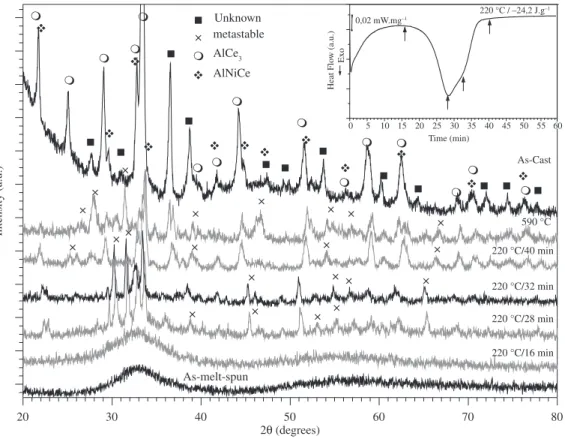
Figure 3 presents the XRD patterns of the as-quenched and partially crystallized ribbons, as well as the
as-cast (Mm55Al25Ni10Cu10) sample. To achieve partial
crystallization, the ribbon was heated continually at 60 K/min up to 220 °C for different annealing times, as indicated in the inset of Figure 3. For comparison, the XRD pattern of the melt-spun ribbon was plotted, and
the Bragg peaks of Ce3Al and AlCeNi taken from JCPDS
cards are clearly visible. The characteristic diffuse halo of an amorphous structure is visible in the XRD pattern of the melt-spun ribbon. This characteristic was maintained in the sample annealed for 16 minutes at 220 °C, before the beginning of the nucleation/growth process. However, with longer annealing times, e.g., 28 minutes (first peak), precipitation of metastable phases occurred and possible
first traces of Mm3Al appeared, which remained up to
32 minutes (close to the second peak). In the annealing interval of 32 and 40 minutes, complete crystallization of the amorphous phase was observed, with the formation
of Al3Ce, AlCeNi and unknown phases, all of which
precipitated simultaneously, resulting in the disappearance of some of the peaks of metastable phases. On the other
Figure 2. Kissinger plots showing activation energy for the glass transition (Tg) and for the two exothermic peaks (Tp1 and Tp2).
hand, the Bragg peaks of crystalline phases clearly visible in the XRD pattern of the cross-section of the as-cast sample are in good agreement with the phases precipitated from the amorphous structure. However, the position of the peaks shifted slightly, possibly due to the mixture of RE elements in Mm, which can induce the expansion or contraction of crystalline structures. The position of the Bragg peaks
was very similar to those of AlCeNi and Ce3Al that have
been reported previously in XRD patterns obtained from arc-melted Mm55Al25Ni10Cu10 master alloy17. This is due to
the fact that Mm, which is constituted of the elements Ce, La, Nd and Pr, exhibits crystallization properties very similar to those of Mm alloy; hence, no remarkable differences are detectable between the XRD patterns of samples annealed at equivalent stages of crystallization20.
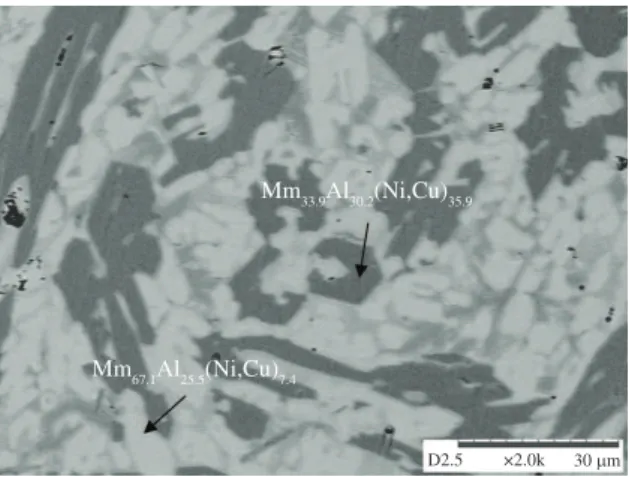
Figure 4 shows a typical backscatter SEM micrograph of the as-cast (Mm55Al25Ni10Cu10) sample. The microstructure shows hexagonal phases with contrasting white and dark gray regions. An EDS/SEM analysis indicated that the composition of the dark gray phase is ~Mm33,9Al30,2(Ni,Cu)8,30
and that of the white phase is ~ Mm67,1Al25,5(Ni,Cu)4,7. This
analysis suggests that the characteristics of these phases are
similar to those of AlRENi (AlCeNi) and RE3Al (Ce3Al)
phases identified in the JCPDS database. Moreover, other phases appear with intermediate contrasts and compositions varying from Mm36,1Al21,4Ni12,4Cu30,1 to Mm42,1Al20,4Ni9,4Cu28,1 (in at.%). However, these phases were not identified in the JCPDS database and probably correspond to the unknown phase visible in the XRD patterns.
The inset in Figure 3 shows an exothermic peak attributed to the nucleation/growth process, indicating that an incubation period occurred before the beginning of the phase transformation became detectable. This transformation involves the overlapping of two crystallization stages and likely corresponds to the exothermic peaks visible in the DSC curves (Figure 1), indicating that the nucleation/growth process is fast and complex due to the initial precipitation of metastable phases followed by the precipitation of
unknown AlMmNi, Mm3Al phases. Conversely, the
asymmetric isothermal thermograms shown in the inset of Figure 3 correspond to diffusion-controlled growth in
alloys that do not present eutectic crystallization21. This
is in good agreement with the SEM and DRX results. The isothermal analysis indicated that the energy released was
lower (–24 J.g–1) than that released during continuous
heating, confirming the activation of the nucleation/growth mechanism characteristic of intermetallic compounds. In this case, the larger amount of released heat may have been due to the activation energy for nucleation of the metastable intermetallic compounds, to which the contribution of activation energy for nucleation is much
smaller than the activation energy for growth22.
I n s h o r t , t h e c r y s t a l l i z a t i o n p r o c e s s o f
Mm55Al25Ni10Cu10 amorphous alloy under both continuous
and isothermal heating conditions can be expressed
as follows: amorphous → metastable phase + Mm3Al
→Mm
3Al + MmAl(NiCu) + unknown phase. This
suggests that the (CeLaNdPr)3Al phase initiates the
crystallization process in the alloy after precipitation of the metastable phase, probably due to the dissimilar diffusion coefficients of the components and also because of the strong interaction between dissimilar Mm-Al, Mm-Ni and
Mm-Cu atoms23. However, the main peak corresponds to the
Mm-Mm correlation, giving rise to the metastable phase,
which is a supersaturated one that later gives rise to Mm3Al
and AlMm(Ni,Cu) primary phases. On the other hand, the activation energies for the crystallization of different phases in Mm55Al25Ni10Cu10 amorphous alloy have been determined as occurring at 182 and 187 kJ.mol–1, which are very close to
the activation energies for self-diffusion of Ce, La and Pr in
Mm-based amorphous alloy24. It should be noted that Ce
3Al,
La3Al, Nd3Al and Pr3Al phases are difficult to distinguish clearly from one other because they have the same crystalline structure with similar lattice constants and nearly the same
atomic radius25; hence, these phases are considered to be
Mm3Al. Conversely, the high activation energy (331 kJ.
mol–1) for crystallization of amorphous Mm
55Al25Ni10Cu10
alloy implies good thermal stability. This value is similar
to that reported in other studies, e.g., 323 kJ.mol–1 for
amorphous Mm55Al25Ni10Cu10 alloy26 and La
55Al25Ni20
metallic glass27. An interesting point to keep in mind is that
low activation energies are generally associated with local atomic rearrangements and high activation energies with the cooperative movement of atomic groups, which result in viscous flow26.
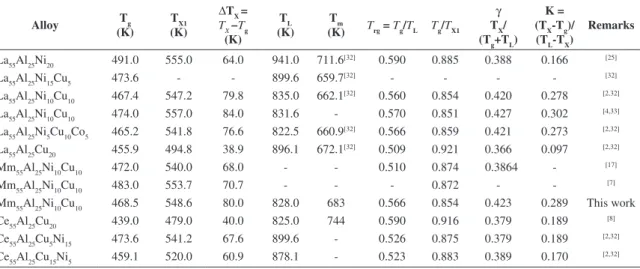
Table 2 describes the thermal properties of amorphous
alloys with compositions close to the Mm55Al25Ni10Cu10
alloy studied here, which has been investigated by other researchers at heating rates of 20 and 40 K/s. The following thermal parameters were evaluated: Tg, TX, ∆TX (=TX-Tg), Tl, Tm, Trg(=Tg/Tl), Tg/TX, γ (=TX/(Tg+Tl)), and K (=(TX–Tg)/
(Tl–TX)). Although these parameters show reasonable
correlations with the GFA of numerous metallic glass alloys, they still do not reflect the real GFA of alloys in many cases3,28. Many GFA indicators related to characteristic
temperatures (i.e., Tg, Txand Tl) are derived based on both crystallization resistance and liquid stability. In other words, the GFA of glass-forming liquids cannot be attributed
solely to the stability of the liquid phase29. However, for
purposes of discussion, parameters such as Tx/Tg and
Trg are quantitative measurements that serve to indicate
crystallization resistance and liquid stability, respectively.
Trgseems not to be an appropriate parameter to evaluate liquid stability in RE-Al-(Cu,Ni) amorphous alloys. On the other hand, the γ, K and Tg/TX parameters seem suitable to evaluate the GFA of RE-Al-(Ni,Cu) alloys. High values of γ and K and low values of Tg/TX were observed in the Mm55Al25Ni10Cu10 and LaAl25Ni10Cu10 alloys, suggesting that these alloys present the best GFA.
4. Conclusions
This study focused on the crystallization, thermal
stability and glass forming ability of Mm55A125Nil0Cu10
amorphous alloy. Crystallization was found to occur through
a multi-stage process: amorphous → metastable + Mm3Al
→Mm3Al + MmAl(NiCu) + unknown phase. The
asymmetric form of the isothermal annealing curves of the as-quenched samples indicated controlled interfacial growth during amorphous to crystalline transformation.
The Mm55A125Nil0Cu10 alloy presented higher GFA when
than amorphous RE-Al-(Cu,Ni) alloys. It was also found that the thermal parameter Trg (=Tg/Tl) is not suitable for
evaluating the GFA of these alloys. The γ, K and Tg/TX
parameters suggest that the complete substitution of RE (Ce,La,Nd,Pr) metal with Mm does not affect the stability, GFA, or formation of the amorphous phase during rapid solidification.
Acknowledgements
The authors acknowledge the Brazilian research funding agency CNPq for its financial support of this work.
For example, Trg or reduced glass transition temperature
indicates that the viscosity must be higher at temperatures
between the liquidus and glass transition, while ∆TX is
a parameter frequently cited to characterize the stability
and deformability of metallic glasses10. The high value of
γ suggests that the alloy is in the state of liquid stability,
while the onset crystallization temperature, Tx, could be
used to roughly compare crystallization resistance during the glass formation of metallic liquids. This means that when the Tg/Txratio decreases, crystallization resistance increases, thereby increasing the GFA. However, it is advisable to use the same heating rate due to the strong dependence of these characteristic parameters on this rate.
The results indicated that the initial melting point, Tm,
the final melting point (liquidus temperature), Tl, and the
glass transition temperature determined at a heating rate of 40 K/s were 683, 828 and 468.5 K respectively. These values change little in similar compositions when La or Ce instead of Mm are considered in the Mm55Al25Ni10Cu10 alloy, except for La55Al25Ni20, La55Al25Cu20 and Ce55Al25Cu10. It should be pointed out that Tm generally changes very little while Tland
Tg change more visibly, with small compositional changes
in alloys of the same system30,31. Note that high values of
∆TX (80 and 84 K) were measured in the Mm55Al25Ni10Cu10 and La55Al25Ni10Cu10 alloys, respectively. However, with additions of more than 10 at.% Cu (substituting Cu for Ni), a progressive reduction was observed in the value of
∆TX, amounting to 38.9 and 40 K in the La55Al25Cu20 and
Ce55Al25Cu20 alloys. This suggests that the best atomic
interactions that favor GFA are obtained in RE-Al-TM alloys with additions of less than 10 at.% Cu. On the other hand,
Table 2. Thermal parameters for the crystallization of RE-Al-(Cu,Ni) alloys during continuous heating.
Alloy Tg
(K)
TX1 (K)
∆TX =
TX −Tg (K)
TL (K)
Tm
(K) Trg = Tg/TL Tg/TX1 γ TX/ (Tg+TL)
K = (TX-Tg)/ (TL-TX)
Remarks
La55Al25Ni20 491.0 555.0 64.0 941.0 711.6[32] 0.590 0.885 0.388 0.166 [25]
La55Al25Ni15Cu5 473.6 - - 899.6 659.7[32] - - - - [32]
La55Al25Ni10Cu10 467.4 547.2 79.8 835.0 662.1
[32] 0.560 0.854 0.420 0.278 [2,32]
La55Al25Ni10Cu10 474.0 557.0 84.0 831.6 - 0.570 0.851 0.427 0.302
[4,33]
La55Al25Ni5Cu10Co5 465.2 541.8 76.6 822.5 660.9
[32] 0.566 0.859 0.421 0.273 [2,32]
La55Al25Cu20 455.9 494.8 38.9 896.1 672.1
[32] 0.509 0.921 0.366 0.097 [2,32]
Mm55Al25Ni10Cu10 472.0 540.0 68.0 - - 0.510 0.874 0.3864
-[17]
Mm55Al25Ni10Cu10 483.0 553.7 70.7 - - - 0.872 - - [7]
Mm55Al25Ni10Cu10 468.5 548.6 80.0 828.0 683 0.566 0.854 0.423 0.289 This work
Ce55Al25Cu20 439.0 479.0 40.0 825.0 744 0.590 0.916 0.379 0.189 [8]
Ce55Al25Cu5Ni15 473.6 541.2 67.6 899.6 - 0.526 0.875 0.379 0.189 [2,32]
Ce55Al25Cu15Ni5 459.1 520.0 60.9 878.1 - 0.523 0.883 0.389 0.170
18. Kissinger HE. Reaction Kinetics in Differential Thermal Analysis. Analytical Chemistry. 1957; 29:1702-1706. http:// dx.doi.org/10.1021/ac60131a045
19. Guo FQ, Poon SJ and Shiglet GJ. Glass Formability in Al- ba se d Mu lti na ry A ll oy s. M a t e r i a l s S c i e n c e
Forum. 2000; 331-337:31-42.
20. Blázquez JS, Fazakas E, Dimitrov H, Latuch J, Varga L and Kulik T. Effect of substitution of rare earth by mischmetal on the devitrification process of Al–X–Ni–Co (X = Y, Ce, Mm) alloys. Journal of Non-Crystalline Solids. 2005; 351:158-166.
21. Pradell T, Crespo D, Clavaguera N and Clavaguera-Mora MT. Diffusion controlled grain growth in primary crystallization: Avrami exponents revisited. Journal of
Physics: Condensed Matter. 1998; 10:3833. http://dx.doi.
org/10.1088/0953-8984/10/17/014
22. Ye F and Lu K. Crystallization kinetics of Al–La–Ni amorphous alloy. Journal of Non-Crystalline Solids. 2000; 262:228-235. http://dx.doi.org/10.1016/S0022-3093(99)00660-2
23. Hoyer W, Jodicke R. Short-range and medium-range order in liquid Au-Ge alloys. Journal of Non-Crystalline
Solids. 1995; 192-193:102-105.
http://dx.doi.org/10.1016/0022-3093(95)00335-5
24. Fromont M. Hétérodiffusion du cérium dans le lanthane cubique centré: Effet de la transformation β→ y sur les coefficients de diffusion. Journal de Physique Lettres. 1976; 37:117-118. http://dx.doi.org/10.1051/jphyslet:01976003705011700
25. Hong SJ, Kim TS, Kim HS, Kim WT and Chun BS. Microstructural behavior of rapidly solidified and extruded Al-14wt%Ni-14wt%Mm (Mm, misch metal) alloy powders.
Materials Science and Engineering: A. 1999; 271:469-476.
http://dx.doi.org/10.1016/S0921-5093(99)00317-2
26. Jeong HT, Kim JH, Kim WT and Kim DH. The mechanical relaxations of a Mm55Al25Ni10Cu10 amorphous alloy studied by dynamic mechanical analysis. Materials Science and
Engineering A. 2004; 385:182-186.
27. Kawamura Y, Nakamura T, Inoue A, Inoue A and Liu CT, editos. Materials Research Society Symposium Proceedings. Warrendale: Materials Research Society; 1998. vol. 554. p.373.
28. Long ZL, Shao Y, Deng XH, Zhang ZC, Jiang Y, Zhang P et al. Cr effects on magnetic and corrosion properties of Fe-Co-Si–B–Nb–Cr bulk glassy alloys with high glass-forming ability. Intermetallics. 2007; 15:1453-1458. http://dx.doi. org/10.1016/j.intermet.2007.05.002
29. Long Z, Xie G, Wei H, Su X, Peng J, Zhang P et al. On the new criterion to assess the glass-forming ability of metallic alloys.
Materials Science and Engineering A. 2009; 509:23-30. http://
dx.doi.org/10.1016/j.msea.2009.01.063
30. Lu ZP, Hu X, Li Y and Ng SC. Glass forming ability of La-Al–Ni–Cu and Pd–Si–Cu bulk metallic glasses. Materials
Science and EngineeringA. 2001; 304-306:679-682. http://
dx.doi.org/10.1016/S0921-5093(00)01563-X
31. Triveño Rios C, Suriñach S, Baró MD, Bolfarini C, Botta WJ and Kiminami CS. Glass forming ability of the Al–Ce–Ni system.
Journal of Non-Crystalline Solids. 2008; 354:4874-4877.
32. Lu ZP, Bei H and Liu CT. Recent progress in quantifying g l a s s - f o r m i n g a b i l i t y o f b u l k m e t a l l i c g l a s s e s .
Intermetallics. 2007; 15:618-624. http://dx.doi.org/10.1016/j.
intermet.2006.10.017
33. Lu ZP, Goh TT, Li Y and Ng SC. Glass formation in La-based La–Al–Ni–Cu–(Co) alloys by Bridgman solidification and their glass forming ability. Acta Materialia. 1999; 47:2215-2224. http://dx.doi.org/10.1016/S1359-6454(99)00058-0
References
1. Inoue A, Zhang T and Masumoto T. Al-La-Ni Amorphous Alloys with a Wide Supercooled Liquid Region. Materials
Transactions. 1989; 30(12):965-972.
2. Lu ZP, Tan H, Li Y and Ng SC. The correlation between reduced glass transition temperature and glass forming ability of bulk metallic glasses. Scripta Materialia. 2000; 42:667-673. http:// dx.doi.org/10.1016/S1359-6462(99)00417-0
3. Lu ZP and Liu CT. A new glass-forming ability criterion for bulk metallic glasses. Acta Materialia. 2002; 50:3501-3512. http://dx.doi.org/10.1016/S1359-6454(02)00166-0
4. Inoue A, Nakamura T, Sugita T, Zhang T and Masumoto T. Bulky La-Al-TM (TM=Transition Metal) amorphous alloys with high tensile strength produced by a high-pressure die casting method. Materials Transactions. 1993; 34:351-358.
5. Inoue A, Zhang T, Takeuchi A and Zhang W. Hard magnetic bulk amorphous nd-fe-al alloys of 12 mm in diameter made by suction casting. Materials Transactions. 1996; 37:636-640. 6. Zhang B, Pan MX, Zhao DQ. “Soft” bulk metallic glasses
based on cerium. Applied Physics Letters. 2004; 85:61-66. http://dx.doi.org/10.1063/1.1768308
7. Kim JH, Park JS, Jeong HT, Kim WT and Kim DH. Fabrication of Misch metal–Al–Ni–Cu–C bulk metallic glass matrix composite by gravitational casting in air atmosphere. Materials
Science and Engineering A. 2004; 386:186-193. http://dx.doi.
org/10.1016/j.msea.2004.07.012
8. Zhang B, Zhao DQ, Pan MX, Wang RJ and Wang WH. Formation of cerium-based bulk metallic glasses. Acta
Materialia. 2006; 54:3025-3032. http://dx.doi.org/10.1016/j.
actamat.2006.02.044
9. Johnson WL. Bulk Glass-Forming Metallic Alloys. Materials
Research Society Bulletin. 1999; 24:42-56.
10. Inoue A. Stabilization of metallic supercooled liquid and bulk amorphous alloys. Acta Materialia. 2000; 48:279-306. http:// dx.doi.org/10.1016/S1359-6454(99)00300-6
11. Wang WH, Dong C and Shek CH. Bulk metallic glasses.
Materials Science and Engineering: Reports. 2004; 44:45-89.
http://dx.doi.org/10.1016/j.mser.2004.03.001
12. Zhang T, Inoue A and Masumoto T. Amorphous Zr-Al-TM (TM=Co, Ni, Cu) alloys with significant supercooled liquid region of over 100 K. Materials Transactions. 1991; 32:1005-1010. 13. Kim YC, Na JH, Park JM, Kim DH, Lee JK and Kim WT.
Role of nanometer-scale quasicrystals in improving the mechanical behavior of Ti-based bulk metallic glasses.
Applied Physics Letters. 2003; 83:3093-3095. http://dx.doi.
org/10.1063/1.1616198
14. Lee JK, Kim SH, Kim WT and Kim DH. Precipitation of the icosahedral phase in amorphous Zr65Cu17.5−xAl7.5Ni10Agx (x=0, 2.5, 5, 7.5 and 10) alloys. Metals and Materials
International. 2001; 7:187-190. http://dx.doi.org/10.1007/
BF03026974
15. Lee ML, Zhang Y, Li Y and Carter CW. Collected Abstracts
of the 3rd International Conference on Bulk Metallic Glasses.
Beijing; 2003. p.115.
16. Tan H, Zhang Y and Li Y. Synthesis of La-based in-situ bulk metallic glass matrix composite. Intermetallics. 2002; 10:1203-1205. http://dx.doi.org/10.1016/S0966-9795(02)00148-6
17. Kim JH, Lee JY, Park JM, Fleury E, Kim WT and Kim DH. Glass Forming Ability and Mechanical Properties of Misch Metal-Based Bulk Metallic Glass Matrix Composite. Materials
Transactions. 2004; 45:1395-1399. http://dx.doi.org/10.2320/