J. Nano- Electron. Phys.
3 (2011) No1, P.151-154 (Sumy State University) 2011 SumDU
151
PACS numbers: 61.43Fs, 64.70.P, 61.40D, 81.70.Pg, 61.43Dq, 65.60
KINETICS STUDY OF (Se80Te20)100–xCdx GLASSY ALLOY BY
DIFFERENTIAL THERMAL ANALYSIS USING NON-ISOTHERMAL TECHNIQUE
Mainika, N. Thakur
Department of Physics, H.P. University, Summer Hill, Shimla-5 Email: [email protected]
The kinetics of crystallization in (Se80Te20)100 – xCdx (x = 0, 2, 4 and 6) alloys at
different heating rates have been studied by Differential Thermal Analysis in non-isothermal condition. A comparison of various quantitative methods to assess the level of stability of the glassy material in the above mentioned system is presented. All these methods are based on the characteristics temperature obtained by heating of the samples, such as glass transition temperature (Tg), temperature of crystallization
(Tc), and the melting temperature (Tm). From the dependence of glass transition
temperature on heating rate, the activation energy (Eg) has been calculated on the
basis of the Kissinger and Moynihan models.
Keywords: CHALCOGENIDE GLASSES, ACTIVATION ENERGY, Tg, DTA, Se-Te-Cd.
(Received 04 February 2011)
1. INTRODUCTION
152 MAINIKA, N. THAKUR
have greater hardness, higher crystallization temperature, higher photo-sensitivity and smaller ageing effects than pure Se [17]. The addition of a third element (Cd) expands the glass forming area and also creates compositional and configurational disorder in the system. Present paper is concentrated on kinetic studies of (Se80Te20)100 – xCdx (x 0, 2, 4, 6) glassy alloy under non-isothermal technique by using DTA.
2. EXPERIMENTAL PROCEDURE
For preparation of Se-Te-Cd glasses, high purity (5N) elements in appropriate atomic percentages were weighted into the quartz ampoules and sealed off in a vacuum of 10 – 5 torr and then heated in furnace at around 1000 C for 12h.
The ampoules were rotated frequently to ensure homogenization. The ampoules were then rapidly quenched in ice-water to obtain the glasses and samples were removed by breaking the quartz ampoule. SHIMADZU DTG-60, simultaneous TG/DTA module is used to measure the caloric manifestation of the phase transformation. The TG/DTA scans are taken at four heating rate (10, 15, 20, 25 C/min) for the four different composition in the micro alumina pans under dry nitrogen gas. The masses of the samples varied between10 and 30 mg. The amorphous nature of the resulting glassy alloys was verified by X-ray diffraction as no prominent peak was observed.
3. RESULT AND DISCUSSION
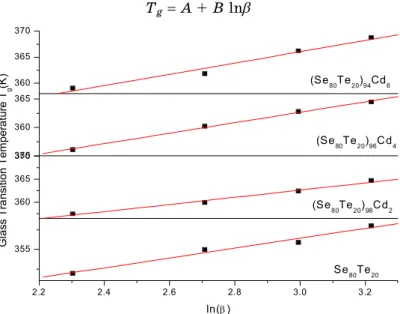
The glass transition temperature represents the strength or rigidity of the glassy structure of the alloy. In present work glass transition region has been studied in terms of variation of glass transition temperature with the heating rate. Three approaches are used to analyze the dependence of Tg on the heating rate ( ). The first is the empirical relationship, which has originally been suggested by Lasocka [18] and has the form,
Tg A + B ln (1)
2.2 2.4 2.6 2.8 3.0 3.2
355 360 365 370 355 360 365 360 365 370
Se80Te20 (Se
80Te20)98C d2
ln( )
G
la
s
s
T
ra
n
s
it
io
n
T
e
m
p
e
ra
tu
re
Tg
(K
)
(Se80Te20)96C d4 (Se
80Te20)94Cd6
KINETICS STUDY OF (Se80Te20)100–xCdx GLASSY ALLOY… 153
where A and B are constants for a given glass compositions and calculated values are given in Table 1. Plots of Tg versus log indicates the validity of Eq. (1) for our compositions (Fig. 1).
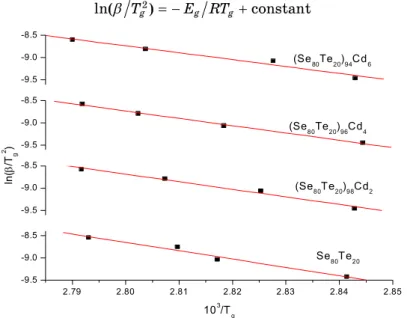
The activation energy (Eg) of the glass transition process is one of the most important parameters for understanding the thermal relaxations that occur in glassy networks during the glass transition. The activation energy for glass transition (Eg), depends on Tg as a function of the heating rate ( ) have been evaluated using Kissinger’s equation [19-21] and is given by the following expression,
2
ln( Tg) Eg RTg constant (2)
2.79 2.80 2.81 2.82 2.83 2.84 2.85
-9.5 -9.0 -8.5 -9.5 -9.0 -8.5 -9.5 -9.0 -8.5 -9.5 -9.0 -8.5
103/Tg
ln
(
/Tg
2 )
(Se
80Te20)96Cd4
(Se
80Te20)98Cd2
(Se80Te20)94Cd6
Se
80Te20
Fig. 2 – Shows the plots of ln( /Tg2) versus 103/Tg
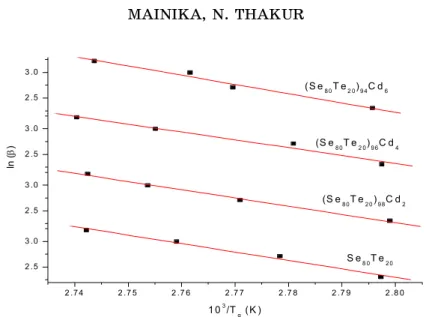
The activation energy of the glass transition (Eg) also has been evaluated using the Moynihan [22] relation derived, based on the concept of thermal relaxation. The plot of ln versus 103/T
g yields a straight line, the slope of which gives the activation energy of glass transition (Fig. 3). Table 1 lists the values of Eg obtained using the Kissinger and Moynihan models, which are in good agreement with each other with the difference within experimental error. The glass transition activation energy is the amount of energy that is absorbed by a group of atoms in the glassy region so that a jump from one metastable state to another state is possible [23]. Accordingly, the atoms in a glass having minimum activation energy have a higher probability to jump the metastable (or local minimum) state of lower internal energy and, hence, are the most stable.
Table 1 – Eg obtained from the Kissinger and Moynihan Models (kJ/mol)
Composition Kissinger Model Moynihan Model A(K) B(K)
x 0 155.88 161.86 337.48 6.32
x 2 131.09 137.09 339.25 7.80
x 4 110.64 116.62 335.06 9.21
154 MAINIKA, N. THAKUR
2 .7 4 2 .7 5 2 .7 6 2 .7 7 2 .7 8 2 .7 9 2 .8 0
2 .5 3 .0 2 .5 3 .0 2 .5 3 .0 2 .5 3 .0
S e 8 0T e2 0
1 03/T g ( K )
(S e
8 0T e2 0)9 8C d2
ln
(
) (S e8 0T e2 0)9 6C d4
( S e8 0T e2 0)9 4C d6
Fig. 3 – The plot of ln versus 103/T
g
4. CONCLUSION
The values of activation energies for glass transition were found to decrease with increase in Cd content in Se-Te glassy alloy. The values of activation energies, using two different methods, are in good agreement with each other. So it can be concluded that any of these two methods can be used to calculate glass transition activation energy.
REFERENCES
1. G.O. Piloyan, I.D. Ryabchikov, O.S. Novikova, Nature212, 1229 (1966). 2. S. Tanabe and R. Otsuka, Netsu Sokutei. (Calor. Therm. Anal.) 4, 139 (1977). 3. R.L. Thakur, S. Thiagrajan, Bull. Cent. Glass Ceram. Res. Inst. 13, 33 (1966). 4. R.L. Thakur, S. Thiagrajan, Bull. Cent. Glass Ceram. Res. Inst. 15, 67 (1968). 5. K. Matusita, S. Sakka, Phys. Chem. Glasses 20, 81 (1979).
6. K. Matusita, S. Sakka and Y. Matsui, J. Mater. Sci. 10, 961 (1975).
7. A. Pratap, A. Prasad, S.R. Joshi, N.S. Saxena, M.P. Saksena, K. Amiya, Mater. Sci. Forum 179-181, 851 (1995).
8. A. Pratap, K.G. Raval, A. Gupta, S.K. Kulkarni, Bull. Mater. Sci. 23, 185 (2000). 9. J. Vazquez,P.L. Lopez-Alemany, P. Villares, R. Jimenez-Garay, J. Phys. Chem.
Solids 61, 493 (2000).
10.M.A. Abdel-Rahim, Physica B239, 238 (1997).
11.A.H. Moharram, M.M. Hafiz, A.A. Abu-Sehly, Appl. Surf. Sci.137, 150 (1999). 12.A.H. Moharram, M.S. Rasheedy, Phys. Status Solidi a 169, 33 (1998).
13.M. Abu El-Oyoun, J. Phys. D: Appl. Phys. 33, 2211 (2000). 14.M. Saxena, P.K. Bhatnagar, Bull. Mater. Sci. 26, 547 (2003). 15.N. El-Kabany, Chalcogenide Lett. 7, 351 (2010).
16.M. Ilyas, M. Zulfequar and M. Husain, Opt. Mater. 13, 397 (2000).
17.S.O. Kasap, T. Wagner, V. Aiyah, O. Krylouk, A. Bekirov, L. Tichy, J. Mater. Sci. 34, 3779 (1999).
18.Maria Lasocka, Mater. Sci. Eng.23, 173 (1976). 19.H.E. Kissinger, Anal. Chem. 29, 1702 (1957). 20.H.S. Chen, J. Non-Cryst. Solids 27, 257 (1978). 21.N.A. Macmillan, J. Phys. Chem. 42, 3497 (1965).