Critical Forces at Fractional Matching Fields in Superconducting Thin Films with
Triangular Pinning Lattice
Nicolas Porto Vizarima*, Maicon Carlonea, Lucas Garcia Vergab, Pablo Antonio Venegasc
Received: September 19, 2016; Revised: December 16, 2016; Accepted: March 10, 2017
We numerically study the commensurability efects in the critical forces in a type II superconducting thin ilm with vortices under the inluence of a triangular pinning lattice at sub matching ields and zero temperature. The analysis is made applying a transport force in two mutually perpendicular directions and magnetic ield perpendicular to the ilm surface. The results show critical force peaks at fractional matching ields, as a direct consequence of the commensurability efects. For the irst time, we simulate the sequence of force peaks detected in recent experiments. Anisotropic efects in the critical forces are also reported, in analogy with that found at higher ields.
Keywords: superconductivity; commensurability; critical forces; vortex pinning
* e-mail: [email protected]
1. Introduction
Commensurability efects in type II superconducting ilms under the inluence of periodic pinning arrays, has been investigated during the last years1-21. As nanotechnology
advances, pinning center modeling has become viable due to the control of size, shape and composition of the defects. Several types of periodical pinning lattices have been studied both experimentally and theoretically, such as triangular, square, honeycomb, Kagomé and others. In these works, a wide variety of commensurability efects have been found in dynamical properties of vortices, such as critical forces, dynamic phases, vortex-low resistance, and magnetization1-21. When the vortex lattice matches the
pinning lattice we say that the system is commensurate, in this case the pinning potential felt by the vortices is maximum. This occurs when the rate between the number of vortices and pinning centers (Nv/Np) or analogously
the rate between the applied magnetic ield and the irst matching ield (B/Bϕ), is an integer or a rational fraction.
The matching efects have been extensively analyzed, in most of cases for B=nBϕ(n=1,2,3...), inding pronounced
peaks of critical current vs (B/Bϕ) at these values of ield. For
the particular case of triangular pinning arrays, numerical and experimental works have been conducted concerning the commensurability efects in the critical forces1,2,11,12,15.
However, only few works2,11,12 have analyzed the matching
efects at sub matching ields. The results of these works show a disagreement between the sequence of critical force peaks predicted by theoretical simulations and experimental results, which needs a better understanding.
S. Ooi et. al.11 studied experimentally the critical currents
and vortex behavior in 2D triangular pinning potentials in single-crystals Bi2Sr2CaCu2O8+y ilms, inding fractional
matching peaks at B/Bϕ=1/4, 1/3, 1/2, 2/3, 3/4, 6/7 and 1.
Additionally, recent experiment conducted by D. Bothner et al.12 investigated the commensurability efects in the critical
currents for superconducting Nb thin ilms with periodic and quasi-periodic antidot arrays. In this work, critical current peaks were found for the triangular pinning lattice at B/Bϕ=1/4, 1/3, 2/3, 3/4 and 1. Theoretical simulations, conducted by
C. Reichhardt and N. Grønbech-Jensen2, have also analyzed
ilms with triangular pinning lattice as a function of pinning strength. They found current peaks at B/Bϕ=1/7, 1/4, 1/3, 2/3,
6/7, and 1 for high values of pinning strength, and additional force peaks at B/Bϕ=1/9, and 1/2 for lower values of pinning
strength. However, the current peak at B/Bϕ= 3/4, which was
found in recent experimental results11,12, was not predicted.
In this work, a numerical study of the critical forces in a two-dimensional superconducting ilm with a triangular pinning lattice is performed, focusing on fractional matching ields and its respective vortex states. The results show a sequence of critical force peaks which has some diferences from previous simulations2, but are in good agreement with
experimental data11,12, including the force peak at B/B
ϕ=3/4.
Two ingredients may be important for the appearance or not of critical force peaks; the pinning strength and the pinning radius. Concerning the pinning strength, numerical analysis2
showed that small values of pinning strength may lead to additional force peaks, however, even for small values, they did not ind the force peak at B/Bϕ=3/4. On the other hand,
V. V. Moschalkov et. al.20 has experimentally shown that a
decrease in the pinning radius may provoke the attenuation
a Programa de Pós-Graduação em Ciência e Tecnologia de Materiais, Faculdade de Ciências,
Universidade Estadual Paulista - UNESP, Bauru, SP, Brazil
or even disappearance of some current peaks. It is not clear which pinning radius was used by C. Reichhardt and N. Grønbech-Jensen2, but we think that the force peak at B/ Bϕ=3/4 is evident in our results because we use a pinning
radius close to the experimental value, and probably larger than in that work. Moreover, our calculations show that diferent pinning radius may lead to diferent ground state vortex conigurations. In some cases, small pinning radius may lead to a disordered ground state, while larger pinning radius to ordered conigurations. Then, changes in the size of pinning centers may dramatically change the commensurability efects, explaining the appearance of additional force peaks
in our simulations.
2. Model
In this simulation, we consider an ininite superconducting thin ilm placed in the xy plane with an external magnetic
ield B applied perpendicularly to the ilm surface and zero
temperature.
A set of Langevin equations describe the dynamical properties of the system22:
In our case, we minimize the energy of the vortex system until inding the optimal vortex positions. Then, the set of Langevin equations are integrated numerically by Molecular Dynamics technique using the optimal vortex coniguration as initial boundary value. After that, the driving force is increased slowly, in steps of ΔF=0.01 up to values just above
the critical force Fc. For each value of force, we use 30000
time steps for evaluation of the time averages. To obtain the critical force values, it is necessary the calculation of the time average vortex velocity , which is proportional to the macroscopically measured voltage-current V(I) curve, for x direction and analogously
for y direction22. To determine these critical forces, we use
the criterion that velocities Vx y, <0 001. corresponds to vortex
luctuations around the equilibrium position.
3. Results and Discussion
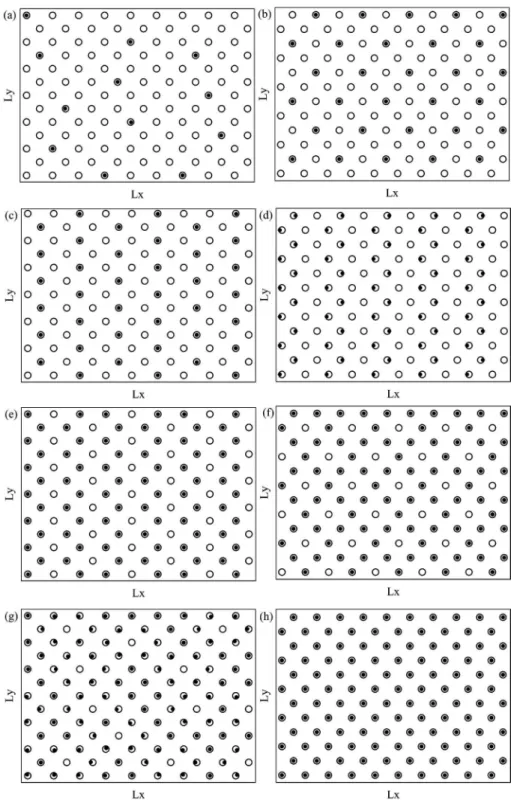
As the commensurability efects strongly depend if a given vortex is sited on top of a pinning site or not, it is essential to obtain the vortex positions of the ground state at zero transport current. Finding the right initial vortex positions is a very delicate work, because each vortex arrangement has slightly diferent energy value. For that task, we use the GSA method described before. The equilibrium coniguration of vortices at zero transport current for B/Bϕ=1/9, 1/4, 1/3, 1/2,
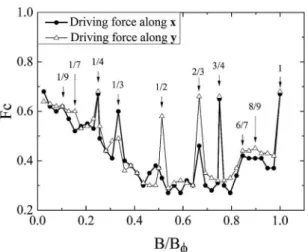
2/3, 3/4, 8/9 and 1, are illustrated in Figure 1. It is important to note that the pronounced force peaks in Figure 2 always correspond to regular vortex lattices, including that for B/ Bϕ=3/4, which was not predicted before2. Other minor peaks
were found at B/Bϕ=1/9 and 8/9, where all vortices are pinned
but do not form a regular lattice. Another coniguration that is necessary to highlight is for B/Bϕ=1/2. The vortex
coniguration in Figure 1 (d) is ordered, with a lowest energy and no interstitial vortices, diferent to that proposed2.
The results of the simulation for the transport forces applied in two mutually perpendicular directions are plotted in Figure 2. In that igure, pronounced peaks appear at
B/Bϕ=1/4, 1/3, 1/2, 2/3, 3/4 and 1, when the vortex and
pinning lattice are commensurate, in good agreement with experimental results11,12.
Furthermore, it is possible to see well deined anisotropic behavior in the critical forces, mainly for the peaks at B/Bϕ=1/3,
1/2, and 2/3. Anisotropic behavior was previously observed in experimental and theoretical for ininite ilms, but for higher magnetic ields and diferent system parameters13-16,19,21. Our
simulations also show that, in general, Fcy> F c
x for fractional
matching ields, with the exception of B/Bϕ=1/3. This behavior
is in agreement with previous works14,15,21.
As pointed out before, previous theoretical2 and
experimental11,12 works show discrepancies between the
sequence of force peaks. As we suggested before, this may be attributed to the pinning size. To that end, we performed simulations for B/Bϕ=1/2 with smaller pinning size to corroborate
( )
dt
dr
iU
r
U r
f
1
i vv ij
j i
i p ip
p
4
4
h
=-
-
+
!
Q
V
Q
V
/
/
The term on the left of Eq. (1) is the velocity of the vortex. In the right side, the irst term is the vortex-vortex
interaction, described as Uvv(rij)=CvK0 (rij/Λ), where rij=|rj-ri|
is the distance between the vortex i and j, Cv is the
vortex-vortex strength deined as Cv= Φ02/8πΛ and K
0 is the modiied
Bessel function. The second term in the right side is the vortex-pinning interaction which is described as a Gaussian function22,23 , where r
ip=|rp-ri| is the
distance between the vortex i and the pinning center p, ap=ξ
is the pinning center range and Cp=0.2Cv is the strength of the
pinning potential. The last term is the driving force due to the transport current . In our simulations, the length scales are normalized by 4ξ, time scale by τ=16ηξ2/C
v
and energy scales by Cv. Where ξ is the coherence length, η
the Bardeen-Stephen friction and ϕ0=h/2e is the elementary
lux quantum. The results can be compared to real thick samples through Λ, the efective penetration depth deined as Λ=2λL
2/d, where d is the sample thickness and λ
L the London
penetration depth22,23.
We simulate the vortex system under the inluence of a triangular pinning array. The transport forces are applied in two mutually perpendicular directions, x and y. We consider
a ixed pinning density of np=Np/LxLy=0.114/ξ2. The initial
vortex ground states are prepared using Generalized Simulated Annealing (GSA) minimization method24. In analogy with
the annealing used in Metallurgy, where a metal is cooled slowly until it reaches its lowest energy state, the Simulated Annealing technique introduces one or more artiicial temperatures that are gradually cooled to reach the extreme of a function, which corresponds to the global minimum.
Vx Vx t Nv1 dxdt
i i
= Q V = /
U r
pQ
ipV
=-
C e
p -Qrip/a 2pV, J f c d J z 0 # z
Figure 1. Static vortex conigurations, where the black dots represent the vortex lattice and the black circles
the triangular pinning lattice at (a) B/Bϕ=1/9, (b) B/Bϕ=1/4, (c) B/Bϕ=1/3, (d) B/Bϕ=1/2, (e) B/Bϕ=2/3, (f) B/ Bϕ=3/4, (g) B/Bϕ=8/9 and (h) B/Bϕ=1 obtained from the minimization, with Cp=0.2Cv and ap=ξ.
our argument. The static vortex coniguration is shown in Figure 3, using ap=ξ/2 and same pinning strength, Cp=0.2Cv.
As a result, vortices did not organize themselves in a regular lattice, moreover, part of the vortices stabilize in interstitial positions. This arrangement is no more commensurate, resulting in a much lower critical force.
4. Conclusions
Figure 2. Critical force, Fc y and F
c x, vs B/B
ϕ for the triangular pinning
array with Cp=0.2Cv and ap=ξ.
Figure 3. Static vortex coniguration for smaller pinning radius,
where the black dots represent the vortex lattice and the black circles the triangular pinning lattice at B/Bϕ=1/2 obtained from the
minimization, with Cp=0.2Cv and ap=ξ/2.
recent experimental data11,12 at sub matching ields. In the
absence of a driving force, we found ordered vortex states for some fractional matching ields, including for B/Bϕ=3/4,
which was not predicted in previous simulations2. These
ordered states lead to a higher energy barrier that avoid vortex movement and lead to peaks in the critical force. According to our simulations, the agreement between our results and experimental data may be attributed to the use of larger pinning size when compared with previous
simulations2.
As the transport force was applied in two diferent directions, we were also able to see anisotropic efects in the critical forces. In general, our system shows that when the transport force is applied along the short diagonal length, vortices move easily than when it is applied along the longer diagonal direction. This anisotropic behavior agrees with other experimental and theoretical works performed for higher ields14,15,21.
5. Acknowledgements
N.P.V. and M.C. acknowledges Capes-Brazil and L.G.V acknowledges the support from FAPESP (Grant: 2012/22141-2), and from the Brazilian Government’s Science Without Borders Programme (Grant: 206419/2014-7). This research was supported by the Center for Scientiic Computing (NCC/ GridUNESP) of the São Paulo State University (UNESP).
6. References
1. Reichhardt C, Olson CJ, Nori F. Commensurate and incommensurate vortex states in superconductors with periodic pinning arrays.
Physical Review B. 1998;57(13):7937-7943.
2. Reichhardt C, Grønbech-Jensen N. Critical currents and vortex states at fractional matching ields in superconductors with
periodic pinning. Physical Review B. 2001;63(5):054510.
3. He SK, Zhang WJ, Wen ZC, Xiao H, Han XF, Gu CZ, et al. Interstitial vortex in superconducting ilm with periodic hole
arrays. Chinese Physics B. 2012;21(8):087401.
4. Cao R, Horng L, Wu TC, Wu JC, Yang TJ. Temperature dependent pinning phenomenon in superconducting Nb ilms with triangular
and honeycomb pinning arrays. Journal of Physics: Condensed
Matter. 2009;21(7):075705.
5. Cuadra-Solís PJ, García-Santiago A, Hernandez JM, Tejada J, Vanacken J, Moshchalkov VV. Observation of commensurability efects in a patterned thin superconducting Pb ilm using microwave
relection spectrometry. Physical Review B. 2014;89(5):054517.
6. Harada K, Kamimura O, Kasai H, Matsuda T, Tonomura A, Moshchalkov VV. Direct Observation of Vortex Dynamics in Superconducting Films with Regular Arrays of Defects.
Science. 1996;274(5290):1167-1170.
7. Lykov AN. Unusual Commensurability Efect in Superconducting Sn Films with Triangular Lattice of Microholes. Journal of Low
Temperature Physics. 2011;164(1):61-73.
8. Grigorenko AN, Howells GD, Bending SJ, Bekaert J, van Bael MJ, van Look L, et al. Direct imaging of commensurate
vortex structures in ordered antidot arrays. Physical Review
B. 2001;63(5):052504.
9. Reichhardt C, Olson CJ, Nori F. Dynamic Phases of Vortices
in Superconductors with Periodic Pinning. Physical Review
Letters. 1997;78(13):2648.
10. Reichhardt C, Zimányi GT, Scalettar RT, Hofmann A, Schuller IK. Individual and multiple vortex pinning in systems with periodic pinning arrays. Physical Review B. 2001;64(5):052503.
11. Ooi S, Mochiku T, Hirata K. Fractional matching efect in single-crystal ilms of Bi2Sr2CaCu2O8+y with antidot lattice.
Physica C: Superconductivity. 2009;469(15-20):1113-1115. 12. Bothner D, Seidl R, Misko VR, Kleiner R, Koelle D, Kemmler
M. Unusual commensurability efects in quasiperiodic pinning arrays induced by local inhomogeneities of the pinning site density.
Superconductor Science and Technology. 2014;27(6):065002.
13. Jaque D, González EM, Martin JI, Anguita JV, Vicent JL. Anisotropic pinning enhancement in Nb ilms with arrays of submicrometric
14. Cao R, Wu TC, Kang PC, Wu JC, Yang TJ, Horng L. Anisotropic
pinning in Nb thin ilms with triangular pinning arrays. Solid
State Communications. 2007;143(3):171-175.
15. Reichhardt C, Olson Reichhardt CJ. Transport anisotropy as a probe of the interstitial vortex state in superconductors with artiicial pinning arrays. Physical Review B. 2009;79(13):134501.
16. Velez M, Jaque D, Martín JI, Montero MI, Schuller IK, Vicent JL. Vortex lattice channeling efects in Nb ilms induced by
anisotropic arrays of mesoscopic pinning centers. Physical
Review B. 2002;65(10):104511.
17. Field SB, James SS, Barentine J, Metlushko V, Crabtree G, Shtrikman H, et al. Vortex Conigurations, Matching, and Domain Structure in Large Arrays of Artiicial Pinning Centers.
Physical Review Letters. 2002;88(6):067003.
18. Cuppens J, Ataklti GW, Gillijns W, van de Vondel J, Moshchalkov VV, Silhanek AV. Vortex Dynamics in a Superconducting Film
with a Kagome and a Honeycomb Pinning Landscape. Journal
of Superconductivity and Novel Magnetism. 2011;24(1):7-11.
19. Verga LG, da Silva MC, Simões RP, Mello DF, Venegas PA. Anisotropy in the Transport Properties of Type II Superconducting
Films with Periodic Pinning. Journal of Superconductivity and
Novel Magnetism. 2013;26(2):351-359.
20. Moshchalkov VV, Baert M, Metlushko VV, Rosseel E, van Bael MJ, Temst K, et al. Pinning by an antidot lattice: The problem of
the optimum antidot size. Physical Review B. 1998;57(6):3615.
21. Wu TC, Kang PC, Horng L, Wu JC, Yang TJ. Anisotropic pinning efect on a Nb thin ilm with triangular arrays of pinning sites.
Journal of Applied Physics. 2004;95(11):6696.
22. Kolton AB, Domínguez D, Grønbech-Jensen N. Hall Noise
and Transverse Freezing in Driven Vortex Lattices. Physical
Review Letters. 1999;83(15):3061.
23. Kolton AB, Exartier R, Cugliandolo LF, Domínguez D, Grønbech-Jensen N. Efective Temperature in Driven Vortex Lattices with
Random Pinning. Physical Review Letters. 2002;89(22):227001.
24. Tsallis C, Stariolo DA. Generalized simulated annealing. Physica A: