Brazilian Journal of Physics, vol. 36, no. 3B, September, 2006 933
The Role of the Boundary Conditions on the Critical Properties of Superconducting Rings Under
the Action of a Tranversal Magnetic Field
J. M. Calero, N. Porras-Montenegro, and J. C. Granada Departamento de F´ısica, Universidad del Valle, A.A. 25360, Cali (Colombia)
Received on 8 December, 2005
In the framework of the Ginzburg-Landau (GL) theory in the limit of a GL parameter much larger than unity, we study theoretically the critical behavior of a mesoscopic superconducting ring with negligible width in the presence of a magnetic field applied perpendicularly to the ring plane. It is assumed that the inner ring edge is in contact with a material whose properties are accounted in the de Gennes boundary condition with a parameter
b(de Gennes extrapolation length), while the outer edge is in contact with vacuum. Special attention is devoted to the influence of the different materials contacting the inner ring edge of the superconductor on the features of the phase diagram, as well as the effect of the confinement on such thermodynamic property.
Keywords: Superconducting rings; Ginzburg-Landau
I. INTRODUCTION
In either of the semiconductor and superconductor systems, the concept of mesoscopics is directly related to that of low-dimensionality. In superconductors there are two fundamental length scales characterizing the confinement of the charge car-riers. One is the penetration lengthλover which an externally applied magnetic field is screened into the superconducting condensate. The other one is the coherence length ξwhich limits the distance over which the superconducting order para-meter can vary appreciably [1]. The ratio between the former length and the latter, known as the Ginzburg-Landau (GL) pa-rameterκ, strongly affects the behavior of these systems under external magnetic fields.
Fluxoid quantization in superconducting systems has been known since many years ago. However, a resurgence of inter-est for the study of mesoscopic superconducting samples (for which their typical size is comparable to the coherence length and the magnetic field penetration length) such as rings [2,3] and disks [4,5] has been noted in the last decade. This interest can be due to the recent impressive progress in nanostructur-ing techniques such as e-beam lithography, snanostructur-ingle atom ma-nipulation with a scanning tunneling microscope tip, etc. In particular, special attention has been paid to quantum coher-ence effects in superconducting rings and their arrays, which can be important for potential applications in quantum com-puting. The basic physics of such rings is governed by flux quantization, as in the Little-Parks experiment [6].
One of the remarkable effects observed in small supercon-ducting samples is the paramagnetic Meissner effect (PME), for which the sample energy decreases upon increasing mag-netic field [7]; as a consequence of this fact the sample presents paramagnetic behavior in certain domain regions of the phase diagram which alternates with the conventional dia-magnetic behavior.
The superconducting condensate confined within these non-trivial topologies is subjected to severe constraints and the properties of such samples are strongly affected by the boundary conditions. In particular, for mesoscopic cylindri-cal superconductors, the influence of boundary conditions has been discussed in Ref. [8].
In this paper we use the Ginzburg-Landau theory in order to study the critical behavior of a mesoscopic superconducting ring with negligible thickness, under the action of a magnetic field applied perpendicularly to the ring plane. It is assumed that the inner ring edge is in contact with a material whose properties are accounted in the de Gennes boundary condition with a parameterb(de Gennes extrapolation length), while the outer edge is in contact with vacuum. Special attention will be paid to the influence of such conditions on the PME.
II. MODEL
We consider a circular ring in the planez= 0, centered on thezaxis, with external radius R and hole radiusRh, under an uniform magnetic fieldH normal to the plane of the film sample. The ring is considered mesoscopic in the sense that its characteristic sizeRsatisfies the conditiond¡¡ξ¡¡R¡¡λ, in whichdis the thickness of the superconducting film. In this range we can neglect the screening of the magnetic field [2] and the vector potential of the applied field is given byA= 1
2H×r.
In cylindrical coordinatesρyϕ, the normalized GL para-meterψ=Ψ.q|α|±
β, whereαandβare the usual GL co-efficients, satisfies the equation:
∂2ψ ∂x2+
1 x
∂ ψ ∂x −
µ 1 x
∂ ∂ ϕ+
Φ Φ0
x ¶2
ψ+
R2 ξ2
¡ ψ−ψ3¢
=0 (1)
under the boundary conditions:
∂ ψ ∂x ¯ ¯ ¯ ¯x=
1
=0, ∂ ψ
∂x ¯ ¯ ¯ ¯x=R
h/R =1
934 J. M. Calero et al.
In order to obtain the upper critical fieldHc3for the meso-scopic ring, using the linearized GL equation [9], we search for solutions of definite angular momentum n of the form ψn(x,ϕ) = fn(x)exp(i nϕ). The solution of the linear ver-sion of Eq. (1) satisfying the first boundary condition (at the external ring edge), can be expressed in the form:
ψn(x,ϕ) =xnexp ³
−x2
2 ΦΦ0+i nϕ
´ × h
M³Y,n+1,x2ΦΦ
0
´
−ΛU³Y,n+1,x2ΦΦ
0
´i, (3)
in whichMandU are the independent solutions of the Kum-mer equation [10],
Λ= (n−z)M(Y,n+1,z) +2zY M(Y+1,n+2,z) (n−z)U(Y,n+1,z) +2zY U(Y+1,n+2,z)
¯ ¯ ¯ ¯z=z
0 ,
(4) and
z0=¡R2h ±
R2¢ ¡Φ± Φ0¢.
The quantity
Y=1 2−
1 4
¡ R2±
ξ2¢ ¡ Φ0±Φ¢
is determined by the non-linear equation
³ nRR
h− Φ Φ0
Rh
R −
1
b ´
[M(Y,n+1,z0)−ΛU(Y,n+1,z0)] +³2ΦΦ
0
Rh
RY ´
[M(Y+1,n+2,z0)−ΛU(Y+1,n+2,z0)] =0. (5) which results from the boundary condition at the inner edge of the ring.
For a given flux Φ, the critical lineTc(Φ) is obtained by choosing the angular momentum value which minimizes the dimensionless quantityR2±
ξ2.
III. NUMERICAL RESULTS
The trascendental equation (5) was solved in order to obtain R2±ξ2as a function of the dimensionless flux given byΦ±
Φ0 for various values of the de Gennes extrapolation lengthband different ratiosRh±R. TheHc3phase transition line is made up of the envelope line of the curvesR2±ξ2vsΦ±
Φ0for differ-ent numbernof flux quanta entering the ring.
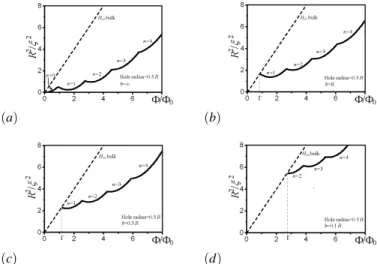
TheHc3lines for a ring withRh=0.5Rand for different val-ues of the de Gennes extrapolation length are shown in Fig. 1. When the inner hole is filled with a perfect insulator (b=∞) theHc3phase transition line is made up of the envelpoe of a set of curves withn=0, 1, 2,. . . starting atΦ/Φ0=0 and show-ing three paramagnetic domains located above the transitions n=0→n=1,n=1→n=2,n=2→n=3 (Fig. 1(a)). The numeri-cal analysis shows that this picture remains qualitatively un-changed for finite values of b satisfying b¿R. But for b¡R
(a) (b)
(c) (d)
FIG. 1. The upper critical fieldHc3(thick line) for a ring withRh=0.5R
and for different values of the de Gennes extrapolation length b:
(a) b=∞,(b)b=R,(c)b=0.5R,(c)b=0.1R. For finitebHc3intersects
the upper critical fieldHc2(dashed line) atΦ/Φ0=Γ.
considerable qualitative changes in the phase diagram are ob-served. In order to illustrate them, in Fig. 1(b)we took an ex-trapolation length comparable with the external radius of the ring (b=R). The following remarcable features are observed: (i)the envelope line defining Hc3 does not include the n=0 curve; (ii) the paramagnetic domains are located above the transitionsn=1→n=2,n=2→n=3;(iii)theHc3line intersects theHc2line at a nonzero valueΓofΦ±Φ0. This means that for magnetic fields satisfying Φ±
Φ0¡Γ the transition to the normal phase is not mediated by the superconducting states associated to the presence of the ring edges. When the de Gennes extrapolation lengthbfurther decreases, Γ shifts to-wards greater values of the applied magnetic field, as can be seen from Fig. 1(c−d). This means that at the inner edge the supercondincting current is supressed for more values of the flux quanta.
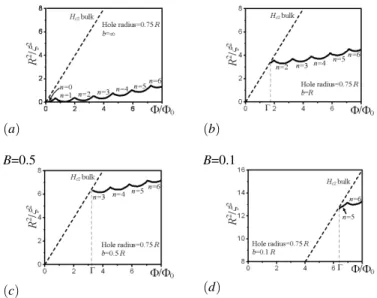
In order to understand the role of the radial confinement on the behavior of the phase diagram, we have considered in Fig. 2 a ring with a hole radiusRh=0.75R for the same set of values ofb as in Fig. 1. It is seen that the increasing of the radial confinement causes an increment of the number of domains exhibiting PME. Additionally, it is noted that the ef-fect of the medium contacting with the internal edge of the ring is more notorius, than in the ring of Fig. 1. This can be understood if we consider the relation between two areas: (i)The area of the region where the order parameter extrapo-lates outside the inner edge and(ii)the superconducting ring area. With the increasing of the radial confinement, this rela-tion also increases, which leads to the fact that the value ofΓ at which theHc3line intersects theHc2line exhibits a faster desplacement along theHc2line asbdiminishes.
In Fig. 3 we have represented theHc3field (in units ofΦ0/(π
Brazilian Journal of Physics, vol. 36, no. 3B, September, 2006 935
(a) (b)
B=0.5
(c)
B=0.1
(d)
FIG. 2. The same as in Fig.1 but for a ring withRh=0.75R
(a) (b)
(c) (d)
FIG.3. Temperature behavior of the upper critical fieldHc3(in units
of (H0 =Φ0/(πR2)) for rings with a fixed de Gennes
extrapola-tion lengthb=0.5Rand different hole radii: (a)Rh=0,(b)Rh=0.25R,
(c)Rh=0.5R,(d)Rh=0.75R.
case of a disk. We see that in the ring the superconductivity can not be preserved up toT/Tc0=1, caused by the proximity effect at the inner edge, which affects the superconducty in the ring region. The corresponding critical temperature at which the superconductivity associated to the presence of edges dis-appears diminishes as the radial confinement increases. A similar conclusion with relation of the role of the proximity effect on the superconducting properties of long cylinder sam-ples in an external magnetic field has been pointed out in Ref. [7].
IV. CONCLUSIONS
We have studied (in the frame of the GL theory) the upper critical field of a type II mesoscopic superconducting ring with negligible width in the presence of a transversal magnetic field under the assumption that the order parameter at the inner ring edge extrapolates outside the boundary at a distanceb. For a given value of the de Gennes extrapolating length, the oscillat-ing behavior of theHc3is controled by the size of the hole and has been observed to be more pronounced as the radial con-finement in the ring increases, which causes an increment of the number of domains exhibiting the Paramagnetic Meissner effect.
For a given hole radius, we have shown that the character-istics of the material filling the hole area strongly influence the behavior of the upper critical field, which manifests in the appearance of a nonzero point at which theHc3line intersects theHc2line.
The obtained relations can be used to consider the influence of the radial confinement on the so called enhanced supercon-ductivity [11]. Additionally, these results can be extended in order to discuss the influence of boundary conditions at the outer edge. A further extension can take into account also the effect of eccentricity; for semiconductor rings such problem has been discussed recently in Ref. [12]
Acknowledgements
This work is supported by Colciencias through the grant N ˚ 1106-05-13828 (research projectStudy of electronic, opti-cal, transport and critical properties of semiconductor and su-perconductor ring-like systems) and by the Excellence Center for Novel Materials (Colciencias-Universidad del Valle con-tract N ˚ D043-2005).
[1] P. G. de Gennes,Superconductivity of metals and alloys, W. H. Benjamin New York, (1966).
[2] C. Meyers, Phys. Rev. B68, 104522 (2003).
[3] M. Morelle, D. S. Golubovic, and V. V. Moshchalkov, Phys. Rev. B70, 144528 (2004).
[4] P. Singha Deo, V. A. Schweigert, F. M. Peeters, and A. K. Geim, Phys. Rev. Lett.79, 4653 (1997): P. Singha Deo, V. A. Schweigert, and F. M. Peeters, Phys. Rev. B59, 6039 (1999). [5] A. Kanda and Y. Ootuka, Physica C404, 205 (2004).
[6] W. A. Little and R. D. Parks, Phys. Rev. Lett.9, 9 (1962); Phys. Rev.133, 97A (1964).
[7] Mai Suan Li, Phys. Rep.376, 133 (2003).
[8] L. Zhao, X.G. Qiu, and B.R. Zhao, Mod. Phys. Lett. B,17, 1445 (2003).
[9] M. Tinkham,Introduction to superconductivity, McGraw-Hill New York, (1996).
[10] M. Abramovitz and I. Stegun, Handbook of Mathematical Functions, Dover Publications, New York, (1970).
[11] S. V. Yampolskii and F. M. Peeters, Phys. Rev. B62, 9663 (2000).