ORIGINAL
ARTICLE
Simultaneous detection of hepatitis B virus genotypes
and mutations associated with resistance
to lamivudine, adefovir, and telbivudine by the
polymerase chain reaction-ligase detection reaction
Authors
Yong-Zhong Wang1 Jun-Hua Xiao2 Long-Gen Liu3 Chun-Yan Ye4 Hong-Yu Shen5 Tian-Min Xu4 Ke-Zhuan Zhu4
1Professor; Director, Institute
for the Study of Liver Diseases, The Third People’s Hospital of Changzhou, China
2PhD, Professor; Director,
College of Chemistry, Chemical Engineering and Biotechnology, Donghua University, China
3Deputy Director, Third People’s
Hospital of Changzhou; Professor, Department of Infectious Diseases, Institute for the Study of Liver Diseases, The Third People’s Hospital of Changzhou, China
4Professors, Department of
Infectious Diseases, Institute for the Study of Liver Diseases, The Third People’s Hospital of Changzhou, China
5MS; Supervising Laboratorian,
Institute for the Study of Liver Diseases, The Third People’s Hospital of Changzhou, China
Submitted on: 05/08/2011 Approved on: 06/29/2011
Correspondence to:
Yong-Zhong Wang 300 North Lanling Road Changzhou
213001 – Jiangsu Province China
Financial Support: This study was supported by Chang Zhou Social development fund (CS 2008218).
We declare no conflict of interest.
©2011 Elsevier Editora Ltda. All rights reserved.
ABSTRACT
Objectives: Detection of mutations associated to nucleos(t)ide analogs and hepatitis B virus (HBV) genotyping are essential for monitoring treatment of HBV infection. We developed a multiplex poly-merase chain reaction-ligase detection reaction (PCR-LDR) assay for the rapid detection of HBV geno-types and mutations associated with lamivudine, adefovir, and telbivudine resistance in HBV-infected patients. Methods: HBV templates were amplified by PCR, followed by LDR and electrophoresis on a sequencer. The assay was evaluated using plasmids that contained wild-type or mutant HBV se-quences and 216 clinical samples. Results: The PCR-LDR assay and sequencing gave comparable results for 158 of the 216 samples (73.1%) with respect to mutation detection and genotyping. Com-plete agreement between the two methods was observed for all the samples (100%) at codon 180 and codon 204. Concordant results were observed for 99.4% of the 158 samples at codon 181 and 98.7% at codon 236. The genotyping results were completely concordant between the PCR-LDR assay and sequencing. The PCR-LDR assay could detect a proportion of 1% mutant plasmid in a back-ground of wild-type plasmid. Conclusion: The PCR-LDR assay is sensitive and specific for detection of HBV genotypes and drug resistance mutations, and could be helpful for decision making in the treatment of HBV infection.
Keywords: hepatitis B; drug resistance; mutation; genotype.
INTRODUCTION
Hepatitis B virus (HBV) infection is a major health problem worldwide. Antiviral thera-pies with interferon, pegylated interferon, or nucleos(t)ide analogs are widely used to treat HBV infection. Given that these therapies cannot eradicate HBV infection, the focus of the treatment is to prolong the suppression of viral replication, prevent complications of infection, and establish immune control by the host over the virus.1 The effectiveness of interferon and pegylated interferon therapy depends on the specific genotype of HBV with which the patient is infected.2,3 In addition, the presence of mutations that confer drug resist-ance often lead to the failure of treatment with nucleos(t)ide analogs.4 HBV has been classi-fied into eight major genotypes (designated from A to H), on the basis of an intergroup divergence of 8% or more in the full-length nu-cleotide sequence, and most of the genotypes show a distinct geographic distribution.5,6 There is evidence that genotypes A and B are associ-ated with higher rates of hepatitis B e antigen
(HBeAg) seroconversion than genotypes C and D during treatment with interferon or pegylated interferon.2,3,7,8 Genotyping of HBV is essential to detect patients who are highly likely to re-spond to interferon or pegylated interferon.9,10
hep-atitis B patients who have not been exposed to nucleoside treat-ment previously, adefovir resistance mutations only emerge in the second year of treatment, and the frequency of these muta-tions reaches cumulative rates of 3%, 6%, 18%, and 29% at the end of 2, 3, 4, and 5 years of therapy, respectively.16,17 Adefovir resistance mutations are much more common in patients who have previously received lamivudine therapy.18
HBV infection is a heavy health burden in China. Nation-al surveys found that the prevNation-alence of HBV was 9.8% in 1992 and 7.2% in 2006 among the population aged 1–59 years. Due to the National Hepatitis B Vaccination to Infant Program, the prevalence of HBV has been dramatically reduced.19 However, because this program was only started in 1992, the prevalence rate of HBV is still high in those aged above 18 years, and the treatment of HBV-infected patients is still an important issue in China. The State Food and Drug Administration of China has approved interferon, pegylated interferon, lamivudine, adefovir, telbivudine, and entecavir for the treatment of HBV infection. All these drugs are widely used in China to treat HBV-infected patients. HBV genotyping and the detection of mutations that confer drug resistance help the selection of an appropriate treatment strategy and monitoring of the treat-ment. However, there are a limited number of methods that enable genotyping and mutation detection to be carried out simultaneously. Although nucleotide sequencing of PCR products is widely used for HBV genotyping and mutational analysis, the technique can only detect mutant virus when it comprises at least 25% of the total viral population.20 The re-verse hybridization-based line-probe assay LiPA DR is more sensitive and can detect resistance mutations when the mu-tant virus comprises at least 5% of the viral population;21,22 however, it is too expensive to be adopted widely in develop-ing countries such as China. In the present study, we estab-lished a polymerase chain reaction-ligase detection reaction (PCR-LDR) assay for the simultaneous detection of the muta-tions rtL180M, rtM204V/I, rtA181T/V, and rtN236T and the HBV genotypes A, B, C, and D, and evaluated its performance using clinical samples.
MATERIALS AND METHODS
Plasmids
The plasmids that contained the mutant and wild-type sequences for rt204, rt181, and rt236 were constructed pre-viously.23,24 The plasmids that contained the mutant and wild-type sequences for rt180 were constructed using the same method described previously.24
Serum samples and extraction of HBV DNA
This study was conducted in accordance with the guidelines of the Declaration of Helsinki and the principles of Good Clinical Practice. All patients gave their informed con-sent. Serum samples were collected from 216 patients with
chronic hepatitis B. Of the 216 patients, 52 were treated with lamivudine alone, 82 were treated with adefovir alone, 51 were treated with lamivudine initially but became re-sistant to lamivudine and were then treated with adefovir, 19 were treated with telbivudine, and 12 were treated with ente-cavir. Given that drug resistance mutations often arise after one year of treatment, we selected patients who had been treated for more than 12 months but still had sufficient HBV DNA in their serum to be detected by real-time PCR, in order to include enough mutant samples to evaluate the assay. HBV DNA was extracted from 100 mL of serum using a QIAamp DNA Blood Kit (Qiagen, Chatsworth, CA) in accordance with the manufac-turer’s instructions.
Measurement of serum HBV DNA levels
Serum levels of HBV DNA were determined by using a real-time PCR kit (Fosun Diagnostics, Shanghai, China). The kit has been approved by the Chinese Food and Drug Adminis-tration for in vitro diagnosis and has a lower limit of detec-tion of 84 IU/mL.25
Primers for PCR and LDR
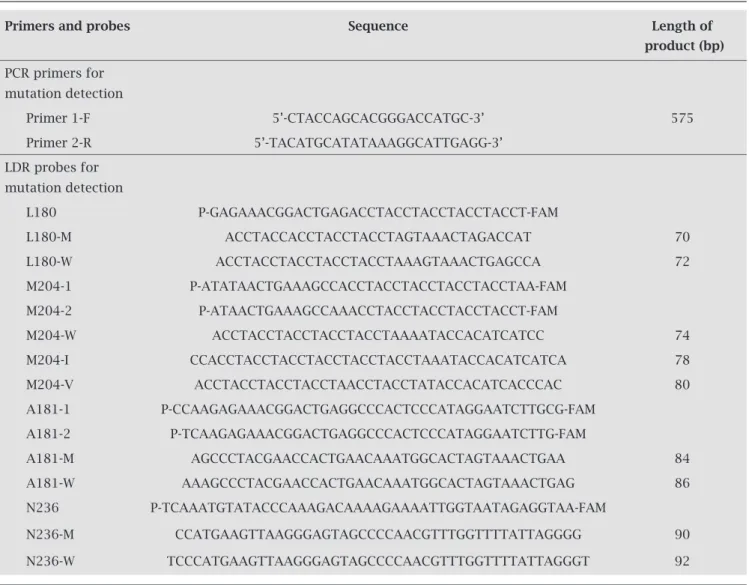
Primers and probes (synthesized by Invitrogen, Shanghai, China) to detect the HBV mutations and genotypes are list-ed in Tables 1 and 2.
Multiplex PCR and LDR
Table 1. Primers and probes used in the PCR-LDR protocol for detection of HBV drug-resistant mutations
Primers and probes Sequence Length of
product (bp)
PCR primers for mutation detection
Primer 1-F 5’-CTACCAGCACGGGACCATGC-3’ 575
Primer 2-R 5’-TACATGCATATAAAGGCATTGAGG-3’
LDR probes for mutation detection
L180 P-GAGAAACGGACTGAGACCTACCTACCTACCTACCT-FAM
L180-M ACCTACCACCTACCTACCTAGTAAACTAGACCAT 70
L180-W ACCTACCTACCTACCTACCTAAAGTAAACTGAGCCA 72
M204-1 P-ATATAACTGAAAGCCACCTACCTACCTACCTACCTAA-FAM
M204-2 P-ATAACTGAAAGCCAAACCTACCTACCTACCTACCT-FAM
M204-W ACCTACCTACCTACCTACCTAAAATACCACATCATCC 74
M204-I CCACCTACCTACCTACCTACCTACCTAAATACCACATCATCA 78
M204-V ACCTACCTACCTACCTAACCTACCTATACCACATCACCCAC 80
A181-1 P-CCAAGAGAAACGGACTGAGGCCCACTCCCATAGGAATCTTGCG-FAM
A181-2 P-TCAAGAGAAACGGACTGAGGCCCACTCCCATAGGAATCTTG-FAM
A181-M AGCCCTACGAACCACTGAACAAATGGCACTAGTAAACTGAA 84
A181-W AAAGCCCTACGAACCACTGAACAAATGGCACTAGTAAACTGAG 86
N236 P-TCAAATGTATACCCAAAGACAAAAGAAAATTGGTAATAGAGGTAA-FAM
N236-M CCATGAAGTTAAGGGAGTAGCCCCAACGTTTGGTTTTATTAGGGG 90
N236-W TCCCATGAAGTTAAGGGAGTAGCCCCAACGTTTGGTTTTATTAGGGT 92
Table 2. Primers and probes used in the PCR-LDR protocol for HBV genotyping
Primers and probes Sequence Length of
product (bp)
Primers for HBV genotyping
Primer-F 5’- ACTGCCTCTCCCATATCGTC-3’
376
Primer-R 5’- GACAAACGGGCAACATACCT-3’
LDR probes for HBV genotyping
Genotype B P-TCGAGGAATATGATAAAACGCCGCAGCCTACCTACCTACCTACCTACCTACCT-FAM
108
CCTACCTACCTACCTACTCCTACCTACCTTAAGATGAGGCATAGCAGCAGGATGT
Genotype C P-TACCAAGGTATGTTGCCCGTTTGTCCCACCTACC TACCTACCTAGCTACCTACCTA-FAM 110
CCTACCTACCTACCTACCTACCTACCTGACCCTGCACCGCCAACATGGAGAAGAC
Genotype A P-TACCAAGGTATGTTGCCCGTTTGTCCCACCTACC TACCTACCTAGCTACCTACCTA-FAM 112
CCTACCTACCTACCTACCTACCTACCTGACCCTTGCCTTTGTTGGTTCTTCTGGAT
Genotype D P-CGAAAGCCCAGGATGATGGGATGGGCCTACCTACCTACTAGTAGCCTACCTACCTACT-FAM 118
Sequencing and subcloning
To validate the mutation detection and HBV genotyping results, the 575- and 376-bp PCR products, respectively, were purified and sequenced by Invitrogen. Discrepancies between the PCR-LDR and sequencing results were resolved by sequencing subcloned PCR products. The PCR products were cloned into the pGEM-T vector (Promega, Madison, WI) and 20 clones for each sample were selected for se-quencing.
RESULTS
Specificity and sensitivity
The strategy of the PCR-LDR assay has been described in detail previously.24 Its specificity and sensitivity were deter-mined by using mutant and wild-type plasmids and clinical samples. All the plasmids produced the expected results. No nonspecific signals were observed at template concentra-tions of 2 x 10³, 2 x 10⁵, or 2 x 10⁷ copies/mL. Serum samples from 10 blood donors, and 20 samples from patients with hepatitis A and C were tested, and gave no signal. Serial dilu-tions of the plasmids and serum samples were used to deter-mine the lower limit of detection of the assay. Each plasmid was assayed three times. The PCR-LDR assay could detect mutant and wild-type plasmids at concentrations of 5 x 10⁷, 5 x 10⁶, 5 x 10⁵, 5 x 10⁴, 5 x 10³, and 500 copies/mL. Thus, the lower limit for the PCR-LDR assay was 500 copies/ml of mutant or wild-type plasmid. Three clinical serum samples with 1 x 10⁷ IU/mL wild-type HBV, 6 x 10⁶ IU/mL rtA181T, and 2 x 10⁶ IU/mL rtN236T were serially diluted 10-fold and each dilution was tested in triplicate in the PCR-LDR assay. The PCR-LDR assay could repeatedly detect HBV in dilu-tions containing 600 IU/mL of HBV or above, but could not detect HBV in dilutions containing an HBV load lower than 600 IU/mL. Therefore, the lower limit of detection for serum samples was 600 IU/mL.
Mixed plasmid experiments
Mixed plasmid experiments were performed to determine the ability of the PCR-LDR assay to distinguish mutant plasmids in a background of wild-type plasmids. Mutant and wild-type plasmids were mixed to give final total concentrations of 1 x 10⁵ and 1 x 10⁶ copies/mL. Each mixture contained 100, 10, 1, or 0.1% mutant plasmid. The mutant plasmids were detected in all the mixtures except for those that contained 0.1% mutant plasmid.
Comparison of the LDR assay and sequencing
The PCR-LDR assay was also evaluated using serum samples from 216 patients who had been treated with lamivudine, adefovir, telbivudine, or entecavir. All samples were screened by both the PCR-LDR assay and sequencing. Discrepancies between the results obtained with the two methods were
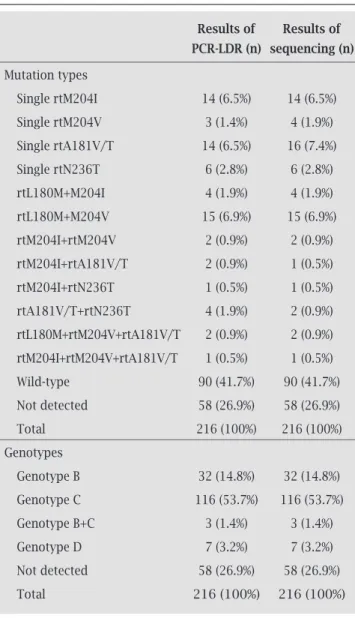
resolved by sequencing subcloned PCR products. The results of both assays are summarized in Table 3. The PCR-LDR as-say and sequencing gave comparable results for 158 (73.1%) of the 216 samples with respect to mutation detection and genotyping. In the remaining 58 samples (26.9%), the muta-tions and genotypes could not be detected by either method because insufficient product was amplified in the PCR step. Complete agreement between the two methods was ob-served for all the samples (100%) at codon 180 and codon 204. Concordant results were observed for 157 out of 158 analyzable samples (99.4%) at codon 181 and 156 out of 158 samples (98.7%) at codon 236. Among the discrepancies, PCR-LDR detected rtA181V/T and rtN236T double muta-tions in two samples and a rtM204V and rtA181V/T double mutation in one sample, whereas the sequencing only de-tected a rtA181V/T single mutation in the two samples and a rtM204V single mutation in the one sample, respectively.
Table 3. Comparison of PCR-LDR and sequencing results
Results of Results of
PCR-LDR (n) sequencing (n)
Mutation types
Single rtM204I 14 (6.5%) 14 (6.5%)
Single rtM204V 3 (1.4%) 4 (1.9%)
Single rtA181V/T 14 (6.5%) 16 (7.4%)
Single rtN236T 6 (2.8%) 6 (2.8%)
rtL180M+M204I 4 (1.9%) 4 (1.9%)
rtL180M+M204V 15 (6.9%) 15 (6.9%)
rtM204I+rtM204V 2 (0.9%) 2 (0.9%)
rtM204I+rtA181V/T 2 (0.9%) 1 (0.5%)
rtM204I+rtN236T 1 (0.5%) 1 (0.5%)
rtA181V/T+rtN236T 4 (1.9%) 2 (0.9%)
rtL180M+rtM204V+rtA181V/T 2 (0.9%) 2 (0.9%)
rtM204I+rtM204V+rtA181V/T 1 (0.5%) 1 (0.5%)
Wild-type 90 (41.7%) 90 (41.7%)
Not detected 58 (26.9%) 58 (26.9%)
Total 216 (100%) 216 (100%)
Genotypes
Genotype B 32 (14.8%) 32 (14.8%)
Genotype C 116 (53.7%) 116 (53.7%)
Genotype B+C 3 (1.4%) 3 (1.4%)
Genotype D 7 (3.2%) 7 (3.2%)
Not detected 58 (26.9%) 58 (26.9%)
Figure 1: Some results of the PCR-LDR assay. The length of the LDR product is determined by the lengths of the LDR probes. Each mutant and/or wild sequences and genotypes produces a peak at the corresponding position when analyzed using GeneMapper
software. (A) Wild-type HBV, genotype C. (B) rtM204V, genotype C. (C) rtM204I+rtA181V/T, genotype C. (D) rtM204I+rtN236T,
genotype B. (E) rtL180M+rtM204V+ rtA181V/T, genotype C.
All the discrepancies corresponded to mutations that were detected by the PCR-LDR assay but not by sequencing of the same sample. The discrepancies were resolved by the se-quencing of 20 randomly chosen subclones for each sample. In each case, at least three clones for the same sample had mutations that were consistent with the PCR-LDR results. To confirm the performance of this assay with respect to the detection of mutations at codons 181 and 236, we retested the 70 samples that had been shown to have rtA181V/T and/or rtN236T mutations in the previous study and 20 samples shown to be wild type,24 and obtained consistent results (Figure 1). The genotyping results were completely concordant between the PCR-LDR assay and sequencing.
Fifty-eight samples could not be analyzed by either method because they could not be amplified with the PCR
primers. Real-time PCR quantification analysis showed that the concentration of HBV DNA in all these samples was be-low 600 IU/mL.
Time required
For a panel of 64 samples, serum DNA extraction takes one hour. PCR-LDR takes about four hours on an ABI 9600 ther-mal cycler. Electrophoresis takes about 1.5 hours on an ABI 377 sequencer. The total time for the PCR-LDR assay is about six hours. In contrast, the sequencing analysis takes about 13 hours, including one hour for serum DNA extraction, 2.5 hours for PCR on a ABI 9600 thermal cycler, one hour for purification of PCR products, 1.5 hours for sequencing reac-tion and purificareac-tion, and seven hours for electrophoresis on a ABI 377 sequencer.
70 80 90 100 110
180M 180W YMDD YIDD YVDD 181M 181W 236M 236W 184M 184W 202M 202W 250M250W B C
A
B
C
D
E 1200 1000 800 600 400 200 0 2400 2000 1600 1200 800 400 0 8000
6000
4000
2000
0
3000
2000
1000
DISCUSSION
Although HBV genotyping and the detection of drug resist-ance mutations are important for monitoring the treatment of chronic hepatitis B, there are a limited number of meth-ods for the simultaneous detection of HBV genotypes and mutations that confer resistance to lamivudine, adefovir, and telbivudine.26 We have established a PCR-LDR assay to detect the major HBV genotypes and the rtL180M, rtM204I, rtM204V, rtA181V/T, and rtN236T mutations, which are as-sociated with lamivudine, adefovir, and telbivudine resist-ance, in patients with chronic HBV infections. The assay could specifically detect mutant and wild-type HBV, and its lower limit of detection was 600 IU/mL for clinical serum samples. In a mixture of mutant and wild-type plasmids, the assay could detect mutant plasmids at a proportion of 1%. Therefore, the PCR-LDR assay was more sensitive than se-quencing for the detection of a low level of mutant mixed with wild-type virus. In addition, the cost of the PCR-LDR assay is below 20 USD dollars per test, which is affordable for patients in China and other developing countries. Com-pared to sequencing, PCR-LDR is less time-consuming.
Fifty-eight samples could not be analyzed by either PCR-LDR or sequencing because the level of HBV DNA in the sam-ples was too low to be amplified in the PCR step. Although the clinical significance of low serum levels of HBV DNA in pa-tients with chronic HBV infection is unclear, papa-tients who have a detectable serum level of HBV DNA have a much higher risk of relapse after the withdrawal of antiviral agents.27 Mutations that occur at a low level may lead to HBV breakthrough and treatment failure during long-term antiviral therapy. The im-provement of HBV DNA extraction protocols and nested PCR should be considered in future studies, to increase the sensitiv-ity of detection of low levels of HBV DNA.
Theoretically, new mutations that cause resistance to antiviral agents used to treat HBV could be detected simul-taneously by multiplex LDR with specific probes. We have designed specific probes to detect the mutations rtT184G, rtS202I, and rtM250V, which are associated with entecavir resistance. However, we did not detect these mutations in the clinical samples analyzed due to the low rates of these mutations and the relatively small number of patients treated with entecavir in our study. The performance of the PCR-LDR assay with respect to the detection of entecavir-resistance mutations needs to be evaluated in future studies. Although at least eight HBV genotypes have been re-ported, the major HBV genotypes in China are B and C.28 Genotypes A and D are found in a very small proportion of Chinese patients, and genotypes E, F, G, and H have not been reported in China. As a consequence, we could only evaluate the performance of the PCR-LDR assay for geno-types A, B, C, and D, and, in fact, we did not detect genotype A in this study. This might be due to the very small number of patients infected with genotype A in eastern China.28
Separate mutations associated with lamivudine and adefovir resistance were detected simultaneously in sam-ples from six patients. All these patients failed to respond to lamivudine treatment initially and were then treated with adefovir for more than 12 months. This result implies that sequential treatment with lamivudine and adefovir can lead to multi-drug resistance in HBV-infected patients, as report-ed in other studies.29,30
In conclusion, the PCR-LDR assay developed in this study was able to detect HBV genotypes and the mutations associ-ated with resistance to lamivudine, adefovir, and telbivudine sensitively and specifically. It might be a useful tool for decision making with respect to the treatment of HBV-infected patients.
REFERENCES
1. Alazawi W, Foster GR. Advances in the diagnosis and treatment of hepatitis B. Curr Opin Infect Dis. 2008; 21: 508-15.
2. Kao JH,Wu NH, Chen PJ, et al. Hepatitis B genotypes and the response to interferon therapy. J Hepatol. 2000; 33: 998-1002. 3. Janssen HL, van Zonneveld M, Senturk H, et al. Pegylated in-terferon alfa-2b alone or in comination with lamivudine for HbeAg-positive chronic hepatitis B: a randomised trial. Lancet. 2005;365:123-9.
4. Lok AS, Zoulim F, Locarnini S. Antiviral drug-resistant HBV: Standardization of nomenclature and assays and recommenda-tions for management. Hepatology. 2007;46:254-65.
5. Fung SK, Lok AS. Hepatitis B virus genotypes: do they play a role in the outcome of HBV infection? Hepatology. 2004;40:790-2.
6. Norder H, Courouce AM, Coursaget P, et al. Genetic diver-sity of hepatitis B virus strains derived worldwide: geno-types, subgenogeno-types, and HBsAg subtypes. Intervirology. 2004;47:289-309.
7. Wai CT, Chu CJ, Hussain M, et al. HBV genotype B is associated with better response to interferon therapy in HBeAg (+) chronic hepatitis than genotype C. Hepatology. 2002;36:1425-30. 8. Erhardt A, Blondin D, Hauck K, et al. Response to
interfer-on alfa is hepatitis B virus genotype dependent: genotype A is more sensitive to interferon than genotype D. Gut. 2005; 54:1009-13.
9. Cooksley WG. Do we need to determine viral genotype in treat-ing chronic hepatitis B? J Viral Hepat. 2010;17:601-10. 10. Ferreira PR, Tenore SD. Response predictors to treatment with
pegylated interferon in chronic hepatitis B. Braz J Infect Dis. 2010;14:519-25.
11. Walsh AW, Langley DR, Colonno RJ, et al. Mechanistic charac-terization and molecular modeling of hepatitis B virus polymer-ase resistance to entecavir. PloS One. 2010;5:e9195.
12. Allen MI, Deslauriers M, Andrews CW, et al. Identification and characterization of mutations in hepatitis B virus resistant to lamivudine. Lamivudine Clinical Investigation Group. Hepatol-ogy. 1998;27:1670-7.
13. Gauthier J, Bourne EJ, Lutz MW, et al. Quantitation of hepa-titis B viremia and emergence of YMDD variants in patients with chronic hepatitis B treated with lamivudine. J Infect Dis. 1999;180:1757-62.
15. Stuyver L, Van Geyt C, De Gendt S, et al. Line probe assay for monitoring drug resistance in hepatitis B virus infected patients during antiviral therapy. J Clin Microbiol. 2000;38:702-7. 16. Marcellin P, Chang TT, Lim SG, et al. Long-term efficacy
and safety of adefovir dipivoxil for the treatment of hepa-titis B e antigen-positive chronic hepahepa-titis B. Hepatology. 2008;48:750-8.
17. Hadziyannis SJ, Tassopoulos NC, Heathcote EJ, et al. Long-term therapy with adefovir dipivoxil for HBeAg-negative chronic hepatitis B. N Engl J Med. 2005;352:2673-81.
18. Lee YS, Suh DJ, Lim YS, et al. Increased risk of adefovir resist-ance in patients with lamivudine-resistant chronic hepatitis B after 48 weeks of adefovir dipivoxil monotherapy. Hepatology. 2006;43:1385-91.
19. Liang X, Bi S, Yang W, et al. Epidemiological serosurvey of hepatitis B in China – declining HBV prevalence due to hepa-titis b vaccination. Vaccine. 2009;27:6550-7.
20. Pas SD, de Man RA, Fries E, et al. The dynamics of mutations in the YMDD motif of the hepatitis B virus polymerase gene during and after lamivudine treatment as determined by re-verse hybridization. J Clin Virol. 2002;25:63-71.
21. Hussain M, Fung S, Libbrecht E, et al. Sensitive line probe as-say that simultaneously detects mutations conveying resist-ance to lamivudine and adefovir. J Clin Microbiol. 2006;44: 1094-7.
22. Niesters HG, Zoulim F, Pichoud C, et al. Validation of the IN-NO-LiPA HBV DR assay (version 2) in Monitoring hepatitis B virus-infected patients receiving mucleoside analog treatment. Antimicrob Agents Chemother. 2010;54:1283-9.
23. Xiao Z, Xiao J, Jiang Y, et al. A novel method based on ligase detection reaction for low abundant YIDD mutants detec-tion in hepatitis B virus. Hepatol Res. 2006;34:150-5. 24. Wang YZ, Xiao JH, Ruan LH, et al. Detection of the
rtA181V/T and rtN236T mutations associated with resist-ance to adefovir dipivoxil using a ligase detection reaction assay. Clin Chim Act. 2009;408:70-4.
25. Shi M, Zhang Y, Zhu YH, et al. Comparison of real-time PCR with the Cobas Amplicor for quantitation of hepati-tis B virus DNA in serum samples. World J Gastroenterol. 2008;14:479-83.
26. Degertekin B, Hussain M, Tan J, et al. Sensitivity and accu-racy of an updated line probe assay (HBV DR v.3) in detect-ing mutations associated with hepatitis B antiviral resist-ance. J Hepatol. 2009;49:695-701.
27. Lee HC, Suh DJ, Ryu SH, et al. Quantitative polymerase chain reaction assay for serum hepatitis B virus DNA as a predictive factor for post-treatment relapse after lamivu-dine induced hepatitis B e antigen loss or seroconverson. Gut. 2003;52:1779-83.
28. Wang Z, Huang Y, Wen S, et al. Hepatitis B virus gen-otypes and subgengen-otypes in China. Hepatol Res. 2007;37(S1):S36-41.
29. Yim HJ, Hussain M, Liu Y, et al. Evolution of multi-drug resistant hepatitis b virus during sequential therapy. Hepa-tology. 2006;44:703-12.