www.bjournal.com.br
Volume 42 (9) 776-869 September 2009
Institutional Sponsors
The Brazilian Journal of Medical and Biological Research is partially financed by
Braz J Med Biol Res, September 2009, Volume 42(9) 816-823
The mutagenic and antimutagenic effects of the traditional
phytoestrogen-rich herbs, Pueraria mirifica and Pueraria
lobata
The mutagenic and antimutagenic effects
of the traditional phytoestrogen-rich herbs,
Pueraria mirifica
and Pueraria lobata
W. Cherdshewasart
1, W. Sutjit
2, K. Pulcharoen
2and M. Chulasiri
3 1Department of Biology, 2Biotechnology Program, Faculty of Science,Chulalongkorn University, Bangkok, Thailand
3Department of Microbiology, Faculty of Pharmacy,
Mahidol University, Bangkok, Thailand
Abstract
Pueraria mirifica is a Thai phytoestrogen-rich herb traditionally used for the treatment of menopausal symptoms. Pueraria lobata
is also a phytoestrogen-rich herb traditionally used in Japan, Korea and China for the treatment of hypertension and alcoholism. We evaluated the mutagenic and antimutagenic activity of the two plant extracts using the Ames test preincubation method plus or minus the rat liver mixture S9 for metabolic activation using Salmonella typhimurium strains TA98 and TA100 as indica-tor strains. The cytotoxicity of the two extracts to the two S. typhimurium indicators was evaluated before the mutagenic and
antimutagenic tests. Both extracts at a final concentration of 2.5, 5, 10, or 20 mg/plate exhibited only mild cytotoxic effects. The plant extracts at the concentrations of 2.5, 5 and 10 mg/plate in the presence and absence of the S9 mixture were negative in
the mutagenic Ames test. In contrast, both extracts were positive in the antimutagenic Ames test towards either one or both of
the tested mutagens 2-(2-furyl)-3-(5-nitro-2-furyl)-acrylamide and benzo(a)pyrene. The absence of mutagenic and the presence of anti-mutagenic activities of thetwo plant extracts were confirmed in rec-assays and further supported by a micronucleus test
where both plant extracts at doses up to 300 mg/kg body weight (equivalent to 16 g/kg body weight plant tuberous powder) failed to exhibit significant micronucleus formation in rats. The tests confirmed the non-mutagenic but reasonably antimutagenic
activities of the two plant extracts, supporting their current use as safe dietary supplements and cosmetics.
Key words: Phytoestrogen; Pueraria mirifica; Pueraria lobata; Mutagenic test; Antimutagenic test; Micronucleus test
Introduction
Correspondence: W. Cherdshewasart, Department of Biology, Faculty of Science, Chulalongkorn University, Phyathai Road, Bangkok 10330, Thailand. Fax: 662-218-5386. E-mail: [email protected]
Received September 9, 2008. Accepted June 25, 2009.
Pueraria mirifica Airy Shaw et Suvatabandu is a pe-rennial climbing vine native to Thailand, Myanmar, and Laos with the domestic Thai name of White Kwao Krua. The large-sized tubers of this plant have long been used in traditional Thai medicine for rejuvenating purposes and are found in at least 29 provinces of Thailand (1). The plant tubers are rich in phytoestrogens, especially miroestrol (2),
deoxymiroestrol (3), and isoflavonoids (1), and have been
shown to be effective as an alternative treatment of meno-pausal symptoms (4). Consumption of the tuberous powder generates a strong estrogenic activity as revealed by the
induction of vaginal cornification in ovariectomized rats (5,6)
and by the MCF-7 cell proliferation assay (7). Treatment of gonadectomized rats with plant tuber powder resulted in a reduction of LH and FSH levels (8), with dose-dependent estrogenic responses in female mice (9), female monkeys
(10), and menopausal monkeys (11-13). The plant tuber powder also elicits dose-dependent physiological responses in male mice with a reduction in the weight of the epididymis and the seminal vesicles and reduced sperm motility and viability (14), promoting protection against osteoporosis in
orchidectomized male (15) and female rats (16). Pueraria lobata, or Kudzu, is a tuberous plant found in China, Korea
and Japan, which contains high amounts of isoflavonoids,
especially puerarin and daidzein (1).
Recently, P. mirifica and P. lobata tuber powders have became highly popular as components of orally consumed traditional medicines and as a dietary supplement for the treatment of menopausal symptoms. In addition, a wide variety of newly formulated cosmetic products contain P.
Mutagenic and antimutagenic activity 817
especially in Asia, are increasingly exposed (frequency and
dose) to phytoestrogens from the two plants. Investigation
of the mutagenic and/or antimutagenic potentials of herbal
plants used in traditional medicine are generating great in-terest with the growing evidence of their safe consumption
and/or low long-term genotoxic effects (17). A few studies
using the Ames test and the micronucleus assay have been conducted on phytoestrogen-rich plants or products such
as the equol-rich product (18) and genistein (19), showing
that the test materials were safe. Therefore, given the in-creasing exposure to plant phytoestrogens, in the present study we evaluated the P. mirifica and P. lobata extracts in in vitro and in vivo studies using the Ames test for mutagenic and anti-mutagenic assays and the micronucleus test for genotoxicity assays to evaluate the genetic risk or safety of the two plant materials. The results of these studies should
contribute directly to the development and/or consumption
of products derived from the two plant powders and plant extracts.
Material and Methods
Chemicals
All chemicals were of analytical grade. Benzo(a)pyrene (B(a)P) was from Sigma (USA); dimethylsulfoxide (DMSO) and the Folin-Ciocalteu phenol reagent were from Merck
(Germany); 2-(2-furyl)-3-(5-nitro-2-furyl)-acrylamide
(AF-2) was from Wako Pure Chemical Industrial, Ltd. (Japan). Ampicillin was purchased from General Drug House Co., Ltd. (Thailand). Tryptic soy broth and Bacto agar were from Difco Laboratories (USA), while nutrient broth No. 2
was from Oxoid, Ltd. (Basingstoke and Hants, England).
Cyclophosphamide (CP) was purchased from Asta Medica (Germany).
AF-2 and B(a)P were used as mutagens. AF-2 was
dissolved in DMSO at a concentration of 2 µg/mL for TA98 and 0.2 µg/mL for TA100 when tested in the absence of
the S9 mixture. B(a)P was dissolved in DMSO at a
con-centration of 200 µg/mL for TA98 and 100 µg/mL for TA100
when tested in the presence of the S9 mixture. For the
micronucleus assay, CP was dissolved in 0.7 mL 1% (v/v) EtOH and injected ip in rats at the dose of 80 mg/kg body
weight.
Plant material
P. mirifica cultivar Wichai-III tuber roots were collected from Chiang Mai Province, Thailand. The plant was
identi-fied by one of us (W.C.) (voucher herbarium reference No. BCU 11045) in the Department of Botany, Faculty of Sci -ence, Chulalongkorn University (20). P. lobata tubers were collected from Ghangzhou Province, People’s Republic of
China, identified by Zhang Yam (Agro-Biotechnical Re -search Institute, Academy of Agricultural Science, Guang-dong, People’s Republic of China). The plant materials were cut with a blade into 2-3-mm thick pieces and oven
dried at 70°C, ground into a powder of 100 mesh size and
subsequently extracted with EtOH at room temperature. The EtOH solution was dried in vacuo (20). The weight/
weight yield in terms of dry starting material was 3.70 and 3.48% for P. mirifica and P. lobata, respectively. The plant extract was dissolved in DMSO, adjusted to the analyzed
concentration, and filtered through a 0.45-µm sterile nitro
-cellulose membrane filter disc. For the micronucleus assay,
the plant crude ethanolic extract was prepared in 0.7 mL
1% (v/v) EtOH.
The isoflavonoid contents of the tuber powder analyzed by RP-HPLC (1) were 35.55 mg/100 g puerarin, 27.39 mg/100 g daidzin, 58.00 mg/100 g genistin, 8.38 mg/100 g daidzein, and 1.99 mg/100 g genistein for P. mirifica, and
32.85 mg/100 g puerarin, 21.90 mg/100 g daidzin, 25.63 mg/100 g genistin, 10.34 mg/100 g daidzein, and 0.81 mg/100 g genistein for P. lobata.
Bacterial strains
Salmonella typhimurium strain TA98 (his D3052, rfa,
uvrB, pKM101) and strain TA100 (his G46, rfa, uvrB, pKM101) were provided by the Biochemistry and Chemi-cal Carcinogenesis Section, Research Division, National Cancer Institute, Bangkok, Thailand. For all assays, a 20-µL inoculum of a thawed permanent culture was added to 20
mL nutrient broth No. 2. Recombination-proficient (rec+) and
recombination-deficient (rec-) Bacillus subtilis strains H17
and M45, respectively, were stored frozen in the Department
of Microbiology, Faculty of Pharmacy, Mahidol University, Bangkok, Thailand. For all assays, a 20-µL inoculum of a thawed permanent culture was added to 20 mL tryptic soy broth. The bacterial cultures were incubated overnight at 37°C with shaking at 200 rpm until an approximate concen-tration of 1.2 x 10⁹ bacteria/mL was obtained as determined
by spectrophotometry.
S9 mixture
Rat liver S9 fraction induced with sodium phenobarbital
and 5,6-benzoflavone in male Sprague-Dawley rats was
prepared as previously described (21).
Mutagenic and antimutagenic assays
Fifteen revertant colonies of S. typhimurium strain TA100 derived by induction with AF-2 were cultured in nutrient broth at 37°C in a shaking water bath at 200 rpm for 14 h.
The turbidity was adjusted to be equivalent to McFarland 0.5 with phosphate buffer, pH 7.4, and 50 µL of the ad -justed culture was mixed with 100 µL of the non-induced
bacterial culture. The final culture was mixed with 500 µL phosphate buffer, pH 7.4, and 100 µL plant extract at a final concentration of 2.5, 5, 10, or 20 mg/plate. The plant extract
was replaced with the same amount of 100 µL DMSO for a negative control. After overnight incubation, the numbers of individual colonies were counted. The dose that exhibits
plant extract was investigated in triplicate.
The Ames reversion assay was carried out on the sample solutions with and without the S9 mixture using the TA98 and TA100 indicator strains (22). The experiments were
performed at a plant extract concentration of 0.25-10 mg/
plate. The mixture, consisting of 0.1 mL sample solution,
0.5 mL of the S9 mixture, and 0.1 mL of the bacterial sus -pension, was pre-incubated for 20 min at 37°C with gentle
shaking at 50 rpm. Molten soft agar (2.5 mL, containing 0.5 mM L-histidine and 0.5 mM D-biotin) was added, and
the resulting mixture of 3.2 mL was layered onto minimal glucose agar plates. The tested plates were incubated for 2 days at 37°C and the numbers of revertant colonies formed were scored. Furylfuramide (AF-2) and B(a)Pwere used as positive controls. The antimutagenic activity of each plant extract was evaluated by comparison with the positive and
negative controls. Antimutagenic assays consisted of 0.05 mL sample solution mixed with 0.05 mL reference mutagen (23). Puerarin, the most abundant isoflavonoid in P. mirifica and P. lobata (1), was also tested in parallel.
Rec-assay
The rec-assaywas carried out using spores of Bacillus
subtilis strains H17 and M45 as indicators. Spore-agar plates
were prepared by mixing 10 mL tryptic soy agar with 0.1 mL spore suspension (2 x 10⁷ spores/mL). A sterile cork borer 8 mm in diameter was used to pierce holes in the solidified agar with a total of 5 holes per plate. Each well received
0.02 mL DMSO and 0.02 mL sample solution at a
concen-tration of 2.5, 5, or 10 mg/well. After overnight incubation,
the diameters of the inhibition zones around each well were measured and the means for each paired treatment were
compared between the H17 and M45 spore plates. AF-2 was used as a positive control (24). Each experiment was
carried out in triplicate.
Micronucleus assay
Three independent in vivo micronucleus tests were performed in male Wistar rats, 6 rats per group weighing 160-200 g, supplied by the National Animal Production
Center, Mahidol University, Nakohnpathom, Thailand. The rats were kept in a room with a 12-h photoperiod at a
temperature of 25 ± 1°C with free access to food and tap water. The rats were sacrificed at 24, 48, and 72 h after the
administration of P. mirifica or P. lobata extracts at a dose of
300 mg/kg body weight (equivalent to 16 g/kg body weight plant tuber powder) dissolved in 0.7 mL 1% EtOH (v/v); 80 mg/kg body weight CP (ip) and 0.7 mL 1% EtOH (v/v)
were used as positive and negative controls, respectively
(25). Air-dried slides with rat bone marrow micronuclei were
stained with May-Grünwald and Giemsa. A total of 2000
polychromatic erythrocytes (PCEs) were scored per animal for the determination of micronucleated PCEs (MnPCEs). In the analysis of PCEs/non-chromatic erythrocytes (PCEs/ NCEs), a total cell count of 1000 erythrocytes was scor -ed per animal. The experimental protocol was approv-ed
by the Animal Ethics Committee in accordance with the
guideline of Chulalongkorn University for the care and use of laboratory animals.
Statistical analysis
Data are reported as means ± SEM of three independent
experiments. The unpaired Student t-test was used for
analysis of the results and P < 0.05 was considered to be significant. The analyses were performed using the SPSS
version 10.0 statistical software program.
Results
The results summarized in Table 1 reveal that the two plant extracts had a mild dose-dependent cytotoxicity (IC50
>1000 µg/mL), with the TA98 indicator strain being more
sensitive than the TA100 strain, and a higher apparent toxicity for the P. lobata than P. mirifica extract.
The data summarized in Table 2 reveal that neither puer-arin nor the P. mirifica and P. lobata extractshad detectable mutagenic activity towards S. typhimurium in the absence or presence of the S9 mixture. For both the TA98 and TA100 reporter isolates, the presence of the S9 mixture initiated a
higher frequency of revertant colonies in the negative and
Table 1. Survival (cytotoxicity) test of the plant extracts on Ames test Salmonella typhimurium indicator strains TA98 and TA100.
Plant extract Bacterial strain Concentration (mg/plate) IC50 (µg/mL)
2.5 5.0 10 20
Pueraria lobata TA98 51.76 ± 7.64
*
24.61 ± 0.98*
9.81 ± 0.84*
3.14 ± 0.12*
>1000 TA100 79.75 ± 5.65*
46.36 ± 1.86*
42.13 ± 0.84*
20.38 ± 0.13*
>1000Pueraria mirifica TA98 74.41 ± 5.22
*
41.81 ± 2.17*
36.67 ± 3.57*
35.36 ± 1.94*
>1000 TA100 78.28 ± 2.69*
51.04 ± 1.73*
54.23 ± 3.03*
48.54 ± 3.04*
>1000Data are reported as means ± SEM of three independent replicates. The test solution contained 2.5 mL top agar, 100 µL plant sample, 500 mL buffer and 100 mL bacterial culture (total volume of 3.2 mL). One milligram/plate plant extract is equivalent to 312.5 µg/mL.
*
PMutagenic and antimutagenic activity 819
positive controls as well as in the test samples including puerarin, P. mirifica and P. lobata extracts. Notice that a
partial killing effect was observed at high doses (10 mg/
plate) of the P. mirifica extractbut not of the P. lobata extract. Nevertheless, compared to the negative control without the S9 mixture, only P. mirifica extracts at the concentration of
Table 2. Mutagenic and antimutagenic activity assays for Pueraria mirifica and P. lobata extracts and the
isoflavonoid puerarin based on non-metabolic (without the S9 mixture) and metabolic activation (with the
S9 mixture) using Salmonella typhimurium TA98 and TA100 strains.
Concentration or per plate
His+ revertant colonies
TA98 TA100
- S9 mixture + S9 mixture - S9 mixture + S9 mixture Puerarin
1.0 pM 27.10 ± 1.89 39.14 ± 3.74 82.38 ± 3.44 109.46 ± 7.76 100 pM 24.96 ± 1.01 30.23 ± 1.44 102.37 ± 9.24 96.53 ± 5.42 10 nM 27.23 ± 0.99 41.42 ± 2.35 103.41 ± 4.29 112.35 ± 3.68 1.0 µM 22.78 ± 2.25 30.33 ± 1.17 104.98 ± 6.43 109.11 ± 7.36
Puerarin plus AF-2 (0.1 µg/plate)
1.0 pM 23.54 ± 1.61
*
9.80 ± 1.55* 33.35 ± 2.43*
17.58 ± 0.63*
100 pM 16.79 ± 0.43
*
1.52 ± 0.15* 39.62 ± 2.03*
6.78 ± 0.26*
10 nM 16.54 ± 1.16
*
16.91 ± 1.62* 21.47 ± 1.87*
16.69 ± 1.18*
1.0 µM 7.42 ± 0.21*
28.60 ± 7.46* 63.24 ± 3.14*
49.52 ± 5.64*
P. lobota
2.5 mg/plate 27.18 ± 2.73 46.37 ± 2.49 142.32 ± 1.46 151.46 ± 1.38
5 mg/plate 28.33 ± 1.42 51.38 ± 6.22 143.39 ± 1.87 160.17 ± 2.23
10 mg/plate 33.47 ± 1.38 51.26 ± 2.14 155.25 ± 4.34 163.58 ± 2.47
P. lobota plus AF-2 (0.1 µg/plate)
2.5 mg/plate 6.83 ± 1.90
*
27.03 ± 0.97*
7.97 ± 0.53*
18.50 ± 1.62*
5 mg/plate 16.15 ± 2.01
*
28.52 ± 1.94*
16.02 ± 1.10*
26.81 ± 1.40*
10 mg/plate 29.74 ± 3.44 29.09 ± 2.26
*
21.29 ± 1.12*
35.53 ± 2.01*
P. mirifica
2.5 mg/plate 27.10 ± 0.87 47.18 ± 1.45 134.47 ± 1.35 137.29 ± 5.43
5 mg/plate 26.74 ± 2.96 48.93 ± 2.26 137.28 ± 3.26 142.37 ± 3.18
10 mg/plate 38.01 ± 1.03
*
52.45 ± 1.46 PK 161.39 ± 9.32P. mirifica plus AF-2 (0.1 µg/plate)
2.5 mg/plate 8.21 ± 0.92
*
0*
3.45 ± 0.21*
0*
5 mg/plate 18.32 ± 2.74
*
0*
2.47 ± 0.80*
7.34 ± 0.82*
10 mg/plate 27.58 ± 1.91 0
*
PK 42.09 ± 3.41*
DMSO
100 µL/plate 27.31 ± 1.10 49.32 ± 3.70 136.02 ± 7.70 165.04 ± 18.00
AF-2
0.01 µg/plate 505.66 ± 7.60
*
NA NA NA0.1 µg/plate NA NA 694.32 ± 8.80 NA
B(a)P
5 µg/plate NA NA NA 705.00 ± 29.11
10 µg/plate NA 742.01 ± 22.51 NA NA
10 mg/plate exhibited a significant increase in the number
of bacterial revertant colonies.
All doses of puerarin, and P. mirifica and P. lobata extracts at the dose of 2.5 and 5 mg/plate but not at the dose of 10 mg/plate showed detectable antimutagenic ef -fects towards the TA98 indicator isolate in the absence of the S9 mixture (Table 2) and the antimutagenic activities were stronger in the TA100 isolate than in the TA98 isolate. The presence of the S9 mixture led to a higher revertant
colony frequency in both the negative and positive con -trols, but not in the plant extract samples, which showed a
reduced revertant colony frequency in both the TA98 and
TA100 indicator isolates. Only P. mirifica exhibited a dose-dependent antimutagenicity (Table 2) with no development of revertant colonies.
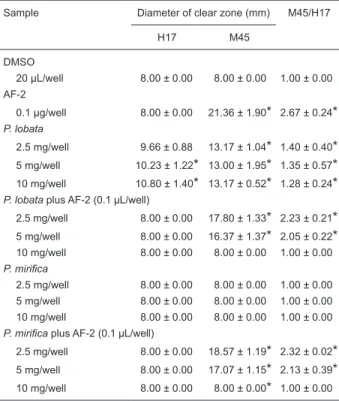
In mutagenic test with H17 (rec+), the P. lobata extracts exhibited a greater 0.28- and 0.23-fold clearance at the
doses of 5 and 10 mg/well, with a significant difference in the corresponding M45/H17 ratios (Table 3). In contrast, the P.
mirifica extracts showed an essentially neutral response. In
the test with M45 (rec-),the P. mirifica extracts exhibited no
detectable mutagenic effects (P < 0.05) while the P. lobata extracts exhibited a greater clearance zone (P < 0.05), some 0.65-, 0.63-, and 0.65-fold than that of the negative control at 2.5, 5, and 10 mg/well, respectively, with a significant difference in the corresponding M45/H17 ratios.
In the antimutagenic assay with H17, the P. mirifica
ex-tracts did not differ significantly from the negative control. In
contrast, the P. lobata extracts induced a significant increase
in the frequency of revertant colonies, some 1.23- and 1.05-fold greater than that seen in the negative control at 2.5 and 5 mg/well, respectively, with a significant difference in the corresponding M45/H17 ratios. P. mirifica extracts
exhibited a significant increase in revertant colonies, 1.32
and 1.13 times greater than that of the negative control,
with a significant difference in the corresponding M45/H17 ratios. However, the increase in revertant colony frequency
in the tested groups was lower than that observed in the positive control (Table 3).
P. mirifica and P. lobata extracts exhibited a lower
MnPCEs/1000 PCE ratio compared to the positive CP control (P < 0.05), which was not significantly greater than
that observed with the negative control (Table 4). Thus, the data showed no detectable genotoxicity of the plant
extracts, a notion supported by the greater PCEs/NCEs ratio observed compared with the positive control (P < 0.05;
Table 4), although not similar to the negative control.
Discussion
The P. mirifica and P. lobata extractsexhibited a dose-dependent cytotoxic effect towards S. typhimurium TA98
Table 4. Micronucleus assay in rat bone marrow at 24, 48, or 72 h after oral administration of Pueraria mirifica or P. lobata extracts
at the dose of 16 g/kg body weight.
Sample Time (h) No. of MnPCEs/1000
PCEs (mean ± SEM) (mean ± SEM)PCEs/NCEs
Pueraria lobata 24 0.33 ± 0.21* 0.63 ± 0.03*
48 0.78 ± 0.27* 0.65 ± 0.03*
72 1.13 ± 0.29* 0.70 ± 0.05*
Pueraria mirifica 24 1.74 ± 0.69* 0.59 ± 0.06*
48 1.14 ± 0.29* 0.74 ± 0.05*
72 0.98 ± 0.36* 0.63 ± 0.04*
1% EtOH (0.7 mL) 24 1.49 ± 0.22* 0.62 ± 0.03*
48 1.97 ± 0.35* 0.65 ± 0.04*
72 2.31 ± 0.33* 0.70 ± 0.03*
Cyclophosphamide (0.08
g/kg body weight, ip) 24 15.61 ± 0.89 0.39 ± 0.03 48 16.12 ± 0.67 0.40 ± 0.05 72 14.43 ± 1.16 0.34 ± 0.04
Data are reported as means ± SEM of 6 independent replicates. PCEs = polychromatic erythrocytes; MnPCEs = micronucleated PCEs; NCEs = non-chromatic erythrocytes. *P < 0.05 compared
to the positive control (unpaired Student t-test).
Table 3. Mutagenic and antimutagenic activity assay of Pueraria lobata and P. mirifica extracts based on non-metabolic activation in a rec assay using Bacillus subtilis var. H17 (rec+) and M45 (rec-) as reporter strains.
Sample Diameter of clear zone (mm) M45/H17
H17 M45
DMSO
20 µL/well 8.00 ± 0.00 8.00 ± 0.00 1.00 ± 0.00
AF-2
0.1 µg/well 8.00 ± 0.00 21.36 ± 1.90* 2.67 ± 0.24*
P. lobata
2.5 mg/well 9.66 ± 0.88 13.17 ± 1.04* 1.40 ± 0.40*
5 mg/well 10.23 ± 1.22* 13.00 ± 1.95* 1.35 ± 0.57*
10 mg/well 10.80 ± 1.40* 13.17 ± 0.52* 1.28 ± 0.24*
P. lobata plus AF-2 (0.1 µL/well)
2.5 mg/well 8.00 ± 0.00 17.80 ± 1.33* 2.23 ± 0.21*
5 mg/well 8.00 ± 0.00 16.37 ± 1.37* 2.05 ± 0.22*
10 mg/well 8.00 ± 0.00 8.00 ± 0.00 1.00 ± 0.00 P. mirifica
2.5 mg/well 8.00 ± 0.00 8.00 ± 0.00 1.00 ± 0.00 5 mg/well 8.00 ± 0.00 8.00 ± 0.00 1.00 ± 0.00 10 mg/well 8.00 ± 0.00 8.00 ± 0.00 1.00 ± 0.00 P. mirifica plus AF-2 (0.1 µL/well)
2.5 mg/well 8.00 ± 0.00 18.57 ± 1.19* 2.32 ± 0.02*
5 mg/well 8.00 ± 0.00 17.07 ± 1.15* 2.13 ± 0.39*
10 mg/well 8.00 ± 0.00 8.00 ± 0.00* 1.00 ± 0.00
Data are reported as means ± SEM of three independent rep
-licates. DMSO = dimethylsulfoxide; AF-2 =
2-(2-furyl)-3-(5-nitro-2-furyl)-acrylamide. *P < 0.05 compared to the negative control
Mutagenic and antimutagenic activity 821
and TA100 isolates. However, the IC50 values observed for
both indicator strains were higher than 1000 µg/mL, dem -onstrating a mild cytotoxic effect. In the mutagenicity assay, some partial killing effect was observed at the higher dose
of 10 mg/plate (3125 µg/mL) for P. mirifica. Thus, the pos-sibility that the decrease in the number of revertant colonies might be partly due to the cytotoxic effects of the P. mirifica samples tested cannot be excluded. Oral administration of P. mirifica tuber powder may elicit adverse hematological effects in long-term chronic toxicity tests in rats receiving
250 mg/kg body weight for 6 months (26). The toxicity of P. lobata tuber powder has not been thoroughly addressed but no cytotoxicity to MCF-7 cells has been reported (20).
In agreement, puerarin, the major isoflavonoid present in
P. mirifica and P. lobata (2), had no detectable cytotoxic ef-fect on MCF-7 at 1.0 pM to 1.0 µM (7). Cytotoxicity tests in MCF-7 with deoxymiroestrol and miroestrol isolated from P.
mirifica revealed that, compared to genistein and daidzein, the two chemicals exhibited a higher estrogenic potency by promotion of cell growth and not a cytotoxic effect on
ERα+ cells (3,27). Thus, the cytotoxic effect of P. mirifica at 10 mg/plate observed here was probably due to other
minor phytoestrogens or to potential synergistic interactions between components.
The results of the Ames tests revealed that the plant extracts had no detectable mutagenic activity towards the two indicator bacterial strains (TA98 and TA100) with or without prior metabolic activation by preincubation with the S9 mixture. Thus, the number of revertant colonies in each test sample was less than two times that seen with the negative control (spontaneous mutation). However, herbal consumption may elicit effects via the metabolite form of the phytochemicals. In tests on hepatocytes containing drug metabolizing enzymes, metabolic activation increased the estrogenic activity of P. mirifica extracts (28). This result
was confirmed by the addition of liver metabolic enzymes
to MCF-7 cells during the tests (29). Although there was a difference between non-metabolic and metabolic activa-tion of the plant extracts with the S9 mixture, suggesting that metabolic activation of phytochemicals in both plant species might increase the mutagenic potential of the plant
extracts, the metabolic dose required was still well outside
the likely greatly exceeded the normaldoses administered. Antimutagenic activity in the Ames test revealed that the P. mirifica extracts exhibited a higher antimutagenic than either the P. lobata extracts or puerarin, the key plant
iso-flavonoids. However, the antimutagenic potentials of these
two plant extracts were still lower than that of another Thai herb, Mucuna collettii submitted to the same test (30). Thus, although not mutagenic, these two herbs are not likely to be preferred to others such as M. collettii for preventive medication against cancer, but are likely to continue to be used for the current purposes.
The absence of detectable mutagenic activity in these two plant extracts observed in the Ames test was supported
by the results of the rec assays, which revealed no muta-genic effects for either extract. The antimutamuta-genicity tests by rec assays also supported the notion that P.mirifica and
P. lobata had a closely similar antimutagenic potential. Even
though this study did not involve cells harboring estrogen
receptors, previous work using the ERα+ cell line, MCF-7,
showed an anti-proliferation effect only at high doses of
both plants extracts (20). Even though P. lobata extracts had a lower estrogenic effect than P. mirifica regarding
vaginal cornification (8) and uterotrophy (31) and a lower
cytotoxicity than P. mirifica in MCF-7 (20), in the present study there was not much difference in the non-mutagenic and anti-mutagenic activities of the two plants.
An additional genotoxicity study was performed using
the micronucleus assay, where an increase in the frequency of MnPCEs in the plant extract-treated animals is an indica -tion of induced chromosome damage. The P. mirifica and
P. lobata extracts caused a delayed and rapid response, respectively, with the maximum micronucleus formation being observed at 72 and 24 h after treatment, respectively (Table 4). However, the amount of micronucleus formation
in both cases was not significantly greater than the nega -tive control in contrast to the posi-tive control, supporting a weak genotoxic effect of the two plant extracts.
Both the P. mirifica and P. lobata plant extracts used in
the present study are known to be relatively rich in isofla -vonoids such as puerarin, daidzin, genistein, and daidzein (1,32). Puerarin had an antiproliferative effect on colon cancer cells (33). Daidzein expressed anti-genotoxic activity while genistein enhanced DNA damage (34). Daidzein and genistein exhibited negative results in the Ames tests for
mutagenicity assay (19,35). In addition, the isoflavonoid
levels within the two plants were related to the antioxidant activity of the plant (36).
Taking all of these data into account, we conclude that the non-mutagenic and anti-mutagenic properties of P. mirifica and P. lobata are derived partly from their major isoflavonoid
constituents. The two plant products are thus likely to be safe for human consumption because the normal human
consumption doses are significantly lower than the highest
dose used in these assays. Recently, the global demand for phytoestrogen products has been steadily increasing, since these products can be used instead of estrogen replace-ment therapy for menopausal women. The raw materials
derived from the two plants have thus rapidly diversified
into a wide variety of cosmetics, dietary supplements and food ingredients. However, a precautionary concern is that the extracts from plants harvested from various sources or at different ages or during different seasons and tested at different doses may all elicit different test results (37). Thus, for example, crude plant extracts prepared from P. mirifica tuber also collected from Chiang Mai Province, Thailand, potentially acted as mutagenic agent at the doses of 600
and 800 mg/kg body weight by inducing higher frequencies
sup-porting data from Ames tests or rec assays were provided
(38). In the present study, only the 300 mg/kg body weight plant extract was tested, which is equivalent to a single consumption of 16 g/kg body weight.
The present results strongly indicate that P. mirifica and P. lobata extracts are mostly non-mutagenic and anti-mutagenic. In addition, data from previous work with human mammary adenocarcinoma cells (MCF-7) (20) and mammary tumor induction in female rats (39) have especially supported the anti-breast cancer potential of P.
mirifica. Most importantly, we have shown that the traditional knowledge regarding the preparation and consumption of the tuber products of these two plants is soundly based on, or at least does not contradict, currently recognized safety
criteria. The present study is the first mutagenic/antimuta -genic investigation conducted on these phytoestrogen-rich
plants whose consumption has recently become popular. The data reported here demonstrate that the phytoestrogens or products derived from these plants may be consumed safely.
Acknowledgments
The authors wish to thank the Graduate School,
Chu-lalongkorn University, the National Center for Genetic En -gineering and Biotechnology, the Ministry of Science and
Technology, the Thai Government Research Fund 2005 within the Center of Excellence in Biodiversity, Faculty of
Science, Chulalongkorn University, and the Thai
Govern-ment Research Fund 2006 (The Bureau of the Budget Office
of the Prime Ministry) for research grants.
1. Cherdshewasart W, Subtang S, Dahlan W. Major isofla -vonoid contents of the phytoestrogen rich-herb Pueraria
mirifica in comparison with Pueraria lobata. J Pharm Biomed
Anal 2007; 43: 428-434.
2. Jones HE, Pope GS. A method for the isolation of miroestrol
from Pueraria mirifica. J Endocrinol 1961; 22: 303-312.
3. Chansakaow S, Ishikawa T, Seki H, Sekine (nee Yoshizawa)
K, Okada M, Chaichantipyuth C. Identification of de-oxymiroestrol as the actual rejuvenating principle of “Kwao Keur”, Pueraria mirifica. The known miroestrol may be an artifact. J Nat Prod 2000; 63: 173-175.
4. Muangman V, Cherdshewasart W. Clinical trial of the phytoestrogen-rich herb, Pueraria mirifica as a crude drug in the treatment of symptoms in menopausal women. Siriraj Hosp Gaz 2001; 53: 300-309.
5. Malaivijitnond S, Chansri K, Kijkuokul P, Urasopon N, Cherd -shewasart W. Using vaginal cytology to assess the estro-genic activity of phytoestrogen-rich herb. J Ethnopharmacol
2006; 107: 354-360.
6. Cherdshewasart W, Kitsamai Y, Malaivijitnond S. Evaluation
of the estrogenic activity of the wild Pueraria mirifica by
vagi-nal cornification assay. J Reprod Dev 2007; 53: 385-393.
7. Cherdshewasart W, Traisup V, Picha P. Determination of the estrogenic activity of wild phytoestrogen-rich Pueraria
mirifica by MCF-7 proliferation assay. J Reprod Dev 2008;
54: 63-67.
8. Malaivijitnond S, Kiatthaipipat P, Cherdshewasart W, Wa-tanabe G, Taya K. Different effects of Pueraria mirifica, a herb containing phytoestrogens, on LH and FSH secretion in gonadectomized female and male rats. J Pharmacol Sci
2004; 96: 428-435.
9. Jaroenporn S, Malaivijitnond S, Wattanasirmkit K, Watanabe G, Taya K, Cherdshewasart W. Assessment of fertility and reproductive toxicity in adult female mice after long-term exposure to Pueraria mirifica herb. J Reprod Dev 2007; 53:
995-1005.
10. Trisomboon H, Malaivijitnond S, Cherdshewasart W, Wata-nabe G, Taya K. Assessment of urinary gonadotropin and
steroid hormone profiles of female cynomolgus monkeys
References
after treatment with Pueraria mirifica. J Reprod Dev 2007;
53: 395-403.
11. Trisomboon H, Malaivijitnond S, Cherdshewasart W,
Wa-tanabe G, Taya K. The influence of Pueraria mirifica herb containing phytoestrogens on the urinary gonadotropin and estradiol levels in aged monkeys. Anim Sci J 2007; 78: 378-386.
12. Trisomboon H, Malaivijitnond S, Watanabe G, Cherdshe-wasart W, Taya K. The estrogenic effect of Pueraria mirifica on gonadotrophin levels in aged monkeys. Endocrine 2006; 29: 129-134.
13. Trisomboon H, Malaivijitnond S, Cherdshewasart W,
Wa-tanabe G, Taya K. Effect of Pueraria mirifica on the sexual skin coloration of aged menopausal cynomolgus monkeys.
J Reprod Dev 2006; 52: 537-542.
14. Jaroenporn S, Malaivijitnond S, Wattanasirmkit K,
Trisom-boon H, Watanabe G, Taya K, et al. Effects of Pueraria
mirifica, an herb containing phytoestrogens, on reproductive organs and fertility of adult male mice. Endocrine 2006; 30: 93-101.
15. Urasopon N, Hamada Y, Asaoka K, Cherdshewasart W,
Malaivijitnond S. Pueraria mirifica, a phytoestrogen-rich herb, prevents bone loss in orchidectomized rats. Maturitas
2007; 56: 322-331.
16. Urasopon N, Hamada Y, Cherdshewasart W, Malaivijitnond
S. Preventive effects of Pueraria mirifica on bone loss in ovariectomized rats. Maturitas 2008; 59: 137-148.
17. Deciga-Campos M, Rivero-Cruz I, Arriaga-Alba M,
Castane-da-Corral G, Angeles-Lopez GE, Navarrete A, et al. Acute
toxicity and mutagenic activity of Mexican plants used in tra-ditional medicine. J Ethnopharmacol 2007; 110: 334-342.
18. Yee S, Burdock GA, Kurata Y, Enomoto Y, Narumi K, Hama -da S, et al. Acute and subchronic toxicity and genotoxicity
of SE5-OH, an equol-rich product produced by Lactococcus garvieae. Food Chem Toxicol 2008; 46: 2713-2720.
19. Michael McClain R, Wolz E, Davidovich A, Bausch J. Ge -netic toxicity studies with genistein. Food Chem Toxicol
2006; 44: 42-55.
differen-Mutagenic and antimutagenic activity 823
tial anti-proliferation effect of white (Pueraria mirifica), red (Butea superba), and black (Mucuna collettii) Kwao Krua plants on the growth of MCF-7 cells. J Ethnopharmacol
2004; 93: 255-260.
21. Matsushima T, Sawamura M, Hara K, Sugimura T. A safe substitute for polychlorinated biphenyls as an inducer of met-abolic activation in mutagenesis testing. In: de Serres FJ,
Fouts JR, Beend JR, Philpot R (Editors), In vitro metabolic activation in mutagenesis testing. North-Holland: Elsevier; 1976. p 85-88.
22. Ames BN, Durston WE, Yamasaki E, Lee FD. Carcinogens
are mutagens: a simple test system combining liver homo-genates for activation and bacteria for detection. Proc Natl
Acad Sci U S A 1973; 70: 2281-2285.
23. Maron DM, Ames BN. Revised methods for the Salmonella
mutagenicity test. Mutat Res 1983; 113: 173-215.
24. Kado T. Screening of enviromental chemical mutagen by the rec-assay system with Bacillus subtilis. In: de Serres FJ,
Hollaender A (Editors), Chemical mutagens. Volume 6. New
York: Plenum; 1980. p 149-173.
25. Heddle JA, Hite M, Kirkhart B, Mavournin K, MacGregor JT,
Newell GW, et al. The induction of micronuclei as a measure
of genotoxicity. A report of the U.S. Environmental Protection
Agency Gene-Tox Program. Mutat Res 1983; 123: 61-118. 26. Chiwapat S, Chavalittumrong P, Rattanajarasroj S,
Panya-mung S. Chronic toxicity of Pueraria mirifica in rats. Thai J
Pharm 2005; 27: 7690.
27. Matsumura A, Ghosh A, Pope GS, Darbre PD. Comparative study of oestrogenic properties of eight phytoestrogens in MCF7 human breast cancer cells. J Steroid Biochem Mol
Biol 2005; 94: 431-443.
28. Lee YS, Park JS, Cho SD, Son JK, Cherdshewasart W, Kang KS. Requirement of metabolic activation for estrogenic activ -ity of Pueraria mirifica. J Vet Sci 2002; 3: 273-277. 29. Cherdshewasart W, Sriwatcharakul S. Metabolic activation
promotes estrogenic activity of the phytoestrogen-rich plant.
Maturitas 2008; 59: 128-136.
30. Cherdshewasart W, Sutjit W, Pulcharoen K, Panriansaen R, Chulasiri M. Antimutagenic potential of the Thai herb, Mu
-cuna collettii Lace. J Ethnopharmacol 2008; 115: 96-103.
31. Kim HY, Hong JH, Kim DS, Kang KJ, Han SB, Lee EJ, et al. Isoflavone content and estrogenic activity in arrowroot
Pueraria radix. Food Technol Biotech 2003; 12: 29-35.
32. Cherdshewasart W, Sriwatcharakul S. Major isoflavonoid
contents of the 1-year-cultivated phytoestrogen-rich herb,
Pueraria mirifica. Biosci Biotechnol Biochem 2007; 71:
2527-2533.
33. Yu Z, Li W. Induction of apoptosis by puerarin in colon cancer
HT-29 cells. Cancer Lett 2006; 238: 53-60.
34. Plewa MJ, Berhow MA, Vaughn SF, Woods EJ, Rundell M,
Naschansky K, et al. Isolating antigenotoxic components and cancer cell growth suppressors from agricultural by-products. Mutat Res 2001; 480-481: 109-120.
35. Bartholomew RM, Ryan DS. Lack of mutagenicity of some phytoestrogens in the salmonella/mammalian microsome
assay. Mutat Res 1980; 78: 317-321.
36. Cherdshewasart W, Sutjit W. Correlation of antioxidant
activ-ity and major isoflavonoid contents of the phytoestrogen-rich
Pueraria mirifica and Pueraria lobata tubers. Phytomedicine
2008; 15: 38-43.
37. Cherdshewasart W, Sriwatcharakul S, Malaivijitnond S. Vari-ance of estrogenic activity of the phytoestrogen-rich plant.
Maturitas 2008; 61: 350-357.
38. Saenphet K, Kantaoop P, Saenphet S, Aritajat S. Mutagenic-ity of Pueraria mirifica Airy Shaw & Suvatabandhu and anti-mutagenicity of Thunbergia laurifolia Linn. Southeast Asian
J Trop Med Public Health 2005; 36 (Suppl 4): 238-241.
39. Cherdshewasart W, Panriansaen R, Picha P. Pretreatment with phytoestrogen-rich plant decreases breast tumor