THE “GREEN CITIES” PROGRAM: STRATEGIES FOR
ENHANCING SPACE IN THE MUNICIPALITIES OF PARÁ
1
JODIVAL MAURICIO DA COSTA2
MARIE-FRANÇOISE FLEURY3
The Discourse of Sustainable Development and the Commodification of
Nature
The current process of the capitalization of nature and sustainable development strategies is reconfiguring and giving new meaning to the appropriation of natural re-sources by capital in eastern Amazonia. The list of natural rere-sources includes the actual Amazonian soil, as a common good that is crucial for the development of a people.
With the shift in eco-development (SACHS, 2008) towards the discourse of sustainable development, neoliberalism has managed to camouflage the contradiction between the environment and economic growth. As Leff (2006, p. 138) writes, “from the neoliberal perspective, the economic causes of environmental problems disappear”. According to the political and economic logic developed at international level, in which an “ecological normative system” has arisen, the economic and ecological stakeholders of globalisation have transformed themselves into those responsible for strategies to solve the environmental crisis.
This process has led to a disconnect between things that are not part of ac-cumulation strategies and their place of reference and purpose, with both deprived of their meaning and use and/or possible meaning for others. The discourse of sustainable development focuses on spatial structures, how they are organised, and the formula to simulate consensus, thereby heralding the death of dialectics and conflict (LEFF, 2006). The sustainability reports of companies, the discourse of institutes managing these com-panies’ interests, new policies drawn up by States and the discourse of NGOs simulate a reality without contradictions. Due to its standardization and trivialization, sustainable
1. PhD thesis results, defended within the Graduate Programme in Environmental Science at the University of São Paulo (PROCAM-USP). Research carried out with CAPES support, including a scholarship for a PhD Internship abroad.
development has entered social structures as if it were an unquestionable truth. The “ecologically correct” action of these stakeholders has been expanding thanks to this “ecological normative system”: given this sustainability discourse it is practically impos-sible to question the positions of those stakeholders and this form of “ecology” without being considered an enemy of the environmental issue itself (FRANÇOIS, 2012). Sud-denly, environmental degradation, exploitation of the workforce and poverty have lost their relationship as a product of the contradiction between economic development and the environment, between capital and labour, and all attention has turned to an envi-ronmental cause held hostage by the political and economic stakeholders that control production and the market.
Currently, much of the success of companies and NGOs is due to the transforma-tion of politics, meaning here social actransforma-tion enabling men and women to deal with their interests in the public sphere, (ARENDT, 2009) towards the action of volunteering. As Heller and Féher (2008) write, the areas to demonstrate social struggles have been transformed into areas for voluntary work. One of the forms of this “politics of goodwill” has manifested itself in the environmental issue through the negation of conflicts and the rise of a game of simulated consensus, the main objective of which is to sustain the urban-industrial model as a new ideological foundation. The discourse of sustainable development denies limits on growth for the benefit of an economy sustained by market indicators. It is increasingly difficult to argue for a solution outside of economic strategies and the commodification of nature. Although these contradictions between economic development and the environment were readily apparent up to the 1990s, nowadays any clarity of meaning has disappeared, because the process has swallowed up its contradic-tions in such a manner that the main result of this game of simulacontradic-tions is the current cooperation between governments, companies, NGOs and universities all working towards a common goal of supporting the market economy.
In this respect, the relationship between the real and the symbolic and the rise of sustainable development as a simulacrum needs to be discussed. Economics and politics do not deny nature, nor the environment, because they have produced a power space where the political and the economic have created an idea of nature and the environ-ment to feed themselves, as enshrined in the “ecological normative system”. The current space to disseminate sustainable development produces what Baudrillard calls hypertelia: an excess of functional imperatives, put in practice by a form of saturation. Baudrillard’s discourse on the rise of simulacra in consumer society finds meaning in the current pro-gramme for action for sustainable development, in which the detachment of the real as a possible measure for the concrete gives way to what we understand as the hypertelic, also with its own meaning (BAUDRILLARD, 1993).
the current model and, even if they did, the system itself would be capable of addressing this. The economy has metamorphosed itself and metamorphosed relationships which make up the current power game between stakeholders. It has enslaved the meaning of development and what is sustainable, thereby monopolising the environmental crisis. The economic rationality which created the current context of degradation “resists its deconstruction and has armed a simulacron within the discourse of sustained develop-ment” (LEFF 2006, pp. 143-44). Sustainable development has established itself through regulatory and standardisation mechanisms which work in favour of rules and standards which produce values from these processes of re-appropriation and redefinition, which adapt the action of public and private stakeholders to this normative system. The “Green Cities” Program offers a vantage point from which we can consider this issue, since it involves an economically devalued space being enhanced after incorporating manage-ment instrumanage-ments that are considered “environmanage-mentally correct”.
THE Green Cities Program
Of note among the municipal actions have been: 1. The signing of the draft bill setting up the Municipal Environmental Code - “a set of laws innovating the municipality’s environmental legislation through climate change and waste policies”; 2. Establishment of the Environmental Observatory, “which brings various partner institutions together to monitor environmental quality” carried out by the following institutions: Institute of Human Beings and the Environment of the Amazon (Instituto do Homem e do Meio Ambiente da Amazônia - Imazon) and The Natural Conservancy (TNC); 3. The Letter of Intent regarding Land Regularisation signed by ITERPA, the Legal Land Programme of the Ministry for Agrarian Development (Ministério do Desenvolvimento Agrário - MDA) and local city councils; 4. Agreement for the Implementation of the “Green Livestock Farming” Project, initially between the Vale Fund and the Paragominas Rural Producers Trade Union, one of the main projects in the Programme. 5. The letter of intent for the creation of municipal microzoning granted to TNC (PARA, 2012).
The PMV received support from the Federal Government’s More Environment Programme (Programa Mais Ambiente - PMA) in addition to the direct participation of IBAMA and the Federal Public Prosecutor’s Office. The main advantages of More En-vironment “range from simplifying the enEn-vironmental regularisation process, with the exemption and suspension of the collection of fines on the environmental liabilities of rural property to the public authority’s support for the effective recovery of degraded APP (Permanent Preservation Areas) and RL (Legal Reserve) areas” (BRAZIL , 2012a), in addition to the following: a) Simplification of the environmental regularisation of rural property, making access to rural credit possible; b) Suspension of the collection of fines imposed by IBAMA, as provided for in Articles 43, 48, 51 and 55 of Decree No. 6.514 / 2008 (BRAZIL, 2008) and their conversion into environmental quality recovery services; c) Exemption from fines in the above mentioned Articles for offences committed up to 10 December 2009; d) Periods for the recovery of environmental liabilities in the APP and RL property areas; e) Public Authority Support for Technical Assistance and Outreach, Training and Environmental Education Programmes; f) Support for special beneficiaries in georeferencing of property boundaries and those of the APP, RL and Remaining Areas of Natural Vegetation (BRAZIL, 2012a).
Organization Chart 1 - Governance Structure of the Green Cities Program
Source: Pará, 2012.
For project managers, the main advantages of the involvement of municipalities would be legal certainty, “compliance with environmental laws reduces the possibility of sanctions such as fines or economic embargoes”; attracting investors, “being a Green City is a market differentiator and is a draw to attract and retain good investors”; credit incentives, “the new vision of the municipalities in relation to environmental and social issues could create the necessary conditions for access to credit, development and rural technical assistance”; clearance and regularisation, “coordination with the Environmental Ministry of Environment and IBAMA for the release and regularisation of rural properties.” (IMAZON, 2011, p. 4). In this way, the Programme helps traditional economic activi-ties – livestock farming and agriculture – and encourages silviculture through forestry management, the discourse of which is the reduction of deforestation and environmental degradation. The PMV promotes land regularisation and the conclusion of the Rural Environmental Register (Cadastro Ambiental Rural - CAR) of the member municipalities (IMAZON, 2011), required for property to be identified by the State, although registration is considered voluntary.
Green Municipalities and the Rural Environmental Register
United Nations Development Programme (UNDP) in order to provide the necessary technical means for its implementation and thus increase the registered area. The first two municipalities covered by the new agreement were Ulianópolis and Dom Eliseu, which were registered in the record time of ten months - from February to December 2012. Paragominas had already been provided with its registration before signing the agreement. The PMV is a territorial policy which greatly impacts on the legalisation of land, as it relaxes laws combating land grabbing, facilitating land use regularisation on the grounds of solving environmental problems. It is also a command, control and regulatory land policy, which is carried out through an agreement established between stakeholders at the three levels of power: federal, state and municipal.
To apply to be a green city, it is necessary to sign the Term of Commitment of the Federal Public Ministry against deforestation; sign the Membership Form for the Programme and use the materials kit which helps the municipal management meet its targets. The municipalities which joined the programme in 2011 had their environmental licensing deadlines extended, provided they fulfilled the stipulated goals: “to sign the agreement to control deforestation, set up a monitoring, inspection and deforestation control structure; not be on the list of the major deforesters of the MMA, and promote environmental education in schools” (IMAZON, 2011, p. 5). According to Imazon, by 18 May 2011, of the 143 municipalities in the State of Pará, 83 had signed the MPF Term of Commitment, and this rose to 94 in 2012.
Using Paragominas, the leading member of the Programme, as an example, agre-ement has been reached between government (local city council and state and federal public bodies), companies, universities and NGOs (we shall return to this issue in the Paragominas Municipality section). The main actors are companies (meaning here agri-cultural, livestock farming, mineral, forestry companies, etc.), since it is such companies which have to act directly at the place of production targeted by the action, in such a way that remedial action is undertaken and the site becomes legally suitable for such purposes. The public bodies are responsible for the regulatory and normative aspects (such as CAR) and provide the necessary technical and scientific instruments to move the process forward, which remains in the hands of partnerships with large universities, such as that of the University of São Paulo Esalq/USP and, also, the control activities, which are currently carried out by state bodies and the NGOs Imazon and TNC.
deforestation, but it is also a planning instrument for the sectoral economy – agriculture and forestry – whose accurate management from the point of view of this environmental policy has become a strategic part of the discourse of combating deforestation and pro-moting sustainable development, and this is also reflected in other states.
In June 2012, the Programme received the support of the Bank of the Amazon, the Rio de Janeiro Green Stock Market and the Sustainable Cities Programme, the term of commitments signed during the World UN Conference in Rio de Janeiro in 2012 – the RIO +20. The agreement signed with the Stock Market specialised in negotiating capital derived from “sustainable development” projects may facilitate the negotiation of rural products from the “Green cities” in the capital market, especially that of soya which is an appreciating commodity on the market . Partnerships with financial institutions allow greater flexibility in approving loans for properties that meet the legal requirements, especially those of an environmental nature.
In the Green Cities, in particular through the CAR, the relationship between en-vironmental and land policy has been established, with the emphasis on linking the three levels of power, namely Federal, State and Municipal, for the implementation of policies to command and control deforestation. One of the factors that led to the creation of the PMV was Resolution 3.545/2008 of the National Monetary Council, which has made funding for rural properties subject to the environmental regularisation of the property. As such, municipalities on the MMA list were embargoed by the Federal Government. To receive funding, farmers were required to submit documents attesting to the environ-mental condition of the property.
As mentioned earlier, one of the benefits of the PMV to farmers was its flexibility in regularising property after joining the Programme. Initially, many owners did not take part in the CAR because the costs of completing the register were very high, a problem which was facilitated by the formation of the partnership with the Norwegian government and by the action of the NGOs. Thus, with the creation of the PMV, investments were earmarked for undertaking the CAR, and the local city councils of some municipalities, such as Dom Eliseu, Ulianópolis and Paragominas pressured landowners into registering. By making CAR one of the main requirements for property regularisation, including dis-pensing with the need to submit a valid chain of records as proof of the legal acquisition of the land, the public authority has thus assumed the position that the origin of the property is not important and, as a result, has become the guarantor of illegally appropriated lands. Paragominas, a pilot-municipality of the Programme, has reached an advanced state of compliance with the targets set and may offer useful information to consider future sce-narios regarding the extension of the PMV and the Rural Environmental Register itself.
Paragominas and the Green Cities Programme
45% of its original forest cover. More than eight thousand square kilometres of forest were lost, according to a survey by the INPE (PARAGOMINAS, 2009, p. 1). It was this situation that led to changes in its municipal management in the last four years and, to date, these have made it one of the largest so-called “green management” examples of note in the country.
According to the local city council, Paragominas began to change from 2008, when the municipality made a commitment to transform its pattern of deforestation which had led to its prominence in Brazil. The “Zero Deforestation Agreement” and the “Legal and Sustainable Product Agreement”, was agreed between the local city council and farming and forestry entrepreneurs within those sectors in the second half of that year. In 2009, the change project for the municipality was strengthened by the arrival of the Vale Fund, which brought to Paragominas the NGOs Imazon and TNC, partners of the company. The NGOs began to carry out the mapping work of vegetation cover and, at the end of that year, presented a socio-economic and environmental diagnosis, focused on the forestry issue. The document helped the work of the local city council in combating deforestation, through providing data supporting the drawing up of the micro-zoning of rural properties for land regularisation purposes and economic planning for the activities of livestock farming and agribusiness. The management of the Vale Florestar project, based in Dom Eliseu, has highlighted the activity of the local city council in the process of regularising land, which is key to the success of the forestry operations of the company.
In addition, the local city council, ITERPA and the Legal Land Programme of the Ministry of Agrarian Development (MDA) signed a cooperation agreement to resolve the issue of illegal properties. The main points of the “Green Paragominas Programme” are: 1) Creation of an environmental code, a document that provides modern environmental legislation for the city - already instituted; 2) The setting up of the Environmental Obser-vatory, to monitor the environmental quality of the city, also implemented; 3) Agreement between the Vale Fund, the NGOs Imazon and TNC and the Union of Rural Farmers for the implementation of the “Green Livestock Farming” Project, which mainly encourages investment in production technology, with the project now underway.
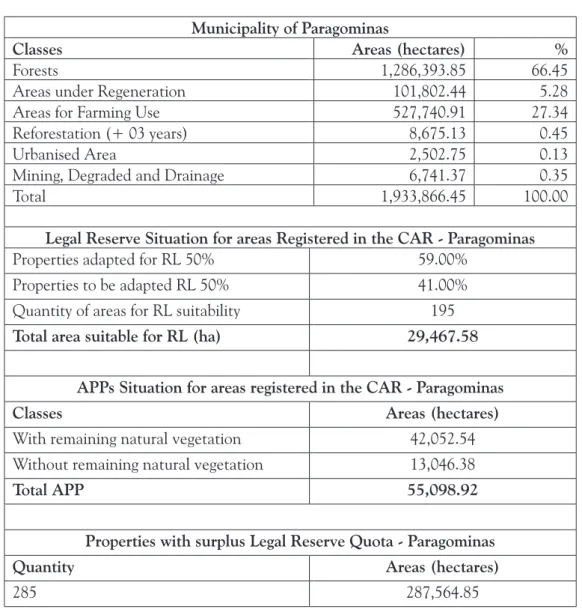
Table 1 - Municipality of Paragominas - Environmental Framework
Municipality of Paragominas
Classes Areas (hectares) %
Forests 1,286,393.85 66.45
Areas under Regeneration 101,802.44 5.28
Areas for Farming Use 527,740.91 27.34
Reforestation (+ 03 years) 8,675.13 0.45
Urbanised Area 2,502.75 0.13
Mining, Degraded and Drainage 6,741.37 0.35
Total 1,933,866.45 100.00
Legal Reserve Situation for areas Registered in the CAR - Paragominas
Properties adapted for RL 50% 59.00%
Properties to be adapted RL 50% 41.00%
Quantity of areas for RL suitability 195
Total area suitable for RL (ha) 29,467.58
APPs Situation for areas registered in the CAR - Paragominas
Classes Areas (hectares)
With remaining natural vegetation 42,052.54
Without remaining natural vegetation 13,046.38
Total APP 55,098.92
Properties with surplus Legal Reserve Quota - Paragominas
Quantity Areas (hectares)
285 287,564.85
Source: Paragominas, 2009.
In hilly areas below 100 metres altitude, 344,931.30 thousand hectares presented excellent conditions for livestock and forestry, with 6,116.56 thousand hectares better suited for forestry and the area suitable only for farming being 1,363.34 thousand hectares. In this gradient classification, there were 351,047.6 hectares better suited for livestock and forestry. Based on this study, the Paragominas municipality established its economic potential framework (Table 2):
The economy is based on the agricultural and forestry sectors. Agriculture in-volves soybean production in particular, and the area is currently the largest producer in the State of Pará, along with maize, which has also increased over the last decade. In the forestry sector, the city has three important projects: the Vale Florestar, the main partner through the Vale Fund, which already consists of more than 10 thousand hectares of planted eucalyptus; the Concrem Group with production of Paricá and Paragoflor, also with production of Paricá. Livestock farming has benefited from the “Green Livestock Farming Project”. The latter is the result of a partnership between the Paragominas Rural Producers Trade Union, the Vale Fund and the Dow AgroSciences company. According to the Trade Union, the goal is to improve and intensify livestock farming and promote increased productivity and profitability.
Table 2. Economic Potential of the Paragominas Municipality
Potential agricultural use for the Paragominas Municipality
Area for Farming Use in Paragominas Area (hectares)
Current area of use 536,416.04
Area lying fallow 101,812.44
Total Area for Farming Use 638,228.48
Development Potential for Major Agricultural Activities
Fitness Area (hectares)
Agricultural Crops and Forestry 265,852.58
Livestock farming and Forestry 344,931.30
Total 610,783.88
Source: Paragominas, 2009.
technologies and techniques to intensify production in areas that have already been and/ or are being converted to pasture.
We believe that the key question in the Green Cities Project is the enhancement of an area punished through environmental degradation, which led to economic devaluation of its main activities (livestock farming and single-crop agriculture). The environmental degradation which led to the devaluation has has been replaced with the same economic activities from the past (along with forestry) on the market as “sustainable development” practices, which benefit from the added value of the means of production being linked to so-called “environmentally correct” methods.
Final Considerations
Given the current situation in the south-eastern part of the State of Pará, which is typified by a major loss of vegetation cover, it is extremely important to consider and implement projects that help control deforestation. The Green Cities Program, consi-dered here as an action programme, has emerged as a proposal to recover those areas of degradation. In this sense, the work of the NGOs has been crucial because it helps in monitoring the properties and, at the same time, gives credibility to the economic activity. Similarly, the partnership agreed with Vale (the Vale Fund) and universities means more investment in research, science and technology in the interests of improving production and harnessing the areas economic value. Similarly, the transformation of the “Green Cities Project” into a State programme, with the added involvement of various institutions, has tended to intensify activities which were already being developed in Paragominas, and which have thus expanded to other municipalities. The trend is that this model will be expanded in the Amazon, with the same logic of land use and occupation of previous models, but with new discourses.
The environmental recovery area classification provides credibility to the public--private partnership, and is bolstered by the involvement of universities and NGOs. Moreover it promotes agreements between these stakeholders to enhance this area and the dominant activities within it. Through the discourse of sustainable development and by means of the Rural Environmental Register, land is easily being regularised, setting a precedent for legalisation without proper proof of the origin of the property.
References
ARENDT, Hannah. A Promessa da Política (The Promise of Politics). Translation by Pedro Jorgensen Jr. 2ª Ed. Rio de Janeiro: DIFEL, 2009.
BAUDRILLARD, Jean. Cultura y Simulacro. Barcelona: Kairós, 1993.
BRASIL. MPF. Termo de Compromisso para o Programa Município Verde. March 2011. _______, Decreto nº 6.514, de 22 de Julho de 2008. Available at: http:// www.planalto.gov.br/ccivil_03/_ato2007-2010/2008/decreto/D6514.htm. Accessed: December 2012.
_______, Mais Ambiente. Available at: www.maisambiente.gov.br/index.php/quais-os-beneficios . Accessed on 15 December 2012b.
FRANÇOIS, Stéphane. L’écologie Politique: une vision du monde réactionnaire? Paris : CERF, 2012
LEFF, Enrique. Racionalidade ambiental: a reapropriação social da natureza. Rio de Janeiro: Civilização Brasileira, 2006.
IMAZON. Diagnóstico Socioeconômico e Florestal do Município de Paragominas. 2009.
________, Boletim de Monitoramento do Município de Paragominas. October 2011. HELLER, Agnes & FEHÉR, Ferenc. A Condição Política Pós-Moderna. Rio de Janeiro: Civilização Brasileira, 2002.
PARÁ. Um Pacto pelo Meio Ambiente: Programa Municípios Verdes. 2012
PARAGOMINAS. Informações históricas. Available at www.paragominas.pa.gov.br. Accessed: December 2012.
INSTITUTO DE PESQUISA AMBIENTAL DA AMAZÔNIA. Paragominas lança mão da ciência para avançar no processo de ordenamento territorial. Available at: http://www. paragominas.pa.gov.br/. Accessed: May 2011.
SACHS, Ignacy. Desenvolvimento includente², sustentável, sustentado. Rio de Janeiro: Garamond, 2008.
SEMA. Cartilha Municípios Verdes, 2011.
VALE, Sobre os Municípios Verdes. Available at www.fundovale.org/categorias/projetos/ municipios-verdes/sobre-municipios-verdes.aspx. Accessed: 22 April 2012.
VALE. Projeto para atividades de projeto de reflorestamento e reflorestamento (MDL-FRCP). http://www.vale.com/ptbr/sustentabilidade/Documents/DCP_Vale%20 Florestar_05042011_v1.pdf. Accessed: May 2011.
Submitted on: 15/08/2014. Accepted on: 23/01/2015.
Abstract: In recent decades, the environmental issue has led to greater flexibility of spa-tial scales, using an environmental discourse to intervene on the ground. The State has been organising this space, using the environmental issue as justification, with specific laws containing spatial planning objectives, as well as allowing municipalities to carry out direct action in their territories to deal with the most urgent issues relating to land management. At the same time, as has happened with policy changes since the 1990s, public power has established territorial strategic alliances with the private sector in a way which has mainly favoured the latter. This article aims to show how this issue is dealt with in the Green Municipalities Program, which began in Southeast Pará in 2008. The results show a process of re-harnessing the economic value of the space using the discourse of “sustainable development”.
Key Words: Green Cities, Sustainable Development, Economic Enhancement of the Space.
Resumo:Nas últimas décadas, a questão ambiental tem possibilitado maior flexibilidade das escalas espaciais, valendo-se de um forte discurso para agir nos territórios. O Estado vem atuando na organização do espaço, utilizando como justificativa esta questão ambiental, com legislações especificas carregadas de finalidades de ordenação espacial, enquanto também permitem aos municípios ação direta sobre seu espaço na articulação dos interesses mais urgentes na gestão do território. Ao mesmo tempo, como vem ocorrendo nas transfor-mações políticas a partir dos anos de 1990, o poder público firma com o privado alianças estratégicas que têm favorecido, principalmente, o segundo. Este artigo tem como objetivo mostrar como essa questão se apresenta no Programa “Municípios Verdes” (PMV), que teve início no Sudeste paraense em 2008. Os resultados mostram um processo de revalorização econômica do espaço a partir do discurso do “desenvolvimento sustentável”.
Palavras-Chave: Municípios Verdes, Desenvolvimento Sustentável, Revalorização Eco-nômica do Espaço.
THE “GREEN CITIES” PROGRAM: STRATEGIES FOR
ENHANCING SPACE IN THE MUNICIPALITIES OF PARÁ
de las escalas espaciales, sustentándose en el discurso ambiental para actuar en los terri-torios. El estado ha trabajando en la organización de la justificación del espacio utilizando el problema ambiental, desplegando con leyes específicas de ordenamiento del territorio, las que a la vez permiten a los municipios dirigir el accionar en su espacio para así articular los intereses más urgentes en la gestión. Al mismo tiempo, como ha venido ocurriendo con los cambios políticos desde la década de 1970, el gobierno ha sellado alianzas estratégicas con los privados, que han favorecido especialmente a estos últimos. Este artículo tiene por objetivo demostrar cómo esta cuestión se presenta en el Programa “Ciudades Verdes”, que comenzó en el sudeste del Estado de Pará en 2008. Los resultados muestran un proceso de modernización económica del espacio desde el discurso del desarrollo sostenible.