Population structure, fluctuating asymmetry and genetic variability in an
endemic and highly isolated
Astyanax
fish population (Characidae)
Maria Claudia Gross
1, Carlos Henrique Schneider
1, Mara Cristina de Almeida Matiello
1,
Maysa de Lima Leite
2, Luiz Antonio Carlos Bertollo
3and Roberto Ferreira Artoni
11
Universidade Estadual de Ponta Grossa, Campus de Uvaranas, Departamento de Biologia Estrutural,
Molecular e Genética, Ponta Grossa, PR, Brazil.
2
Universidade Estadual de Ponta Grossa, Campus de Uvaranas, Departamento de Biologia Geral,
Ponta Grossa, PR, Brazil.
3Universidade Federal de São Carlos, Departamento de Genética e Evolução, São Carlos, SP, Brazil.
Abstract
Morphological and chromosomal markers were used to infer the structure and genetic variability of a population of fish of the genusAstyanax, geographically isolated at sinkhole 2 of Vila Velha State Park, Paraná, Brazil. Two morphotypes types were observed, the standard phenotype I and phenotype II which showed an anatomical alteration probably due to an inbreeding process. Fluctuating asymmetry (FA) analysis of different characters showed low levels of morphological variation among the population from sinkhole 2 and in another population from the Tibagi river (Paraná, Brazil). TheAstyanax karyotype was characterized in terms of chromosomal morphology, constitutive heterochromatin and nucleolar organizer regions. Males and females presented similar karyotypes (2n = 48, 6M+18SM+14ST+10A) with no evidence of a sex chromosome system. One female from sinkhole 2 was a natural triploid with 2n = 3x = 72 chromosomes (9M+27SM+21ST+15A). The data are discussed regarding the maintenance of population structure and their evolutionary importance, our data suggesting thatAstyanax from the Vila Velha State Park sinkhole 2 is a recently isolated population.
Key words:Fish,Astyanaxsp., fluctuating asymmetry, karyotype structure, triploidy, genetic conservation.
Received: May 7, 2003; Accepted: May 5, 2004.
Introduction
In South America, theAstyanaxspecies is a very di-versified and widely distributed group exhibiting taxo-nomic and systematic complexity (Gery, 1977; Garutti and Britski, 2000). These small Characidae live in varied fresh-water environments, including under conditions of high stress such as those occurring in headwaters (LoweMc Connel, 1969), and can also form species complexes show-ing morphological and genetic variability (Caramaschi, 1986; Langeani, 1989; Moreira-Filho and Bertollo, 1991). At Vila Velha State Park (Paraná state, Brazil), there is a rare form of sandstone landscape made up of deep cave or crater-like wells known as `sinkholes’ which have been formed by the action of the water in the water table (Soares, 1989) and which present a water column approximately 50m deep (Figure 1) where isolated populations of
Astyanaxcan be found (Artoni and Almeida, 2001). The genera Astyanaxalso occurs in rivers in the Paraná region and since there is some chromosomal variability between the different riverine populations it is possible that the iso-lated sinkhole habitats could hold new species of the Astyanaxcomplex (Artoni and Almeida, 2001; Matosoet al., 2002).
Isolated populations tend to reduce their genetic vari-ability and, consequently, their vari-ability to adapt to environ-mental variation, thus restricting their evolutionary options (Meffe and Caroll, 1994). Inbreeding predisposes small populations the population to a deleterious recessive allele effect which can manifest itself not only by precocious mortality but also by a reduction in fertility or growth rate which can lead to the extinction of the populations (Galbuseraet al., 2000). An accurate measurement of ge-netic heterozygosity and the environmental stress on organ-isms can be assessed using the fluctuating asymmetry index (FA; Palmer, 1996), which Van Valen (1962) defined as the mean difference between two bilateral characteristics in a population.
www.sbg.org.br
Send correspondence to Roberto Ferreira Artoni. Universidade Estadual de Ponta Grossa, Campus de Uvaranas, Departamento de Biologia Estrutural, Molecular e Genética, 84030-900 Ponta Grossa, PR, Brasil. E-mail: [email protected].
Our study used external anatomy and karyotype char-acteristics to estimate the genetic variation and evolution-ary behavior of the endemicAstyanaxpopulation of Vila Velha State Park sinkhole 2.
Material and Methods
Characterization of the study area and sampling
Vila Velha State Park is situated in the southern Brazil-ian state of Paraná at 25°14’09” S, 50°00’17” W and covers an area of 3,122 ha destined for environmental preservation and eco-tourism. The Vila Velha sinkholes (Figure 1) num-ber 1, 2 and 3 occur at an altitude of 850 m and are deep wells excavated from the sandstone bedrock by the action the wa-ter in the wawa-ter table, sinkholes 1 and 2 being connected to the water table at a depth of more than 50 m by only tiny fis-sures in the rocks without any defined or continuous large-scale connections, sinkhole 3 being presently dry (Soares, 1989). All the sinkholes drains into a 200 m diameter lake called the Dourada Lagoon (Golden Lagoon), surrounded by a well-preserved riparian forest, and there is constant drain-age of water into the Tibagi river (Maack, 1956).
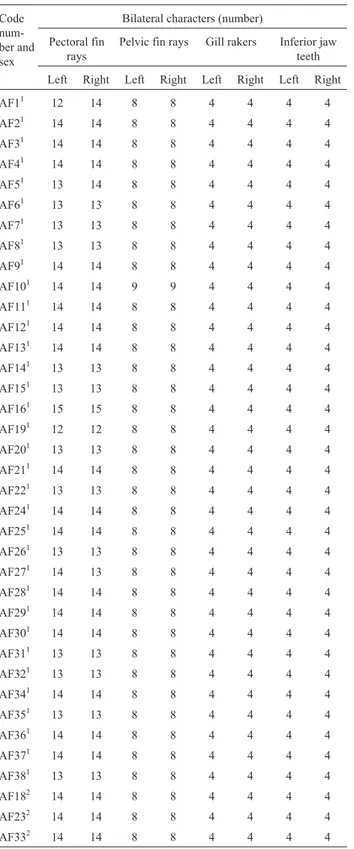
For our study, the first of its kind in these sinkholes, 39Astyanaxspecimens were caught at random in sinkhole 2 (Table 1) and 37 furtherAstyanaxspecimens in the Tibagi river inside the Vila Velha Park, the riverine fish being only used in the morphological analysis (Table 2). All speci-mens were identified and catalogued by Dr Oscar A. Shibatta (Zoology Museum of Londrina State University, Londrina, Paraná, Brazil).
Morphological characters
Based on morphological characters diagnostic for the genusAstyanax(e.g.continuity of the lateral line and the
Figure 1- General view of the sinkhole landscape of Vila Velha State Park (Paraná state, Brazil). Detail shows the twoAstyanaxphenotypes: a = phenotype I; b = phenotype II. Bar = 3cm.
Table 1- Meristic data for the Vila Velha sinkhole 2 Tibagi riverAstyanax
specimens and the bilateral characters used for fluctuating asymmetry analysis.
Code num-ber and sex
Bilateral characters (number)
Pectoral fin rays
Pelvic fin rays Gill rakers Inferior jaw teeth
Left Right Left Right Left Right Left Right
871 13 13 8 8 4 4 4 4
891 13 13 - - 4 4 3 4
911 13 13 8 8 4 4 4 4
921 12 13 8 8 3 4 4 4
931 13 11 - - 4 4 4 4
941 11 11 7 7 4 4 4 4
961 14 13 8 8 4 4 4 4
981 - - 8 6 4 4 4 4
1011 13 13 8 8 4 4 4 4
1041 13 13 8 8 4 4 4 4
1061 13 8 - - 4 4 4 4
1081 13 11 8 8 4 4 2 4
1091 13 13 7 8 4 4 4 4
1111 13 13 8 8 4 4 4 4
1121 13 13 8 8 4 4 2 4
1131 13 13 7 8 4 4 4 3
1141 13 13 8 8 4 4 4 4
1151 13 13 8 8 4 4 2 4
1351 13 13 8 8 4 4 4 4
1361 13 13 8 8 4 4 4 4
1371 13 13 8 8 4 4 4 4
1401 13 13 8 8 4 4 4 4
1411 13 13 8 8 4 4 4 4
1421 13 11 8 8 0 4 4 4
1691 13 13 8 8 4 4 4 4
1701 12 12 8 8 4 4 4 3
1711 13 13 8 8 4 4 4 4
862 14 14 9 8 4 4 4 4
882 13 10 8 8 4 4 4 0
902 13 13 8 8 4 4 4 4
972 13 13 9 9 4 4 4 4
992 13 11 8 8 4 4 4 4
1002 13 13 8 8 4 4 4 4
1022 13 13 8 8 4 4 4 4
1032 13 13 8 8 4 4 4 0
1052 13 13 8 8 4 4 4 4
1072 11 10 8 8 4 4 4 4
1102 14 14 9 9 4 4 5 5
1392 13 13 8 8 4 4 4 4
body height/body length ratio; Bristskiet al., 1984) there were two main morphotypes, the standard phenotype (phe-notype I) and phe(phe-notype II which presented some deforma-tion of the spinal column in reladeforma-tion to phenotype I (Figure
1a, b), the chi-squared (χ2) test being used to test the relationship between sex and phenotypes I and II.
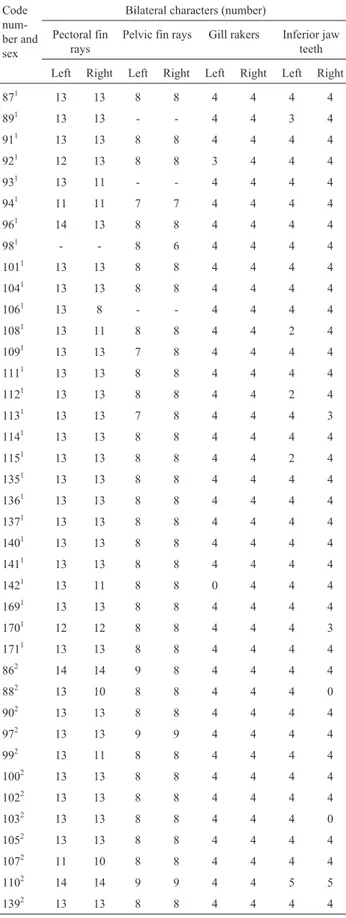
Four bilateral characters (number of pectoral and pel-vic fin rays, number of inferior jaw teeth and number of gill rakers on the right and left side of each specimen) were used to estimate the fluctuating asymmetry of theAstyanax
specimens from both sinkhole 2 and the Tibagi river (Figu-re 2, Tables 1 and 2).
Fluctuating asymmetry (FA) analysis
The fluctuating asymmetry (FA) of the sinkhole 2 and Tibagi riverAstyanaxspecimens was estimated using the formula of Palmer and Strobeck (1986):
FA =Ri- Li
whereRiandLiare the right (Ri) and left (Li) side
morpho-logical characteristic chosen for the study (number of pec-toral and pelvic fin rays, number of inferior jaw teeth and number of gill rakers; Figure 2 and Tables 1 and 2). The FA frequency distribution for each character was analyzed comparatively for the two populations as the absolute dif-ference between both sides for each individual in both pop-ulations using the Kolmogorov-Smirnov test at the 5% significance level.
Chromosomal markers
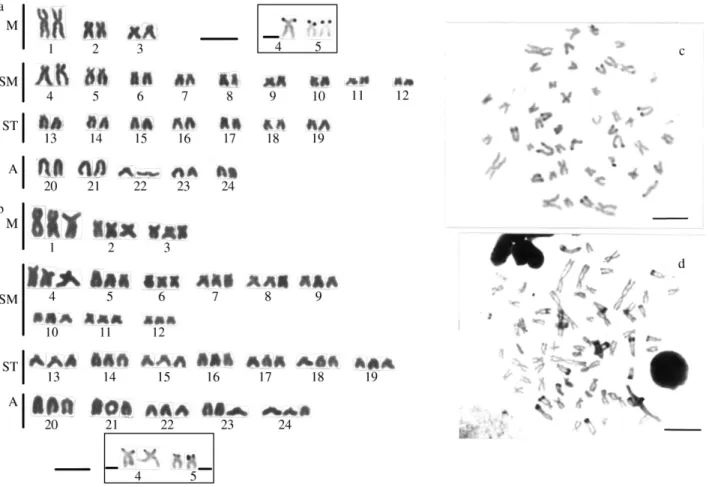
Thirty-five sinkhole 2Astyanaxspecimens (10 males and 25 females; Table 1) were analyzed cytogenetically (Figure 3). Chromosome preparations were obtained by the air-drying method of Bertolloet al. (1978) and the constitu-tive heterochromatin detected using Sumner’s (1972) method, silver nitrate (Ag) staining being used to visualize the nucleolar organizer regions (Ag-NORs) according to the method of Howell and Black (1980). The chromosomes were classified as metacentric (M), submetacentric (SM), subtelocentric (ST) or acrocentric (A) according to their morphology and arm ratios (Levanet al., 1964) and ar-ranged in decreasing order of size in the karyotype.
Table 2- Meristic data for the Tibagi riverAstyanaxspecimens and the bilateral characters used for fluctuating asymmetry analysis.
Code num-ber and sex
Bilateral characters (number)
Pectoral fin rays
Pelvic fin rays Gill rakers Inferior jaw teeth
Left Right Left Right Left Right Left Right
AF11 12 14 8 8 4 4 4 4
AF21 14 14 8 8 4 4 4 4
AF31 14 14 8 8 4 4 4 4
AF41 14 14 8 8 4 4 4 4
AF51 13 14 8 8 4 4 4 4
AF61 13 13 8 8 4 4 4 4
AF71 13 13 8 8 4 4 4 4
AF81 13 13 8 8 4 4 4 4
AF91 14 14 8 8 4 4 4 4
AF101 14 14 9 9 4 4 4 4
AF111 14 14 8 8 4 4 4 4
AF121 14 14 8 8 4 4 4 4
AF131 14 14 8 8 4 4 4 4
AF141 13 13 8 8 4 4 4 4
AF151 13 13 8 8 4 4 4 4
AF161 15 15 8 8 4 4 4 4
AF191 12 12 8 8 4 4 4 4
AF201 13 13 8 8 4 4 4 4
AF211 14 14 8 8 4 4 4 4
AF221 13 13 8 8 4 4 4 4
AF241 14 14 8 8 4 4 4 4
AF251 14 14 8 8 4 4 4 4
AF261 13 13 8 8 4 4 4 4
AF271 14 13 8 8 4 4 4 4
AF281 14 14 8 8 4 4 4 4
AF291 14 14 8 8 4 4 4 4
AF301 14 14 8 8 4 4 4 4
AF311 13 13 8 8 4 4 4 4
AF321 13 13 8 8 4 4 4 4
AF341 14 14 8 8 4 4 4 4
AF351 13 13 8 8 4 4 4 4
AF361 14 14 8 8 4 4 4 4
AF371 14 14 8 8 4 4 4 4
AF381 13 13 8 8 4 4 4 4
AF182 14 14 8 8 4 4 4 4
AF232 14 14 8 8 4 4 4 4
AF332 14 14 8 8 4 4 4 4
1: Male. 2: Female.
Results
External morphology and sex ratio
Two morphological types were observed for the sink-hole 2Astyanax(Figure 1), 16 specimens (4 males and 12 females) belonging to phenotype I while 19 (6 males and 13 females) belonged to phenotype II, but there was no signifi-cant association between sex and morphotype (χ2-test, p = 0.9572). The number of females exceeded the number of males by about 2.5 times, indicating a possible distortion of the sex ratio.
Fluctuating asymmetry
The fluctuating asymmetry (FA) of the sinkhole 2
Astyanaxspecimens did not differ significantly from that of
Astyanaxspecimens from the Tibagi river, suggesting no significant morphological differences between the two populations according to the Kolmogorov-Smirnov test (p = 0.1337 for the pectoral fin; 0.1111 for the pelvic fin, 0.0512 for the gill rakers and 0.2051 for the inferior jaw teeth).
Chromosomal variability
Both male and female sinkhole 2Astyanaxspecimens had a diploid number of 2n = 48 composed of 3
metacen-tric, 9 submetacenmetacen-tric, 7 subtelocentric and 5 acrocentric pairs (Figure 3a) and there was no differentiation regarding heteromorphic sex chromosomes. One female specimen was a natural triploid with a chromosome complement of 2n = 3x = 72 (9M + 27 SM + 21 ST +15 A) (Figure 3b). As normally seen in other Characidae, the number 1 meta-centric pair was the largest chromosome of the comple-ment, indicating that this is a preserved characteristic of the
Astyanaxgroup.
The Ag-NORs were mainly located on chromosomal pairs 4 and 5 at the distal region of the short arm (Figure 3a, b, in the box). Conspicuous heterochromatic segments were present on the telomeric regions of the long arm of the subtelo-acrocentric chromosomes and less evident hetero-chromatin blocks also occurred on several other chromo-somes (Figure 3c, d).
Discussion
Genetic variation, inbreeding effects and implications for species conservation
Populations with a high level of endogamy generally show depressed fitness, especially in respect to factors such as fertility, growth and survival (Leberg, 1990), lower lev-els of which damage the ability of a population to adapt to
changes in their environment. For example, the South Afri-can cheetahAcinomyx jubatus jubatus has an uncommon allozyme loci and a complex major histocompatibilty monomorphism resulting from a severe bottleneck and in-breeding during its recent evolutionary history (O’Brienet al., 1983; 1985) and, in contrast with other felines, also presents a low level of fertility due the significant quantity (71%) of morphologically anomalous sperm produced by the male and a high infant mortality rate (O’brienet al., 1985). In addition,A. jubatus jubatusalso has a high level of variation in the morphological characters of the facial area of the skull, which reinforces the theory that this feline has suffered developmental instability as consequence of inbreeding.
The sinkhole 2Astyanaxspecimens showed some al-teration in external morphology (Figure 1) against a low (but not statistically significant) level of asymmetry and karyotypic stability. For example, Phenotype II showed an alteration in the normal vertebral column not present in phenotype I (Figure 1), although no association was found between these two phenotypes and sex (χ2-test, p = 0.9572), and it is probable that the anomalous phenotype II is a con-genital deformation caused by inbreeding and the absence of gene flow between populations. Genetic problems such as loss of the genetic variability and low fertility rate due to inbreeding are common artificially-reared salmon (Oncorhynchus kisutch) stocks (Winkleret al., 1999) but these problems are uncommon in natural populations be-cause of a large gene pool and a slight endogamic effect (Zakharov and Graham, 1992).
The review by Palmer and Strobeck (1986) shows that there is a high index of fluctuating asymmetry in vari-ous fish populations under strong environmental pressure. In spite of the exaggerated endemism of the sinkhole 2
Astyanaxpopulation and the probable morphological evi-dence for a possible loss of heterozygosity detected by us the level of fluctuating asymmetry detected within this pop-ulation does not indicate that endogamy is having an effect on development. Although both the sample size and the morphological characters employed for fluctuating asym-metry analysis may have influenced the results, the possi-bility of a recent colonization of the sinkhole byAstyanax
remains plausible. In addition, the effective size of the pio-neer population is still unknown.
Karyotypic data did not show significant differences between phenotypes I and IIAstyanaxspecimens, support-ing the notion that this population is one taxonomic unit.
The sinkhole 2Astyanaxspecimens showed a distor-tion in the sex ratio (2.5 females for each captured male), which seems to be a common occurrence in otherAstyanax
populations (Salvador and Moreira-Filho, 1992; Vicenteet al., 1996) and is probably related to the behavioral and eco-logical strategies of this group of fish.
Karyotypic features of theAstyanaxpopulations
studied
The sinkhole 2Astyanaxhad a diploid chromosome number of 2n = 48, with a preferential distribution of the constitutive heterochromatin in the telomeric region of the acrocentric chromosomes (Figure 3c, d). This hetero-chromatin distribution seems to be quite common among theAstyanaxpopulations which live in the different Vila Velha sinkholes, this same karyotypic pattern having been detected in sinkhole 1 (Matosoet al., 2002) and Tibagi river (Artoni and Almeida, 2001) Astyanax specimens. This karyotype homogeneity may indicate that the sinkhole and riverine populations became isolated only recently and that insufficient evolutionary time has elapsed for the fixation of chromosomal rearrangements. In addition, the genomic and mitochondrial DNA of these populations are very simi-lar with only a small divergence occurring in the sinkhole 2
Astyanaxpopulation, which also supports the recent coloni-zation hypothesis (Matoso, 2002).
Karyotypic divergence is a common feature of
Astyanax populations with, for example, Astyanax scabripinnispopulations from different populations from regions of the Piracuama river (São Paulo state, Brazil) which are at different altitudes showing the same diploid chromosome number (2n = 50) but exhibiting conspicuous differentiation in regard to chromosome types, with geo-graphical accidents such as waterfalls appearing to have served to isolate different populations (Souza and Moreira-Filho, 1995). According Lowe-McConnel (1969), some neotropical fish species can be isolated at the headwa-ters of river basins through physical, chemical and even bi-otic barriers. Indeed, works on the taxonomy, distribution and cytogenetics of the ichthyofauna of headwaters have reinforced this proposition (Caramaschi, 1986; Langeani, 1989; Moreira-Filho and Bertollo, 1991).
Natural triploidy is a relatively common event in neo-tropical fish, especially in members of the genusAstyanax
In conclusion, our data, including the karyotype char-acteristics, indicate that this interesting model of enclosed
Astyanaxpopulations from the Vila Velha sinkholes shows evidence of inbreeding depression and loss of hetero-zygosity due to the particular conditions verified in the sinkholes.
Acknowledgments
The authors thank Dr Wagner F. Molina (Univer-sidade Federal do Rio Grande do Norte, Natal, Brazil) for his valuable suggestions. We also thank Instituto Ambien-tal do Paraná (IAP), Instituto Brasileiro do Meio Ambiente e Recursos Naturais Renováveis (IBAMA) and Parana-turismo for permission to capture fish and the Second De-tachment of Military Firemen of Ponta Grossa-PA (Destacamento Militar do Corpo de Bombeiros de Ponta Grossa) for its support in the fish capture at sinkhole 2. This work was also supported by the Brazilian agency Conselho Nacional de Desenvolvimento Científico e Tecnológico (CNPq).
References
Artoni RF and Almeida MC (2001) A singular diversidade dos peixes dos Campos Gerais: Uma visão genética para abor-dagem conservacionista da região. In: Ditzel CHM and Sahr CLL (eds) Espaço e Cultura: Ponta Grossa e os Campos Gerais. Editora da UEPG, Ponta Grossa, Brazil, pp 505-518. Bertollo LAC, Takahashi CS and Moreira-Filho O (1978)
Cytotaxonomic considerations onHoplias lacerdae(Pisces, Erythrinidae). Brazil J Genet 1:103-120.
Britski HA, Sato Y and Rosa ABS (1984) Manual de identificação de peixes da região de Três Marias: Com chaves de identifi-cação para os peixes da Bacia do São Francisco. Coordena-ção de Publicações – CODEVASF, Divisão de Piscicultura e Pesca, Câmara dos Deputados, Brasilia, Distrito Federal, 143 pp.
Caramaschi EP (1986) Distribuição da ictiofauna de riachos das bacias do Tietê e do Paranapanema, junto ao divisor de águas (Botucatu, SP). PhD Thesis, Universidade Federal de São Carlos, São Paulo.
Centofante L, Bertollo LAC and Moreira-Filho, O (2001) Com-parative cytogenetics among sympatric species of
Characidium (Pisces, Characiformes). Diversity analysis with the description of a ZW sex chromosome system and natural triploidy. Caryologia 54(3):253-260.
Cuellar D and Uyeno T (1972) Triploidy in rainbow trout. Cytogenetics 11:508-515.
Fauaz G, Vicente VE and Moreira-Filho O (1994) Natural triploidy and B chromosomes in the neotropical fish genus
Astyanax(Characidae). Brazil J Genet 2:157-163.
Galbusera P, Lens L, Schnenck T, Waiyaki E and Matthysen E (2000) Genetic variability and gene flow in the globally, critically-endangered Taita thrush. Conservation Genetics 1:45-55.
Garutti V and Britski HA (2000) Descrição de uma espécie nova de Astyanax (Teleostei: Characidae) da bacia do alto rio Paraná e considerações sobre as demais espécies do gênero na bacia. Comum Mus Ciên Tecnol 13:65-68.
Gery J (1977) Characoids of the world. T.F.H. Publications, Nep-tune City, New Jersey, 672 pp.
Howell WM and Black DA (1980) Controlled silver staining of nucleolus organizer regions with a protective colloidal de-veloper: A 1-step method. Experientia 36:1014-1915. Langeani F (1989) Ictiofauna do alto curso do rio Tietê (SP):
Taxonomia. Master Thesis, Universidade de São Paulo, São Paulo.
Leberg PL (1990) Influence of genetic variability on population growth: Implications for conservation. J Fish Biol 37:193-195.
Levan A, Fredga K and Sandberg AA (1964) Nomenclature for centromeric position on chromosomes. Hereditas 52:201-220.
Lowe-McConnel RH (1969) Speciation in tropical fresh water fishes. Biol J Linnean Soc 1:51-75.
Maack R (1956) Fenômenos carstiformes de natureza climática e estrutural nas regiões de arenitos do Estado do Paraná. Arquivos de Biologia e Tecnologia 11:151-162.
Matoso DA (2002) Análise da diversidade genética e estrutura populacional emAstyanaxsp. do Parque Estadual de Vila Velha e cabeceira do rio Tibagi. Master Thesis, Univer-sidade Federal de São Carlos, São Paulo.
Matoso DA, Vicari MR, Almeida MC, Shibatta AO, Moreira-Filho O, Bertollo LAC and Artoni RF (2002) Karyotypic studies in the characidae fish, genusAstyanax. An endemic and highly isolated populations ofAstyanaxsp. Cytologia 67:123-128.
Meffe GK and Caroll R (1994) Genetics: Conservation of diver-sity within species. In: Sinauer Associates (ed) Principles of Conservation Biology. Sunderland, MA, pp 143-178. Moreira-Filho O and Bertollo LAC (1991)Astyanax scabripinnis
(Pisces, Characidae): A species complex. Brazil J Genet 2:331-357.
O’Brien SJ, Goldman D, Merril CR, Bush M and Wildt DE (1983) The cheetan is depauperate in biochemical genetic variation. Science 221:459-462.
O’Brien SJ, Roelke ME, Marker L, Newman A, Winkler CA, Meltzer D, Colly L, Evermann JF, Bush M and Wildt DE (1985) A genetic basis for species vulnerability in the chee-tah. Science 227:1428-1434.
Palmer AR (1996) Waltzing with asymmetry. Is fluctuating asym-metry a powerful new tool of biologist or just an alluring new dance step? BioScience 46:518-532.
Palmer AR and Strobeck C (1986) Fluctuating asymmetry: Mea-surement, analysis, patterns. Annu Rev Ecol Syst 17:75-86. Salvador LB and Moreira-Filho OM (1992) B chromosomes in
Astyanax scabripinnis (Pisces, Characidae). Heredity 69:50-56.
Soares O (1989) Furnas nos Campos Gerais, Paraná. Scientia et Labor, Curitiba, 82 pp.
Souza IL and Moreira-Filho OM (1995) Cytogenetic diversity in theAstyanax scabripinnis(Pisces, Characidae) complex. II. Different cytotypes living in sympatry. Cytologia 60:273-281.
Sumner AT (1972) A simple technique for demonstrating centromeric heterochromatin. Exp Cell Res 75:304-306. Valenti RJ (1975) Induced poliploidy in Tilapia aurea
Van Valen L (1962) A study of fluctuating asymmetry. Evolution
16:125-142.
Vicente VE, Moreira-Filho OM and Camacho JPM (1996)
Sex-ratio distortion associated to the presence of a B
chromo-some in Astyanax scabripinnis (Pisces, Characidae).
Cytogenet Cell Genet 74:70-75.
Zakharov VM and Graham JH (1992) Developmental stability in natural populations. Acta Zool Fennica 191:1-201. Winkler FM, Bartley D and Díaz NF (1999) Genetic differences
among year classes in a hatchery population of coho salmon (Oncorhynchus kisutch (Walbaum, 1792)) in Chile. Aquaculture 173:425-433.