www.biogeosciences.net/7/2433/2010/ doi:10.5194/bg-7-2433-2010
© Author(s) 2010. CC Attribution 3.0 License.
Biogeosciences
Microbial conversion of inorganic carbon to dimethyl sulfide in
anoxic lake sediment (Plußsee, Germany)
Y. S. Lin1, V. B. Heuer1, T. G. Ferdelman2, and K.-U. Hinrichs1
1Organic Geochemistry Group, Department of Geosciences and MARUM Center for Marine Environmental Sciences, University of Bremen, P.O. Box 330 440, 28334 Bremen, Germany
2Max-Planck-Institute for Marine Microbiology, Celsiusstr. 1, 28359 Bremen, Germany Received: 30 March 2010 – Published in Biogeosciences Discuss.: 8 April 2010 Revised: 9 July 2010 – Accepted: 3 August 2010 – Published: 16 August 2010
Abstract. In anoxic environments, volatile methylated sul-fides like methanethiol (MT) and dimethyl sulfide (DMS) link the pools of inorganic and organic carbon with the sul-fur cycle. However, direct formation of methylated sulfides from reduction of dissolved inorganic carbon has previously not been demonstrated. When studying the effect of temper-ature on hydrogenotrophic microbial activity, we observed formation of DMS in anoxic sediment of Lake Plußsee at 55◦C. Subsequent experiments strongly suggested that the formation of DMS involves fixation of bicarbonate via a re-ductive pathway in analogy to methanogenesis and engages methylation of MT. DMS formation was enhanced by ad-dition of bicarbonate and further increased when both bi-carbonate and H2 were supplemented. Inhibition of DMS formation by 2-bromoethanesulfonate points to the involve-ment of methanogens. Compared to the accumulation of DMS, MT showed the opposite trend but there was no ap-parent 1:1 stoichiometric ratio between both compounds. Both DMS and MT had negativeδ13C values of−62‰ and
−55‰, respectively. Labeling with NaH13CO3showed more rapid incorporation of bicarbonate into DMS than into MT. The stable carbon isotopic evidence implies that bicarbon-ate was fixed via a reductive pathway of methanogenesis, and the generated methyl coenzyme M became the methyl donor for MT methylation. Neither DMS nor MT accumula-tion were stimulated by addiaccumula-tion of the methyl-group donors methanol and syringic acid or by the methyl-group accep-tor hydrogen sulphide. The source of MT was further inves-tigated in a H352 S labeling experiment, which demonstrated a microbially-mediated process of hydrogen sulfide
methy-Correspondence to:Y. S. Lin ([email protected])
lation to MT that accounted for only <10% of the accu-mulation rates of DMS. Therefore, the major source of the 13C-depleted MT was neither bicarbonate nor methoxylated aromatic compounds. Other possibilities for isotopically de-pleted MT, such as other organic precursors like methionine, are discussed. This DMS-forming pathway may be relevant for anoxic environments such as hydrothermally influenced sediments and fluids and sulfate-methane transition zones in marine sediments.
1 Introduction
1
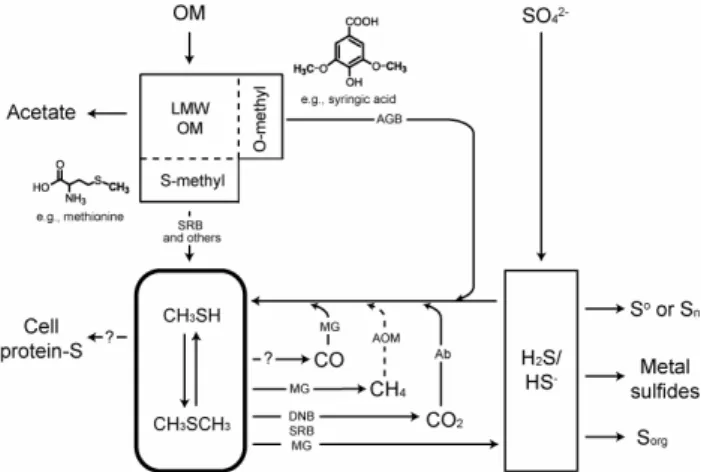
Fig. 1. A schematic diagram summarizing geochemical processes linked by methylated sulfides in anoxic environments. Arrows with dashed line: hypothesized processes; arrows with a question mark: processes that have not been examined. See text for detailed dis-cussion. The structures of syringic acid and methionine are also shown as examples of compounds with O- and S-methyl groups, respectively. Abbreviations: Ab, abiotic process; AGB, acetogenic bacteria; AOM, anaerobic oxidation of methane; DNB, denitrifying bacteria; LMW, low molecular weight; MG, methanogens; OM, or-ganic matter;Sorg: sulfurized OM formed during early diagenesis; SRB, sulfate reducing bacteria.
known to oxidize methylated sulfides include denitrifying bacteria (Visscher and Taylor, 1993), sulfate reducing bac-teria (Tanimoto and Bak, 1994) and methanogens (Lomans et al., 1999a). During degradation of DMS, MT usually accumulates transiently as an intermediate (Lomans et al., 1999b). Whether methylated sulfides can be used to synthe-size protein-sulfur during anabolism in anoxic environments is not clear, but evidence exists that pelagic marine bacteri-oplankton preferentially assimilate methylated sulfides over sulfate or hydrogen sulfide (Kiene et al., 1999).
In addition to processes whereby methylated sulfides are produced from organic sulfur compounds, other processes exist in which methylated sulfides are derived by linking organic or inorganic carbon to H2S/HS− (hydrogen sul-fide hereafter), either biologically and/or abiotically (Fig. 1). First, O-methyl groups (methyl groups bonding to an oxy-gen atom) can be transferred microbially to hydrooxy-gen sul-fide to form MT, with additional methylation under cer-tain circumstances yielding DMS (Lomans et al., 2002). Known O-methyl donors include methanol (van Leerdam et al., 2006) and methoxylated aromatic compounds such as lignin monomers (Lomans et al., 2002). This process is proposed to be the main mechanism contributing to methy-lated sulfides in DMSP-limited freshwater sediments, as ev-idenced by the strong correlation between concentrations of methylated sulfides and hydrogen sulfide in lake sediment (Lomans et al., 1997). Second, based on the study of trace methane oxidation ofMethanosarcina acetivorans, Moran et
al. (2007) hypothesized that during anaerobic oxidation of methane (AOM), methane is converted to methylated sul-fides, which are subsequently oxidized by sulfate reducers. It is currently not known whether and exactly how such cou-pling proceeds in AOM organisms. Third, conversion of car-bon monoxide (CO) to MT and DMS has also been observed inM. acetivorans(Moran et al., 2008), which represents the first finding of microbially mediated incorporation of inor-ganic carbon into methylated sulfides. The process probably proceeds via stepwise reduction of CO as coenzyme-bound intermediates to form a methyl group and could be coupled to energy conservation via a chemiosmotic mechanism. How-ever, this process has not yet been studied using environmen-tal samples, and the lack of knowledge on CO abundance in aquatic environments hampers evaluation of the signifi-cance of this process in natural settings. Last, small alkyl-S molecules, except DMalkyl-S, can be abiotically synthesized from carbon dioxide (CO2) and hydrogen sulfide in the pres-ence of iron monosulfide under anoxic conditions (Heinen and Lauwers, 1996). This process is accelerated at tempera-tures higher than 50◦C. The abiotically synthesized alkylated sulfides are considered as building blocks for larger organic molecules in the primitive earth (Huber and W¨achtersh¨auser, 1997). Jointly, these biological and abiotic reactions com-pete for hydrogen sulfide with other reactions such as the formation of elemental sulfur, polysulfur, metal sulfides and complex organic sulfur compounds.
The finding of formation of methyl sulfides from CO by M. acetivorans raises the question whether CO2 (or bicar-bonate at neutral pH), the most abundant dissolved inorganic carbon species in natural waters, can be converted to MT and DMS by microbial activity. Although CO2 is not a growth substrate of M. acetivorans, it is produced in vivo via ox-idation of CO and then introduced into the reductive steps by methanofuran (Oelgeschl¨ager and Rother, 2008), a coen-zyme shared by autotrophic methanogens. In anoxic environ-ments, reduction of CO2to a methyl group is mostly coupled to hydrogenotrophy, such as autotrophic methanogenesis and acetogenesis. Previous studies of the effect of molecular hy-drogen (H2)on methylated sulfides have yielded inconclu-sive results. Lomans et al. (1999b) found that after prolonged incubation of anoxic lake sediment under H2, degradation of methylated sulfides decreased dramatically. In contrast, the addition of H2 did not affect thiol methylation potential in wetland sediments (Stets et al., 2004).
experiments to characterize the mechanism and to identify the microbial group responsible for the production of methy-lated sulfides in sediment slurry incubations. The effect of H2and bicarbonate on methylated sulfides, methane and ac-etate was examined, followed by tests aimed at verifying whether the observed DMS formation is related to methyl transfer during O-demethylation from organic substrates. We used a specific inhibitor to investigate the involved enzymatic pathway, which was subsequently supported by a study of the natural carbon isotopic abundance in methylated sulfides. The flow of C- and S-atoms into MT and DMS was further tracked by isotope labeling using13C- and35S-labeled com-pounds.
2 Materials and methods
2.1 Study site and sampling
Lake Plußsee (54◦10′N, 10◦23′E) is a well-studied eu-trophic lake located in northern Germany. It has a stable ther-mal stratification in summer and regularly occurring anoxia in the hypolimnion, leading to high hydrogen sulfide con-centrations in the bottom water (up to 50 µmol L−1; Eller et al., 2005). Sediment samples used for this study were col-lected in July 2006 from the deepest part of the lake, i.e., at 28 m using a small multicorer from a rowboat. After sam-pling, the upper 15-cm portion of triplicate sediment cores was transferred into an air-tight bottle without gas headspace and stored in the dark at 4◦C for three months before being used for incubation experiments.
2.2 Slurry preparation
Sediment slurries were prepared anoxically by homogeniz-ing approximately one volume of sediment with one vol-ume of sterilized distilled water. After autoclaving, the distilled water was sparged with nitrogen (N2) for at least one hour to remove dissolved oxygen. NaHCO3 was added as buffer after sparging (final concentration = 1 to 3 mmol L−1) and Na2S·9H2O as reducing agent (final con-centration = 50 µmol L−1). Aliquots of 8 or 10 mL of sedi-ment slurry were dispensed into 16 mL Hungate tubes and sealed with butyl rubber stoppers. The tubes were evacuated three times and flushed with N2or H2, and were finally pres-surized to 200 kPa. All the tubes were incubated at 55◦C in the dark without shaking.
2.3 Substrate and inhibitor amendments
Substrate and inhibitor concentrations are reported for a liquid phase that is ca. 95% (w/w) of the sediment slurry. NaHCO3 was added to 10 mmol L−1 from a CO2-stabilized stock solution. Other tested substrates (reported in final concentrations) include: Na2S·9H2O, 200 µmol L−1MT, 50 µmol L−1, methanol, 800 µmol L−1; syringic acid, 100 µmol L−1. 2-Bromoethanesulfonic acid (BES, 20 mmol L−1)was applied to inhibit methanogenesis.
2.4 Stable isotope labeling
NaH13CO3 was spiked in the middle of an experiment, which was initiated by addition of both H2and 10 mmol L−1 NaHCO3at time zero. Assuming that the consumption kinet-ics of bicarbonate was identical to that of the parallel incu-bations with substrate amendments, we added 80 µmol L−1 NaH13CO3(99.9%13C) to achieve a final13C abundance of
∼2% of the estimated bicarbonate concentration remaining at this time point (∼4 mmol L−1). The exact13C content of the spiked NaHCO3pool was not confirmed by stable carbon isotope analysis.
Before stable carbon isotopic analysis of DMS and MT, Hungate tubes were stored after incubation for one month at−20◦C. To improve the transfer of DMS and MT vapors into the headspace, the tubes were heated to 60◦C for 20 min prior to analysis.
2.5 Radioisotope labeling
In the labeling experiment with H352 S, Na2S·9H2O was not added to the sterilized and purged distilled water in order to maintain sufficient specific activity of dissolved inorganic sulfide. Instead, the distilled water was blended with the re-dox indicator resazurin (final concentration = 1 mg L−1)and reduced slowly with freshly-prepared sodium dithionite so-lution until the pink color of the liquid indicative for oxic conditions had cleared out completely. Aliquots of sedi-ment slurry of 25 mL were poured through a funnel into 120 mL serum vials and amended with H2and 10 mmol L−1 NaHCO3. Autoclaved slurries (120◦C, 25 min) were used as control to account for non-biological reaction and/or pro-cessing artifacts.
Radioactive sulfide was produced biologically and puri-fied to remove S-bearing byproducts (T. Holler, unpublished data). The specific activity was 50.9 MBq mmol−1 in the form of Zn35S. Each serum vial was supplemented with H352 S gas generated by acidifying a defined volume of Zn35S sus-pension (equivalent to 59.5 kBq). The injected H352 S should have resulted in a final hydrogen sulfide concentration of 37 µmol L−1ignoring partitioning into solid S phases.
DMS, which was trapped using the method slightly modi-fied from Kiene and Linn (2000). The original butyl stop-per on the serum vial was exchanged for a butyl stopstop-per that had an Eppendorf centrifuge vial (1.5 mL) attached to it. In-side the Eppendorf vial was a strip of Gelman AR glass fiber filter treated with freshly prepared 3% H2O2 solution. The serum vials were placed in the dark at room temperature and the sediment slurries were stirred for >6 h. The traps were then removed, and the strips placed in 5 mL scintilla-tion vials with scintillascintilla-tion fluid for determinascintilla-tion of 35 S-radioactivity. Tests with 50 µmol L−1DMS showed that af-ter trapping, DMS decreased to a level below the detection limit of the flame ionization detector. 35S-DMS was not available to determine the exact trapping efficiency, but the trapping efficiency for H352 S in bicarbonate-buffered solu-tion was higher than 90%. The remaining sediment slurries were subjected to a two-step cold distillation (Fossing and Jørgensen, 1989) to investigate the distribution of radioactiv-ity in acid volatile sulfide (AVS: H2S+FeS) and chromium reducible sulfur (CRS: S0+FeS2).N,N-dimethylformamide was applied in the second step to improve the yield of ele-mental sulfur (Kallmeyer et al., 2004).
Assuming that only the dissolved fraction could be respon-sible for formation of methylated sulfides, we calculated the average production rate of DMS derived from doubly methy-lated hydrogen sulfide (Rate6H2S+2Me) during a labeling pe-riod using the following equation
Rate6H2S+2Me=
atrap
adis
× {H2S} ×1
t. (1)
Here Rate6H2S+2Me is expressed as µmol (L of slurry)−1d−1. atrap is the radioactivity of the trapped pool,adisis the activity in the dissolved pool of the sediment slurry, {H2S} is the concentration of hydrogen sulfide per volume of sediment slurry (µmol (L of slurry)−1), andt is the number of days during which the reaction was run. Since H352 S is likely to be oxidized into aqueous sulfur oxyanions even under anoxic conditions (Elsgaard and Jørgensen, 1992), adis can be an overestimation of the H352 S pool, leading to underestimated values of Rate6H2S+2Me.
2.6 Analytical techniques
Concentrations of methane and methylated sulfides were de-termined by headspace analysis. Care was taken to main-tain the incubation temperature during gas sampling. An aliquot of 100 µL gas was taken from a headspace of 6 to 8 mL using a Hamilton gas-tight syringe for on-column in-jection via a programmable temperature vaporizing inlet. A gas chromatograph (Trace GC Ultra, ThermoFinnigan) equipped with a CP-PoraBOND Q (Varian Inc.) column and a flame ionization detector was used to quantify the com-pounds. The column temperature was programmed from 60◦C (1 min isothermal) to 240◦C (2 min isothermal) at a rate of 40◦C min−1. The distribution coefficients for DMS
and MT at 55◦C are 6.9 and 4.3, respectively (Przyjazny et al., 1983). Calibration was made with standards prepared anoxically from chemicals. The limits of detection (LOD) were 0.4 µmol L−1for MT and 0.5 µmol L−1for DMS under the described analytical conditions.
For carbon isotope analysis, the same model of GC was coupled to a ThermoFinnigan Delta Plus XP isotope ratio mass spectrometer via a Finnigan combustion interface-III. One milliliter of gas was injected into the split/splitless in-let. A column and a temperature program identical to those described above were used. Values ofδ13C relative to that for Vienna-PeeDee Belemnite are defined by the equation
δ13C (‰) = (Rsample/Rstandard−1)×1000 withR=13C/12C andRstandard=0.0112372±2.9×10⁻⁶. Internal precision of δ13C was better than±0.1‰ (one standard deviation). We used two types of standards to evaluate the isotopic ac-curacies of methylated sulfides at low concentrations: (1) gaseous standards were prepared by injecting 5 to 550 µL of pure standards into helium-flushed, water-free headspace vials that were allowed to equilibrate at 60◦C. Isotopic val-ues of the gaseous standards were not influenced by partition of methylated sulfides into aqueous solution and were taken as “real” values. (2) Solution standards of different concen-trations were prepared under a helium headspace with a de-fined volume of water. By comparing the isotopic values of the solution standards with those of the gaseous standards, we found that at concentrations lower than 5 µmol L−1, there was a positive shift for MT (up to 4.5‰) and a negative shift for DMS (up to 2.5‰). Since a strict relationship between the correction factor and concentration was not established, we did not correct theδ13C values of MT, which had concen-trations lower than the threshold during the whole course of the incubation experiments.
Radioactivity was determined by liquid scintillation count-ing (Packard 2500 TR) with a countcount-ing window of 4 to 167 keV without luminescence correction. The scintillation cocktail Lumasafe Plus (Lumac BV, Holland) was mixed with the zinc acetate-fixed dissolved fraction and the glass fiber strips. The counting efficiency was higher than 95%. Counting time was 10 min for all samples. The concentra-tion of hydrogen sulfide was determined colorimetrically by the methylene blue method (Cline, 1969).
1
Fig. 2.Effects of H2and bicarbonate on the formation of dimethyl sulfide (DMS), methanethiol (MT), methane, and acetate in the sediment slurries of Lake Plußsee. Gray lines mark the final concentration of each compound in parallel with the concentration when no substrate was added. Data are from a single sample tube but the pattern is reproducible in similar incubations.
2.7 Statistical analysis
The LOD of instrumental methods was assessed statistically by the equation LOD=YB+3×Sy/x, where YB represents
the signal of instrumental background and was estimated by the intercept of a calibration curve, and Sy/x stands for the
deviation ofY values (see Miller and Miller, 2005, for de-tailed description). The effect of individual treatments was tested using a one- or two-tailed t test withαset at 0.05.
3 Results
3.1 Addition of substrates
In the first experiment, we examined the effects of H2 and bicarbonate on the dynamics of DMS and MT formation at 55◦C. We also monitored the concentrations of methane and acetate, the major carbon pools whose formation can poten-tially compete for H2and bicarbonate in this system. Com-pared to the control without any addition (Fig. 2a), there was no stimulation of DMS accumulation when H2 was added as the single substrate (Fig. 2b). However, addition of bi-carbonate resulted in an increase of DMS (Fig. 2c), and si-multaneous addition of both H2and bicarbonate further en-hanced DMS accumulation (Fig. 2d). The average
1
Fig. 3. Concentrations and stable carbon isotopic values of dimethyl sulfide (DMS), methanethiol (MT) and methane in sediment slurries under non-labeling and labeling conditions. NaH13CO3was added on day 6 of the incubation. Error bars represent±1 standard error of duplicate tubes.
experiments we added bicarbonate together with H2 in or-der to obtain higher yields of DMS and to facilitate labeling studies.
To test whether the observed DMS formation was related to the activity of O-demethylation, we examined the effects of sodium sulfide, MT, methanol and syringic acid under ei-ther a N2or a H2headspace (Table 1). Experimental concen-trations of each of these compounds were in the range that stimulated production of DMS and MT in previous studies of freshwater sediment (Lomans et al., 1997; Stets et al., 2004). The results indicated that the presence of H2 and bicarbon-ate was the major factor leading to increased DMS forma-tion; none of the other four substrates significantly increased DMS formation after 12 days of incubation. The effects of sodium sulfide, methanol or syringic acid on MT formation were either minor or insignificant. The added MT decreased over time and reached 30% of the initial values after 12 days of incubation. An autoclaved control confirmed that the dis-appearance of MT was driven by abiological processes (data not shown).
3.2 Inhibition tests
Reduction of bicarbonate with H2 in anoxic sediment is commonly associated with activities of either acetogens or methanogens. Acetogenesis was very active in our incu-bated sediment but could not be specifically inhibited to ex-amine the corresponding effects on formation of methylated sulfides. However, the role of methanogens can be evalu-ated by BES, an inhibitor for methanogenesis (Chidthaisong and Conrad, 2000). Relative to the positive control (Ta-ble 2), DMS formation was 60% inhibited by 20 mmol L−1 BES (P =0.024, one-tailed t-test), whereas MT
accumula-tion increased slightly (P =0.044, one-tailed t-test). Since methane production was already suppressed in the presence of high H2 partial pressure (Fig. 2i–l), BES did not signifi-cantly lower the methane level (P =0.182, one-tailed t-test) in this experiment in which 200 kPa H2 was applied. BES had no effect on the formation of acetate.
3.3 Stable carbon isotopic compositions under non-labeling and13C labeling conditions
The stable carbon isotopic compositions of methylated sul-fides provide additional evidence on the enzymatic pathways involved in their formation. Under the non-labeling condi-tion, DMS was 13C-depleted with δ-values as negative as
−62‰ on day 6, and increased slightly to−56‰ at the end of incubation (Fig. 3b). The analyzed δ13C values of MT were−55‰ and−53‰ on days 6 and 12 (Fig. 3d), respec-tively, but the actualδ13C values of MT should have been more negative, since the MT concentrations were below the threshold value of 5 µmol L−1(cf. Materials and Methods). Methane production was low and theδ13C values remained around−50‰ during the course of incubation (Fig. 3f).
Table 1.Concentrations of DMS and MT after 12 days of incubation with inorganic and organic substrates. Results are presented as means and standard errors from duplicate tubes.
Treatment Headspace DMS µmol (L of slurry)−1 MT µmol (L of slurry)−1
No addition N2 3.7±1.7 3.0±1.7 Methanol, 800 µmol L−1 N2 1.5±0.1 2.6±0.2 Syringic acid, 100 µmol L−1 N2 1.1±0.4 2.7±0.1 No addition H2(+HCO−3) 11.1±0.3 2.8±0.1 Sodium sulfide, 200 µmol L−1 H2(+HCO−3) 9.6±1.0 4.4±1.6 Methanethiol, 50 µmol L−1 H2(+HCO−3) 9.1±0.6 14.8±4.2 Methanol, 800 µmol L−1 H2(+HCO−3) 3.7±0.4 4.3±0.1 Syringic acid, 100 µmol L−1 H2(+HCO−3) 6.8±0.5 3.8±0.4
Table 2.Effects of 20 mmol L−12-bromoethanesulfonate (BES) on formation of dimethyl sulfide, methanethiol, methane and acetate after 12 days of incubation. The sediments slurries were added with 200 kPa H2and 10 mmol L−1bicarbonate. Results are presented as means and standard errors from duplicate tubes.
Compounds Positive control + BES
Dimethyl sulfide, 11.7±0.3 4.2±2.2 µmol (L of slurry)−1
Methanethiol, 3.1±0.1 4.7±0.8 µmol (L of slurry)−1
Methane, 48.2±16.9 32.8±8.2 µmol (L of slurry)−1
Acetate, 6.4±0.3 6.7±0.4 mmol (L of slurry)−1
calculated the13C abundance of the newly fixed carbon into DMS based on the measured size andδ-values of the DMS pool at different time points. The results showed that (1) if both methyl groups were derived from bicarbonate, the av-erage 13C abundance of the newly fixed carbon was 1.3% during the period after labeling addition, and (2) if only one methyl group was involved, the average13C abundance of the newly fixed carbon would raise to 2.6%. These estimates are consistent with at least one methyl group being derived from the NaH13CO3spiked DIC pool (∼2%13C abundance). MT showed a much slower but significant (P =0.002, one-tailed t-test) enrichment, and reached−24‰ by the end of the experiment. 13C-enrichment of methane was merely 9‰ (Fig. 3f), a finding that agrees with our observation that methanogenesis via reduction of CO2was low.
3.4 Labeling with H352 S
The result of the13C-labeling experiment indicated incorpo-ration of bicarbonate with MT, but the source of MT remains unclear. The effects of sodium sulfide, methanol and syringic acid on MT formation, if any, might have been too small to
1
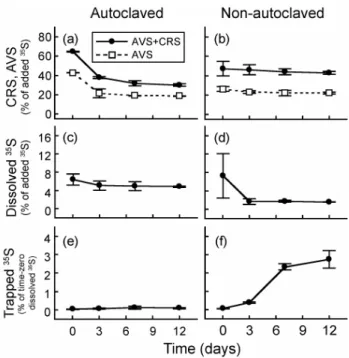
Fig. 4.Distribution of radioactivity in the sediment slurries of Lake Plußsee during incubation with H2, bicarbonate and H352 S. Time-zero values were measured two hours after addition of radiotracer. AVS: acid volatile sulfide (H2S + FeS); CRS: chromium reducible sulfur (S0+ FeS2). The dissolved35S was measured from filtered slurry supernatant. The trapped35S was interpreted to represent labeled dimethyl sulfide. Error bars represent±1 standard error of duplicate bottles.
At time zero (after two hours of incubation), the dissolved fraction contained less than 10% of total added radioactivity (Fig. 4c, d). A significant amount of H352 S entered the solid phase AVS (most likely FeS) and CRS fractions via isotope exchange (Figs. 4a, 4b; Fossing et al., 1992). The trapped ra-dioactivity in non-autoclaved samples was much higher than in the autoclaved control (Fig. 4e, f; P=0.008, one-tailed t-test), suggesting that DMS formed biologically. In the non-autoclaved samples, the trapped radioactivity increased most rapidly between days 3 and 7 and finally reached 2.5% of the dissolved radioactivity. We obtained an aver-age Rate6H2S+2Meof 0.06 µmol (L of slurry)
−1d−1over the whole period of incubation and a higher rate of 0.1 µmol (L of slurry)−1d−1 between days 3 and 7. The rates are in the range of reported sulfide-dependent MT production rates in freshwater sediment at low hydrogen sulfide concentra-tions (Lomans et al., 1997), but represent<10% of the ambi-ent DMS production rate determined by the kinetics of total DMS formation in this study.
4 Discussion
Our experimental data showed that both DMS and MT were of biogenic origin and depleted in13C. However, both com-pounds responded differently to addition of substrates and inhibitors, and exhibited different patterns of13C incorpora-tion. Therefore, DMS and MT formation will be discussed separately, followed by a note on the implication of these processes for natural anoxic environments.
4.1 Microbial DMS formation
Our observation indicates that dissolved inorganic carbon in anoxic aquatic environments can be incorporated into DMS: H2alone did not stimulate DMS formation while bicarbon-ate alone did, and both together stimulbicarbon-ated DMS even more; MT accumulated slightly when DMS production was hin-dered by the lack of H2and bicarbonate or by the addition of BES;13C-labeled bicarbonate was incorporated much more rapidly into DMS than into MT. These facts suggest the fol-lowing reaction:
HCO−3 +H++3H2+CH3SH→CH3SCH3+3H2O (2)
1G◦′= −159.8kJ per reaction
The standard-state free energy for the proposed reac-tion was calculated using thermodynamic data for aqueous species listed in Scholten et al. (2003). The production rate is consistent with the previously observed kinetics in other freshwater environments (Lomans et al., 1997; Stets et al., 2004). Addition of MT did not further stimulate DMS for-mation (Table 1), suggesting that this process is not limited by MT. Since addition of methanol or syringic acid failed to stimulate DMS production, this process is not related to O-demethylation.
DMS under the non-labeling condition was13C-depleted withδ-values as negative as−62‰ (Fig. 3b). According to Eq. (2), one of the methyl groups was from MT and the other from reduced bicarbonate. Since the measuredδ13C value of MT in experiments without label addition was around
−54‰, a simple mixing model provides a rough estimate of −70‰ for the δ13C value of the methyl group from re-duced bicarbonate. Compared with the δ13C value of the added NaHCO3(−2.2‰; data not shown), the strong13 C-depletion of the methyl group is consistent with a kinetic isotopic effect typical for H2/CO2 metabolizers such as au-totrophic methanogens (Whiticar, 1999) or acetogens (Gel-wicks et al., 1989).
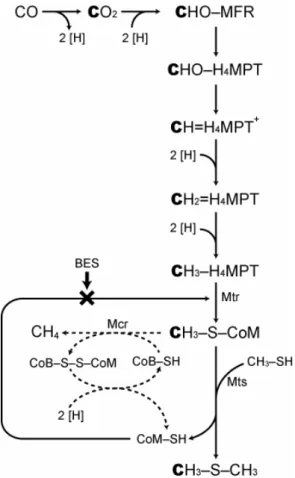
Suppression of DMS production by BES further suggests that methanogens are involved in DMS formation. Moran et al. (2008) previously discussed the enzymatic steps of M. acetivorans to produce methylated sulfides. We hy-pothesize that the same pathway is active with CO2rather than CO as the direct precursor (Fig. 5). Normally, coen-zyme M (CoM-SH) receives the methyl group from N5 -methyl-H4MPT:CoM-SH methyltransferase (Mtr) complex to form methyl-CoM, which releases methane by forming heterodisulfide with coenzyme B (CoB-SH) by the catal-ysis of methyl-CoM reductase (Mcr). Under the condi-tion of DMS produccondi-tion, the methyl group is transferred from methyl-CoM to MT, a reaction that is the reverse of the CoM methylation step employed by DMS-consuming methanogens (Hedderich and Whitman, 2006). As Moran et al. (2008) pointed out, such a shortcut to regenerate CoM-SH is feasible, owing to the low energy barrier in the activa-tion step of methanogenic DMS consumpactiva-tion by methylth-iol:CoM methyltransferase (Mts) (1G◦′=0.35 kJ per reac-tion; Tallant et al., 2001). The overall energy yield for the methanogenic DMS production is theoretically lower than normal methanogenesis, as the H+-pumping step of het-erodisulfide reduction is bypassed and energy conservation is restricted to the Na+-pumping Mtr complex (Hedderich and Whitman, 2006). From an energetic point of view, there-fore, DMS might be considered as a by-product of inefficient methanogenesis.
1
Fig. 5. A simplified scheme of methanogenic dimethyl sulfide (DMS) formation. The formation of DMS from carbon monox-ide (CO) is reported in Moran et al. (2008). The carbon atoms highlighted in bold type refer to the process proposed in this study, i.e., formation of DMS from CO2. The dashed arrows are path-ways that are bypassed when DMS rather than methane is pro-duced. The enzymatic step inhibited by 2-bromoethanesulfonic acid (BES) is marked with a cross. Abbreviations: MFR, methanofuran; H4MPT, tetrahydromethanopterin; CoM-SH, coenzyme M; CH3 -S-CoM, methyl coenzyme M; CoB-SH, coenzyme B; Mtr, N5 -methyl-H4MPT:CoM-SH methyltransferase; Mcr, methyl-CoM re-ductase; Mts, methylthiol:CoM methyltransferase.
thermophilic population of methanogens did not occur. The elevated temperature may have also improved the availability of substrates such as MT, CO2and H2via acceleration of or-ganic matter breakdown, making the DMS-forming pathway thermodynamically feasible for methanogens. Nevertheless, growth by this mechanism remains to be determined, even if it is thermodynamically feasible.
We note that high H2partial pressure, which favored DMS formation when added together with bicarbonate, failed to stimulate methanogenesis during our incubation (Fig. 2). A similar lack of methanogenesis was also found in previous in-cubation experiments with Lake Plußsee sediments that used H2rich gas mixture (80:20 H2/CO2)but lower temperatures
(4◦ and 25◦C) (N¨usslein and Conrad, 2000; Heuer et al., 2010), while incubation under 4% H2 headspace enhanced methanogenic activity (N¨usslein and Conrad, 2000). The reasons why methanogenesis is stimulated successfully with addition of low H2concentrations but not with high concen-trations remain to be explored. Although our data do not pro-vide epro-vidence that would help to explain this phenomenon, we demonstrated that under the condition of high H2partial pressure and elevated temperature, a fraction of H2and CO2 still enter the methanogenic pathway but with DMS as the final product.
Sequences retrieved from fresh Lake Plußsee sediment using the mcrA-gene primer showed the greatest homol-ogy with members of theMethanomicrobiales(Heuer et al., 2010), which are strict H2/CO2metabolizers and are unlikely to possess Mts required for the transfer of methylated sulfides (Fig. 5). Therefore, it is likely that the observed DMS forma-tion was performed by a minor populaforma-tion of methanogens that, like some members of theMethanosarcinales, are ca-pable of using both H2/CO2and methylated sulfides (Kendal and Boone, 2006).
4.2 Microbial MT formation
Autoclaved controls confirmed that MT in our system is also of biological origin, and the natural δ13C-values are very negative (<−50‰). In contrast to some previous studies suggesting that methyl transfer from methoxylated aromatic compounds to hydrogen sulfide is a main source of MT in freshwater sediment (Lomans et al., 1997, 2002), addition of sodium sulfide, methanol and syringic acid to our microcosm failed to stimulate MT formation. By labeling with H352 S we were able to quantify the inventory of methylated hydrogen sulfide that finally entered the DMS pool. The minor supply of MT derived directly from hydrogen sulfide does not sup-port the accumulation rate of DMS that is supposed to derive from MT (Eq. (2)). Taken together, our experiments suggest that the DMS production proceeded via MT derived mostly from organic-S pools. However, from these experiments we can not yet identify the mechanism of MT formation.
MT is lost to other reactions (cf. Sect. 3.1) there must have been some other major source. A second possible source of a 13C-depleted methyl group would be methoxylated aromatic compounds: Keppler et al. (2004) reported that the methyl pool in lignin hasδ13C values as negative as −66‰. This possibility is nevertheless not supported by our results from the substrate tests and H352 S-labeling experiment. A last po-tential source that has received little attention but cannot be ruled out is the S-methyl pool of amino acids. MT accu-mulated rapidly after addition of methionine in the Plußsee sediment (data not shown), but we have no information on the pool size of free methionine and its endogenesis from enzymatic hydrolysis of macromolecules. According to a study on the carbon isotopic pattern in purine alkaloids in higher plants (Weilacher et al., 1996), the methyl pool in S-adenosylmethionine, a coenzyme with its methyl group derived from methionine, showed a moderate13C-depletion (δ13C<−39‰). If methionine has an identical carbon iso-topic composition in its methyl group, it could be another source for a moderately13C-depleted methyl pool. Addition-ally, methionine and S-adenosylmethionine are involved in biosynthesis of many O- and S-methyl pools in organic mat-ter, including DMSP and lignin monomers. Direct isotopic analysis of the methyl group in methionine will be essential to better constrain the propagation and distribution ofδ13C signatures of C1 compounds in nature, including methylated sulfides.
4.3 Implications for anoxic environments
Although our experimental temperature hinders implications for the local biogeochemistry of the lake, the incorpora-tion of bicarbonate into DMS may be relevant to several anoxic environments. The fact that this process was more easily observed at elevated temperature in our incubations makes geothermally influenced subsurface sediments and hy-drothermal vents a potential target for future studies on this topic. For example, as summarized in Fig. 1, abiotic synthe-sis of alkylated sulfides has been demonstrated in the lab-oratory and is considered relevant for hydrothermal envi-ronments. A recent study on in situ measurements further demonstrated considerable amounts of MT in a hydrother-mal area (Reeves and Seewald, 2009). The supply of MT, the usually high chemical potential of H2and bicarbonate, and, possibly, elevated temperature, qualify hydrothermal systems as candidate ecosystems in which the DMS-forming process characterized in this study could take place.
However, the possibility to detect such a process at lower temperatures should not be excluded. We suggested that the high temperature during incubation facilitates this reaction by increasing the availability of substrates (MT, CO2and H2)
to methanogens. If this is true and elevated temperature is not a prerequisite, there are low-temperature environments with similar chemical conditions in the real world that de-serve further examination. One setting is the sulfate-methane
transition zone (SMTZ) in marine sediments associated with AOM activity (e.g., Hoehler et al., 2000). It is a particular zone where sulfate is exhausted and methane from under-lying sediment is consumed. Additionally, this zone is of-ten accompanied by peak hydrogen sulfide and bicarbonate concentrations. Laboratory experiments demonstrated that during the transition from sulfate reduction to methanogene-sis, there is a decoupling of H2production and consumption and hence a temporary accumulation of H2(Hoehler et al., 1999). Isotopic evidence for acetogenesis via CO2reduction in an extended sediment interval just below the SMTZ at the Cascadia Margin is also consistent with elevated H2 concen-tration in situ (Heuer et al., 2009). If there are sources of MT, e.g., transmethylation from lignin monomer to hydrogen sul-fide, the SMTZ qualifies as an additional environment where DMS formation by methanogens is thermodynamically fa-vorable.
5 Conclusions
In this study, we investigated the formation of DMS and MT in anoxic lake sediment at elevated temperature. On the one hand, we provided multiple lines of evidence for a novel microbial pathway of DMS production in anoxic lake sediment. This pathway connects DMS to bicarbonate and H2 and is mediated by methanogens. Subsequent investi-gations will have to characterize the physiological condi-tions under which methanogens favor production of DMS and other methylated sulfides rather than methane, and to ex-plore the environmental relevance of this novel pathway. On the other hand, our data could not identify the mechanism of MT formation despite various experimental attempts. This il-lustrates a more complicated biogeochemistry of MT, which will remain a great challenge for future research.
Acknowledgements. We thank M. Kr¨uger and G. Eller for provid-ing the sediment; C. Deusner for producprovid-ing radio-labeled sulfide for the first round of the radiotracer experiment; K. Imhoff for performing cold distillation of the samples; L. Wehrmann for the instruction of sulfide determination; M. Elvert and X. Prieto Mollar for assisting the carbon isotopic analysis of gases. We would like to address our gratitude to T. Holler for providing radio-labeled sulfide for the second round of the radiotracer experiment and for his comments on an earlier version of the manuscript. We would like to cordially thank R. Kiene and J. Pohlman for their careful and stimulating reviews of this manuscript. This work was supported by the DFG-Research Center/Excellence Cluster “The Ocean in the Earth System” (MARUM), the Deutscher Verband Fl¨ussiggas (DVFG), and the Max Planck Society. YSL was co-sponsored by the Bremen International Graduate School for Marine Sciences (GLOMAR).
References
Adewuyl, Y. G. and Carmichael, G. R.: Kinetics of hydrolysis and oxidation of carbon disulfide by hydrogen peroxide in alkaline medium and application to carbonyl sulfide, Environ. Sci. Tech-nol., 21, 170–177, 1987.
Charlson, R. J., Lovelock, J. E., Andreae, M. O., and Warren, S. G.: Oceanic phytoplankton, atmospheric sulphur, cloud albedo and climate, Nature, 326, 655–661, 1987.
Chidthaisong, A. and Conrad, R.: Specificity of chloroform, 2-bromoethanesulfonate and fluoroacetate to inhibit methanogen-esis and other anaerobic processes in anoxic rice field soil, Soil Biol. Biocem., 32, 977–988, 2000.
Cline, J. D.: Spectrophotometric determination of hydrogen sulfide in natural waters, Limnol. Oceanogr., 14, 454–458, 1969. Eller, G., K¨anel, L., and Kr¨uger, M.: Cooccurrence of aerobic
and anaerobic methane oxidation in the water column of Lake Plußsee, Appl. Environ. Microbiol., 71, 8925–8928, 2005. Elsgaard, L. and Jørgensen, B. B.: Anoxic transformations of
ra-diolabeled hydrogen sulfide in marine and freshwater sediments, Geochim. Cosmochim. Acta, 56, 2425–2435, 1992.
Ferdelman, T. G., Church, T. M., and Luther III, G. W.: Sulfur en-richment of humic substances in a Delaware salt marsh sediment core, Geochim. Cosmochim. Acta, 55, 979–988, 1991.
Fossing, H. and Jørgensen, B. B.: Measurement of bacterial sulfate reduction in sediments: Evaluation of a single-step chromium reduction method, Biogeochemistry, 8, 205–222, 1989. Fossing, H., Thode-Andersen, S., and Jørgensen, B. B.: Sulfur
iso-tope exchange between35S-labeled inorganic sulfur compounds in anoxic marine sediments, Mar. Chem., 38, 117–132, 1992. Gelwicks, J. T., Risatti, J. B., and Hayes, J. M.: Carbon isotope
effects associated with autotrophic acetogenesis, Org. Geochem., 14, 441–446, 1989.
Hedderich, R. and Whitman, W. B.: Physiology and biochemistry of the methane-producing archaea, Prokaryotes, 2, 1050–1079, 2006.
Heinen, W. and Lauwers, A. M.: Organic sulfur compounds result-ing from the interaction of iron sulfide, hydrogen sulfide and car-bon dioxide in an anaerobic aqueous environment, Origins Life Evol. Biosphere, 26, 131–150, 1996.
Heuer, V. B., Kr¨uger, M., Elvert, M., and Hinrichs, K.-U.: Exper-imental studies on the stable carbon isotope biogeochemistry of acetate in lake sediments, Org. Geochem., 41, 22–30, 2010. Heuer, V. B., Pohlman, J. W., Torres, M. E., Elvert, M., and
Hin-richs, K.-U.: The stable carbon isotope biogeochemistry of ac-etate and other dissolved carbon species in deep subsurface sed-iments at the northern Cascadia Margin, Geochim. Cosmochim. Acta, 73, 3323–3336, 2009.
Hoehler, T. M., Albert, D. B., Alperin, M. J., and Martens, C. S.: Acetogenesis from CO2in an anoxic marine sediment, Limnol. Oceanogr., 44, 662–667, 1999.
Hoehler, T. M., Borowsky, W. S., Alperin, M. J., Rodrigeuz, N. M., and Paull, C. K.: Model, stable isotope, and radiotracer charac-terization of anaerobic methane oxidation in gas hydrate-bearing sediments of the Blake Ridge, in: Proc. ODP, Sci. Results, edited by: Paull, C. K., Matsumoto, R., Wallace, P. J., and Dillon, W. P., 164, College Station, TX, 79–85, 2000.
Huber, C. and W¨achtersh¨auser, G.: Activated acetic acid by carbon fixation on (Fe, Ni)S under primordial conditions, Science, 276, 245–247, 1997.
Kallmeyer, J., Ferdelman, T. G., Weber, A., Fossing, H., and Jørgensen, B. B.: A cold chromium distillation procedure for radiolabeled sulfide applied to sulfate reduction measurements, Limnol. Oceanogr. Meth., 2, 171–180, 2004.
Kendall, M. M. and Boone, D. R.: The orderMethanosarcinales, Prokaryotes, 3, 244–256, 2006.
Keppler, F., Kalin, R. M., Harper, D. B., McRoberts, W. C., and Hamilton, J. T. G.: Carbon isotope anomaly in the major plant C1 pool and its global biogeochemical implications, Biogeo-sciences, 1, 123–131, doi:10.5194/bg-1-123-2004, 2004. Kiene, R. P., and Linn, L. J.: The fate of dissolved
dimethylsul-foniopropionate (DMSP) in seawater: Tracer studies using35 S-DMSP, Geochim. Cosmochim. Acta, 64, 2797–2810, 2000. Kiene, R. P., Linn, L. J., Gonz´alez, J., Moran, M. N., and Bruton, J.
A.: Dimethylsulfoniopropionate and methanethiol are important precursors of methionine and protein-sulfur in marine bacterio-plankton, Appl. Environ. Microbiol., 65, 4549–4558, 1999. Kiene, R. P., Malloy, K. D., and Taylor, B. F.: Sulfur-containing
amino acids as precursors of thiols in anoxic coastal sediments, Appl. Environ. Microbiol., 56, 156–161, 1990.
Lomans, B. P., Maas, R., Luderer, R., Op den Camp, H. J. M., Pol, A., van der Drift, C., and Vogels, G. D.: Isolation and character-ization ofMethanomethylovorans hollandicagen. nov., sp. nov., isolated from freshwater sediment, a methylotrophic methanogen able to grow on dimethyl sulfide and methanethiol, Appl. Envi-ron. Microbiol., 65, 3641–3650, 1999a.
Lomans, B. P., Op den Camp, H. J. M., Pol, A., and Vogels, G. D.: Anaerobic versus aerobic degradation of dimethyl sulfide and methanethiol in anoxic freshwater sediments, Appl. Environ. Mi-crobiol., 65, 438–443, 1999b.
Lomans, B. P., Smolders, A. J. P., Intven, L. M., Pol, A., Op den Camp, H. J. M., and van der Drift, C.: Formation of dimethyl sulfide and methanethiol in anoxic freshwater sediments, Appl. Environ. Microbiol., 63, 4741–4747, 1997.
Lomans, B. P., van der Drift, C., Pol, A., and Op den Camp, H. J. M.: Microbial cycling of volatile organic sulfur compounds, Cell Mol. Life Sci., 59, 575–588, 2002.
Miller, J. N. and Miller, J. C.: Statistics and Chemometrics for An-alytical Chemistry, Pearson Education, Harlow, 2005.
Moran, J. J., Beal, E. J., Vrentas, J. M., Orphan, V. J., Freeman, K. H., and House, C. H.: Methyl sulfides as intermediates in the anaerobic oxidation of methane, Environ. Microbiol., 10, 162– 173, 2007.
Moran, J. J., House, C. H., Vrentas, J. M., and Freeman, K. H.: Methyl sulfide production by a novel carbon monoxide metabolism inMethanosarcina acetivorans, Appl. Environ. Mi-crobiol., 74, 540–542, 2008.
N¨usslein, B. and Conrad, R.: Methane production in eutrophic Lake Plußsee: seasonal change, temperature effect and metabolic pro-cesses in the profundal sediment, Arch. Hydrobiol., 149, 597– 623, 2000.
Oelgeschl¨ager, E. and Rother, M.: Carbon monoxide-dependent en-ergy metabolism in anaerobic bacteria and archaea, Arch. Micro-biol., 190, 257–269, 2008.
Reeves, E. and Seewald, J. S.: Methanethiol: A geochem-ical link between carbon and sulfur in hydrothermal sys-tems? Geochim. Cosmochim. Acta, 73(Suppl.), A1079, doi:10.1016/j.gca.2009.05.014, 2009.
Scholten, J. C. M., Murrell, J. C., and Kelly, D. P.: Growth of sulfate-reducing bacteria and methanogenic archaea with methy-lated sulfur compounds: A commentary on the thermodynamic aspects, Arch. Microbiol., 179, 135–144, 2003.
Stets, E. G., Hines, M. E. and Kiene, R. P.: Thiol methylation potential an anoxic, low-pH wetland sediments and its relation-ship with dimethylsulfide production and organic carbon cycling, FEMS Microbiol. Ecol., 47, 1–11, 2004.
Tanimoto, Y. and Bak, F.: Anaerobic degradation of methylmercap-tan and dimethyl sulfide by newly isolated thermophilic sulfate-reducing bacteria, Appl. Environ. Microbiol., 60, 2450–2455, 1994.
Tallant, T.C., Paul, L., and Krzycki, J. A.: The MtsA subunit of the methylthiol:coenzyme M methyltransferase ofMethanosarcina barkeri catalyses both half-reactions of corrinoid-dependent dimethylsulfide: coenzyme M methyl transfer, J. Biol. Chem., 276, 4486–4493, 2001.
van Leerdam, R. C., de Bok, F. A. M., Lomans, B. P., Stams, A. J. M., Lens, P. N. L., and Janssen, A. J. H.: Volatile organic sulfur compounds in anaerobic sludge and sediments: Biodegradation and toxicity, Environ. Toxicol. Chem., 25, 3101–3109, 2006. Visscher, P. T. and Taylor, B. F.: Aerobic and anaerobic
degrada-tion of a range of alkyl sulfides by denitrifying marine bacterium, Appl. Environ. Microbiol., 59, 4083–4089, 1993.
Weilacher, T., Gleixner, G., and Schmidt, H. -L.: Carbon isotope pattern in purine alkaloids. A key to isotope discriminations in C1 compounds, Phytochemistry, 41, 1073–1077, 1996. Whiticar, M. J.: Carbon and hydrogen isotope systematics of