Soil Methane Sink Capacity Response to a
Long-Term Wildfire Chronosequence in
Northern Sweden
Niall P. McNamara1*, Ruth Gregg1,7, Simon Oakley1, Andy Stott2, Md. Tanvir Rahman3, J. Colin Murrell4, David A. Wardle5, Richard D. Bardgett6,7, Nick J. Ostle1,7
1Centre for Ecology & Hydrology, Lancaster Environment Centre, Lancaster, United Kingdom,2NERC Life Sciences Stable Isotope Facility, Centre for Ecology & Hydrology, Lancaster Environment Centre, Lancaster, United Kingdom,3Department of Microbiology and Hygiene, Bangladesh Agricultural University,
Mymensingh, Bangladesh,4School of Environmental Science, University of East Anglia, Norwich Research Park, Norwich, United Kingdom,5Department of Forest Ecology and Management, Swedish University of Agricultural Sciences, Umeå, Sweden,6Faculty of Life Sciences, Michael Smith Building, The University of Manchester, Oxford Road, Manchester, United Kingdom,7Lancaster Environment Centre, Lancaster University, Lancaster, United Kingdom
Abstract
Boreal forests occupy nearly one fifth of the terrestrial land surface and are recognised as globally important regulators of carbon (C) cycling and greenhouse gas emissions. Carbon sequestration processes in these forests include assimilation of CO2into biomass and sub-sequently into soil organic matter, and soil microbial oxidation of methane (CH4). In this study we explored how ecosystem retrogression, which drives vegetation change, regu-lates the important process of soil CH4oxidation in boreal forests. We measured soil CH4 oxidation processes on a group of 30 forested islands in northern Sweden differing greatly in fire history, and collectively representing a retrogressive chronosequence, spanning 5000 years. Across these islands the build-up of soil organic matter was observed to increase with time since fire disturbance, with a significant correlation between greater humus depth and increased net soil CH4oxidation rates. We suggest that this increase in net CH4oxidation rates, in the absence of disturbance, results as deeper humus stores accumulate and provide niches for methanotrophs to thrive. By using this gradient we have discovered important regulatory controls on the stability of soil CH4oxidation processes that could not have not been explored through shorter-term experiments. Our findings indicate that in the absence of human interventions such as fire suppression, and with increased wildfire frequency, the globally important boreal CH4sink could be diminished.
Introduction
The Earth’s boreal forests lie between 45° and 70°N and account for one third of all forested lands [1], covering between 9–12 million km2. As such, they play a major role in global
OPEN ACCESS
Citation:McNamara NP, Gregg R, Oakley S, Stott A, Rahman MT, Murrell JC, et al. (2015) Soil Methane Sink Capacity Response to a Long-Term Wildfire Chronosequence in Northern Sweden. PLoS ONE 10(9): e0129892. doi:10.1371/journal.pone.0129892
Editor:R. Michael Lehman, USDA-ARS, UNITED STATES
Received:December 15, 2014
Accepted:May 15, 2015
Published:September 15, 2015
Copyright:© 2015 McNamara et al. This is an open access article distributed under the terms of the
Creative Commons Attribution License, which permits unrestricted use, distribution, and reproduction in any medium, provided the original author and source are credited.
Data Availability Statement:Data are available from the Natural Environmental Research Councils’ Environmental Information Data Centre (http://doi.org/ 10.5285/66cc8fd4-e722-44c4-9363-5930b8373b2c).
carbon (C) storage and greenhouse gas regulation [2]. It is estimated that 37% of all terres-trial C is stored in boreal forests, which is greater than combined temperate and tropical stocks [1]. Currently, there is mounting concern for these high latitude C stores as they are predicted to undergo some of the strongest warming resulting from global climate change [3]. A possible consequence of rising temperatures is enhanced likelihood of wildfire igni-tions and conflagration of forest biomass and organic soil by lightning strikes and human activity. It has been suggested that wildfire events could increase in frequency, intensity and extent as a result of a greater availability of drier fuel materials following more persistent and extreme drought events, and longer growing seasons due to earlier snow melt [4]. To date, both increases and decreases in fire events have been recorded, with diminishing fire fre-quency being associated with improved fire suppression techniques and habitat fragmenta-tion as a result of land-use change [4]. This means that climate-driven increases in severe wildfire events may in part be balanced by human activity to suppress forest fires. Nonethe-less, boreal forest wildfires burn between 3 and 23.6 million ha/year, representing an average of 13 million ha/year [5]. Wildfire events can have significant, large scale and prolonged impacts on terrestrial C storage as a consequence of both direct and indirect effects. In the short term, fire results in the conversion of forest biomass and soil organic C to CO2that is
released to the atmosphere [6–7], whilst a smaller fraction of biomass enters soils as more recalcitrant black carbon [8]. Black carbon or charcoal additions can have varying effects on soil processes, at least for decades, including altering nutrient availability and increasing decomposition [9]. In the longer term, wildfires act as a fundamental regulator of succession, and thus C sequestration processes [2].
Globally, soils are the largest natural terrestrial CH4sink through biological oxidation by
methantrophic bacteria. It is widely accepted that in aerobic soils, methanotrophic activity [10] can be impaired for up to a century following soil disturbance events such as land use change or nitrogen addition [11]. To date, fire as a driver of this disturbance has received relatively lit-tle attention. At least in the short term (decadal), fire can increase [12–13], decrease [14] or have no change [15] for the net soil CH4sink, however, the underlying processes are poorly
understood and are likely to be ecosystem dependent. Beneath forested organic rich wet soils recent fires have also been shown to alter soils from CH4sink to source [16]. Critically,
how-ever, the effects of increased or decreased wildfire frequency on soil CH4processes over longer
(centennial or millennial) time scales is uncertain. The paucity of detailed studies of microbial CH4oxidation in boreal forest soils represents a serious gap in understanding that we sought
to address in this study.
Here, we used a unique natural boreal forest fire chronosequence to determine the effects of historic fire disturbance on soil microbial methanogenesis and methanotrophy. This involved the study of 30 boreal forested islands located in freshwater lakes in Northern Sweden. These islands range in surface area from 0.02 to 15 ha. Lightning strikes were generally more frequent and thus more recent on larger islands; some large islands have burned as recently as 60 years ago while some small islands have not burned for 5,000 years [17–20]. Consistent with previous work across this island gradient, we have classified these islands as early (time since last fire (mean ± SE) = 585 ± 233 years; area>10 ha; n = 10), mid (2,180 ± 385 years; area of 0.1 to 1.0 ha; n = 10) and late (3,250 ± 439 years; area<0.1 ha; n = 10) successional stages [17–19]. Using this natural fire chronosequence and substituting space for time, we aimed to better understand how ecosystem retrogression, as driven by wildfires, affects the soil-atmosphere exchange of CH4. We made a series of in-situ and ex-situ measurements of soil CH4fluxes to
characterise net CH4fluxes during two successive growing seasons across the gradient of 30
islands. Competing Interests:The authors have declared
Results and Discussion
The effect of time elapsed since last wildfire event onin situnet soil CH4fluxes was examined
using a static chamber method (n = 5 per island, 30 islands). Results show that the net soil CH4
sink significantly increases (R2= 0.40, P<0.001) with time since last wildfire disturbance (Fig 1). We propose that this effect is mediated by successional changes in the plant community since fire disturbance. As time since fire increases, vegetation community composition shifts from domination by early successionalPinus sylvestrisandVaccinium myrtilus, to the late suc-cessionalPicea abiesandEmpetrum hermaphroditum[18,20]. The late succession plant com-munity is characterised by having recalcitrant litter inputs, impaired productivity and
decomposer activity, and greater humus depth and C storage (S1 Table) [17–20]. The build-up of soil organic matter was observed to increase significantly with time since fire disturbance (R2= 0.41; P0.001), with a significant correlation between greater humus depth and net soil CH4oxidation rates (R2= 0.35; P0.001;Fig 2). Soil moisture variation in the top 25 cm of
humus, a common driver of short-term soil CH4oxidation rates, was found to have a weak but
positive correlation with the net CH4oxidation rates (R2= 0.15; P = 0.03,Table 1), whilst no
Fig 1. In situ CH4flux versus time since last fire.In situ2006 CH4chamber flux data versus time since last
fire (R2= 0.4; P = 0.001). Each data point represents the mean of five measurements made on each island at
the same time. 10 depth measurements were made per island.
doi:10.1371/journal.pone.0129892.g001
Fig 2. In situ CH4flux versus depth of humus.In situ2006 CH4flux versus depth of humus (R2= 0.35;
P0.001). Each data point represents the mean of five measurements made on each island at the same time. 10 depth measurements were made per island.
relationship was identified with bulk density. Using island area classes that corresponded with plant successional classifications, early successional islands showed significantly lower net CH4
oxidation than islands at mid or late successional stages (Table 2). Overall, these results offer strong evidence that deeper soils of later post-fire successional forest stages provided condi-tions for enhanced methanotrophic activity.
We targeted CH4flux measurements on the uppermost 25 cm of the soil profile where
pre-vious studies have shown evidence of maximal methanotrophic activity [21–22]. Intact 25 cm deep soil cores (n = 4 per island x 30) were sampled from each island. These cores were then examined inex situlaboratory incubations where we did not detect a relationship between net CH4fluxes and time since last fire, or with successional stage (Table 2). This result, combined
with net field CH4flux data, suggests that significant CH4oxidation must be occurring at
depths greater than 25 cm. To investigate this we returned to the islands in of the following year and collected whole humus soil profile cores (up to 85 cm depth to bedrock) from each island. These were taken back to the laboratory to carry out CH4flux measurements under
controlled environmental conditions. Another possible cause for the lack of observed differ-ences in CH4oxidation rates from the 25 cm cores was ourex-situmethodologies; ex-situ
approaches by their nature are disruptive, for example, through altering diffusional rates of CH4from the atmosphere or by removing the supply of CH4from deeper anaerobic regions.
By measuring CH4fluxes from deeper cores we aimed to confirm that this was not the case.
During the second year’s campaign soils were considerably wetter than in the previous (Table 1). The observed rates ofex situCH4oxidation from the deep cores was lower than the
previousin situandex situmeasurements made during the previous year, however, net CH4
oxidation rates were in the order Late>Mid>Early successional islands (Table 2). Thus, comparing net CH4oxidation results from our 25 cm and the deep cores indicate that
Table 1. Soil moisture determinations (%) made from soil cores from early, mid and late succession islands.
Year Depth (cm) Early Mid Late F P
2006 0–25 54.2a(3.7) 58.8a,b(2.2) 66.6b(1.7) 5.42 0.01
2007 0–20 71.3a(4.8) 73.3a(3.2) 74.5a(0.9) 0.23 0.8
2007 20–40 66.9a(13.3) 81.6b(1.5) 76.8ab(0.6) 3.45 0.05
2007 40–60 nd 78.3a(0.8) 79.3a(0.9) 0.39 0.55
2007 60–80 nd nd 82.0 (2.7) nd nd
For 2006 all values in brackets are standard errors of the mean (n = 10). Values followed by the same letter in superscript indicate no significant difference at P<0.05, d.f = 2,27. For 2007, 20–40 cm values in brackets are standard errors of the mean for early (n = 3), mid (n = 8) and late (n = 10), d.f = 2,18; 40–60 cm values in brackets are standard errors of the mean for mid (n = 3) and late (n = 8), d.f = 1,9; 60–80 cm values in brackets are standard errors of the mean for late (n = 5).‘nd’indicates where samples could not be obtained due to a shallow humus depth.
doi:10.1371/journal.pone.0129892.t001
Table 2. Net CH4oxidation rate of early, mid and late succession islands forin situandex situsoil core measurements.
Measurement Early Mid Late F P
In situ2006 -25.76a(4.28) -40.32b(4.61) -45.20b(4.88) 4.84 0.02
Ex situ2006 (25 cm core) -11.08a(2.31) -12.81a(2.50) -9.09a(2.82) 0.53 0.59
Ex situ2007 (up to 85 cm core) -6.38a(2.55) -11.99a,b(2.44) -16.52b(2.90) 3.70 0.04
Values in brackets are standard errors of the mean (n = 10). Values followed by the same letter in superscript indicate no significant difference at P<0.05, d.f = 2,27.
methanotrophic activity is prevalent in deeper soil layers that form under the prolonged absence of wildfire.
Based on ourin-situresults from our first campaign we hypothesised that methanogenic processes were concurrent in deeper humus layers, thus potentially priming methanotrophic activity through provision of additional CH4substrate supply [23]. During our second field
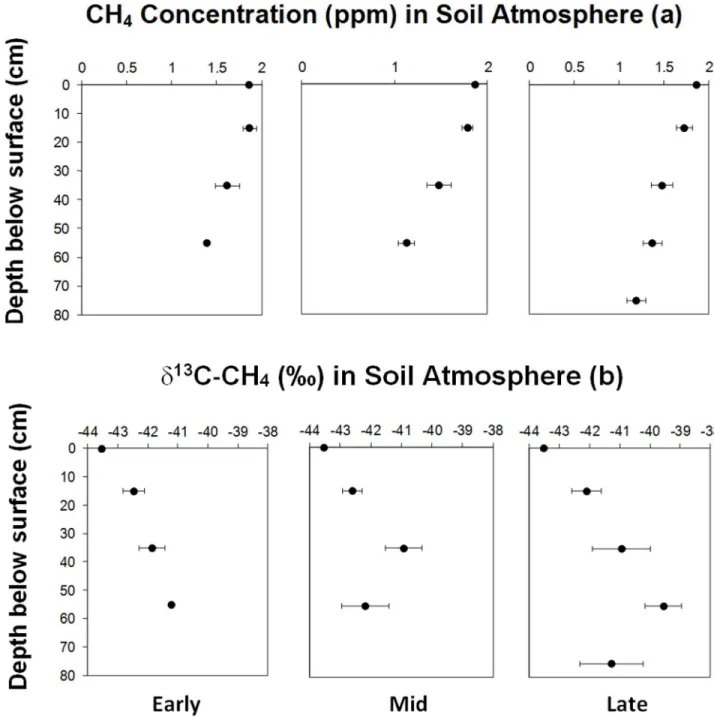
campaign we therefore used a natural abundance stable isotopein situapproach to gain addi-tional insight into CH4processes at depth. For this, a series of sub-surface CH4concentration
measurements were made across the islands at a range of soil depths. These measurements allowed us to initially determine whether we could detect above ambient concentrations of CH4as evidence of active methanogenesis in the soil profile. Concentration of CH4measured
in the humus profile were consistently below ambient levels, suggesting that either methano-genesis was not dominant in these soils during the peak growth season (Fig 3A), or that rapid oxidation of CH4by the methanotroph community was removing any endogenous CH4
pro-duction. Analyses of the stable13/12C isotope ratio of CH4in these samples confirmed that
methanogenesis was not occuring, asδ13C values of13CH4were enriched relative to
atmo-spheric CH4(Fig 3B). It has been shown that methanotrophs preferentially assimilate lighter
isotopes, leaving residual CH4that is13C enriched [24]. Our results demonstrated that both
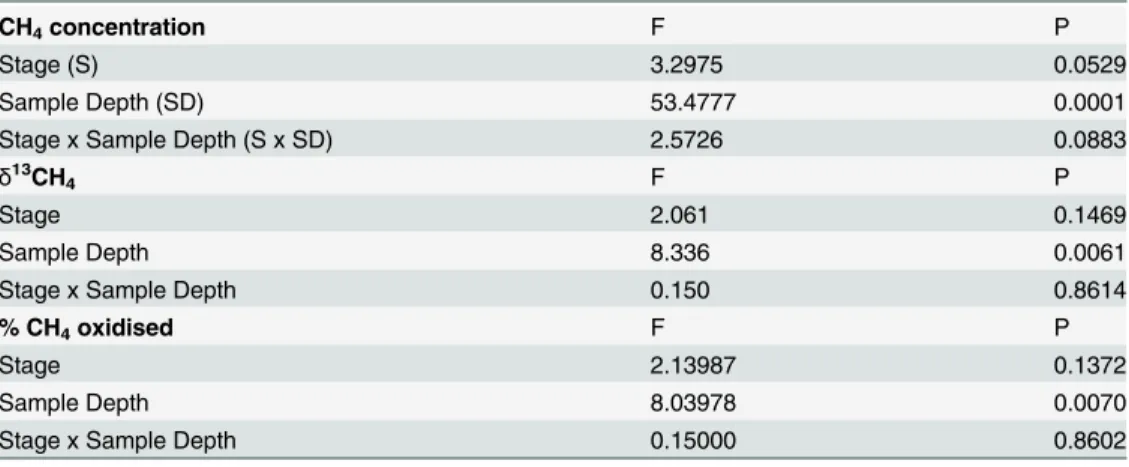
CH4concentrations and theδ13C values of13CH4were strongly influenced by the depth of the
humus profile (Table 2). Using these data, we quantified the CH4oxidation rate at sub-surface
depthsin situusing a‘top-to-bottom difference’13C-CH4modelling approach [24–25]. We found that soils typically oxidised between 2–5% of CH4in the atmosphere (Table 3), with deeper soils leading to a higher cumulative CH4oxidation rate (Table 4). As these soils were
not found to produce CH4, the supply of this substrate to deeper soil profile was from the
atmosphere. This increasing CH4oxidation at depth corresponded to the sub-surface
mini-mum CH4concentrations detected in the humus profile recorded with ourin-situdepth
mea-surements (Fig 3A), and also inex situprofile cores (up to 85 cm) taken during the second field campaign (S2andS3Tables). Collectively, these results support the notion that increasing time since wildfire has indirectly affected the CH4oxidation process by enabling the development of
deeper humus profiles which harbour the niches necessary for methanotrophs.
Our study reveals, for the first time, that across contrasting islands differing in exposure times to historical fire disturbance, net CH4oxidation processes vary predictably. Specifically,
we have shown that low productivity, old growth boreal forest ecosystems that have not burned for up to 5000 years develop deeper humus layers, leading to enhanced soil microbial CH4
oxi-dation. Crucially, our results indicate that disturbance of these humus C stores will threaten the stable microhabitat conditions required for methanotrophs to thrive. In the future, climate change is expected to result in increased wildfire ignitions from lightning and increased fire season length [26]. These same drivers are also expected to increase wildfire severity which will in turn promote soil organic matter loss and methanotrophic community disturbance.
Together, these global changes could reduce the apparent natural CH4sink capacity of late
suc-cession boreal forest soils, with potential feedback to greenhouse gas forced climate warming. Our results indicate that in the absence of human interventions, such as fire suppression, the globally important boreal CH4sink could be diminished by future wildfire events.
Materials and Methods
Ethics Statement
reserves, and the land is public and not government protected. We confirm that all national and international rules were complied with during the field work and no specific permissions were required to access the islands. The research did not involve measurements on humans or animals. The soil and plant material collected for this study had negligible effects on broader ecosystem functioning. We have no commercial interests or conflicts of interest in performing this work.
Fig 3. Meanin situconcentration depth profiles of CH4(a) and distribution ofδ13C-CH4(b) in boreal forest soils.The depth at surface (0 cm) represents the ambient concentration andδ13C-CH4value. Error bars represent±standard error (n = 10). The changes in CH4and CO2concentration and
δ13C-CH4with depth were only significant in mid and late successional stages (P0.05). Statistical analyses of data are shown inTable 2.
Study System
The lakes were formed when the retreat of land ice 9,000 years ago left behind granite and moraine boulders to form the foundation of the current islands. All of these islands are of the same geological age and experience the same climatic conditions, having a mean annual precip-itation of 750 mm and mean temperature of +13°C in July and -14°C in January. All islands are the same distance from the shore irrespective of island size which prevents confounding effects of erosion, wind and radiation. The forested portions of the islands are not subjected to other major disturbances such as flooding and ice formation, as the level of the lake is always below the level of the lowest forested vegetation. The only extrinsic factor which varies among the islands is wildfire frequency [17–19]. The 30 islands are of varying size (0.02 to 15 ha) with lightning strikes being more frequent on larger islands as they have a larger area to intercept these strikes. The age of major wildfire events was previously determined using14C dating of buried charcoal fragments and through examination of fire scars from the last 250 years [17–
20]. These islands collectively form a retrogressive chronosequence, with retrogression increas-ing with decreasincreas-ing island size. A description of island properties is given inS1 Table.
Table 3. Percentage of atmospheric CH4oxidised in the soil profile and statistical analysis of whole profile % CH4oxidised for early, mid and late succession islands.
CH4(%) oxidised at specific depth ranges
Successional Stage 0–15 cm n 0–35 cm n 0–55 cm n 0–75 cm n Whole profile n
Early 1.47 (0.5) 10 2.30 (0.61) 6 3.18 (NA) 1 nd 0 2.02 (0.45)a 10
Mid 1.27 (0.45) 10 3.66 (0.85) 9 1.88 (0.9) 6 nd 0 3.1 (0.83)a 10
Late 1.96 (0.68) 10 3.73 (1.41) 10 5.63 (0.80) 9 3.14 (1.51) 4 5.09 (1.15)a 10
Model assumes transport of CH4in to the soil by diffusion (αtransport= 1.0195). The whole profile estimate considers the total CH4oxidised for the given
depths of humus. Values in brackets are standard errors of the mean. For early and mid islands‘nd’indicates where samples could not be obtained due to a shallow humus depth. The number of depths sampled is given by n. For whole profile analyses values followed by the same letter in subscript indicate no significant difference at P<0.05, F = 2.6129, P = 0.09176, d.f = 2, 27.
doi:10.1371/journal.pone.0129892.t003
Table 4. Statistical analyses for the effects of, and interactions between, depth and sucessional stage onin situprofile CH4concentration,δ13C-CH4and % CH4oxidised.
CH4concentration F P
Stage (S) 3.2975 0.0529
Sample Depth (SD) 53.4777 0.0001
Stage x Sample Depth (S x SD) 2.5726 0.0883
δ13CH4 F P
Stage 2.061 0.1469
Sample Depth 8.336 0.0061
Stage x Sample Depth 0.150 0.8614
% CH4oxidised F P
Stage 2.13987 0.1372
Sample Depth 8.03978 0.0070
Stage x Sample Depth 0.15000 0.8602
df: S = 2, 26, SD = 1, 42, S x SD = 2, 42
Determining
in situ
CH
4fluxes
Thein situgas fluxes were measured over one week using a static chamber method during
August 2006 (n = 5 per island; chamber volume = 0.0054 m3, diameter = 0.2 m). Cylindrical chamber base rings were installed and subsequently removed on the day of measurement. The installation involved gently cutting the base ring into the humus to 5 cm depth. Headspace gas samples, 9 ml, were drawn at 0, 5, 10, 15, 20, 25 and 30 minutes after an opaque chamber lid was sealed onto the base ring. Samples were stored in exetainer vials (Labco, UK) for up to one month prior to analyses. Concentrations of CH4were analysed by gas chromatography, on a
PerkinElmer Autosystem XL Gas Chromatograph (GC) with Flame Ionization Detector, and results were calibrated using certified gas standards. CH4was separated isothermally on a 2 m
Poropak Q 50–80 mesh packed column at 40°C, with N2as the carrier gas. The mean detectable concentration change was 0.05 ppm CH4which was equivalent to 3μg CH4m-2hr-1[27].
Where fluxes fell below this detection limit they were still included in the analyses following others [27–29]. Calculations of the rates of exchange of CH4are based on a standard linear regression methodology [30].
Determining
ex situ
CH
4fluxes from intact cores
We measured CH4fluxes fromex situcores from the top 25 cm of soil (or to the bedrock
where soil depth was less than 25 cm) in 2006 and then through the entire humus profile to the bedrock (20–85 cm depth) in 2007. In August 2006, four intact cores (11 cm diameter, 25 cm depth) were removed from each island (40 per island size classification) and were weighed on the day of collection. Cores were stored at 12°C in the dark until measurement and were main-tained at their field collected moisture content using an artificial rain solution. The artificial rain solution was made up according to a formula which results in rainwater with a pH of 5.6 with a conductivity of 22.4μS (S4 Table). Cores were grouped into late, mid and early succes-sional stage dependent upon the island from which they were removed (n = 10). Soil CH4
fluxes were measured using the static chamber method (volume = 0.0008 m3) with sampling at 0, 30, 60, 90, 120 and 150 minutes after headspace closure. In 2007, one full profile core (0.15 m diameter) was collected from each island humus profile to the bedrock in July 2007. A simi-lar static chamber approach (volume = 0.0021 m3, diameter = 0.15 m) for measuring soil CH4
fluxes, applied under the same measurement conditions as previously described. Sample stor-age using 3.6 ml exetainers vials, GC analysis and data analysis was as described for thein situ
CH4sample analyses. Soil moisture was calculated after drying soils in an oven at 105°C until
no further moisture loss was recorded.
In situ
depth profiles of
δ
13CH
4and concentrations of CH
4, and CO
2In situgas samples were collected from within the soil atmosphere in the humus profiles of
each island over 4 days in July 2007. Four stainless steel sampling probes (19 gauge, 0.69 mm inner diameter) were inserted into the soil profiles 30 minutes before soil atmosphere samples were collected at 15, 35, 55 and 75 cm depth (dead-space volume = 0.06, 0.13, 0.21, 0.28 ml, respectively). From each probe a 100 ml sample was collected with 90 ml being transferred to a 50 ml Wheaton bottle with butyl rubber stopper and crimp top seals and 9 ml to a 3.6 ml exe-tainer vial. After collection each butyl rubber stopper and crimp top was sealed with wax. Anal-yses of theδ13C values of CH
4were completed within one month at the Natural
and CO2. The CH4was then oxidized in a combustion furnace using a braided platinum/copper/
nichrome furnace wire inside a ceramic furnace tube of 200 mm x 0.4 mm i.d. heated in a furnace at 950°C. A preparation flow rate of 10 psi was required to give a flow rate of 20 ml min-1through the furnace at full operating temperature. Precisions were better than or equal to 0.2‰. The
δ13C of CH4was expressed in per mil and calculated with respect to Pee Dee Belemnite (PDB).
Reference CO2was calibrated to National Institute of Standard Technology (NIST) certified
ref-erence materials (N.I.S.T. 8559 and 8561) and working CH4standards (Scientific and Technical
Gases Ltd).
Isotopic method to determine the quantity of CH
4oxidised
Non-equilibrium or kinetic isotope effects (KIEs) associated with methanotrophy in soils are denoted using the isotope fractionation factor (α
ox). The KIE represents the different rates of
uptake of the CH4isotopologues (12CH4,13CH4), withαoxbeing the ratio of the rate constants
of isotopically light and heavy CH4for both physical and biological processes associated with
methanotrophy in soil [24–25]. The resultant isotopic fractionation factor for CH
4oxidation
(α
ox) is known to vary across boreal soils [24], therefore it was necessary to determineαoxfor
each island. A straightforward and effective method of determiningα
oxis by using the‘
Top-to-Bottom’δ13C-CH
4approach [24–25]. This allows the determination of the fraction of
atmo-spheric CH4as it passes through soil layers. It involves calculating the difference inδ13C-CH4
values from atmospheric CH4samples and samples taken from the soil atmosphere at depth.
This difference is then added to 19.7‰to take account of fractionation by gas diffusion through the soil due to the higher translational velocity of12CH4versus13CH4in air filled
pores spaces. Diffusion of CH4into the soil tends to result in isotopic depletion as12CH4
dif-fuses more quickly along its gradient than13CH4causing12CH4to travel further in soil pore
space. During the process of CH4oxidation the remaining CH4becomes heavier as12CH4is
more readily oxidised by methanotrophs. The calculated isotope fractionation factors (α
ox) for
this work are given inS4 Table.
To determine the fraction of CH4oxidised by boreal forest soils, a mass balance model was
used that accounted for the fractionation effects of both biological oxidation and transport of CH4from the atmosphere. The model is adapted from previous work that estimated CH4
oxi-dation in landfill [31] cover soils, but has since been used in natural systems to investigate CH4
cycling in humid tropical forests [32].Eq 1describes the model:
Fo¼ ðd
soil datmosÞ=½ðaox atransÞ 1000 Eq1
where Forepresents the fraction of CH4oxidised. To calculate the percentage of CH4oxidised,
Fois multiplied by 100.δsoilandδatmosrepresent the isotopic composition (‰) of CH4at soil
depths and atmosphere respectively.α
transis the isotopic fractionation associated with gas
transport. There is no method to directly calculateα
trans. Other studies have assumed
move-ment of CH4by advective transport [31] which involves no isotopic fractionation of CH4giving
aα
transvalue of 1. Using this value can result in an underestimation of CH4oxidation. As in
this study, it was not possible to calculateα
trans, Fowas calculated usingαtransvalues of 1.0195,
which is the diffusion fractionation factor reported for temperate forest soils [33].
Ecosystem properties
GmbH, Hanau, Germany). In July 2007 the humus depth of each island was assessed by taking ten depth measurements along a transect across approximately the centre of each island. Depths were sampled at equal intervals by inserting a metal rod to the bedrock. Additional existing information on vegetation mass, shrub productivity, tree productivity and humus mass are as reported previously [17–20].
Statistical Analyses
All analyses were conducted with the R statistical program (R Development Core Team, 2011). Simple regression analyses were used to model the relationship between response variables and predictors (successional age of system from14C dating, humus development). Differences in island soil moisture content,in situandex situCH4fluxes between successional stages (Early,
Mid and Late) were tested with theglmfunction. This same approach was applied when testing for differences between the quantity of CH4oxidised for successional stages using the stable
isotope approach. A constant value, equal to lowest datapoint + 1, was added to each datapoint to ensure all data were non-negative and a quasi-likelihood function with a log link and con-stant variance parameter used to account for the non-normal distribution. Differences in other CH4measures (CH4concentration,δ13C of CH4and % CH4oxidised) across successional
stages and soil depths were tested with a linear mixed effect model using thelmefunction in thenlmepackage. Island was included as a random term to account for dependencies between measures made on the same core. Diagnostic plots of residuals versus fitted values were inspected to ensure there was no bias or heteroscedasticity in model residuals.
Supporting Information
S1 Table. Changes in island properties for each successional class across the island size gra-dient.
(DOCX)
S2 Table. Mean CH4concentration (ppm) in soil air ofex situcores at stratified depths. (DOCX)
S3 Table. Statistical analyses for the effects of, and interactions between, depth and succes-sional stage onex situprofile CH4concentrations.
(DOCX)
S4 Table. Kinetic Isotope Effect (KIE) for soil methanotrophy on early, mid and late succes-sion islands.
(DOCX)
S5 Table. Artificial Rain Solution. (DOCX)
Acknowledgments
We thank Micael Jonsson for support in the field and Helen Grant for stable isotope analyses. We thank Aidan Keith and Peter Henrys for statistical advice.
Author Contributions
reagents/materials/analysis tools: NPM NJO JCM AS. Wrote the paper: NPM JCM MdTR DAW RDB NJO.
References
1. Zhang Y-H, Wooster MJ, Tutubalina O, Perry GLW (2003) Monthly burned area and forest fire carbon emission estimates for the Russian Federation from SPOT VGT. Remote Sens Environ 87: 1–15. 2. Bradshaw CJA, Warkentin IG, Sodhi NS (2009) Urgent preservation of boreal carbon stock and
biodi-versity. Trends Ecol Evol 24: 541–548. doi:10.1016/j.tree.2009.03.019PMID:19679372
3. Soja AJ, Tchebakova NM, French NHF, Flannigan MD, Shugart HH, Stocks BJ, et al. (2007) Climate-induced boreal forest change: Predictions versus current observations. Global Planet Change 56: 274–296.
4. Girardin G, Ali AA, Carcaillet C, Mudelsee M, Drobyshev I, Hély C et al. (2009) Heterogeneous response of circumboreal wildfire risk to climate change since the early 1900s. Global Change Biol 15: 2751–2769.
5. Chuvieco E, Englefield P, Trishchenko AP, Luo Y (2008) Generation of long time series of burn area maps of the boreal forest from NOAA–AVHRR composite data. Remote Sens Environ 112: 2381– 2396.
6. Kasischke ES, Hyer EJ, Novelli PC, Bruhwiler LP, French NHF, Sukhinin AI, et al. (2005) Influences of boreal fire emissions on Northern Hemisphere atmospheric carbon and carbon monoxide. Global Bio-geochem Cy 19: GB1012. doi:10.1029/2004GB002300
7. Kasischke ES, Bruhwiler LP (2002) Emissions of carbon dioxide, carbon monoxide, and methane from boreal forest fires in 1998. J Geophys Res 107: 8146.
8. Ohlson M, Dahlberg B,Økland T, Brown KJ, Halvorsen R (2009) The charcoal carbon pool in boreal for-est soils. Nature Geosci 2: 692–695.
9. Pluchon N, Gundale MJ, Nilsson M-C, Kardol P, Wardle DA (2014) Stimulation of boreal tree seedling growth by wood-derived charcoal: effects of charcoal properties, seedling species and soil fertility. Funct Ecol 28: 766–775.
10. Trotsenko YA, Murrell JC (2008) Metabolic aspects of aerobic obligate methanotrophy. Adv Appl Micro-biol 63: 183–229. doi:10.1016/S0065-2164(07)00005-6PMID:18395128
11. Smith KA, Dobbie KE, Ball BC, Bakken LR, Sitaula BK, Hansen S, et al. (2000) Oxidation of atmo-spheric methane in Northern European soils, comparison with other ecosystems, and uncertainties in the global terrestrial sink. Global Change Biol 6: 791–803.
12. Burke RA, Zepp RG (1997) Effect of fire on soil-atmosphere exchange of methane and carbon dioxide in Canadian boreal forest sites. J Geophys Res 102: 29289–29300.
13. Jaatinen K, Knief C, Dunfield PF, Yrjälä K, Fritze H (2004) Methanotrophic bacteria in boreal forest soil after fire. FEMS Microbiol Ecol 50: 195–202. doi:10.1016/j.femsec.2004.06.013PMID:19712360
14. Priemé A, Christensen S (1999) Methane uptake by a selection of soils in Ghana with different land use. J Geophys Res 104: 23617–23622.
15. Gathany MA, Burke IC (2011) Post-fire soil fluxes of CO2, CH4and N2O along the Colorado Front
Range. Int J Wildland Fire 20: 836–846.
16. Nakano T, Takeuchi W, Inoue G, Fukuda M, Yasuoka Y (2006) Temporal variations in soil-atmosphere methane exchange after fire in a peat swamp forest in West Siberia. J Soil Sci Plant Nut 52: 77–88. 17. Wardle DA, Zackrisson O, Hörnberg G, Gallet C (1997) Influence of island area on ecosystem
proper-ties. Science 277: 1296–1299.
18. Wardle DA, Hörnberg G, Zackrisson O, Kalela-Brundin M, Coomes DA (2003) Long term effects of wild-fire on ecosystem properties across an island area gradient. Science 300: 972–975. PMID:12738863
19. Wardle DA, Zackrisson O (2005) Effects of species and functional group loss on island ecosystem properties. Nature 435: 806–810. PMID:15944702
20. Wardle DA, Jonsson M, Bansal S, Bardgett RD, Gundale MJ, Metcalfe DB (2011) Linking vegetation change, carbon sequestration and biodiversity: insights from island ecosystems in a long term natural experiment. J Ecol 100: 16–30.
21. Reay DS, Nedwell DB, McNamara N, Ineson P (2005) Effect of tree species on methane and ammo-nium oxidation capacity in forest soils. Soil Biol Biochem 37: 719–730.
23. Knief C, Kolb S, Bodelier PLE, Lipski A, Dunfield PF (2005) The active methanotrophic community in hydromorphic soils changes in response to changing methane concentration. Environ Microbiol 8: 321–333.
24. Reeburgh WS, Hirsch AJ, Sansone FJ, Popp BN, Rust BN (1997) Carbon kinetic isotope effect accom-panying microbial oxidation of methane in boreal forest soils. Geochim Cosmochim Ac 61: 4761–4767. 25. Maxfield PJ, Evershed RP, Hornibrook ERC (2008) Physical and biological controls on the in situ kinetic isotope effect associated with oxidation of atmospheric CH4in mineral soils. Environ Sci Technol 42:
7824–7830. PMID:19031867
26. Beck PSA, Goetz SJ, Mack MC, Alexander HD, Yufang J, Randerson JT, et al. (2011) The impacts and implications of an intensifying fire regime on Alaskan boreal forest composition and albedo. Global Change Biol 17: 2853–2866.
27. McNamara NP, Black HIJ, Piearce TG, Reay DS, Ineson P (2008) The influence of afforestation and tree species on soil methane fluxes from shallow organic soils at the UK Gisburn Forest Experiment. Soil Use Manage 24: 1–7.
28. Chan ASK, Parkin TB (2001) Effect of land use on methane flux from soil. J Environ Qual 30: 786–797. PMID:11401268
29. Sjögersten S, Wookey PA (2002) Spatio-temporal variability and enviromental controls of methane fluxes at the forest-tundra ecotone in the Fennoscandian mountains. Global Change Biology, 8, 885– 895.
30. Holland EA, Robertson GP, Greenberg J, Groffman PM, Boone RD, Gosz J, et al. (1999) Soil CO2,
N2O, and CH4Exchange. In: Robertson GP, Coleman DC, Bledsoe CS, Sollins P. editors. Standard
Soil Methods for Long-Term Ecological Research. Oxford University Press.
31. Liptay A, Chanton J (1998) Use of stable isotopes to determine methane oxidation in landfill cover soils. J Geophys Res 103: 8243–8250.
32. Teh YA, Silver WL, Conrad ME (2005) Oxygen effects on methane production and oxidation in humid tropical forest soils. Global Change Biol 11: 1283–1297.