www.biogeosciences.net/9/5291/2012/ doi:10.5194/bg-9-5291-2012
© Author(s) 2012. CC Attribution 3.0 License.
Biogeosciences
Non-microbial methane formation in oxic soils
A. Jugold1, F. Althoff1, M. Hurkuck1,2, M. Greule1, K. Lenhart1, J. Lelieveld1, and F. Keppler1 1Max-Planck-Institute for Chemistry, Hahn-Meitner-Weg 1, 55128 Mainz, Germany
2Johann Heinrich von Th¨unen-Institute, Institute of Agricultural Climate Research, Bundesallee 50,
38116 Braunschweig, Germany
Correspondence to:F. Keppler ([email protected])
Received: 16 July 2012 – Published in Biogeosciences Discuss.: 3 September 2012
Revised: 24 November 2012 – Accepted: 26 November 2012 – Published: 20 December 2012
Abstract.Methane plays an important role as a radiatively and chemically active gas in our atmosphere. Until recently, sources of atmospheric methane in the biosphere have been attributed to strictly anaerobic microbial processes during degradation of organic matter. However, a large fraction of methane produced in the anoxic soil layers does not reach the atmosphere due to methanotrophic consumption in the overlaying oxic soil. Although methane fluxes from aerobic soils have been observed, an alternative source other than methanogenesis has not been identified thus far.
Here we provide evidence for non-microbial methane for-mation in soils under oxic conditions. We found that soils re-lease methane upon heating and other environmental factors like ultraviolet irradiation, and drying-rewetting cycles. We suggest that chemical formation of methane during degra-dation of soil organic matter may represent the missing soil source that is needed to fully understand the methane cycle in aerobic soils. Although the emission fluxes are relatively low when compared to those from wetlands, they may be important in warm and wet regions subjected to ultraviolet radiation. We suggest that this methane source is highly sen-sitive to global change.
1 Introduction
Traditionally, biogenic methane (CH4) was thought to be
formed only by methanogens under strictly anaerobic con-ditions in wetland soils and rice paddies, intestinal tracts of termites and ruminants, and human and agricultural waste. However, Keppler et al. (2006) demonstrated that plants produce CH4 under aerobic conditions. Subsequently, this
possibility has been critically debated (Dueck et al., 2007;
Ferretti et al., 2007; Kirschbaum et al., 2007; Keppler and R¨ockmann, 2007; Vigano et al., 2008; Wang et al., 2008; Nisbet et al., 2009; Keppler et al., 2009; Beerling et al., 2008) and some researchers have suggested alternative ex-planations for the observed release of CH4from plants
(Nis-bet et al., 2009; Kirschbaum and Walcroft, 2008; Terazawa et al., 2007). Nevertheless, recent observations have provided unambiguous evidence for several pathways by which CH4
is generated under aerobic conditions, independent of micro-bial activity (Wang et al., 2008; Keppler et al., 2008; McLeod et al., 2008; Cao et al., 2008; Bruhn et al., 2009; Messenger et al., 2009; Br¨uggemann et al., 2009; Qaderi and Reid, 2009; Althoff et al., 2010). Although details of the mechanism(s) are still unknown, methoxy groups of plant pectin have been identified in several studies as a precursor compound of aero-bic CH4emission from detached plant matter (Vigano et al.,
2008; Keppler et al., 2008; McLeod et al., 2008) (Bruhn et al., 2009). Furthermore, temperature and UV-light have been confirmed as environmental factors that control CH4
emis-sion from dried plant matter (Vigano et al., 2008; Keppler et al., 2008). Next to plants, saprotrophic fungi were also re-cently found to produce CH4 in their own metabolism and
without assistance of methanogenic archaea (Lenhart et al., 2012).
1.1 Previous observations of methane formation in aerobic soils
Whilst aerobic soils are considered to be net CH4sinks due
to methanotrophic oxidation of CH4, it has been shown that
oxic upland forest soils produce CH4. Although
observa-tions of CH4production in oxic soil are numerous
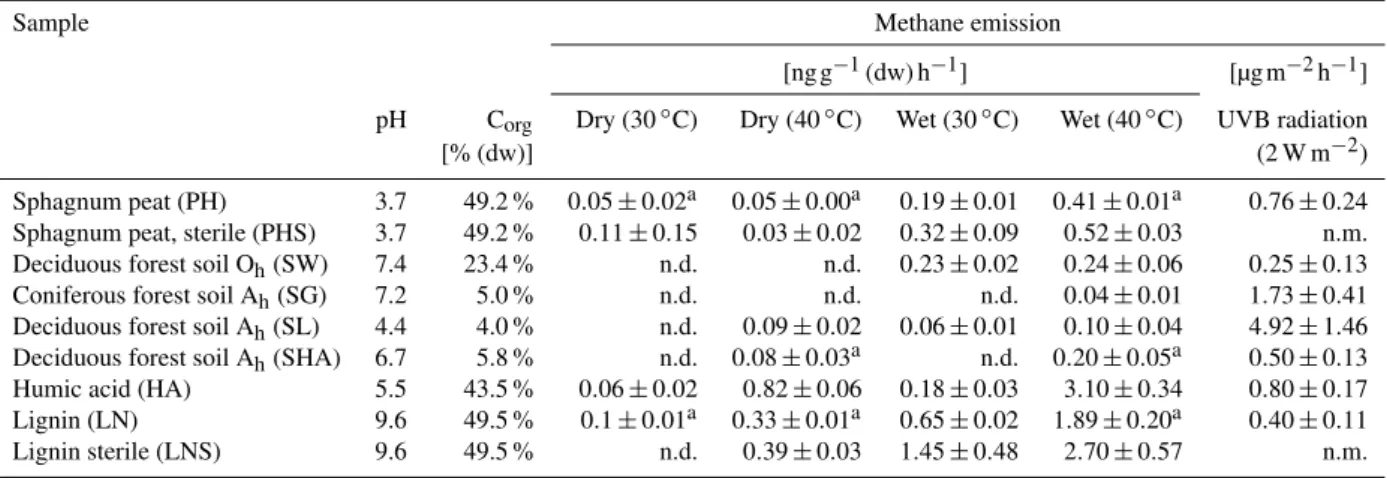
Table 1.Organic carbon content, pH value and CH4emissions from dry and wetted samples heated at 30 and 40◦C and under UV irradiation of different soils and soil components at 30◦C.
Sample Methane emission
[ng g−1(dw)h−1] [µg m−2h−1]
pH Corg Dry (30◦C) Dry (40◦C) Wet (30◦C) Wet (40◦C) UVB radiation
[% (dw)] (2 W m−2)
Sphagnum peat (PH) 3.7 49.2 % 0.05±0.02a 0.05±0.00a 0.19±0.01 0.41±0.01a 0.76±0.24
Sphagnum peat, sterile (PHS) 3.7 49.2 % 0.11±0.15 0.03±0.02 0.32±0.09 0.52±0.03 n.m.
Deciduous forest soil Oh(SW) 7.4 23.4 % n.d. n.d. 0.23±0.02 0.24±0.06 0.25±0.13
Coniferous forest soil Ah(SG) 7.2 5.0 % n.d. n.d. n.d. 0.04±0.01 1.73±0.41
Deciduous forest soil Ah(SL) 4.4 4.0 % n.d. 0.09±0.02 0.06±0.01 0.10±0.04 4.92±1.46
Deciduous forest soil Ah(SHA) 6.7 5.8 % n.d. 0.08±0.03a n.d. 0.20±0.05a 0.50±0.13
Humic acid (HA) 5.5 43.5 % 0.06±0.02 0.82±0.06 0.18±0.03 3.10±0.34 0.80±0.17
Lignin (LN) 9.6 49.5 % 0.1±0.01a 0.33±0.01a 0.65±0.02 1.89±0.20a 0.40±0.11
Lignin sterile (LNS) 9.6 49.5 % n.d. 0.39±0.03 1.45±0.48 2.70±0.57 n.m.
Subscript h indicates soil horizon, Corgis organic carbon content, PH is peat Hille, Germany; SW is soil H¨averst¨adt, Wiehen Mountains, Germany; SG is soil Gonsenheim, Germany; SL is soil Lerchenberg, Germany; SHA is soil Hainich, Germany; n.d. is not detectable (rate cannot be provided as increase in headspace CH4was less than 0.02 ppm); n.m. is not measured;adata from Hurkuck et al. (2012). Data show mean value±SD (n=3–5).
to methanogenesis. Methane production by oxic eubacteria (Rimbault et al., 1988) and anaerobic microsites, a refuge for methanogens (Peters and Conrad, 1995), were offered as possible explanations even though CH4production from
eubacteria could only be detected in trace quantities. In ex-periments by Kammann et al. (2009), soil cores emitted up to 4.58 µg kg−1d−1CH
4 per core even after
homogeniza-tion, which may be expected to lead to the destruction of anoxic microsites. Von Fisher and Hedin (2007), using sta-ble carbon isotope studies, showed that our understanding of CH4formation in oxic soils is incomplete and discussed that
methanogens as the sole source for CH4in oxic soils should
be critically reviewed.
1.1.1 Possibility of non-microbial methane formation in soil
In this study we tested the previously postulated hypothe-sis that non-microbial CH4formation occurs in soils (Jugold
and Keppler, 2009; Hurkuck et al., 2012). Following pre-liminary observations, we undertook a series of experiments measuring CH4formation from soils (see Table 1 and
Meth-ods section) as a function of temperature, water content and UV-B irradiation. We used five different soils, including one highly organic soil (referred to as peat, Table 1), which had been lyophilised and homogenized prior to the experiments. Humic acid and lignin were used as alternatives for soil or-ganic matter. Additionally, subsamples of peat and lignin, sterilised using gamma radiation, were also used in our in-vestigations. Finally, inhibitors of methanogenic microorgan-isms were tested in order to further prove the hypothesis of non-microbial CH4formation in soil.
1.2 Materials and methods
1.2.1 Origin of samples and preparation
Four soils and one peat type were used. If present, stones and larger wood particles were removed from the samples before they were lyophilised and then milled using an elec-tronic coffee grinder (Elta UM105).
Soil SL was sampled at the Lerchenberg forest south of Mainz, Germany (49◦ 57′47′′N 8◦11′01′′E). The sampling site is a deciduous forest dominated by beech trees (Fagus sylvatica), featuring few oaks and nearly no undergrowth. The sample was collected from the surface after brushing away the layer of leaf litter.
For soil SG the upper 10 cm of a pine forest soil was sampled at Mainz-Gonsenheim, Germany (50◦0′24.4′′N, 8◦11′50.3′′E). The soil in this area is rich in medium to coarse sand and powdery clay particles. It also contains rot-ting wood debris, pine twigs and is densely rooted.
Soil SHA was topsoil of aterra fuscasampled at the Na-tionalpark Hainich, Germany (51◦04′46′′N, 10◦27′08′′E). The sampling site is a deciduous forest dominated by beech trees.
Soil SW was collected from the organic rich O-horizon of a deciduous forest soil. The vegetation is dominated by beech trees. The sampling site is situated south of Minden, Germany (52◦15′17.4′′N, 8◦52′29.5′′E).
Peat PH was sampled at the peat bog Großes Torfmoor
1.3 Exposure toγ-radiation
Sterilisation of the soil samples was performed by exposure toγ-radiation using a60Co source (dose, 25 kGy; dose rate, 2.2 kGy h−1; temperature, 4◦C).
1.4 Reaction vials
Samples were incubated in glass vials (360 ml); made in-house by modification of a 300 ml Erlenmeyer-flask (Duran group) fitted with the neck of a 40 ml screw top vial (Su-pelco) sealed with a hole type screw cap (Su(Su-pelco) containing a PTFE/silicone septum (Supelco). The UV reaction cham-bers were also custom built; 200 ml glass chamcham-bers with a quartz glass lid and a septa sealed side port for headspace sampling. The irradiated surface was 19.63 cm2.
1.5 Determination of organic carbon
Organic carbon content of the samples was determined with an SC Analyser (SC-144 DR, LECO) by combustion of 0.1– 0.5 g of sample material at 1300◦C. The carbon content was calculated by comparison to a calcium carbonate standard. For soil SW, the organic carbon content was determined by loss on ignition. Therefore the weight loss after two hours at 600◦C was determined. Half of the loss was assigned to carbon combustion.
1.6 Methane measurements
Headspace above samples in the sealed vials were sampled (5 ml) with a Hamilton gas syringe and analysed using a gas chromatograph (Shimadzu GC-14B) with flame ionization detector (GC-FID). Two reference CH4 standards
(contain-ing 8.905 ppm and 1.736 ppm) were used.
1.7 Statistical methods
The statistical comparison of different samples was exam-ined with the software package SPSS version 20 (Chicago, IL, USA). The Student’s t-test was employed to evaluate statistical difference in CH4 content between the various
inhibitor treatments. Levels of significances were defined as follows:P <0.001 highly significant andP >0.05 non-significant.
1.8 Experimental setups
1.8.1 Temperature dependence
Sets of non-sterile and sterile peat samples (PH, 5 g per 360 ml screw cap vial,n=5) as well as non-sterile sets of each soil sample were incubated for 24 h at temperatures ranging from 30 to 90◦C at 10◦C intervals. At the end of the incubation period, a sample of the vial headspace was analysed for CH4content.
1.8.2 Drying-rewetting cycles
Peat PH (5 g in 360 ml screw cap vials,n=5) was incubated for 24 h at either 30, 40 or 50◦C. Another set of samples was incubated under the same conditions but supplemented with 5 ml of double distilled water. After incubation a sample of the headspace was analysed for CH4 content. The samples
were frozen and lyophilised again directly after measure-ments. After being rewetted and incubated again, headspace samples were analysed again for CH4. This cycle was
re-peated five times.
In a further experiment, dependence of CH4 release on
the water-sample-ratio was investigated. For this, samples of peat PH (5 g in 360 mL screw cap vials,n=5) were supple-mented with 1, 5 and 10 ml double distilled water.
1.8.3 Inhibition of methanogenic microorganisms
Non-sterile peat (PH) and lignin samples (5 g per 360 ml screw cap vial, n=3) were used with the inhibitors 2-bromoethanesulfonate, (BES) and chloromethane (CH3Cl)
of methanogenic microorganisms (Chidthaisong and Conrad, 2000; Chan and Parkin, 2000). Five ml of a 10 mm BES aqueous solution was added to the sample so that the wa-ter content was 50 %. This concentration has been shown to completely inhibit methanogenesis or acetate metabolism in both pure culture of microorganisms and in environmental samples (Oremland and Capone, 1988).
Approximately 3 ml of gaseous CH3Cl was added to the
sample so that the mixing ratio in the vial was around 0.8 %. Chan and Parkin (2000) reported that at a mixing ratio of 0.1 % CH3Cl inhibited soil methanogenesis by 89 %. The
samples were incubated for 24 h at 50◦C and then a sam-ple of the vial headspace was analysed for CH4content.
1.8.4 Activity of methanogenesis
For enrichment of possible methanogenic microorganisms in the soils samples, aliquots of the peat and lignin were incubated in defined, anaerobically prepared bicarbonate-buffered, sodium sulfide-reduced methanogenic mineral me-dia (Widdel and Bak, 1992). As substrates, sterile solu-tions of methanol (50 mm) and acetate (10 mm) and ster-ile hydrogen gas (80 %) were added to each vial (100 ml). The headspace (approximately 50 ml) of the sealed vial was flushed with N2-CO2to remove oxygen. Afterwards the vials
were incubated for 10 days at 25◦C. The control was pre-pared in the same way except that sterile water was added instead of the enrichment culture.
1.8.5 Experiments with H2O2
Samples PH or SHA (5 g in 360 ml vials,n= 3) and 10 ml aqueous solution with varying concentrations of H2O2(0–
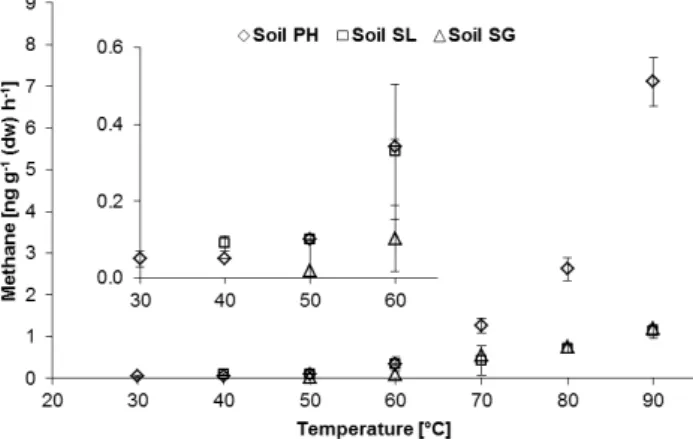
Fig. 1. Formation of CH4 from soil with increasing temperature. Temperature dependence of CH4emissions from peat PH, soil SL and soil SG. Data show mean value±SD (n= 5). Inset shows mag-nified area between 30 and 60◦C.
of the vial headspace was analysed for CH4content. The
ex-periment was also repeated for lignin and humic acid with 25 mm H2O2.
1.8.6 UV irradiation experiments
An Osram Ultra-Vitalux lamp (300 W) served as UV source. The radiation of this lamp shows an UV-A/UV-B content comparable to solar radiation when the source is located at the appropriate distance. The total unweighted UV-B radia-tion was determined with a UV radiometer (UVlog, sglux, Berlin, Germany) precalibrated for the used lamp type. For more details of the lamp characteristics we refer to Vigano et al. (2008). The UV lamp was placed above the leak-tight UV reaction chambers. The height was adjusted so as to set the UV-B intensities to the desired value between 1 and 4 W m−2. To exclude undesired UV-C radiation, the quartz glass lids were covered with a 95 nm film of cellulose diac-etate. Two fans were employed in order to keep the temper-atures in the chambers at 30◦C (±2◦C). Temperature was monitored with a thermocouple. All experiments were con-ducted with 2–5 g of sample material but the data is presented based on irradiated area rather than sample weight. Methane concentrations in the headspace were measured after 0, 24 and 48 h. The difference between 0 and 24 h was used to cal-culate emission rates.
The emissions induced solely by UV-B were calculated by subtracting the CH4concentration measured for the control
samples from that measured for the UV irradiated samples so as to eliminate the temperature effect. The temperature mon-itored in the vials during UV experiments ranged from 28 to 32◦C. The control samples, which were also placed under the UV lamp, but covered with UV-opaque glass, showed emissions (transferred to ng g−1 (dw) h−1) comparable to those observed for the temperature experiments which were incubated in the dark at similar temperatures.
1.8.7 Isotopic data
δ13C sample analysis was carried out using gas chromatog-raphy combustion isotope ratio mass spectrometry (GC-C-IRMS) which consisted of a cryogenic pre-concentration unit directly coupled to an HP 6890 N gas chromatograph (Agilent, Santa Clara, USA), which was connected to a DeltaPLUSXL isotope ratio mass spectrometer (Thermo-Quest Finnigan, Bremen, Germany) via an oxidation re-actor (ceramic tube (Al2O3), length 320 mm, 0.5 mm i.d.,
with oxygen activated Cu/Ni/Pt wires inside, reactor tem-perature 960◦C) and a GC Combustion III Interface (Ther-moQuest Finnigan, Bremen, Germany). The gas chromato-graph (GC) was fitted with a GS-Carbonplot capillary col-umn (30 m×0.32 mm i.d.,df 1.5 µm; Agilent, Santa Clara,
USA) and a PoraPlot capillary column (25 m×0.25 mm i.d.,
df8 µm; Varian, Lake Forest, USA). Both columns were
cou-pled using a press fit connector.
A tank of high-purity carbon dioxide (carbon dioxide 4.5, Messer Griesheim, Frankfurt, Germany) with a knownδ13C value of –23.6 ‰(VPDB) was used as the working reference gas. Allδ13C values obtained from analysis of methane were corrected using three CH4working standards (isometric
in-struments, Victoria, Canada) calibrated against IAEA and NIST reference substances. The calibratedδ13C values of the three working standards in ‰ vs. VPDB were –23.9 0.2 ‰ , –38.3 0.2 ‰ and –54.5 ± 0.2 ‰.
All13C/12C -isotope ratios are expressed in the conven-tionalδnotation in per mil versus VPDB, defined as (Eq. 1):
δ13C=((13C/12C)sample/(13C/12C)standard)−1 (1)
2 Results
2.1 Temperature dependence
The first experiment was designed to determine the temperature dependence and the required activation en-ergy of CH4 formation in a deciduous forest soil (SL),
a coniferous forest soil (SG) and a sphagnum peat sample (PH). Samples were incubated at temperatures ranging from 30 to 90◦C. Methane emissions reached 7.11±0.59 ng g−1 (dw) h−1, 1.19
±0.15 ng g−1 (dw) h−1
and 1.12±0.16 ng g−1(dw) h−1at 90◦C for PH, SG and SL,
respectively (Fig. 1). Whereas CH4release could be observed
for PH and SL at 30◦C and 40◦C respectively (Table 1), CH4 release from SG was only measurable above 50◦C. Soil SHA which had a similar organic carbon content to soils SL and SG (Table 1) was also investigated, and CH4 emissions of
0.45±0.02 ng g−1(dw) h−1at 70◦C were observed. For all samples the temperature curves showed an exponential in-crease of CH4emissions with temperature. Interestingly, the
0.0 0.1 0.2 0.3 0.4 0.5 0.6 0.7 0.8 0.9
dry cycle 1 cycle 2 cycle 3 cycle 4 cycle 5
M
e
th
a
n
e
[
n
g
g
-1
(d
w
)
h
-1]
30 °C
40 °C
50 °C
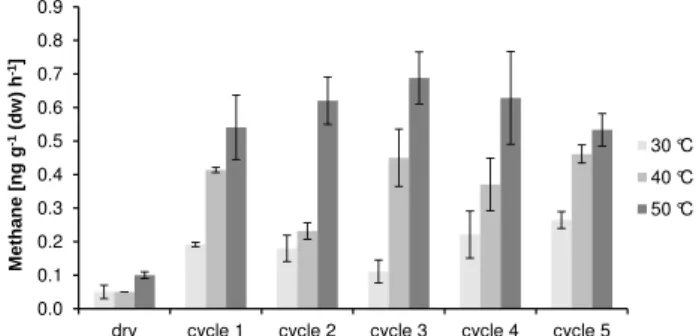
Fig. 2.Methane formation from wetted and dry peat samples. Effect of repeated wetting and drying cycles on CH4release from peat PH at 30, 40 and 50◦C. Data show mean value±SD (n= 5).
and Vigano et al. (2008) for heated plant matter. Whereas bi-otically mediated reactions usually have their optimum tem-peratures between 25 and 40◦C (Dunfield et al., 1993) the observed strong increase in CH4emissions over the whole
temperature range from 30 to 90◦C supports a chemically driven process. Furthermore, sterile peat samples (exposed toγ-radiation) showed similar or slightly higher emissions of CH4when compared to untreated peat samples. The fact
that the emissions were not reduced in the sterile sample is further evidence for a non-microbial pathway. The slightly higher emissions observed for some of the sterile samples may possibly be ascribed to CH4production during the
ster-ilisation process.
Since humic substances are usually the main constituents of organic-rich soils, commercially available lignin and hu-mic acid were investigated for CH4 release. These
sub-stances, with an organic carbon content of 49.5 % and 43.5 % respectively, when similarly heated up to 90◦C, showed even higher CH4emissions (at 30◦C 0.1±0.01 ng g−1 (dw) h−1
for lignin and at 90◦C 18.3±0.4 and 6.6±0.9 ng g−1 (dw) h−1 for lignin and humic acid, respectively) than the organic-rich soil PH. The similar dependence of CH4
for-mation in soils and organic soil components on temperature strongly suggests that the organic soil fraction is the source of CH4thermally produced in soils.
The experimental data obtained from samples SL, SG and PH were used to draw Arrhenius plots for CH4
for-mation (Supplementary Fig. S1). The activation energies (Ea)for CH4formation, calculated from these plots, yielded
values of 50.1 kJ mol−1 for SL, 77.5 kJ mol−1 for SG and
79.2 kJ mol−1 for PH. These activation energies, being
higher than 50 kJ mol−1, provide supportive evidence of an
abiotic process (Sch¨onknecht et al., 2008). Since adsorp-tion/desorption processes of CH4can occur with organic
ma-terials, it was considered that in this instance, desorption might explain the observed emissions upon heating of the soil samples. Therefore, a series of experiments were per-formed to test such a possibility. From these it was found that a desorption process did not give rise to significant
CH4 fluxes from any of the soil samples employed in this
study except when exceptionally high levels of CH4 were
added (12 500 ppm, see Supplementary Information). These results are in accordance with the findings of Kirschbaum and Walcroft (2008) who reported no significant desorption of CH4 from plant matter and concluded that desorption is
not a quantitatively important artefact contributing to ob-served aerobic CH4fluxes in dry plant leaves.
2.2 Effect of wetting and drying
Many surface soils and sediments are frequently subjected to changing precipitation and evaporation conditions and as a consequence undergo changes in water content. In ex-treme cases these conditions range from droughts to flood-ing events, includflood-ing anthropogenic influences on the water budget like damming rivers or drainages for land reclama-tion. It is therefore important to study the effect of sample water content on the release of CH4. This was investigated in
an experiment where soil samples were exposed to repeated cycles of wetting and drying. The sample PH emitted up to five times more CH4 after the addition of water, compared
to the dried sample when incubated at the same temperature (Fig. 2). Interestingly, this increase appeared to be indepen-dent of the amount of water added, when the water content of the sample was in the range of 17 to 67 %. In a succession of five wetting-drying cycles, no decline in CH4release rate was
observed. A highly significant rise in emissions was noted with increasing temperature (p <0.001). Emissions from dry samples doubled when the temperature was increased from 30 to 50◦C and a similarly strong effect was also observed for the wetted samples at these temperatures.
2.3 Influence of methanotrophic and methanogenic microorganisms on CH4formation
To rule out the influence of CH4consuming bacteria on our
findings, a selection of measurements was repeated after the addition of difluoromethane (DFM) (Miller et al., 1998) as described in the supplementary section. No differences were observed between samples with and without added DFM. Considerable CH4 emissions could also be detected after
wetting samples of lignin and humic acid, where, respec-tively, 1.9±0.2 and 3.1±0.3 ng g−1(dw) h−1were released
(Table 1).
Although some experiments were conducted with soils that were sterilised byγ-radiation, we cannot fully exclude that methanogens contributed to CH4 formation in the dry
and wet soil samples. As discussed by Brock (1978) it is very difficult to prepare sterile soil samples. Thus we conducted further experiments to test for the possibility of methanogenic activity in the dry and wet peat and lignin samples. We added BES and CH3Cl compounds that are
0 10 20 30 40 50 60
Peat PH wet Peat PH dry Lignin wet Lignin dry
M
e
th
a
n
e
[
n
g
g
-1
(d
w
)]
inhibitor
without inhibitor
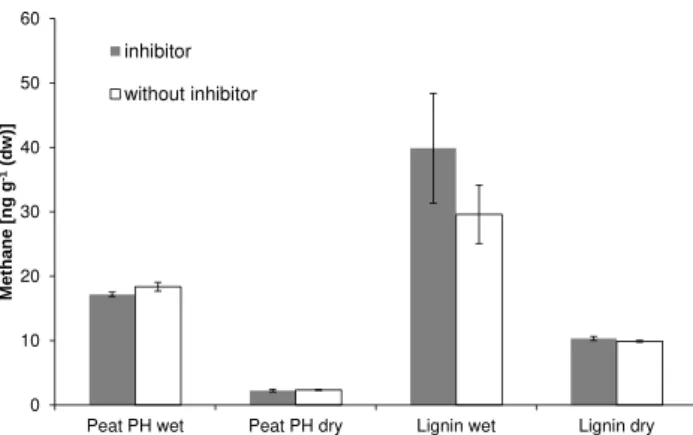
Fig. 3.Methane formation from wetted and dry peat and lignin samples treated with inhibitors of methanogenic microorganisms. Inhibitors for wet and dry samples were BES and CH3Cl, respec-tively. No significant difference in CH4formation was found be-tween samples treated with or without inhibitors (pranging from
>0.1 to 0.5). Data show mean value±SD (n= 3). Incubation: 23 h at 50◦C.
Conrad, 2000) to the peat and lignin sample (homogenized and lyophilised prior to the experiments). The samples con-taining BES were wet whereas gaseous CH3Cl was added to
the dry samples. For all peat and lignin samples there was no significant difference (p ranging from>0.1 to 0.5) of CH4
formation when treated with or without the inhibitors BES or CH3Cl (Fig. 3) at a temperature of 50◦C. Analogous to
the results described above (Table 1 and paragraph 3.2 Effect of wetting and drying) similar differences between emission rates of CH4 between wet and dry samples (factor 3 to 8)
were observed.
In another experiment an aliquot of the sample PH or lignin was added to an enrichment culture known to enrich the growth of methanogenic archaea. When samples with or without enrichment culture were compared, no difference in CH4formation was measured after an incubation period of 4
days at a temperature of 25◦C. Moreover, no further increase in CH4formation was noted when samples were incubated
for a longer time period.
These results provide strong support that neither methan-otrophs nor methanogens were active in the soils investigated in this study and that CH4formation was solely driven by a
chemical process.
2.4 Effect of hydrogen peroxide
Reactive oxygen species (ROS) such as hydroxyl radicals (HO•) have been suggested to play an important role in the release of CH4 from pectin and might be the driving
force in the CH4release during UV radiation of plant foliage
(McLeod et al., 2008; Messenger et al., 2009). Hydrogen per-oxide (H2O2)as a precursor of HO• is an important
reac-tant in many degradation processes in soils, being abundant due to its release by roots, soil bacteria and white rot fungi
R² = 0.9926
0.0 0.1 0.2 0.3 0.4 0.5 0.6 0.7 0.8
0 10 20 30 40 50 60
M
e
th
a
n
e
[
n
g
g
-1
(d
w
)
h
-1]
H2O2[µmol g-1]
Fig. 4. Relationship between CH4 emission from peat PH and added amount of H2O2. Data show mean value±SD (n= 3, except 20 µmol (n= 1)). Incubation: 24 h at 30◦C.
(Frahry and Schopfer, 1998; Kersten and Kirk, 1987). We therefore investigated the influence of H2O2 on CH4
emis-sions from peat PH and soil SHA.
Interestingly, it was found that peat and soil responded rather differently following addition of H2O2. A strong
in-crease in CH4 emissions and a linear relationship (R2=
0.99) with increasing amounts of added H2O2to sample PH
(Fig. 4) was observed whereas for soil sample SHA no addi-tional emissions were observed. It is not clear why the soil and peat samples behaved so differently to the addition of H2O2. One possible explanation might be related to the
dif-ferences in the composition of soil SHA and peat PH. Peat consists mostly of organic matter and low mineral content, which might make it more prone to be attacked by ROS. Soil, on the other hand, contains other major components such as clay minerals and metal oxides that might more efficiently interact with H2O2.
Samples of lignin and humic acid were also treated with H2O2. Whereas increased CH4emissions were observed for
humic acid, no elevated emissions were found for lignin. Thus it is evident that the structural composition of the or-ganic matter in soil has a major impact on the CH4emissions.
2.5 Effect of ultraviolet radiation
Ultraviolet (UV) radiation has been shown to be an important factor for aerobic production of CH4from plant tissues and
pectin. It was demonstrated that both UV-A (320–400 nm) and UV-B (280–320 nm) induce CH4emissions from plant
tissue (Vigano et al., 2008; McLeod et al., 2008), with UV-B radiation showing a much stronger effect. Nevertheless, because average UV-A intensities are around 30-fold higher than UV-B values, UV-A is also an important component on a global level for UV-induced CH4emissions (Bruhn et
al., 2009). Thus, the effect of UV radiation on the formation of CH4 from soil was evaluated. For most experiments we
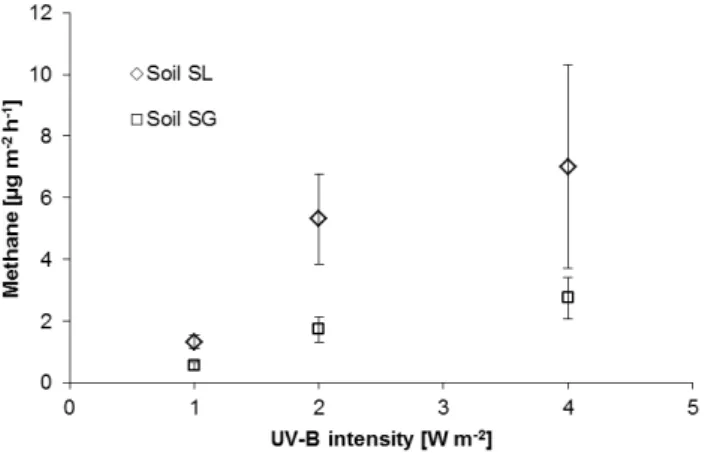
Fig. 5.Relationship between CH4emissions from soils SL and SG and UV-B intensity. Data show mean value±SD (n= 3).
Measurements at 2 W m−2 UV-B and temperatures of 28
to 32◦C showed emissions of 0.25 to 4.92 µg m−2h−1
(Ta-ble 1), which were linear over a two-day period. Methane emission rates were also found to be a function of UV-B in-tensity. With increasing intensities from 1 to 4 W m−2, CH4
emissions from soil SL increased linearly from 1.33±0.22 to 7.28±2.75 µg m−2h−1. Emissions from soil SG increased from 0.56±0.12 to 2.75±0.69 µg m−2h−1 over the same intensity range (Fig. 5).
The combined emission rates under the influence of UV and temperature are similar to those reported for plant foliage (Vigano et al., 2008; Keppler et al., 2008). Interestingly, vari-ations in CH4emissions under UV are not correlated to soil
organic content (Table 1). However, the emission rates might be influenced by organic photo sensitizers, which have been shown to have a positive effect on CH4emissions from pectin
(Messenger et al., 2009), or by clay minerals, often described as photo-catalysts (Katagi, 1990; Wu et al., 2008; Kibanova et al., 2011).
2.6 Stable carbon isotope composition of methane emitted from soil
In addition to CH4emission rates, the stable isotope
com-position (δ13C values) of the released CH4 from soil SHA,
peat PH, humic acid and lignin were also measured. Heat-ing experiments showedδ13C values of –56 to –65 ‰ for lignin, –51 to –56 ‰ for PH and –42 to –52 ‰ for humic acid. Methane emitted from wet samples of lignin, humic acid and peat PH showedδ13C values ranging from –53 to –69 ‰ with humic acid again being the substrate with the highest (less negative) CH4values (–53.2 ‰ ±0.3 ‰ ). The δ13C values measured for CH4emitted from humic acid and
peat PH over a 24 h period following the addition of H2O2
were –54.9±1.2 ‰ and –60.2±4.5 ‰ , respectively. Theδ13C values measured for CH4 emitted during 48 h
under UV irradiation were –56.0±6.0 ‰ for lignin, – 63±3.3 ‰ for SHA, –44.2±1.4 ‰ for PH and –
35.3±9.4 ‰ for humic acid. In summary, theδ13C values of CH4 emitted from soil differed between substrates and
experimental conditions and ranged from –35.5 to 69 ‰ , whereas the δ13C values for the organic matter of the bulk soil samples were in the range of –22 to –29 ‰ . Thus, it ap-pears that all treatments caused substantial fractionation be-tween the precursor carbon and emitted CH4. Similarδ13C
values and isotope fractionations have been reported for CH4
emitted from plant foliage due to UV radiation or upon heat-ing (Vigano et al., 2009). Both the isotopic values reported for the chemical formation of CH4 from soil and
vegeta-tion are commonly also found for terrestrial biogenic sources (Vigano et al., 2009).
3 Conclusions and outlook
Our study shows that several hitherto unknown processes ex-ist that produce CH4 in soil and peat, which is clearly not
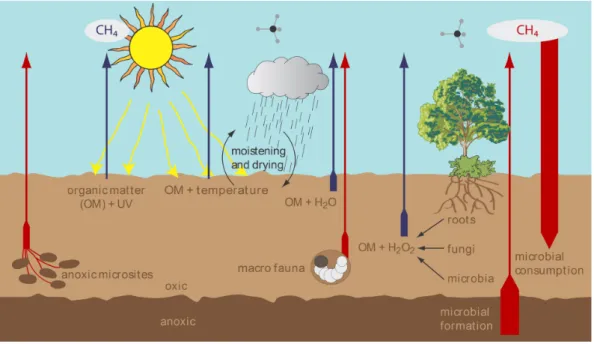
related to methanogenic activity. Figure 6 summarizes our re-sults regarding non-microbial CH4formation in the aerobic
layers of soils and the environmental factors that might con-trol emissions. From our findings we suggest that the abiotic formation of CH4through degradation of organic soil matter
represents a thus far undiscovered pathway for CH4
forma-tion in oxic soils. Our results imply that there are at least two different mechanisms for non-microbial CH4formation
in soils. This can be best distinguished by comparing thermal and UV-B induced CH4release. Samples that released only
minor amounts of CH4 when heated or wetted emitted
sig-nificant amounts when irradiated with UV-B, and vice versa. The amounts of CH4 produced at ambient temperatures
of 30◦C are small but increase considerably with increasing temperature. Wetted samples during the drying and rewet-ting cycle experiments showed much higher emissions than the dry sample itself at low temperatures. Assuming that the first five centimetres of the soil horizon account for most of the CH4 production, the emission rates from dry and wet
soil at 30 to 40◦C (Table 1) would correspond to emission rates of 0 to 18 µg m−2h−1, assuming a dry bulk density of 1.5 g cm−3 for soil and 0.1 g cm−3 for peat (Minkinnen
and Laine, 1998). These emissions increase up to an order of magnitude when the soil surface temperature reaches 50 to 70◦C. Although these temperatures are often only ob-served at soil surfaces in tropical and savannah regions, when compared to field measurements from wetlands with ob-served CH4emissions up to 11.9 mg m−2h−1(286.5 mg m−2
d−1)and calculated average emission rates of 2.1 mg m2h−1
(51 mg m−2d−1)(Morrissey and Livingston, 1992; Roulet et al., 1992; Cao et al., 1998), these are relatively minor emis-sions. The CH4emissions under UV light are consistent with
findings by Vigano et al. (2008) and McLeod et al. (2008), who showed that UV irradiation drives CH4production from
Fig. 6.Scheme of CH4cycling in soil including non-microbial (blue) and the previously known microbial sources (red). Environmental fac-tors such as temperature, UV irradiation, drought/wet cycles and formation of hydrogen peroxide produced by biota might control chemical formation of CH4in soil.
supported by CH4emissions that were observed when lignin
and humic acid were exposed to UV irradiation under the same conditions as that for the soil samples. However, it is in-teresting that under UV irradiation there was no apparent cor-relation between CH4production and the soil organic matter
content. This indicates that other soil components also play a role in CH4 formation. Organic photo-sensitizers such as
tryptophan (Messenger et al., 2009) or the mineral soil frac-tion, e.g., clay minerals and metal oxides (Katagi, 1990; Wu et al., 2008; Kibanova et al., 2011) may catalyze surface reac-tions of organic matter leading to CH4formation. This would
also be in agreement with the recent observation that mete-oritic matter, such as carbonaceous chondrites, which contain only a few per cent organic matter, releases large amounts of CH4when exposed to UV irradiation (Keppler et al., 2012).
Methane emissions under UV radiation were found to be in the range of 0.25 to 7.28 µg m−2h−1for various soils in the
UV-B intensity range of 1 to 4 W m−2. Again, these emission
rates are considerably lower than emissions observed from natural wetlands (Morrissey and Livingston, 1992; Roulet et al., 1992; Cao et al., 1998). Further studies on samples collected from different vegetation zones, including subtrop-ical and tropsubtrop-ical regions, would be required to better esti-mate the global implications of our findings. A large frac-tion of the terrestrial surface is directly exposed to UV ra-diation, and this might even increase due to anthropogenic activities leading to deforestation and desertification. Inter-esting regions for on-site studies of UV-induced CH4
re-lease could then be steppes regions, newly deforested land, and freshly ploughed fields, whereas for water-mediated CH4
release flooding plains and irrigation areas in dry climates would be relevant. However, it has to be considered that more than 90 % of CH4formed within soils is oxidised by
methan-otrophic bacteria before it reaches the atmosphere (King, 1990). Methane uptake into aerated temperate forest soils ranges from 10 to 204 µg m−2h−1, depending on soil type,
temperature and water saturation (Born et al., 1990; Castro et al., 1995; King, 1997). Field measurements regarding the temperature and water-mediated CH4emissions may thus be
impaired by methanotrophic consumption. In contrast, di-rect photolysis of soil organic matter will occur at the up-per soil surface at maximum depths of 0.2 to 0.4 mm and indirect photolysis processes might affect the soil down to 2 mm depth (Hebert and Miller, 1990). Thus CH4formation
induced by UV irradiation at the soil surface might lead to direct CH4emissions to the atmosphere.
Hydrogen peroxide was found to have a positive effect on CH4 production from peat. Levels of H2O2in soils are
influenced by the activity of plant roots, fungi and bacteria (Sch¨onknecht et al., 2008; Miller et al., 1998). As the release of H2O2 from living organisms is often a defence
mecha-nism, the amount released might be affected by organism density in the soil and the level of stress applied by (chang-ing) environmental factors.
The chemical CH4 formation from organic soil
compo-nents observed in this study might be only one of several CH4 formation pathways that occur in aerated soils.
biological soil crusts (Angel et al., 2011). However, presently our knowledge on the (bio)chemical CH4 formation
pro-cesses behind all identified sources are limited, therefore it is much too early to speculate about the contribution of the various sources to the release of CH4to the atmosphere. The
amount emitted by various sources to the atmosphere will be affected to a different extent by chemical, physical and bio-chemical environmental factors like UV radiation, tempera-ture and moistempera-ture.
For example, soil moisture will not only affect the CH4
re-lease from chemical degradation of organic soil compounds and from fungi but will also affect oxygen concentration and therefore anoxic microsites where methanogenesis takes place. Thus, it will be a challenge to differentiate between the microbial and non-microbial sources of oxic soils in the field.
All effects shown to increase CH4 production from oxic
soils might gain importance in the course of climate change considering predicted changes in temperatures, precipitation levels and evaporation rates. Flood plains and other environ-ments with strong fluctuations in the water budget might be of particular interest. Further investigations will be essential to fully understand the biogeochemical cycle of CH4in oxic
soils and its relevance for the atmosphere and to gain fur-ther information on the chemical pathways involved. For the latter employing isotopically labelled precursor compounds would be beneficial. In particular identification of the differ-ences between the pathways of thermal and photocatalytic CH4 generation would be worthwhile for future
investiga-tions.
Supplementary material related to this article is available online at: http://www.biogeosciences.net/9/ 5291/2012/bg-9-5291-2012-supplement.pdf.
Acknowledgements. The authors thank Michael Kersten for com-ments on the methods and John T. G. Hamilton for comcom-ments on the draft, Colin McRoberts, for sterilising the peat sample and Jennifer Rinne and Ilka Hermes for laboratory assistance. Thanks to Carl Brenninkmeijer and Dieter Scharffe for provision and maintenance of the GC-FID system. We thank Sylvia Schnell and Stefan Rater-ing for their help with the archaea-enrichment experiment. We ac-knowledge the Environmental Agency of Minden and Mr. L¨ubbert for permission and help with sampling in Hille.
This work was funded by the ESF (EURYI Award to F.K.) and DFG (KE 884/2-1) and by the DFG research unit 763 ’Natural Halogenation Processes in the Environment – Atmosphere and Soil’ (KE 884/6-1; KE 884/7-1).
The service charges for this open access publication have been covered by the Max Planck Society.
Edited by: A. Neftel
References
Althoff, F., Jugold, A., and Keppler, F.: Methane forma-tion by oxidaforma-tion of ascorbic acid using iron miner-als and hydrogen peroxide, Chemosphere, 80, 286–292, doi:10.1016/j.chemosphere.2010.04.004, 2010.
Andersen, B. L., Bidoglio, G., Leip, A., and Rembges, D.: A new method to study simultaneous methane oxidation and methane production in soils, Global Biogeochem. Cycles, 12, 587, doi:10.1029/98GB01975, 1998.
Angel, R., Matthies, D., Conrad, R.: Activation of methanogene-sis in arid biological soil crusts despite the presence of oxygen, PLoS One, 6, e20453, doi:10.1371/journal.pone.0020453, 2011. Beerling, D. J., Gardiner, T., Leggett, G., McLeod, A. R., and Quick, W. P.: Missing methane emissions from leaves of terrestrial plants, Glob. Change Biol., 14, 1821–1826, doi:10.1111/j.1365-2486.2008.01607.x, 2008.
Bernhard, G., Mayer, B., Seckmeyer, G., and Moise, A.: Mea-surements of spectral solar UV irradiance in tropical Australia, J. Geophys Res. (Journal of Geophysical Research D – Atmo-sphere), 102, 8719–8730, 1997.
Born, M., D¨orr, H., and Levin, I.: Methane consumption in aerated soils of the temperate zone, Tellus, 42, 2–8, 1990.
Brock, T.D.: The poisoned control in biogeochemical investiga-tions, in: Environmental Biogeochemistry and Geomicrobiology, volume 3: Methods, Metals and Assessment, edited by: Krum-bein, W. E., Ann Arbor Science Publishers, Ann Arbor, MI, 717, 1978.
Br¨uggemann, N., Meier, R., Steigner, D., Zimmer, I., Louis, S., and Schnitzler, J.: Nonmicrobial aerobic methane emission from poplar shoot cultures under low-light conditions, New Phytol., 182, 912–918, doi:10.1111/j.1469-8137.2009.02797.x, 2009. Bruhn, D., Mikkelsen, T. N., Willats, W. G. T., and Ambus, P.:
Effects of temperature, ultraviolet radiation and pectin methyl esterase on aerobic methane release from plant material, Plant Biol., 11, 43–48, doi:10.1111/j.1438-8677.2009.00202.x, 2009. Cao, G. M., Xu, X. L., Long, R. J., Wang, Q. L., Wang, C. T., Du, Y.
G., and Zhao, X. Q.: Methane emissions by alpine plant commu-nities in the Qinghai-Tibet Plateau, Biol. Lett, 4, 681–684, 2008. Cao, M., Gregson, K., and Marshall, S.: Global methane emissions from wetlands and its sensitivity to climate change, Atmos. Env-iron., 32, 3293–3299, 1998.
Castro, M. S., Steudler, P. A., and Melillo, J. M.: Factors control-ling atmospheric methane consumption by temperate forest soils, Global Biogeochem. Cy., 9, 1–10, 1995.
Chan, A. S. K. and Parkin, T. B.: Evaluation of potential inhibitors of methanogenesis and methane oxidation in a landfill cover soil, Soil Biol. Biochem. 32, 1581–1590, 2000.
Chidtaisong, A. and Conrad, R.: Specificity of chloroform, 2-bromoethanesulfonate and fluoroacetate to inhibit methanogen-esis and other anaerobic processes in anoxic rice field soil, Soil. Biol. Biochem., 32, 977–988, 2000.
Dueck, T. A., Visser, R. de, Poorter, H., Persijn, S., Gorissen, A., Visser, W. de, Schapendonk, A., Verhagen, J., Snel, J., Harren, F. J. M., Ngai, A. K. Y., Verstappen, F., Bouwmeester, H., Voe-senek, L. A. C. J., and van der Werf, A.: No evidence for sub-stantial aerobic methane emission by terrestrial plants: a 13 C-labelling approach, New Phytol., 175, 29–35, 2007.
soils: Response to temperature and pH, Soil. Biol. Biochem., 25, 321–326, doi:10.1016/0038-0717(93)90130-4, 1993.
Ferretti, D. F., Miller, J. B., White, J. W. C., Lassey, K. R., Lowe, D. C., and Etheridge, D. M.: Stable isotopes provide revised global limits of aerobic methane emissions from plants, Atmos. Chem. Phys., 7, 237–241, doi:10.5194/acp-7-237-2007, 2007.
Fischer, J. C. von and Hedin, L. O.: Controls on soil methane fluxes: Tests of biophysical mechanisms using stable isotope tracers, Global Biogeochem. Cy., 21, 2, doi:10.1029/2006GB002687, 2007.
Frahry, G. and Schopfer, P.: Hydrogen peroxide production by roots and its stimulation by exogenous NADH, Physiol. Plant., 103, 395–404, doi:10.1034/j.1399-3054.1998.1030313.x, 1998. Hao, W. M., Scharffe, D., Crutzen, P. J., and Sanhueza, E.:
Pro-duction of N2O, CH4, and CO2 from soils in the tropical sa-vanna during the dry season, J. Atmos. Chem., 7, 93–105, doi:10.1007/BF00048256, 1988.
Hebert, V. R. and Miller, G. C.: Depth dependence of direct and indirect photolysis on soil surfaces, J. Agric. Food Chem., 38, 913–918, doi:10.1021/jf00093a069, 1990.
Hurkuck, M., Althoff, F., Jungkunst, H. F., Jugold, A., and Kep-pler, F.: Release of methane from aerobic soil: An indication of a novel chemical natural process?, Chemosphere, 86, 684–689, doi:10.1016/j.chemosphere.2011.11.024, 2012.
Jugold, A. and Keppler, F.: Possibility of non-methanogenic methane formation in soils, Geochim. Cosmochim. Ac., 73, A608, 2009.
Kammann, C., Hepp, S., Lenhart, K., and M¨uller, C.: Stimula-tion of methane consumpStimula-tion by endogenous CH4 producStimula-tion in aerobic grassland soil, Soil. Biol. Biochem., 41, 622–629, doi:10.1016/j.soilbio.2008.12.025, 2009.
Katagi, T.: Photoinduced oxidation of the organophosphorus fungi-cide tolclofos-methyl on clay minerals, J. Agric. Food Chem., 38, 1595–1600, doi:10.1021/jf00097a035, 1990.
Keppler, F. and R¨ockmann, T.: Methane, Plants and Climate Change, Sci. Am., 296, 52–57, 2007.
Keppler, F., Hamilton, J. T. G., Braß, M., and R¨ockmann, T.: Methane emissions from terrestrial plants under aerobic condi-tions, Nature, 439, 187–191, 2006.
Keppler, F., Hamilton, J. T. G., McRoberts, C. W., Vigano, I., Braß, M., and R¨ockmann, T.: Methoxyl groups of plant pectin as a precursor of atmospheric methane: evidence from deuterium la-belling studies, New Phytol., 178, 808–814, doi:10.1111/j.1469-8137.2008.02411.x, 2008.
Keppler, F., Boros, M., Frankenberg, C., Lelieveld, J., McLeod, A. R., Pirttil¨a, A. M., R¨ockmann, T., and Schnitzler, J.: Methane formation in aerobic environments, Environ. Chem, 6, 459–465, doi:10.1071/EN09137, 2009.
Keppler, F., Vigano, I., McLeod, A., Ott, U., Fr¨uchtl, M., and R¨ockmann, T.: Ultraviolet-radiation-induced methane emissions from meteorites and the Martian atmosphere, Nature, 486, 93– 96, doi:10.1038/nature11203, 2012.
Kersten, P. J. and Kirk, T. K.: Involvement of a new enzyme, glyoxal oxidase, in extracellular H2O2 production by phanerochaete-chrysosporium, J. Bacteriol., 169, 2195–2201, 1987.
Kibanova, D., Trejo, M., Destaillats, H., and Cervini-Silva, J.: Pho-tocatalytic activity of kaolinite, Catal. Commun., 12, 698–702, doi:10.1016/j.catcom.2010.10.029, 2011.
King, G. M.: Regulation by light of methane emissions from a wet-land, Nature, 345, 513–515, 1990.
King, G. M.: Responses of atmospheric methane consumption by soils to global climate change, Glob. Change Biol., 3, 351–362, 1997.
Kirschbaum, M. U. F. and Walcroft, A.: No detectable aero-bic methane ef ux from plant material, nor from adsorp-tion/desorption processes, Biogeosciences, 5, 1551–1558, 2008, http://www.biogeosciences.net/5/1551/2008/.
Kirschbaum, M. U. F., Niinements, ¨U., Bruhn, D., and Winters, A. J.: How Important is Aerobic Methane Release by Plants?, Func-tional Plant Biol., 1, 138–145, 2007.
Lenhart, K., Bunge, M., Ratering, S., Neu, T. R., Sch¨uttmann, I., Greule, M., Kammann, C., Schnell, S., M¨uller, C., Zorn, H., and Keppler, F.: Evidence for methane production by saprotrophic fungi, Nat. Commun., 3, 1046, doi:10.1038/ncomms2049, 2012. McLeod, A. R., Fry, S. C., Loake, G. J., Messenger, D. J., Reay, D. S., Smith, K. A., and Yun, B.: Ultraviolet radiation drives methane emissions from terrestrial plant pectins, New Phytol., 180, 124–132, doi:10.1111/j.1469-8137.2008.02571.x, 2008. Megonigal, J. P. and Guenther, A. B.: Methane emissions from
upland forest soils and vegetation, Tree Physiol., 28, 491–498, 2008.
Messenger, D. J., McLeod, A. R., and Fry, S. C.: The role of ultravi-olet radiation, photosensitizers, reactive oxygen species and ester groups in mechanisms of methane formation from pectin, Plant Cell Environ., 32, 1–9, doi:10.1111/j.1365-3040.2008.01892.x, 2009.
Miller, L. G., Sasson, C., and Oremland, R. S.: Difluoromethane, a new and improved inhibitor of methanotrophy, Appl. Environ. Microbiol, 64, 4357–4362, 1998.
Minkinnen, K. and Laine, J.: Effect of forest drainage on the peat bulk density of peat mires in Finland, Can. J. Forest Res., 28, 178–186, 1998.
Morrissey, L. A. and Livingston, G. P.: Methane Emis-sions From Alaska Arctic Tundra: An Assessment of Lo-cal Spatial Variability, J. Geophys. Res., 97, 16661–16670, doi:10.1029/92JD00063, 1992.
Nisbet, R. E. R., Fisher, R., Nimmo, R. H., Bendall, D. S., Crill, P. M., Gallego-Sala, A. V., Hornibrook, E. R. C., L´opez-Juez, E., Lowry, D., Nisbet, P. B. R., Shuckburgh, E. F., Sriskantharajah, S., Howe, C. J., and Nisbet, E. G.: Emission of methane from plants, Proc. R. Soc. B, 276, 1347–1354, 2009.
Oremland, R.S., Capone, D.G.: Use of “specific” inhibitors in bio-geochemistry and microbial ecology, Adv. Microb. Ecol., 10, 285–383, 1988.
Peters, V. and Conrad, R.: Methanogenic and other strictly anaer-obic bacteria in desert soil and other oxic soils, Appl. Environ. Microb., 61, 1673–1676, 1995.
Qaderi, M. M. and Reid, D. M.: Methane emissions from six crop species exposed to three components of global climate change: temperature, ultraviolet-B radiation and water stress, Physiol. Plant, 137, 139–147, doi:10.1111/j.1399-3054.2009.01268.x, 2009.
Rimbault, A., Niel, P., Virelizier, H., Darbord, J. C., and Leluan, G.: L-Methionine, a Precursor of Trace Methane in Some Proteolytic Clostridia, Appl. Environ. Microbiol, 54, 1581–1586, 1988. Roulet, N. T., Ash, R., and Moore, T. R.: Low Boreal Wetlands as
3749, 1992.
Sch¨onknecht, G., Brown, J. E., and Verchot-Lubicz, J.: Plas-modesmata transport of GFP alone or fused to potato virus X TGBp1 is diffusion driven, Protoplasma, 232, 143–152, doi:10.1007/s00709-008-0293-z, 2008.
Terazawa, K., Ishizuka, S., Sakata, T., Yamada, K., and Takahashi, M.: Methane emissions from stems of Fraxinus mandshurica var. japonica trees in a floodplain forest, Soil. Biol. Biochem., 39, 2689–2692, doi:10.1016/j.soilbio.2007.05.013, 2007.
Vigano, I., van Weelden, H., Holzinger, R., Keppler, F., McLeod, A. R., and R¨ockmann, T.: Effect of UV radiation and temperature on the emission of methane from plant biomass and structural components, Biogeosciences, 5, 937–947, 2008,
http://www.biogeosciences.net/5/937/2008/.
Vigano, I., R¨ockmann, T., Holzinger, R., van Dijk, A., Keppler, F., Greule, M., Brand, W. A., Geilmann, H., and van Weelden, H.: The stable isotope signature of methane emitted from plant material under UV irradiation, Atmos. Environ., 43, 5637–5646, doi:10.1016/j.atmosenv.2009.07.046, 2009.
Wang, Z.-P., Han, X. G., Wang, G. G., Song, Y., and Gulledge, J.: Aerobic methane emission from plants in the Inner Mongolia steppe, Environ. Sci. Technol., 42, 62–68, 2008.
Wang, Z.-P., Keppler, F., Greule, M., Hamilton, J. T. G.: Non-microbial methane emissions from fresh leaves: effects of physi-cal wounding and anoxia, Atmos. Environ., 45, 4915-4921, 2011. Widdel, F., Bak, F.: Gram-negative mesophilic sulfate-reducing bac-teria, in: The Prokaryotes, 2nd edn., edited by: Balows, A., Tru-per H. G., Dworkin M., Harder W., Schleifer K.-H., Springer Publishing, New York, USA, 3352–3378, 1992.