Two Novel Anoxia-Induced Ethylene Response Factors
That Interact with Promoters of Deastringency-Related
Genes from Persimmon
Ting Min1, Fang Fang1, Hang Ge1, Yan-na Shi1, Zheng-rong Luo2, Yun-cong Yao3, Donald Grierson1,4, Xue-ren Yin1*, Kun-song Chen1
1Laboratory of Fruit Quality Biology/The State Agriculture Ministry Laboratory of Horticultural Plant Growth, Development and Quality Improvement, Zhejiang University, Zijingang Campus, Hangzhou, PR China,2Key Laboratory of Horticultural Plant Biology, Ministry of Education, Huazhong Agricultural University, Wuhan, PR China, 3Department of Plant Science and Technology, Beijing University of Agriculture, Beijing, PR China,4Plant & Crop Sciences Division, School of Biosciences, University of Nottingham, Sutton Bonington Campus, Loughborough, United Kingdom
Abstract
A hypoxic environment is generally undesirable for most plants and stimulates anaerobic metabolism. It is a beneficial treatment, however, for the removal of astringency from persimmon to improve the fruit quality after harvest. High soluble tannins (SCTs) content is one of most important causes of astringency. High CO2(95%) treatment effectively reduced SCTs in both ‘‘Mopan’’ and ‘‘Gongcheng-shuishi’’ persimmon fruit by causing increases in acetaldehyde. Using RNA-seq and realtime PCR, twelve ethylene response factor genes(DkERF11-22) were isolated and characterized, to determine those responsive to high CO2 treatment. Only two genes, DkERF19 and DkERF22, showed trans-activation effects on the promoters of deastringency-related genes pyruvate decarboxylase genes (DkPDC2andDkPDC3) and the transcript levels of these genes was enhanced by hypoxia. Moreover, DkERF19 and the previously isolated DkERF9 had additive effects on activating theDkPDC2promoter. Taken together, these results provide further evidence that transcriptome changes in the level of DkERF mRNAs regulate deastringency-related genes and their role in the mechanism of persimmon fruit deastringency is discussed.
Citation:Min T, Fang F, Ge H, Shi Y-n, Luo Z-r, et al. (2014) Two Novel Anoxia-Induced Ethylene Response Factors That Interact with Promoters of Deastringency-Related Genes from Persimmon. PLoS ONE 9(5): e97043. doi:10.1371/journal.pone.0097043
Editor:Jin-Song Zhang, Institute of Genetics and Developmental Biology, Chinese Academy of Sciences, China
ReceivedJanuary 23, 2014;AcceptedApril 14, 2014;PublishedMay 7, 2014
Copyright:ß2014 Min et al. This is an open-access article distributed under the terms of the Creative Commons Attribution License, which permits unrestricted use, distribution, and reproduction in any medium, provided the original author and source are credited.
Funding:This research was supported by the National Natural Science Foundation of China (no. 31101507; no. 31372114; no. 31030052), the Special Fund for Agro-scientific Research in the Public Interest (no. 201203047), the 111 project, and the Fundamental Research Funds for the Central Universities (no. 2013FZA6010). The funders had no role in study design, data collection and analysis, decision to publish, or preparation of the manuscript.
Competing Interests:The authors have declared that no competing interests exist.
* E-mail: [email protected]
Introduction
Low oxygen is a common abiotic stress in plant developmental physiology, which is mainly caused by flooding/submerge. On the contrary, however, reduced oxygen concentration is beneficial for some fruit quality traits, eg. Controlled Amosphere (CA) storage with low oxygen level prolongs storage life and maintains fruit quality [1,2]. Besides CA storage, one interesting additional advantage of low oxygen improvement of fruit quality occurs in persimmon fruit (Diospyros kaki), where it removes undesirable astringency. Development of persimmon fruit is accompanied by the accumulation of proanthocyanidins (PAs; also known as condensed tannins, CTs). CTs are colourless polyphenolic compounds important both for the plant and human, however, the soluble part of CTs (SCTs) make an important adverse contribution to fruit taste by causing astringency [3,4]. Most persimmon fruit are of the astringent type, which are rich in SCTs even at maturity [5,6]. Among the artificial treatments, high CO2
treatment (with reduced oxygen level) and to a lesser extent ethylene treatment, leads to anaerobic fermentation in persimmon fruit, thus triggering acetaldehyde metabolism [7–9]. Acetalde-hyde plays important roles in polymerization of SCTs, converting them to insoluble condensed tannins (InSCTs) [10,11].
Due to the importance of deastringency for persimmon fruit quality, we investigated the molecular mechanisms whereby low oxygen drove deastringency by isolation of eight alcohol dehydro-genase genes (DkADH) and pyruvate decarboxylase (DkPDC) genes from persimmon fruit and showed that increased DkADH1,
DkPDC1andDkPDC2mRNA levels were closely correlated with persimmon deastringency. Transient overexpression ofDkPDC2in persimmon leaves resulted in lower SCTs content [12]. In addition, several hypoxia-responsiveERFtranscriptional regulator genes were also isolated, includingDkERF4,DkERF5,DkERF9and
DkERF10[12,13], but only DkERF9andDkERF10activated the promoters of DkPDC2 and DkADH1, respectively [12]. These results suggested that ERFgenes are involved in transcriptional regulation of persimmon fruit deastringency, and also expanded the functional changes involvingERF genes, which also include texture [14–16], carotenoids [17], ethylene [18], senescence [19] and stress response [20]. However, due to the lack of genome information for persimmon fruit, a genome-wide overview of the effects of ERF genes on persimmon fruit deastringency was prevented.
characterized as the main plant oxygen-sensing regulators. These
ERF genes could transcriptionally regulate ADH and PDC, and lead to hypoxia tolerance [21–26]. Compared with arabidopsis
ERFgenes, only twoDkERFgenes (DkERF9andDkERF10) were characterized as the transcriptional regulator on persimmon deastringency related genes [12]. Thus, additional ERF genes related to deastringency might exist in persimmon. Moreover, the four arabidopsisERFgenes were all belong to subfamily VII, the regulatory effect of theERFgenes from the other subfamilies on
hypoxia response or persimmon deastringency need further investigation.
Following our previous studies, a more comprehensive analysis was performed using RNA-seq and twelve novelERFgenes were isolated, in addition to the four studied previously. A dual luciferase assay was used to study their regulatory effects on deastringency-related target genes in ‘Mopan’ and ‘Gong cheng-shui shi’ cultivars which were are both astringent types.
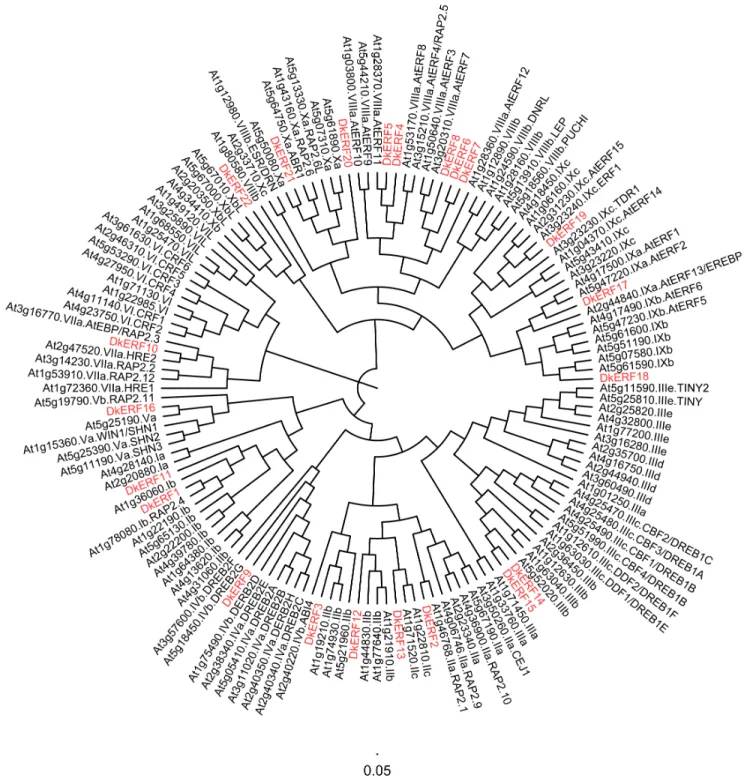
Figure 1. Phylogenetic tree of ethylene response factors.PersimmonDkERFsare highlighted in red. The amino acid sequences of the ArabidopsisERFfamily were obtained from The Arabidopsis Information Resource. The phylogenetic tree was constructed with figtree (version 3.1). doi:10.1371/journal.pone.0097043.g001
Materials and Methods
Fruit Materials
Two persimmon cultivars that respond to deastringency treatment, ‘Mopan’ and ‘Gong cheng-shui shi’, were chosen as materials. The batch of ‘Mopan’ persimmon was the same as that used in our previous report [12]. The other batch of astringent persimmon, ‘Gong cheng-shui shi’, was obtained from a commer-cial orchard at Gongcheng (Guilin, China) in 2012. The fruit were transported to Zhejiang University (Hangzhou, Zhejiang, China) on the second day after harvest. The 180 fruit were divided into two 90 fruit lots. Treated fruit were exposed to 95% CO2 and
control fruit were placed in air, both in air-tight plastic containers for 1 day. After treatment, the fruit were held in air at 20uC until the end of the experiment. For each sampling point, fruit flesh samples (without skin and core) were taken from three replicates of
four fruit each. The samples were frozen in liquid nitrogen and stored at280uC until further use.
Fruit Physiology Evaluation
Fruit firmness measurement was carried out in a TA-XT2i texture analyzer (Stable Micro Systems, Godalming, Surrey, UK), fitted with a 5 mm diameter head, 1 mm/s penetration test rate and 1 mm thickness of peel, according to our previous report [13]. 10 fruit per sampling point were measured at two positions 90uto each other at the fruit equator.
The content of soluble condensed tannins (SCTs), the most important index for astringency, were measured using Folin-Ciocalteu reagent according to the method described in our previous report [13].
RNA Extraction and cDNA Synthesis
Total RNA was prepared according to the method used in our previous report [27]. The trace amount of genomic DNA in total RNA was digested with TURBO DNA free kit (Ambion). First strand cDNA was synthesized from 1.0mg DNA-free RNA, using iScript cDNA Synthesis Kit (Bio-Rad). For each sampling point, three biological replicates were used for RNA extraction and the subsequent cDNA synthesis.
Gene Isolation and Sequence Analysis
The novel ERF genes induced by anoxia deastringency treatment were isolated based on RNA-Seq. ‘Mopan’ fruit, 0 d (astringency) and 2 d in CO2 treatment (deastringency), were
chosen and constructed into two different libraries. The RNA extraction and preparatory procedures were as previously reported [28]. The libraries construction and RNA-Seq was performed and sequences assembled and annotated by the Beijing Genome Institute (BGI) (Shenzhen, China). The data were firstly removed the adapter sequences and low quality sequences and de novo assembled into Unigenes using SOAPdevono assembly program Figure 2.DkERFexpression patterns in response to CO2(95%, 1 d) treatment in Mopan’ persimmon fruit at 20uC.Relative mRNA abundance was evaluated by real-time PCR. The heatmap indicates the average mRNA abundance from three biological repeats and was constructed by MeV4.8.1.
doi:10.1371/journal.pone.0097043.g002
Figure 3. Effects of CO2 treatment (95%, 1 day) on soluble
tannins in ‘Gong cheng-shui shi’ fruit at 20uC.Black columns and red columns represent the control and the CO2treatment respectively.
Error bars represent6SE from three replicates. doi:10.1371/journal.pone.0097043.g003
(version 1.04) [29] and TGICL [30], with the parameters described in previous report [28]. Furthermore, the Unigenes
was annotated by BLASTxing to NCBI non-redundant (nr) database with E-value cutoff of 1e25. Meanwhile, RPKM (Reads
per kb per million reads) values were used to calculate the UniGene expression level using SOAPaligner software (Version 2.20, http://soap.genomics.org.cn/soapaligner.html) and DFR value, which was calculated based on P value, was used to identify genes expressed differentially between two samples as described as previously reported [28].
Full-lengthERFgenes were amplified with a SMART RACE cDNA Amplification Kit (Clontech). The sequences of primers used for RACE are described in Table S1. Based on the deduced amino acid sequences, a phylogenetic tree of ERF genes was Figure 4.DkERFexpression patterns in response to CO2(95%, 1 d) treatment in ‘Gong cheng-shui shi’ fruit at 20uC.Relative mRNA abundance was evaluated by real-time PCR. The heatmap indicates the average mRNA abundance from three biological repeats and was constructed by MeV4.8.1.
doi:10.1371/journal.pone.0097043.g004
Figure 5.In vivo interaction ofDkERF with the promoters of DkADH1,DkPDC2andDkPDC3.The ratio of LUC/REN of the empty vector (SK) plus promoter was used as calibrator (set as 1). The data in grey columns are derived from Minet al., (2012) for comparison. Error bars indicate6SEs from five biological replicates.
doi:10.1371/journal.pone.0097043.g005
Figure 6. Synergistic trans-activation effect of combination of DkERFgenes onDkPDC2promoter.
doi:10.1371/journal.pone.0097043.g006
generated using ClustalX (v 1.81) and calculated using Figtree (v1.3.1). The deduced amino acid sequences of homologous genes of Arabidopsis were obtained from TAIR (The Arabidopsis Information Resource).
Oligonucleotide Primers and Real-time PCR
Oligonucleotide primers for real-time PCR analysis were designed with primer3 (v. 0.4.0, http://frodo.wi.mit.edu/cgi-bin/primer3/primer3_www.cgi). The specificity of primers was determined by melting curves and PCR products resequencing. The sequences of oligonucleotide primers are in Table S2.
Real-time PCR was carried out using a CFX96 instrument (Bio-Rad). The PCR mixtures and reactions were according to our previous report, with Ssofast EvaGreen Supermix (Bio-Rad) [13].
The relative abundance of each gene was calibrated by comparison with a sample of day 0 fruit (set as 1). Abundance of cDNA templates was monitored withDkActin, a housekeeping gene [31].
Dual Luciferase Assay
Dual luciferase assay was performed according to our previous report [12,14]. Two vectors were used as backbones: (1) pGreen II 0029 62-SK vector (SK) was used for harboring the full-length coding sequences of transcription factors, (2) pGreen II 0800-LUC vector (LUC) was used for harboring promoters. The isolated full-lengthDkERF9and DkERF10, as well as promoters ofDkADH1
andDkPDC2, were constructed into the two vectors, SK and LUC respectively [12]. NewERFgenes (DkERF11-22) and promoters of
DkPDC3were constructed into SK and LUC vector respectively, using the primers described in Table S3.
All of the constructs were confirmed by sequencing and were then electroporated into Agrobacterium tumefaciens GV3101. The transient assay was performed with Nicotiana benthamiana leaves.
Agrobacteriumculture mixtures of TFs (1 ml) and promoters (100ml) were infiltrated into tobacco leaves by needle-less syringes with the infiltration buffer (10 mM MES, 10 mM MgCl2, 150 mM
acetosyringone, pH 5.6). Tobacco plants were grown in a growth chamber, with light: dark cycles of 16:8 h. Three days after infiltration, firefly luciferase and renilla luciferase were assayed using the dual luciferase assay reagents (Promega). For each TF-promoter interaction, three independent experiments were per-formed (at least five replicates in each experiment).
Yeast One-hybrid Assay
In order to verify the results obtained from the dual luciferase assay, yeast one-hybrid assays were performed using the Match-maker Gold Yeast One-Hybrid Library Screening System (Clontech, USA). The promoter ofDkADH1, DkPDC2, DkPDC3
were constructed into pAbAi vector (primers are listed in Table S4). Due to the auto-activation activities ofDkADH1andDkPDC3
promoters, onlyDkPDC2promoter was chosen for interaction test. The DkPDC2-AbAi and p53-AbAi were linearized and trans-formed into Y1HGold. The full-lengths of transcript factor
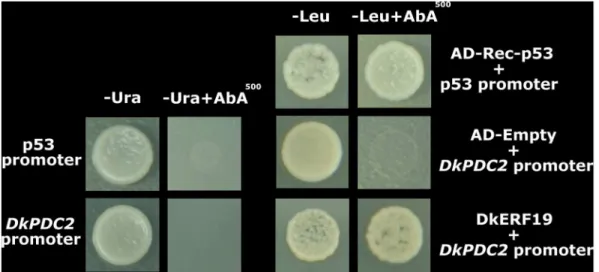
DkERF19were subcloned into pGADT7 AD vector (AD) (primers are listed in Table S4). Transformed Y1HGold were cultured on Figure 7. Yeast one-hybrid analysis ofDkERF19binding to promoter ofDkPDC2.Auto-activation of promoters were tested on SD medium lacking Ura in presence of aureobasidin A. Interaction was determined on SD medium lacking Leu in presence of aureobasidin A.
doi:10.1371/journal.pone.0097043.g007
Figure 8. High concentration CO2 (95%) affects in vivo
interaction ofDkERFand theDkADH1promoter.Tobacco plants, 2 d after infiltration, were treated with 95% CO2for 12 h. Black and red
columns represent control (air) and CO2treatment, respectively. The
ratio of LUC/REN of the empty vector (SK) plus promoter was used as calibrator (set as 1). Error bars indicate6S.E.s from five biological replicates.
doi:10.1371/journal.pone.0097043.g008
SD/2Leu containing 0–200 ng/ml aureobasidin A at 28uC for
3 d to test interaction. pGADT7-Rec (AD-Rec-P53) was co-transformed with the p53-promoter fragment to Y1HGold as positive control.
Statistical Analysis
Statistical significance of differences was calculated using Student’s t test or least significant difference (LSD) using DPS software (v. 3.11).
Results
Gene Isolation and Sequence Analysis
In our previous reports, tenDkERF genes (DkERF1-DkERF10) were isolated, among which DkERF9 and DkERF10 functioned as transcriptional activators of ADH and PDC promoters [12,13]. However, additional mRNAs for ERF related homologs were discovered that increased in amount during anoxia/deastringency treatment, using RNA-seq. Twelve novelERFgenes, designated as
DkERF11toDkERF22(KJ170911-KJ170922), were isolated from ‘Mopan’ persimmon using RNA-seq and RACE.
Phylogenetic analysis of the deduced amino acid sequences showed that the 12ERF genes were clustered into seven subfamilies,DkERF11 was very close toDkERF1in subfamily I,
DkERF12 and DkERF13 belong to subfamily II, DkERF14 and
DkERF15belong to subfamily III,DkERF16belongs to subfamily V, DkERF17-19 and DkERF20-22were clustered in subfamilies IX and X, respectively (Fig. 1).
Expression Analysis in Relation to Deastringency in ‘Mopan’ Persimmon
Since the twelve novel ERF genes were indicated as being induced by anoxia/deastringency treatment, realtime PCR was used to confirm the changes in transcript abundance of theERF
genes. The results indicated thatERF11-ERF22 transcripts were induced by CO2 treatment, whereas they remained constant in
control fruit (Fig. 2, Figure S1). Most of theERFgenes transcripts reached a peak at 1 d; while threeERFgenes (DkERF14,DkERF16
andDkERF19) were expressed most abundantly at 2 d.
Expression Analysis in Relation to Deastringency in ‘Gong Cheng-shui Shi’ Fruit
A further experiment was performed with ‘Gong cheng-shui shi’ persimmon, which also respond to deastringency treatment, to confirm the association betweenDkERFgenes and deastringency, using CO2(95%), as with ‘Mopan’. The results indicated that CO2
treatment accelerated the decrease of soluble tannins content in the flesh of ‘Gong cheng-shui shi’ fruit, as soluble tannins content was much lower in CO2-treated fruit (1.101mg/g at 1 d and
0.450mg/g at 4 d) than the control fruit (1.432mg/g at 1 d and 1.423mg/g at 4 d) (Fig. 3). Fruit softening was also promoted by CO2treatment, as fruit softened from an initial value of 47.375 N
to 28.944 N after CO2 treatment compared to 46.641 N in
control fruit after 4 days in storage (Figure S2).
Concomitantly with the deastringency process (decreasing of soluble tannins), the twelveDkERFgenes all exhibited an increase in expression. Most of theDkERFgenes rapidly responded to CO2
treatment at 1 d, while transcripts of DkERF11 and DkERF19
exhibited delayed accumulation at 2 d, andDkERF16peaked at 3 d (Fig. 4, Figure S3). Coordinate changes in DkERF genes,
DkADH andDkPDCgenes were also induced by CO2treatment
(Figure S4). Taking the results from ‘Mopan’ and ‘Gong cheng-shui shi’ fruit together, the gene expression studies showed that
increased expression ofDkERFgenes was closely associated with persimmon fruit deastringency.
Interaction of DkERF and Promoters of Deastringency-related Target Genes
On the basis of the initial expression correlation studies, a more direct experiment was performed to test the transcriptional regulatory roles of DkERF on deastringency-related target genes. Firstly,in vivo interactions were examined with a dual luciferase assay in Nicotiana benthamiana leaves. The previously identified DkERF9 and DkERF10 could activate promoters of deastrin-gency-related genes (Fig. 5). From the novel twelve DkERF, DkERF19 and DkERF22 acted as activators of DkPDC2 and
DkPDC3, respectively. No significant interactions were observed between DkERF andDkADH1, except for that with the previously characterized DkERF10 (Fig. 5). Moreover, combination of the two activators, DkERF9 and DkERF19, produced a higher activation (LUC/REN = 9.150) than the single transcription factor (LUC/REN values for DkERF9 and DkERF19 are 3.437 and 2.726, respectively) (Fig. 6). Using yeast one-hybrid system, interaction of DkERF19 and DkPDC2 promoter was further confirmed (Fig. 7).
A further experiment was conducted in order to test the trans-activation activities under the anoxic environment used for deastringency treatment. The results indicated that transcription from the promoters of DkADH1, DkPDC2 and DkPDC3 were inducible with 95% CO2 treatment (supplemented with 4% N2
and 1% O2). With present of DkERF genes, the relative LUC/
REN values were also enhanced with 95% CO2treatment, except
for the combination of DkERF19 - DkPDC2 promoter and DkERF22 -DkPDC3promoter (Fig. 8).
Discussion
Ethylene response factors, the downstream components in the ethylene signal transduction pathway, are encoded by a plant-specific transcription factor gene family [32]. Numerous ERF
genes have been characterized and shown to be key regulators in plant defense/response to abiotic and biotic stresses, including the newly identified hypoxia-responsiveERF[22]. So far, at least five
ERF genes, including HRE1, HRE2, RAP2.2, RAP2.3 and
RAP2.12, have been implicated as key control elements in Arabidopsis tolerance to anoxia, by transcriptional regulation of
ADHandPDCgenes [23,26]. Generally, hypoxia is an undesirable growth environment for most plants, although, on the contrary, an hypoxia/low oxygen environment is one of the most effective treatments to improved persimmon fruit quality for human consumption, because it leads to production of acetaldehyde, which is responsible for removal of the astringency taste caused by soluble tannins [9,13,33]. Thus, investigating the roles of hypoxia-responsiveERFgenes in persimmon fruit should contribute both to the functional analysis of theERFfamily and also to fruit quality improvement.
Our previous results indicated that two hypoxia-responsive ERF genes, DkERF9 and DkERF10, interacted with promoters of the deastringency-related genesDkPDC2andDkADH1[12]. However, the results from persimmon showed some differences compared to the Arabidopsis results, where the hypoxia-responsiveERFgenes were mainly clustered within the subfamily VII [34], while in persimmonDkERF9 and DkERF10they belong to subfamily IV and VII [12]. Thus, we proposed that the role ofERFgenes in persimmon astringency removal might be more complicated than in the Arabidopsis hypoxia response. Thus, transcriptome analysis by RNA-seq was chosen for the present research, due to the lack of
genome information available. Twelve novel ERF genes (DkERF11-22) were characterized as being responsive to anoxia/ deastringency (95% CO2) treatment. These DkERF genes were
widely distributed throughout theERFfamily, including subfamily I, II, III, VII, IX and X. Moreover, the transcriptional responses of theseDkERFgenes to the CO2treatment were conserved in two
different astringent cultivars, cv. ‘Mopan’ and cv. ‘Gong cheng-shuishi’, and the expression patterns were similar to the five hypoxia-responsiveERFgenes in Arabidopsis [23]. These results, once again, indicated thatERFgenes involved in persimmon fruit deastringency show some similarities to those in the Arabidopsis
hypoxia response, but in persimmon the four DkERF genes,
DkERF9/10/19/22, were distributed into subfamilies IV, VII, VIII and IX (Fig. 1), while the hypoxia responsiveERFgenes were mainly clustered into subfamily VII.
In persimmon, DkERF19 and DkERF22, activated promoters ofDkPDC2andDkPDC3(Fig. 5). Taken together with our previous results, three anoxia-responsive deastringency genes have their own specific regulators, DkERF10 for the DkADH1 promoter, DkERF9 and DkERF19 for theDkPDC2promoter, and DkERF22 for the DkPDC3 promoter. In Arabidopsis, hypoxia responsive
ERF positively regulate the ADH and PDC genes [23], but the effect of anoxia environment on the trans-activation of ERF on the promoters of target genes were not reported. Here, we found that the transient activations ofDkERFgenes on the target promoters were substantially enhanced by deastringency treatment (95% CO2). Due to the slight changes were observed from
DkERF19-DkPDC2 promoter and DkERF22-DkPDC3 promoter, thus the enhancement of 95% CO2 on ERF-promoter may not only by
turning on the target promoters. However, the mechanisms of thus increasing transient activations need further investigations.
One of the most interesting observations from the present research is the additive effect of DkERF9 and DkERF19 on the promoter ofDkPDC2. In plants, there are examples of transcrip-tion factor complexes, where two or even more transcriptranscrip-tion factors interact with each other generating stronger activation phenomenon, such as MYB-bHLH-WD40 in anthocyanin biosynthesis [35,36]. Some new transcription factors interaction have also been reported, such as HD2 and ERF1 in longan fruit [19]. However, The mechanisms of additive effect of DkERF9 and DkERF19 need further research in order to test this possibility.
In conclusion, on the basis of our previous studies and transcriptome analysis, there are at least 18 DkERF genes (DkERF1, 4, 5, 6, 9–22) responsive to hypoxia/deastringency treatment (95% CO2). Taken together our previous report and the
present results, only four DkERF, DkERF9/10/19/22, were characterized as activators for specific target genes. Based on the present findings, we propose that DkERF genes involved in persimmon deastringency may partially mimic the similar functions of hypoxia-responsive ERF genes in Arabidopsis. The
five keyHREgenes in Arabidopsis, however, belong to subfamily VII, while four of the persimmon DkERF genes belong to subfamily IV, VII, IX and X, respectively. These results provided a more comprehensive overview of functions of DkERF in persimmon deastringency removal at the transcriptome level, and also provided some hints to isolate more hypoxia-responsive
ERFgenes from other plants.
Supporting Information
Figure S1 Expression of DkERF genes in response to CO2 treatment in ‘Mopan’ persimmon. Supplemental to
Fig. 2 in manuscript. (TIF)
Figure S2 Effects of high concentration of CO2 (95%,
red open circles, 1 day) treatment on firmness in ‘Gong cheng-shui shi’ fruit at 20uC.Error bars represent6SE from ten replicates.
(TIF)
Figure S3 Expression of DkERF genes in response to CO2 treatment in ‘Gongcheng-shuishi’ persimmon.
Supplemental to Fig. 5 in manuscript. (TIF)
Figure S4 DkADH and DkPDC Expression patterns in response to CO2 treatment in ‘Gong cheng-shui shi’
persimmon fruit at 20uC. Relative mRNA abundance was evaluated by real-time PCR from three biological repeats by Mev.4.8.1 soft.
(TIF)
Table S1 The sequences of primers used for RACE.
(PDF)
Table S2 The sequences of primers used for Real-time PCR.
(PDF)
Table S3 The sequences of primers used for full-length amplification.
(PDF)
Table S4 The sequences of primers used for yeast one-hybrid analysis.
(PDF)
Author Contributions
Conceived and designed the experiments: TM ZrL YcY XrY KsC. Performed the experiments: TM FF HG YnS. Analyzed the data: TM FF ZrL XrY DG KsC. Contributed reagents/materials/analysis tools: TM FF HG YnS YcY XrY. Wrote the paper: XrY TM DG KsC.
References
1. Wang Y, Sugar D (2013) Internal browning disorder and fruit quality in modified atmosphere packaged ‘Bartlett’ pears during storage and transit. Postharvest Biol Technol 83: 72–82.
2. Latocha P, Krupa T, Jankowski P, Radzanowska J (2014) Changes in postharvest physicochemical and sensory characteristics of hardy kiwifruit (Actinidia argutaand its hybrid) after cold storage under normal versus controlled atmosphere. Postharvest Biol Technol 88: 21–33.
3. Taira S, Ono M, Matsumoto N (1997) Reduction of persimmon astringency by complex formation between pectin and tannins. Postharvest Biol Technol 12: 265–271.
4. McRae JM, Kennedy JA (2011) Wine and grape tannin interactions with salivary proteins and their impact on astringency: a review of current research. Molecules 16: 2348–2364.
5. Yamada M, Yamane H, Sato A, Hirakawa N, Wang RZ (1994) Variations in fruit ripening time, fruit weight and soluble solids content of oriental persimmon cultivars native to Japan. J Jpn Soc Hortic Sci 63: 485–491.
6. Wang RZ, Yang Y, Li GC (1997) Chinese persimmon germplasm resources. Acta Hortic 436: 43–50.
7. Matsuo T, Ito S (1977) On mechanisms of removing astringency in persimmon fruits by carbon dioxide treatment I. Some properties of the two processes in the de-astringency. Plant Cell Physiol 18: 17–25.
8. Pesis E, Ben-Arie R (2006) Involvement of acetaldehyde and ethanol accumulation during induced deastringency of persimmon fruits. J Food Sci 49: 896–899.
9. Salvador A, Arnal L, Besada C, Larrea V, Quiles A, et al. (2007) Physiological and structural changes during ripening and deastringency treatment of persimmon fruit cv. ‘Rojo Brillante’. Postharvest Biol Technol 46: 181–188.
10. Tanaka T, Takahashi R, Kouno I, Nonaka GI (1994) Chemical evidence for the de-astringency (insolubilization of tannins) of persimmon fruit. J Chem Soc, Perkin Trans 1 20: 3013–3022.
11. Taira S, Ikeda K, Ohkawa K (2001) Comparison of insolubility of tannins induced by acetaldehyde vapor in fruit of three types of astringent persimmon. J Jpn Soc Hortic Sci 48: 684–687.
12. Min T, Yin XR, Shi YN, Luo ZR, Yao YC, et al. (2012) Ethylene-responsive transcription factors interact with promoters of ADH and PDC involved in persimmon (Diospyros kaki) fruit de-astringency. J Exp Bot 63: 6393–6405. 13. Yin XR, Shi YN, Min T, Luo ZR, Yao YC, et al. (2012) Expression of ethylene
response genes during persimmon fruit astringency removal. Planta 235: 895– 906.
14. Yin XR, Allan AC, Chen KS, Ferguson IB (2010) Kiwifruit EIL and ERF genes involved in regulating fruit ripening. Plant Physiol 153: 1280–1292. 15. Chapman NH, Bonnet J, Grivet L, Lynn J, Graham N, et al. (2012)
High-resolution mapping of a fruit firmness-related quantitative trait locus in tomato reveals epistatic interactions associated with a complex combinatorial locus. Plant Physiol 159: 1644–1657.
16. Li M, Zhang YM, Zhang ZY, Ji XH, Zhang R, et al. (2013) Hypersensitive ethylene signaling and ZMdPG1 expression lead to fruit softening and dehiscence. PLoS ONE 8: e58745.
17. Chung MY, Vrebalov J, Alba R, Lee J, McQuinn R, et al. (2010) A tomato (Solanum lycopersicum)APETALA2/ERFgene,SlAP2a, is a negative regulator of fruit ripening. Plant J 64: 936–947.
18. Xiao YY, Chen JY, Kuang JF, Shan W, Xie H, et al. (2013) Banana ethylene response factors are involved in fruit ripening through their interactions with ethylene biosynthesis genes. J Exp Bot 64: 2499–2510.
19. Kuang JF, Chen JY, Luo M, Wu KQ, Sun W, et al. (2012) Histone deacetylase HD2 interacts with ERF1 and is involved in longan fruit senescence. J Exp Bot 63: 441–454.
20. Yin XR, Zhang Y, Zhang B, Yang SL, Shi YN, et al. (2013) Effects of acetylsalicylic acid on kiwifruit ethylene biosynthesis and signaling components. Postharvest Biol Technol 83: 27–33.
21. Hinz M, Wilson IW, Yang J, Buerstenbinder K, Llewellyn D, et al. (2010) ArabidopsisRAP2.2: an ethylene response transcription factor that is important for hypoxia survival. Plant Physiol 153: 757–772.
22. Licausi F, van Dongen JT, Giuntoli B, Novi G, Santaniello A, et al. (2010)HRE1
andHRE2, two hypoxia-inducible ethylene response factors, affect anaerobic responses inArabidopsis thaliana. Plant J 62: 302–315.
23. Yang CY, Hsu FC, Li JP, Wang NN, Shih MC (2011) The AP2/ERF transcription factor AtERF73/HRE1 modulates ethylene responses during hypoxia in Arabidopsis. Plant Physiol 156: 202–212.
24. Gibbs DJ, Lee SC, Isa NM, Gramuglia S, Fukao T, et al. (2011) Homeostatic response to hypoxia is regulated by the N-end rule pathway in plants. Nature 479: 415–418.
25. Licausi F, Kosmacz M, Weits DA, Giuntoli B, Giorgi FM, et al. (2011) Oxygen sensing in plants is mediated by an N-end rule pathway for protein destabilization. Nature 479: 419–422.
26. Sasidharan R, Mustroph A (2011) Plant oxygen sensing is mediated by the N-end rule pathway: a milestone in plant anaerobiosis. Plant Cell 23: 4173–4183. 27. Yin XR, Chen KS, Allan AC, Wu RM, Zhang B, et al. (2008) Ethylene-induced modulation of genes associated with the ethylene signaling pathway in ripening kiwifruit. J Exp Bot 59: 2097–2108.
28. Feng C, Chen M, Xu Cj, Bai L, Yin XR et al. (2012) Transcriptomic analysis of Chinese bayberry (Myrica rubra) fruit development and ripening using RNA-Seq. BMC Genomics 13: 19.
29. Li R, Zhu H, Ruan J, Qian W, Fang X, et al. (2010) De novo assembly of human genomes with massively parallel short read sequencing. Genome Res 20(2): 265–272.
30. Pertea G, Huang XQ, Liang F, Antonescu V, Sultana R, et al. (2003) TIGR gene indices clustering tools (TGICL): a software system for fast clustering of large EST datasets. Bioinformatics 19(5): 651–652.
31. Akagi T, Ikegami A, Tsujimoto T, Kobayashi S, Sato A, et al. (2009) DkMyb4 is a Myb transcription factor involved in proanthocyanidin biosynthesis in persimmon fruit. Plant Physiol 151: 2028–2045.
32. Merchante C, Alonso JM, Stepanova AN (2013) Ethylene signaling: simple ligand, complex regulation. Curr Opin Plant Biol 16: 554–560.
33. Del Bubba M, Giordani E, Pippucci L, Cincinelli A, Checchini L, et al. (2009) Changes in tannins, ascorbic acid and sugar content in astringent persimmons during on-tree growth and ripening and in response to different postharvest treatments. J Food Compost Anal 22: 668–677.
34. Serres JB, Fukao T, Gibbs D, Lee SC, Licausi F, et al. (2012) Making sense of low oxygen sensing. Trends Plant Sci 17: 129–138.
35. Espley RV, Hellens RP, Putterill J, Stevenson DE, Kutty-Amma S, et al. (2007) Red colouration in apple fruit is due to the activity of the MYB transcription factor, MdMYB10. Plant J 49: 414–427.
36. Liu XF, Feng C, Zhang MM, Yin XR, Xu CJ, et al. (2013)The MrWD40– 1 gene of Chinese bayberry (Myrica rubra) interacts with MYB and bHLH to enhance anthocyanin accumulation. Plant Mol Biol Rep 31: 1474–1484.