BGD
7, 3227–3255, 2010Ground-truthing of spaceborne AGB estimates in tropcial
rain forests
P. K ¨ohler and A. Huth
Title Page
Abstract Introduction
Conclusions References
Tables Figures
◭ ◮
◭ ◮
Back Close
Full Screen / Esc
Printer-friendly Version
Interactive Discussion
Discussion
P
a
per
|
Dis
cussion
P
a
per
|
Discussion
P
a
per
|
Discussio
n
P
a
per
|
Biogeosciences Discuss., 7, 3227–3255, 2010 www.biogeosciences-discuss.net/7/3227/2010/ doi:10.5194/bgd-7-3227-2010
© Author(s) 2010. CC Attribution 3.0 License.
Biogeosciences Discussions
This discussion paper is/has been under review for the journal Biogeosciences (BG). Please refer to the corresponding final paper in BG if available.
Towards ground-truthing of spaceborne
estimates of above-ground biomass and
leaf area index in tropical rain forests
P. K ¨ohler1and A. Huth2
1
Alfred Wegener Institute for Polar and Marine Research, P. O. Box 120161, 27515 Bremerhaven, Germany
2
UFZ – Helmholtz Centre for Environmental Research, Department of Ecological Modelling, Permoserstr. 15, 04318 Leipzig, Germany
Received: 26 April 2010 – Accepted: 30 April 2010 – Published: 5 May 2010 Correspondence to: P. K ¨ohler ([email protected])
BGD
7, 3227–3255, 2010Ground-truthing of spaceborne AGB estimates in tropcial
rain forests
P. K ¨ohler and A. Huth
Title Page
Abstract Introduction
Conclusions References
Tables Figures
◭ ◮
◭ ◮
Back Close
Full Screen / Esc
Printer-friendly Version
Interactive Discussion
Discussion
P
a
per
|
Dis
cussion
P
a
per
|
Discussion
P
a
per
|
Discussio
n
P
a
per
|
Abstract
The canopy height of forests is a key variable which can be obtained using air- or spaceborne remote sensing techniques such as radar interferometry or lidar. If new allometric relationships between canopy height and the biomass stored in the vege-tation can be established this would offer the possibility for a global monitoring of the
5
above-ground carbon content on land. In the absence of adequate field data we use simulation results of a tropical rain forest growth model to propose what degree of in-formation might be generated from canopy height and thus to enable ground-truthing of potential future satellite observations. We here analyse the correlation between canopy height in a tropical rain forest with other structural characteristics, such as
10
above-ground biomass (AGB) (and thus carbon content of vegetation) and leaf area index (LAI). The process-based forest growth model FORMIND2.0 was applied to simulate (a) undisturbed forest growth and (b) a wide range of possible disturbance regimes typically for local tree logging conditions for a tropical rain forest site on Bor-neo (Sabah, Malaysia) in South-East Asia. It is found that for undisturbed forest and a
15
variety of disturbed forests situations AGB can be expressed as a power-law function of canopy heighth(AGB=a·hb) with anr2∼60% for a spatial resolution of 20 m×20 m (0.04 ha, also called plot size). The regression is becoming significant better for the hectare wide analysis of the disturbed forest sites (r2=91%). There seems to exist no functional dependency between LAI and canopy height, but there is also a linear
20
correlation (r2∼60%) between AGB and the area fraction in which the canopy is highly disturbed. A reasonable agreement of our results with observations is obtained from a comparison of the simulations with permanent sampling plot data from the same region and with the large-scale forest inventory in Lambir. We conclude that the spaceborne remote sensing techniques have the potential to quantify the carbon contained in the
25
BGD
7, 3227–3255, 2010Ground-truthing of spaceborne AGB estimates in tropcial
rain forests
P. K ¨ohler and A. Huth
Title Page
Abstract Introduction
Conclusions References
Tables Figures
◭ ◮
◭ ◮
Back Close
Full Screen / Esc
Printer-friendly Version
Interactive Discussion
Discussion
P
a
per
|
Dis
cussion
P
a
per
|
Discussion
P
a
per
|
Discussio
n
P
a
per
|
here 20–40% (95% confidence level) corresponding to a standard deviation of less than±10%. This uncertainty on the 1 ha-scale is much smaller than in the analysis of 0.04 ha-scale data. At this small scale (0.04 ha) AGB can only be calculated out of canopy height with an uncertainty which is at least of the magnitude of the signal itself due to the natural spatial heterogeneity of these forests.
5
1 Introduction
Tropical forests contain about 50% of the carbon stored in the vegetation worldwide (Sabine et al., 2004). Carbon emissions from tropical deforestation are with about 1.5 Pg C yr−1(years 2000–2007) responsible for 16% of the total anthropogenic carbon emissions. The carbon flux from deforestation in South-East Asia was estimated in
10
2007 with 0.6 Pg C yr−1
to be as large as that from Latin America (Canadell et al., 2007; Global-Carbon-Project, 2008). These carbon fluxes have estimated uncertainties of around 50% and they are within the global carbon cycle those which are by far the most uncertain ones (Le Qu ´er ´e et al., 2009). For balancing the global carbon budget in higher accuracy than today, also of interest for Reducing Emissions from Deforestation
15
and Degradation (REDD) within the Kyoto protocol and its successors, it is therefore necessary to reduce the uncertainties contained in the land-atmosphere carbon fluxes. Our knowledge of the amount of carbon stored in tropical forests is incomplete, but steadily increasing. From tree allometry it is now known that above-ground biomass AGB (and thus carbon contained in the vegetation) might be predicted by trunk
diame-20
ter or basal area of trees (Chave et al., 2005; Slik et al., 2010), but allometric relations between canopy height and standing biomass are so far missing. Biomass estimates and changes in carbon allocation were calculated from ground measurements for var-ious different areas (e.g. Chave et al., 2003, 2008; Malhi et al., 2006; Lewis et al., 2009; Phillips et al., 2009; Slik et al., 2010). These estimates are restricted to selected
25
BGD
7, 3227–3255, 2010Ground-truthing of spaceborne AGB estimates in tropcial
rain forests
P. K ¨ohler and A. Huth
Title Page
Abstract Introduction
Conclusions References
Tables Figures
◭ ◮
◭ ◮
Back Close
Full Screen / Esc
Printer-friendly Version
Interactive Discussion
Discussion
P
a
per
|
Dis
cussion
P
a
per
|
Discussion
P
a
per
|
Discussio
n
P
a
per
|
To overcome the uncertainty in our knowledge of carbon stored in vegetation and to monitor future changes spaceborne remote sensing techniques seems to be the only practical solution. Although various studies used remote sensing for forest character-isation (e.g. Garrigues et al., 2008; Anderson et al., 2009; Bergen et al., 2009; Potter et al., 2009; Frolking et al., 2009; Hawbaker et al., 2009; Dubayah et al., 2010) a
region-5
wide coverage and carbon storage calculation is still missing. This lack of data might be improved by future satellite mission for spaceborne remote sensing of the environment which are now underway (e.g. TANDEM-L or DESDynI – http://desdyni.jpl.nasa.gov – Frolking et al., 2009; Moreira et al., 2009; Hurtt et al., 2010). Therefore, Houghton et al. (2009) laid out the required specifications for these and other future satellite missions
10
to significantly reduce the nowadays existing uncertainties. They claimed, that in order to reduce the uncertainty in the land-atmosphere fluxes to those of the next uncertain term (which is the net carbon uptake of the ocean with an uncertainty of±18%) a mea-surement error of less than 2 Mg C (or an AGB uncertainty of about 4 tons organic dry matter, abbreviatedt in the following) per ha over 25 ha is required. It is furthermore
15
argued, that deforestation is patchy on spatial scales of 100 m and less and only if re-mote sensing is operating on a similar scale, one can clearly identify changes in carbon storage over time and minimise sampling errors due to averaging.
One crucial aspect of remote sensing estimates of vegetation parameters, however, is the validation against reference measurements, so-called ground-truthing. Remote
20
sensing nowadays accurately describes, for example, the height of the canopy (e.g. Lefsky et al., 2002, 2005; Balzter et al., 2007; Hajnsek et al., 2009). To be able to calculate other parameters of the forest (e.g. carbon content) out of the canopy height some well justified assumptions need to be made. In other words some new or modified allometric relationships between canopy height and other structural parameters need
25
BGD
7, 3227–3255, 2010Ground-truthing of spaceborne AGB estimates in tropcial
rain forests
P. K ¨ohler and A. Huth
Title Page
Abstract Introduction
Conclusions References
Tables Figures
◭ ◮
◭ ◮
Back Close
Full Screen / Esc
Printer-friendly Version
Interactive Discussion
Discussion
P
a
per
|
Dis
cussion
P
a
per
|
Discussion
P
a
per
|
Discussio
n
P
a
per
|
amount and distribution of field sites was significantly increased during the last years, e.g. in the Amazon (Malhi et al., 2006) or on Borneo (Slik et al., 2009, 2010).
The attempt of this study is to use in the light of restricted field inventories the results of a process-based tropical forest growth model to analyse allometric relationships be-tween canopy heighth, a major forest variable measurable from spaceborne remote
5
sensing techniques, and of AGB and leaf area index (LAI), both variables of interest in the research of the carbon cycle and of vegetation dynamics. Accuracy and uncertain-ties in the calculation of the canopy height during remote sensing are not discussed here. We show from simulations covering the range of disturbances typically found in tropical rain forests in Borneo, how accurate AGB (and thus the carbon content of the
10
vegetation) and LAI can be determined, once the canopy height is known. The analy-sis is performed on a forest plot level of 20 m×20 m (0.04 ha), representative for typical achievable spatial resolution of spaceborne remote sensing configurations (Frolking et al., 2009), and for larger areas of one hectare (1 ha). The ha-wide averages further-more enable us to calculate relationships between the degree of canopy disturbance
15
and AGB. Simulation results are finally compared with field data from disturbed and undisturbed forests in Borneo.
2 Methods
2.1 Description of the model
We used the individual-oriented process-based forest growth model FORMIND (K ¨ohler
20
and Huth, 1998) in its updated version FORMIND2.0 (K ¨ohler, 2000) to simulate the for-est dynamics of an uneven-aged mixed tropical rain forfor-est. The model has been proven suitable to simulate a wide range of forest sites on Borneo (Sabah) (K ¨ohler et al., 2001), Venezuela (Kammesheidt et al., 2001), French Guiana (K ¨ohler et al., 2003), Mexico (R ¨uger et al., 2008), Brazil (Groeneveld et al., 2009) and Ecuador (Dislich et al., 2009).
25
BGD
7, 3227–3255, 2010Ground-truthing of spaceborne AGB estimates in tropcial
rain forests
P. K ¨ohler and A. Huth
Title Page
Abstract Introduction
Conclusions References
Tables Figures
◭ ◮
◭ ◮
Back Close
Full Screen / Esc
Printer-friendly Version
Interactive Discussion
Discussion
P
a
per
|
Dis
cussion
P
a
per
|
Discussion
P
a
per
|
Discussio
n
P
a
per
|
forest in Borneo (Sabah) as used here were published elsewhere (Huth et al., 2004, 2005; K ¨ohler and Huth, 2004). Here, the model is used in exactly the same config-uration than in these three applications. The model was also used in an extended version for the analysis of tree species richness in Sabah depending on disturbance and recruitment limitation (K ¨ohler and Huth, 2007).
5
The model describes forest dynamics as a mosaic of interacting forest patches (20 m×20 m), which have the typical crown size of emergent trees in our observation area. This also implies that the spatial resolution possible with FORMIND2.0 is similar to that of remote sensing estimates (Frolking et al., 2009; Hajnsek et al., 2009). Finer spatial-scale features are not covered by the model. Within these patches trees are
10
not spatially explicitly distributed, and thus all compete for light and space following the gap model approach (Botkin, 1993). Allometric relationships connect the above-ground biomass of a tree with its stem diameter, the tree height, the bole volume and the crown dimensions. Using these relationships, the distribution of individual tree crowns and their leaf area in the canopy is calculated in horizontal canopy layers with
15
a discretisation of 0.5 m.
The growth of an individual tree is based on a carbon balance. Calculations in-clude the photosynthesis of the trees and assimilate losses due to respiration, litter-fall and fine root decay. Within a patch, vertical light attenuation in the canopy is calculated from light intensity above the canopy with respect to the absorption of tree crowns. The
20
dependence of specific photosynthetic productivity on irradiance is modelled using a Michaelis-Menten-type light response curve. Photosynthetic production is calculated from the tree’s leaf area. We assume an increasing limitation effect of water transport deficiencies with increasing tree height. Thus, actual productivity is calculated by ap-plying a size-dependent limitation factor. Assimilation losses are estimated in relation
25
BGD
7, 3227–3255, 2010Ground-truthing of spaceborne AGB estimates in tropcial
rain forests
P. K ¨ohler and A. Huth
Title Page
Abstract Introduction
Conclusions References
Tables Figures
◭ ◮
◭ ◮
Back Close
Full Screen / Esc
Printer-friendly Version
Interactive Discussion
Discussion
P
a
per
|
Dis
cussion
P
a
per
|
Discussion
P
a
per
|
Discussio
n
P
a
per
|
certain probability, knocking down smaller trees in neighbouring patches and creating gaps of a size depending upon their crown size. Recruitment takes into account the production and explicit dispersal of individual seeds produced by local mother trees. We assume constant seed input rates which is correlated with the reproductive suc-cess at minimum diameter of 1 cm. Thus, the seed production rate lumps together
5
several regeneration stages: fecundity, seed survival, germination and possible preda-tion upon young seedlings. Incoming seeds update a seed pool, taking into account the dormancy variability across functional groups.
We took an undisturbed, primary forest stand (P1) for our stand initialisation from a research inventory in the Deramakot Forest Reserve (DFR) in Sabah (North Borneo,
10
Malaysia, 117◦30′E, 5◦25′N, 130–300 m a.s.l.) (Schlensog, 1997). Deramakot has a per-humid climate typical of the inner tropics. The mean annual temperature is 27◦C with little seasonal variation. The average annual precipitation is about 3500 mm, with no pronounced dry season. The geology of Deramakot is characterised by tertiary sediments, mostly sandstone. The soils are low in nutrients and prone to erosion once
15
left devoid of tree cover. The prevailing forest type is lowland dipterocarp forest. The shrub and tree species found in DFR (total number: 468 species) are assigned to 13 different plant functional types (PFT) based on their successional status and maximum height at maturity (K ¨ohler et al., 2000). The successional status (early, mid, or late) is determined by their growth rates under various light regimes, as well as
20
through a survey of wood densities, which are good indicators of growth rates for most species. In FORMIND2.0 thus the life-cycle of individual trees belonging to one of the 13 PFT is calculated.
2.2 Simulated scenarios
Besides the simulation of the evolution of the undisturbed dipterocarp forest (P1) for
25
BGD
7, 3227–3255, 2010Ground-truthing of spaceborne AGB estimates in tropcial
rain forests
P. K ¨ohler and A. Huth
Title Page
Abstract Introduction
Conclusions References
Tables Figures
◭ ◮
◭ ◮
Back Close
Full Screen / Esc
Printer-friendly Version
Interactive Discussion
Discussion
P
a
per
|
Dis
cussion
P
a
per
|
Discussion
P
a
per
|
Discussio
n
P
a
per
|
logging cycle (time period between two logging events), and cutting limit dmin (only trees with a diameter above the cutting limit are logged). The size of the simulated forest area was kept constant at 100 ha and we assumed the boundary conditions to be periodic. The length of simulation in the logging scenarios was 240 yr.
Our modelling of logging methods was motivated by several studies, but see
ref-5
erences and more details in Huth et al. (2004, 2005). We distinguish two methods: highly damaging conventional logging (CON), which generally uses heavy machinery and unskilled workers, but little planning, and reduced-impact logging (RIL), where sub-stantial planning for road construction, felling directions etc. is performed. In RIL, tree removal usually implies the use of winching cables or airborne cable systems. The
10
differences modelled between the two methods represent the logging impact on the residual stand. The time between two logging operations was constant, but differed between the scenarios (20, 40, 60, 80 years). All commercial trees of the mid- and late-successional species above the cutting limit (dmin=40, 50, 60 cm) were removed in a logging operation.
15
The simulated forests were analysed over the whole simulated areaA (in ha) over the whole simulation periodsT (in yr) with outputs produced every year including one initial output at t=0 yr. Thus, we can rely for every simulation on (T+1)×A data sets of ha-wide mean averages and on (T+1)×A×25 on detailed 0.04 ha plot-related infor-mations. These are 40 100 (ha) and 1 002 500 (0.04 ha) data sets for the 400 yr runs
20
of P1 and 24 100 (ha) and 602 500 (0.04 ha) data sets for each logging scenario. For the latter, some additional data sets directly after each logging event might be added to them. If we finally average over all disturbed forests we end up with 578 000 or 14 460 000 data sets for the ha and plot related informations, respectively. On average, the simulated undisturbed and disturbed forests contained 2795 and 3202 trees per
25
hectare, respectively.
BGD
7, 3227–3255, 2010Ground-truthing of spaceborne AGB estimates in tropcial
rain forests
P. K ¨ohler and A. Huth
Title Page
Abstract Introduction
Conclusions References
Tables Figures
◭ ◮
◭ ◮
Back Close
Full Screen / Esc
Printer-friendly Version
Interactive Discussion
Discussion
P
a
per
|
Dis
cussion
P
a
per
|
Discussion
P
a
per
|
Discussio
n
P
a
per
|
as the mean height of the largest trees of the 25 individual plots of each ha on the 1 ha-scale. Additionally, at the 1 ha-scale the relationship between the gap fraction and AGB is analysed. Gap fraction is here defined as the fraction of the simulated forest area with a canopy heighthbelow 25 m.
2.3 Permanent sampling plots data from Sabah and large-scale field inventory
5
from Lambir
The data from permanent sampling plots (PSPs), with which we compared our simula-tion results, were collected in five different forest reserves in Sabah, Malaysia between 1973 and 1993. The data are described and analysed in K ¨ohler et al. (2001). PSPs are between 1 and 11 ha large, contain more than 12 000 tress, which were sampled
10
between 9 and 20 years in intervals of 1 to 5 years. All plots were regrowing forests in which during their first inventory the last logging event was 8 to 45 years ago. The PSP data therefore cover forest regrowth 8 to 54 years after disturbance. The data consist of repeated measurements of diameter at breast height (dbh). AGB is calculated out of dbh with the allometric relationship and species grouping embedded in FORMIND2.0.
15
The large-scale (52 ha) field inventory at Lambir covers one initial sampling of biomass per 0.04 ha plot (Yamakura et al., 1996). This forest is believed to be largely undisturbed by anthropogenic activities and might therefore be a representative for an undisturbed rain forest site on Borneo. However, please note, that the parameterisation of our model was not optimised for Lambir (Sarawak, Borneo), and differences in detail
20
BGD
7, 3227–3255, 2010Ground-truthing of spaceborne AGB estimates in tropcial
rain forests
P. K ¨ohler and A. Huth
Title Page
Abstract Introduction
Conclusions References
Tables Figures
◭ ◮
◭ ◮
Back Close
Full Screen / Esc
Printer-friendly Version
Interactive Discussion
Discussion
P
a
per
|
Dis
cussion
P
a
per
|
Discussion
P
a
per
|
Discussio
n
P
a
per
|
3 Results
3.1 Undisturbed tropical rain forest
In the simulation of undisturbed tropical rain forest only natural gap creation by falling large trees occurs, neither anthropogenic tree extraction nor external disturbances, such as storms, are considered. These simulations are potential representations of
5
forest development (potential natural vegetation dynamics) in the remote interior of Borneo.
If analysed on the forest plot level (0.04 ha) AGB can be predicted from canopy height
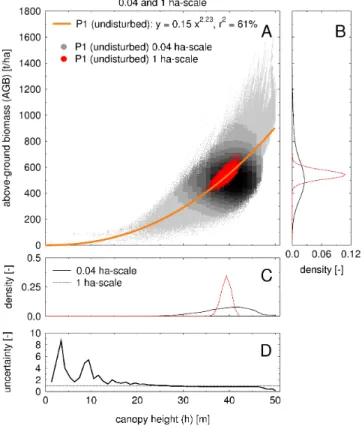
husing a power-law function AGB=a·hbwith anr2=61.4% (Fig. 1A). Linear or quadratic function are with a correlation coefficient of 58.9% and 60.8%, respectively, only slightly
10
worse than the power-law equation. The spread in AGB data for a given canopy height is large. The relative uncertainty on the 95% confidence interval (4σ/mean) is larger than 100% for trees smaller than 26 m and generally larger than 200% forh smaller than 12 m (Fig. 1D). The relative uncertainty is with 80–85% stable for canopy heights between 30 and 45 m and declines towards 20% for plots with canopy heights of 50 m.
15
The decline in relative uncertainty for canopies larger than 45 m might be caused by the low sample size. Only very few tree species, or PFTs, can grow to such heights, thus reducing the variability. To summarise, the variability of biomass growth underneath the largest growing tree within a plot is in tropical rain forests huge and a simple back calculation without additional information from canopy height to standing stock at this
20
scale is ambiguous.
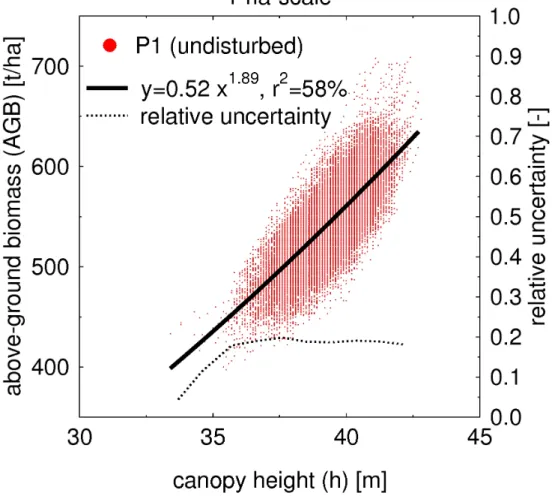
In the 1 ha-scale analysis regressions between AGB andhare withr2=58% of sim-ilar quality than for the plot-size (0.04 ha-scale) (Fig. 2). However, uncertainties in the prediction of AGB as functions ofhare much smaller. Canopy height, now represented as ha-wide averages, varied only between 35 and 42 m, the relative uncertainty was
25
stable at 18–20% throughout the range ofh(95% confidence level).
BGD
7, 3227–3255, 2010Ground-truthing of spaceborne AGB estimates in tropcial
rain forests
P. K ¨ohler and A. Huth
Title Page
Abstract Introduction
Conclusions References
Tables Figures
◭ ◮
◭ ◮
Back Close
Full Screen / Esc
Printer-friendly Version
Interactive Discussion
Discussion
P
a
per
|
Dis
cussion
P
a
per
|
Discussion
P
a
per
|
Discussio
n
P
a
per
|
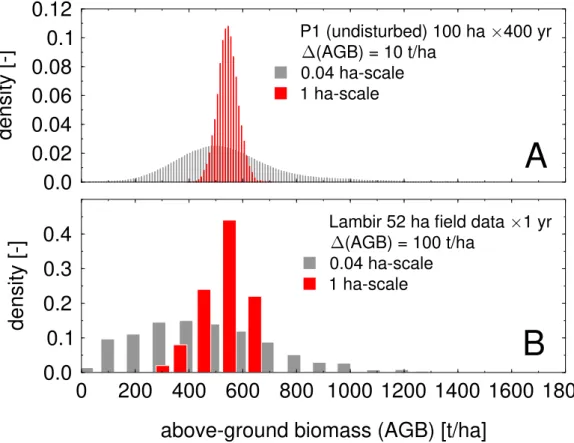
reserve in the Malaysian province Sarawak on Borneo. In the biomass distribution of the 1 ha-scale from the 52 ha inventory in Lambir (Yamakura et al., 1996) the frequency maxima of 541 t/ha is very close to 545 t/ha of our undisturbed forest simulations P1 (Fig. 3). The distribution is wider for Lambir in both spatial scales, probably due to the sampling size which was nearly three orders of magnitude smaller in the field data
5
(n=40 100 or 52 ha for simulations and Lambir, respectively). This comparison is there-fore restricted, but it shows that the biomass distribution of the simulated rain there-forest is within the range seen in real forest inventories, and strongly depends on the spatial scale.
3.2 Logged (disturbed) tropical rain forest
10
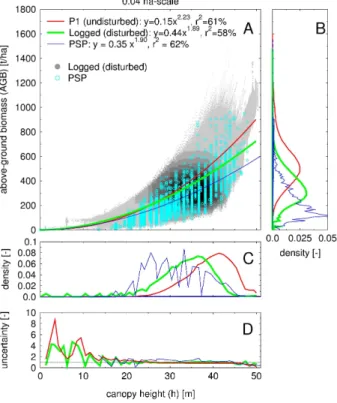
For the logged forests some interesting patterns emerged. The number of forest plots with large canopy heights is strongly reduced. The maximum in the AGB distribution in the plot (0.04 ha) scale is shifted from 500 t/ha in the undisturbed to 300 t/ha in the disturbed forests (Fig. 4B). Similarly, canopy height is reduced from a maximum in the distribution at 42 m to 37 m (Fig. 4C). In the PSPs the distribution is shifted
15
to even smaller canopies (maximum at ∼30 m height) with less biomass (maximum ∼100 t/ha). This indicates, that the PSP data do not cover the same range as the simulated disturbed forests, but are biased towards smaller, heavier disturbed sites. This bias is based on the fact, that the PSP data are restricted to 8–54 years after tree extraction. They are thus not representative for disturbed forest dynamics with
20
long cutting cycles (60–80 years), although these conditions are found in 50% of our logging scenarios.
On the 0.04 ha-scale regressions are with an r2 of about 60% of similar quality for undisturbed and disturbed forests simulations as well as for the PSP data, although the power-law equations differ in detail (Fig. 4A, Table 2). The relative uncertainty on
25
BGD
7, 3227–3255, 2010Ground-truthing of spaceborne AGB estimates in tropcial
rain forests
P. K ¨ohler and A. Huth
Title Page
Abstract Introduction
Conclusions References
Tables Figures
◭ ◮
◭ ◮
Back Close
Full Screen / Esc
Printer-friendly Version
Interactive Discussion
Discussion
P
a
per
|
Dis
cussion
P
a
per
|
Discussion
P
a
per
|
Discussio
n
P
a
per
|
On the larger spatial scale of ha-averages the power-law regression equation leads in the disturbed forest simulations as well as in the PSP data to significantly better agreement with the underlying data (r2=90 and 91%, respectively) than in the undis-turbed simulations (58%) (Fig. 5A). One can clearly identify in the scatter plot of AGB overh (Fig. 5A), that the undisturbed simulations are only a subsample at the upper
5
end of the disturbed forest simulations. Furthermore, the PSP data represent the lower range of the disturbed forest simulations. The scatter of disturbed forest data points for AGB<200 t/ha and canopy height h∼32 m (Fig. 5A) is caused by the appearance of pioneer PFT after logging operations. They dominate the plots for some years, be-fore in the secondary successions other PFTs take over. However, because of their
10
low wood densities these pioneers are rather unimportant for the calculation of mean above-ground biomass. The relative uncertainty at the 95% confidence level is larger than 40% in the disturbed forests for canopies smaller than 25 m, and between 20 and 40% for larger canopies and throughout the PSP data set (Fig. 5B).
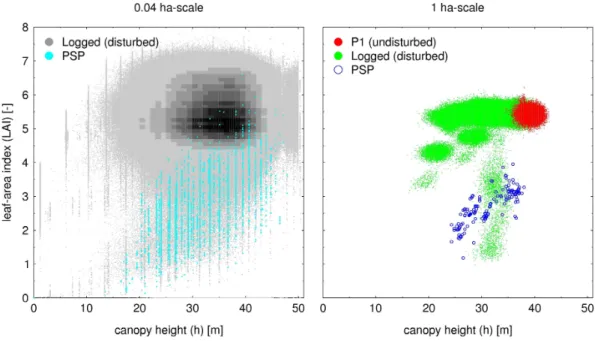
There is no significant correlation between LAI and canopy height (r2<5%), neither in
15
the undisturbed nor in the disturbed forest simulations, neither on the smaller 0.04 ha-scale (Fig. 6A) nor on the large 1 ha-ha-scale (Fig. 6B). Again, PSP data are on the lower end of the range of the simulated data.
A linear relationship with anr2of 58% can be obtained from the 1 ha-scale analysis of AGB as function of gap fraction (Fig. 7A). Here, gaps are defined as 20 m×20 m plots
20
with a canopy height below 25 m. In all logging simulations there are areas with low gap fraction (typically <15%) and with high gap fraction (around 25% for reduced-impact logging RIL, and above 40% for conventional logging CON), the range in-between is somehow not covered at all (Fig. 7B). This might be understood as the following: The high gap fractions are a direct result of the logging operations. Directly after logging
25
BGD
7, 3227–3255, 2010Ground-truthing of spaceborne AGB estimates in tropcial
rain forests
P. K ¨ohler and A. Huth
Title Page
Abstract Introduction
Conclusions References
Tables Figures
◭ ◮
◭ ◮
Back Close
Full Screen / Esc
Printer-friendly Version
Interactive Discussion
Discussion
P
a
per
|
Dis
cussion
P
a
per
|
Discussion
P
a
per
|
Discussio
n
P
a
per
|
will thus happen more or less simultaneously in all plots which were disturbed by the logging operation. Each disturbance regime produces its own typical pattern in a AGB-gap fraction diagram (Fig. 7B). This is a first indication that such patterns might be detectable by remote sensing in the future to distinguish different disturbance regimes in tropical forests from air- and spaceborne observations.
5
4 Discussion and conclusions
To reduce the uncertainties in our knowledge of the carbon cycle a global coverage of the terrestrial carbon storage is a desirable target, for which spaceborne remote sens-ing techniques have to be applied. Repeated annual measurements could thus identify large sources and sinks of carbon due to large-scale deforestation or reforestation
pro-10
grams.
Within this effort a knowledge of the uncertainties and at best their minimisation is crucial to determine whether or not new approaches might improve our knowledge of the terrestrial carbon storage and its variability over time. It was already shown, how er-ror propagates in inventory-based biomass estimates in tropical forests, in which AGB
15
is typically derived from allometric relationship with the stem diameter of individual trees and only seldomly measured directly (Chave et al., 2004). Another huge uncertainty on the way to a complete carbon balance of tropical forests is the amount of carbon bound in dead wood, so-called necromass, above ground (Chao et al., 2009) and in forest soils below ground (Luyssaert et al., 2008). Both pools are largely unsampled,
20
but might introduce due to their relatively small size in the tropics (Bonan, 2008) and due to their linear relationship with AGB only a small bias to the overall carbon budgets (Cairns et al., 1997).
If AGB is calculated not as a function of tree diameter known to be the best predic-tor of AGB (Chave et al., 2005; Slik et al., 2010), but from more aggregated variables
25
BGD
7, 3227–3255, 2010Ground-truthing of spaceborne AGB estimates in tropcial
rain forests
P. K ¨ohler and A. Huth
Title Page
Abstract Introduction
Conclusions References
Tables Figures
◭ ◮
◭ ◮
Back Close
Full Screen / Esc
Printer-friendly Version
Interactive Discussion
Discussion
P
a
per
|
Dis
cussion
P
a
per
|
Discussion
P
a
per
|
Discussio
n
P
a
per
|
systematic vegetation monitoring. There is a need to establish new allometric relation-ships for tropical forests. In the absence of field inventories covering all possible forest situations forest growth models are useful tools to derive such new relationships. This is especially the case for uneven-aged mixed forest stands in the tropics in which long logging cycles are necessary for sustainable timber harvesting. The simulation results
5
can not completely compensate for inventories, but they can significantly broaden the spectra of possible forest situations on the plot level.
Another advantage of forest growth modelling is the consistency of the analysed set of simulation results. The FORMIND2.0-model does not account for uncertainties in the allometric relationships between dbh and AGB and reduces species-specific diff
er-10
ences to the 13 PFT, which were selected for Borneo’s rain forest. Thus, the uncertain-ties we here calculate are structural uncertainuncertain-ties between the aggregated variables canopy height hand AGB and LAI. They might in detail differ in field inventories, but they are in principle contained in the vegetation structure of tropical rain forests.
We therefore conclude that the structural uncertainties in AGB estimates based on
15
given spaceborne canopy height measurements are according to our simulations re-sults (and in agreement with PSP data) on the order of 20–40% if ha-wide averages are investigated (95% confidence level). However, for the calculation of the overall un-certainty of AGB the accuracy of the canopy height derived from remote sensing tech-niques must also be taken into consideration. Canopy height estimates obtained from
20
airborne polarimetric interferometric synthetic aperture radar (Pol-InSAR) or airborne LIDAR over dipterocarp tropical rain forests have shown, that the mean canopy height of the hundred largest trees on one hectare can be measured with an accuracy of 10% (1σ) (Hajnsek et al., 2009). It therefore seems possible that the suggested target of maximum uncertainty of±18% for AGB given by Houghton et al. (2009), equivalent
25
BGD
7, 3227–3255, 2010Ground-truthing of spaceborne AGB estimates in tropcial
rain forests
P. K ¨ohler and A. Huth
Title Page
Abstract Introduction
Conclusions References
Tables Figures
◭ ◮
◭ ◮
Back Close
Full Screen / Esc
Printer-friendly Version
Interactive Discussion
Discussion
P
a
per
|
Dis
cussion
P
a
per
|
Discussion
P
a
per
|
Discussio
n
P
a
per
|
itself. The uncertainty can be reduced if it would be possible to derive information on the vertical forest structure by remote sensing techniques in the future. According to our analysis the LAI can not be predicted from canopy height.
Acknowledgements. This project received funding from ESA under the contract RFQ-3-11536/06/L-BC. We thank Kostas Papathanassiou and Florian Kugler for comments on earlier
5
drafts.
References
Anderson, L. O., Malhi, Y., Ladle, R. J., Arag ˜ao, L. E. O. C., Shimabukuro, Y., Phillips, O. L., Baker, T., Costa, A. C. L., Espejo, J. S., Higuchi, N., Laurance, W. F., L ´opez-Gonz ´alez, G., Monteagudo, A., N ´u ˜nez-Vargas, P., Peacock, J., Quesada, C. A., and Almeida, S.: Influence
10
of landscape heterogeneity on spatial patterns of wood productivity, wood specific density and above ground biomass in Amazonia, Biogeosciences, 6, 1883–1902, doi:10.5194/bg-6-1883-2009, 2009. 3230
Balzter, H., Rowland, C., and Saich, P.: Forest canopy height and carbon estimation at Monks Wood National Nature Reserve, UK, using dual-wavelength SAR interferometry, Remote
15
Sens. Environ., 108, 224–239, doi:10.1016/j.rse.2006.11.014, 2007. 3230
Bergen, K. M., Goetz, S. J., Dubayah, R. O., Henebry, G. M., Hunsaker, C. T., Imhoff, M. L., Nelson, R. F., Parker, G. G., and Radeloff, V. C.: Remote sensing of vegetation 3-D structure for biodiversity and habitat: Review and implications for lidar and radar spaceborne missions, J. Geophys. Res., 114, G00E06, doi:10.1029/2008JG000883, 2009. 3230
20
Bonan, G. B.: Forest and climate change: forcgins, feedbacks, and the climate benefits of forests, Science, 320, 1444–1449, doi:10.1126/science.1155121, 2008. 3239
Botkin, D. B.: Forest Dynamics: An Ecological Model, Oxford University Press, Oxford, 1993. 3232
Cairns, M., Brown, S., Helmer, E., and Baumgardner, G.: Root biomass allocation in the world’s
25
upland forests, Oecologia, 111, 1–11, 1997. 3239
Canadell, J. G., Le Qu ´er ´e, C., Raupach, M. R., Field, C. B., Buitenhuis, E. T., Ciais, P., Conway, T. J., Gillett, N. P., Houghton, R. A., and Marland, G.: Contributions to accelerating atmo-spheric CO2growth from economic acitivity, carbon intensity, and efficiency of natural sinks, P. Natl. Acad. Sci., 104, 18866–18870, doi:10.1073/pnas.0702737104, 2007. 3229
BGD
7, 3227–3255, 2010Ground-truthing of spaceborne AGB estimates in tropcial
rain forests
P. K ¨ohler and A. Huth
Title Page
Abstract Introduction
Conclusions References
Tables Figures
◭ ◮
◭ ◮
Back Close
Full Screen / Esc
Printer-friendly Version
Interactive Discussion
Discussion
P
a
per
|
Dis
cussion
P
a
per
|
Discussion
P
a
per
|
Discussio
n
P
a
per
|
Chao, K.-J., Phillips, O. L., Baker, T. R., Peacock, J., Lopez-Gonzalez, G., V ´asquez Mart´ınez, R., Monteagudo, A., and Torres-Lezama, A.: After trees die: quantities and determinants of necromass across Amazonia, Biogeosciences, 6, 1615–1626, doi:10.5194/bg-6-1615-2009, 2009. 3239
Chave, J., Condit, R., Lao, S., Caspersen, J., Foster, R., and Hubbell, S.: Spatial and temporal
5
variation in biomass of a tropical forest: results from a large census plot in Panama, J. Ecol., 91, 240–252, 2003. 3229
Chave, J., Condit, R., Aguilar, S., Hernandez, A., Lao, S., and Perez, R.: Error propagation and scaling for tropical forest biomass estimates, Philos. T. Roy. Soc. B, 359, 409–420, doi: 10.1098/rstb.2003.1425, 2004. 3239
10
Chave, J., Andalo, C., Brown, S., Cairns, M., Chambers, J., Eamus, D., F ¨olster, H., Fromard, F., Higuchi, N., Kira, T., Lescure, J.-P., Nelson, B., Ogawa, H., Puig, H., Ri ´era, B., and Yamakura, T.: Tree allometry and improved estimation of carbon stocks and balance in tropical forests, Oecologia, 145, 87–99, doi:10.1007/s00442-005-0100-x, 2005. 3229, 3239
Chave, J., Condit, R., Muller-Landau, H. C., Ashton, P. S., Bunyavejchewin, S., Co, L. L.,
15
Dattaraja, H. S., Davies, S. J., Esufali, S., Ewango, C. E. N., Feeley, K. J., Foster, R. B., Gunatilleke, N., Gunatilleke, S., Hall, P., Hart, T. B., Hern ´andez, C., Hubbell, S. P., Itoh, A., Kiratiprayoon, S., LaFrankie, J. V., de Lao, S. L., Makana, J.-R., Nur Supardi Noor, M., Kassim, A. R., Samper, C., Sukumar, R., Suresh, H. S., Tan, S., Thompson, J., Tongco, M. D. C., Valencia, R., Vallejo, M., Villa, G., Yamakura, T., Zimmerman, J. K., and Losos, E. C.:
20
Assessing evidence for a pervasive alteration in tropical tree communities, Plos Biol., 6, e45, doi:10.1371/journal.pbio.0060045, 2008. 3229
Condit, R.: Research in large long-term tropical forest plots, Trends Ecol. Evol., 10, 18–21, 1995. 3230
Dislich, C., G ¨unter, S., Homeier, J., Schr ¨oder, B., and Huth, A.: Simulating forest dynamics of
25
a tropical montane forest in South Ecuador, Erdkunde, 63, 347–364, doi:10.3112/erdkunde. 2009.04.05, 2009. 3231
Dubayah, R. O., Sheldon, S. L., Clark, D. B., Hofton, M. A., Blair, J. B., Hurtt, G. C., and Chazdon, R. L.: Estimation of tropical forest height and biomass dynamics using lidar remote sensing at La Selva, Costa Rica, J. Geophys. Res., 115, G00E09, doi:
30
BGD
7, 3227–3255, 2010Ground-truthing of spaceborne AGB estimates in tropcial
rain forests
P. K ¨ohler and A. Huth
Title Page
Abstract Introduction
Conclusions References
Tables Figures
◭ ◮
◭ ◮
Back Close
Full Screen / Esc
Printer-friendly Version
Interactive Discussion
Discussion
P
a
per
|
Dis
cussion
P
a
per
|
Discussion
P
a
per
|
Discussio
n
P
a
per
|
Frolking, S., Palace, M. W., Clark, D. B., Chambers, J. Q., Shugart, H. H., and Hurtt, G. C.: Forest disturbance and recovery: A general review in the context of spaceborne remote sensing of impacts on aboveground biomass and canopy structure, J. Geophys. Res., 114, G00E02, doi:10.1029/2008JG000911, 2009. 3230, 3231, 3232
Garrigues, S., Lacaze, R., Baret, F., Morisette, J. T., Qeiss, M., Nickeson, J. E., Fernandes,
5
R., Plummer, S., Shabanov, N. V., Myneni, R. B., Knyazikhin, Y., and Yang, W.: Validation and intercomparison of global Leaf Area Index products derived from remote sensing data, J. Geophys. Res., 113, G02028, doi:10.1029/2007JG000635, 2008. 3230
Global-Carbon-Project: Carbon budget and trends 2007, www.globalcarbonproject.org, last access: 26 September 2008, 2008. 3229
10
Groeneveld, J., Alves, L., Bernacci, L., Catharino, E., Knogge, C., Metzger, J., P ¨utz, S., and Huth, A.: The impact of fragmentation and density regulation on forest succession in the At-lantic rain forest, Ecol. Model., 220, 2450–2459, doi:10.1016/j.ecolmodel.2009.06.015, 2009. 3231
Hajnsek, I., Kugler, F., Lee, S.-K., and Papathanassiou, K. P.: Tropical-Forest-Parameter
Es-15
timation by Means of Pol-InSAR: The INDREX-II Campaign, IEEE T. Goasci. Remote, 47, 481–493, doi:10.1109/TGRS.2008.2009437, 2009. 3230, 3232, 3240
Hawbaker, T. J., Keuler, N. S., Lesak, A. A., Gobakken, T., Contrucci, K., and Radeloff, V. C.: Improved estimates of forest vegetation structure and biomass with a LiDAR-optimized sam-pling design, J. Geophys. Res., 114, G00E04, doi:10.1029/2008JG000870, 2009. 3230
20
Houghton, R. A., Hall, F., and Goetz, S. J.: Importance of biomass in the global carbon cycle, J. Geophys. Res., 114, G00E03, doi:10.1029/2009JG000935, 2009. 3230, 3240
Hurtt, G. C., Fisk, J., Thomas, R., Dubayah, R., Moorcroft, P., and Shugart, H.: Linking models and data on vegetation structure, J. Geophys. Res., in press, doi:10.1029/2009JG000937, 2010. 3230
25
Huth, A., Drechsler, M., and K ¨ohler, P.: Multicriteria evaluation of simulated logging scenarios in a tropical rain forest, J. Environ. Manage., 71, 321–333, doi:10.1016/j.envman.2004.03.008, 2004. 3232, 3234
Huth, A., Drechsler, M., and K ¨ohler, P.: Using multicriteria decision analysis and a forest growth model to assess impacts of tree harvesting in Dipterocarp lowland rain forests, Forest Ecol.
30
BGD
7, 3227–3255, 2010Ground-truthing of spaceborne AGB estimates in tropcial
rain forests
P. K ¨ohler and A. Huth
Title Page
Abstract Introduction
Conclusions References
Tables Figures
◭ ◮
◭ ◮
Back Close
Full Screen / Esc
Printer-friendly Version
Interactive Discussion
Discussion
P
a
per
|
Dis
cussion
P
a
per
|
Discussion
P
a
per
|
Discussio
n
P
a
per
|
Kammesheidt, L., K ¨ohler, P., and Huth, A.: Sustainable timber harvesting in Venezuela: a modelling approach, J. Appl. Ecol., 38, 756–770, doi:10.1046/j.1365–2664.2001.00629.x, 2001. 3231
K ¨ohler, P.: Modelling anthropogenic impacts on the growth of tropical rain forests – using an individual-oriented forest growth model for analyses of logging and fragmentation in three
5
case studies, online at: http://hdl.handle.net/10013/epic.15101, last access: May 2010, PhD thesis, University of Kassel, Der Andere Verlag, Osnabr ¨uck, Germany, 2000. 3231
K ¨ohler, P. and Huth, A.: The effect of tree species grouping in tropical rain forest mod-elling – Simulation with the individual based model FORMIND, Ecol. Model., 109, 301–321, doi:10.1016/S0304-3800(98)00 066-0, 1998. 3231
10
K ¨ohler, P. and Huth, A.: Simulating growth dynamics in a South-East Asian rain forest threatened by recruitment shortage and tree harvesting, Climatic Change, 67, 95–117, doi:10.1007/s10 584-004-0713-9, 2004. 3232
K ¨ohler, P. and Huth, A.: Impacts of recruitment limitation and canopy disturbances on tropical tree species richness, Ecol. Model., 203, 511–517, doi:10.1016/j.ecolmodel.2006.11.023,
15
2007. 3232
K ¨ohler, P., Ditzer, T., and Huth, A.: Concepts for the aggregation of tropical tree species into functional types and the application on Sabah’s lowland rain forests, species list used for the article at http://www.usf.uni-kassel.de/usf/archiv/dokumente/specieslists/sabah/sabah.html, last access: May 2010, J. Trop. Ecol., 16, 591–602, 2000. 3233
20
K ¨ohler, P., Ditzer, T., Ong, R. C., and Huth, A.: Comparison of measured and modelled growth on permanent plots in Sabahs rain forests, Forest Ecol. Manag., 144, 101–111, doi:10.1016/S0378-1127(00)00364-9, 2001. 3231, 3235
K ¨ohler, P., Chave, J., Ri ´era, B., and Huth, A.: Simulating long-term response of tropical wet forests to fragmentation, Ecosystems, 6, 129–143, doi:10.1007/s10021-002-0121-9., 2003.
25
3231
Le Qu ´er ´e, C., Raupach, M. R., Canadell, J. G., Marland, G., Bopp, L., Ciais, P., Conway, T. J., Doney, S. C., Feely, R. A., Foster, P., Friedlingstein, P., Gurney, K., Houghton, R. A., House, J. I., Huntingford, C., Levy, P. E., Lomas, M. R., Majku, J., Metz, J. P. O., Peters, G. P., Prentice, I. C., Randerson, J. T., Running, S. W., Sarmiento, J. L., Schuster, U., Sitch, S.,
30
BGD
7, 3227–3255, 2010Ground-truthing of spaceborne AGB estimates in tropcial
rain forests
P. K ¨ohler and A. Huth
Title Page
Abstract Introduction
Conclusions References
Tables Figures
◭ ◮
◭ ◮
Back Close
Full Screen / Esc
Printer-friendly Version
Interactive Discussion
Discussion
P
a
per
|
Dis
cussion
P
a
per
|
Discussion
P
a
per
|
Discussio
n
P
a
per
|
Lefsky, M. A., Cohen, W. B., Parker, G. G., and Harding, D. J.: Lidar Remote Sensing for Ecosystem Studies, Bioscience, 52, 19–30, 2002. 3230
Lefsky, M. A., Harding, D. J., Keller, M., Cohen, W. B., Carabajal, C. C., Del Bom Espirito-Santo, F., Hunter, M. O., and de Oliveira, R. J.: Estimates of forest canopy height and aboveground biomass using ICESat, Geophys. Res. Lett., 32, L22S02, doi:10.1029/2005GL023971, 2005. 3230
5
Lewis, S. L., Lopez-Gonzalez, G., Sonk ´e, B., Affum-Baffoe, K., Baker, T. R., Ojo, L. O., Phillips, O. L., Reitsma, J. M., White, L., Comiskey, J. A., Djuikouo-K., M.-N., Ewango, C. E. N., Feldpausch, T. R., Hamilton, A. C., Gloor, M., Hart, T., Hladik, A., Lloyd, J., Lovett, J. C., Makana, J.-R., Malhi, Y., Mbago, F. M., Ndangalasi, H. J., Peacock, J., Peh, K. S.-H., Sheil, D., Sunderland, T., Swaine, M. D., Taplin, J., Taylor, D., Thomas, S. C., Votere, R., and W ¨oll,
10
H.: Increasing carbon storage in intact African tropical forests, Nature, 457, 1003–1006, doi:10.1038/nature07771, 2009. 3229
Luyssaert, S., Schulze, E.-D., B ¨orner, A., Knohl, A., Hessenm ¨oller, D., Law, B. E., Ciais, P., and Grace, J.: Old-growth forests as global carbon sinks, Nature, 455, 213–215, doi:10.1038/nature07276, 2008. 3239
15
Malhi, Y., Wood, D., Baker, T. R., Wright, J., Phillips, O. L., Cochrane, T., Meir, P., Chave, J., Almeida, S., Arroyo, L., Higuchi, N., Killeen, T. J., Lauranc, E. S. G., Laurance, W. F., Lewis, S. L., Monteagudo, A., Neill, D. A., Vargas, P. N., Pitman, N. C. A., Quesada, C. A., Salomao, R., Silva, J. N. M., Lezama, A. T., Terborgh, J., Martinez, R. V., and Vinceti, B.: The regional variation of aboveground live biomass in old-growth Amazonian forests, Global Change Biol.,
20
12, 1107–1138, doi:10.1111/j.1365-2486.2006.01120.x, 2006. 3229, 3231
Moreira, A., Hajnsek, I., Krieger, G., Papathanassiou, K., Eineder, M., Zan, F. D., Younis, M., and Werner, M.: Tandem-L: Monitoring the Earth’s dynamic with INSAR and PoL-INSAR, Proc. of 4th Int. Workshop on Science and Applications of SAR Polarimetry and Polarimetric Interferometry – PolInSAR 2009, 26–30 January 2009, ESA SP-668, April 2009, Frascati,
25
Italy, 2009. 3230
Phillips, O. L., Aragao, L. E. O. C., Lewis, S. L., Fisher, J. B., Lloyd, J., Lopez-Gonzalez, G., Malhi, Y., Monteagudo, A., Peacock, J., Quesada, C. A., van der Heijden, G., Almeida, S., Amaral, I., Arroyo, L., Aymard, G., Baker, T. R., Banki, O., Blanc, L., Bonal, D., Brando, P., Chave, J., de Oliveira, A. C. A., Cardozo, N. D., Czimczik, C. I., Feldpausch, T. R., Freitas,
30
BGD
7, 3227–3255, 2010Ground-truthing of spaceborne AGB estimates in tropcial
rain forests
P. K ¨ohler and A. Huth
Title Page
Abstract Introduction
Conclusions References
Tables Figures
◭ ◮
◭ ◮
Back Close
Full Screen / Esc
Printer-friendly Version
Interactive Discussion
Discussion
P
a
per
|
Dis
cussion
P
a
per
|
Discussion
P
a
per
|
Discussio
n
P
a
per
|
Silveira, M., Thomas, A. S., Steege, H. T., Stropp, J., Vasquez, R., Zelazowski, P., Davila, E. A., Andelman, S., Andrade, A., Chao, K.-J., Erwin, T., Di Fiore, A. C. E. H., Keeling, H., Killeen, T. J., Laurance, W. F., Cruz, A. P., Pitman, N. C. A., Vargas, P. N., Ramirez-Angulo, H., Rudas, A., Salamao, R., Silva, N., Terborgh, J., and Torres-Lezama, A.: Drought Sen-sitivity of the Amazon Rainforest, Science, 323, 1344–1347, doi:10.1126/science.1164033, 2009. 3229
5
Potter, C., Klooster, S., Huete, A., Genovese, V., Bustamante, M., Guimaraes Ferreira, L., R. C. de Oliveira Jr., and Zepp, R.: Terrestrial carbon sinks in the Brazilian Amazon and Cerrado region predicted from MODIS satellite data and ecosystem modeling, Biogeosciences, 6, 937–945, doi:10.5194/bg-6-937-2009, 2009. 3230
R ¨uger, N., Williams-Linera, G., Kissling, W., and Huth, A.: Long-Term Impacts of Fuelwood
10
Extraction on a Tropical Montane Cloud Forest, Ecosystems, 11, 868–881, 2008. 3231 Sabine, C. L., Heimann, M., Artaxo, P., Bakker, D. C. E., Arthur, C.-T., Field, C. B., Gruber,
N., Le Qu ´er ´e, C., Prinn, R. G., Richey, J. E., Lankao, P. R., Sathaye, J. A., and Valentini, R.: Current status and past trends of the global carbon cycle, in: The global carbon cycle: integrating humans, climate, and the natural world, edited by: Field, C. B. and Raupach,
15
M. R., Island Press, Washington, Covelo, London, 17–44 pp., 2004. 3229
Schlensog, M.: Experimentelle Untersuchungen des Lichtklimas in Urwaldparzellen Nordbor-neos, no. 117 in G ¨ottinger Beitr ¨age zur Land- und Forstwirtschaft in den Tropen und Sub-tropen, Goltze, G ¨ottingen, 1997. 3233
Slik, J. W. F., Raes, N., Aiba, S.-I., Brearley, F. Q., Cannon, C. H., Meijaard, E., Nagamasu, H.,
20
Nilus, R., Paoli, G., Poulsen, A. D., Sheil, D., Suzuki, E., van Valkenburg, J. L. C. H., Webb, C. O., Wilkie, P., and Wulffraat, S.: Environmental correlates for tropical tree diversity and distribution patterns in Borneo, Divers. Distrib., 15, 523–532, 2009. 3231
Slik, J. W. F., Aiba, S.-I., Brearley, F. Q., Cannon, C. H., Forshed, O., Kitayama, K., Nagamasu, H., Nilus, R., Payne, J., Paoli, G., Poulsen, A. D., Raes, N., Sheil, D., Sidiyasa, K., Suzuki,
25
E., and van Valkenburg, J. L. C. H.: Environmental correlates of tree biomass, basal area, wood specific gravity and stem density gradients in Borneo’s tropical forests, Global Ecol. Biogeogr., 19, 50–60, doi:10.1111/j.1466-8238.2009.00489.x, 2010. 3229, 3231, 3239 Yamakura, T., Kanzaki, M., Itoh, A., Ohkubo, T., Ogino, K., Lee, H. S., and Ashton, P. S.: Forest
structure of a tropical rain forest at Lambir, Sarawak with special reference to the dependency
30
BGD
7, 3227–3255, 2010Ground-truthing of spaceborne AGB estimates in tropcial
rain forests
P. K ¨ohler and A. Huth
Title Page
Abstract Introduction
Conclusions References
Tables Figures
◭ ◮
◭ ◮
Back Close
Full Screen / Esc
Printer-friendly Version
Interactive Discussion
Discussion
P
a
per
|
Dis
cussion
P
a
per
|
Discussion
P
a
per
|
Discussio
n
P
a
per
|
Table 1. Simulation scenarios. Undisturbed site P1 or different logging scenarios with dis-turbed forests.
Scenario Logging Logging Cutting Simulation Area Plots runs tree
method cycle limit periodT A n density
(yr) (cm) (yr) (ha) (400 m2) (1/ha)
P1 (undisturbed) – – – 400 100 2500 1 2795
BGD
7, 3227–3255, 2010Ground-truthing of spaceborne AGB estimates in tropcial
rain forests
P. K ¨ohler and A. Huth
Title Page
Abstract Introduction
Conclusions References
Tables Figures
◭ ◮
◭ ◮
Back Close
Full Screen / Esc
Printer-friendly Version
Interactive Discussion
Discussion
P
a
per
|
Dis
cussion
P
a
per
|
Discussion
P
a
per
|
Discussio
n
P
a
per
|
Table 2. Regression functions between above-ground biomass AGB (per plot or as ha-mean) and canopy heighthor gap fraction (gap: maximum height of plot<25 m) of site for undisturbed site P1 or average over all 24 logging scenarios.
Relation
y: AGBplot(t/ha) AGBha(t/ha) AGBha(t/ha) x: h(m) h¯(m) gap (%)
Scenario Function r2 Function r2 Function r2
BGD
7, 3227–3255, 2010Ground-truthing of spaceborne AGB estimates in tropcial
rain forests
P. K ¨ohler and A. Huth
Title Page
Abstract Introduction
Conclusions References
Tables Figures
◭ ◮
◭ ◮
Back Close
Full Screen / Esc
Printer-friendly Version
Interactive Discussion
Discussion
P
a
per
|
Dis
cussion
P
a
per
|
Discussion
P
a
per
|
Discussio
n
P
a
per
|
Fig. 1. Relation between above-ground biomass (AGB) and canopy height (h) for the undis-turbed forest (site P1). (A)Data on 0.04 ha-scale (grey to black) (red: 1 ha-scale for compari-son) are plotted together with a power-law regression function. Due to the huge number of data points in the scatter plot of the 0.04 ha-scale (more than 1 000 000) the grey-scale indicates the density of the data points with highest densities in black. Normalised density of(B)AGB and of
BGD
7, 3227–3255, 2010Ground-truthing of spaceborne AGB estimates in tropcial
rain forests
P. K ¨ohler and A. Huth
Title Page
Abstract Introduction
Conclusions References
Tables Figures
◭ ◮
◭ ◮
Back Close
Full Screen / Esc
Printer-friendly Version
Interactive Discussion
Discussion
P
a
per
|
Dis
cussion
P
a
per
|
Discussion
P
a
per
|
Discussio
n
P
a
per
|
BGD
7, 3227–3255, 2010Ground-truthing of spaceborne AGB estimates in tropcial
rain forests
P. K ¨ohler and A. Huth
Title Page
Abstract Introduction
Conclusions References
Tables Figures
◭ ◮
◭ ◮
Back Close
Full Screen / Esc
Printer-friendly Version
Interactive Discussion
Discussion
P
a
per
|
Dis
cussion
P
a
per
|
Discussion
P
a
per
|
Discussio
n
P
a
per
|
0
200 400 600 800 1000 1200 1400 1600 1800
above-ground biomass (AGB) [t/ha]
0.0
0.1
0.2
0.3
0.4
density
[-]
B
1 ha-scale 0.04 ha-scale
(AGB) = 100 t/ha
Lambir 52 ha field data 1 yr
0.0
0.02
0.04
0.06
0.08
0.1
0.12
density
[-]
A
1 ha-scale 0.04 ha-scale
(AGB) = 10 t/ha
P1 (undisturbed) 100 ha 400 yr
Fig. 3. Comparison of the normalised frequency distribution of above-ground biomass for
BGD
7, 3227–3255, 2010Ground-truthing of spaceborne AGB estimates in tropcial
rain forests
P. K ¨ohler and A. Huth
Title Page
Abstract Introduction
Conclusions References
Tables Figures
◭ ◮
◭ ◮
Back Close
Full Screen / Esc
Printer-friendly Version
Interactive Discussion
Discussion
P
a
per
|
Dis
cussion
P
a
per
|
Discussion
P
a
per
|
Discussio
n
P
a
per
|
BGD
7, 3227–3255, 2010Ground-truthing of spaceborne AGB estimates in tropcial
rain forests
P. K ¨ohler and A. Huth
Title Page
Abstract Introduction
Conclusions References
Tables Figures
◭ ◮
◭ ◮
Back Close
Full Screen / Esc
Printer-friendly Version
Interactive Discussion
Discussion
P
a
per
|
Dis
cussion
P
a
per
|
Discussion
P
a
per
|
Discussio
n
P
a
per
|
BGD
7, 3227–3255, 2010Ground-truthing of spaceborne AGB estimates in tropcial
rain forests
P. K ¨ohler and A. Huth
Title Page
Abstract Introduction
Conclusions References
Tables Figures
◭ ◮
◭ ◮
Back Close
Full Screen / Esc
Printer-friendly Version
Interactive Discussion
Discussion
P
a
per
|
Dis
cussion
P
a
per
|
Discussion
P
a
per
|
Discussio
n
P
a
per
|
BGD
7, 3227–3255, 2010Ground-truthing of spaceborne AGB estimates in tropcial
rain forests
P. K ¨ohler and A. Huth
Title Page
Abstract Introduction
Conclusions References
Tables Figures
◭ ◮
◭ ◮
Back Close
Full Screen / Esc
Printer-friendly Version
Interactive Discussion
Discussion
P
a
per
|
Dis
cussion
P
a
per
|
Discussion
P
a
per
|
Discussio
n
P
a
per
|