Original article (short paper)
Predicting the future of sports organizations
Jugoslav Vojinovic Nebojsa Maksimovic
Dragan Kokovic Aleksandar Raic Radenko Matic
University of Novi Sad, Serbia
Dragan Doder
Regional Institute of Sport, Novi Sad, Serbia
Abstract—The current crisis of sport in Serbia justiies its prediction of real potential future of sport organizations.
Sample of respondents (N=277) was divided in two subsamples: 113 professional persons involved in the management of sports clubs (“experimental” sample) and 164 individuals (“control” sample). The results of structural analysis showed that experimental sample based its vision on the staff as a determinant of the system, which is providing creativity as a characteristic of the organizational culture of the club. Control subsample of respondents could indicate some characteristic variables to predict the future of clubs, but can’t say a clear prediction system based on a long sequence of reasoning. We can conclude that the mentioned two sub-samples are differerent in terms of the ability to orient to predict the future of their clubs on the basis of assessment of the key variables that shape the future scenarios.
Keywords: sports organizations, scenario planning, prediction, future, development
Resumo—“Previndo o futuro das organizações desportivas.” A crise atual do esporte na Sérvia justiica sua predição para
um potencial real no futuro das organizações desportivas. Amostra de entrevistados foi dividida em duas sub-amostras: 113 pessoas proissionais envolvidos na gestão de clubes esportivos (amostra ˝experimental˝) e 164 indivíduos (amostra de ˝controle˝). O resultado de análise estrutural mostrou que a amostra experimental baseou sua visão no pessoal como um fator determinante do sistema, fornecendo a criatividade como uma característica da cultura organizacional do clu -be. Sub-amostra de controle dos entrevistados poderia indicar algumas características variáveis para predizer o futuro dos clubes, mas não posso dizer que um sistema de previsão é baseado numa longa seqüência de raciocínio. Podemos concluir que as mencionadas duas sub-amostras são diferentes em termos de capacidade de predizer o futuro de seus clubes na base de avaliação das variáveis principais que formam os futuros cenários.
Palavras-chave: organizações desportivas, planejamento de cenários, predição, desenvolvimento
Resumen—“Predecir el futuro de las organizaciones deportivas.” La crisis actual en el deporte en Serbia, justiica la
predicción del verdadero potencial de las organizaciones deportivas. La muestra de entrevistados (N=277) fue dividida en dos grupos: 113 profesionales que desarrollan su labor en clubes deportivos (grupo experimental) y 164 individuos (grupo control). Los resultados del análisis estructural mostraron que el grupo experimental basó su visión en el personal como un factor determinante para el sistema, que genera creatividad como una característica de la cultura organizativa del club. El grupo control de entrevistados, podrían indicar algunas variables especíicas para predecir el futuro de los clubes, pero sin llegar a proporcionar sistemas claros de predicción basados en una secuencia larga de razonamiento. Podemos concluir que los dos grupos mencionados diieren en su habilidad para orientar las predicciones de futuro de sus clubes, basándose en la evaluación de las variables clave que dan forma a los escenarios futuros.
Palabras claves: organizaciones deportivas, planiicación de escenarios, predicción, futuro, desarrollo
Introduction
The management of contemporary sports organizations is faced with the problem of rapid changes and complexity of the envi-ronment in which they operate. From such global socio-econo-mic processes characterized by globalization, new approaches
Computerized tools appropriate for systematic deining and testing of research hypotheses (Bar-Yam, 2003, 2008a; 2008b) largely contributed to this. With increasing importance of strategic management, prediction function is also becoming more important—within planning function or as a separate ma-nagement function (Maksimovic & Raic, 2012; Rui, Jie, Xiao-bing, Dongdong, & Xiaoming, 2011). In the basis of a long-term strategic planning there is a problem of predicting alternative futures. “Predicting, as an activity that provides an estimate of the probability of events to happen, enables understanding of the consequences for business and development plans” (Lekovic, 1995). Key point of strategic management relates to the pre-paration of top management to deal with critical uncertainties brought by the future. Scenario planning is a process that puts these matters into real framework, that is, enables “discovering or inding, reviewing and evaluation, recommending and pro-motion of possible, probable and desirable futures” (Ratcliffe, 2003). The need for formulating a national strategy of the de-velopment of sport in Serbia (especially in Vojvodina, which is a highly-developed region with regard sport activities) justiies both research efforts to summarize and apply methodological knowledge on research of future of sports, and experiments in the ield of scientiic establishing and practical monitoring of actual and preferred strategies of sustainable development of sports in the real circumstances of local communities and their European environment.
The aim of this study is delimited by research question: Is there a correlation between the presence of systematic opinions of the subjects engaged in management of sports organization and predictions of its future development derived from such opinions, and the creation and implementation of the sports organization development strategy?
Method
We have used the Godet’s structural analysis computer pro-gram (Godet, 1987, 2006) that contains elements of computer simulation (especially detailed ranking of scenarios according to their probability). According to Godet’s approach to planning the future, the system of predicting the future of sports clubs is described by a set of two domains (vision of the future of the club, and the future club development factors) and ten variables. These variables are the following: Preferred level of competition, Desirable future success in the competition, Preferred type of sport for the club in the future, Preferred ownership status of the club in the future, Organization structure, Culture, Resources, Local environment, European environment and Globalization. Each variable contains sub-variables used for measuring the value of each variable.
By its methodological approach research performed can be characterized as a survey research, which has the character of quasi-experimental research (Trochim, & Donnelly, 2006). Given that respondents were not previously prepared for this analytical procedure, the survey has allowed gaining insight into the presence of elements of the systematic and strategic thinking among the respondents.
The objective of this research is supported by employing a survey in a sample of respondents from the circle of professionals involved in the management of sports-clubs (as a basic “experi-mental” sample) and individuals (students of the Faculty of Sport and Physical Education in Novi Sad, as a “control” sample). These respondents, although inexperienced, were oriented towards future professional activities related to sports. The inal size of the sample, selected in the manner described, in this case amounts to 277 sub-jects. Out of total number of respondents, 113 were sports experts (management) and 164 athletes. Especially, it should be noted that 220 respondents were students of 3rd and 4th year of the Faculty of
Sport and Physical Education in Novi Sad. The selection of athletes, sports managers and students of the Faculty is performed according to the existing lists based on a table of random numbers. This study was approved by the Ethics Committee of the University of Novi Sad (approval number 3/2014 on March 5, 2014).
Characteristics of sports clubs
The population of sports organizations that provides the sample consists of all sports associations in Vojvodina and organizations institutionally included by them (119 clubs from 29 sports branches, one (athletic) sports association and one sports institute – Sports Institute of Vojvodina). Within each of the identiied sports organization-club, surveys were supposed to include representatives of management (president, secretary, mid-level managers – marketing managers, inance and so on, as well as representative of the coaching staff and the leaders of the senior squads – a total of 5 to 10 participants). A list of respondents regarding sports shows that four commercial mass sports (football, basketball, volleyball and handball) are responsible for 66.71 %, and all other sports for 33.29 %, of the respondents in the sample. However, given the primary intention of this study, it is reasonable to differentiate new sports from traditional, long time practiced sports in Vojvodina. In order to analyze the connection between types of sports, a two-dimensio-nal variable “Sports Type” (TIPS) was constructed. A typology of sports comprised of four categories of sports was created (TIPS variable): 1 – Traditional non-commercial (21.1 %), 2 – Traditional commercial (72.1 %), 3 – New non-commercial (5.8 %) and 4 – New commercial sports (1.0 %). From this insight into the distribution of respondents by type of sport, it was con-cluded that recoding of TIPS variable is justiied (compression of categories 3 and 4 into a single category 3 – Modern sports) resulting in a variable TIPS3.
Type of variable Domain Retained variables
Experimental group Control group
System
determinants
Resources Equipment
Globalisation World sports events
Resources Facilities
Relay variables
Structure Organization Organization
Culture Creativity Creativity
Culture Interpersonal relationships
Culture Shared vision, values Shared vision, values
Resource Human Personnel
Resource Information
Locally Local environment, economy Local environment, economy
Locally Technology
Result variables
Level Provincial
Type of sports Recreational-commercial
Globalisation Scinece, information technology – knowledge society
Table 1. Key variables identiied based on the analysis of meaningful core of the system.
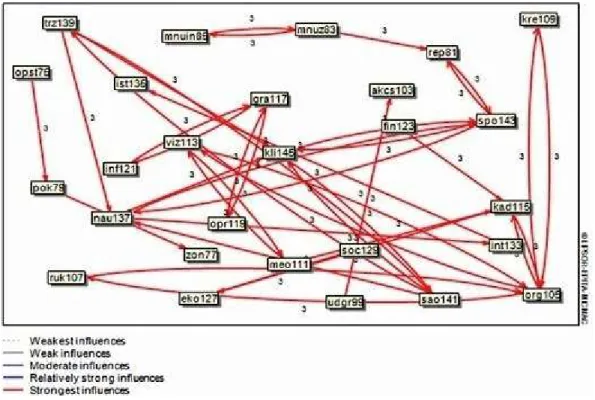
Figure 1. Experimental sample of respondents – direct inluence.
Legend: vrhtb87 - Top of the table
spo143 - World sports mega-events, performances, Olympic games ist135 - Pro-East orientation
rekr97- Recreational-commercial type of sport kli145 - Global climate changes, pollution, environmental deterioration nau137 – Science, information technologies – Society of knowledge trz139 - Global market, inance
sao141 - Global trafic, migrations, tourism kre109 - Creativity intl133 - Integration into European union profs93 - Professional
org105 - Organization teh131 - Technology
in123 - Finance eko127 – Economy
to the introduction of commercial programs); 4) development – short-term: focusing the activities on the senior squad with expectation of rapid effects in the short term; 5) development – long-term: focusing the activities on junior squad with the
Figure 2. Control sample of respondents – direct inluence.
Legend: gra117 - Facilities
opst75- Municipal level of competition kli145 - Global climate changes, pollution, environmental deterioration pok79 – Provincial level of competition meo111 - Interpersonal relations
ruk107 - Management udgr99 - Association of citizens
trz139 - Global market, inance soc129 - Social issues
nau137 - Science, information technologies – Society of knowledge in123 - Finance
ist135 - Pro-East orientation akcs103 - Shareholders’ private property
inf121 – Information rep81 – Republic level of competiton
mnuin85 - International, abroad - vision of future spo143 - World sports mega-events, performances, Olympic games
viz113 - Shared vision, values kad115 – Human resources
zon77 – Zonal level of competition int133 - Integration into European union
eko127 - Economy org105 - Organization
opr119 - Equipment kre109 – Creativity
The irst step in preparing the matrix is derived by cal-culating the Lambda indicator of asymmetric test which determines the direction of relations between two variables (Lambda indicator which with a higher percentage reduces the likelihood of error of reasoning regarding the direction of the connection between the X variable as an independent and Y variable as a dependent variable). Obtained Lambda indicators were entered into two tables in order to explore two sub-samples of respondents. The next step required the con-version of Lambda indicators table into the matrix of Godet’s indicators of the degree of correlation between variables (0 no correlation, 1 weak correlation, 2 moderate and 3 strong correlation). The conversion assumed linear relationship between Lambda indicators and Godet’s indicators of the degree of correlation between variables (relationship impact/ dependence). After entering an adequate number of converted indicators it was shown that there is a statistical justiication for this kind of conversion of indicators. Lambda test converted into Godet’s scale: .00 to .25 – little, if any correlation; .26 to .49 – low correlation; .50 to .69 – moderate correlation; .70 to .89 – high correlation and .90 to 1.00 – very high correlation.
The result of the reliability test for such a conversion (R2 =
.835) justiied the accepted method of preparing the matrix for structural analysis.
Results
Understanding the concepts and methods of predicting the future is based on the scenario method, developed by M. Godet (French “la prospective” concept) and here less consulted, the narrower concept of morphological analysis by Richy (Swedish School). The number of variables identiied by previous procedure of MICMAC structural analysis is greater than the number that allows the system of prediction of future to be interpreted in a rational way (10 to 15 va-riables). This outcome of reducing the number of variables requires further analysis and elimination of variables not contributing to the understanding of the operations of the system of predicting clubs future.
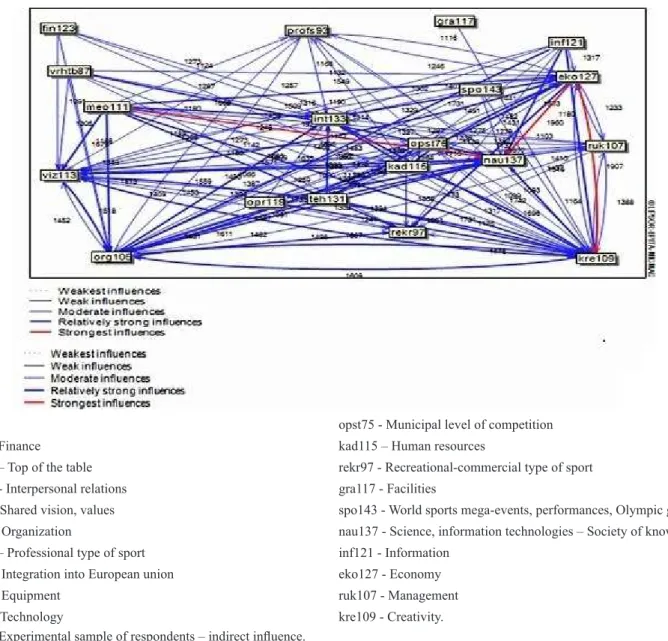
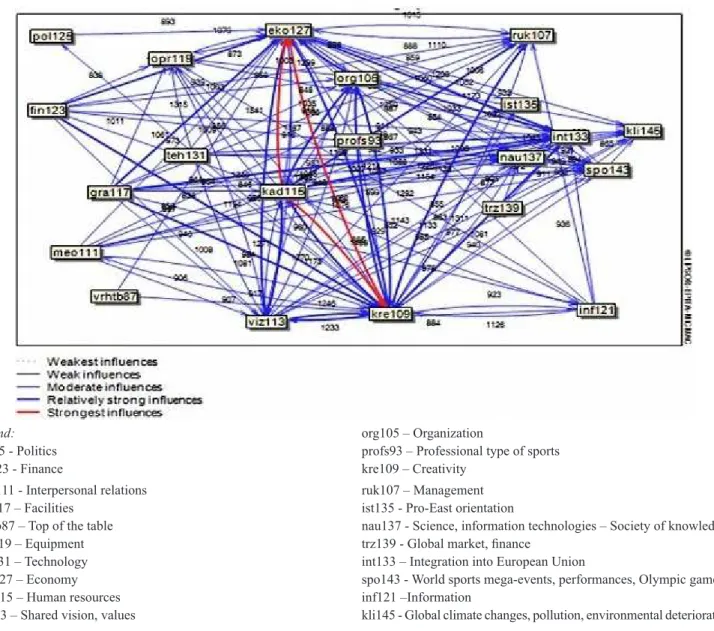
creation of the real picture about the nature of relationships between variables but do not provide a reliable basis for insight into how respondents approach predicting the future of sports clubs. Introduction of the analysis of the chart of indirect influences of variables (Figure 3 and Figure 4), gives reliable support for identifying key variables but, at the same time, makes the identification difficult due to dis-playing of all relations of various strengths, in the system of variables. Bearing in mind that the purpose of identifying key variables is obtaining the reduced number of variables, in this procedure the analysis relies on biggest strength relations and relatively strong influences. The purpose of this analysis was to detect meaningful core of the system, which could be interpreted as a simplified system or clubs future prediction model.
Based on results for experimental (Figure 3) and control group (Figure 4) we extracted statistical signiicant relations which are presented in Table 2 and Table 3:
Figure 3. Experimental sample of respondents – indirect inluence.
Legend: opst75 - Municipal level of competition
in123 - Finance kad115 – Human resources
vrhtb87 – Top of the table rekr97 - Recreational-commercial type of sport meo111 - Interpersonal relations gra117 - Facilities
viz113 - Shared vision, values spo143 - World sports mega-events, performances, Olympic games org105 - Organization nau137 - Science, information technologies – Society of knowledge profs93 – Professional type of sport inf121 - Information
int133 - Integration into European union eko127 - Economy opr119 - Equipment ruk107 - Management teh131 - Technology kre109 - Creativity.
sample (Figure 1) reveals the existence of two isolated varia-bles (Desirable future success in the competition – the top of the table and Preferred type of sport for the club in the future – Professional) and one determinant (Resources – Finance). Other variables have at least one feedback, which makes the whole system unstable and hard to predict. There is no paths of unidirectional dependent variables clearly associated with the strongest inluences shown here (indicator of the inluence level 3), in this system.
At control group level (Figure 2) we isolated three variables (Preferred level of competition in the future – municipal, zonal, provincial), two determinants (Preferred ownership status of the club in the future – Association of citizens, and Finance) and two result variables (Preferred level of competition in the future - Zonal, Local environment – Economy).
Interpersonal relations --> Economy --> Creativity
Personnel --> Creativity --> Globalization – Science, use of information technology – Knowledge society --> Shared vision, values --> Organization structure --> Preferred type of sports for club in the future (Recreational-commercial)
Top of the table --> Globalization – Science, information technology – knowledge society.
Table 2. Experimental sample – Meaningful core of the system – statistical signiicant correlations based on Figure 3. Figure 4. Control sample of respondents - indirect inluence.
Legend: org105 – Organization
Po125 - Politics profs93 – Professional type of sports Fin123 - Finance kre109 – Creativity
Meo111 - Interpersonal relations ruk107 – Management Gra117 – Facilities ist135 - Pro-East orientation
Vrhtb87 – Top of the table nau137 - Science, information technologies – Society of knowledge Opr119 – Equipment trz139 - Global market, inance
Teh131 – Technology int133 – Integration into European Union
Eko127 – Economy spo143 - World sports mega-events, performances, Olympic games Kad115 – Human resources inf121 –Information
viz113 – Shared vision, values kli145 - Global climate changes, pollution, environmental deterioration.
Facilities--> Integration into European Union Top of the table --> Economy
Finance--> Economy --> Integration into European Union Finance --> Creativity --> Integration into European Union
Facilities --> Creativity Economy <--> Creativity
Personnel <--> Creativity --> Integration into European Union Organization structure --> Creativity
Top of the table --> Creativity
Organization structure --> Integration into European Union
Discussion
The results of the analysis of the chart of indirect impacts (Figure 3 and Figure 4) of variables are meaningful cores of the system of sports clubs future prediction by two samples of respondents in this study. The analysis of the system of indirect impact of variables for experimental sample of respondents shows that these respondents, based on ten key variables, predict that the result of the realization of their visions of future will be transition of clubs towards recreational, commercial type of sport. The basic sequence of this prediction starts from the staff as a determinant of the system, which provide creativity as a characteristic of the organizational culture of the club. The main mediating relay variable in this prediction sequence is Science, Information technology – Knowledge society, which inspires a shared vision and values as a feature of organizational culture of the club (these two variables are mutually reinforcing each other in the form of feedback) which leads to said result—a recrea-tional commercial sport as a backbone of the future of the club. Relying of prediction on the society of knowledge and application of science, respondents associate with achieving highly competitive results (probably assuming the existence of adequate competitive team in the club oriented toward re-creational and commercial basic programs). Respondents also relate establishing of a culture of creativity in the club with supportive interpersonal relationships and favorable economic local environment of their clubs. For the control subsample of respondents, some characteristic variables could be indicated as predictors of the future of clubs but cannot determine a clear prediction system based on a long sequence of reasoning. The major feature here is the European integration as the expected environment for the future development of sports and clubs. Creativity, as a feature of organizational culture of clubs, here also is the main relay variable. The second relay variable is the economic condition of the local environment. Determinants of this prediction system are primarily inance, personnel, buildings (sports facilities) and clubs’ resources. Also, organization, as a frame of the club structure, emerges as determinant. Achieving superior competitive success (top of the table) is perceived by these respondents as a motive for creativity and the chance to use the economic beneits from the club’s local environment. By incremental identiication procedure described above, a sample was obtained, made of ten key variables for each sample of res-pondents. Analytical procedure and interpretation of prediction function can rely on these variables in relation with the long term perspective of sports clubs development.
This research is oriented towards the practice of strategic management in sports organizations (clubs) in Vojvodina. It revealed “a storm of ideas” about the paths of our sport in the future, which grows in these organizations. This research also discovered, a lagging, dificult to understand lack of interest of sports infrastructure (branch associations, local administra-tion) in creation of organizational culture in our sports, which supports creativity in the ield of convergence of visions of the sports future and their democratic way of articulation through scenario planning and developing strategies for sustainable development of sport in the European environment.
Responses to these questions can be obtained by using analytical techniques (Porter, 1985), but strategic approach to the future of the organization remains a key vision, and response to the question “What we want our organization to be in ive or ten years?” It is a cornerstone of predicting the future of sports organizations (Wilson, 1996). Therefore, in order to encourage and maintain the utopian imagination and mood of participants, in relation with vision for the future, some questions need to be answered: “What are the major obstacles in achieving our vision?” “How are we going to deal with these obstacles,” “What should our strategy be for overcoming obstacles?” About the importance of these issues, Wilson (1997) concludes: “This way we will recapture process of planning by professionals, make it more democratic, and we’ll put primacy on the creative and imaginative thinking, and not on the pro forma planning documents.”
At the same time, knowledge of the existence of deca-des-long successful implementation of scenario planning me-thods—not as a bureaucratic “planning” intended for narrow apparatus of experts in the ministries and departments of the local administrations, but as a process of mobilization and hol-ding “of a course” regarhol-ding realizing the visions of the future of the democratic base of sports—encourages critical approach towards the sluggishness of development of our sport. Without accepting scientiic approaches for predicting the future of sport within broader visions, scenarios and strategies of development of the European (and global) environment, above mentioned “storm of ideas” can start criticism without real effects, without setting and socialization of achievable strategies for survival and development of sports organizations. Without intertwining of scientiic approaches towards the future and the broad democra-tic pracdemocra-tice of sports reforms, one cannot expect a turnaround from stagnation and decay of state-regulated sports structure towards the sports directed by private investors, so-called spon-sors, private patrons and commercially motivated partnerships, expected by majority of sports activists. Achieving this turna-round assumes changed attitude towards strategic management, particularly its function of predicting the future, primarily in the very basic sports organizations. It seems that sports upgrading (associations) is lagging behind, and that we cannot expect the management to start desirable initiatives “from above to below” in the ield of strategic management.
question the role of the institutional reform of sports, as well as scientiic-research institutions in getting closer to the practice of sports management in the world of veriied and successfully used methods of scenario planning and other methods and techniques for predicting the future?
References
Bar-Yam, Y. (2003). Dynamics of Complex Systems. Boulder, CO:
Westview Press.
Bar–Yam, Y. (2008a). Applications of Complex Systems: Sports and Complexity. [Web log post]. Retrieved from http://necsi.edu/guide/
examples/basketballcomplexity.html.
Bar–Yam, Y. (2008b). Complex Systems insights to building effective teams. Unpublished lecture available on New England Complex Systems Institute. Retrieved from http://necsi.edu /proj ec t s /yaneer/
SportsBarYam.pdf.
Bishop, P., Hines, A., & Collins, T. (2007). The Current State of Sce
-nario Development: an overview of techniques. Foresight, 9, 5-25.
Godet, M. (1987). Scenarios and Strategic Management. London:
Butterworth Scientiic.
Godet, M. (2006). Creating Futures: Scenario Planning as a Strategic Management Tool (2nd ed). London: Economica-Brookings.
Lekovic, B. (1995). Principi menadzmenta (Management principles).
Subotica: Faculty of Economics.
Maksimovic, N., & Raic, A. (2012). Sportski menadzment (Sports Management). Novi Sad: Faculty of Sports and Physical Education.
Morrison, J.L., & Wilson, I. (1997). Analyzing Environments and Developing Scenarios for Uncertain Times.” In M.W. Peterson, D.D., Dill, L.A. Mets, and Associates (eds.), Planning and Mana-gement for a Changing Environment: A Handbook on Redesigning Postsecondary Education. San Francisco: Jossey-Bass.
Porter, M. (1985). Competitive Advantage. New York: Free Press.
Ratcliffe, J. (2003). Scenario Planning: An Evaluation of Practice.
Futures Research Quarterly, 19, 77-94.
Rui, Y., Jie, T., Xiaobing, L, Dongdong, S., & Xiaoming, L. (2011). Citation count prediction: learning to estimate future citations for literature. In: B. Berendt, A. de Vries, W. Fan, C. Macdonald, I. Ounis, I. Ruthven (Eds.), Proceedings of the 20th Association for Computing Machinery international conference on Information and knowledge management, 1247-1252. New York: Association
for Computing Machinery.
Schoemaker, P.J.H. (1991). When and How to Use Scenario Planning: A Heuristic Approach with Illustration. Journal of Forecasting, 10, 549–617.
Trochim, W., & Donnelly, J. (2006). Research Methods Knowledge Base. Ohio: Atomic Dog/Cengage Learning.
Willmore, J. (2001). Scenario Planning: Creating Strategy for Uncertain Times Information Outlook [online] 9.1.2001 [available from http:// www.encyclopedia.com/doc/1G1-78544351.html].
Wilson, I. (1995). Envisioning (and Inventing) the Future. On the Horizon, 3, 2-5.
Wilson, I. (1996). The Practical Power of Vision. On the Horizon, 4, 3–5.
Wilson, I. (1997). Focusing Our Organizations on the Future: Turning Intelligence into Action. On the Horizon, 5, 3-6.
Authors’ note
Jugoslav Vojinovic is afiliated with the Faculty of Interdisciplinary studies, ACIMSI, University of Novi Sad, Serbia.
Nebojsa Maksimovic is afiliated with the Faculty of Sport and Physical Education, University of Novi Sad, Serbia.
Dragan Kokovic is afiliated with the Faculty of Philosophy, University of Novi Sad, Serbia.
Aleksandar Raic is afiliated with the Faculty of Sport and Physical Education, University of Novi Sad, Serbia.
Radenko Matic is afiliated with the Faculty of Sport and Physical Education, University of Novi Sad, Serbia.
Dragan Doder is afiliated with the Regional Institute of Sport, Novi Sad, Serbia.
Corresponding author
Radenko Matic
University of Novi Sad
Faculty of Sport and Physical Education Lovcenska 16, 21000 Novi Sad, Serbia E-mail: [email protected]
Manuscript received on March 20, 2014 Manuscript accepted on March 10, 2015
Dimensions Domains No Long name of variable Short name
Vision of future
Levl of competition
1 Municipal opst75
2 Zonal zon77
3 Provincial pok79
4 Republic rep81
5 International, in country mnuz83
6 International, abroad mnuin85
Success in the competition
7 Top of the table vrhtb87
8 Middle of the table sretb89
9 Bottom of the table dnotb91
Type of sports
10 Professional profs93
11 High-quality amateur amat95
12 Recreational-commercial rekr97
Ownership structure
13 Association of citizens udgr99 14 Individual or partnership private property inds101
15 Shareholders’ private property akcs103
Structure 16 Organization org105
17 Management ruk107
Culture
18 Creativity kre109
19 Interpersonal relations meo111
20 Shared vision, values viz113
Resources
21 Personnel kad115
22 Facilities gra117
23 Equipment opr119
24 Information inf121
25 Finance in123
Local environment
26 Politics pol125
27 Economy eko127
28 Social issues soc129
29 Technology teh131
European environment 30 Integration into European union int133
31 Pro-East orientation, Anti-Americanism ist135
Globalization
32 Science, information technologies – Society of knowledge nau137 33 Global market, inance trz139 34 Global trafic, migrations, tourism sao141
35 World sports mega-events, performances, Olympic games spo143 36 Global climate changes, pollution, environmental deterioration kli145
Appendix