Original article (short paper)
Electromyographic analysis of riding posture
during the bicycling start moment
Johnny Padulo
University e-Campus, Novedrate, Italy University of Split, Split, Croatia
National Centre of Medicine and Science in Sport, Tunis, Tunisia
Luca Paolo Ardigò University of Verona, Verona, Italy
Mirjana Milić
University of Split, Split, Croatia
Douglas William Powell
Campbell University, Buies Creek, NC, USA
Abstract — Professional cyclists often adopt a competition-start standing posture, which has been shown to improve performance. The biomechanical basis of this is unclear, and might be due to a greater mechanical advantage or increased key muscle activity. Previous observations in steady state cycling showed greater activation of the tibialisanterior, erector spinae, and biceps brachii when adopting a standing vs. seated-riding posture. Little is known regarding the effect of riding posture on activation during a standing start. Eleven cyclists performed standing starts in seated and standing-postures using stationary-cycle and on the track. Electromyography of the gastrocnemius medialis, tibialis anterior, erector spinae, and biceps brachii was recorded during irst and subsequent pedal strokes. Results showed that the gastrocnemius medialis did not modify activity. The tibialis anterior, erector spinae, and biceps brachii activity was
increased during the standing posture compared to seated, only during the irst pedal stroke. These increased activation intensities were accompanied by a corresponding 10% increase in bike speed during the irst 5 meters following a
standing start in the standing posture compared to the seated one. Adopting a standing posture during a standing start improves performance through greater initial acceleration.
Keywords: sEMG, cycling, performance
Introduction
Many factors are known to affect cycling performance: (i) the geometry of the bike, such as crank length1 and saddle position2,3;
(ii) various aerodynamic variables such as proper aero position
and (iii) pedaling frequency, which determines maximal power
output during cycling3,4. Alterations in posture, such as
chang-ing from a seated to a standchang-ing posture, also result in changes in performance5,6. When cycling with a standing posture, a greater production of power output is developed for the same speed, presumably to manage the increased number of degrees of freedom of the lower limbs due to the loss of contact of the buttocks with the saddle7. Yet, cycling with a standing posture
allows a signiicant but temporary mechanical power “over-boost”, which riders can exploit for special situations (e.g., start, attack and sprint at the inish). Such a posture change has therefore a great inluence on pedal kinetics3.
Cyclists predominantly adopt a prolonged standing posture during an all-out standing start (from zero speed as opposed to
a lying start) to increase power output compared to a seated
posture3,8,9. However, the use of a standing posture requires the
maintenance of a larger metabolic power and to counterbalance
the higher aerodynamic drag due to an increased drag area asso-ciated with the overall postural change9,10. Therefore, a standing
posture seems to be advantageous and metabolically sustainable
only for short duration, high-acceleration, and high-torque peri -ods, such as an all-out standing start. For these peri-ods, skilled cyclists prefer to adopt a standing posture.
The speciic motor control of the lower extremities dur -ing stand-ing vs. seated cycling postures has been previously described using surface electromyography (sEMG)11-14. The
indings of these investigations have suggested that a standing
posture is associated with greater force applied to the pedals and that this increased for application is likely due to the ped-als supporting the mass of the cyclist. Conversely, in a seated posture, the cyclist’s mass is mostly supported by the saddle15.
The indings of this study are supported by individual power proiles and demonstrate that instantaneous power is strongly
correlated to pedal normal force16. However, the same study
has also shown that the overall maximum power is highly
correlated to the cyclist’s muscle mass. Although previous research has demonstrated that a standing posture is associ-ated with greater pedal force and overall powers applied to the
joint kinetics between standing and seated cycling postures3.
It has been suggested that when cycling with a standing
pos-ture, forces produced by the upper extremity enhance overall
power production17. Limited research has investigated the
contributions of the upper extremity musculature to cycling
performance, and changes in muscle activation of the upper
extremity have not been previously investigated in standing
vs. seated cycling postures.
An understanding of the changing contributions of upper
and lower extremity musculature to the observed differences in
standing start performance using a standing compared to seated cycling posture, would enhance individually optimized training programs. In addition to improving performance, individualized training programs may also reduce the incidence and prevalence of training-related injuries in cyclists. Therefore, the purpose
of this study was to quantify changes in muscle activation of
ankle, trunk, and elbow musculature in standing compared to
seated cycling postures during a maximal standing start. It was
hypothesized that the standing posture would be associated with
signiicantly greater muscle activation intensities compared to
seated postures.
Methods Participants
Eleven male amateur cyclists participated in this study (age:
31 ± 3 years [range 27 ÷ 36], mass: 69.0 ± 4.1 kg, height: 1.76 ± 0.04 meters, BMI: 22.1 ± 1.5 kg/m2; data reported as mean
± SD; with no history of major lower extremities injuries). All participants were highly skilled cyclists with more than six years of sport-speciic training, had a cycling-speciic training volume
of more than 400 km per week and were ranked regionally or nationally within their category. This study was conducted in
accordance with the Declaration of Helsinki. The experimental
protocol was approved by the University e-Campus research ethics board, and each participant gave signed informed consent prior to participation in this study.
Laboratory measures and procedures
The participants were asked to pedal on a commercial and
commonly available cycle ergometer (Schwinn, Johnny G Pro Spin Bike; crank length: 17 cm; resistance mob: halfway),
wearing their competition cycling shoes and pedals with toe
clips. Seat height was adjusted for each participant according
to his preferred seated cycling posture on a road bike, such that
his knee was nearly fully extended and the sole of the foot was
perpendicular to the shank when the crank was at the bottom-dead-center. Crank position was considered to be at 0° when the
crank was aligned with the positive Y-axis and the clockwise
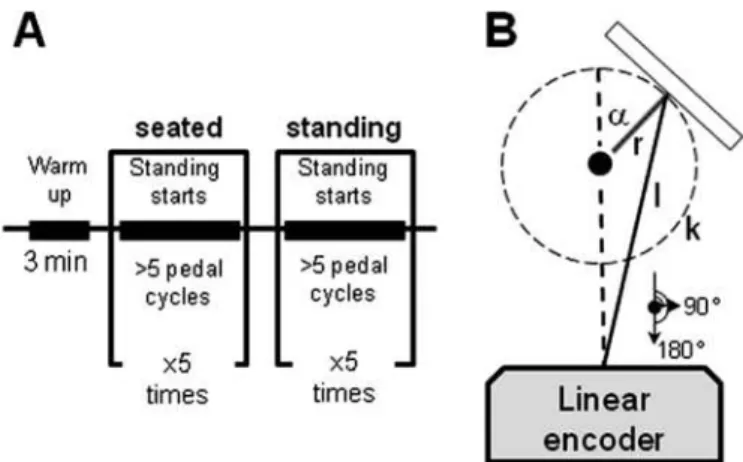
(anterior) rotation (facing rider’s right side) was considered positive (Figure 1B). The handlebars were positioned accord-ing to each individual participant’s preferred seated cyclaccord-ing posture on a road bike.
Participants completed the whole experimental procedure during one single visit. Experimental procedure laboratory tem -perature was comfortable (i.e., ~ 20°C) and participants were allowed to drink water ad libitum to keep their hydration status
adequate. Participants were irst required to perform a 3-min
warm up consisting of low-resistance pedaling (Figure 1A). All participants started pedaling with their right (dominant) limb.
The dominant limb was deined as the limb the athlete would
use to kick a ball, and was the only limb evaluated for each
participant. Participants performed ive maximal effort trials
with hands positioned on the bottom of the handlebar and a 70°
starting crank angle for a minimum of ive consecutive pedaling cycles (maximum of ten consecutive pedaling cycles; average trial duration 5 s18. Between trials, participants were asked to stop
completely and rest for 4 min (Figure 1A). A minimum of 25
pedaling strokes was collected from each participant. Participants
completed this protocol for each experimental condition (seated and standing cycling postures). The sequence of riding posture
conditions (seated vs. standing) was randomized across
par-ticipants. To standardize the exercise in the seated compared to standing posture, participants were required to accelerate as quickly as possible from a standing start (zero speed) and then
to pedal at same (seated) warm up cadence.
The crankshaft pedal was connected to a customized linear encoder (sEMG system with encoder included, MuscleLabTM
4020e, Bosco System, Ergotest Technology, Langensund,
Norway), which recorded the vertical displacement of the pedal to synchronize with sEMG signals (Fig. 1B) as previously de-scribed19-22. The linear encoder had a spatial resolution of 0.1
mm (range 3.5 m, max speed 24 m/s) and a sampling frequency
of 100 Hz. The vertical displacement of the pedal was then converted into the angular position of the pedal according to the
following equation (Figure 1B): α = cos−1 (k2 + r2 – l2) / (2 k r)
where α = crank angle; k = distance of the linear encoder from crank center; l = distance pedal-linear encoder; r = crank
length. The angular resolution was determined to be 0.03°.
Surface EMG of the gastrocnemius medialis (GAS), tibialis anterior (TA), erector spinae (at L3 level; ES), and biceps brachii (BB) were recorded at 1500 Hz using pre-ampliied
bipolar silver–silver chloride (Ag/AgCl) sEMG electrodes.
Previous studies have shown that the selected muscles play a major contribution to the production of power during sprint
cycling exercises6,11,18. The disc electrodes had a diameter of 1
cm and inter-electrode distance of 2 cm. The input impedance
was 2GΩ, common mode rejection rate 100 dB, band-pass ilter 6–1,500 Hz, and gain ×600. The electrodes were positioned longitudinally with respect to the orientation of muscle ibers and located according to the recommendations of SENIAM23. To
reduce electrical impedance, the participant’s skin was shaved and cleansed using an alcohol pad prior to electrode placement. To prevent movement artifacts due to movement of electrode cables, the cables were secured using elastic bands (VetrapTM).
The raw EMG signal was band-pass iltered (8–1,200 Hz) and converted to root mean square (RMS) with a 20-ms smooth
-ing window as previously reported in the literature. Maximal
voluntary isometric contractions (MVIC) for each muscle of interest were systematically determined by averaging the inte-grated sEMG (iEMG) signal during a 3-s period of sustained
maximal force output after the initial peak in the force curve during a maximal contraction of each muscle as previously
described24,25. Normalized iEMG values were calculated as
the quotients of the recorded iEMG values from dynamic trials
divided by the iEMG values recorded during the MVIC trials and were represented as percentages of MVIC26.
To ensure correct riding posture and to investigate cycling kinematics, sagittal plane kinematic data were recorded (210 Hz,
480×360 resolution, Exilim EX-FH20, Casio, Tokyo, Japan).
The high-speed digital camera was placed perpendicular to the
sagittal plane of the participant’s right side at a distance of 5
meters with the camera height at the vertical height of each par-ticipant’s estimated center of mass27,28. Markers were positioned
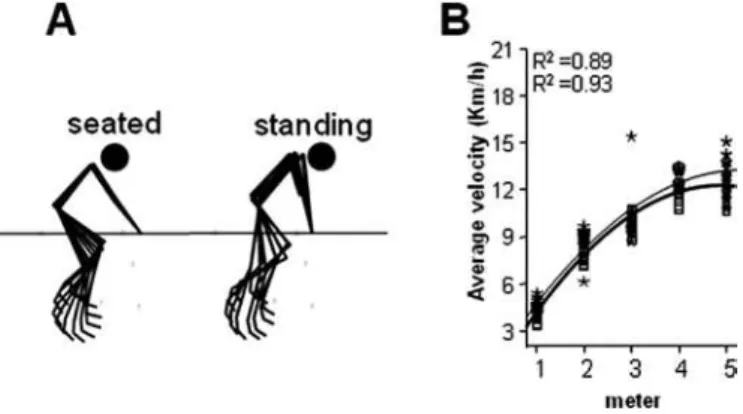
on main body joints (Figure 2A).
Figure 2. (A) Stick igure of body angles during a standing start in seated and standing positions. (B) Effect of riding position on average speed following a standing start at different distances from the start.
To investigate changes in muscle activation patterns associat-ed with seatassociat-ed comparassociat-edto standing cycling posture, sEMG, and kinematic data were recorded in a laboratory setting. However, to verify the effect of the two riding postures on instantaneous cycling speed in a real cycling environment, participants were
also required to perform a similar experimental protocol on a race bicycle on a sport-speciic oval track. This protocol has
been used previously to assess cycling performance19.
Track measures and procedures
To verify the effects of riding posture on instantaneous speed during a standing start, participants repeated the testing protocol using a race bicycle (FP1, Pinarello, Italy; crank length 17 cm). The participant’s hand position was similar to the stationary cycling task (bottom of the handle bar) and the gear selected was consistent with the stationary cycling task19. The same bicycle
was used to test all participants. The participants wore standard cycling shoes and pedals with toe clips. The seat height was adjusted for each participant according to his preferred cycling
posture on a road bike, such that his knee was fully extended
and the sole of the foot was perpendicular to the shank when the crank was at bottom-dead-center. The handlebars were positioned according to each participant’s preferred posture on a road bike. After a 3-min pedaling warm up, participants were
asked to pedal as fast as possible starting in each experimental
posture (seated and standing) again with a 70° starting crank angle18. Participants were given 4 min rest between trials. The
irst 5 meters of each standing start trial were recorded with a high-speed digital camera (210 Hz, 480×360 resolution, Exilim EX-FH20, Casio, Tokyo, Japan). The camera was placed on a
tripod, perpendicular to the sagittal plane of the participant’s
right side at a distance of 5 meters from the 5-meter run with
the camera placed at the vertical height of each participant’s estimated center of mass. To calculate the instantaneous speed of the bicycle the center of the anterior wheel was tracked using
Dartish 5.0 Pro (Dartiish, Fribourg, Switzerland).
Statistical analysis
The RMS signal of each muscle for each experimental condi
-tion was averaged over 36 × 10° intervals constituting the entire
crank cycle. Previous research has suggested that 10° intervals
are most eficacious in the analysis of muscle activation patterns
during cycling29. For each trial, custom software was used to
calculate the average sEMG amplitude across each 10° pedal angle interval (MatLab 2013, MathWorks, Inc., Natick, MA,
USA). Average data were then analyzed using a univariate analysis of variance (ANOVA) to identify signiicant differences
in sEMG activity due to riding posture (seated vs. standing) and
crank angle (36 intervals). All data were provided as mean ± standard deviation. The Shapiro-Wilk test was used to ensure
normal distribution of the data.
A two-way repeated measures ANOVA was used to assess
the inluence ofriding posture (seated vs. standing) and crank
angle (36 intervals) on theaverage instantaneous speed during
the irst 5 m of the standing start performance with repeated
measures for cycling posture and crank angle factors. In the
presence of a signiicant main effect of posture or posture by
crank angle interaction, post-hoct-tests were used to determine
the source of the signiicant indings. Statistical analyses were performed using Excel 2003 and SPSS 15 software. The statisti
Results
Quantitative sEMG elicited during the irst and subsequent
pedal strokes (i.e., as steady state was achieved), in the seated and standing cycling postures are presented in Figure 3. Peak
sEMG amplitudes are showed in normalized data, a inding that
is consistent with previously published data11,30,31.
The univariate ANOVA with pedaling intervals (i.e., 10° pedal intervals) and riding posture as factors revealed no
signiicant changes in iEMG among the different conditions.
The time of occurrence and the intensity of the peak activity
were not signiicantly different between the two riding pos -tures (Figure 3, P > 0.05) in contrast with the inding by Hug, Turpin, Couturier, Dorel5. Similar to the irst stroke, there were
no signiicant changes in iEMG during the subsequent pedal strokes. The univariate ANOVA with pedaling order (i.e., irst
pedal stroke vs. subsequent pedal strokes) and riding posture as
factors revealed signiicant differences for both pedaling order
(P < 0.05) and riding posture (P < 0.01) as well as a signiicant pedaling posture interaction (P < 0.05). The standing compared
to seated cycling posture was associated with signiicantly greater
iEMG amplitude (Figure 3).
The analysis of the peak activity of TA muscle revealed no change in peak activity between the two riding postures (P <
0.05). Similarly there was no difference between the irst pedal stroke compared to subsequent pedal strokes. However, the intensity of the iEMG signal was signiicantly greater during the irst pedal stroke (P < 0.01) and during the standing posture compared to the seated one (P < 0.001). Unsurprisingly, univariate
ANOVA showed signiicant effect for riding posture on sEMG,
but not for pedaling cycle phase, without interaction effect.
Riding posture did not significantly affect BB sEMG.
However, univariate ANOVA with riding posture and pedaling
order as factors showed that pedaling order (e.g., irst vs.
sub-sequent pedal strokes) had a signiicant effect on iEMG data. iEMG was higher during the irst pedal stroke. Therefore, as a preliminary key message, we may suggest speciic TA strength -ening to improve all-out standing start performance.
The basic kinematic analysis of the riding posture during the pedaling cycle phase showed that with standing posture there was little vertical displacement of the hip (Figure 2A). Analysis of the instantaneous speed during on-track standing starts showed
that with standing posture the mean acceleration during the irst 5 meters was 10% greater than with seated posture (Figure 2B).
A t-test showed signiicant differences in the acceleration (P <
0.05) between the two postures. The acceleration was 1.32 ± 0.22 and 1.59 ± 0.24 m/s2 (mean ± SD) for the seated and standing
posture, respectively.
Discussion
The purpose of this study was to investigate the effects of seated vs. standing posture on muscle activation intensity in
muscles of the lower extremities, trunk, and upper extremi -ties in two cycling conditions including a standing start (zero
speed) and steady state cycling. The major indings of this
study demonstrate that during a standing start (zero speed),
muscle activation intensities of the TA and ESare signiicantly
greater in the standing vs. seated posture. Additionally, during steady state cycling, greater muscle activation intensities were observed in the TA and BB in the standing compared toseated cycling posture. These data demonstrate that cycling posture
signiicantly alters muscle activation of the lower extremities, trunk, and upper extremities.
In competitive cycling and cycling-inclusive sports such as triathlon, it is not uncommon for races to be decided by small differences in time. Therefore, optimizing performance during training and competition are of the utmost importance to maxi
-mize athlete performance. To our knowledge, this is the irst
study to provide data pertaining to changes in muscle activation intensity associated with a standing compared to seated posture during a standing start and steady state cycling.
The standing start (zero speed) is commonly used in time trials and cycling-inclusive sports to begin the cycling portion
of the competition. Successful sprint cyclists produce greater
accelerations from a standing start resulting in greater speeds earlier in the race. This is achieved by generating greater crank
torques and powers. The results of the current study indicate Figure 3. Average sEMG RMSs (% max activity) of the gastrocnemius medialis
that the standing start was associated with signiicantly greater
TA and BB muscle activation intensity compared to steady state cycling. It is theorized that these alterations in muscle
activa-tion would result in greater lower extremity power output to be
transferred to the crank during the standing start3,8,9. Speciically,
the increased amplitude of the BB activation would produce
greater elbow lexion torques to the cycle handles and aid in
reducing unwanted vertical displacement of the center of mass, allowing greater downward force to be applied to the pedals in the standing start condition 11-14. This increased transfer of
lower extremity power would generate greater accelerations for
the standing start. Therefore, increased BB activation intensity
may result in improved eficiency of lower extremity kinetics by maintaining a stable platform from which the lower extremity can apply torques to the cycle. Similarly, greater TA activation
may be present to functionally stiffen the ankle joint through antagonist co-activation in response to greater loading from the
lower extremity32. By increasing ankle joint stiffness, the joint
torques and powers produced by large anti-gravity muscles of the lower extremities are more optimally applied to the cycle pedals. Although TA-GAS co-activation was not empirically
calculated in the current study, no differences were observed
in GAS activation while TA activation was signiicantly in -creased. Further, previous research has supported our hypothesis by suggesting that TA function in cycling is associated with enhanced power transmission to the crank22,33. These indings
would strongly suggest that an increase in TA co-activation is associated with improved cycling performance. While the
postulated mechanics offer plausible explanations for the ob
-served changes in muscle activation of the lower extremities, no quantitative data was included in the present study to sup -port these proposed mechanisms of function including handle forces or joint stiffness data.
Conversely, previous data has been published pertaining
to differences in lower extremities muscle activation during
steady state cycling in a standing compared to seated posture.
Speciically, previous research data has shown that cycling in a standing posture is associated with signiicantly greater
muscle activation intensities of the vastus lateralis and gluteus maximum compared to a seated posture11-14. The observed
in-creases in hip and knee extensor muscle activation may serve to increase hip and knee joint torques and powers to improve
cycling performance when cycling with a standing compared
to seated postures. Conversely, greater hip and knee extensor muscle activation may be due to the requisite need to increase hip and knee extensor forces to support the greater load associ -ated with a standing posture.
During steady state cycling, no signiicant differences in GAS and BB muscle activation intensities were observed in
the standing compared to seated cycling posture. These indings contrast with previously published data11,12. Speciically, it has
been shown that cycling with a standing posture is associated
with signiicantly greater lower extremity muscle activation
intensities compared to a seated posture11,12. Further, it was also
noted that uniarticular muscles exhibited larger increases in
muscle activation intensity compared to biarticular muscles12.
It is possible that the methodological differences between each
of these studies underlie these conlicting indings.
While the current study presents unique indings pertain -ing to differences in the intensity of muscle activation when cycling with a standing compared to seated posture, the authors acknowledge several limitations of the current study. First, the sample size was relatively small. Although several statistically
signiicant differences were observed, it is possible that the study was underpowered to detect all signiicant differences. Second,
the low number of muscles recorded during testing. Previous studies investigating cycling performance with changing postures have collected data from a greater number of muscles11,12. It is
possible that by collecting from a greater number of muscles, this study could have captured other differences in
neuromuscu-lar strategy that exist in a standing compared to seated cycling
posture. Third, there was a lack of joint and crank kinetic data
(i.e., crank torque and power output). The presence of kinetic
data would provide greater insight into the biomechanical
ef-icacy of the observed neuromuscular changes associated with
a standing vs. seated posture. Fourth, lateral sway of the cycles
used in ield testing were not recorded. It is possible that energy was expended in the frontal plane, which was not accounted for
in our analysis of cycling performance.
Conclusions
The indings of this study demonstrate that the enhanced per -formance during a standing start (zero speed) when adopting a standing cycling posture, is associated with increased muscle activation of the biceps brachii and tibialis anterior muscles. Although these muscle activations do not drive the pedal stroke,
they may indirectly beneit cycling performance by providing a more stable platform and more eficient lever to improve power
transfer to the crank. A straight practical indication provided by this study is that the standing posture allows a bike standing start speed 10% increase with respect to the seated posture. Therefore,
this inding may potentially be useful for speciic training protocols for cyclists to improve the technique for a standing start. Further research is required to more fully understand the
biomechanical effects of altering cycling posture during both steady state cycling and a standing start.
References
1. Martin JC, Malina RM, Spirduso WW. Effects of crank length on maximal cycling power and optimal pedaling rate of boys aged 8-11 years. Eur J Appl Physiol. 2002; 86:215–217.
2. Bini RR, Hume PA, Kilding AE. Saddle height effects on pedal forces, joint mechanical work and kinematics of cyclists and triathletes. Eur J Sport Sci. 2014; 14:44–52.
3. Martin JC, Davidson CJ, Pardyjak ER. Understanding sprint-cycling performance: the integration of muscle power, resistance, and modeling. Int J Sports Physiol Perform. 2007; 2:5–21. 4. Gardner AS, Martin JC, Martin DT, Barras M, Jenkins DG.
5. Hug F, Turpin NA, Couturier A, Dorel S. Consistency of muscle synergies during pedaling across different mechanical constraints. J Neurophysiol. 2011; 106:91–103.
6. Padulo J, Laffaye G, Bertucci W, Chaouachi A, Viggiano D. Optimisation of starting conditions in track cycling. Sport Sci Health. 2014; 10:189–198.
7. Millet GP, Tronche C, Fuster N, Candau R. Level ground and uphill cycling eficiency in seated and standing positions. Med Sci Sports Exerc. 2002; 34:1645–1652.
8. Martin JC, Gardner AS, Barras M, Martin DT. Modeling sprint cycling using ield-derived parameters and forward integration. Med Sci Sports Exerc. 2006; 38:592–597.
9. Hansen EA, Waldeland H. Seated versus standing position for maximization of performance during intense uphill cycling. J Sport Sci. 2008; 26:977–984.
10. Harnish C, King D, Swensen T. Effect of cycling position on oxygen uptake and preferred cadence in trained cyclists during hill climbing at various power outputs. Eur J Appl Physiol. 2007; 99:387–391.
11. Duc S, Bertucci W, Pernin JN, Grappe F. Muscular activity dur -ing uphill cycl-ing: effect of slope, posture, hand grip position and constrained bicycle lateral sways. J Electromyogr Kinesiol. 2008; 18:116–127.
12. Li L, Caldwell GE. Muscle coordination in cycling: effect of surface incline and posture. J Appl Physiol. 1998; 85:927–934. 13. Sakamoto M, Endoh T, Nakajima T, Tazoe T, Shiozawa S,
KomiyamaT. Modulations of interlimb and intralimb cutaneous relexes during simultaneous arm and leg cycling in humans. Clin Neurophysiol. 2006; 117:1301–1311.
14. Usabiaga J, Crespo R, Iza I, Aramendi J, Terrados N, Poza JJ. Adaptation of the lumbar spine to different positions in bicycle racing. Spine, 1997; 22:1965–1969.
15. Minetti AE, Pinkerton J, Zamparo P. From bipedalism to bi-cyclism: evolution in energetics and biomechanics of historic bicycles. Proc Biol Sci. 2001; 268:1351–1360.
16. Bolourchi F, Hull ML. Measurement of rider induced loads during simulated bicycling. Int J Sport Biomechan. 1985; 1:308–329. 17. Davidson CJ, Horscroft RD, McDaniel J, Tomas A, Hunter EL,
Grisham JD et al. The biomechanics of producing standing and seated maximal cycling power. Med Sci Sports Exerc. 2005; 37, S393.
18. Padulo J, Powell DW, Ardigò LP, Viggiano D. Modiications in activation of lower limb muscles as a function of initial foot position in cycling. J Electromyogr Kinesiol. 2015; 25:648–652. 19. Padulo J, Di Capua R, Viggiano D. Pedaling time variability is
increased in dropped riding position. Eur J Appl Physiol. 2012; 112:3161–3165.
20. Padulo J, Annino G, Tihanyi J, Calcagno G, Vando S, Smith L, et al. Uphill racewalking at iso-eficiency speed. J Strength Cond Res. 2013; 27:1964–1973.
21. Padulo J, Mignogna P, Mignardi S, Tonni F, D'Ottavio S. Effect of different pushing speeds on bench press. Int J Sports Med. 2012; 33:376–380.
22. Padulo J, Tiloca A, Powell D, Granatelli G, Bianco A, Paoli A. EMG amplitude of the biceps femoris during jumping compared to landing movements. Springerplus. 2013; 9:520.
23. Hermens HJ, Freriks B, Disselhorst-Klug C, Rau G. Development of recommendations for SEMG sensors and sensor placement procedures. J Electromyogr Kinesiol, 2000; 10:361–374. 24. Cormie P, McGuigan MR, Newton RU. Changes in the eccentric
phase contribute to improved stretch-shorten cycle performance after training. Med Sci. Sports Exerc. 2010; 42:1731–1744. 25. Padulo J, Laffaye G, Ardigò LP, Chamari K. Concentric and
eccentric: muscle contraction or exercise? J Human Kinetics. 2013; 37:5–6.
26. Burden A. How should we normalize electromyograms obtained from healthy participants? What we have learned from over 25 years of research. J Electromyogr Kinesiol. 2010; 20:1023–1035. 27. Padulo J, Chamari K, Ardigò LP. Walking and running on
treadmill: the standard criteria for kinematics studies. Muscles Ligaments Tendons J. 2014; 4:159–162.
28. Padulo J, D'Ottavio S, Pizzolato F, Smith L, Annino G. Kinematic analysis of soccer players in shuttle running. Int J Sports Med. 2012; 33:459–462.
29. Ting LH, Kautz SA, Brown DA, Zajac FE. Phase reversal of bio -mechanical functions and muscle activity in backward pedaling. J Neurophysiol. 1999; 81:544–551.
30. Hug F, Dorel S. Electromyographic analysis of pedaling: a review. J Electromyogr Kinesiol. 2009; 19:182–198.
31. Caldwell GE, Li L, McCole SD, Hagberg JM. Pedal and crank kinetics in uphill cycling. J Appl Biomech. 1988; 14:245–259. 32. Hortobágyi T, DeVita P. Muscle pre- and coactivity during
downward stepping are associated with leg stiffness in aging. J Electromyogr Kinesiol. 2000; 10: 117–126.
33. Ryan MM, Gregor RJ. EMG proiles of lower extremity muscles during cycling at constant workload and cadence. J Electromyogr Kinesiol. 1992; 2:69–80.
Acknowledgements
The authors thank Davide Viggiano for his useful suggestions.
Corresponding author
Luca Paolo Ardigò
School of Exercise and Sport Science, Department of Neurosciences, Biomedicine and Movement Sciences, University of Verona, Via Felice Casorati, 43
37131 Verona, Italy Email: [email protected]
Manuscript received on August 21, 2015 Manuscript accepted on May 12, 2016