ABSTRACT
Friction between different wire bracket combinations
in vitro
evaluation
Tatiana Kelly da Silva FIDALGO1, Matheus Melo PITHON2, José Vinicius Bolognesi MACIEL2, Ana Maria BOLOGNESE3
1- PhD student of Pediatric Dentistry, Dental School, Federal University of Rio de Janeiro, Rio de Janeiro, RJ, Brazil. 2- PhD student of Orthodontics, Dental School, Federal University of Rio de Janeiro, Rio de Janeiro, RJ, Brazil. 3- Chair Professor of Orthodontics, Dental School, Federal University of Rio de Janeiro, Rio de Janeiro, RJ, Brazil.
Corresponding address: Ana Maria Bolognese - Faculdade de Odontologia da Universidade Federal do Rio de Janeiro - Departamento de Ortodontia - Av. Professor Rodolpho Paulo Rocco, 325 - 21941590 - Ilha do Fundão - RJ - Brazil - Phone/ Fax: 55 21 2590-2727 - e-mail address: [email protected]
O
and wires of different materials under conditions simulating the oral environment. Material and Methods: Stainless steel (SS) and titanium-molybdenum alloy (TMA) wires of 0.019x0.025-in diameter (American Orthodontics) and polycarbonate bracket (American Orthodontics), ceramic bracket (American Orthodontics), and metal bracket (3M Unitek) !" " !""" "# !# $"% The system using TMA wire and polycarbonate bracket had the highest roughness (p<0.05). && " # '" !*$+/46' !# difference in the system using TMA wire and ceramic bracket compared to that using TMA wire and polycarbonate bracket (p=0.038). Conclusions: Ceramic brackets in association && !' !"#
Key words: Friction. Tensile strength. Orthodontic brackets. Orthodontic wires. Topography.
INTRODUCTION
A successful orthodontic movement is directly related to the ability of orthodontic wires to slide through brackets slots and tubes, and it is well known that the sliding resistance between the !7 the tooth movement3,22. The sliding mechanism is
important not only to close the space, but also in the initial phase of the treatment in which leveling and alignment of the teeth occur9.
;"$ #! demand, aesthetic accessories consisting of different materials have been developed, among which are the aesthetic ceramic and polycarbonate brackets11. Therefore, these accessories alleviate
the aesthetic problem despite the limitations of their use, such as fracture of the brackets, abrasion of antagonist teeth and, mainly, the increased friction resulting from the mechanical sliding24,26. Friction
$$#""
two objects in direct contact to each other, and its direction is tangent to a common interface between both surfaces. The intensity of this force is closely related to the surface characteristics and properties of the materials involved1,23. Therefore, knowing
7 "# mechanism, the aim of this study was to assess the frictional force existing between conventional and aesthetic brackets in association with stainless steel (SS) and titanium-molybdenum alloy (TMA) wires by correlating the mean roughness values of wires and bracket slots.
MATERIAL AND METHODS
Materials
of 0.022x0.030-in were used for study. SS and TMA wires (American Orthodontics), both measuring 0.019x0.025-in, were evaluated (Figure 1).
Mechanical Traction Test
A device for mechanical test was developed in order to simulate the sliding movement of the wire through the bracket slots as seen during the orthodontic treatment. This device consisted of a glass box with a support centrally positioned. Holes $ # $$ # rotation penholders (Dabi Atlante, Ribeirão Preto, SP, Brazil) into which the brackets were inserted *E#G4$ curing composite (3M Unitek, São Paulo, SP, Brazil), thus creating a base for bonding the brackets. The brackets were then positioned and bonded to their respective penholders by using cyanoacrylate ester (Super Bonder; Loctite, São Paulo, SP, Brazil) (Figure 2B). This set was hold within the glass box through lateral rods made from glass lamina in order to keep the system stable enough during the traction test. The glass box was designed to $!""" ' providing a better simulation of the oral cavity. Also, a heater with thermostat was added to this system so that the inner temperature was maintained at 37°C during the whole experiment.
G K "#"" wires was attached to the universal testing machine (EMIC DL 10.000; São José dos Pinhais, PR, Brazil), mounted onto the bonded bracket with no active torque and then tied to it with an elastic thread (3M Unitek, USA) by using a ligature elastic applicator (Morelli, Sorocaba, SP, Brazil).
The universal testing machine simulated the sliding movement of the bracket through the orthodontic wire during the retraction movement of the canines, which yielded a total dislocation of 8 mm that corresponds to the mean width of a premolar.
A personal computer connected to the equipment recorded graphic results showing values of maximum load (N) generated by a load cell. Such a test was repeated 5 times for each of the 3 combinations of bracket/wire of each group.
Surface Roughness
The wings of the brackets were removed with a steel diamond discs (22-mm diameter, 0.15-mm thickness, ref. 7016, KG Sorensen, São Paulo, SP,
Brazil) at low speed on a handpiece (Dabi Atlante) # # $" *& &[' 201, Mitutoyo Co., Kawasaki, Honshu, Japan). Three milliliters of slots of the 3 types of brackets were analyzed, yielding three readings for each bracket. Similarly, 5-mm segments of each wire submitted to mechanical traction test were sectioned, and 3 mm of them were analyzed, also yielding three readings for each wire.
Scanning Electronic Microscopy (SEM) The orthodontic brackets and wires were randomly selected, and sectioned for analysis of their surface with a JEOL scanning electron microscope (2000 FX, Tokyo, Japan). The samples were separately washed with isopropylic alcohol for 5 min. Next, the orthodontic bracket and wires were positioned on a double-faced adhesive tape whose sequence was carefully recorded. The samples were then placed in the sample chamber of the microscope for visualization of the surfaces of the bracket slots and wires.
Statistical Analysis
The data obtained were submitted to simple ANOVA with Tukey’s test for post-hoc multiple "$!"^ interval was set at 95% (p<0.05).
RESULTS
SS wire had a lower mean value of roughness value compared to TMA wire. On the other hand, the polycarbonate bracket had a greater roughness compared to the ceramic and metallic ones (Table 1). The results regarding roughness of brackets and wires after be submitted to mechanical traction test demonstrated a reduction in the roughness in all Figure 2- A) Device made for stabilizing the combinations of bracket and wire during mechanical test. B) Detail of the bracket moving through the wire and angulation close to 0°
Bracket/Wire Stainless steel TMA
Metallic SSB-SS MB-TMA Ceramic CB-SS CB-TMA Polycarbonate PB-SS PB-TMA
materials studied, with the metallic brackets having " # *`{|}4 polycarbonate brackets having the lowest (47.6%).
Comparing the maximum mean friction values for the bracket systems using SS wire (Table 2), ! # between metallic (SSB-SS) and polycarbonate (PB-&&4 # between the systems of ceramic (CB-SS) and metallic brackets using SS wire (SSB-SS) (p<0.001*) as well comparing the systems CB-SS and PB-SS (p=0.001).
With regard to systems of brackets using G ' ! # were found between metallic (SSB-TMA) and
polycarbonate (PB-TMA) brackets or between metallic (SSB-TMA) and ceramic (CB-TMA) brackets. 6' ! # observed between the PB-TMA and CB-TMA systems (p=0.038).
The SSB-SS system had the lowest friction '## !"&&G (p=0.012). However, when the systems PB-SS and CB-SS were compared to the systems PB-TMA and CB-TMA, respectively, no statistical differences were found.
The SSB-SS and CB-SS systems had the lowest # '$ !E# G even higher in the CB-SS group. On the other
Condition Wire Bracket
Stainless steel TMA Metallic Polycarbonate Ceramic New 3300 4900 13300 28600 28400 Used 1580 780 5100 14975 11333
Table 1- Mean values for roughness in Å. Reading regarding 3-mm segment of each sample
'$# '$# '*
Abreviation Friction (N)±SD Abreviation Friction (N)±SD p-value
SSB-SS 1.37±0.26 PB-SS 1.48±0.62 0.999 SSB-SS 1.37±0.26 CB-SS 3.20±2.01 <0.001*
PB-SS 1.48±0.62 CB-SS 3.20±2.01 0.001* SSB-TMA 3.14±1.22 PB-TMA 2.54±0.95 0.698 SSB-TMA 3.14±1.22 CB-TMA 4.16±2.40 0.34
PB-TMA 2.54±0.95 CB-TMA 4.16±2.40 0.038* SSB-SS 1.37±0.26 SSB-TMA 3.14±1.22 0.012* PB-SS 1.48±0.62 PB-TMA 2.54±0.95 0.396 CB-SS 3.20±2.01 CB-TMA 4.16±2.40 0.518
Table
!"#$%$&'(+;'=>?"%E
Figure 3-GH" H> K" K
hand, the PB-TMA system had the lowest friction ' ! &&&& ^G !"'# "# all systems (Figure 3B).
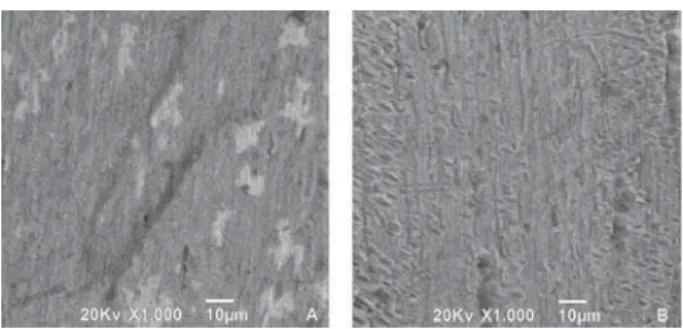
The TMA wire (Figure 5A, B) has less smooth surfaces compared to SS wire (Figure 4A, B). The conventional metallic bracket (Figure 6A, B) also exhibits a smoother surface than the polycarbonate (Figure 7A, B – polymers homogeneously distributed) and ceramic (Figure 8A, B – the most irregular surface among all) brackets.
After the mechanical traction test, the surfaces of all materials studied were more polished, which was more evident in the polycarbonate brackets and less evident in the ceramic brackets.
DISCUSSION
The friction on a given surface is closely related to both material involved and surface characteristics4,10,14,15. With regard to roughness, the
SS wire exhibited less irregular surface compared to G' ## in the literature16,18 "##
#'# 22.
In the present study, the systems using TMA wire # # type of bracket used. In addition, TMA has been shown to present lower modulus of elasticity, springback greater than that of steel8. With regard
to the brackets, the slots of metallic brackets exhibited less roughness compared to those of polycarbonate and ceramic ones. However, the $! lower than that of ceramic bracket either with SS wire (p=0.01) or TMA wire (p=0.038), both !# "!$! $" " irregularities which were easily observed in the SEM images, and the ceramic bracket showed more irregularities than the polycarbonate accessory, thus justifying the similarity of roughness between SS and TMA wires.
The authors developed an apparatus that was "" # " Figure 4- Scanning electron microscopy micrograph
showing surface topography of TMA wire (associated with MB) before (A) and after (B) mechanical traction
Figure 5- Scanning electron microscopy micrograph showing surface topography of SS wire (associated with MB) before (A) and after (B) mechanical traction
Figure 6- Scanning electron microscopy micrograph showing surface topography of MB slot (associated with SS wire) before (A) and after (B) mechanical traction
Figure 7- Scanning electron microscopy micrograph showing surface topography of PB slot (associated with SS wire) before (A) and after (B) mechanical traction
traction test, which not only reduces the friction but also simulates the sliding mechanism as seen in vivo and control an important variable, the lubrication21,28. Furthermore, studies demonstrated
# ! between bracket and wire14,23,27,28. Also, a device was
developed to correct the small vertical angulations so that the angle formed between wire and bracket was close to 0°, thus helping to reduce the friction G # ' # bracket and wire increases20, 29.
Generally, when extraction is indicated during orthodontic treatment, closing of extraction spaces can be performed mainly by canine retraction through distal movement13. For this reason, canine
brackets were selected for the present study. Wire was attached to the bracket with elastic ligatures because it promotes an additional force in comparison to wire ligature2,12. In addition,
attachment to the bracket with elastic guarantees a standard force in comparison to the wire ligature.
The different combinations comparing the SSB-SS and PB-SSB-SS systems showed that both yielded ! # $ ! the use of brackets and wires made from the same material, which reduces friction as surfaces from the same material tend to have less friction compared to surfaces from different materials, in addition to their low roughness compared to other groups. With regard to the PB-SS system, despite using different "' "! be explained by the fact that the polymeric chains (macromolecules consisting of simple molecules) are small spheres homogeneously distributed on the surface of the polycarbonate bracket, being partially responsible for its roughness. These factors may $ !# systems.
On the other hand, the CB-SS system had # ' # ! # "&&&&!"' is also in agreement with the literature5,19,30. This
can be explained by the higher surface roughness of the ceramic brackets and also by the different wire material (SS)26, thus making the sliding
"" # In addition, the ceramic bracket showed higher "$$! bracket, since the former consists of crystal grains that are clearly larger than the monomers of the polycarbonate. As can be seen in the SEM images, the ceramic surface also exhibits more irregularities, thus increasing the friction.
&"!' ! # between polycarbonate and metallic brackets was
found when they were used in combination with TMA wire, with both systems having a lower friction &# relation to the ceramic brackets (p=0.038), but not between metallic and ceramic brackets. This is due to the fact that both ceramic bracket and TMA wire # ! a rougher topography compared to other systems. 6' !# observed between polycarbonate and metallic ## of the increased friction observed in relation to the SS wire.
G7!#
movements166'$
the treatment in which the long-range movements are not the main goal, TMA wire should be carefully used as the results of the present study have shown # !#&& " '# elsewhere6,7. However, when polycarbonate and
ceramic brackets are used in combination with TMA ' "$ systems using SS wire. It is suggested that despite the brackets being of different materials and TMA wire having a rougher surface compared to SS '$7!G wire might have produced less friction, reducing the frictional resistance for small inclination angles, although the brackets were in a rotating platform. ' ! # between metallic and polycarbonate brackets was '# between the polycarbonate and ceramic brackets. This latter system also showed higher friction "$!"' !#
One can observe that the SS wire has a lower " compared to the TMA wire, which is well described in the literature17,25. As the materials composing
brackets and wires of each system are different, no # !"# polycarbonate and ceramic brackets in association with SS and TMA wires were observed.
The orthodontic brackets and wire submitted to mechanical traction tests were then evaluated !#$"! # on the surface. The results showed a decrease in the roughness of all materials tested: SS wire (52.2%), TMA wire (84.1%), polycarbonate bracket (47.6%), ceramic bracket (60.1%), and metallic bracket (61.7%). These results were corroborated by SEM analysis.
instead of SS wire in order to maintain a satisfactory speed of the tooth movement. On the other hand, this increased force requires other issues to be evaluated. Some undesirable consequences such as loss of anchorage, tooth inclination, root absorption, and intense pain may occur, among other complications that may cause short- and long-term irreversible damages. Future studies are suggested to evaluate how human salivary components act on the friction between bracket and wire during orthodontic treatment.
CONCLUSIONS
The following conclusions can be drawn: the system formed by metallic bracket and SS wire exhibited less roughness and lower friction.
the use of ceramic brackets with TMA wire should be judiciously used as this system was found to #
ACKNOWLEDGMENTS
The authors thank FAPERJ for the financial support.
REFERENCES
1- Al-Khatib S, Berradja A, Celis JP, Willems G. In vitro friction of stainless steel arch wire-bracket combinations in air and different aqueous solutions. Orthod Craniofac Res. 2005;8:96-105. 2- Baccetti T, Franchi L, Camporesi M, Defraia E, Barbato E. Forces produced by different nonconventional bracket or ligature systems during alignment of apically displaced teeth. Angle Orthod. 2009;79:533-9.
3- Bortoly TG, Guerrero AP, Rached RN, Tanaka O, Guariza-Filho O, Rosa EA. Sliding resistance with esthetic ligatures: an in-vitro
study. Am J Orthod Dentofacial Orthop. 2008;133:340, e1-7. 4- Burrow SJ. Friction and resistance to sliding in orthodontics: a critical review. Am J Orthod Dentofacial Orthop. 2009;135:442-7. 5- Cacciafesta V, Sfondrini MF, Ricciardi A, Scribante A, Klersy C, Auricchio F. Evaluation of friction of stainless steel and esthetic self-ligating brackets in various bracket-archwire combinations. Am J Orthod Dentofacial Orthop. 2003;124:395-402.
6- Cacciafesta V, Sfondrini MF, Scribante A, Klersy C, Auricchio F. Evaluation of friction of conventional and metal-insert ceramic brackets in various bracket-archwire combinations. Am J Orthod Dentofacial Orthop. 2003;124:403-9.
7- Cash A, Curtis R, Garrigia-Majo D, McDonald F. A comparative study of the static and kinetic frictional resistance of titanium molybdenum alloy archwires in stainless steel brackets. Eur J Orthod. 2004;26:105-11.
8- Claro CA, Abrão J, Reis SA. Forces in stainless steel, TiMolium and TMA intrusion arches, with different bending magnitudes. Braz Oral Res. 2007;21:140-5.
9- Damon DH. The Damon low-friction bracket: a biologically compatible straight-wire system. J Clin Orthod. 1998;32:670-80. 10- Downing A, McCabe J, Gordon P. A study of frictional forces between orthodontic brackets and archwires. Br J Orthod. 1994;21:349-57.
11- Eliades T. Orthodontic materials research and applications: part 2. Current status and projected future developments in materials and biocompatibility. Am J Orthod Dentofacial Orthop. 2007;131:253-62.
12- Gandini P, Orsi L, Bertoncini C, Massironi S, Franchi L. In vitro
frictional forces generated by three different ligation methods. Angle Orthod. 2008;78:917-21.
13- Janson G, Maria FR, Barros SE, Freitas MR, Henriques JF. Orthodontic treatment time in 2- and 4-premolar-extraction protocols. Am J Orthod Dentofacial Orthop. 2006;129:666-71. 14- Karamouzos A, Athanasiou AE, Papadopoulos MA. Clinical characteristics and properties of ceramic brackets: a comprehensive review. Am J Orthod Dentofacial Orthop. 1997;112:34-40. {/'[&'67 "' ligation force and wear on frictional resistance of orthodontic brackets. Br J Orthod. 1993;20:109-15.
16- Krishnan V, Kumar KJ. Mechanical properties and surface characteristics of three archwire alloys. Angle Orthod. 2004;74:825-31.
{|!%'