Copyright © 2014 Revista Latino-Americana de Enfermagem This is an Open Access article distributed under the terms of the Creative Commons Attribution Non-Commercial License (CC BY-NC).
This license lets others distribute, remix, tweak, and build upon your work non-commercially, and although their new works must also acknowledge you and be non-commercial, they don’t have to license their derivative works on the same terms.
DOI: 10.1590/0104-1169.3240.2415 www.eerp.usp.br/rlae
Corresponding Author:
Ana Luiza Vilela Borges
Universidade de São Paulo. Escola de Enfermagem Av. Dr. Enéas de Carvalho Aguiar, 419
CEP: 05403-000, São Paulo, SP, Brasil E-mail: [email protected]
Ana Luiza Vilela Borges
2Renata Luciria Monteiro
3Luiza Akiko Komura Hoga
4Elizabeth Fujimori
4Christiane Borges do Nascimento Chofakian
5Osmara Alves dos Santos
61 Supported by Apoio financeiro da Fundação de Amparo à Pesquisa do Estado de São Paulo (FAPESP), process # 2010/15298-0. 2 PhD, Professor, Escola de Enfermagem, Universidade de São Paulo, São Paulo, SP, Brazil.
3 RN.
4 PhD, Associate Professor, Escola de Enfermagem, Universidade de São Paulo, São Paulo, SP, Brazil. 5 Doctoral student, Escola de Enfermagem, Universidade de São Paulo, São Paulo, SP, Brazil. 6 Master’s student, Escola de Enfermagem, Universidade de São Paulo, São Paulo, SP, Brazil.
Objective: to analyze assistance regarding contraception methods received by women during
hospitalization due to abortion, and contraceptive practices the month after this episode.
Methods: a longitudinal study of women hospitalized due to abortion in a public hospital in
the city of São Paulo. Face-to-face interviews (n=170) followed by telephone interviews in the
subsequent month (n=147) were conducted between May and December of 2011. Results: a
small number of women reported they received guidance on, and prescription for, contraceptive
methods at hospital discharge. A trend of statistical significance was identified for prescription
of contraceptive methods at discharge and its use in the following month, when adjusted for
age. Most women reported sexual intercourse (69.4%) with the use of contraceptive method
(82.4%), but no health professional guidance (63.1%). Conclusion: despite the fact that
post-abortion contraception assistance was lower than the recommended guidelines by public health
policies, women demonstrated willingness to use contraceptive methods.
Descriptors: Contraception; Abortion; Health Care (Public Health).
Rev. Latino-Am. Enfermagem 2014 Mar.-Apr.;22(2):293-300.
Introduction
In 2011, the Ministry of Health(1) (MoH) revised the
Guidelines for Comprehensive Abortion Care, aiming
to standardize and qualify women’s health care. Aside from the abortion or miscarriage itself, qualiied care to women who experience such an episode is considered
a priority, primarily to minimize unfavorable outcomes
such as maternal and neonatal death – a major challenge
that persists in the current health care context(1). The
priority of abortion care emerged, among other aspects,
as a result of the need to follow the propositions of the
Cairo and Beijing Conferences and reach the targets set
by the Millennium Development Goals(2), which include
the reduction of the maternal mortality ratio in Brazil,
which is close to 60(3).
The conceptual framework for abortion care
supporting the aforementioned guideline recommends
that an integrated network of health care services should
be available to women in order to meet their physical and
psychological needs, considering their social background.
Also, it was recommended that family planning services
should be offered during hospitalization, to ensure the
provision of appropriate guidance for women who wish
to become pregnant again, and to prevent new episodes
of abortion.
This object of study for article was post-abortion
contraceptive practices, considering the complexity of the
relationship between contraception and abortion. In most
cases, women who experienced miscarriage planned
to become pregnant again as soon as possible; while
those who experienced abortion probably did not have
such intention. Whatever the personal desires of these
women, the adoption of measures to provide autonomy
and freedom over reproductive planning decisions is
important at this moment that is experienced by women.
The World Health Organization (WHO)(4) and the
International Federation of Gynecology and Obstetrics
(IFGO)(5) recommend that women who experience
abortion should receive contraception assistance,
so they can become pregnant in appropriate clinical
conditions for the proper development of pregnancy.
This requires a minimal interpregnancy interval of six
months, mainly to minimize the risk of adverse health
outcomes for women and children, such as maternal
anemia, premature birth, and low birth weight. These
outcomes are widely recognized as associated with an
interpregnancy interval lower than six months(6).
The MoH(1) recommends that contraceptive
methods (CM) should be available at the same health
facility where women receive care during the abortion
process. This position is based on the fact that 75% of
women restart the ovulation process within six weeks
after the occurrence of abortion(4), indicating the need
for early initiation of contraceptive counseling.
Although the relevance of contraceptive assistance
is an aspect of comprehensive care for women during
the abortion process, there is a lack of knowledge about
the contraceptive practices adopted by them. This fact
was considered as the rationale for this research, which
aimed to analyze the contraception assistance received
by women during hospitalization due to abortion, and
the contraceptive practices adopted by them the month
after this episode. We hypothesized that access to
contraceptive care during post-abortion hospitalization
was associated with the use of CM the month
after this episode.
Methods
The data presented in this article was part of a
broader longitudinal quantitative study aimed to assess
contraceptive practices adopted by women during the irst six months after hospitalization due to abortion. This article focuses on data regarding contraceptive
assistance received during hospitalization, and practices adopted during the irst month after the abortion.
The study population was composed of a
non-probabilistic sample of women hospitalized due to
abortion at a public hospital in the city of São Paulo,
between May and December of 2011. All women
hospitalized due to abortion were invited to participate
in this study. Data were collected through individual
face-to-face interviews during hospitalization (Time
0) and by telephone, 30 days after discharge (Time
1). Women who did not have a telephone (landline
or mobile) and who could not establish a dialogue in
Portuguese were excluded. This criteria was established
because many women attended by this institution are
immigrants from countries whose native language is
not Portuguese.
Nurse midwives, who were trained to collect data
through subject interviews, performed data collection at Time 0. Two experienced researchers in the ield of sexual and reproductive health, who were also experts in the
development of telephone interviews, were responsible
for conducting the interviews at Time 1. A total number
of 184 women were invited to participate in the study at
personal and intimate information). This resulted in 170 women participating in the irst interview at Time 0. At Time 1, there were 23 losses, caused by: one maternal
death, 15 women who could not be reached by phone
(number did not exist), did not answer calls, or could
not be found at the reported phone number; and seven
refusals. This resulted in 147 women participating in the study. There were no statistically signiicant differences between losses and those who remained in the study
for Time 1 in relation to age, pregnancy planning or
previous abortion.
Structured questionnaires were used to collect
data. The questionnaire used at Time 0 contained
questions about social, demographic and reproductive data and speciic questions to classify pregnancy planning. The original questionnaire was translated into
Portuguese and validated for the Brazilian culture(7).
The reproductive data were related to contraceptive
assistance received during hospitalization, the use of CM
during the month after abortion, in addition to questions
about the last menstrual period and the possibilities
of becoming pregnant again. As abortion is legally
restricted in Brazil, we did not question the etiology of
the pregnancy termination, since this fact could result in
underestimation of data.
Data were analyzed using the Statistical Package
for Social Sciences (SPSS) version 17.0 for Windows.
Descriptive techniques, along with univariate and
multivariate analyses were used for data analysis.
The quantitative variables were described by mean
and standard deviation, and absolute and relative
frequencies were calculated for qualitative variables.
The differences between two proportions were analyzed
using the chi-square test and Fisher’s exact test. The
description of the interval between abortion and the irst period (in days) was calculated using the Kaplan-Meier technique.
The multivariate logistic regression method
was used for the analysis of association between the
dependent variable (using CM 30 days after the abortion)
and the following independent variables: CM prescribed
during hospitalization (yes / no); CM counseling during
hospitalization (yes / no); age (15-24, 25-34 and >35);
paid work (yes / no); marital status (living / not living
with partner); children (yes / no); previous abortion
(yes / no); planned pregnancy (yes / no, or ambiguous);
and, intention to become pregnant again (no / yes / no
thoughts about it).
The independent variables were analyzed using
multiple logistic regression only when presenting a
p-value of <0.20 in the previous univariate analysis
results, regarding use of CM 30 days after abortion.
The entry of each variable in the model had the
following sequence: 1) independent variable of interest
according to the study hypothesis (CM prescription and
CM guidance during hospitalization) entered into the model; 2) statistical signiicance, i.e., those that had lower p-value were allocated irst into the model. The Hosmer-Lemeshow test was used to analyze the model
adjustment.
The project was approved by two Research Ethics
Committees accredited by the National Council on Ethics
in Research (CONEP), with one of them being at the
study setting. All ethical rules determined by CONEP
were followed. Women aged less than 18 years were
authorized by their parent or guardian to participate in the study. Women themselves deined the best time to receive phone calls and answer the interview questions. In the data collection instrument there was a speciic ield where the woman could indicate the possibility of leaving a message, and with whom the interviewers
could talk about the research. Such indications were
strictly followed.
Results
The mean age of the women was 29 years old
(SD=7.5). Twelve (7.0%) were 17 years old or less.
Regarding schooling, they had a mean of 9.2 years
of study (SD=2.5); two had completed a university
degree and six had begun one, and one woman
was illiterate.
Almost half of the women were classiied as black or mixed race (48.8%). Over half of interviewees had a
role within the job market at the time of the interview
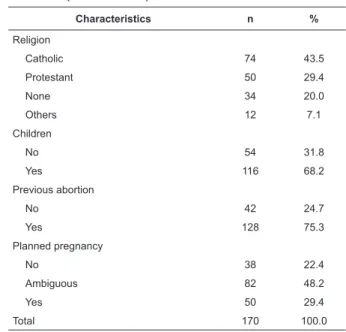
(59.4%); 43.5% reported being Catholic. Regarding
sexual behavior and reproductive history, 75.3% lived
with a partner who had a mean age of 32.7 years
(SD=8.7). About two thirds (68.2%) had children. For three quarters (75.3%), this was the irst experience of abortion, and 22.4% of the total reported an unplanned
pregnancy that resulted in abortion. Some of these data
are presented in Table 1.
Almost half of the women (45.3%) reported having menstruated in the irst month post-abortion, after a mean of 28.5 days (95% CI = 27.4 to 29.6),
with a median of 29.0 days. Figure 1 shows the
distribution of women according to the time interval
(days) between the hospitalization and return of
Rev. Latino-Am. Enfermagem 2014 Mar.-Apr.;22(2):293-300.
Characteristics n %
Age (years)
15-24 54 31.8
25-34 69 40.6
≥35 47 27.6
Ethnicity
White 79 46.5
Mixed 57 33.5
Black 26 15.3
Asian 6 3.5
Indigenous 2 1.2
Paid work
No 69 40.6
Yes 101 59.4
Marital status
Living with a partner 128 75.3
Living without a partner 42 24.7
(continue...) Table 1 - Social, demographic and reproductive
characteristics of study subjects, São Paulo, SP,
Brazil, 2012
Figure 1 - Distribution of study subjects according to the time interval between hospital
discharge and return of menses. São Paulo, SP, Brazil, 2012
Table 1 - (continuation)
Characteristics n %
Religion
Catholic 74 43.5
Protestant 50 29.4
None 34 20.0
Others 12 7.1
Children
No 54 31.8
Yes 116 68.2
Previous abortion
No 42 24.7
Yes 128 75.3
Planned pregnancy
No 38 22.4
Ambiguous 82 48.2
Yes 50 29.4
Total 170 100.0
1.0
0.8
0.6
0.4
0.2
0.0
Proportion
40
First menstruation after abortion (days) 30 20
10 0
Regarding health care and contraceptive
practices, only 33.3% of women were counseled during
hospitalization, and a lower proportion (8.9%) was discharged with a prescription for CM. During the irst month after hospitalization, 25.9% of women received
counseling on CM use, not always provided by health
professionals. Most of the women reported sexual intercourse with the use of CM during the irst month after abortion (Table 2). The most frequently used CM was the
male condom, followed by the contraceptive pill, with an
initiation starting at a mean of 15 days (SD = 10.9) after
(continue...) Table 2 - Contraceptive counseling received during hospitalization due to abortion and contraceptive practices
during the subsequent month. São Paulo, SP, Brazil, 2012
Table 3 - Number, proportion and aspects associated with the use of CM 30 days after abortion (univariate
analysis and multiple logistic regression), São Paulo, SP, Brazil, 2012
Variable n %
During hospitalization (n=170)
Counseling on contraceptive methods 49 33.3
Prescription for contraceptive method 13 8.9
During the subsequent month of abortion (n=147)
Were you counseled about contraception methods? 38 25.9
Counseling setting
Primary Health Care service 24 63.2
At home 10 26.3
Ambulatory service 3 7.9
Private practice 1 2.6
Who provided the counseling?
Physician 27 71.1
Family and friends 10 26.3
Nurse 1 2.6
Did you have sexual intercourse? 102 69.4
Did you use a contraceptive method? 84 82.4
For all intercourse 77 91.7
For some intercourse 7 8.3
Did you use contraceptive methods without counseling from a health professional? 53 63.1
Did you buy a contraceptive method in a private pharmacy? 49 58.3
When questioned about the desire for a new
pregnancy one month after hospitalization, the majority
(61.8 %) reported that they intended to become
pregnant again in some point of their life; nearly a ifth (19.2%) did not wish to get pregnant again, and a similar proportion (19.0%) had no thoughts about it
(data not shown in the table).
Variables presenting a p-value of <0.20 were
included in the multiple logistic regression analysis along
with the prescription of CM. They were: age, marital
Variable Category
Univariate analysis Multiple logistic
regression analysis Use of contraceptive methods
30 days after abortion Final model
n % p OR adjust* IC 95%
CM prescription at hospital discharge 0.074
No 76 87.4 1.0
-Yes 11 12.6 4.7 [0.9-22.9]
CM counseling during hospitalization period 0.722
No 57 65.5
Yes 30 34.5
Age 0.019
15-24 20 22.9 1.0
-25-34 44 50.6 3.3 [1.4-7.5]
> 35 23 26.5 1.8 [0.7-4.3]
status and paid work. In the multivariate analysis, the
age-adjusted prescription of CM was maintained, as this was the only variable that presented a signiicant association with the use of CM the month after abortion
(Table 3).
The variable “CM counseling during hospitalization”,
Rev. Latino-Am. Enfermagem 2014 Mar.-Apr.;22(2):293-300.
Variable Category
Univariate analysis Multiple logistic
regression analysis Use of contraceptive methods
30 days after abortion Final model
n % p OR adjust* IC 95%
Paid employment 0.180
No 31 35.6
Yes 56 64.4
Marital status 0.041
Living with a partner 72 82.8
Not living with a partner 15 17.2
Children 0.223
No 25 28.7
Yes 62 71.3
Previous abortion 0.851
No 65 74.7
Yes 22 25.3
Planned pregnancy 0.838
No 17 19.5
Ambiguous 44 50.9
Yes 26 29.9
Desire to become pregnant again 0.776
No 17 19.5
Yes 55 63.2
No thoughts about it 15 17.2
Table 3 - (continuation)
* Hosmer-Lemeshow test=0.919
Discussion
Results showed that approximately two weeks
post-abortion, many women were already vulnerable to
a new pregnancy, although fewer than a half of them
menstruated the month after abortion. These data
support the possibility of ovulation and return of fertility
around two weeks post-abortion(4,8). Most women had
resumed sexual activity at this stage, not always with
proper use of CM, corroborating the results of another
study(9). This situation highlights the contraceptive
vulnerability to which women were subject in the month
after abortion.
The only variable that was associated with the
use of CM was the woman’s age (between 25 and 34
years). These women were 2.3 times more likely to
use CM compared to young women (below 24 years).
It was found that this association was independent
of reproductive history, unplanned pregnancy, or
future reproductive intentions. As it is not clear how age inluenced the decision of using CM in the post-abortion period, this result should not be interpreted
in isolation, as it could lead to hasty conclusions about an event that was socially inluenced - in this case, the use of CM.
The multiple logistic regression model revealed that
CM prescription during hospitalization was very close to reaching statistical signiicance, indicating a probable inluence on the use of CM the month after abortion. The excessively wide conidence interval suggests that the number of women in this group was small. In fact,
only 13 women reported they were discharged with
a prescription for CM. Findings of a study(10) in three
capitals of Northeastern Brazil showed that support
for women during the abortion process is still weak,
and the actions to ensure continuity of care – among
them, the contraception counseling – was the least
cited. Therefore, it seems that the contraceptive care
recommendations of the revised MoH guideline(1) have
not reached a level of full compliance. Interestingly,
the counseling about CM during hospitalization showed no inluence on their later use, which indicated that care should not only be based on counseling about CM
importance or manners of use, but also should include
the supply of CM inputs.
In fact, studies have shown that the adoption rate
of contraceptive in the post-abortion period is higher
when inputs are offered during hospitalization(11-12).
Other studies also emphasize that both counseling and
use in the subsequent months(13-15). Thus, hospitalization,
though brief, seems to be the most propitious time
to develop actions that meet the women’s needs(16),
including those related to the use of CM.
After hospital discharge, only one out of four women
received counseling on how to prevent pregnancy.
This result highlighted the lack of continuity in care in the post-abortion period, relecting the absence of comprehensiveness in the care provided to these
women, as previously described(17).
The proportion of women who reported sexual
intercourse was higher than the proportion of woman
who reported CM use the month after abortion. The
CM adopted after abortion was similar to those used
by the majority of Brazilian women(18), which were
the contraceptive pill and male condom. Moreover, it
is noteworthy that about half of the time, the CM was
purchased in private pharmacies, without any guidance
from a health professional. Although many women took the initiative to use CM during the irst month after abortion, and obtained inputs to prevent another
pregnancy, one cannot deny that some remained
vulnerable to pregnancy during this period, even if they
reported their intention not to become pregnant again. Although this study highlighted interesting indings regarding the contraceptive assistance and practices in
the post-abortion period, it is important to emphasize
that it was not possible to conclude whether women who
experienced abortion would adopt different practices in
this area, or whether other public or private hospitals
would have provided the same kind of attention.
The fact that this study was conducted with
non-probability sampling did not allow the generalization of these indings.
It is important to highlight that the development of
a longitudinal study is permeated by challenges, such
as the need to ensure as few losses as possible. Given
the fact that this study focused on a delicate matter that
is a controversial subject in the Brazilian context, and
that literature(19) recommend that losses in quantitative
studies should not exceed 20%, the losses in this study
were considered acceptable (13.8 %).
Conclusion
Few women were discharged from hospital
post-abortion with a CM prescribed, so the MoH guidelines
in relation to health care in post-abortion contraception were not fulilled. Many women adopted CM in the subsequent post-abortion month, which showed a
desire to adopt measures to postpone a new pregnancy,
regardless of whether or not they received professional
support. The prescription of CM at hospital discharge –
adjusted for age – showed a trend of association with the
use of CM the month after abortion. This data showed
the importance of contraceptive assistance and practices
in the post-abortion period.
References
1. Ministério da Saúde (BR). Atenção Humanizada ao
Abortamento. Norma Técnica. Série Direitos Sexuais e
Direitos Reprodutivos – Caderno no 4. 2.ed. Brasília:
Ministério da Saúde; 2011.
2. Victora CS, Aquino EML, Leal MC, Monteiro CA,
Barros FA, Szwarcwald CL. Saúde de mães e crianças
no Brasil: progressos e desafios. Lancet. 2011;
6736(11):60138-4.
3. World Health Organization. Trends in maternal
mortality: 1990 to 2010. WHO, UNICEF, UNFPA and The
World Bank estimates. Genebra: WHO; 2012.
4. World Health Organization. Report of a WHO Technical
Consultation on Birth Spacing. Genebra: WHO; 2006.
5. Federação Internacional de Ginecologia e Obstetrícia.
Planejamento familiar: componente-chave no
atendimento pós-abortamento [Internet]. FIGO. 2009.
[acesso 13 jan 2013]; Disponível em: http://www.
esdproj.org/site/DocServer/PAC_FP_consensus_report_
Port_final_for_web.pdf?docID=3162
6. Conde-Agudelo A, Belizán IM, Breman R, Brockman SC,
Rosas-Bermudez A. Effect of the interpregnancy interval
after an abortion on maternal and perinatal health in
Latin America. Int J Gyn Obst. 2005;89:s34-s40. 7. Borges ALV, Cavalhieri FB, Hoga LAK, Fujimori E, Barbosa LR. Planejamento da gravidez: prevalência
e aspectos associados. Rev Esc Enferm USP.
2011;45(spe2):1679-84.
8. Wilcox AJ, Dunson D, Baird DD. The timing of
the “fertility window” in the menstrual cycle: day
specific estimates from a prospective study. Br Med J.
2000;321(7271):1259-62.
9. Boesen HC, Rörbye C, Närgaard M, Nilas L. Sexual
behavior during the first eight weeks after legal
termination of pregnancy. Acta Obstet Gynecol Scand.
2004;83(12):1189-92.
10. Aquino EML, Menezes G, Barreto-de-Araújo TV,
Alves MT, Alves SV, Almeida MCC, et al. Qualidade da
atenção ao abortamento no Sistema Único de Saúde do
Nordeste brasileiro: o que dizem as mulheres? Ciênc
Rev. Latino-Am. Enfermagem 2014 Mar.-Apr.;22(2):293-300.
Received: Apr. 15th 2013 Accepted: Nov. 14th 2013
11. Schunmann C, Glasier A. Specialist contraceptive
counselling and provision after termination of pregnancy
improves uptake of long-acting methods but does not
prevent repeat abortion: a randomized trial. Hum
Reprod. 2006;21(9):2296-2303.
12. Ferreira ALCG, Souza AI, Lima RA, Braga C. Choices
on contraceptive methods in post-abortion family
planning clinic in the northeast Brazil. Rep Health.
2010;7(5):1-5.
13. McDougall J, Fetters T, Clark KA, Rathavy T. Determinants of contraceptive acceptance among
Cambodian abortion patients. Stud Fam Plann.
2009;40(2):123-32.
14. Kestler E, Barrios B, Hernández EM, del Valle V, Silva A. Humanizing access to modern contraceptive methods
in national hospitals in Guatemala, Central America.
Contraception. 2009;80(1):68-73.
15. Ferreira AL, Souza AI, Pessoa RE, Braga C. The
effectiveness of contraceptive counseling for women
in the postabortion period: an intervention study.
Contraception. 2011;84(4):377-83.
16. Mariutti MG, Almeida AM, Panobianco MS. Nursing
care according to women in abortion situations. Rev.
Latino-Am. Enfermagem. 2007;15(1):20-6.
17. Koch C, Santos C, Santos MR. Study of the measurement properties of the Portuguese version of
the Well-Being Questionnaire 12 (W-BQ12) in women
with pregnancy loss. Rev. Latino-Am. Enfermagem.
2012;20(3):567-74.
18. Ministério da Saúde (BR). PNDS 2006. Pesquisa
Nacional de Demografia e Saúde da Criança e da Mulher.
Relatório. Brasília: Ministério da Saúde; 2008.
19. Babbie E. Métodos de pesquisa de survey. Belo