Original Article
Copyright © 2015 Revista Latino-Americana de Enfermagem
This is an Open Access article distributed under the terms of the Creative Commons Attribution Non-Commercial License (CC BY-NC).
This license lets others distribute, remix, tweak, and build upon your work non-commercially, and although their new works must also acknowledge you and be non-commercial, they don’t have to license their derivative works on the same terms.
Corresponding Author: Lívia Maia Pascoal
Universidade Federal do Maranhão
Centro de Ciências Sociais, Saúde e Tecnologia Av. da Universidade, s/n
Bairro: Bom Jesus
CEP: 65900-000, Imperatriz, MA, Brasil E-mail: [email protected]
1 Paper extracted from master’s thesis “Respiratory nursing diagnosis in children with acute respiratory infection: a longitudinal study”, presented to Universidade Federal do Ceará, Fortaleza, CE, Brazil.
2 Doctoral student, Departamento de Enfermagem, Universidade Federal do Ceará, Fortaleza, CE, Brazil. Assistant Professor, Centro de Ciências Sociais, Saúde e Tecnologia, Universidade Federal do Maranhão, Imperatriz, MA, Brazil.
3 PhD, Associate Professor, Departamento de Enfermagem, Universidade Federal do Ceará, Fortaleza, CE, Brazil.
4 Doctoral student, Departamento de Enfermagem, Universidade Federal do Ceará, Fortaleza, CE, Brazil. RN, Prefeitura Municipal de Fortaleza, Fortaleza, CE, Brazil.
5 Doctoral student, Departamento de Enfermagem, Universidade Federal do Ceará, Fortaleza, CE, Brazil. Professor, Universidade Estadual do Ceará, Fortaleza, CE, Brazil.
6 PhD, Adjunct Professor, Departamento de Enfermagem, Universidade Federal do Ceará, Fortaleza, CE, Brazil.
7 PhD, Adjunct Professor, Curso de Enfermagem, Universidade da Integração Internacional da Lusofonia Afro-Brasileira, Redenção, CE, Brazil.
Impaired gas exchange: accuracy of defining characteristics in children
with acute respiratory infection
1Lívia Maia Pascoal
2Marcos Venícios de Oliveira Lopes
3Daniel Bruno Resende Chaves
4Beatriz Amorim Beltrão
5Viviane Martins da Silva
6Flávia Paula Magalhães Monteiro
7Objective: to analyze the accuracy of the defining characteristics of the Impaired gas exchange
nursing diagnosis in children with acute respiratory infection. Method: open prospective cohort
study conducted with 136 children monitored for a consecutive period of at least six days and
not more than ten days. An instrument based on the defining characteristics of the Impaired gas
exchange diagnosis and on literature addressing pulmonary assessment was used to collect data.
The accuracy means of all the defining characteristics under study were computed. Results: the
Impaired gas exchange diagnosis was present in 42.6% of the children in the first assessment.
Hypoxemia was the characteristic that presented the best measures of accuracy. Abnormal breathing
presented high sensitivity, while restlessness, cyanosis, and abnormal skin color showed high
specificity. All the characteristics presented negative predictive values of 70% and cyanosis stood
out by its high positive predictive value. Conclusion: hypoxemia was the defining characteristic
that presented the best predictive ability to determine Impaired gas exchange. Studies of this
nature enable nurses to minimize variability in clinical situations presented by the patient and to
identify more precisely the nursing diagnosis that represents the patient’s true clinical condition.
Descriptors: Nursing Assessment; Nursing Diagnosis; Signs and Symptoms, Respiratory; Child.
Rev. Latino-Am. Enfermagem 2015 May.-June;23(3):491-9
Introduction
Nursing diagnoses related to respiratory function,
speciically Impaired gas exchange, Ineffective airway
clearance, and Ineffective breathing pattern have been
frequently indicated in the literature as affecting people
in different age ranges and situations(1-6). Of these,
Impaired gas exchange is a severe clinical condition
deined as an “excess or deicit in oxygenation and/
or carbon dioxide elimination at the alveolar-capillary
membrane”(7).
According to the North American Nursing Diagnosis
Association (NANDA-I), this diagnosis belongs to the
domain Elimination and Exchange, Respiratory Function
class, and the deining characteristics of it include: nasal laring; headache upon awakening; cyanosis (in
neonates only); confusion; abnormal skin color (e.g.,
pale, dusky); diaphoresis; decreased carbon dioxide;
dyspnea; visual disturbances; abnormal arterial blood
gases; hypercapnia; hypoxia; hypoxemia; restlessness;
irritability; abnormal arterial pH; abnormal breathing
(e.g., rate, rhythm, depth); somnolence; and
tachycardia(7).
In acute respiratory infections, such as pneumonia,
the functions of gas exchange in the lungs change
according to the stages of the disease, resulting in two
pulmonary changes: a reduced ratio between ventilation
and perfusion and a decrease of the respiratory
membrane’s total surface area available. Both situations
lead to hypoxemia and hypercapnia, which are deining
characteristics of the Impaired gas exchange diagnosis(8).
Nonethless, even though conditions such as acute
respiratory infection may lead to this nursing diagnosis,
there are few studies addressing accuracy concerning
this subject.
Acute respiratory infections are most common
during childhood and contribute to high levels of
morbidity and mortality among children under the age
of ive. This is the most affected age range due to the
susceptibility and immaturity of the respiratory tract at
this age. Respiratory infections are classiied as upper
or lower respiratory tract, depending on its degree of
involvement. Lower respiratory tract infections affect
the lower airways and tend to last longer and, if not
properly treated, may endanger the child’s life(9).
In the face of such a situation, nurses should
carefully assess respiratory function to establish a
nursing diagnosis regarding the patient’s clinical
condition early on and implement nursing interventions
intended to reach its resolution.
Establishing a nursing diagnosis, however, is a
process full of uncertainties. For this reason, nurses
should use a diagnostic rationale to ind standard
signs and symptoms compatible with the most likely
diagnoses(10). The identiication of each new deining
characteristic may conirm a diagnostic suspicion,
eliminate one or redirect the nurse’s attention to a human
response, not considered to that point. Thus, studies of
diagnostic tests can be used to determine the probability
of the presence of a given nursing diagnosis(11).
Studies contributing to the establishment of useful
deining characteristics help to minimize the variability
existing in clinical situations presented by the patient
and to identify the nursing diagnosis accurately that
represents the true clinical condition. Usually, a single
piece of clinical information is not suficient to conirm
the presence of a nursing diagnosis safely. Hence, a set of
deining characteristics needs to be established and the
relationship of these with plausible diagnostic hypotheses
for a speciic clinical situation needs to be veriied(12). It is important to note that the prevalence and
accuracy measures of the deining characteristics
of a given nursing diagnosis vary according to the
particularities of the population under study(2-3,13-15).
Additionally, the fact that the Impaired gas exchange
diagnosis shares deining characteristics that are
common to other nursing diagnoses may make its
identiication dificult.
Given the previous discussion and aiming to improve
nursing diagnoses’ rationales, this study’s objective was
to analyze the accuracy of deining characteristics of the
Impaired gas exchange diagnosis among children with
acute respiratory infections.
Method
Open prospective cohort study performed with a
group of 136 children with acute respiratory infection for
a consecutive period of at least six days and ten days at
most to verify the occurrence of the Impaired gas exchange
diagnosis. Prospective cohorts enable the complete and
accurate measurement of information concerning clinical
signs and symptoms considering temporal dependency
among the variables. Due to the short duration of
hospitalization of children with respiratory infections, we
opted for an open cohort in which each individual was
included at the time of admission.
The study was conducted in two public children’s
hospitals located in the Northeast of Brazil. The study
one of the facilities. The parents or legal guardians were
informed of the study’s objectives and consented to data
collection by signing free and informed consent forms.
Inclusion criteria were being admitted to the
hospital for less than 48 hours and aged from zero to
ive years old. Acute respiratory infections included:
pneumonia, bronchiolitis, sinusitis, pharyngitis and
tonsillitis diagnosed by the facility’s physician. Children
who did not complete a minimum of six days of
follow-up (discontinuity criterion) or had chronic diseases
that changed the speciic clinical condition of acute
respiratory infection (e.g., congenital heart disease or
cerebral palsy) were excluded from the study.
The patients were recruited through consecutive
sampling as they were admitted to the hospital and after
verifying inclusion and exclusion criteria. The sample size
was computed considering a conidence level of 95%, with a minimum sensitivity of 80%, with conidence
intervals of 13%, and an estimated prevalence of 27.2%,
according to a prior study(1). Based on these values, an
estimate of 134 children was found. The inal sample
was composed of 136 children who were assessed for
a consecutive period of six to ten days, so that total
number of assessments totaled 1,128.
Instrument for data collection
The instrument used to collect data was based on
the deining characteristics of the Impaired gas exchange
diagnosis according to the NANDA-I(7) taxonomy and
on literature addressing pulmonary assessment(16-17).
This instrument also included information related
to the identiication of children: sex, origin, medical
diagnosis, number of hospitalizations, date of birth, and
hospitalization. Operational deinitions were created for each of the deining characteristics under study.
Data were collected by previously trained
members of a research group on nursing diagnoses.
The training consisted of an eight-hour workshop so
that the diagnostic methods inherent to the respiratory
assessment were reviewed and standardized. Data were
obtained through interviews and physical assessments
were performed on inpatients in bed.
Diagnoses inference process
The nurses selected to participate in the
process of diagnostic inference belonged to the same
research group. These nurses were initially trained to
recognize the presence or absence of the Impaired gas
exchange diagnosis based on the review of its deining
characteristics. Afterwards, they were assessed in
regard to their ability to correctly classify individuals with
and without a diagnosis, based on their analysis of 12
ictitious clinical histories. The objective of this strategy
was to enable all nurses to reach the same level of ability
in inferring the diagnosis, so that more consistent and
uniform assessments would be achieved(12). Ten nurses
divided into pairs participated in this stage.
The total number of assessments (1,128) was
divided into ive blocks containing approximately 226 clinical histories each. The ive blocks were assessed
by different pairs to determine the presence or
absence of Impaired gas exchange diagnosis. Each
pair independently made a diagnostic inference of all
the assessments concerning the same children.
Inter-rater agreement measured using Kappa coeficient was
0.8948 (z=0.9605; p<0.001), which, according with the
literature, is considered strong(18). In the cases in which
there was disagreement in regard to the diagnosis under
study, the research team analyzed the assessments and
established the presence or absence of the diagnosis.
Data analysis
Data were statistically analyzed using R software,
version 2.12.1 (R Foundation for Statistical Computing,
Vienna, Austria). The model of generalized estimating
equation was adjusted to assess association between
the deining characteristics and Impaired gas exchange.
This method enabled analyzing all the assessments of
the nursing diagnosis per person, taking into account
the correlation between the repeated measures. The
models of generalized estimating equations were
based on a structure called the autoregressive model
of order 1 (AR1), which assumes the presence of
this diagnosis in the previous assessment(19). The
characteristics that represent association with the
nursing diagnosis according to the model of the
generalized estimating equations were assessed in
regard to accuracy measures.
The analysis of the accuracy of deining characteristics was based on sensitivity, speciicity,
predictive values (positive and negative), likelihood
ratio (positive and negative), and diagnostic odds ratio.
The quality of the deining characteristics was assessed based on conidence intervals for positive and negative likelihood ratios. In this case, a deining characteristic is considered appropriate when the conidence intervals do
In this study, these measures are deined based
on the descriptions presented in the literature(12).
Sensitivity represents the likelihood of a deining
characteristic being present in patients with the nursing
diagnosis under study. Speciicity is the likelihood of a deining characteristic being absent in patients without
the nursing diagnosis. A positive predictive value of a
deining characteristic refers to the likelihood of the
patient presenting the nursing diagnosis. If negative,
the predictive value represents the likelihood of the
nursing diagnosis being absent among patients without
this deining characteristic.
Results
The children assessed in this study were hospitalized
for an average of 8.29 days (SD: ± 1.58); were 20.35
months old on average (SD: ± 3.11); and 58.1% were
boys. The medical diagnosis most frequently observed
was pneumonia (85.3%), though some children (11.8%)
were admitted without having their respiratory infection
speciied and, in some cases, presented more than one
medical diagnosis.
Figure 1 presents the distribution of the nursing
diagnosis Impaired gas exchange and its deining
characteristics during the time children with acute
respiratory infection were monitored. The highest
percentage (42.6%) of children with Impaired gas
exchange was observed on the day one. On the
days two and three, approximately 38% of children
presented this diagnosis, while the number of children
with this diagnosis kept decreasing up to the last day
of monitoring. In regard to the deining characteristics,
abnormal breathing was the most prevalent over the
course of the ten days of assessment, the values
of which ranged from 79.5% to 69.1% on the irst
and tenth days, respectively. Apnea was the second
most frequent characteristic, presenting decreasing
percentages over the course of the follow-up:
74.3% on the irst day and 30.9% on the tenth day. Hypoxemia was frequently observed only in the irst
three assessments.
Figure 1 – Distribution of deining characteristics of the diagnosis Impaired gas exchange during the monitoring of
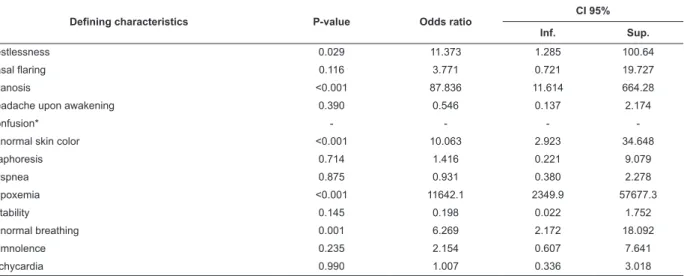
The model of the generalized estimating equation
showed that the presence of the characteristics
restlessness (OR = 11.37), cyanosis (OR = 87.83),
abnormal skin color (OR = 10.06), hypoxemia (OR =
11642.1), and abnormal breathing (OR = 6.26) are
associated with a greater likelihood of children with
acute respiratory infection manifesting the Impaired gas
exchange diagnosis when compared to children who did
not present these characteristics (Table 1).
The accuracy of the deining characteristics that presented statistical signiicance (p < 0.05) was assessed
based on the results obtained through the model of the
generalized estimating equation. The characteristic that
presented the best measures of accuracy was hypoxemia
(Sensitivity: 96.57%; Speciicity: 98.38%; Predictive
value+: 95.97%; Predictive value-: 93.21%). Other
characteristics that also presented a high level of accuracy,
above 70%, were: abnormal breathing (Sensitivity and
Predictive value-); restlessness (Speciicity and Predictive value-); cyanosis (Speciicity, Predictive value+ and Predictive value-); and abnormal skin color (Speciicity,
Predictive value-). These results are presented in Table 2.
Table 1 – Results of the model of the generalized estimating equation for all the assessments using Impaired gas
exchange as the response variable (yes or no) and the deining characteristics as explanatory variables in the model
(using AR1). Fortaleza, CE, Brazil, 2011
Defining characteristics P-value Odds ratio
CI 95%
Inf. Sup.
Restlessness 0.029 11.373 1.285 100.64
Nasal flaring 0.116 3.771 0.721 19.727
Cyanosis <0.001 87.836 11.614 664.28
Headache upon awakening 0.390 0.546 0.137 2.174
Confusion* - - -
-Abnormal skin color <0.001 10.063 2.923 34.648
Diaphoresis 0.714 1.416 0.221 9.079
Dyspnea 0.875 0.931 0.380 2.278
Hypoxemia <0.001 11642.1 2349.9 57677.3
Irritability 0.145 0.198 0.022 1.752
Abnormal breathing 0.001 6.269 2.172 18.092
Somnolence 0.235 2.154 0.607 7.641
Tachycardia 0.990 1.007 0.336 3.018
* There was no convergence for this model
Table 2 – Description of accuracy measures of the deining characteristics of Impaired gas exchange among children
with acute respiratory infections. Fortaleza, CE, Brazil, 2011
Defining characteristics Sensitivity Specificity
Predictive value
Positive Negative
Restlessness 20.81 89.33 43.79 73.85
Cyanosis 1.55 99.88 83.33 71.75
Abnormal skin color 17.70 86.10 33.73 72.37
Hypoxemia 96.57 98.38 95.97 93.21
Abnormal breathing 82.92 36.97 34.45 84.42
Discussion
Usually, respiratory nursing diagnoses are a priority
because they directly affect tissue oxygenation, which
is a vital function. Identiication of these diagnoses is
particularly important among individuals with diseases
in the respiratory tract due to impairment caused in
their airways(20). Among these diagnoses, Impaired
gas exchange stands out because it is related to
acute respiratory infection, which causes changes that
negatively impact the functionality of the respiratory
system, contributing to the onset of characteristic signs
and symptoms.
The prevalence of the diagnosis Impaired gas
diverged from another study(1) that was also conducted
with children with acute respiratory infections (27.2%).
These divergent results may be related to the fact that
that study was developed in a secondary public hospital,
the children of which usually present more stable clinical
conditions. This study, though, was conducted in a
tertiary hospital, to which children with more severe
conditions are referred, including those coming from the
aforementioned secondary hospital.
No studies addressing Impaired gas exchange
using methodology similar to this study were found.
There is, however, one meta-analysis(21) that addressed
this diagnosis using data concerning the prevalence of
deining characteristics presented in the literature to
determine their accuracy measures.
In this study, the characteristic hypoxemia
presented the best measures of accuracy for the
diagnosis Impaired gas exchange, which corroborates
data from another study conducted with children
with acute respiratory infections (Sensitivity: 90%
and Speciicity: 95%)(21). This clinical indicator is associated with respiratory infections in children due
to compromised respiratory function and alveolar
ventilation. This occurs due to the retention of
secretions, which may cause atelectasis, accruing from
the occlusion of airways, compromising gas exchange
and triggering hypoxemia(22).
Depending on the degree of hypoxemia, imbalance
between the supply and demand of oxygen may lead to
the appearance of the deining characteristic cyanosis, which, in this study, presented speciicity and positive
and negative predictive values. Nonetheless, no studies
with statistically signiicant results were found for the
purpose of comparison.
In this study, abnormal respiration was a
characteristic that presented high sensitivity (82.92%)
and negative predictive value (84.42%) to determine
Impaired gas exchange in children with acute respiratory
infections. It is important, however, to highlight that the
presence of this diagnosis was indirectly determined
by the manifestation of at least one of the deining
characteristics, namely: change in rhythm, respiratory
rate or depth.
The literature shows that increased respiratory
frequency and depth can occur as the body’s
compensatory mechanism attempts to increase the low of air in the respiratory system to ight high levels of
carbon dioxide and hydrogen ions in the blood. These
changes can be triggered by compromised airways due to
the presence of secretions retained in the airways, which
is common in children with respiratory infections(23).
Note that even though the deining characteristic
abnormal breathing belongs to the Impaired gas
exchange diagnosis, it is indirectly related to the deining
characteristics changes in respiratory depth, tachypnea
and bradypnea, which together constitute the Ineffective
breathing pattern diagnosis(7). Hence, it is possible that
nurses have dificulty to precisely inferring respiratory nursing diagnoses when facing speciic clinical situations.
It is due to the fact that the process of inferring related
nursing diagnoses may be affected when cases present
similar deining characteristics or characteristics with
descriptions that lead to the incorporation of information
from another characteristic.
This may explain the divergent results reported by
a study conducted with adult patients with pulmonary
diseases receiving mechanical ventilation and the results
of another study addressing children with respiratory
infections, since it did not present signiicant statistical
values(21).
Restlessness presented high speciicity in the
determination of Impaired gas exchange in the
population under study, corroborating the results of
another study conducted with a similar population, the
speciicity of which was 91%(21). Restlessness may be triggered by conditions that change the respiratory state,
such as acute respiratory infection, and is an important
sign in cases in which there is hypoxic and respiratory
failure. Inappropriate gas exchange intensiies signs
of respiratory failure, making breathing a conscious
effort, which results in apprehension, agitation and
restlessness(8).
Nonetheless, no statistically signiicant relationship
was found for the restlessness characteristic in a study
conducted with adult patients using invasive ventilation
support(21). It is known that patients using mechanical
ventilation may be kept under sedation, which may
compromise the identiication of clinical manifestations
of restlessness. Hence, we conjecture that this fact
Abnormal skin color (paleness) stood out due
to speciicity values and negative predictive value.
Paleness may be related to the generalized mechanism
of vasoconstriction as a consequence of neurogenic or
hormonal stimuli and also due to decreased cardiac
output, severe anemia, hypovolemia, acidosis or
hyportermia(24).
The relationship of the abnormal skin color
characteristic with the Impaired gas exchange diagnosis
may be explained by pathological processes such as
pneumonia, which may obstruct the airways, trap
gases, cause atelectasis, and increase dead space.
Consequently, increase in the partial pressure of carbon
dioxide in the blood leads to respiratory acidosis and
stimulates chemo-sensitive bulb regions (central
chemoreceptors), producing vasoconstriction and
increasing peripheral resistance(8).
In regard to the prevalence of the deining
characteristics under study, dyspnea and abnormal
breathing were the most frequently found. A possible
explanation is that diseases affecting the exchange of
respiratory gas through the pulmonary alveolar-capillary
membrane, such as an acute respiratory infection, may
promote disturbances in ventilation/perfusion, with an
excess of carbon dioxide and an oxygen deicit. In this
way, the body increases breathing as a compensating
mechanism attempting to reach normal levels of these
gases in the blood(8).
The vigorous activity of the respiratory muscles
contribute to the onset of abnormal breathing patterns
that may manifest through dyspnea, changes in breathing
frequency, rate or depth. These clinical indicators
corroborate the results found in a similar study, in which
these clinical manifestations were reported with high
prevalence(1).
Additionally, the result obtained by the Model of
the generalized estimating equation for the Impaired
gas exchange diagnosis showed that the presence of the
characteristics of restlessness, cyanosis, abnormal skin
color, hypoxemia, and abnormal breathing are related
to an increased likelihood of this diagnosis occurring in
children with acute respiratory infections. Respiratory
and alveolar ventilation impairment caused by respiratory
infections trigger adaptive compensatory mechanisms,
which if not suficient to stabilize breathing, may lead to
other more severe manifestations.
As previously discussed, hypoxemia caused by an
imbalance between oxygen supply and demand may
lead to abnormal breathing, restlessness, cyanosis,
or paleness. Therefore, the set of these clinical signs
may increase the likelihood that children with acute
respiratory infection develop Impaired gas exchange.
The close relationship of hypoxemia with this diagnosis
was observed by the accuracy measures obtained.
It is important to note that the scarcity of studies
in the literature with a methodological design similar to
this study limited the comparison of results. Therefore,
we believe that similar studies addressing children
with acute respiratory infections are needed to enable
comparison with these indings. Note that the results presented here may have been inluenced by the bias
of incorporation and diagnostic assessment, which
happens when prior knowledge concerning deining
characteristics is incorporated during the process of
diagnostic inference(25).
Despite the contribution of this study’s indings concerning the accurate identiication of the Impaired
gas exchange diagnosis among children with acute
respiratory infections, the results should be addressed
with care, as most children were assessed in a hospital
that provides care to patients with a greater probability
of manifesting more severe clinical conditions.
Conclusion
The Impaired gas exchange nursing diagnosis
was manifested in 42.5% of the sample. The most
prevalent deining characteristics were abnormal
breathing, dyspnea and hypoxemia. The model of
generalized estimating equations showed that the
concomitant presence of restlessness, cyanosis,
abnormal skin color, hypoxemia and abnormal
breathing are associated with an increased likelihood
of the occurrence of this diagnosis in children with
acute respiratory infections.
In regard to accuracy measures, hypoxemia was the
deining characteristic that predicted the occurrence of
Impaired gas exchange diagnosis. Other characteristics,
(abnormal breathing) and speciicity (restlessness,
cyanosis, and abnormal skin color).
It is believed that the determination of the predictive
ability of these deining characteristics increases the
reliability of the process of diagnostic inference and
enables nurses to produce hypotheses consisting of
more likely nursing diagnoses in the representation of
the clinical situation presented by the patient.
References
1. Andrade LZC, Chaves DBR, Silva VM, Beltrão BA,
Lopes MVO. Diagnósticos de enfermagem respiratórios
para crianças com infecção respiratória aguda. Acta Paul
Enferm. 2012;25(5):713-20.
2. Cavalcante JCB, Mendes LC, Lopes MVO, Lima LHO.
Indicadores Clínicos de Padrão Respiratório Ineficaz em
crianças com asma. Rev RENE. 2010;11(1):66-75.
3. Sousa VE, Lopes MVO, Araujo TL, Rolim IL, Nascimento
RV, Oliveira TF. Clinical indicators of ineffective airway
clearance for patients in the cardiac postoperative
period. Eur J Cardiovasc Nurs. 2013;12(2):193-200.
4. Silva VM, Lopes MVO, Araujo TL, Beltrão BA, Chaves
DBR. Nursing diagnoses in children with congenital heart
disease: differences by gender and age. Enferm Clin.
2011;21(4):214-8.
5. Pascoal LM, Beltrão BA, Chaves DBR, Lopes MVO,
Silva VM, Sousa VEC, et al. Estudio longitudinal
de los diagnósticos de enfermería respiratorios en
niños con infección respiratoria aguda. Enferm Clin.
2012;22(5):255-60.
6. Sallum AMC, Santos JLF, Lima FD. Nursing diagnoses
in trauma victims with fatal outcomes in the emergency
scenario. Rev. Latino-Am. Enfermagem.
2012;20(1):3-10.
7. Herdman TH. International nursing diagnoses:
definitions and classification, 2012-2014. Oxford, UK:
Wiley-Blackwell; 2012.
8. Guyton AC, Hall JE. Guyton & Hall: Textbook of Medical
Physiology. 12 ed. Philadelphia: W.B. Saunders; 2011.
9. Benguigui Y. Acute respiratory infections control in the
context of the IMCI strategy in the Americas. Rev Bras
Saude Mater Infant. 2003;3(1):25-36.
10. Garcia TR, Nóbrega MML, Carvalho EC. Nursing
process-application to the professional practice.
Online Braz J Nurs. [Internet]; 2004; [acesso 15 dez
2013];3(2). Disponível em: http://www.nepae.uff.br//
siteantigo/objn302garciaetal.htm
11. Greenberg RS, Daniels SR, Flandres WD, Eley JW,
Boring JR. Epidemiologia Clínica. 3ed. Porto Alegre:
Artmed; 2005.
12. Lopes MVO, Silva VM, Araujo TL. Methods for
Establishing the Accuracy of Clinical Indicators in
Predicting Nursing Diagnoses. Int J Nurs Knowl.
2012;23(3):134-9.
13. Silva VM, Lopes MVD, Araujo TL, Ciol MA, Carvalho
EC. Clinical indicators of ineffective airway clearance
in children with congenital heart disease. J Clin Nurs.
2009;18(5):729-36.
14. Pascoal LM, Lopes MV, Silva VM, Beltrão BA, Chaves
DB, Santiago JM, et al. Ineffective breathing pattern:
defining characteristics in children with acute respiratory
infection. Int J Nurs Knowl. 2014;25(1):54-61.
15. Zeitoun SS, Barros ALL, Michel JLM, Bettencourt
ARC. Clinical validation of the signs and symptoms
and the nature of the respiratory nursing diagnoses in
patients under invasive mechanical ventilation. J Clin
Nurs. 2007;16(8):1417-26.
16. Jarvis C. Physical Examination & Health Assessment.
5 ed. Philadelphia: W.B. Saunders; 2007. 928 p.
17. Potter PA, Perry AG. Fundamentals of Nursing. 8 ed.
St Louis: MO:Elsevier; 2012.
18. Kestenbaum B. Epidemiology and Biostatistics: An
Introduction to Clinical Research. New York: Springer;
2009.
19. Van Belle G, Fisher LD, Heagerty PJ, Lumley T.
Biostatistics: a Methodology for the Health Sciences. 2
ed. Oxford, UK: Wiley; 2004. 467 p.
20. Tacsi YRC, Vendruscolo DMS. Nursing assistance
in pediatric emergency services. Rev. Latino-Am.
Enfermagem. 2004;12(3):477-84.
21. Sousa VEC, Lopes MVOL, Silva VM. Meta-analisi
dell’accuratezza delle caratteristiche definenti di
“Compromissione degli scambi gassosi”. Assist Inferm
Ric 2014;33(1):29-35.
22. Meats-Dennis M. Bronchiolitis. Arch Dis Child Educ
Pract Ed. 2005;90(4):81-6.
23. Piva JP, Garcia PCR, Santana JCB, Barreto SSM.
Insuficiência respiratória na criança. J Pediatr.
1998;74(Supl. 1):S99.
24. Tarantino AB. Doenças pulmonares. 6 ed. Rio de
25. Zhou X, Obuchowski NA, McClish DK. Statistical
methods in diagnostic medicine. 2 ed. New York: Wiley
Interscience; 2011. 592 p.
Received: Jun 27th 2014