Objective: To assess the level of caregiver knowledge about respiratory signs and symptoms of acute respiratory infection (ARI) as well as their ability to detect the early warning signs and need for medical assistance in children referred to an emergency service.
Methods: This is a prospective, cross-sectional study. A standardized questionnaire with questions on the perception of the severity of ARI signs and symptoms was applied to caregivers of pediatric patients assisted in the emergency room of a university hospital from August 2011 to May 2012. Chi-square and Student’s t-tests were used to determine which variables contributed with caregivers’ recognition of severity of acute respiratory diseases.
Results: 499 caregivers were interviewed. The most cited causes of ARI were lu syndrome (78.6%), common cold (73.9%), pharyngitis (64.1%), and pneumonia (54.5%). Fever (34.1%) and cough (15.8%) were major reasons for referral to hospital. The most cited signs of severity recognized by caregivers were fever (99.6%), dyspnea (91.4%), wheezing (86.4%), adynamia (80.2%), coughing (79.8%), and tachypnea (78.6%). Children’s history of respiratory diseases (p=0.002), caregiver’s age (p=0.010) and marital status (p=0.014) were signiicantly associated with tachypnea, the most severe ARI symptom.
Conclusions: Although caregivers of children can recognize ARI most important signs and symptoms, they are unable to judge severity, which may delay medical care and early treatment. Keywords: Tachypnea; Respiratory tract infections; Knowledge; Medical care; Pneumonia; Diagnosis.
Objetivo: Avaliar o nível de conhecimento do cuidador em relação aos sinais e sintomas respiratórios de Infecções Respiratórias Agudas (IRA) e a percepção dos mesmos em relação às crianças que necessitam de assistência médica.
Métodos: Estudo prospectivo e transversal, no qual um questionário padronizado com itens relacionados à percepção da gravidade dos sinais e sintomas de IRA foi administrado a cuidadores de pacientes pediátricos admitidos no serviço de emergência de um hospital universitário no período de agosto de 2011 a maio de 2012. A análise estatística foi realizada com os testes do qui-quadrado e t-Student para determinar quais variáveis contribuíram para o reconhecimento pelos cuidadores da gravidade das doenças respiratórias agudas.
Resultados: Foram entrevistados 499 cuidadores. As causas de IRA mais citadas foram Síndrome gripal (78,6%), Resfriado comum (73,9%), Faringites (64,1%) e Pneumonia (54,5%). Febre (34,1%) e Tosse (15,8%) foram as principais razões para a procura de atendimento. Os sinais de gravidade mais citados pelos cuidadores foram: febre (99,6%), dispneia (91,4%), sibilância (86,4%), adinamia (80,2%), tosse (79,8%) e taquipneia (78,6%). O histórico de doença respiratória anterior do paciente (p=0,002), a idade (p=0,010) e o estado civil do cuidador (p=0,014) foram as variáveis signiicativamente associadas com taquipneia, o sintoma mais grave de IRA.
Conclusões: Embora cuidadores pediátricos possam perceber os principais sinais de IRA, eles não são capazes de reconhecer a gravidade destes, o que pode atrasar os cuidados médicos e impedir o tratamento precoce.
Palavra-chave: Taquipneia; Infecções do trato respiratório; Conhecimento; Cuidados médicos; Pneumonia; Diagnóstico.
ABSTRACT
RESUMO
*Corresponding author. E-mail: [email protected] (S.D. Passos). aFaculdade de Medicina de Jundiaí (FMJ), Jundiaí, SP, Brazil.
bHospital Universitário, FMJ, Jundiaí, SP, Brazil.
Received on November 22, 2016; approved on April 04, 2017; available online on December 06, 2017.
ACUTE RESPIRATORY DISEASES IN
BRAZILIAN CHILDREN: ARE CAREGIVERS
ABLE TO DETECT EARLY WARNING SIGNS?
Doenças respiratórias agudas em crianças brasileiras:
Os cuidadores são capazes de detectar os primeiros sinais de alerta?
Saulo Duarte Passos
a,*, Francila Ferreira Maziero
a, Diego Quilles Antoniassi
a,
Lidiane Trevisan de Souza
a, Arianna Freire Felix
a, Eloise Dotta
b,
INTRODUCTION
Pneumonia is a major public health concern in developing countries, particularly among children under 5 years of age. Approximately 150 million new cases of pneumonia occur each year; 11-20 million children require hospitalization, and 2 mil-lion die.1 In Brazil, respiratory diseases (especially pneumonia) are responsible for 22.3% of all deaths among 1- to 4-year-olds, ranking as the leading cause of death for this age group. Pneumonia is associated with a high rate of hospitalization2, and 30% to 50% of children taken to emergency or basic med-ical care have respiratory symptoms.3
Clinical and radiological diagnosis of pneumonia in chil-dren can be diicult, although physical and radiological signs are readily recognized in pediatric practice.4 In 1980, the World Health Organization (WHO) developed the irst guidelines for the diagnosis and management of pneumonia in children in developing countries in an attempt to reduce the number of pneumonia-related deaths.5-7 hese guidelines rely on simple clinical signs and consist of three steps:
1. identifying children in whom pneumonia should be investigated,
2. identifying pneumonia cases, and
3. administering appropriate antibiotic treatment.8
In addition, in 2012, WHO provided new recommendations for the use of irst-line antibiotics and reset the classiication of pneumonia severity.7 he distinction between the previous-ly-deined “pneumonia” (rapid breathing) and “severe pneu-monia” (chest indrawing) was no longer considered suicient. he new classiication, also comprised of two categories, was modiied to include the appropriate therapy: “pneumonia” with fast breathing and/or chest indrawing, which requires home therapy with oral amoxicillin; and “severe pneumonia”, refer-ring to pneumonia with any general danger sign, which requires hospitalization and intravenous therapy.8 Nevertheless, the ini-tial step of identifying children who should receive antibiotics or undergo chest radiography is based on clinical predictors.9
According to WHO, raised respiratory rate (also referred to as tachypnea) as determined by visual inspection is the most expressive clinical sign of pneumonia in children presenting with cough or breathing diiculty.10,11 Shann et al.11 proposed that intercostal retractions are a major sign of severe pneumonia in children and also a warning for immediate hospital referral. he authors suggested that isolated tachypnea, even with respi-ratory rate greater than 50 breaths/minute, is a reliable sign that antibiotics should be prescribed for home use in cases of pneumonia without other signs of severity.
For decades, tachypnea has been one of the most relevant clinical signs of pneumonia, as children presenting with this
condition are more likely to have pneumonia than those with-out it.12 Indeed, the recognition of signs such as tachypnea by parents should be the irst step in detection of children at risk for pneumonia. In the developing world, these simple clini-cal criteria can be used to identify more than 80% of children who require antibiotic therapy for bacterial pneumonia.5,13 Consequently, empowering parents/caregivers to recognize signs and symptoms may facilitate early and appropriate treatment, thereby helping reduce child mortality.
Because caregivers are often the irst to notice respiratory signs and symptoms of an acute respiratory infection (ARI) in children, the present study sought to verify their knowledge and perceptions regarding severity or early warning signs of ARI, including the recognition of tachypnea, and the need to seek emergency medical assistance. Additionally, based on this information, this study aimed to teach parents/guardians to successfully recognize early warning signs and to seek medical assistance when appropriate.
METHOD
Data were obtained from a cross-sectional study of children and adolescents under 15 years of age who were consecutively referred to the emergency room at the University Hospital of the Medical College of Jundiai (HU-FMJ), São Paulo, Brazil, from August 2011 to May 2012 during weekdays. HU-FMJ is a maternal and pediatric reference center with approximately 120,000 pediatric emergency entries annually. The catch-ment area of Jundiaí micro-region includes approximately 650,000 inhabitants, according to national census data from 2010.14 he only exclusion criterion was refusal to participate in the study.
Data were collected from children’s parents or guardians using a previously tested standardized questionnaire, composed of multiple-choice and open questions using terms suitable for the lay audience. A trained investigator applied the question-naires to ensure that respondents understood the questions and to clarify possible misinterpretations (Figure 1).
he questionnaire was divided into three sections: the irst had questions about parents/guardians’ socioeconomic status and was aimed to evaluate their general knowledge about ARI. he second section addressed the child’s previous history of respiratory diseases (with ID in list). Finally, the third section pertained to the current infection and the caregiver’s percep-tion of signs/symptoms considered worrisome, which led them to seek medical care.
(pneumonia, lu syndrome, colds, asthma, bronchitis, phar-yngitis/tonsillitis or other diseases). hen, they were shown a second list, from which they could select one or more symp-toms that they considered early warning signs of severe respi-ratory disease: rapid breathing, shortness of breath, coughing, runny nose, nasal congestion, fever, weakness, clear or yel-lowish/greenish phlegm, wheezing, painful breathing, dii-culty breathing, purplish lips and ingertips, refusal of food and drink. Any queries about the symptoms were clariied. In addition, two open-ended questions were posed: one sought the opinion of caregivers about which respiratory disease the child was presently experiencing; the other asked caregivers to cite three of the previously identiied symptoms that would be most worrisome in children, justifying a visit to the emergency room. hey were also asked whether the children had received any medications over the previous 48 hours, so one could deter-mine the possibility of disease severity masking with the use of common over-the-counter medications.
A multivariate analysis was performed to identify the variables correlated with tachypnea. his symptom is con-sidered the most important early warning sign of severe ARI. To classify socioeconomic status, the Economic Classiication Criteria (2011/2012) were used, as recommended by the Brazilian Research Association (ABEP). Such criteria esti-mate the purchasing power of urban individuals and fami-lies (http://www.abep.org/criterioBrasil.aspx). he system is based on two major axes: possession of items of consump-tion and educaconsump-tional level of the household head. Each item is assigned a score, and the total ranks families into eight economic classes (A1, A2, B1, B2, C1, C2, D and E). A1 economic class is relected by a total of 42-46 points; A2 (35- 1); B1 (29-34); B2 (23-28); C1 (18-22); C2 (14-17); D (8-13) and E (0-7 points). he value corresponds to an average gross monthly family income of $5006.66 USD for A1; $2832.77 for B1; $1434.49 for B2; $910.74 for C1; $619.95 for C2 and $419.43 for DE class.
he variables are described as n (percentage). Chi-square and Student’s t-tests were performed to determine which variables contributed with the caregivers’ recognition of an acute respiratory disease picture. Double-entry of data was carried out and analysis was done using SAS-PC® version 9.1 (SAS Institute, Inc., Cary, NC, USA). his research was conducted in accordance with ethical standards, the interna-tional guidelines established by the Declaration of Helsinki of 2013, and Resolution 466/2012 of the Brazilian Ministry of Health. Additionally, the Institutional Review Board approved the project.
RESULTS
Interviews with 499 parents/guardians were conducted for the purpose of this study, and no respondent was excluded. Most caregivers were females (87.4 vs. 12.6% males), sorted in the following age groups: 15–30 years (55.7%), 31–50 years (39.8%), and 51–74 years (4.4%).
A similar number of male and female children were included in the sample (50.1% females vs. 49.9 males) and they were arranged in the following age groups: 0–2 years (48.1%), 3–4 years (19%), 5–10 years (22.6%), and 11–15 years (10.2%). Most of them (72.2%) did not have any previ-ous diseases.
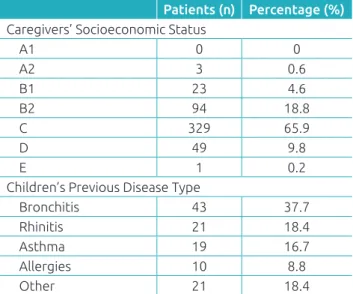
he caregivers’ socioeconomic status and children’s previ-ous disease types are shown in Table 1. Parents/guardians cited lu syndrome (n=392, 78.6%), common cold (n=396, 73.9%), pharyngitis (n=320, 64.1%), bronchitis (n=307, 61.5%), pneumonia (n=272, 54.5%) and asthma (n=217, 43.5%) as the most common respiratory diseases in childhood. Allergic Standardized questionnaire: three sections
Explanation and clariication of queries and standardization of survey responses
Socio-economic characterization: identiication of prior knowledge of caregivers on ARIs
Medications given by caregiver up to 48 hours before presenting to emergency service
If tachypnea chosen, how the caregiver identiied this sign Multiple choice questions on caregivers’ opinion of signs/symptoms consistent with
the disease and severity of disease
Identiication of three signs/symptoms, in order of importance, that prompted
emergency service attendance
Figure 1 Standardized questionnaire used to identify caregivers’ socioeconomic characteristics, children’s comorbidities, and caregivers’ knowledge about ARI characteristics.
rhinitis was the most frequently cited as “other” respiratory disease (n=13, 2.6%).
Table 2 lists the major symptoms that led parents/guard-ians to seek medical assistance for their children and caregiv-ers’ perceptions regarding the signs of ARI severity. Almost all respondents cited fever as the most important sign of ARI severity (99.6%), followed by dyspnea, wheezing, diiculty breathing and weakness. Tachypnea was identiied as a sign of ARI severity by 78.6% of respondents. he least cited symp-toms/signs were clear phlegm and cyanosis. Table 2 also lists the symptoms/signs that parents/guardians reported to make them recognize respiratory disease in their children. Most of them acknowledged tachypnea and rapid breathing (41.7%) or fatigue (12.2%) as signs of ARI. Other items were reported by less than 5% of respondents. he symptoms considered the most worrisome by caregivers, leading them to seek emergency assistance, were dyspnea (n=147, 29.5%), tachypnea (n=119, 23.8%), and fever (n=107, 21.4%) (Table 2).
he drugs most commonly given to their children 48 hours prior to seeking care were: antipyretics (n=207, 42%), with dipy-rone for 125 (25,0%), paracetamol for 66 (13.2%), ibuprofen for 16 (3.6%), and aspirin for 1 of them (0.2%). Antipyretics were followed by antibiotics, administered to 17 children (3.4%). Other medications included: fenoterol hydrobromide (n=16, 3.2%), beclomethasone dipropionate (n=7,1.4%), and loratadine (n=5, 1.0%).
he child’s history of respiratory disease (p=0.002), as well as the presence of old-age (p=0.010) and married caregiver (p=0.014), were signiicantly associated with early detection of tachypnea (Table 3).
Patients (n) Percentage (%) Caregivers’ Socioeconomic Status
A1 0 0
A2 3 0.6
B1 23 4.6
B2 94 18.8
C 329 65.9
D 49 9.8
E 1 0.2
Children’s Previous Disease Type
Bronchitis 43 37.7
Rhinitis 21 18.4
Asthma 19 16.7
Allergies 10 8.8
Other 21 18.4
Table 1 Baseline characteristics of the 499 caregivers and children.
Major symptoms reported by respondents justifying their child’s need for medical care Symptom* Respondents (n) Percentage (%)
Fever 170 34.1
Coughing 79 15.8
Sore throat 24 4.9
Vomiting 23 4.6
Stomach ache 21 4.2
Shortness of breath 19 3.8
Earache 14 2.8
Painful urination 12 2.4
Wheezing 10 2
Yellow phlegm 8 1.6
Chest congestion 7 1.4
Perceived signs and symptoms
of severe respiratory disease
Symptom Respondents (n) Percentage (%)
Fever 497 99.6
Dyspnea 456 91.4
Wheezing 431 86.4
Diiculty breathing 425 85.2
Weakness 400 80.2
Coughing 398 79.8
Tachypnea 392 78.6
Refusal of food and
drink 378 75.8
Nasal congestion 356 71.3
Runny nose 341 68.3
Pain when
breathing 328 65.7
Yellow phlegm 322 64.5
Clear phlegm 227 45.5
Cyanosis 210 42.1
Most worrisome symptoms cited by parents/caregivers which led them to seek emergency treatment Symptom Patients (n) Percentage (%) First symptom
Dyspnea 147 29.5
Tachypnea 119 23.8
Fever 107 21.4
Second symptom
Dyspnea 100 20
Fever 95 19
Tachypnea 48 9.6
Third symptom
Fever 71 14.2
Diiculty breathing 67 13.4
Wheezing 53 10.6
Table 2 Identiication of signs and symptoms reported in questionnaires by respondents.
DISCUSSION
Any intervention that reduces the number of deaths caused by pneumonia in children under ive years is of great impor-tance to public health5 and should be given consideration in any ARI prevention program. he ideal diagnostic marker of bacterial pneumonia should be accurate, minimally invasive, and readily available.4 Depending on the age of the patient, tachypnea might fulil the criteria of an ideal marker; however, many variables, such as fever, wheezing, dehydration, and anemia can afect the ability of a caregiver to detect tachypnea.
he parents/guardians who participated in our study were chiely adolescents and young women of low socioeconomic status (class C), and most of the patients were younger than two years old, constituting the most-at-risk group for pneumo-nia. Parents/guardians cited viral diseases as the most common causes of childhood ARI; an important complication, pneumo-nia ranked the ifth most common cause. his inding suggests limited knowledge about serious complications of ARI and indicates inappropriate use of healthcare services.
Increased breathing efort is an early warning sign and precedes changes in blood gases. herefore, recognizing respi-ratory distress in children is utterly important for ARI early detection and treatment, in order to avoid complications and more invasive treatments.15,16 Although caregivers stated that they understood changes in breathing pattern such as dys-pnea and diiculty in breathing as important early warning signs, these were not the main reasons they sought emergency services. here may still be a lack of understanding of severe respiratory disease signs.
Despite knowing that ARI has viral etiology and is usu-ally a self-limiting disease, parents/guardians sought emer-gency care even with mild symptoms - also bearing in mind that only 22.8% of children had medical history, the most frequent case being hyper-reactivity of the lower air-ways (ICD codes J40-J47). his practice typically leads to overcrowding of emergency services, inadequate care, and increased costs due to treatment. In a large study conducted
in the United Kingdom, McHale et al.17 found that 11.7% of emergency visits were rated as inadequate, with the high-est rates of inadequacy occurring among 1- to 2-year-olds and patients living in disadvantaged areas. he costs of pri-mary care associated with coughing in UK were estimated in £31 million, most of which was spent on medical staf.18
This study shows that fever was the primary reason to seek emergency care. his may be attributed to the anxiety of parents/guardians19,20 and the lack of primary care resources available. Fever is not a reliable sign of pneumonia in children because it also occurs in other childhood diseases21 and can markedly interfere with respiratory rate. A study conducted in he Gambia with children presenting with cough showed that the average respiratory rate increased by 2.5 breaths per minute for each 1°C higher in body temperature.22
Parents/guardians did not cite tachypnea as a reason for seeking emergency care for their children. Tachypnea requires immediate treatment; thus, all caregivers should be able to identify it to avoid unfavorable outcomes.2,23 A study that examined ARI-related deaths in developing countries found that 50% of all caregivers did not recognize signs of severity before death occurrence.24
Recognizing tachypnea may be diicult because caregivers do not frequently understand the biomedical deinitions of diseases.25 In our study, most parents/guardians had a sense of the importance of tachypnea and how to evaluate it. A mul-tivariate analysis showed that the recognition of this sign was signiicantly associated with children’s history of respiratory disease and with caregiver’s age and marital status. A total of 208 (41.7%) caregivers reported recognizing tachypnea by the acceleration of respiratory movements. Others reported not-ing that their children seemed tired or had an accelerated heart rate, conirming that they had not received previous informa-tion on tachypnea. herefore, interveninforma-tions that train parents/ guardians and healthcare professionals to recognize the signs of tachypnea and the appropriate time to seek medical care are needed.26 Community intervention studies have shown a sig-niicant increase in care and a 32% reduction in mortality by pneumonia following the education of caregivers about ARI signs and symptoms.27
he strengths of this study, particularly compared to sim-ilar studies, are:
1. his was a consecutive series of emergency room admis-sions of a population from a deined acre area.
2. Data about hospital care were based on interviews with parents/caregivers, and we included children treated at the hospital regardless of their hospitalization status.
3. HU-FMJ is the only referral center for area that includes neighboring towns with approximately 900,000 inhabitants.
OR 95%CI p-value
Children’s previous
disease (yes) 2.11 1.32–3.37 0.002
Caregiver’s age (years) 0.97 0.95–0.99 0.010 Caregiver’s marital
status (married) 1.75 1.12–2.73 0.014
Table 3 Variables signiicantly associated with tachypnea, considered the most worrisome sign of ARI.
REFERENCES
1. Rudan I, Tomaskovic L, Boschi-Pinto C, Campbell H, WHO Child Health Epidemiology Reference Group. Global estimate of the incidence of clinical pneumonia among children under ive years of age. Bull World Health Organ. 2004;82:895-903.
2. Nascimento-Carvalho CM, Souza-Marques HH. Recommendation of the Brazilian society of pediatrics for antibiotic therapy in children and adolescents with community-acquired pneumonia. Rev Panam Salud Publica. 2004;15:380-7.
3. Prado SR, Fujimori E. Maternal/familiar knowledge in relation to care provided to sick children. Rev Bras Enferm. 2006;59:492-6.
4. Lynch T, Bialy L, Kellner JD, Osmond MH, Klassen TP, Durec T, et al. A systematic review on the diagnosis of pediatric bacterial pneumonia: when gold is bronze. PLoS One. 2010;5:e11989.
5. Sazawal S, Black RE. Efect of pneumonia case management on mortality in neonates, infants, and preschool children: a meta-analysis of community-based trials. Lancet Infect Dis. 2003;3:547-56.
This study also had some limitations. The assessment of healthcare knowledge levels in emergency services might have lacked accuracy because parents/guardians were concerned with their children’s conditions and could not have been able to fully focus on completing the questionnaire. he majority of the pop-ulation treated at the hospital lived in Jundiaí, the city with the highest socioeconomic status in the micro-region. herefore, par-ticipants may not have accurately relected the entire population, which includes poorer regions and more remote rural areas. Also, as the medical reports containing the full clinical assessment of these children were unavailable, it was not possible to compare the caregivers’ assessment of severity with that of the medical staf. Although parents/guardians were able to intuitively recog-nize that rapid breathing is a sign of respiratory illness severity, they did not consider it suiciently important to seek medical attention. Caregivers were also unable to acknowledge the severity of certain clinical signs such as fever. Diiculties in recognition of tachypnea documented in this study indicate that disease sever-ity is not as efectively assessed at primary care visits as it is on presentation at hospital emergency departments. Grant et al.28 obtained similar indings when it comes to antibiotic adminis-tration by primary care facilities for children subsequently hos-pitalized with community-acquired pneumonia. Opportunities to identify tachypnea are commonly missed and can cause fail-ure or delay in pneumonia diagnosis. he early management of pneumonia in children reduces mortality substantially.5
A lack of understanding of signs and symptoms that require monitoring in a child with suspected acute lower respiratory tract infection (LRTI) prompts parents/guardians to inappro-priately seek medical care. In most cases, caregivers seek treat-ment after the patient’s condition has already deteriorated, requiring rescue intervention and occasionally invasive treat-ments that might not be efective. hus, adequate guidance regarding these clinical manifestations, particularly tachy-pnea and intercostal retractions, must be implemented at all
healthcare levels to reduce the number of preventable hospi-talizations and deaths. In this context, broad dissemination of appropriate warnings to the general population, particularly to less-privileged strata, is desirable.
Recently, Rambaud-Althaus et al. reported that no indi-vidual clinical feature is suicient for accurately diagnosing pneumonia and that using a combination of clinical features in decision-making might improve diagnostic performance; moreover, the authors reported that adding new point-of-care tests for diagnosis of bacterial pneumonia would help to reach an acceptable level of accuracy.29 Also, their survey points out the unrestrained use of analgesics/antipyretics by caregivers as possibly associated with symptomatic treatment of pain and fever. Pereira et al.30 reported identical indings in a large study addressing self-medication in children and adolescents. he same situation was detected with systemic antibiotics. his is an important fact that can contribute with adverse efects and development of bacterial resistance.
Based on this evidence, recognition of respiratory system changes related to ARI by parents/caregivers may contribute to early diagnosis and treatment, signiicantly reducing infant mortality rate by pneumonia. Tachypnea is rarely recognized by caregivers, and this inding reinforces the need for public poli-cies of health prevention and promotion at all levels, including pediatric emergency services.
Funding
his study was funded by CNPq as part of a scholarship pro-gramme for medical students (N. 01020112012). he researchers were not dependent of study funders. Sponsors played no role in the study design; data collection, analysis, or interpretation; writ-ing of the report; decision to submit the article for publication.
Conflict of interests
© 2017 Sociedade de Pediatria de São Paulo. Published by Zeppelini Publishers. This is an open access article under the CC BY license (http://creativecommons.org/licenses/by/4.0/). 6. World Health Organization. Management of the young child
with acute respiratory infections. Geneva: WHO; 1990.
7. Alkema L, New JR, Pedersen J, You D, UN Inter-agency Group for Child Mortality Estimation, Technical Advisory Group. Child mortality estimation 2013: an overview of updates in estimation methods by the United Nations inter-agency group for child mortality estimation. PLoS One. 2014;9:e101112.
8. World Health Organization. Revised WHO classiication and treatment of childhood pneumonia at health facilities– evidence summaries. Geneva: WHO; 2015.
9. Qazi S, Were W. Improving diagnosis of childhood pneumonia. Lancet Infect Dis. 2015;15:372-3.
10. Pio A. Standard case management of pneumonia in children in developing countries: the cornerstone of the acute respiratory infection programme. Bull World Health Organ. 2003;81:298-300.
11. Shann F, Hart K, Thomas D. Acute lower respiratory tract infections in children: possible criteria for selection of patients for antibiotic therapy and hospital admission. Bull World Health Organ. 1984;62:749-53.
12. Ebell M. Clinical diagnosis of pneumonia in children. Am Fam Physician. 2010;82:192-3.
13. World Health Organization. Consultative meeting to review evidence and research priorities in the management of acute respiratory infections (ARI). Geneva: WHO; 2004.
14. Brazil. Ministério do Planejamento, Orçamento e Gestão. Brazilian Institute of Geography and Statistics. Population census. Rio de Janeiro: Brazilian Institute of Geography and Statistics; 2010.
15. Fontoura MS, Matutino AR, Silva CC, Santana MC, Nobre-Bastos M, Oliveira F, et al. Diferences in evolution of children with non-severe acute lower respiratory tract infection with and without radiographically diagnosed pneumonia. Indian Pediatr. 2012;49:363-9.
16. Gupta GR. Tackling pneumonia and diarrhoea: the deadliest diseases for the world’s poorest children. Lancet. 2012;379:2123-4.
17. McHale P, Wood S, Hughes K, Bellis MA, Demnitz U, Wyke S. Who uses emergency departments inappropriately and when - a national cross-sectional study using a monitoring data system. BMC Med. 2013;11:258.
18. Hollinghurst S, Gorst C, Fahey T, Hay AD. Measuring the financial burden of acute cough in pre-school children: a cost of illness study. BMC Fam Pract. 2008;9:10.
19. Kai J. What worries parents when their preschool children are acutely ill, and why: a qualitative study. BMJ. 1996;313:983-6.
20. Cornford CS, Morgan M, Ridsdale L. Why do mothers consult when their children cough? Fam Pract. 1993;10:193-6.
21. Benguigui Y. Technical bases for the prevention, diagnosis, treatment and control of ARI at the irst level of attention. In: Benguigui Y, Antunano F, Schmunis H, Yunes J, editors. Respiratory infections in children. Washington, D.C.: Pan American Health Organization; 1998. p. 335-52.
22. Campbell H, Byass P, O’Dempsey TJ. Effects of body temperature on respiratory rate in young children. Arch Dis Child. 1992;67:664.
23. Geldsetzer P, Williams TC, Kirolos A, Mitchell S, Ratclife LA, Kohli-Lynch MK, et al. The recognition of and care seeking behaviour for childhood illness in developing countries: a systematic review. PLoS One. 2014;9:e93427.
24. Chatkin J, Mendes J, Dalcomo M, Penna M, Ribeiro S, Gerhardt Filho G. Estudo de óbitos infantis por infecção respiratória aguda (IRA) por meio de inquérito familiar. J Bras Pneumol. 1990;16:67-70.
25. Straus L, Munguambe K, Bassat Q, Machevo S, Pell C, Roca A, et al. Inherent illnesses and attacks: an ethnographic study of interpretations of childhood acute respiratory infections (ARIs) in Manhiça, Southern Mozambique. BMC Public Health. 2011;11:556.
26. Hadad S, França E, Uchôa E. Preventable infant mortality and quality of health care: maternal perception of the child’s illness and treatment. Cad Saúde Pública. 2002;18:1519-27.
27. Das JK, Lassi ZS, Salam RA, Bhutta ZA. Efect of community based interventions on childhood diarrhea and pneumonia: uptake of treatment modalities and impact on mortality. BMC Public Health. 2013;13:S29.
28. Grant CC, Harnden A, Mant D, Emery D, Coster G. Why do children hospitalised with pneumonia not receive antibiotics in primary care? Arch Dis Child. 2012;97:21-7.
29. Rambaud-Althaus C, Althaus F, Genton B, D’Acremont V. Clinical features for diagnosis of pneumonia in children younger than 5 years: a systematic review and meta-analysis. Lancet Infect Dis. 2015;15:439-50.