Revista Gaúcha
de Enfermagem
How to cite this article:
Medeiros ABA, Frazão CMFQ, Fernandes MICD, Andriola IC, Lopes MVO, Lira ALBC. Association of socioeconomic and clinical factors and tissue integrity outcome of patients with ulcers. Rev Gaúcha Enferm. 2016 mar;37(1):e54105. doi: http://dx.doi.org/10.1590/1983-1447.2016.01.54105.
DOI: http://dx.doi.org/10.1590/1983-1447.2016.01.54105
Association of socioeconomic and clinical
factors and tissue integrity outcome
of patients with ulcers
Associação dos fatores socioeconômicos e clínicos e o resultado integridade tissular em pacientes com úlceras
Asociación de los factores socioeconómicos y clínicos y el resultado integridad tissular en pacientes con úlceras
Ana Beatriz de Almeida Medeirosa
Cecília Maria Farias de Queiroz Frazãoa
Maria Isabel da Conceição Dias Fernandesa
Isadora Costa Andriolaa
Marcos Venícios de Oliveira Lopesa
Ana Luisa Brandão de Carvalho Liraa
ABSTRACT
Objective: to analyze the association between socioeconomic and clinical factors and indicators of the tissue integrity outcome in nursing among patients with venous ulcers.
Methods: a cross-sectional study at a university hospital in Natal, RN, Brazil, from February to June 2012, with 50 individuals. To analyze the variables, we used the Spearman correlation test and the Mann-Whitney and Kruskal-Wallis tests at a level of 5%.
Results: there was a correlation of low intensity between age and the indicators hydration and skin peeling, and family income and necrosis. There was also an association between gender and the indicators temperature, amount of body hair and exudation.
Conclusion: the associated variables provide important information for the treatment of patients with venous ulcers, and can help reduce ulcer time and the consequent discomfort, limitations and costs. This information should be considered when providing care for patients with a nursing diagnosis of impaired skin integrity and/or impaired tissue integrity.
Keywords: Nursing. Varicose ulcer. Health profi le. Outcome assessment (Healthcare). RESUMO
Objetivo: analisar a associação entre os fatores socioeconômicos e clínicos e os indicadores do resultado de enfermagem Integridade Tissular em pacientes com úlceras venosas.
Métodos: estudo transversal realizado em um hospital universitário de Natal/RN/Brasil entre os meses fevereiro a junho de 2012, com 50 indivíduos. Para a análise das variáveis, utilizou-se o teste de Correlação de Spearman, Mann-Whitney e Kruskal-Wallis, adotando-se um nível de 5%.
Resultados: houve correlação, de intensidade fraca, entre idade e os indicadores hidratação e descamação cutânea; renda familiar e necrose, bem como associação entre sexo e indicadores temperatura, quantidade de pelos e exsudato.
Conclusão: as variáveis que apresentaram associação geram informações relevantes para o tratamento dos pacientes com úlceras venosas, contribuindo na redução do tempo úlcera e, consequentemente, do incômodo, das restrições e dos gastos. Assim, devem ser considerados durante a assistência a um paciente com os diagnósticos de enfermagem Integridade da pele prejudicada e/ou Integridade Tissular prejudicada.
Palavras-chave: Enfermagem. Úlcera varicosa. Perfi l de saúde. Avaliação de resultados (Cuidados de Saúde). RESUMEN
Objetivo: analizar la asociación entre los factores socioeconómicos y clínicos y los índices del resultado Integridad del Tejidos en pacientes con úlceras venosas.
Métodos: estudio transversal en un hospital universitario de Natal / RN / Brasil, de febrero a junio de 2012, con 50 individuos. Para el análisis de las variables se utilizó la prueba de correlación de Spearman, Mann-Whitney y Kruskal-Wallis, adoptando un nivel de 5%.
Resultados: se observó una correlación de baja intensidad, entre la edad y los índices de la hidratación y la descamación de la piel; ingresos familiares y necrosis, así como la asociación entre el sexo y la temperatura, la cantidad de pelo y exudado.
Conclusión: las variables que se asociaron generan información relevante para el tratamiento de pacientes con úlceras venosas, que contri-buyen a reducir el tiempo de la úlcera, y, en consecuencia, las molestias, restricciones y gastos. Por lo tanto, deben ser considerados durante el cuidado de un paciente con el diagnóstico de enfermería Deterioro de la integridad de la piel y / o la integridad del tejido deteriorado.
Palabras clave: Enfermería. Úlcera varicosa. Perfi l de salud. Evaluación de resultado (Atención de salud).
a Universidade Federal do Rio Grande do Norte
INTRODUCTION
Leg ulcers aff ect the extremities of the lower limbs and the cause is generally related to the arterial or venous vascular system. Common forms of ulcer include venous ulcers (VU), which represent 70 to 90% of all lower limb ul-cers and are considered the most serious complication of chronic venous insuffi ciency (CVI)(1-2).
CVI is related to prolonged venous hypertension caused by increased venous pressure and diminished blood re-turn, and may be the result of primary varicose veins, the sequela of deep vein thrombosis, venous disorders or other causes that interfere with the return of venous blood(2).
Venous ulcers are a public health problem, and the prevalence increases with the growing elderly population and age, since it aff ects more than 4% of people over 65(3). With regard to sex, studies indicate the predominance of VU among women, who also show a high number of re-lapses and a high dependency on health services(1, 3-4).
In terms of clinical aspects, VU are characterized by slow progression, infi ltrated edges, hot extremities, edema, varicose veins, sharp or continuous pain, the presence of secondary infection and skin alterations such as stasis der-matitis, sclerosis and hyperpigmentation. These ulcers are usually located in the perimalleolar medial and distal third of the leg(5).
Patients with venous ulcers inevitably present a nursing diagnosis related to skin, such as the impaired skin integri-ty diagnosis, which is defi ned as altered epidermis and/or dermis justifi ed by the presence of a solution of continuity in these patients(6).
In addition, the impaired tissue integrity diagnosis that is defi ned as damage to the mucous membrane, cornea, tegumentary tissue, muscle fascia, muscle, bone, cartilage, articular capsule and/or ligament is also an evident diagno-sis among patients with venous ulcers(6).
In order to evaluate the diagnoses mentioned above, and considering that each nursing diagnosis must include a nursing outcome based on the Nursing Outcomes Clas-sifi cation (NOC), the study highlights the nursing outcome “Tissue Integrity: skin and mucous membranes” as being the best suited to these diagnoses(7).
This result is defi ned as structural integrity and nor-mal physiological function of the skin and mucous mem-branes, with the clinical indicators temperature, sensitivi-ty, elasticisensitivi-ty, hydration, sweating, texture, thickness, tissue perfusion, growth of hair on the skin, skin integrity, abnor-mal pigmentation, mucous lesions, scar tissue, skin can-cers, fl aky skin, skin peeling, redness, whitening, necrosis and hardening(7).
It is therefore important to obtain further knowledge of patients with venous ulcer and their peculiarities in order to establish possible associations with the studied nursing outcome. The identifi cation of socioeconomic and clinical data allows health professionals to identify the profi le of patients aff ected by this type of condition, and the asso-ciation of these data with tissue integrity data supports the planning and organization of more eff ective goals and the provision of nursing care that observes the reality and needs of these patients.
The identifi cation of studies that associate tissue in-tegrity and the socioeconomic and clinical data of pa-tients with venous ulcers is scarce. A study conducted in northeastern Brazil can be considered relevant to this subject, since it characterizes the health status referent to tissue integrity in patients with venous ulcers and makes the association between socioeconomic data and the outcome itself, without specifying the relationship with the individual indicators. This study found a statistically signifi cant association between the nursing outcome and age, where the older the patient, the lower the score of the indicator(4).
In light of the representativeness of this subject and its implications and considering the specifi c characteristics of patients with venous ulcer, this study was based on the fol-lowing guiding question: is there an association between socioeconomic and clinical factors and the indicators of the nursing outcome tissue integrity in patients with ve-nous ulcers? The aim of this paper is to analyze the associ-ation between socioeconomic and clinical factors and in-dicators of the nursing outcome tissue integrity in patients with venous ulcers.
METHOD
Cross-sectional study conducted in the outpatient sur-gery clinic of a university hospital in northeastern Brazil, with 50 individuals recruited through consecutive sampling cal-culated using the formula n = (z*s/e)2, where “z” is the level of confi dence, “s” is the standard deviation of the NOC average and “e” is the absolute sample error in relation to the NOC average. Additional considerations included z = 95% (1.96), average NOC normality of “3” and an error of 0.83.
The criteria for inclusion were patients with venous ulcer based on clinical signs and an Ankle Brachial Index
value above 0.8, which represents venous impairment(8);
or cognitive abnormality, suff ering or impairment; and pa-tients with an oncological lesion or of mixed etiology.
It should be noted that the referred consultation that was adopted as a criterion for inclusion is based on the dy-namics of outpatient care of the studied hospital by means of the referral system of the Unifi ed Health System provid-ed by the primary care units for consultations with the an-giologist/vascular surgeon. Individuals with lesions are re-ferred to the dressing rooms to remove the coverage and clean the lesion so the angiologist can look at the lesion before the patient enters the consultation room. The nurs-ing stuff dresses the lesion under the nurse’s supervision.
The data collection instrument was an interview form and a physical examination based on the script created for a study in northeastern Brazil(4). The instrument of op-erational defi nitions for indicators of the nursing outcome tissue integrity constructed and validated by the same au-thor(4) was also applied to the patients with VU.
The variables for socioeconomic characterization were sex (female, male), occupation, marital status (with and without companion), age (in years), years of schooling, family income and per capita income.
The variables of the clinical data for patients with VU were dorsal pedal and posterior tibial pulse (regular and strong; regular and weak; irregular and strong; irregular and weak; measurement impaired, measured using pulse palpitation), foul smell (yes or no, according to the interviewer when viewing the lesion) and ambulation (no change; with help; does not walk, according to direct observation and patient response), ulcer time (in years, according to patient/com-panion response), systolic and diastolic pressure (in mmHg, measured with a simple stethoscope brand Premium and aneroid sphygmomanometer brand Premium with latex hose and bulb and nylon cuff with Velcro closure. The device was duly calibrated), ankle systolic pressure (in mmHg, mea-sured with a sphygmomanometer and Doppler-type stetho-scope), Ankle/Brachial Index (ratio between the systolic arte-rial pressure and the ankle systolic pressure), the lesion area (in cm2, calculated by multiplying the greatest width by the greatest length of the lesion using a paper ruler).
Finally, we used the variables of the tissue integrity outcome: skin and mucous membranes of the NOC, with fi ve point values of the Likert scale with regard to level of impairment: 1 - Serious; 2 - Substantial/very; 3 - Moder-ate; 4 - Fair; 5 - No/None. The indicators of the outcomes in question were skin temperature, sensitivity, elasticity, hydration, texture, thickness, tissue perfusion, amount of hair, abnormal pigmentation, skin lesions, scar tissue, skin fl aking/peeling, erythema, necrosis, induration, itching, pain and exudation. The indicators used in this study were
described and detailed in the study mentioned earlier(4), in which some NOC indicators were eliminated and new indi-cators were proposed.
Two propaedeutic methods - inspection and palpation - were used to measure the indicators of the tissue integrity outcome: skin and mucous membranes. However, two of the indicators were measured using specifi c instruments. Temperature was measured with an MT-305 Minipa infra-red thermometer calibrated with the emissivity of 0.98, which is specifi c for human skin, and sensitivity was mea-sured using Semmes-Weinstein monofi lament examina-tion or a Sorri® monofi lament aesthesiometer. For the ABI, ankle systolic pressure was measured with a sphygmoma-nometer and Doppler-type stethoscope.
Data were collected by a Master´s level graduate stu-dent responsible for the study from February to June 2012. The data were stored in an Excel spreadsheet, tabulated using IBM SPSS version 19.0 for Windows and analyzed by means of descriptive statistics and nonparametric tests. The Shapiro-Wilk test was conducted to assess the distri-bution of quantitative data according to normality.
The Spearman correlation coeffi cient was used to check the correlation between the variables. Statistical associations were analyzed using the Mann-Whitney test for both groups, and the Kruskal-Wallis test was used to compare three or more groups. A level of 5% (p< 0.05) was established to determine the statistical signifi cance of the specifi ed tests. The values recommended by the British Medical Journal were used to classify the power of the cor-relations among the variables. These values are: 0.00 - 0.19: absent or very weak; 0.20 - 0.39: weak; 0.40 - 0.59: moder-ate; 0.60 - 0.79: strong; 0.80 - 1.00: very strong(9). The data were discussed using literature published on the subject.
The study observed Resolution 466/2012 of the Con-selho Nacional de Saúde(10), and the project was approved by Comitê de Ética em Pesquisa of the Hospital Universi-tário Onofre Lopes (Universidade Federal do Rio Grande do Norte), under protocol 608/11 and Certifi cado de Apre-sentação para Apreciação Ética 0038.0.294.000-11. The patients agreed to participate in the study by signing an informed consent statement.
RESULTS
The results of the study are presented below in tables of socioeconomic and clinical characterization and the asso-ciation of these data with the indicators of the NOC tissue integrity outcome.
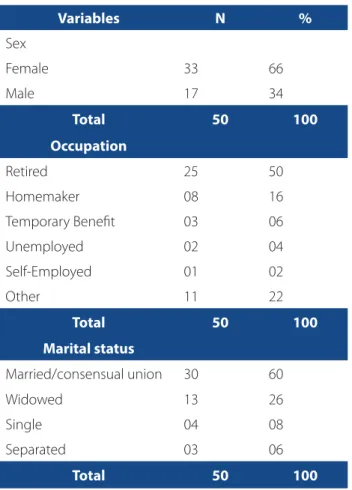
Most of the patients were women, retirees and living with a companion. To check the normality of the numeric variables, we used the Shapiro-Wilk test represented by the p value. The average age was 59.72 years (± 12.71) with a minimum of 28 and a maximum of 88 years (p = 0.533). The median number of schooling year was fi ve, ranging from zero to 12 years and p = 0.030, which falls into the category of unfi nished primary school. Average family income was 1244.00, or the equivalent of two minimum wages, with a minimum income of BRL622.00 and maximum income of BRL3732,00 (p = 0.000). Average per capita income was 311.00, or half a minimum wage, ranging from BRL 69.11 to BRL1244.00 (p = 0.000). The minimum wage of BRL622.00 was considered at the time of the study(11).
Table 2 shows the descriptive clinical data of the pa-tients with venous ulcer.
With regard to clinical aspects, there was a prevalence of regular and strong pulse for pedal and posterior tibi-al pulses. Measurement impaired is the impossibility of
Table 1 – Social Characterization of patients with venous ulcers. Natal, RN, Brazil, 2013
Variables N %
Sex
Female 33 66
Male 17 34
Total 50 100
Occupation
Retired 25 50
Homemaker 08 16
Temporary Benefi t 03 06
Unemployed 02 04
Self-Employed 01 02
Other 11 22
Total 50 100
Marital status
Married/consensual union 30 60
Widowed 13 26
Single 04 08
Separated 03 06
Total 50 100
Source: Research data, 2013.
Table 2 – Clinical characterization of patients in terms of pulse, ambulation and odor from the venous ulcer. Natal, RN, Brazil, 2013
Variables n %
Pedal pulse
Regular and strong 32 64
Measurement impaired 14 28
Regular and weak 04 08
Total 50 100
Posterior Tibial Pulse
Regular and strong 26 52
Measurement impaired 19 38
Regular and weak 05 10
Total 50 100
Foul odor coming from the ulcer Present Absent
04 46
08 92
Total 50 100
Ambulation
No change 42 84
With help 08 16
Total 50 100
Source: Research data, 2013.
checking the pulse due to the location of the lesion, which is sometimes in the same location where the pulse is pal-pated. A foul odor coming from the ulcer was identifi ed by a minority of patients. However, ambulation was un-changed in most of the sample.
respectively; and the median for the lesion was 19.5 cm2 (p = 0.000), ranging from 0.5 cm2 to 450 cm2.
Table 3 presents the correlations identifi ed among the socioeconomic data and indicators of the nursing out-come tissue integrity: skin and mucous membranes.
There was a statistically signifi cant correlation of weak intensity between age and the indicators of the tissue in-tegrity outcome: hydration (p = 0.032; rs = -0.304) and skin fl aking/peeling (p = 0.026; rs = -0.316); between years of schooling and the indicator skin fl aking/peeling (rs = 0.300; p = 0.034), and between family income and the indicator necrosis (p = 0.012; rs = -0.353). The Mann-Whitney U test revealed a diff erence between the sexes for the indicators temperature (p = 0.046), amount of hair (p = 0.011) and exudation (p = 0.016).
Table 4 shows the correlations between the clinical aspects and the indicators of the nursing outcome tissue integrity: skin and mucous membranes.
With regard to the correlation between the clinical aspects and the indicators of the studied outcome, only the ABI variable presented a statistically signifi cant cor-relation of low intensity with the indicator tissue perfusion (p = 0.044; rs = -0.329).
DISCUSSION
The predominance of females in the study converges with data from other studies (1, 5, 12) where thepercentage of women with venous ulcers ranges from to 68.2% to 88.9%. The largest proportion of VU among the female sex is the result of neuroendocrine disorders, changes resulting from pregnancy, puerperium and a higher incidence of varicose veins among women, all of which trigger CVI(5).
In terms of occupation, half of the sample was identi-fi ed as retired or a pensioner, and four of these individuals were under the age of 60. These individuals, together with
Table 3 – Analysis of correlation and association between socioeconomic aspects and indicators of the nursing outcome tissue integrity: skin and mucous membrane in patients with venous ulcers. Natal, RN, Brazil, 2013
Indicators Age1 Sex2 Marital
status3 Occupation
3 Years of schooling1
Family income1
Income per capita1
Temperature 0.768 0.046* 0.492 0.446 0.209 0.052 0.286
Sensitivity 0.068 0.759 0.097 0.278 0.053 0.054 0.688
Elasticity 0.092 0.865 0.779 0.180 0.381 0.450 0.625
Hydration 0.032* 0.954 0.111 0.096 0.253 0.158 0.223
Texture 0.082 0.836 0.568 0.177 0.967 0.091 0.210
Thickness 0.050 0.859 0.851 0.386 0.208 0.788 0.248
Tissue perfusion 0.064 0.548 0.377 0.363 0.698 0.589 0.668
Amount of hair 0.122 0.011* 0.464 0.222 0.891 0.669 0.063
Abnormal pigmentation 0.314 0.130 0.873 0.539 0.957 0.572 0.406
Skin lesions 0.540 0.928 0.949 0.581 0.773 0.264 0.362
Scar tissue 0.393 0.275 0.967 0.308 0.951 0.629 0.566
Skin peeling/fl aking 0.026* 0.862 0.549 0.066 0.034* 0.514 0.885
Erythema 0.761 0.946 0.484 0.447 0.678 0.996 0.675
Necrosis 0.356 0.681 0.383 0.411 0.155 0.012* 0.415
Induration 0.144 0.082 0.710 0.328 0.113 0.826 0.814
Itching 0.770 0.765 0.780 0.981 0.373 0.676 0.518
Pain 0.648 0.450 0.730 0.566 0.381 0.174 0.344
Exudation 0.489 0.016* 0.751 0.347 0.859 0.267 0.708
Source: Research data, 2013.
the unemployed patients (four) and temporary benefi cia-ries (three), total 11 patients, which represents 22% of the sample and may lead to the assumption that they are un-able to work due to their condition.
Venous ulcers may lead to leave from work(12), given the impaired functional capacity, problems with mobility and pain. These issues may interfere with the patients’ capacity to work and lead to a series of consequences with social and economic repercussions, such as early retirement, un-employment, dependency on family members and a high number of medical leaves from work(13).
Occupational data and the fact that patients were ac-tive or inacac-tive are consistent with data from two other characterization studies, where 70% and 69.1% of patients did not have an occupational activity, respectively(3, 13).
The marital status of patients with VU was highly rel-evance due to the help and psychosocial support com-panions can off er these patients and to the support they receive from their companions when conducting daily
rou-tines, such as personal hygiene or dressing their wounds(1, 3). It should be noted that these subjects are included in a
so-called social network that basically consists of individ-uals who discuss issues related to care and treatment and off er emotional support, company and fi nancial help(14).
Most of the study sample was over 60 years of age (54%), as found in other studies where there was a greater prevalence of this type of lesion among the over-60 age group(1, 14-15).
Venous ulcers are most common among this age group because the infl ammatory response diminishes as patients get older, which reduces the metabolism of collagen. Other associated factors in this age group are angiogenesis and epithelialization, poor nutrition, vascular insuffi ciency and systemic diseases, which slow down the healing process(12).
A statistically signifi cant correlation between the vari-able age and the indicator hydration can be caused by the dry perilesional area and inadequate hydration that is com-mon acom-mong elderly people and with some chronic skin
Table 4 – Analysis of the correlation between clinical aspects and indicators of the nursing outcome tissue integrity: skin and mucous membrane in patients with venous ulcers. Natal, RN, Brazil, 2013
Indicators *SBP1 **DBP1 ***ASP1 ****ABI1
Temperature 0.834 0.770 0.793 0.703
Sensitivity 0.831 0.859 0.903 0.573
Elasticity 0.376 0.300 0.856 0.817
Hydration 0.570 0.714 0.373 0.278
Texture 0.893 0.766 0.991 0.766
Thickness 0.363 0.367 0.918 0.643
Tissue perfusion 0.604 0.441 0.277 0.0442
Amount of hair 0.133 0.295 0.052 0.338
Abnormal pigmentation 0.137 0.305 0.648 0.832
Skin lesions 0.806 0.618 0.945 0.574
Scar tissue 0.397 0.557 0.315 0.175
Skin peeling/fl aking 0.184 0.146 0.633 0.917
Erythema 0.534 0.638 0.479 0.862
Necrosis 0.929 0.810 0.536 0.606
Induration 0.176 0.266 0.105 0.176
Itching 0.192 0.410 0.359 0.501
Pain 0.192 0.283 0.469 0.620
Exudation 0.842 0.835 0.318 0.391
Source: Research data, 2013.
diseases, such as VU(16). In the referred study, both charac-teristics were found among the patients, which leads nurs-es to treat the ulcer and the area surrounding the lnurs-esion.
In this study, there was a weak correlation between age and skin fl aking/peeling. Interestingly, skin fl aking can be physiologically explained by the reduction of dermal elasticity due to the reduced number of fi broblasts, which modifi es the collagen and elastin fi bers(5) and causes dry and scaly skin.
The low educational level and income identifi ed in this study could be justifi ed by the fact that the reference clinic where the study was conducted is a public health service that provides care for low-income users with low schooling. Schooling and income are jointly found among patients with VU, since these factors are precarious in most studies conducted with this population(1, 4, 12). These facts may indicate a lifestyle that promotes the appearance of lesions, little or no access to specialized health services or inadequate management on the part of professionals who provide healthcare services to this population(13).
The statistically signifi cant correlation between family income and necrosis is justifi ed because treatment for le-sions of venous origin tends to be neglected or less eff ec-tive among individuals with low income, thus increasing the risk of developing non-viable tissue in the wound bed, as in the case of necrotic tissue, and preventing the healing process from occurring in the ideal time.
In order to contribute to the diagnosis of lesions of ve-nous origin, the presence of a pedal or dorsal pulse and posterior tibial pulse in patients with leg injuries must be verifi ed(5). Arterial disease should be considered in the ab-sence of distal pulses. If found together with lesions that are characteristics of venous ulcers, the venous alterations should be diagnosed(8).
The pulses mentioned above were found among most of the studied individuals, except in the case of patients where measurement was not possible due to lesions in the pulse palpation site. A normal fl ow was found in some sit-uations, although the pulse could not be palpated due to specifi c VU characteristics, such as edema and subcutane-ous fi brosis(5).
The foul odor from the VU could be the result of some form of infection, such as bacterial infection by Pseudomo-nas aeruginosa(5). In this study, 8% of the individuals had le-sions with a foul odor, which is similar to a characterization study(12) that found foul odor in 9% of the sample.
The mobility of patients with venous ulcers may also be impaired and limit their ability to complete household chores(3). Data related to impaired ambulation or ambula-tion with the help of others are similar to the data found
in another study, which highlights the importance of as-sessing the level of diffi culty of mobility among these pa-tients(17).
Prolonged time of lesion, as found in this study, reveals the complexity of VU treatment and the consequent suff er-ing and loss of the patient’s capacity to work. It should also be noted that these lesions often remain open for months or years for several reasons such as preexisting conditions related to age, diabetes, poor circulation, poor nutritional status, immunodefi ciency, and local factors such as infec-tion and the presence of necrotic tissue, the presence of cells in low mitotic activity, a decrease of growth factors and low cellular responses(12).
The results regarding VU time agree with research con-ducted in an outpatient clinic of a public hospital in Rio Grande do Sul(14), in which the time evolution of VU ranged from six months to 25 years.
Blood pressure, defi ned as the force exerted by the blood in a blood vessel, when high, can trigger the collapse of vascular walls. The increased blood fl ow can aggravate venous hypertension in the case of insuffi ciency. In this re-gard, the average SBP was 123.60 and the average DBP was 81.40. These values are considered normal according to the Sociedade Brasileira de Hipertensão(18).
Most of the studied sample suffered from systemic hypertension (44%). However, the use of hypertension medication by these patients justified the normal blood pressure. A study conducted with similar patients re-vealed an important association between CVI and hy-pertension, which emphasizes the importance of con-trolling or treating CVI and the need of treatment for hypertension(19).
The Ankle/Brachial Index (ABI) was also calculated to clinically characterize the ulcers of the sample. The result-ing median value was 1. Normal ABI values vary from 0.91 to 1.3. Values below this range reveal arterial insuffi ciencies, while values above this range indicate the calcifi cation of the arteries. The median value detected in this study dis-cards the possibility of arterial involvement(8).
Although the ABI presented a negative correlation with the indicator tissue perfusion, the intensity of this correla-tion was low and lacks clinical support, since there is no arterial alteration for venous ulcers and the magnitudes should be directly proportional.
The correlations found between these variables and their repercussions on the health of patients with venous ulcer reveal the importance of considering socioeconomic and clinical aspects when assessing patients with impaired tissue/skin integrity
CONCLUSION
The results of this study, based on a master’s disserta-tion “Integridade tissular de pacientes com úlceras venosas: um estudo baseado na Classifi cação dos Resultados de Enfer-magem”(20), corroborate the socioeconomic profi le of the population aff ected by venous ulcers within the context of outpatient services in regional public health institutions. Elderly women, low income and low schooling were the predominant characteristics of this population, as found in literature.
In summary, the results revealed a statistically signif-icant correlation, of weak intensity, between age, hydra-tion and skin peeling, and family income and necrosis. The results also revealed an association between sex and the indicators temperature, amount of hair and exudation. The studied clinical factors showed a weak correlation between ABI and tissue perfusion.
Consequently, the identifi cation of socioeconomic and clinical factors of patients with venous ulcer and the studied nursing outcome provide information that can help nurses monitor and treat patients with venous ulcers, reduce the ulcer time and the resulting discomfort, lim-itations and costs, and improve the quality of life of these individuals and their families.
The fact that this study was conducted with patients with venous ulcer, since the instrument targeted this pop-ulation, is considered a study limitation. Therefore, further research should include lesions of diff erent origins with specifi c interventions and results that focus on improving the quality of patients with any type of injury.
REFERENCES
1. Dias TYAF, Costa IKF, Melo MDM, Torres SMSGSO, Maia EMC, Torres GV. Avaliação da qualidade de vida de pacientes com e sem úlcera venosa. Rev Latino-Am Enfermagem [Internet]. 2014 [cited 2015 jan. 31];22(4):576-81. Available at: http://www.scielo.br/pdf/rlae/v22n4/pt_0104-1169-rlae-22-04-00576.pdf
2. Seide AC, Coelho RL, Coelho ML, Belczak CEQ. É a lesão venosa a única respon-sável pela clínica da insufi ciência venosa crônica dos membros inferiores? J Vasc Bras [Internet]. 2014 [cited 2015 fev. 1];13(3):162-7. Available at: http://www. scielo.br/pdf/jvb/v13n3/pt_1677-5449-jvb-13-03-0162.pdf
3. Costa IKF, Nóbrega WG, Torres GV, Lira ALBC, Tourinho FSV, Enders BC. Pessoas com úlceras venosas: estudo do modo psicossocial do Modelo Adaptativo de
Roy. Rev Gaúcha Enferm [Internet]. 2011 [cited 2015 jan. 31];32(3):561-8. Available at: http://www.scielo.br/pdf/rgenf/v32n3/18.pdf
4. Santos FAAS, Melo RPM, Lopes MVO. Characterization of health status with regard to tissue integrity and tissue perfusion in patients with venous ulcers according to the nursing outcomes classifi cation. J Vasc Nurs. 2010;28(1):14-9. 5. Silva MC. Insufi ciência venosa crônica: diagnóstico e tratamento clínico. In: Maf-fei FHA, Lastória S, Yoshida WB, Rollo HA, Giannini M, Moura R. Doenças vascu-lares periféricas. 4. ed. Rio de janeiro: Guanabara Koogan; 2008. p. 1804-14. 6. Herdman TH, Kamitsuru S. NANDA International Nursing Diagnoses: defi nitions
& classifi cation, 2015-2017. Oxford: Wiley Blackwell; 2014.
7. Moorhead S, Johnson M, Maas ML, Swanson E. Classifi cação dos resultados de enfermagem (NOC). 4. ed. Rio de Janeiro: Elsevier; 2010.
8. Giollo Júnior LT, Martin JFV. Índice tornozelo-braquial no diagnóstico da doença aterosclerótica carotídea. Rev Bras Hipertens [Internet]. 2010 [cited 2015 jan. 20];17(2):117-8, 2010. Available at: http://departamentos.cardiol.br/dha/re-vista/17-2/13-indice.pdf
9. Swinscow TDV. Correlation and regression. In: Swinscow TDV. Statistics at square one [Internet]. London: BMJ Publishing Group; 1997 [cited 2015 jan. 11]. Chap-ter 11 Available at: http://www.bmj.com/about-bmj/resources-readers/publi-cations/statistics-square-one/11-correlation-and-regression
10. Ministério da Saúde (BR). Conselho Nacional de Saúde. Resolução nº. 466 de 12 de dezembro de 2012. Dispõe sobre diretrizes e normas regulamentadoras de pesquisa envolvendo seres humanos. Diário Ofi cial da União [da] República Federativa do Brasil. 2013 jun 13;150(112 Seção 1):59-62.
11. Presidência da República (BR). Decreto n.º 7.655, de 23 de dezembro de 2011. Regulamenta a Lei no 12.382, de 25 de fevereiro de 2011, que
dis-põe sobre o valor do salário mínimo e a sua política de valorização de longo prazo. Diário Ofi cial da União [da] República Federativa do Brasil. 2011 dez 26;148(247 Seção 1):5.
12. Benevides JP, Coutinho JFV, Santos MCL, Oliveira MJA, Vasconcelos FF. Avaliação clínica de úlceras de perna em idosos. Rev Rene [Internet]. 2012 [cited 2014 nov. 14]; 13(2):300-8. Available at: http://www.revistarene.ufc.br/revista/in-dex.php/revista/article/view/213/pdf
13. Malaquias SG, Bachion MM, Sant’Ana SMSC, Dallarmi CCB, Lino Junior RS, Fer-reira PS. People with vascular ulcers in outpatient nursing care: a study of socio-demographic and clinical variables. Rev Esc Enferm USP [Internet]. 2012 [cited 2015 jan. 20];6(2):302-10. Available at: http://www.scielo.br/pdf/reeusp/ v46n2/a06v46n2.pdf
14. Silva, DC,Budó MLD,Schimith MD,Torres GV,Durgante VL,Rizzatti SJS,et al. Infl uência das redes sociais no itinerário terapêutico de pessoas acometi-das por úlcera venosa. Rev Gaúcha Enferm [Internet]. 2014 [cited 2015 jan. 20];35(3):90-96. Available at: http://www.scielo.br/pdf/rgenf/v35n3/ pt_1983-1447-rgenf-35-03-00090.pdf
15. Salomé GM. Identifi cação do índice tornozelo/braço em pacientes com úlcera de perna. Saúde Coletiva [Internet]. 2012 [cited 2015 jan. 22];9(58):118-22. Available at: http://www.redalyc.org/articulo.oa?id=84225063004
16. Porto CC. Exame clínico: bases para a prática médica. 7. ed. Rio de Janeiro: Gua-nabara Koogan; 2013.
18. Pierin AMG, Guimarães AC, Brandão AP, Amodeo C, Mion Jr. D, Casarini DE, et al. Diretrizes Brasileiras de Hipertensão VI. Rev Hipertens [Internet]. 2010 [cited 2014 dec. 21];13(1):5-66. Available at: http://www.sbh.org.br/pdf/diretrizes_fi nal.pdf 19. Silva FAA, Moreira TMM. Características sociodemográficas e clínicas de
clientes com úlcera venosa de perna. Rev Enferm UERJ [Internet]. 2011
[cited 2014 dec. 21];19(3):468-72. Available at: http://www.facenf.uerj. br/v19n3/v19n3a22.pdf
20. Medeiros ABA. Integridade tissular de pacientes com úlceras venosas: um es-tudo baseado na classifi cação dos resultados de enfermagem [dissertação]. Natal: Universidade Federal do Rio Grande do Norte; 2013.
Corresponding author:
Ana Beatriz de Almeida Medeiros E-mail: [email protected]