ABSTRACT
BACKGROUND AND OBJECTIVES:Mandibular condylar hyperplasia is a disease where excessive growth of mandibular condyle, ramus and body elicits facial asymmetry. Its therapeutic management is not a consensus and, due to its complexity, is a challenge for maxillofacial surgeons and orthodontists. his study aimed at discussing clinical, diagnostic and therapeutic as-pects of the management of this disease, and at explaining the role of condylectomy.
CASE REPORT: Female patient, 19 years old, Caucasian, looked for maxillofacial surgeon assistance due to facial asym-metry and pain on right temporomandibular joint. Patient had no medical, gestational or family history of facial deformity, or history of previous joint trauma or infection. his was a case of hemimandibular elongation treated with condylectomy. CONCLUSION: Condylectomy is a safe and efective proce-dure, without functional joint sequelae, which prevents dental-facial deformity progression, minimizing its psychosocial impact and helping future treatment.
Keywords: Facial asymmetry, Hyperplasia, Mandibular condyle, Temporomandibular joint disorders.
RESUMO
JUSTIFICATIVA E OBJETIVOS: A hiperplasia da cabeça man-dibular é uma doença na qual há um crescimento excessivo da ca-beça, ramo e corpo mandibulares que causa assimetria facial. A sua abordagem terapêutica não apresenta um consenso e, dada a sua complexidade, constitui um desaio para o cirurgião maxilofacial e para o ortodontista. O objetivo deste estudo foi discutir os
aspec-Mandibular condylar hyperplasia: diagnosis and management. Case report
Hiperplasia da cabeça mandibular: diagnóstico e tratamento. Relato de caso
Isabel Pinto1, Júlio Fonseca2, Alexandra Vinagre3, David Ângelo4, David Sanz5, Eduardo Grossmann6
1. Hospital de São João, Unidade de Cirurgia Maxilofacial, Porto, Portugal. 2. Prática Privada de Medicina Dentária, Coimbra, Portugal.
3. Universidade de Coimbra, Faculdade de Medicina, Área de Medicina Dentária, Coimbra, Portugal.
4. Centro Hospitalar Lisboa Norte, Serviço de Estomatologia, Lisboa, Portugal. 5. Centro Hospitalar Universitário de Coimbra, Serviço de Cirurgia Maxilofacial, Coimbra, Portugal.
6. Universidade Federal do Rio Grande do Sul, Programa de Pós-Graduação em Ciências Cirúrgicas, Porto Alegre, RS, Brasil.
Submitted in April 06, 2016.
Accepted for publication in August 23, 2016. Conlict of interests: none – Sponsoring sources: none.
Correspondence to: Rua Coronel Corte Real, 513 90630-080 Porto Alegre, RS. Brasil. E-mail: [email protected]
© Sociedade Brasileira para o Estudo da Dor
tos clínicos, diagnósticos e terapêuticos envolvidos na abordagem dessa doença, clariicando o papel da condilectomia.
RELATO DO CASO: Paciente do gênero feminino, 19 anos, caucasiana, procurou atendimento de um Cirurgião Maxilofacial devido a assimetria facial e dor na articulação temporomandibu-lar direita. Não possuía antecedentes médicos ou gestacionais ou familiares de deformidade facial, nem história de trauma ou in-fecção articular prévios. Apresenta-se um caso clínico de alonga-mento hemimandibular tratado com condilectomia.
CONCLUSÃO: A condilectomia é um procedimento seguro e eicaz, sem sequelas articulares funcionais, que evita a progressão da deformidade dentofacial, minimizando o seu impacto psicos-social e facilitando o tratamento posterior.
Descritores: Assimetria facial, Cabeça mandibular, Distúrbios da articulação temporomandibular, Hiperplasia.
INTRODUCTION
Mandibular condylar hyperplasia was irst described by Rob-ert Adams in 1836, while describing a case of rheumatoid arthritis1. It is a temporomandibular joint (TMJ) pathology where there is excessive mandibular growth, in general uni-laterally, which leads to esthetic and functional problems2. It occurs preferably between 10 and 30 years of age, however there are reports of cases from 9 to 80 years of age, and this discrepancy might be explained by the time patients look for professional treatment3,4. Its etiology is unknown, however several causal factors have been reported, such as post-trauma mandibular condyle hyper-remodeling, joint infection, hor-monal disorders, mandibular condyle hypervascularization, intrauterine changes and genetic factors5.
In 1986, Obwegeser and Madek have classiied mandibular condylar hyperplasia in two major types: hemimandibu-lar elongation and hemimandibuhemimandibu-lar hyperplasia. However, the disease may manifest as hybrid unilateral or combined bilateral6. In hemimandibular elongation, growth vector is horizontal with elongation of all components of the afected hemimandible. Major characteristics are contralateral devia-tion of the chin and of the lower dental midline, contralateral crossbite and ipsilateral molar relationship Class III. On the other hand, hemimandibular hyperplasia is characterized by a tridimensional growth of the afected side, with vertical in-crease of the lower hemi-third of the face and inferomedial projection of mandibular basilar edge.
In general, there is maxillary occlusal plane inclination and minimum deviation of the chin and of the lower dental mid-line in the contralateral sense, being even more frequent an
ipsilateral deviation. In case of mandibular condylar hyper-activity in a post-puberty phase, there might be ipsilateral posterior open bite due to lack of maxillary compensation7. In functional terms, mandibular condylar hyperplasia may course with phonetic, chewing and swallowing diiculties due to occlusal disharmony, nasal obstruction by nasal septum de-viation and turbinates hypertrophy, temporomandibular joint disorder and esthetic and self-esteem problems7,8.
Diganosis is clinical and by images2. Approximately 98% of facial growth is complete at 15 years of age in females and be-tween 17 and 18 years of age in males. During growth phase, mandible grows from Condylion (most postero-superior co-point of mandibular condyle) to Point B (co-point located in the largest concavity of the chin symphysis anterior face) at a speed of 1.6mm/year in females and 2.2mm/year in males. Accelerated growth may indicate active mandibular condyle hyperplasia8. Bone scintigraphy with single photons emission computerized tomography (SPECT) of the head is currently the most common method to detect mandibular condylar hy-perplasia9-11. However, it may be inconclusive in case of young patients and with slow-growth hyperplasia12, or may supply false positive results in cases of inlammation, infection, post-trauma regeneration and malignant processes2.
Face X-rays, such as panoramic and face frontal and proile teleradiography, are useful to evidence skeletal changes typi-cal of mandibular condylar hyperplasia8. Positrons emission tomography (PET) is starting to be used to study such disease and may contribute in the future for better accuracy of its di-agnosis13. Treatment depends on mandibular condyle activity (active versus non active hyperplasia), on the level of asym-metry, on malocclusion and age14. Diferent therapeutic pos-sibilities have been described, from condylectomy to orthog-natic surgery, with or without associated orthodontics2. Since mandibular condylar hyperplasia therapeutic approach is not a consensus, and given its complexity, it is a challenge both for surgeons and orthodontists.
his study aimed at systematizing diagnostic process and treat-ment, clarifying the role of condylectomy, increasingly used technique, by presentation of a case report.
CASE REPORT
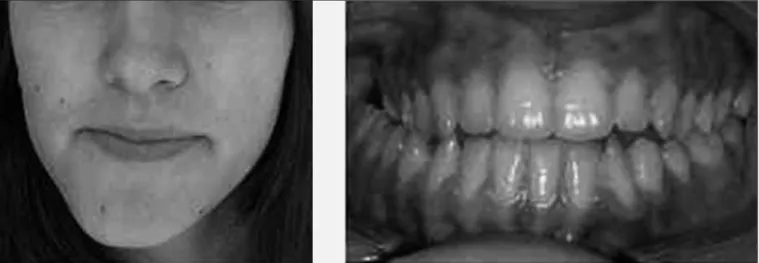
Female patient, 19 years old, Caucasian, looked for assistance of a Maxillofacial Surgeon due to facial asymmetry and pain in right temporomandibular joint. Patient had no medical, gesta-tional or family history of facial deformity, or history of previous joint trauma or infection. Clinically, patient presented right lat-erognathy, top to top in the incisive region, with molar relation-ship Class III to the left, right posterior crossbite and inferior dental midline deviation less than 4mm to the right and minimal inclination of maxillary occlusal plane to the left (Figures 1a and b). Mouth opening was 40mm, with 8mm of lateral movement to the right, 8mm to the left and 5mm protrusion.
Joint and muscle physical evaluation has shown pain at palpation of right TMJ lateral pole of 3 according to the visual analog scale (VAS) worsened by chewing and lack of joint noises. Panoramic
DISCUSSION
When mandibular condylar hyperplasia is suspected, initial clinical evaluation shall include documentation with extra and intraoral photographs, study models and some imaging exams, such as panoramic and face proile and frontal tele-radiography. Mandibular condyle growth activity should be evaluated by means of skeleton bone scintigraphy with SPECT of the head12,17.
A diference in activity above 10% between both mandibu-lar condyles18,19 is suggestive of active hyperplasia. If there is no active mandibular condylar growth, the case is treated as facial asymmetry, in general requiring orthodontic-surgical-orthodontic approach. If mandibular condylar hyperactivity is conirmed, the treatment varies. After six months to one year of clinical observation with serial comparison of study models, face photographs and X-rays, and depending on the mandibu-lar condymandibu-lar hyperactivity severity, maxillofacial surgeon may decide to follow up the case and repeat SPECT at six months, or perform condylectomy17. Condylectomy may be isolated17,20 or simultaneously associated to orthognatic surgery8,21.
Figures 1a and b. Right laterognathy, with ipsilateral posterior crossbite and mandibular dental midline deviation to the right
Figures 2a and b. Occlusion at the end of six months
Figure 3. Tridimensional reconstruction of left mandibular con-dyle on cone beam computed tomography, where surgery was performed
It is possible o observe remodeling and similarity with right, non--operated mandibular condyle, eight months after surgery.
Less recent studies suggested hypercorrection of mandibular lateral deviation estimating the excessive growth that would still happen in the hyperplastic mandibular condyle8 or wait for the end of the hyperplastic growth and then correct dento-facial deformity18,22. Condylectomy is currently considered a safe surgery and the only way to deinitely eliminate mandib-ular condylar growth center which is hyperactive12,23. It may be performed in early ages4,23,24, before the end of growth, because its advantage is, on the one side, spontaneous remod-eling of facial and condylar soft tissues24 and on the other, prevention of maxillary occlusal plane inclination. Mandibu-lar hypercorrection with orthognatic surgery is not recom-mended, because its results are unpredictable8.
Conversely, the option of waiting for the end of excessive mandibular growth, which will in general occur in the third decade of life, may bring severe functional, esthetic and psy-chosocial consequences, in addition to impairing the success of the orthodontic-surgical treatment2,12,23. After condylec-tomy, authors suggest repetition of scintigraphy within six months, as seen in our case report. In the lack of excessive uptake and clinical conirmation of end of growth, dento-facial deformity treatment should continue. In our case, notwithstanding left mandibular condylar uptake index be-ing within normal parameters, with the value of 1.18, there was still some uptake diference between both condyles, with more intensity to the left. A possible justiication would be a still active bone remodeling since surgery had been performed only six month ago. Studies with a large number of cases are needed to evaluate the ideal period to repeat postoperative SPECT to minimize false positive results due to bone remod-eling during this period.
Early identiication of active hyperplasia may allow for the resolution of the case just with condylectomy and orthodon-tics, avoiding posterior orthognatic surgery2,20,25. Condylec-tomy aims at removing joint cartilage responsible for active growth17. his cartilage is considered a center of craniofacial growth. In a normal mandibular condyle this growth is com-plete at approximately 20 years of age1. In 1977, histologi-cal constitution of the joint surface of mandibular condyle was described in four layers, with maximum total thickness of 0.48mm: ibrous joint layer, proliferative layer, transition layer and hypertrophic cartilage layer26. More recently, these four layers were called: articular zone, proliferative zone, i-brocartilaginous zone and calciied cartilage zone27.
The proliferative layer is responsible for hyperactive man-dibular condylar growth1,27. With regard to articular surface histology in mandibular condylar hyperplasia, there is no consensus in the literature. Several authors have observed the presence of a continuous layer of undifferentiated mes-enchymal germ cells2,28-30, chondrocyte islands in subcondral trabecular bone2,4,5,28-30, increased thickness of bone trabecu-lae and of different layers28-30, or just of the hypertrophic cartilage layer2,4,31. Slootweg and Muller have hystologically classified mandibular condylar hyperplasia in four types16, but their accurate reproduction in further studies was not always possible2.
While some authors suggest that hyperplasia severity and in-creased uptake in scintigraphy are directly related to inin-creased frequency and depth of penetration of chondrocyte islands in the subcondral bone28,29, others have not found diferences between cases and controls in the frequency and depth of penetration of chondrocyte islands in the subcondral bone31. No previous authors have found relationship between histo-logical indings and scintigraphic indings2,16.
his diference in results may be explained by the reduced number of cases involved in most studies, by the variability of mandibular condylar hyperplasia level and by limitations in imaging exams documentation. So, in the lack of scientiic evidence to support an ideal condylectomy depth, this varies from mandibular condyle osteoplasty (2-3mm)17-30, to high condylectomy (4-5mm)2,12,23,30,32,33 to low condylectomy (8-12mm)20,25,34. High condylectomy allows the removal of car-tilaginous surface and subcondral bone, eliminating growth center2. In recent studies, some authors have chosen to re-move excessive condylar height as compared to the healthy side, procedure they call proportional low condylectomy, which in some cases reaches almost 12mm.
An advantage of this procedure would be less need for pos-terior orthognatic surgery, being enough the orthodontic treatment with elastic traction to correct remaining occlusal changes20,25. A possible limitation of this technique is intra and interindividual variability in the measurement of the image of the length of normal and hyperplastic mandibular ramus. Authors favor condylectomy since it has more predict-able results. In our case, there was a considerpredict-able face asym-metry, with progressive worsening of occlusion. Patient was young, with good remodeling and adaptation potential and active hyperplasia. So, gathering all these factors, we decided for a 10mm condylectomy to even mandibular ramus height and center chin and mandibular incisive midline the most. Patient is still under orthodontic treatment to prepare for fu-ture orthognatic surgery or just mentoplasty. Literafu-ture points condylectomy as a safe surgery with minimal consequences for jaw function in the long run2,12,23,32,35. A study evaluating jaw function after such procedure has observed higher preva-lence of joint pain in operated patients. However, authors re-fer that this does not interre-fere with quality of life of patients and question whether it would be more associated to baseline joint disease than to the surgery32. Other authors have not observed any type of joint impairment2,12,35. A possible expla-nation would be the fact that superior articular compartment remains intact32. In our case, disappearance of right TMJ pain may have been due to decreased joint overload caused by con-tinuous and accelerated unilateral mandibular growth.
CONCLUSION
REFERENCES
1. Rushton MA. Unilateral hyperplasia of the mandibular condyle. Proc R Soc Med. 1946;39(7):431-8.
2. Villanueva-Alcojol L, Monje F, Gonzalez-Garcia R. Hyperplasia of the mandibular condyle: clinical, histopathologic, and treatment considerations in a series of 36 pa-tients. J Oral Maxillofac Surg. 2011;69(2):447-55.
3. Nitzan DW, Katsnelson A, Bermanis I, Brin I, Casap N. he clinical characteris-tics of condylar hyperplasia: experience with 61 patients. J Oral Maxillofac Surg. 2008;66(2):312-8.
4. Hampf G, Tasanen A, Nordling S. Surgery in mandibular condylar hyperplasia. J Maxillofac Surg. 1985;13(2):74-8.
5. Angiero F, Farronato G, Benedicenti S, Vinci R, Farronato D, Magistro S, et al. Man-dibular condylar hyperplasia: clinical, histopathological, and treatment considera-tions. Cranio. 2009;27(1):24-32.
6. Obwegeser HL, Makek MS. Hemimandibular hyperplasia--hemimandibular elonga-tion. J Maxillofac Surg. 1986;14(4):183-208.
7. Posnick JC. Asymmetric Mandibular Excess Growth Patterns. In: Duncan L, (editor). Orthognathic Surgery: Principles and Practice. Missouri: Elsevier; 2014. 807-65p. 8. Wolford LM. Morales-Ryan CA, García-Morales P, Perez D. Surgical management of
mandibular condylar hyperplasia type 1. Proc (Bayl Univ Med Cent). 2009;22(4):321-9. 9. Saridin CP, Raijmakers PG, Al Shamma S, Tuinzing DB, Becking AG. Comparison of
diferent analytical methods used for analyzing SPECT scans of patients with unilat-eral condylar hyperactivity. Int J Oral Maxillofac Surg. 2009;38(9):942-6. 10. Chan WL, Carolan MG, Fernandes VB, Abbati DP. Planar versus SPET imaging in
the assessment of condylar growth. Nucl Med Commun. 2000;21(3):285-90. 11. Hodder SC, Rees JI, Oliver TB, Facey PE, Sugar AW. SPECT bone scintigraphy in the
diagnosis and management of mandibular condylar hyperplasia. Br J Oral Maxillofac Surg. 2000;38(2):87-93.
12. Wolford LM, Mehra P, Reiche-Fischel O, Morales-Ryan CA, García-Morales P. Ef-icacy of high condylectomy for management of condylar hyperplasia. Am J Orthod Dentofacial Orthop. 2002;121(2):136-51.
13. Laverick S, Bounds G, Wong WL. [18F]-luoride positron emission tomography for imaging condylar hyperplasia. Br J Oral Maxillofac Surg. 2009;47(3):196-9. 14. Alyamani A, Abuzinada S. Management of patients with condylar hyperplasia: a
di-verse experience with 18 patients. Ann Maxillofac Surg. 2012;2(1):17-23. 15. Carlson CR, Bertrand PM, Ehrlich AD, Maxwell AW, Burton RG. Physical
self-reg-ulation training for the management of temporomandibular disorders. J Orofac Pain. 2001;15(1):47-55.
16. Slootweg PJ, Muller H. Condylar hyperplasia. A clinico-pathological analysis of 22 cases. J Maxillofac Surg. 1986;14(4):209-14.
17. Monje-Gil F. Hiperplasia de cóndilo mandibular. In: Rafael Gómez, editor. Diag-nóstico y tratamiento de la patología de la articulación temporomandibular: Madrid: Ripano; 2009. 611-35p.
18. Saridin CP, Raijmakers PG, Tuinzing DB, Becking AG. Bone scintigraphy as a
diag-nostic method in unilateral hyperactivity of the mandibular condyles: a review and meta-analysis of the literature. Int J Oral Maxillofac Surg. 2011;40(1):11-7. 19. Pogrel MA. Quantitative assessment of isotope activity in the temporomandibular
joint regions as a means of assessing unilateral condylar hypertrophy. Oral Surg Oral Med Oral Pathol. 1985;60(1):15-7.
20. Farina R, Pintor F, Perez J, Pantoja R, Berner D. Low condylectomy as the sole treat-ment for active condylar hyperplasia: facial, occlusal and skeletal changes. An observa-tional study. Int J Oral Maxillofac Surg. 2015;44(2):217-25.
21. Shefer MA, Corso A, Tomazi M, Bortoluzzi MC. Condylar hyperplasia treated by si-multaneous orthognathic surgery and high condylectomy: A case report. Rev Odonto Cienc. 2008;23(4):407-10.
22. Motamedi MH. Treatment of condylar hyperplasia of the mandible using unilateral ramus osteotomies. J Oral Maxillofac Surg. 1996;54(10):1161-9.
23. Brusati R, Pedrazzoli M, Colletti G. Functional results after condylectomy in active laterognathia. J Craniomaxillofac Surg. 2010;38(3):179-84.
24. Bertolini F, Bianchi B, De Riu G, Di Blasio A, Sesenna E. Hemimandibular hyperpla-sia treated by early high condylectomy: a case report. Int J Adult Orthodon Orthog-nath Surg. 2001;16(3):227-34.
25. Farina R, Olate S, Raposo A, Araya I, Alister JP, Uribe F. High condylectomy versus proportional condylectomy: is secondary orthognathic surgery necessary? Int J Oral Maxillofac Surg. 2016;45(1):72-7.
26. Hansson T, Oberg T, Carlsson GE, Kopp S. hickness of the soft tissue layers and the articular disk in the temporomandibular joint. Acta Odontol Scand. 1977;35(2):77-83. 27. Okeson JP. Functional Anatomy and Biomechanics of the Masticatory System. In:
Duncan L. (editor). Management of Temporomandibular Disorders and Occlusion. Missouri: Elsevier; 2012. 2-20p.
28. Gray RJ, Sloan P, Quayle AA, Carter DH. Histopathological and scintigraphic fea-tures of condylar hyperplasia. Int J Oral Maxillofac Surg. 1990;19(2):65-71. 29. Gray RJ, Horner K, Testa HJ, Lloyd JJ, Sloan P. Condylar hyperplasia: correlation of
histological and scintigraphic features. Dentomaxillofac Radiol. 1994;23(2):103-7. 30. Mehrotra D, Dhasmana S, Kamboj M, Gambhir G. Condylar hyperplasia and facial
asymmetry: report of ive cases. J Maxillofac Oral Surg. 2011;10(1):50-6.
31. Eslami B, Behnia H, Javadi H, Khiabani KS, Safar AS. Histopathologic comparison of normal and hyperplastic condyles. Oral Surg Oral Med Oral Pathol Oral Radiol Endod. 2003;96(6):711-7.
32. Saridin CP, Gilijamse M, Kuik DJ, te Veldhuis EC, Tuinzing DB, Lobbezoo F, et al. Evaluation of temporomandibular function after high partial condylectomy because of unilateral condylar hyperactivity. J Oral Maxillofac Surg. 2010;68(5):1094-9. 33. Jones RH, Tier GA. Correction of facial asymmetry as a result of unilateral condylar
hyperplasia. J Oral Maxillofac Surg. 2012;70(6):1413-25.
34. Delaire J. La place de la condylectomie dans le traitement des hypercondylies. Rev Stomatol Chir Maxillofac. 1983;84(1):11-8.