AR
TIGO ORIGINAL / ORIGINAL AR
TICLE
INTRODUCTION
Celiac disease (CD) is an autoimmune disorder triggered by intestinal exposure to gluten, a protein commonly found in wheat, barley and rye. Typi-cal manifestation of CD consists of early onset of malabsortion-related symptoms, while atypical forms of the disease are commonly diagnosed during adulthood and frequently related to extra-intestinal manifestations(8).
Several extra-intestinal features have been associ-ated with CD, such as metabolic osteopathy, anemia, and dermatitis herpetiformis(23). There has been evi-dence indicating a link between CD and reproductive disorders, such as recurrent abortions(3).
The relationship between CD and infertility has been previously assessed by several studies, with con-tradictory results(13, 20). Hence, we sought to perform a systematic review and meta-analysis of current evidence on this particular subject.
METHODS
Criteria for study inclusion
Meta-analysis was performed according to the
RISK OF INFERTILITY IN PATIENTS WITH
CELIAC DISEASE: a meta-analysis of
observational studies
Juan Sebastian
LASA
, Ignacio
ZUBIAURRE
and Luis Oscar
SOIFER
ABSTRACT – Context- Celiac disease is an autoimmune disorder of the small intestine associated with several extra-intestinal features,
such as reproductive disorders. The relationship between celiac disease and infertility has been previously assessed, with conlicting results. Objective - We seek to determine the relationship between celiac disease and infertility. Methods - Data was extracted from case-control or cohort design studies from 1966 to December 2013 using the MEDLINE-Pubmed, EMBASE, LILACS and Cochrane Library databases. We analyzed two kinds of trials: those assessing the risk of infertility in subjects with already diagnosed celiac disease, and those evaluating the prevalence of undiagnosed celiac disease in subjects with a diagnosis of infertility. Results - The search yielded 413 potentially relevant studies for revision, 12 of which were inally included for analysis. A signiicant association was found between women with a diagnosis of infertility and undiagnosed celiac disease [OR 3.09 (95% CI 1.74-5.49)]. When considering those studies assessing the occurrence of infertility in subjects with already-diagnosed celiac disease, no difference was found between celiac disease patients and control subjects [OR 0.99 (0.86-1.13)]. Conclusion - Undiagnosed celiac disease is a risk factor for infertility. Women seeking medical advice for this particular condition should be screened for celiac disease. Adoption of a gluten-free diet could have a positive impact on fertility in this group of patients.
HEADINGS - Celiac disease. Infertility female. Diet gluten-free.
Declared conflict of interest of all authors: none
Gastroenterology Division, Internal Medicine Department. Centro de Educación Médica e Investigación Clínica - CEMIC, Buenos Aires, Argentina Correspondence: Juan Sebastian Lasa. 1958 Austria St. Buenos Aires, Argentina - ZIP Code 1425. Email: [email protected]
recommendations of the Meta-analysis of Observa-tional Studies in Epidemiology (MOOSE) Group(28). Controlled studies with case-control or cohort study designs were considered for review. Uncontrolled ob-servational studies and case series were excluded. Two kinds of studies were analyzed in-depth: those assess-ing the risk of infertility in subjects with previously diagnosed CD, and those evaluating the prevalence of undiagnosed CD in subjects already diagnosed with infertility.
Search strategy
A computer-assisted search was performed from 1966 to December 2013 in the MEDLINE-Pubmed, EMBASE, LILACS and Cochrane Library databas-es. The search strategy consisted of the MESH terms “celiac disease” or “celiac sprue” and “infertility” or “genital diseases, female” or “sterility”. There was no language restriction. We reviewed the bibliography of identiied relevant papers. Additionally, abstracts from Digestive Disease Week and United European Gastroenterology Week 2008-2013 were manually reviewed.
Compatible abstracts were reviewed to check compliance with eligibility criteria. The indings of each author were then compared. If there was disagreement towards a par-ticular study, its inclusion was decided by a third author. If there was evidence of duplicated data, original papers’ authors were contacted in order to determine study inclu-sion or excluinclu-sion.
Quality assessment
Methodological quality of included studies was evalu-ated by two authors in an independent manner using the Newcastle-Ottawa assessment scale for case-control and cohort studies(27). If disagreement on a particular subject was encountered, a third author resolved the difference.
Statistical analysis
Meta-analysis was performed using REVMAN software (Review Manager Version 5.1. Copenhagen: The Nordic Cochrane Center, The Cochrane Collaboration, 2011). Heterogeneity was evaluated using the I2 and chi square test. Because of anticipated variability in patient popula-tion and study design, a random-effect model was used. The irst analysis included studies assessing the occurrence of non-diagnosed CD in patients suffering from infertility; the outcome was described as an Odds Ratio (OR) with a 95% conidence interval (95% CI). In a second analysis, we included studies evaluating the odds of infertility in patients previously diagnosed with CD. We also used an OR with a 95% CI in order to describe the latter. Sensitiv-ity analysis was performed according to heterogeneSensitiv-ity or if signiicant methodological quality differences were found. Funnel plots were performed in order to assess potential publication bias.
RESULTS
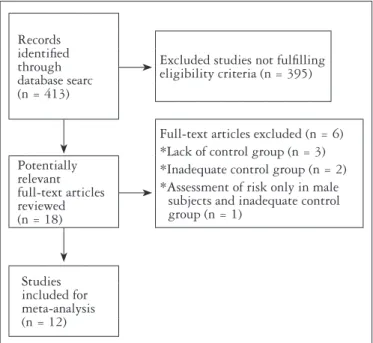
The search identiied 413 bibliographic citations. Of these, 395 were excluded, and eighteen potentially relevant studies were evaluated. Six studies were excluded because they did not fulilled elegibility criteria: three studies lacked a control group(5, 13, 17), a large population-based study(9) was not designed to compare infertility prevalence in celiac subjects and used U.S. general population as a control group; another study(20) used an inadequate control group (previously known prevalence of silent CD in the northen Sardinian population) and another one(7) assessed the risk of infertility only in male subjects and used Crohn’s disease patients as control group. Finally, as shown in Figure 1, twelve studies were included for analysis. Two of the ana-lyzed studies were population-based cohort studies (Zugna 2010 and Tata 2005) which evaluated the risk of infertility in a CD population(29, 31). Two other studies (Molteni 1990 and Sher 1994) were case-control studies evaluating the odds of infertility in a CD group compared to a non-celiac control group(21, 25). Finally, eight studies (Collin 1996, Kohlo 1999, Shamaly 2004, de Silva Martins 2006, Tiboni 2006, Kumar 2010, Khoshbaten 2011, Hogen Esch 2011)
assessed the occurrence of non-diagnosed CD in subjects suffering from infertility compared to apparently healthy controls(4, 6, 12, 14, 15, 16, 24, 30). Two studies included data on male partners also evaluated for non-diagnosed CD versus controls (Khoshbaten 2011, Hogen Esch 2011).
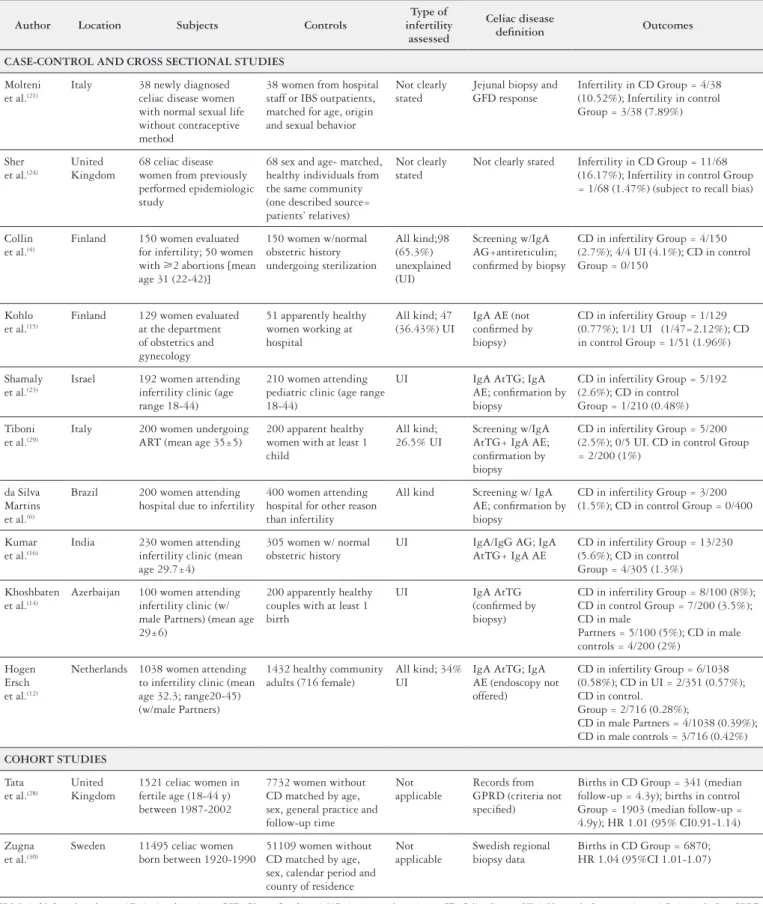
Characteristics of included studies are summarized in Table 1. Infertility was assessed in a similar fashion in most studies; however, this was not clearly stated in the studies by Moltoni et al., Sher et al., Zugna et al. and Tata et al. Three studies (Shamaly 2004, Kumar 2010 and Khoshbaten 2011) evaluated patients with unexplained infertility (UI) only.
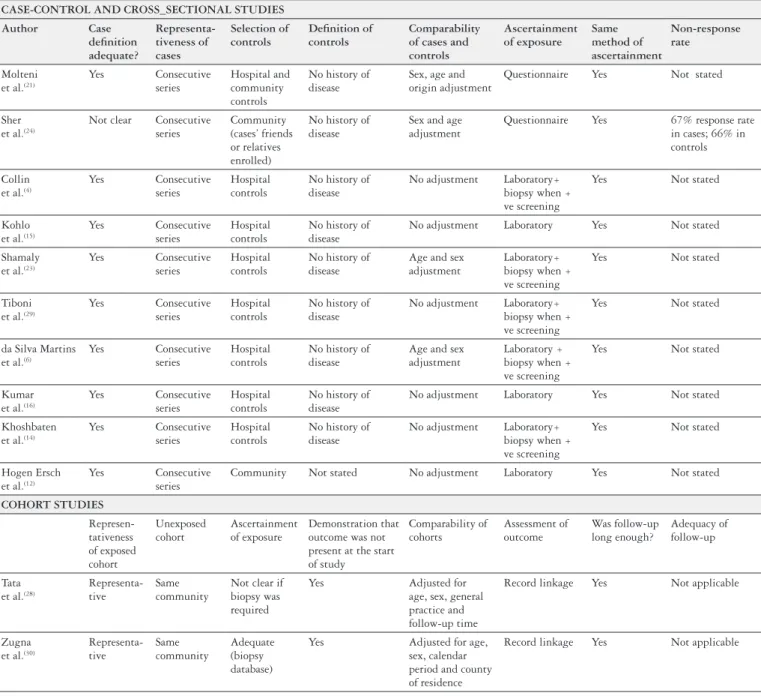
Methodological assessment of included studies is des-cribed in Table 2. No study was excluded due to metho-dological limitations.
Non-diagnosed celiac disease in subjects with infertility
Meta-analytical indings of the irst condition are des-cribed in Table 3. Overall, 4471 subjects were included in this analysis. No heterogeneity was observed (I2 0%; P 0.67), and a signiicant association was found between women with a diagnosis of infertility and CD [OR 3.09 (95% CI 1.74-5.49)]. Sensitivity analysis was also performed; studies assessing all kinds of infertility (not only UI) were also excluded. No relevant differences were found as a result [OR3.41 (1.65-7.03)]. Further sensitivity analysis was carried out by excluding studies that did not use anti-transglutaminase and/or anti-endomysium antibodies for initial CD screening (Collin 1996); again, no signiicant difference was found in the result [OR 2.95 (1.64-5.31)].
Meta-analysis of studies which evaluated CD in male partners versus control subjects included 2054 patients and
Records identiied through database searc (n = 413)
Excluded studies not fulilling eligibility criteria (n = 395)
Full-text articles excluded (n = 6) *Lack of control group (n = 3) *Inadequate control group (n = 2) *Assessment of risk only in male
subjects and inadequate control group (n = 1)
Potentially relevant full-text articles reviewed (n = 18)
Studies included for meta-analysis (n = 12)
TABLE 1. Characteristics of included studies
Author Location Subjects Controls
Type of infertility
assessed
Celiac disease
deinition Outcomes
CASE-CONTROL AND CROSS SECTIONAL STUDIES
Molteni
et al.(21)
Italy 38 newly diagnosed
celiac disease women with normal sexual life without contraceptive method
38 women from hospital staff or IBS outpatients, matched for age, origin and sexual behavior
Not clearly stated
Jejunal biopsy and GFD response
Infertility in CD Group = 4/38 (10.52%); Infertility in control Group = 3/38 (7.89%) Sher
et al.(24)
United Kingdom
68 celiac disease women from previously performed epidemiologic study
68 sex and age- matched, healthy individuals from the same community (one described source= patients’ relatives)
Not clearly stated
Not clearly stated Infertility in CD Group = 11/68
(16.17%); Infertility in control Group = 1/68 (1.47%) (subject to recall bias) Collin
et al.(4)
Finland 150 women evaluated
for infertility; 50 women
with 2 abortions [mean
age 31 (22-42)]
150 women w/normal obstetric history undergoing sterilization All kind;98 (65.3%) unexplained (UI) Screening w/IgA AG+antireticulin; conirmed by biopsy
CD in infertility Group = 4/150 (2.7%); 4/4 UI (4.1%); CD in control Group = 0/150
Kohlo
et al.(15)
Finland 129 women evaluated
at the department of obstetrics and gynecology
51 apparently healthy women working at hospital
All kind; 47 (36.43%) UI
IgA AE (not conirmed by biopsy)
CD in infertility Group = 1/129 (0.77%); 1/1 UI (1/47=2.12%); CD in control Group = 1/51 (1.96%) Shamaly
et al.(23)
Israel 192 women attending
infertility clinic (age range 18-44)
210 women attending pediatric clinic (age range 18-44)
UI IgA AtTG; IgA
AE; conirmation by biopsy
CD in infertility Group = 5/192 (2.6%); CD in control Group = 1/210 (0.48%) Tiboni
et al.(29)
Italy 200 women undergoing
ART (mean age 35±5)
200 apparent healthy women with at least 1 child
All kind; 26.5% UI
Screening w/IgA AtTG+ IgA AE; conirmation by biopsy
CD in infertility Group = 5/200 (2.5%); 0/5 UI. CD in control Group = 2/200 (1%)
da Silva Martins
et al.(6)
Brazil 200 women attending
hospital due to infertility
400 women attending hospital for other reason than infertility
All kind Screening w/ IgA
AE; conirmation by biopsy
CD in infertility Group = 3/200 (1.5%); CD in control Group = 0/400 Kumar
et al.(16)
India 230 women attending
infertility clinic (mean age 29.7±4)
305 women w/ normal obstetric history
UI IgA/IgG AG; IgA
AtTG+ IgA AE
CD in infertility Group = 13/230 (5.6%); CD in control
Group = 4/305 (1.3%) Khoshbaten
et al.(14)
Azerbaijan 100 women attending
infertility clinic (w/ male Partners) (mean age 29±6)
200 apparently healthy couples with at least 1 birth
UI IgA AtTG
(conirmed by biopsy)
CD in infertility Group = 8/100 (8%); CD in control Group = 7/200 (3.5%); CD in male
Partners = 5/100 (5%); CD in male controls = 4/200 (2%)
Hogen Ersch
et al.(12)
Netherlands 1038 women attending
to infertility clinic (mean age 32.3; range20-45) (w/male Partners)
1432 healthy community adults (716 female)
All kind; 34% UI
IgA AtTG; IgA AE (endoscopy not offered)
CD in infertility Group = 6/1038 (0.58%); CD in UI = 2/351 (0.57%); CD in control.
Group = 2/716 (0.28%);
CD in male Partners = 4/1038 (0.39%); CD in male controls = 3/716 (0.42%)
COHORT STUDIES
Tata
et al.(28)
United Kingdom
1521 celiac women in fertile age (18-44 y) between 1987-2002
7732 women without CD matched by age, sex, general practice and follow-up time
Not applicable
Records from GPRD (criteria not speciied)
Births in CD Group = 341 (median follow-up = 4.3y); births in control Group = 1903 (median follow-up = 4.9y); HR 1.01 (95% CI0.91-1.14) Zugna
et al.(30)
Sweden 11495 celiac women
born between 1920-1990
51109 women without CD matched by age, sex, calendar period and county of residence
Not applicable
Swedish regional biopsy data
Births in CD Group = 6870; HR 1.04 (95%CI 1.01-1.07)
TABLE 2. Methodological characteristics of included studies
CASE-CONTROL AND CROSS_SECTIONAL STUDIES
Author Case deinition adequate? Representa-tiveness of cases Selection of controls Deinition of controls Comparability of cases and controls Ascertainment of exposure Same method of ascertainment Non-response rate Molteni
et al.(21)
Yes Consecutive
series
Hospital and community controls
No history of disease
Sex, age and origin adjustment
Questionnaire Yes Not stated
Sher
et al.(24)
Not clear Consecutive
series
Community (cases’ friends or relatives enrolled)
No history of disease
Sex and age adjustment
Questionnaire Yes 67% response rate
in cases; 66% in controls Collin
et al.(4)
Yes Consecutive
series
Hospital controls
No history of disease
No adjustment Laboratory+
biopsy when + ve screening
Yes Not stated
Kohlo
et al.(15)
Yes Consecutive
series
Hospital controls
No history of disease
No adjustment Laboratory Yes Not stated
Shamaly
et al.(23)
Yes Consecutive
series
Hospital controls
No history of disease
Age and sex adjustment
Laboratory+ biopsy when + ve screening
Yes Not stated
Tiboni
et al.(29)
Yes Consecutive
series
Hospital controls
No history of disease
No adjustment Laboratory+
biopsy when + ve screening
Yes Not stated
da Silva Martins
et al.(6)
Yes Consecutive
series
Hospital controls
No history of disease
Age and sex adjustment
Laboratory + biopsy when + ve screening
Yes Not stated
Kumar
et al.(16)
Yes Consecutive
series
Hospital controls
No history of disease
No adjustment Laboratory Yes Not stated
Khoshbaten
et al.(14)
Yes Consecutive
series
Hospital controls
No history of disease
No adjustment Laboratory+
biopsy when + ve screening
Yes Not stated
Hogen Ersch
et al.(12)
Yes Consecutive
series
Community Not stated No adjustment Laboratory Yes Not stated
COHORT STUDIES Represen-tativeness of exposed cohort Unexposed cohort Ascertainment of exposure Demonstration that outcome was not present at the start of study Comparability of cohorts Assessment of outcome Was follow-up long enough? Adequacy of follow-up Tata
et al.(28)
Representa-tive
Same community
Not clear if biopsy was required
Yes Adjusted for
age, sex, general practice and follow-up time
Record linkage Yes Not applicable
Zugna
et al.(30)
Representa-tive Same community Adequate (biopsy database)
Yes Adjusted for age,
sex, calendar period and county of residence
Record linkage Yes Not applicable
TABLE 3. Meta-analysis of case-control studies assessing frequency of undiagnosed celiac disease in infertility patients
Infertility Control Odds Ratio Odds Ratio
Study or Subgroup Events Total Events Total Weight M-H, Random, 95% CI Year M-H, Random, 95% CI
Collin et al.(4) 4 150 0 150 3.9% 9.25 [0.49, 173.25] 1996
Kohlo et al.(15) 1 129 1 51 4.2% 0.39 [0.02, 6.37] 1999
Shamaly et al.(23) 5 192 1 210 7.1% 5.59 [0.65, 48.27] 2004
da Silva Martins et al.(6) 3 200 0 400 3.8% 14.19 [0.73, 276.16] 2006
Tiboni et al.(29) 5 200 2 200 12.1% 2.54 [0.49, 13.24] 2006
Kumar et al.(16) 13 230 4 305 25.7% 4.51 [1.45, 14.01] 2010
Hogen Esch et al.(12) 6 1038 2 716 12.9% 2.08 [0.42, 10.31] 2011
Khoshbaten et al.(14) 8 100 7 200 30.3% 2.40 [0.84, 6.81] 2011
Total (95% CI) 2239 2232 100.0% 3.09 [1.74, 5.49]
Total events 45 17
Heterogeneity: Tau2 = 0.00; Chi2 = 4.95, df = 7 (P = 0.67); I2 = 0%
Test for overall effect: Z = 3.84 (P = 0.0001)
TABLE 4. Meta-analysis of case-control studies assessing frequency of undiagnosed celiac disease in the male partners of infertility patients
Infertility Control Odds Ratio Odds Ratio
Study or Subgroup Events Total Events Total Weight M-H, Random, 95% CI Year M-H, Random, 95% CI
Hogen Esch et al.(12) 4 1038 3 716 44.4% 0.92 [0.21, 4.12] 2011
Khoshbaten et al.(14) 5 100 4 200 55.6% 2.58 [0.68, 9.82] 2011
Total (95% CI) 1138 915 100.0% 1.63 [0.60, 4.46]
Total events 9 7
Heterogeneity: Tau2 = 0.01; Chi2 = 1.01, df = 1 (P = 0.31); I2 = 1%
Test for overall effect: Z = 0.96 (P = 0.34) 0.001 0.1 Infertility Control1 10 100
TABLE 5. Meta-analysis of case-control studies assessing frequency of undiagnosed celiac disease in infertility patients
Celiac Disease Control Odds Ratio Odds Ratio
Study or Subgroup Events Total Events Total Weight M-H, Random, 95% CI Year M-H, Random, 95% CI
Molteni et al.(21) 4 38 3 38 0.8% 1.37 [029, 6.59] 1990
Sher et al.(24) 11 68 1 68 0.4% 12.93 [1.62, 103.22] 1994
Tata et al.(28) 1001 1521 5124 7732 44.0% 0.98 [0.87, 1.10] 2005
Zugna et al.(30) 1296 4466 5842 19705 54.8% 0.97 [0.90, 1.04] 2010
Total (95% CI) 6093 27543 100.0% 0.99 [0.86, 1.13]
Total events 45 17
Heterogeneity: Tau2 = 0.01; Chi2 = 6.16, df = 3 (P = 0.10); I2 = 51%
Test for overall effect: Z = 0.17 (P = 0.86)
0.01 0.1 1 10 100
Favours Control Favours Celiac Disease
did not show a signiicant association [OR 1.63 (95% CI 0.6-4.46)], as described in Table 4. Figure 2A shows the funnel plot of included studies mentioned above, with no signiicant asymmetry (Egger test, P = 0.3).
Infertility in subjects with diagnosed celiac disease
When considering studies assessing the occurrence of in-fertility in subjects with CD, 33636 subjects were included for analysis. No difference was found between CD patients and control subjects [OR 0.99 (95% CI 0.86-1.13)], as described in Table 5. Signiicant heterogeneity was corrected by the ex-clusion of one of the studies (Sher 1994), which did not alter the result of the analysis [OR 0.97 (0.92-1.03)]. Figure 2B shows funnel plot of these studies, with an asymmetry that could be related to a publication bias (Egger test, P<0.001).
DISCUSSION
Our meta-analysis evaluates the association between a frequent reproductive disorder such as infertility and CD.
According to our results, non-diagnosed untreated CD con-stitutes a risk factor signiicantly associated with infertility in women. When comparing studies that enrolled patients previously diagnosed with CD, this association is not as evident as in the former context. This could be related to the effect that adoption of a gluten-free diet (GFD) may have on this particular health issue.
The association between CD and female reproductive disorders has been previously described(3). It is well known that CD increases the risk of recurrent miscarriages, low weight at birth, early menopause and other pregnancy dis-orders(10, 11, 18, 19, 26). It is also known that these kinds of com-plications appear to diminish once a GFD is implemented. Infertility is deined as the impossibility of conceiving after 12 months of unprotected intercourse(1). It can be related to both male and female factors, with the latter subdivided into ovarian, tubal, endometrial or unexplained causes. It is relatively frequent, with approximately 8%-12% of couples with women at child-bearing age carrying this condition(2).
FIGURE 2. Funnel plot assessing for publication bias among (A) studies assessing undiagnosed celiac disease risk in patients with infertility. (B) studies assessing risk of infertility in already-diagnosed celiac disease
Reports on infertility risk in CD patients are far from scarce, but often show non-deinite, sometimes conlicting results. Jackson et al.(13) described a cohort of women suf-fering from infertility that were tested for CD by means of serology. This study found a relatively low frequency of CD among infertile women compared to the background rate in the general U.S. population. Choi et al.(5) tested women as-sisting at an infertility clinic for CD; although an increased prevalence overall was not found, CD was more frequent in those women with UI; again, this study lacked a control group.
Case-control and cross-sectional studies assessing the risk of CD in infertile patients also show conlicting results. The largest study published by Hogen Esch et al.(12) included 1038 patients attending to an infertility clinic and 1432 controls. They did not ind a signiicant difference in CD prevalence between groups; it is worth mentioning though that they only performed serological tests to determine CD prevalence. Da Silva Martins et al.(6) published the only experience so far in a South-American setting: they included 200 patients attending an infertility clinic and 400 control subjects. They also were not able to ind a signiicant CD prevalence among infertile women.
Only the study by Kumar et al.(16) proved a signiicant association between CD and infertility. The other studies included in this analysis did not reach a statistically relevant difference, probably due to insuficient sample size. However, as revealed in our meta-analysis, the pooled OR is signii-cantly increased.
These results contrast with those derived from cohort and case-control studies including previously diagnosed CD subjects. Tata et al.(29) published a large cohort study that assessed 1521 CD women in fertile age and 7732 non-CD women matched by age, sex, general practice and follow-up time. They found that the birth rates in both groups with a similar median follow-up time (4.3 vs 4.9 years) were similar (HR 1.01 95%CI 0.91-1.14). What is more, Zugna et al.(31) published an even larger cohort study including 11495 women with CD and 51109 controls: they also did not ind en excessive risk of infertility in the CD cohort. These results contrast with those from studies that included non-diagnosed CD. A potential explanation for this difference may be that in the cohort studies, CD patients were already treated: this may underline that GFD may cause a reversal of infertility
problems in celiac women. Cohort studies including already-diagnosed CD women did not assess GFD compliance, so it is not possible to conclude that gluten ingestion may actu-ally be a risk factor for developing infertility in CD subjects. However, Zugna et al.(31) found that although women with CD had normal fertility overall, fertility levels decreased in the last two years preceding CD diagnosis. This emphasizes the fact that untreated CD is a risk factor for infertility and that GFD may be suficient to correct this abnormality.
There is no clear explanation why these two entities are associated. CD is associated with many extra-intestinal diseases that have an immunological basis. Persistent inlam-mation can produce some serological markers that may have an impact in the development of infertility(22). As seen with other extra-intestinal diseases, early introduction of a GFD may decrease the risk of this complication. Further studies should focus on this particular subject.
Although evidence is relatively scarce, studies evaluating male partners failed to show a signiicant association between infertility and CD. However, these studies do not mention a relationship between CD and certain factors related to male infertility, such as hypogonadism or semen quality deicien-cies. Farthing et al.(7) described a high frequency of seminal alterations and sexual dysfunction in a cohort of CD male patients compared to Crohn’s disease subjects.
Limitations must be taken into consideration. Among all of the studies analyzed, heterogeneity in CD deinition and serological tests used for screening were found. Most of them, however, required histological conirmation. Secondly, the impact that GFD may exert cannot be estimated due to the design of included studies. Furthermore, the impact of poor adherence to GFD cannot be calculated from available evidence. Although funnel plot analysis doesn’t suggest a signiicant publication bias when considering studies assess-ing CD risk in subjects with infertility, there is a signiicant asymmetry in the funnel plot of studies assessing risk of infertility in already-diagnosed CD patients.
REFERENCES
1. Balen AH, Rutherford AJ. Management of infertility. BMJ 2007;335:608-11. 2. Boiving J, Bunting L, Collins JA, Nygren KG. International estimates of infertility
prevalence and treatment seeking: potential need and demandfor infertility medical care. Hum Reprod. 2007;22:1506-12.
3. Ciacci C, Cirillo M, Auriemma G, Di Dato G, Sabatini F, Mazzacca G. Celiac disease and pregnancy outcome. Am J Gastroenterol. 1996;91:718-22. 4. Collin P, Vilska S, Heinonen PK, Hallstrom O, Pikkarainen P. Infertility and
coeliac disease. Gut. 1996;39:382-4.
5. Choi JM, Lebwohl B, Wang J, Lee SK, Murray JA, Sauer MV, Green PH. Increased prevalence of celiac diseasein patients with unexplained infertility in the United States: a prospective study. J Reprod Med. 2011;56:199-203.
6. Da Silva Martins CL, Gandoli L, Tauil PL, de Almeida Rocha Picanco M, Gal-vao de Araujo MO, Pratesi R. Celiac disease and female infertility: a frequently neglected association. Rev Bras Ginecol Obstet. 2006;28:601-6.
7. Farthing MJG, Edwards CRW, Rees LH, Dawson AM: Male gonadal function in coeliac disease: sexual dysfunction, infertility and semen quality. Gut 1982; 23: 608-614.
8. Fasano A, Catassi C. Clinical practice. Celiac disease. N Engl J Med. 2012; 367:2419-26.
9. Fasano A, Berti I, Gerarduzzi T, Not T, Colletti RB, Drago S, et al. Prevalence of celiac diseasein at-risk and not-at-risk groups in the United States. Arch Intern Med. 2003;163:286-92.
10. Gasbarrini A, Torre ES, Trivellini C, De Carolis S, Caruso A, Gasbarrini G. Recurrent spontaneous abortionand intrauterine fetal growth retardation as symptoms of coeliac disease. Lancet. 2000;356:399-400.
11. Greco L, Veneziano A, Di Donato L, Zampella C, Pecoraro M, Paladini D, et al. Undiagnosed coeliac disease does not appear to be associated with unfavourable outcome of pregnancy. Gut. 2004;53:149-51.
12. Hogen Esch CE, Van Rijssen MJL, Roos A, Koning F, Dekker FW, Mearin ML, et al. Screening for unrecognized coeliac disease in subfertile couples. Scand J Gastroenterol. 2011;46:1423-8.
13. Jackson JE, Rosen M, Mc Lean T, Moro J, Croughan M, Cedars MI. Prevalence of celiac disease in a cohort of women with unexplained infertility. Fertil Steril. 2008;89:1002-4.
14. Khoshbaten M, Nejad MR, Farzady L, Sharii N, Hashemi SH, Rostami K. Fertility disorder associated with celiac disease in males and females: fact or iction? J Obstet Gynael Res. 2011;37:1308-12.
15. Kolho KL, Tiitinen A, Tulppala M, Unkila-Kallio L, Savilahti E. Screening for coeliac disease in women with a history of recurrent miscarriage or infertility. Br J Obst Gynaecol. 1999;106:171-3.
16. Kumar A, Meena M, Begum N, Kumar N, Gupta RK, Agarwal S, et al. Latent celiac disease in reproductive perfomance of women. Fertil Steril. 2011;95:922-7. 17. Machado AP, Silva LR, Zausner B, Oliveira J de A, Diniz DR, de Oliveira J.
Undiagnosed celiac disease in women with infertility. J Reprod Med. 2013;58:61-6. 18. Martinelli D, Fortunato F, Tafuri S, Germinario CA, Prato R. Reproductive life disorders in italian celiac women. A case-control study. BMC Gastroenterology. 2010;10:89.
19. Martinelli P, Troncone R, Paparo F, Torre P, Trapanese E, Fasano C, et al. Coeliac disease and unfavourable outcome of pregnancy. Gut. 2000;46:332-5. 20. Meloni GF, Dessole S, Vargiu N, Tomasi PA, Musumeci S. The prevalence of
coeliac disease in infertility. Hum Reprod. 1999;14:2759-61.
21. Molteni N, Bardella MT, Bianchi PA. Obstetric and gynecological problems in women with untreated celiac sprue. J Clin Gastroenterol. 1990;12:37-9. 22. Östensson M, Montén C, Bacelis J, Gudjonsdottir AH, Adamovic S, Ek J, et al.
Presentation of celiac disease. Gastrointest Endosc Clin N Am. 2012;22:613-21. 23. Reilly NR, Fasano A, Green PH. Presentation of celiac disease. Gastrointest
Endosc Clin N Am. 2012;22:613-21.
24. Shamaly H, Mahameed A, Sharony A, Shamir R. Infertility and celiac disease: do we need more than one serological marker? Acta Obstet Gynecol Scand. 2004;83:1184-8.
25. Sher KS, Mayberry JF. Female fertility, obstetric and gynaecological history in coeliac disease. Digestion. 1994;55:243-6.
26. Smecuol E, Mauriño E, Vazquez H, Pedreira S, Niveloni S, Mazure R, et al. Gynaecological and obstetric disorders in coeliac disease: frequent clinical onset during pregnancy or the puerperium. Eur J Gastroenterol Hepatol. 1996;8:63-89. 27. Stang A: Critical evaluation of the Newcastle-Ottawa scale for the assessment
of the quality of nonrandomized studies in meta-analyses. Eur J Epidemiol. 2010;25:603-5.
28. Stroup DF, Berlin JA, Morton SC, Olkin I, Williamson GD, Rennie D, et al. Meta-analysis of observational studies in epidemiology: a proposal for reporting. JAMA. 2000;283:2008-12.
29. Tata LJ, Card TR, Logan RFA, Hubbard RB, Smith CJP, West J. Fertility and pregnancy-related events in women with celiac disease: a population-based cohort study. Gastroenterology. 2005;128:849-55.
30. Tiboni GM, de Vita MG, Faricelli R, Giampietro F, Liberati M. Serological testing for celiac diseasein women undergoingassisted reproduction techniques. Hum Reprod. 2006;21:376-9.
31. Zugna D, Richiardi L, Akre O, Stephansson O, Ludvigsson JF. A nationwide population-based to determine whether coeliac disease is associated with infertility. Gut. 2010;59:1471-5.
Received 8/1/2014. Accepted 3/2/2014. Lasa JS, Zubiaurre I, Soifer LO. Risco de infertilidade em pacientes com doença celíaca: uma meta-análise de estudos observacionais. Arq Gastroenterol.
2014,51(2):144-50.
RESUMO - Contexto - A doença celíaca é uma doença auto imune do intestino delgado associada a manifestações extra-intestinais, tais como distúr-bios reprodutivos. A relação entre a doença celíaca e a infertilidade foi previamente avaliada, com resultados conlitantes. Objetivos - Procuramos determinar a relação entre a doença celíaca e a infertilidade. Método - Utilizou-se dados extraídos de estudos de projeto de caso-controle ou coorte de 1966 à dezembro de 2013 utilizando o MEDLINE-Pubmed, EMBASE, LILACS e Cochrane Library. Foram analisados dois tipos de ensaios: os que avaliam o risco de infertilidade em pacientes com doença celíaca já diagnosticados e, os que avaliam a prevalência da doença celíaca não diag-nosticada em indivíduos com diagnóstico de infertilidade. Resultados - A busca resultou em 413 estudos potencialmente relevantes para a revisão, 12 dos quais foram inalmente incluídos para análise. Foi encontrada uma associação signiicativa entre as mulheres com diagnóstico de infertilidade e doença celíaca não diagnosticada [TR 3,09 (IC 95% 1,74-5,49)]. Ao considerar esses estudos avaliando a ocorrência de infertilidade em pacientes com doença celíaca já diagnosticada, não foi encontrada diferença entre os pacientes com doença celíaca e controles [TR 0,99 (0,86-1,13)]. Conclusão – A falta de diagnóstico para a doença celíaca é um fator de risco para a infertilidade. As mulheres que procuram o conselho médico para esta condição particular, devem ser examinados para a doença celíaca. A adoção de uma dieta sem glúten pode ter um impacto positivo sobre a fertilidade neste grupo de pacientes.