Incentive Spirometry with Expiratory Positive Airway Pressure Brings
Benefits after Myocardial Revascularization
Glória Menz Ferreira
1, Mauren Porto Haeffner
1, Sérgio Saldanha Menna Barreto
1, Pedro Dall’Ago
2 HCPA/UFRGS1; UFCSPA2, Porto Alegre, RS - BrazilAbstract
Background: Patients submitted to coronary artery bypass graft (CABG) surgery present higher risk to develop pulmonary complications, such as atelectasia, pneumonia and pleural effusion. These complications may increase the time of hospitalization as well as the necessity of financial resources, and are also associated with the reduction of life quality and long-term functional capacity.
Objective: To test whether the use of incentive spirometry (IS) in association with expiratory positive airway pressure (EPAP) in the airway via after CABG improves not only dyspnea, but also the sensation of effort perceived and the quality of life within the 18 months after the intervention.
Methods: Sixteen patients submitted to CABG were randomized to control group (n=8) or to IS+EPAP (n=8). The protocol IS+EPAP was carried out in the immediate postoperative period and during four more weeks in domicile. Eighteen months after CABG, the muscle respiratory strength, the functional capacity, the pulmonary function, the quality of life and the physical activity levels were assessed.
Results: After the 6-minute walk test (6MWT), the score for dyspnea (1.6±0.6 versus 0.6±0.3, p<0.05) and the effort sensation (13.4±1.2 versus 9.1±0.7, p<0.05) were higher in control group in comparison to IS+EPAP group. In the assessment of life quality, the issues related to physical limitations was better in the IS+EPAP group (93.7±4.1 versus 50±17, p<0.02).
Conclusion: Patients who were submitted to IS + EPAP presented less dyspnea and lower sensation of effort after 6MWT, as well as improvement in life quality 18 months after CABG. (Arq Bras Cardiol 2010;94(2): 230-235)
Key words: Thoracic surgery; respiratory physical therapy; motor activity; quality of life.
Mailing address: Pedro Dall’Ago •
Rua Casemiro de Abreu, 219/403 - Rio Branco - 90420-001 - Porto Alegre, RS - Brazil
E-mail: [email protected], [email protected]
Manuscript received December 30, 2008; revised manuscript received July 30, 2009; accepted August 21, 2009.
Introduction
The coronary artery bypass graft (CABG) surgery is the routine procedure for the treatment of patients who present symptoms of myocardial ischemia. Annually, about 1 million of surgeries are carried out in the world1. The patients who are
submitted to CABG present a relatively high risk of developing pulmonary complications (PC), such as atelectasias, pneumonia and pleural effusion. These complications enlarge the time of hospitalization and the necessity of financial resources2. Age
superior to 70 years old, productive cough, diabetes mellitus, smoking history, chronic obstructive pulmonary disease, obesity and previous reduction of pulmonary function are considered as risk factors for the development of postoperative PC3. Likewise, transoperatory factors, such as general
anesthesia, pulmonary modifications after extracorporeal
circulation (ECC), utilization of internal mammary artery as well as postoperative pain, are factors that contribute with the occurrence of PC4-8. Follow-up studies on pulmonary function
and capacity after cardiac surgeries demonstrated that the volumes did not recover the preoperative values eight weeks after the surgery9. The pulmonary function remains 25 to 30%
lower even 3.5 months after surgery10,11.
Among the strategies that might be used to minimize PC, respiratory physiotherapy is widely used for prevention and treatment of these complications. Two commonly used resources of respiratory physiotherapy are the incentive spirometry (IS) and the expiratory positive airway pressure (EPAP), which have the main physiological effect of promoting pulmonary reexpansion. Recently, it was demonstrated that the addition use of IS and EPAP in patients who went through CABG is capable of reducing the loss of pulmonary function, of respiratory muscle strength and of functional capacity 30 days after the surgery12. However, there are no studies available on
the assessment of long-term effects of IS+EPAP yet.
perceived effort sensation as well as the patient’s life quality 18 months after CABG.
Methods
Participants
This is a prospective and transversal study carried out with patients from Hospital das Clínicas de Porto Alegre (HCPA), who participated in a protocol that utilized IS+EPAP in the immediate postoperative period of CABG and during four more weeks at home.
Patients older than 50 years old, smoking history and/ or chronic obstructive pulmonary disease (COPD) and utilization of mammary graft were included in the study. Patients diagnosed with congestive heart failure (CHF),
diabetes mellitus, peripheral neuropathy, obesity (BMI ≥ 30),
neurological or skeletal-muscle diseases, as well as patients who needed prolonged mechanical ventilation (more than 24 hours) or reintubation were excluded of the sample.
After accepting to take part in the study, all individuals signed the informed consent. The patients were randomized into two groups: intervention group (IS+EPAP) or control group. Control group received orientation only about the cough technique, early mobilization and deep breathing exercises. Both groups were treated according to medical, pharmacological and nursing routines of HCPA for the cardiac surgery postoperative period. Eighteen months after the surgery, the patients were recruited to the assessment of respiratory muscle strength, functional capacity, pulmonary function, life quality and physical activity level. This study was designed in compliance with the guidance and regulatory rules for researches on human beings (resolution of the National Health Council, number 196/96), and was also approved by the Ethics Committee of the institution.
Intervention protocol
The IS+EPAP system was built by means of a jet connected to a T-form piece that had an inspiratory unidirectional valve in one of its extremities and were connected to a corrugated tube of IS. In the other extremity, the T-form piece was connected to an expiratory valve in order to graduate the EPAP level. In the first postoperative day, after patient’s extubation, the protocol of intervention was initiated, consisting of the accomplishment of respiratory exercises by means of a volumetric incentive espirometer (Voldyne® 5000, Salt
Lake City, UT, USA) connected to a EPAP valve (Vital Signs®,
Totowa, NJ, USA). Both techniques were carried out at the same time by the construction of a system that included one IS and one EPAP valve, as already described. The expiratory pressure in EPAP was progressively increased, as follows: 1st
and 2nd postoperative days (5 cmH 2O); 3
rd postoperative day
(6 cmH2O); 4th and 5th postoperative days (8 cmH 2O); 6
th
and 7th postoperative days (10 cmH
2O); and after hospital
discharge (15 cm de H2O)12. To adequately adjust the pressure
of the EPAP valve, a cmH2O-calibrated pressure manometer was used.
The IS+EPAP protocol was executed twice a day with the
supervision of a physical therapist. Besides, the patients from IS+EPAP group were encouraged to perform the protocol twice a day without direct orientation. The protocol lasted 15 minutes, with a one-minute interval when necessary, according to patients’ tolerance. The EPAP pressure was increased according to the postoperative day; however, if the patient were incapable of performing the exercise adequately, the load would be maintained and only elevated in the following day.
During intervention, the patients were oriented to maintain a diaphragmatic ventilation pattern, with respiratory frequency of 12 to 18 cycles per minute. The employed IS+EPAP protocol is of easy application and execution, and may be executed without direct supervision after training. The protocol would be interrupted if the cardiac frequency exceeded 120 beats per minute, the blood pressure increased (systolic blood pressure higher than 150, or diastolic higher than 100 mmHg) or there were a decrease in the O2 arterial saturation (SatO2 menor 90%).
Patients were daily followed-up till hospital discharge. After patients’ discharge, they kept the equipment, which made possible the continuity of the protocol in domicile twice a day, for a period of 15 minutes, during four weeks. To reinforce the importance of executing the protocol, weekly phone contacts were maintained with both groups.
Assessments carried out 18 months after IS+EPAP protocol
Measurement of ventilatory muscle strength
As to assess the ventilator muscle strength, the measurement of the maximal inspiratory pressure (PImax) and maximal expiratory pressure (PEmax) was made by means of a pressure measuring
system (MVD-500, Globalmed, Porto Alegre, RS, Brazil). As to determine PImax, the patient accomplished expiration till the residual volume followed by a maximal inspiration. An orifice with 2 mm diameter was utilized in the system during maximal inspiration maneuver as to prevent the production of pressure by facial muscle13,14. The determination of PE
max was made after
inspiration till the total pulmonary capacity followed by a forced expiration15. The measurements were repeated six times with
one-minute interval between them, as only the maximal value reached was considered, and there were no differences higher than 5% between two highest values16.
Assessment of functional capacity
Submaximal functional capacity was assessed through the 6-minute walk test (6MWT), which was carried out in a plane surface with a rectilinear course. During the test, the distance roamed as well as dyspnea and sensation of perceived effort degrees were measured by BORG Scale. The test was finished when the patient completed six minutes or when angina, intense dyspnea, dizziness, sweating, pale or cyanotic appearance were observed17.
Assessment of pulmonary function
submitted to a computed espirometric test (Eric Jaeger GmbH, Wüerzburg, Germany), carried out according to the Brazilian council of Spirometry18, as to analyze the variables of forced
vital capacity (FVC), volume expired during the first second (VEF1) and peak expiratory flow (PEF). Absolute and reference values were used in compliance with the American Thoracic Society recomendantions19. All measurements were made by
a technician registered in the Brazilian Society of Pneumology and Tisiology.
Life quality assessment
The questionary used to assess patients’ life quality was the Brazilian version SF-36. This questionary has the purpose of evaluating eight domains divided into two big components: physical (which comprises the functional capacity, physical aspects, pain and general health status) and mental (which comprises mental health, emotional and social aspects, as well as vitality)20. The counting for each domain might vary from
0 (worse) to 100 (best), as the highest count indicates better health status related to life quality21.
Physical activity level assessment:
Information about habitual physical activity practicing was obtained by IPAQ application22. The self-administration IPAQ
questionary was used in its short version (version 8), as the week anterior to the assessment was used as reference. The questions are about frequency (days/week) and time (minutes/ day) spent in walks and in any activities that involve physical efforts of moderate and vigorous intensity23.
Statistical analysis
Data are expressed as mean ± standard deviation. The values between groups were analyzed through Student’s t-test for independent samples. The parameters of groups were compared through two-way analysis of variance for repeated
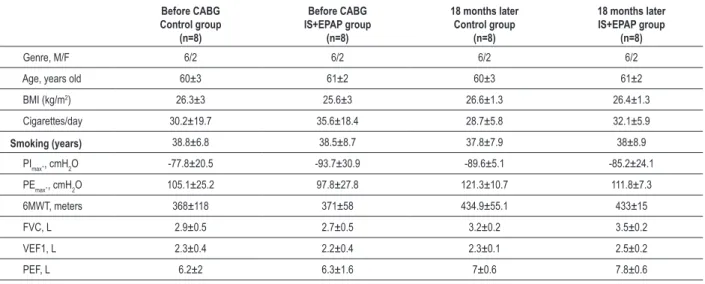
Table 1 - Clinical characteristics and functional variables before CABG and 18 months after the procedure
Before CABG Control group
(n=8)
Before CABG IS+EPAP group
(n=8)
18 months later
Control group
(n=8)
18 months later
IS+EPAP group
(n=8)
Genre, M/F 6/2 6/2 6/2 6/2
Age, years old 60±3 61±2 60±3 61±2
BMI (kg/m2) 26.3±3 25.6±3 26.6±1.3 26.4±1.3
Cigarettes/day 30.2±19.7 35.6±18.4 28.7±5.8 32.1±5.9
Smoking (years) 38.8±6.8 38.5±8.7 37.8±7.9 38±8.9
PImax., cmH2O -77.8±20.5 -93.7±30.9 -89.6±5.1 -85.2±24.1
PEmax., cmH2O 105.1±25.2 97.8±27.8 121.3±10.7 111.8±7.3
6MWT, meters 368±118 371±58 434.9±55.1 433±15
FVC, L 2.9±0.5 2.7±0.5 3.2±0.2 3.5±0.2
VEF1, L 2.3±0.4 2.2±0.4 2.3±0.1 2.5±0.2
PEF, L 6.2±2 6.3±1.6 7±0.6 7.8±0.6
Values expressed in mean ± standard deviation; BMI - body mass index; PImax - maximal inspiratory pressure; PEmax - maximal expiratory pressure; 6MWT - six-minute walk test; FVC - forced vital capacity; VEF1 - volume expired in the irst second; PEF - peak expiratory low.
measures, followed by Student-Newman-Keuls post-test. The
values were considered different when p≤0.05.
Results
Between January and April 2008, 16 patients were assessed: 8 from control group and 8 from IS+EPAP group. Mean time period from the surgery date till the accomplishment of the protocol IS+EPAP was 18 months.
Clinical characteristics, pulmonary function, PImax, PEmax and 6MWT
Table 1 presents the clinical characteristics values of both groups in the preoperative period and 18 months after CABG. There were no significant differences between groups or among members of the same group (ANOVA, Student-Newman-Keuls as post-test).
Perceived effort sensation
The sensation of perceived effort before 6MWT did not present differences between groups (8.3±0.7 versus 8.8±0.6). However, after concluding 6MWT, the sensation of effort was higher in control group in comparison to IS+EPAP group (13.4±1.2 versus 9.1±0.7; p<0.05 for hospitalization, time and group, ANOVA, Student-Newman-Keuls post-test) (Figure 1A).
Dyspnea
The sensation of dyspnea perceived before 6MWT was similar between groups (0.66±0.4 versus 0.36±0.2). However, after 6MWT, dyspnea score was higher in control group than in IS+EPAP group (1.6±0.6 versus 0.6±0.3; p<0.05, ANOVA, Student-Newman-Keuls post-test) (Figure 1B).
Life quality
Figure 1 -Values expressed in mean±SD. A: values of perceived effort sensation before and after 6MWT. *p<0.05, IS±EPAP versus control group. B: values of perceived dyspnea sensation before and after 6MWT. *p<0.05, IS+EPAP versus control group. All comparisons were made through ANOVA test for repeated measures, followed by Student-Newman-Keuls post-test.
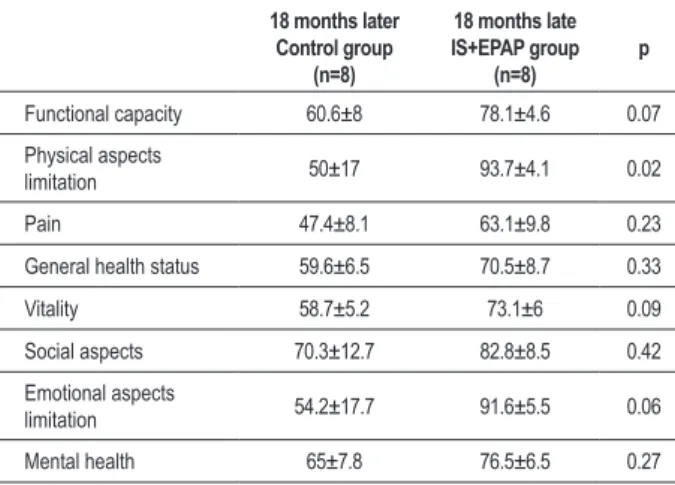
no statistical differences in the majority of the assessed parameters between groups (Table 2). The domain which presented significant difference between group concerned the limitations in physical aspects, in which IS+EPAP group presented higher values in comparison to control group (93.7±4.1 versus 50±17, p<0.02; Student’s t-test), which represents less limitation.
Physical activity level
The analysis of physical activity level, made according to IPAQ-8, demonstrated that in IS+EPAP group, seven patients were considered to be active (87.5%) and one of them, to be sedentary (12.5%). In the control group, only three out of eight patients were considered active (37.5%) and the five remaining individuals were considered irregularly active (62.5%).
Discussion
The main findings of the present study show that IS+EPAP group present less sensation of effort and dyspnea after 6MWT, as well as a better quality of life and less limitation with regard to physical aspects in comparison to control group. As far as we know, this is the first study carried out with the purpose of following-up, at long term, the patients
Table 2 - Results of SF-36 assessment 18 months after CABG
18 months later
Control group
(n=8)
18 months late
IS+EPAP group
(n=8) p
Functional capacity 60.6±8 78.1±4.6 0.07
Physical aspects
limitation 50±17 93.7±4.1 0.02
Pain 47.4±8.1 63.1±9.8 0.23
General health status 59.6±6.5 70.5±8.7 0.33
Vitality 58.7±5.2 73.1±6 0.09
Social aspects 70.3±12.7 82.8±8.5 0.42
Emotional aspects
limitation 54.2±17.7 91.6±5.5 0.06
Mental health 65±7.8 76.5±6.5 0.27
Values are expressed in mean ± standard deviation. Student’s t-test.
submitted to a physiotherapy protocol in the postoperative CABG. The protocol used includes the combined use of IS and EPAP. The incentive spirometry allows a sustained maximal inspiration. During inspiration, there is the elevation of a pulmonary embolus, which encourages the patient, through a visual feedback, to perform slow and deep inspirations. This pattern determines the increase of inspiratory volumes, increase of transpulmonary pressure, improvement of the performance of inspiratory muscles, thus reestablishing the pattern of pulmonary expansion. On the other hand, EPAP is a technique that allows expiratory positive airway pressure during spontaneous breathing, thus improving alveolar ventilation through the increase in pressure during expiration, which is related to alveolar recruitment. In this manner, the result of pulmonary rexpansion is present in the inspiratory phase as well as in the expiratory phase.
Besides, the present study enables the assessment, at long term, of the effects of the application of a IS+EPAP protocol in the immediate postoperative period (30 days last) on the evolution of pulmonary function, functional capacity and life quality of these patients. We also observed that there were three re-hospitalizations in control group, while only one patient from IS+EPAP group had to return.
As expected, the pulmonary variables (FVC, VEF1 PEF) assessed in this paper did not present significant difference between groups. Such findings are supported by the study of Kristjansdottir and Ragnarsdorttir24, which demonstrated
normalization of the pulmonary variables 12 months after cardiac surgery. Similarly, data concerning the assessment of PImax, EPmax and the distance roamed during 6MWT were not different between groups either.
References
1. Keenan TD, Abu-Omar Y, Taggart DP. Bypassing the pump: changing practices in coronary artery surgery. Chest. 2005;128:363-69.
2. Pasquina P, Tramèr MR, Walder B. Prophylactic respiratory physiotherapy after cardiac surgery: systematic review. BMJ. 2003;327:1-6.
3. Hulzebos EH, Van Meeteren NL, De Bie RA, Dagnelie PC, Helders PJ. Prediction of postoperative pulmonary complications on the basis of preoperative risk factors in patients who had undergone coronary artery bypass graft surgery. Phys Ther. 2003;83:8-16.
4. Ferguson MK. Preoperative assessment of pulmonary risk. Chest. 1999;115:58S-63S.
5. Groeneveld AB, Verheij J, van den Berg FG, Wisselink W, Rauwerda JA. Increased pulmonary capillary permeability and extravascular lung water after major vascular surgery: effect on radiography and ventilatory variables. Eur J Anaesthesiol. 2006;23:36-41.
6. Groeneveld AJ, Jansen EK, Verheij J. Mechanisms of pulmonary dysfunction after on-pump and off-pump cardiac surgery: a prospective cohort study. J Cardiothorac Surg. 2007;2(11)1-7.
7. Daganou M, Dimopoulou I, Michalopoulos N, et al. Respiratory complications after coronary artery bypass surgery with unilateral or bilateral internal mammary artery grafting. Chest. 1998;113:1285-9.
8. Berrizbetia LD, Tessler S, Jacobowitz IJ, Kaplan P, Budzilowicz L, JN. C. Effect of sternotomy and coronary bypass surgery on postoperative pulmonary mechanism. Comparison of internal mammary saphenous vein bypass graft. Chest. 1989;96(4):873-6.
9. Johnson D, Hurst T, Thomson D, et al. Respiratory function after cardiac surgery. J Cardiothorac Vasc Anesth. 1996;10:571–77.
10. Shekman Z, Shir Y, Weiss Y, Bleiberg B, Gross D. The effects of cardiac surgery on early and late pulmonary functions. Acta Anaesthesiol Scand. 1997;41:1193–99.
effort in these patients. It is demonstrated that the functional limitations correlate positively to the roamed distance and to dyspnea reporter during 6MWT25. Conversely, studies that
assessed the sensation of effort and dyspnea perceived during 6MWT after cardiac surgery demonstrated that the effort sensation may be related to psychological aspects and to the performance during 6MWT.
The CABG, when electively carried out, is associated with a significant improvement in patient’s life quality. However, in certain subgroups of patients – such as elderly, women and obese patients – these effects are less perceptible after surgery. In this manner, CABG may result in few benefits for these patients26. The findings of the
present study show that the patients submitted to CABG and to physiotherapy protocol presented a better life quality concerning physical aspects limitations, as compared to patients who went through CABG, but not postoperative physiotherapy. Studies have showed that the improvement of aerobic capacity and of cardiac function of cardiopatic patients, obtained after an interval-aerobic training protocol, correlates to these individuals life quality27,28; it
is suggested that this fact is explained by the improvement of physiological adaptation in accordance with the increase of the aerobic training capacity.
When assessing the physical activity level, we demonstrated that 85.7% of the patients from IS+EPAP group were considered active, while only 37.5% of the patients from control group were active. Sedentarism, besides representing personal enfermity risk, also results in economical costs for the individual, his family and the society. data reported in literature indicate that for each increase of 1% in the physical activity level of the adult population, there would be an associated economy of 7 million dollars in potential costs of treatment for myocardial infarction, stroke, diabetes, colon and breast cancer, as well as depression29. As to confirm these findings, other studies
are needed, but with a greater number of patients in each group, so we could affirm that the group that accomplished the physiotherapy protocol in the postoperative period is really more active than the control group.
Study limitations
It is still difficult to compare our results to those of other papers. This is owed especially to the fact that there are no follow-up studies that assess the sensation of effort and dyspnea after 6MWT in this population. Besides, we also did not find any study which evaluated life quality and physical activity level in patients previously submitted to CABG and to a protocol of physiotherapy intervention for more than a year. The small number of studied patients was also a strong limiting factor in our study. The new thing about our paper is that the abovementioned assessments were carried out in patients submitted to a protocol of respiratory physiotherapy, which involved the use of IS+EPAP in the immediate postoperative period, during hospitalization and that was maintained in domicile for four more weeks.
Based on the data herein presented, we may conclude that patients who accomplished a protocol of respiratory physiotherapy with IS+EPAP in the postoperative period of CABG presented a slighter sensation of effort and dyspnea after submaximal functional capacity test assessed through 6MWT, as well as a better life quality with regard physical aspects limitations 18 months after surgery. These facts are important once the used of incentive spirometry together with expiratory positive airway pressure requires little effort, present minimum risk for health and may be easily applied in domicile, which facilitates patient’s adherence to the treatment.
Potential Conflict of Interest
No potential conflict of interest relevant to this article was reported.
Sources of Funding
This study was partially funded by FIPE-HCPA.
Study Association
11. Wynne R, Botti M. Postoperative pulmonary dysfunction in adults after cardiac surgery with cardiopulmonary bypass: clinical significance and implications for practice. Am J Crit Care. 2004;13:384-93.
12. Haeffner MP, Ferreira GM, Barreto SSM, Arena R, Dall’Ago P. Incentive spirometry with expiratory positive airway pressure reduces pulmonary complications, improves pulmonary function and six-minute walk distance in patients undergoing coronary artery bypass graft surgery. Am Heart J. 2008;156:900.e1-e8.
13. Tzelpis GE, Vega DL, Cohen ME, McCool FD. Lung volume specificity of inspiratory muscle training. J Appl Physiol. 1994;77:789-94
14. Tzelpis GE, Vega DL, Cohen ME, Fulambarker AM, Patel KK, McCool FD. Pressure-flow specificity of inspiratory muscle training. J Appl Physiol. 1994;77:795-801.
15. Silva L.C.C., Rubin A.S., Silva L.M.C. Avaliação Funcional Pulmonar. Rio de Janeiro: Editora Revinter, 2000.
16. Nava S, Ambrosino N, Crotti P, Fracchia C, Rampulla C. Recruitment of some respiratory muscles during three maximal inspiratory manoeuvres. Thorax. 1993;48:702-7.
17. ATS statement: guideline for the six-minute walk test. Am J Respir Crit Care Med. 2002;166:111–17.
18. Pereira C. I Consenso Brasileiro sobre Espirometria. J Pneumol. 1996;22:105-164.
19. Lung function testing: selection of reference values and interpretative strategies. American Thoracic Society. Am Rev Respir Dis. 1991;144:1202-18.
20. Ciconelli RM, Ferraz MB, Santos W, Meinao I, Quaresma MR: Tradução para a língua portuguesa e validação do questionário genérico de avaliação de qualidade de vida SF-36 (Brasil SF-36). Rev Bras Reumatol. 1999;39:143-50.
21. Velanovich V, MD. Behavior and analysis of 36-item short-form health. Arch Surg. 2007;142:473-78.
22. Craig CL, Marshall AL, Sjöström M, Bauman AE, Booth ML, Ainsworth BE, et al. International Physical Activity Questionnaire: 12-Countr reliability and validity. Med Sci Sports Exerc. 2003;35:1381-95.
23. Guedes DP; Gonçalves LA. Impacto da Prática Habitual de Atividade Física no Perfil Lipídico de Adultos. Arq Bras Endocrinol Metab. 2007;51:72-8.
24. Kristjansdottir A., Ragnarsdorttir M. Chest wall motion and pulmonary function are more diminished following cardiac surgery when the internal mammary artery retractor is used. Scand Cardiovasc J. 2004;38:369-74.
25. Wijkstra, PJ et al. Relation of lung function, maximal inspiratory pressure, dyspnoea, and quality of life with exercise capacity in patients with chronic obstructive pulmonary disease. Thorax. 1994;49:468-472.
26. Parikh CR, Coca SG, Smith GL, Vaccarino V, Krumholz HM. Impact of chronic kidney disease on health-related quality-of-life improvement after coronary artery bypass surgery. Arch Intern Med. 2006;166:2014-19.
27. Herridge MS, Cheung AM, Tansey CM, et al. One-year outcomes in survivors of the acute respiratory distress syndrome. N Engl J Med. 2003;348:683– 93.
28. Spiraki C, Kaitelidou D, Papakonstantinou V, Prezerakos P, Maniadakis N. Hellenic J Cardiol. 2008;49(4):241-7.
29. Wisløff U, Støylen A, Loennechen JP, Bruvold M, Rognmo Ø, Haram PM, Tjønna AE, Helgerud J, Slørdahl SA, Lee SJ, Videm V, Bye A, Smith GL, Najjar SM, Ellingsen Ø, Skjaerpe T. Superior cardiovascular effect of aerobic interval training versus moderate continuous training in heart failure patients: a randomized study. Circulation. 2007 Jun, 19; 115 (24): 3042-4.