J Bras Pneumol. 2008;34(9):707-714
707
Review Article
those that favor the colonization of the oropharynx or the stomach, the aspiration of secretions into the lower respira-tory tract or reflux of the gastrointestinal tract, and factors inherent in the host.(2,4,5)
The bacterial agent found will depend on length of hospital stay, use of antimicrobial agents, host susceptibility, and ICU microbiota. Gram-negative bacilli (Pseudomonas aeruginosa, Proteus spp., Acinetobacter spp.) and Staphylococcus aureus are frequently isolated.(6,7)
Considering that the microbiota of the oral cavity represents a threat to critical patients,(2,4,8-12) some
strate-Introduction
Ventilator-associated pneumonia (VAP) is defined as that developing in the period from 48 h after initiation of mechanical ventilation to 48 h after extubation. It is one of the most common cross infections in intensive care units (ICUs), with rates that range from 9 to 40% of the infections acquired in these units, and is associated with an increase in length of hospitalization and in morbidity and mortality rates, which significantly affects costs.(1-3)
The aspiration of microorganisms present in the oropharynx constitutes the most common means of acquiring the disease, and the principal risk factors are
Oral hygiene with chlorhexidine in preventing
pneumonia associated with mechanical ventilation*
Higiene bucal com clorexidina na prevenção de pneumonia associada à ventilação mecânica
Carolina Contador Beraldo1, Denise de Andrade2
Abstract
Ventilator-associated pneumonia (VAP) is a common infection in intensive care units (ICUs), and oral antiseptic is used as a preventive measure. We reviewed meta-analyses and randomized clinical trials indexed in the Medical Literature Analysis and Retrieval System and Cumulative Index to Nursing and Allied Health Literature databases regarding the topical use of chlorhexidine in the prevention of VAP. Eight publications were analyzed. In seven (87.5%) chlorhexidine diminished the colonization of the oropharynx, and in four (50%) there was a reduction of VAP. Chlorhexidine seems to reduce colonization, thus reducing the incidence of VAP.
Keywords: Pneumonia, ventilator-associated; Oral hygiene; Chlorhexidine.
Resumo
A pneumonia associada à ventilação mecânica (PAVM) é uma infecção freqüente nas unidades de terapia intensiva (UTI), e anti-sépticos bucais são utilizados preventivamente. Revisamos metanálises e ensaios clínicos randomizados indexados no Medical Literature Analysis and Retrieval System e Cumulative Index to Nursing and Allied Health Literature sobre o uso tópico da clorexidina na prevenção da PAVM. Oito publicações foram avaliadas. Em sete (87,5%), a clorexidina diminuiu a colonização da orofaringe, e em quatro (50%) houve redução de PAVM. A clorexidina parece diminuir a colonização, podendo reduzir a incidência da PAVM.
Descritores: Pneumonia associada à ventilação mecânica; Higiene bucal; Clorexidina.
* Study carried out in the Department of Basic Nursing of the Escola de Enfermagem de Ribeirão Preto da Universidade de São Paulo – EERP-USP, University of São Paulo at Ribeirão Preto School of Nursing – Ribeirão Preto, Brazil, as part of the Masters thesis “Prevention of Ventilator-Associated Pneumonia: An Integrative Review”, which was incorporated into the Fundação de Amparo à Pesquisa do Estado de São Paulo – FAPESP, Foundation for the Support of Research in the State of São Paulo – project “Facing Intensive Care Unit Care and Oral Health of Critical Patients with and without Pneumonia: Integrated Investigation”.
1. Nurse in the Department of Basic Nursing. Escola de Enfermagem de Ribeirão Preto da Universidade de São Paulo – EERP-USP, University of São Paulo at Ribeirão Preto School of Nursing – Ribeirão Preto, Brazil.
2. Associate Professor in the Department of Basic Nursing. Escola de Enfermagem de Ribeirão Preto da Universidade de São Paulo – EERP-USP, University of São Paulo at Ribeirão Preto School of Nursing – Ribeirão Preto, Brazil.
Correspondence to: Denise de Andrade. Av. Bandeirantes, 3900, Campus Universitário USP, Monte Alegre, CEP 14040-902, Ribeirão Preto, SP, Brasil. Tel 55 16 3602-3381. Fax 55 16 3633-3271. E-mail: [email protected]
Financial support: This study received financial support from the Fundação de Amparo à Pesquisa do Estado de São Paulo (FAPESP, Foundation for the Support of Research in the State of São Paulo) and the Coordenação de Aperfeiçoamento de Pessoal de Nível Superior (CAPES, Coordination of the Advancement of Higher Education).
discussion on the results; as well as presentation of the review.(19-21)
The following question was posed in order to guide the review: What is the scientific evidence on the topical use of chlorhexidine in the oral hygiene of adult ICU patients for the prevention of VAP?
The articles were selected using two major heath care databases, accessed via the Internet: the Medical Literature Analysis and Retrieval System (Medline) and the Cumulative Index to Nursing and Allied Health Literature (CINAHL). The following keywords, which are included in the Medical Subject Headings, were used in the search: pneumonia, ventilator-associated; oral hygiene; chlorhexidine; cross infection/prevention and control; critical care; and intensive care. In addition, a search was carried out in the references cited in the articles selected using the databases.
The inclusion criteria were as follows: full text being available; having addressed the topical use of chlorhexidine in the oral hygiene of adult ICU patients for the prevention of VAP; having been published in English, Spanish, or Portuguese between January of 1998 and August of 2007; and having been classified as level of evidence I and II, according to the classification system devised by Stetler et al.(22)
It is important to emphasize that the aforemen-tioned classification of scientific evidence is based on the study design, level I consisting of evidence from meta-analysis of multiple controlled studies, and level II comprising individual experimental studies.
In order to select the studies, each title and abstract were carefully read to determine whether they responded to the guide question. Furthermore, information about characteristics and methodo-logical rigor, intervention studied, and main results were extracted. The extracted data were analyzed descriptively.
Results and discussion
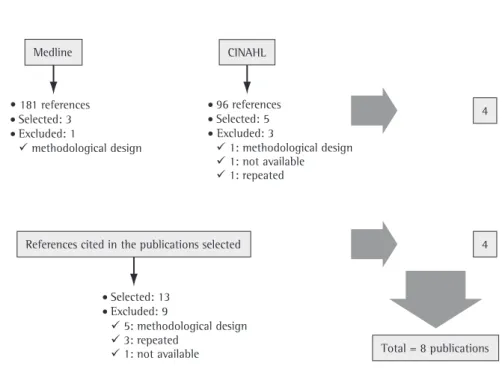
In the search for evidence, 181 references were found in Medline, and 96 were found in CINAHL. These references were analyzed regarding the inclu-sion criteria, and 4 publications were selected. In those 4 publications, there were 13 articles listed in the reference lists, and, after being carefully read, 4 of the papers cited were included in the selection gies to prevent colonization, such as administration
of nonabsorbable topical antibiotics, have been studied. However, prolonged use of prophylactic antibiotics increases the risk of the induction and selection of resistant microorganisms and has there-fore not been recommended.(1)
The use of antiseptics in oral hygiene has also been the object of investigation.(6,9-13) Among the products used is chlorhexidine, an antimicrobial agent with a broad spectrum of activity against gram-positive bacilli, including oxacillin-resistant S. aureus and vancomycin-resistant Enterococcus sp., and lower efficacy against gram-negative bacilli. It is absorbed by the tissues and has a residual effect over time, presenting activity even 5 h after admin-istration.(14,15)
Various aspects affect oral cavity hygiene and further favor microbial growth, such as difficulty in or impossibility of self-care, presence of tracheal tube, which makes access to the oral cavity difficult, and the consequent formation of dental plaque biofilm.(10-12,16) The Centers for Disease Control and Prevention (CDC) recommends oral hygiene with chlorhexidine in patients in the perioperative period of cardiac surgery. However, regarding medical-surgical ICU patients, the theme is considered an unresolved question.(1)
In view of these facts, we have sought theo-retical references on which to base this study in evidence-based practice, since it makes it possible to systematically use the best scientific evidence available to evaluate options and make decisions regarding the holistic care of the patient.(17,18)
In this sense, our objective was to critically analyze the evidence available on the topical use of chlorhexidine in the oral hygiene of adult ICU patients for the prevention of VAP.
Methods
Oral hygiene with chlorhexidine in preventing pneumonia associated with mechanical ventilation
J Bras Pneumol. 2008;34(9):707-714
709
cardiac surgery,(23) the intervention was also admin-istered in the preoperative period, that is, prior to orotracheal intubation, a procedure that was not performed in the remaining studies, in which none-lective intubation was performed.
Regarding the intervention administered, chlo-rhexidine was used at a concentration of 0.12% in 2 studies (40%), at a concentration of 0.2% in 2 studies (40%), and at a concentration of 2% in 1 study (20%). Koeman et al.(13) evaluated two types of intervention: 2% chlorhexidine (group 1) and 2% chlorhexidine combined with colistin (group 2), which is an antibiotic polymyxin that is highly effective against gram-positive and gram-negative bacteria and has been topically administered with few reports of the induction of microbial resistance. The authors explain that the combination of these two substances provided better results against gram-negative bacteria, although both interventions had beneficial effects for the prevention of VAP.
Considering the control groups of the RCTs included, placebos, presenting characteristics similar to chlorhexidine in terms of presentation, color, odor, and taste, were used in 2 (40%) of the publications. In one study,(23) Listerine®, which is a nonabsorbable of this review, the final sample therefore consisting
of 8 publications (Figure 1).
Of the 8 articles on the use of chlorhexidine in the prevention of VAP, 5 (62.5%) were rand-omized controlled clinical trials (RCTs - level of evidence II), and 3 (37.5%) were meta-analyses (level of evidence I), all of them written in English and published between 2000 and 2007. Four (50%) of the studies were carried out in the United States, 2 (25%) were carried out in France, and the 2 remaining studies were carried out in Canada and in the Netherlands.
Chart 1 presents a synopsis of the critical anal-ysis of the RCTs evaluated.(13,16,23-25)
Regarding the methodological design, 2 (40%) of the 5 RCTs were double-blind, 1 (20%) was single-blind, and 2 (40%) were not blind. In addition, 4 (80%) involved patients admitted to medical-sur-gical ICUs, and 1 (20%) involved patients submitted to cardiac surgery. It is worthy of note that, in all of the studies evaluated, chlorhexidine was admin-istered periodically, using a standard technique, during the period in which the patient remained on mechanical ventilation. However, in the study that evaluated patients in the perioperative period of
Medline
References cited in the publications selected
Total = 8 publications 4
4 CINAHL
• 181 references
Selected: 3
Excluded: 1
methodological design
96 references
Selected: 5 Excluded: 3
1: methodological design
1: not available
1: repeated
Selected: 13
Excluded: 9
5: methodological design
1: not available
3: repeated
Medline: Medical Literature Analysis and Retrieval System; and CINAHL: Cumulative Index to Nursing and Allied Health Literature.
14
of the dental plaque and the occurrence of CI in patients on MV.
bicarbonate) risk reduction (p < 0.05)
• higher frequency of positive dental plaque
cultures in controls (days 5-7; p < 0.05)
prevention of VAP taken in both groups not described
Houston et al., 2002(23)
To evaluate the efficacy of the oral use of 0.12% chlorhexidine in reducing the colonization of the respiratory tract and the incidence of nosocomial pneumonia in patients submitted to cardiac surgery.
RCT Perioperative
period of cardiac surgery
0.12% chlorhexidine
Listerine® • 58% lower rate of pneumonia in the
experimental group (intubation > 24 h; p = 0.06)
• higher frequency of positive secretion
cultures in the experimental group (NS)
• age bracket not described • standard measures for
the prevention of VAP not described
• low statistical power (66%)
Grap et al., 2004(24)
To describe the effect of administration of a single dose of chlorhexidine in the oral cavity immediately after intubation on the oral microbiota and the incidence of VAP.
RCT
Medical-surgical ICU
0.12% chlorhexidine
Usual care • increase in diagnostic score for VAP
greater in controls (from 4.7 at admission to 6.6 after 48 h) than in the experimental group (from 5.17 to 5.57) (NS)
• higher frequency of negative
oropharyngeal cultures in the experimental group (NS)
• usual care performed in
controls not described
• small sample (n = 34) • diagnosis of VAP with score • calculation of the sample
not described
Fourrier et al., 2005(25)
To document the effect of decontamination of the dental plaque and oral cavity with chlorhexidine on the incidence of nosocomial bacteremia and ICU-acquired respiratory infections.
Double-blind
RCT
Medical-surgical ICU
0.2% chlorhexidine
Placebo • incidence of VAP, bacteremia, or bronchitis
similar in both groups
• higher frequency of Candida albicans in the dental plaque of controls (p < 0.05)
• samples of dental plaque of controls
remained positive longer (p < 0.05)
• no complementary
observations
Koeman et al., 2006(13)
To determine the effect of decontamination of the oral cavity with chlorhexidine or chlorhexidine combined with colistin on the incidence of VAP.
Double-blind
RCT
Medical-surgical ICU
2% chlorhexidine
(1) and chlorhexidine
+ colistin (2)
Placebo • 65% lower risk of VAP in group 1
(p = 0.012) and 55% lower risk in group 2 (p = 0.03) than in controls
• lower colonization of the oral cavity in
groups 1 and 2 (p < 0.001)
• length of the follow-up
period not mentioned
Oral hygiene with chlorhexidine in preventing pneumonia associated with mechanical ventilation
J Bras Pneumol. 2008;34(9):707-714
711
and did not consider the analysis of fluid cultures performed by standard methods (tracheal aspirate, bronchoalveolar lavage, and protected lavage) or blood culture for laboratory confirmation, which might have resulted in an over- or underestimation of the number of cases of infection listed.
Despite conducting a double-blind RCT that was well delineated in terms of methodology, Fourrier et al.(25) attributed the absence of statistically signifi-cant results to the low incidence of VAP registered in the experimental and in the control groups, which implies an underestimated sample (insufficient to obtain statistically significant results).
Regarding the colonization of the oral cavity or dental plaque, 4 (80%) of the studies demonstrated that the use of chlorhexidine reduced the incidence of colonization in relation to that found in the control group. In only one study,(23) the number of phenolic antiseptic agent and, therefore, has no
residual effect like that of chlorhexidine, was used for comparison. However, 2 (40%) of the publica-tions mentioned usual care as a control: in one study, the usual care employed was not described(24); and, in the other, an isotonic solution of sodium bicarbonate was used to rinse the oral cavity.(16)
Analyzing the results obtained, it was observed that, in 3 (60%) of the RCTs, the topical use of chlorhexidine in the oral hygiene of adult patients on mechanical ventilation reduced the incidence of VAP, with statistically significant results.(13,16,23) Although Grap et al.(24) found no differences between the experimental and the control groups in terms of incidence of VAP, they considered their study sample small (34 subjects). It should be noted that, in that study, the diagnosis of VAP was determined by a score, based only on clinical and X-ray findings,
Chart 2 - Synopsis of the meta-analyses (level of evidence I) regarding the use of chlorhexidine in the prevention of ventilator-associated pneumonia by authorship, objectives, method, population, intervention/control, main results, and complementary observations (1998 to 2007), Ribeirão Preto, 2007.
Authorship Objective Studies
included (n)
Results Recommendations Observations
Pineda et al., 2006(26)
To evaluate the effect of oral administration of
chlorhexidine on the incidence of
VAP.
4 • no statistically
significant differences between controls and the experimental group
in terms of incidence of VAP (random effect
model)
• oral hygiene with
chlorhexidine combined with other preventive measures recommended
(oral hygiene with chlorhexidine in isolation
does not prevent VAP)
• preoperative
period of cardiac surgery versus medical surgical
ICU
• use of different
concentrations of chlorhexidine Chan et al.,
2007(27)
To evaluate the effect of decontamination of the oral cavity with topical antibiotics
or antiseptics on the incidence of
VAP.
11 • 44% reduction in the incidence of VAP in the experimental group/
antiseptics (random effect model; p = 0.002)
• decontamination of
the oral cavity favored by combined meta-analysis of the articles
(p < 0.001)
• prophylactic hygiene
of the oral cavity with antiseptics recommended
• studies showing
moderate heterogeneity
Chlebicki & Safdar, 2007(28)
To evaluate the efficacy of the
topical use of chlorhexidine in the
prevention of VAP.
7 • 30% reduction in the risk of acquiring VAP in the experimental group (random effect model;
NS)
• use of chlorhexidine in
the prevention of VAP in patients on mechanical ventilation recommended
• studies showing
moderate heterogeneity
Chlebicki and Safdar(28) analyzed 7 RCTs selected using PubMed, Medline, Current Contents, CINAHL, Database of Abstracts of Reviews of Effectiveness, and the Cochrane Library. Of those, 5 were the RCTs included in our study,(13,16,23-25) and the remaining 2 were an unpublished article and an article published before 1998, which is outside the time period estab-lished the inclusion criteria of the present review. Due to the heterogeneity of the studies, no statis-tical significance was found, even though the use of chlorhexidine resulted in a 30% reduction in the relative risk of acquiring VAP.
Only one study(26) found statistically signifi-cant results favoring the use of chlorhexidine in the prevention of VAP. However, the 3 publications recommend that oral hygiene with chlorhexidine be performed as a preventive measure against VAP, although suggestions regarding concentra-tions, forms of presentation (gel, liquid, or paste), frequency, and administration techniques are not considered, due to the heterogeneity found in rela-tion to these topics.
As previously mentioned, the CDC considers the use of chlorhexidine in the prevention of VAP in patients submitted to cardiac surgery as level of evidence II. The CDC recommendations are based on the following levels of evidence: IA, strongly recom-mended for implementation and based on good experimental, clinical, or epidemiological studies; IB, strongly recommended for implementation and based on some experimental, clinical, or epide-miological studies, as well as on strong theoretical models; IC, rules or standardizations of the federal regulations of the United States; II, suggested for implementation and based on suggestive clinical or epidemiological trials or on theoretical models; and unresolved question, when, according to the CDC, there is not enough evidence on which to base the recommendation.(1)
Therefore, for level II, the measure is only suggested for implementation rather than being strongly recommended. Specifically in this case, this suggestion was based on only one double-blind RCT.(29)
In Brazil, the Sociedade Brasileira de Pneumologia e Tisiologia (SBPT, Brazilian Thoracic Association) recommends decontamination of the oral cavity with chlorhexidine, or with chlorhexidine combined with colistin, in the prevention of VAP in patients on mechanical ventilation.(30) This is a recommen-positive cultures was greater in the experimental
group, although the difference did not reach statis-tical significance.
Chart 2 presents a synopsis of the critical anal-ysis of the meta-analyses evaluated.(26-28)
In the meta-analyses evaluated, differences were found in terms of the methods employed in the search for articles, inclusion/exclusion criteria, and objectives of the authors. However, there was concordance in the inclusion of some studies, which were also analyzed in the present review.
Pineda et al.(26) selected RCTs using various elec-tronic databases, including Medline, Biosis Previews, PubMed, Excerpta Medica, and the Cochrane Library. Their objective was to analyze the effect of the use of chlorhexidine on the incidence of VAP, and the studies that combined mechanical removal and pharmacological treatment in the prevention of dental plaque formation were excluded. A total of 4 articles were analyzed, 2 of which involved patients who used 0.12% chlorhexidine in the preopera-tive period of cardiac surgery(23,29) and 2 of which involved medical-surgical ICU patients who used 0.2% chlorhexidine.(16,25) The differences between the target populations and the concentrations of chlorhexidine used made it difficult to compare the data.
Oral hygiene with chlorhexidine in preventing pneumonia associated with mechanical ventilation
J Bras Pneumol. 2008;34(9):707-714
713
4. Inglis TJ. New insights into the pathogenesis of ventilator-associated pneumonia. J Hosp Infect. 1995;30 Suppl:409-13.
5. Gusmão ME, Dourado I, Fiaccone RL. Nosocomial pneumonia in the intensive care unit of a Brazilian university hospital: an analysis of the time span from admission to disease onset. Am J Infect Control. 2004;32(4):209-14.
6. Bassin AS, Niederman MS. New approaches to prevention and treatment of nosocomial pneumonia. Semin Thorac Cardiovasc Surg. 1995;7(2):70-7.
7. George DL. Epidemiology of nosocomial pneumonia in intensive care unit patients. Clin Chest Med. 1995;16(1):29-44.
8. Ewig S, Torres A, El-Ebiary M, Fábregas N, Hernández C, González J, et al. Bacterial colonization patterns in mechanically ventilated patients with traumatic and medical head injury. Incidence, risk factors, and association with ventilator-associated pneumonia. Am J Respir Crit Care Med. 1999;159(1):188-98.
9. Garcia R. A review of the possible role of oral and dental colonization on the occurrence of health care-associated pneumonia: underappreciated risk and a call for interventions. Am J Infect Control. 2005;33(9):527-41.
10. Brennan MT, Bahrani-Mougeot F, Fox PC, Kennedy TP, Hopkins S, Boucher RC, et al. The role of oral microbial colonization in ventilator-associated pneumonia. Oral Surg Oral Med Oral Pathol Oral Radiol Endod. 2004;98(6):665-72.
11. El-Solh AA, Pietrantoni C, Bhat A, Okada M, Zambon J, Aquilina A, et al. Colonization of dental plaques: a reservoir of respiratory pathogens for hospital-acquired pneumonia in institutionalized elders. Chest. 2004;126(5):1575-82. 12. Okuda M, Kaneko Y, Ichinohe T, Ishihara K, Okuda K.
Reduction of potential respiratory pathogens by oral hygienic treatment in patients undergoing endotracheal anesthesia. J Anesth. 2003;17(2):84-91.
13. Koeman M, van der Ven AJ, Hak E, Joore HC, Kaasjager K, de Smet AG, et al. Oral decontamination with chlorhexidine reduces the incidence of ventilator-associated pneumonia. Am J Respir Crit Care Med. 2006;173(12):1348-55. 14. Eldridge KR, Finnie SF, Stephens JA, Mauad AM, Munoz
CA, Kettering JD. Efficacy of an alcohol-free chlorhexidine mouthrinse as an antimicrobial agent. J Prosthet Dent. 1998;80(6):685-90.
15. Eaton KA, Rimini FM, Zak E, Brookman DJ, Hopkins LM, Cannell PJ, et al. The effects of a 0.12% chlorhexidine-digluconate-containing mouthrinse versus a placebo on plaque and gingival inflammation over a 3-month period. A multicentre study carried out in general dental practices. J Clin Periodontol. 1997;24(3):189-97.
16. Fourrier F, Cau-Pottier E, Boutigny H, Roussel-Delvallez M, Jourdain M, Chopin C. Effects of dental plaque antiseptic decontamination on bacterial colonization and nosocomial infections in critically ill patients. Intensive Care Med. 2000;26(9):1239-47.
17. Conn VS, Burks K, Rantz M, Knudsen KS. Evidence-based practice for gerontological nursing. J Gerontol Nurs. 2002;28(2):45-52.
18. Galvão CM. A prática baseada em evidências: uma contribuição para a melhoria da assistência de enfermagem perioperatória [thesis]. Ribeirão Preto: Universidade de São Paulo; 2002.
dation with level of evidence B, that is, based on a limited database, which includes experimental studies and meta-analyses. However, the aforemen-tioned recommendation is used when the number of studies is small, with a reduced sample, an inad-equate population, or inconsistent data. The SBPT recommendation was based on 3 RCTs.(13,16,29)
Although their level of evidence is not considered strong, the CDC and the SBPT recommendations on the use of chlorhexidine support a practice that is already routinely performed at some health care facilities. This review revealed that there is more evidence available to reinforce these recommenda-tions and guide clinical practice.
Conclusion
In summary, of the 8 articles included in the present review, 3 RCTs and 2 meta-analyses (50% of the total sample) favored the use of chlorhexidine as a preventive measure against VAP. Regarding the colonization of the oral cavity, 4 (80%) of the 5 RCTs revealed preventive effects of chlorhexidine.
Based on the studies analyzed, we conclude that the topical use of chlorhexidine in the oral hygiene of patients on mechanical ventilation seems to reduce the colonization of the oral cavity, thereby reducing the incidence of VAP. In addition, this procedure is safe and quite tolerable, since no side effects were found in any of the studies. Furthermore, taking into account the increase in hospitalization costs caused by an episode of cross infection, it can be considered a low-cost measure.
However, further investigations are necessary to determine the ideal concentration, as well as the most suitable form of presentation, frequency, and administration technique.
References
1. Tablan OC, Anderson LJ, Besser R, Bridges C, Hajjeh R; CDC, et al. Guidelines for preventing health-care--associated pneumonia, 2003: recommendations of CDC and the Healthcare Infection Control Practices Advisory Committee. MMWR Recomm Rep. 2004;53(RR-3):1-36.
2. Safdar N, Crnich CJ, Maki DG. The pathogenesis of ventilator-associated pneumonia: its relevance to developing effective strategies for prevention. Respir Care. 2005;50(6):725-39; discussion 739-41.
the intensive care unit: a double-blind placebo-controlled multicenter study. Crit Care Med. 2005;33(8):1728-35. 26. Pineda LA, Saliba RG, El Solh AA. Effect of oral
decontamination with chlorhexidine on the incidence of nosocomial pneumonia: a meta-analysis. Crit Care. 2006;10(1):R35.
27. Chan EY, Ruest A, Meade MO, Cook DJ. Oral decontamination for prevention of pneumonia in mechanically ventilated adults: systematic review and meta-analysis. BMJ. 2007;334(7599):889.
28. Chlebicki MP, Safdar N. Topical chlorhexidine for prevention of ventilator-associated pneumonia: a meta-analysis. Crit Care Med. 2007;35(2):595-602.
29. DeRiso AJ 2nd, Ladowski JS, Dillon TA, Justice JW, Peterson AC. Chlorhexidine gluconate 0.12% oral rinse reduces the incidence of total nosocomial respiratory infection and nonprophylactic systemic antibiotic use in patients undergoing heart surgery. Chest. 1996;109(6):1556-61. 30. Sociedade Brasileira de Pneumologia e Tisiologia. Diretrizes
brasileiras para tratamento das pneumonias adquiridas no hospital e das associadas à ventilação mecânica e Diretrizes brasileiras em pneumonia adquirida na comunidade em pediatria - 2007. J Bras Pneumol. 2007; 33(supl. 1):S1-S50. 19. Broome ME. Integrative literature reviews for the development
of concepts. In: Rodgers BL, Knafl KA, editors. Development in nursing: foundations, techniques, and applications. Philadelphia: Saunders; 2000. p. 231-50.
20. Ganong LH. Integrative reviews of nursing research. Res Nurs Health. 1987;10(1):1-11.
21. Whittemore R, Knafl K. The integrative review: updated methodology. J Adv Nurs. 2005;52(5):546-53.
22. Stetler CB, Morsi D, Rucki S, Broughton S, Corrigan B, Fitzgerald J, et al. Utilization-focused integrative reviews in a nursing service. Appl Nurs Res. 1998;11(4):195-206. 23. Houston S, Hougland P, Anderson JJ, LaRocco M, Kennedy
V, Gentry LO. Effectiveness of 0.12% chlorhexidine gluconate oral rinse in reducing prevalence of nosocomial pneumonia in patients undergoing heart surgery. Am J Crit Care. 2002;11(6):567-70.
24. Grap MJ, Munro CL, Elswick RK Jr, Sessler CN, Ward KR. Duration of action of a single, early oral application of chlorhexidine on oral microbial flora in mechanically ventilated patients: a pilot study. Heart Lung. 2004;33(2):83-91. 25. Fourrier F, Dubois D, Pronnier P, Herbecq P, Leroy O, Desmettre