Point of View
Risk Scores in Valvular Heart Disease Interventions
Ricardo Casalino and Flávio Tarassoutchi
InCor, São Paulo, SP - Brazil
Mailing Address: Ricardo Casalino •
Rua Capote Valente, 442 – Pinheiros – 05409- 001 – São Paulo, SP - Brazil E-mail: [email protected], [email protected] Manuscript received November 10, 2011, revised manuscript received November 12, 2012; accepted March 15, 2012.
Abstract
The risk scores used as assistance agents in valve diseases are validated worldwide; however, the data are not homogeneous. The epidemiological characteristics of each population require local validation of these risk tools. The percutaneous valve replacement, which is a reality in valvular diseases (especially aortic stenosis), is indicated for patients with high or prohibitive surgical risk. Studies with this new treatment strategy use risk scores as criteria for inclusion and there are few studies that use such tools as predictors of risk.
The risk scores, after due validation in their relevant populations, are combined with clinical practice (individualization of conduct) in the definition of the conduct to be adopted in the clinical practice of valvular heart disease.
Introduction
Recent epidemiological data show some changes in the profile of patients with valvular disease who attend clinics, wards and emergency units. Worthy of note is the age and number of comorbidities that increase patient’s surgical risk.
Thus, preoperative risk stratification is critical and assists in decision-making directed towards the patient, taking into account their risk factors, chances of complications and mortality.
Besides the use of risk scores to predict morbidity and mortality in heart valve disease patients, these models are used as criteria for inclusion in the recent studies with new strategies of valve replacement1,2. Given this fact, a question
arises: are risk scores assessing properly the heart valve disease in different institutions?
Risk scores
The scores mostly used in the context of valve surgery are: Euroscore3, STS score4,5 and Ambler score6. Each score has
its specifications. The Euroscore emerged from the European database with approximately 19,000 patients. Out of these, 29% underwent valve surgery and it was first validated with 1,497 patients prospectively. The additive Euroscore is a simple mathematical calculation and the logistics form requires a computer (complex algorithm with the same variables).The STS score was generated from the U.S. database separated into three large cohorts with more than 100,000 patients
each. In groups 2 and 3, only valve surgeries (aortic valve replacement, mitral valve replacement and mitral valve repair), and combined valve surgery and coronary artery bypass grafting were respectively included. The Ambler score was based on the surgical database of the United Kingdom with more than 32,000 patients, all suffering from valve disease.
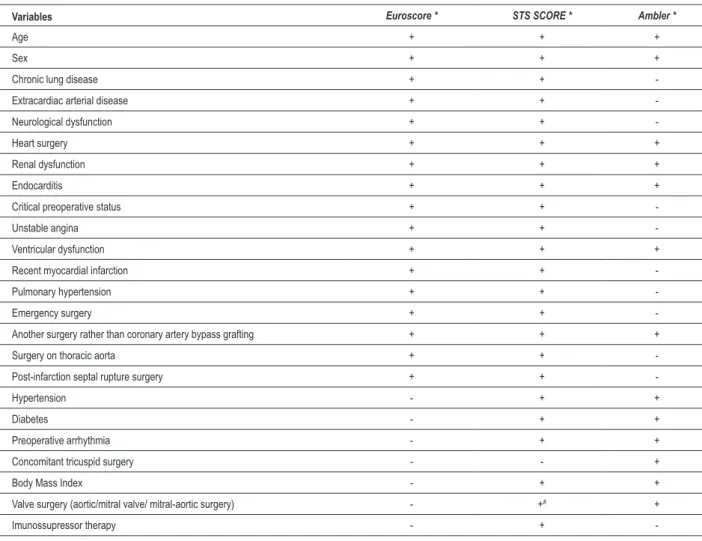
In order to predict postoperative mortality (primary outcome), the variables of patient and surgical procedure that comprise the risk models were chosen after univariate and multivariate analyzes (Table 1). The performance of scores is evaluated by the area under the ROC curve (AUC) and aims to differentiate patients with low or high risk of complications (increased risk of occurrence of the outcome). The AUC equal to the unit means 100% of accurate predictive ability. The discriminative capacity predicted by the scores on the initial validations was considered good to very good - AUC of 0.72, 0.72, 0.77 and 0.80, respectively, for additive and logistic Euroscore, Ambler and STS.
Another methodology used in the validation of risk scores is the calibration, in which we compare the mortality predicted by the score and that observed in the population studied. The most commonly used method is the Hosmer-Lemeshow test. It is expected that the observed and predicted mortality be equal from a statistical viewpoint (p > 0.05). In their validations, the scores showed good calibration. However, in other analyzes with different populations, the Ambler and logistic Euroscore overestimated mortality, while the STS underestimated it.
It is noteworthy that there are differences between our patients and the population evaluated in the initial studies that validate the risk scores. Worthy of note is the younger age of our patients, the prevalence of rheumatic etiology, which increases the frequency of combined procedures (mitral and aortic and mitral and tricuspid) and the amount of reoperations7. These considerations are important because
of the possibility of changing the percentages of patients at low and high risk and may affect the accuracy of the score in our population. However, when the Euroscore was applied in the Brazilian population, it showed ASRC of 0.73, i.e., good discriminative capacity8.
Although it is objective, there are limitations on the applicability of the score at the bedside and individualized approach is fundamental. Each variable has a weight that is comparable when using the score, but from the standpoint of clinical practice, this comparison may be inaccurate. An example of this inaccuracy was that of a patient aged 60 years and severe left ventricular dysfunction, which had an additive Euroscore of 4 and that of a female patient aged 73 with no comorbidities, who had an additive Euroscore of four points, as well. Definitely, these patients do not have the same operative risk, although they have the same Euroscore.
Keywords
Risk assessment; heart valve diseases / surgery; heart valve diseases / mortality; aortic valve stenosis.
Point of View
Casalino & Tarassoutchi Surgical risk in valve diseaseArq Bras Cardiol 2012;98(5):e84-e86
in which there was no difference among the procedures tested within one year of follow-up. Despite the use of scores in this work, we should know that the publications that have validated the clinical use of these tools did not include any cases of percutaneous procedure. Thus, the use of the scores to predict death in these patients is considered data extrapolation.
A Dutch retrospective study with 168 patients who underwent percutaneous valve replacement attempted to evaluate the performance of the logistic Euroscore and STS in predicting mortality and obtained some striking results with AUC of 0.49 and 0.69, respectively10.
Concluding remarks and perspectives
Preoperative stratification in surgery is fundamental because it is a way to predict events and, if possible, plan interventions. To this end, the tools must be validated in their respective institutions (sites with low and high volume
New procedures
The percutaneous procedure fills a gap complicated for surgeons and physicians in the surgical indication in valvular heart disease. Up to 35% of patients with severe aortic stenosis, elderly patients and those with significant comorbidities are not subjected to any procedures at high operative risk9.
For this purpose, percutaneous therapy (percutaneous valve replacement) was tested and confirmed as an eligible procedure in aortic stenosis of high operative risk. The evidence was generated by case reports, records and a prospective work1,2. The risk assessment of each patient was
determined by the surgical team responsible for each center and a minimum of 15% risk of preoperative mortality was expected (30 days post-procedure). To make the sample more homogeneous with respect to risk prediction, we used the STS of at least 10% as inclusion criteria. Patients were randomized to receive any of the therapies (surgery or percutaneous exchange)1,2. It was a non-inferiority study
Table 1 - Risk scores
Variables Euroscore * STS SCORE * Ambler *
Age + + +
Sex + + +
Chronic lung disease + +
-Extracardiac arterial disease + +
-Neurological dysfunction + +
-Heart surgery + + +
Renal dysfunction + + +
Endocarditis + + +
Critical preoperative status + +
-Unstable angina + +
-Ventricular dysfunction + + +
Recent myocardial infarction + +
-Pulmonary hypertension + +
-Emergency surgery + +
-Another surgery rather than coronary artery bypass grafting + + +
Surgery on thoracic aorta + +
-Post-infarction septal rupture surgery + +
-Hypertension - + +
Diabetes - + +
Preoperative arrhythmia - + +
Concomitant tricuspid surgery - - +
Body Mass Index - + +
Valve surgery (aortic/mitral valve/ mitral-aortic surgery) - +# +
Imunossupressor therapy - +
-(+) Presence of the variable in the score; (-) absence of the variable in the score; * Tools available online - www.euroscore.org; riskcalc.sts.org/STSWebRiskCalc273; www.ucl.ac.uk/statistics/research/riskmodel/index.html
(#) STS SCORE allows calculating aortic and isolated mitral valve surgeries; combined surgery cannot be included in the STS, only in Ambler.
Point of View
Casalino & Tarassoutchi Surgical risk in valve diseaseArq Bras Cardiol 2012;98(5):e84-e86
References
1. Leon MB, Smith CR, Mack M, Miller DC, Moses JW, Svensson LG, et al. Transcatheter aorticvalve implantation for aortic stenosis in patients who cannot undergo surgery. N Engl J Med. 2010;363(17):1597-607.
2. Smith CR, Leon MB, Mack MJ, Miller DC, Moses JW, Svensson LG, et al. Transcatheter versus surgical aortic-valve replacement in high-risk patients. N Engl J Med. 2011;364(23):2187-98.
3. Nashef SA, Roques F, Michel P, Gauducheau E, Lemeshow S, Salamon R. European system for cardiac operative risk evaluation (EuroSCORE). Eur J Cardiothorac Surg. 1999;16(1):9-13.
4. O’Brien SM, Shahian DM, Filardo G, Ferraris VA, Haan CK, Rich JB, et al. The Society of Thoracic Surgeons 2008 cardiac surgery risk models: part 2—isolated valve surgery. Ann Thorac Surg. 2009;88(1 Suppl):S23-42.
5. Shahian DM, O’Brien SM, Filardo G, Ferraris VA, Haan CK, Rich JB, et al. The Society of Thoracic Surgeons 2008 cardiac surgery risk models: part 3—valve plus coronary artery bypass grafting surgery. Ann Thorac Surg. 2009;88(1 Suppl):S23-42.
6. Ambler G, Omar RZ, Royston P, Kinsman R, Keogh BE, Taylor KM. Generic, simple risk stratification model for heart valve surgery. Circulation. 2005;112(2):224-31.
7. Tarasoutchi F, Montera MW, Grinberg M, Barbosa MR, Piñeiro DJ, Sánchez CRM, et al.; Sociedade Brasileira de Cardiologia. Diretriz brasileira de valvopatias - SBC 2011. / I Diretriz Interamericana de Valvopatias - SIAC 2011. Arq Bras Cardiol. 2011;97(5 supl. 3):1-67.
8. Andrade ING, Moraes Neto FR, Oliveira JPSP, Silva ITC, Andrade TG, Moraes CRR. Avaliação do EuroSCORE como preditor de mortalidade em cirurgia cardíaca valvar no Instituto do Coração de Pernambuco. Rev Bras Cir Cardiovasc. 2010;25(1):11-8.
9. Rosenhek R, Iung B, Tornos P, Antunes MJ, Prendergast BD, Otto CM, et al. ESC Working Group on Valvular Heart Disease Position Paper: assessing the risk of interventions in patients with valvular heart disease. Eur Heart J. 2011; 33(7):822-8.
10. Piazza N, Wenaweser P, van Gameren M, Pilgrim T, Tzikas A, Otten A, et al. Relationship between the logistic EuroSCORE and the Society of Thoracic Surgeons predicted risk of mortality score in patients implanted with CoreValve ReValving system—A Bern Rotterdam Study. Am Heart J. 2010;159(2):323-9.
of patients; proportions proper to the percentile of risk) and should preferably be updated continuously.
The percutaneous procedure is completely different from the surgery and such risk scores should not be the only tools used in clinical decision-making in valve disease. With increase in the volume of that procedure, the data generated may lead to new risk prediction tools.
Therefore, despite these limitations, when risk scores are properly used and interpreted are useful tools in clinical practice.
Potential Conflict of Interest
No potential conflict of interest relevant to this article was reported.
Sources of Funding
There were no external funding sources for this study.
Study Association
This article is part of the thesis of Doctoral submitted by Ricardo Casalino and Flávio Tarassoutchi, from Instituto do Coração – InCor - FMUSP.