Original Article
Artigo Original
Juliana Nogueira Chaves1
Ana Lívia Libardi1
Raquel Sampaio Agostinho-Pesse2
Marina Morettin3
Kátia de Freitas Alvarenga3
Descritores
Telemedicina Internet Triagem Neonatal Audição Família
Keywords
Telemedicine Internet Neonatal Screening Hearing Family
Correspondence address: Kátia de Freitas Alvarenga
Faculdade de Odontologia de Bauru, Departamento de Fonoaudiologia Alameda Doutor Octávio Pinheiro Brisola, 9/75, Cidade Universitária, Bauru (SP), Brasil, CEP: 17043-101. E-mail: [email protected] Received: 09/17/2014
Study carried out at the Speech-Language Pathology and Audiology Department, Dental School of Bauru, Universidade de São Paulo – USP – Bauru (SP), Brazil.
(1) Graduate Program in Speech-Language Pathology and Audiology, Dental School of Bauru, Universidade de São Paulo – USP – Bauru (SP), Brazil.
(2) Speech-Language Pathology and Audiology Clinic, Dental School of Bauru, Universidade de São Paulo – USP – Bauru (SP), Brazil.
(3) Speech-Language Pathology and Audiology Department, Dental School of Bauru, Universidade de São Paulo – USP – Bauru (SP), Brazil.
Conlict of interests: nothing to declare.
Tele-health: assessment of websites on
newborn hearing screening in Portuguese Language
Telessaúde: avaliação de websites sobre
triagem auditiva neonatal na Língua Portuguesa
ABSTRACT
Purpose: To verify the aspects of technical quality and the content of websites on neonatal hearing screening in Portuguese. Methods: Eighteen audiologists, invited to participate according to the inclusion criteria, selected descriptors of websites for research using the Delphi technique. Later, they were fed into Google Trends to get the possible terms to be used by parents in inding information on the Internet about the subject. They were then fed into Google to search the websites. The following assessment instruments were used: list of topics on newborn hearing screening, Flesch Reading Ease Score Formula, Health-Related Web Site Evaluation Emory Form, and PageRank. Results: The most discussed topics in the 19 websites were on the objectives and beneits of neonatal hearing screening, as well as the process of audiological diagnosis. The least discussed were about the false-negative result, development of hearing and language, false-positive results, audiologic, interpretation of results — “Pass”/”Do not pass”, retest, and protocol. Dificult reading level was prevalent, with aspects of technical quality considered the best quality-related content, audience, navigation, and structure. The results also showed there is no culture of inserting links on Brazilian national websites, so they had little relevance on Google. Conclusions: The sites differed in the aspects addressed because there is a need to revise the reading level of the content and quality of the technical aspects regarding the accuracy and timeliness of information, authorship, and links.
RESUMO
Objetivo: Veriicar os aspectos de qualidade técnica e o conteúdo dos websites sobre triagem auditiva neonatal na Língua Portuguesa. Métodos: Dezoito fonoaudiólogos, convidados de acordo com critérios de inclusão, selecionaram os descritores para a pesquisa dos websites por meio da Técnica Delphi. Posteriormente, foram inseridos no Google Trends a im de se acrescentar os termos possíveis de utilização pelos pais na busca de informações na internet sobre o assunto. Em seguida, foram inseridos no Google para pesquisa dos websites. Foram utilizados os seguintes instrumentos de avaliação: lista de tópicos sobre triagem auditiva neonatal, fórmula Flesch Reading Ease Score,questionário Health-Related Web Site Evaluation Form Emory e o
INTRODUCTION
Actions on child hearing health are often discussed to pre-vent, identify, diagnose, and treat hearing loss of congenital and acquired origin(1). In this context, the newborn hearing
screening (NHS) allows to identify the newborn with hear-ing impairment, and, consequently, diagnose and intervene in the irst months of life(2).
However, even with the release of Law No. 12.303, from August 2, 2010, which provides for the mandatory NHS at national level, there are many newborns who do not take (test) or do not complete (retest) the NHS(1,3,4). Thus, a broader
approach is necessary aiming at health education, that is, edu-cational actions involving the population, health professionals, and managers. For decades, the Internet has proven effective for the dissemination of several areas, the websites about health being the most visited ones(5).
Recently, a study showed that 89% parents search for infor-mation on the Internet within the irst hours or days after the result “Do not pass” in the newborn screening(6). These data
show that people are trying to solve their doubts outside the traditional interaction with expert professionals.
However, it is questionable just exactly how much this really is beneficial, because despite making the informa-tion more accessible to the individual, there is no control of the veracity of its content and the quality of all the websites. This also applies to the information regarding the NHS on the Internet, which makes it essential to evaluate the websites so that the professional involved in child hearing health may recommend parents to access information that is reliable and easily understandable.
Thus, the objective of the study was to verify the aspects of technical quality and the contents of the websites on NHS in Portuguese.
METHODS
This study is a part of the type of research on Tele-health and Speech Language and Audiology of the Speech Language Pathology and Audiology Department of theDental School of Bauru, Universidade de São Paulo (USP), with the approval of the Human Research Ethics Committee of this institution, iled under the process No. 09241412.8.0000.5417.
Deinition of descriptors for website research
The descriptors used in the search for websites on the NHS were deined from the opinion of specialists in the area and of the Google Trends tool.
Experts’ opinion
The descriptors were irst selected based on the opinion of audiologists and speech language pathologists using the Delphi Technique, which consists of an interactive activity to match the opinion of a group of specialists for obtaining a con-sensus on a given subject(7). The tool used for this study was
GoogleDocs (docs.google.com), a pack of free applications that allows the elaboration and online access to several kinds of iles. The sequence of activities involved in the execution of this technique is described next:
Selection of specialists
Audiologists and speech language pathologists who had a scientiic article indexed in LILACS database within the last 10 years on the NHS, e-mail for contact in the article or in the Lattes curriculum, as well as the minimum title of spe-cialist in the audiology ield informed in the Lattes curricu-lum were invited.
Invitation to the specialists
The professional received an invitation by e-mail contain-ing information on the participation in the study. In case of agreement, they accessed the electronic address speciied in the e-mail to begin their participation in the study. Twenty-eight audiologists and speech language pathologists who met the inclusion criteria of the study were invited, out of whom 18 (64%) agreed to take part in the study; all specialists who participated were female.
Filling out of the informed consent, identiication chart, and research questions
The professionals accessed the tool to answer the follow-ing contents:
1. Informed consent: to agree or not to participate in the study; 2. Identiication chart: after agreeing to participate in the study,
they informed demographic data; and
3. Question of the research: in this question they informed, at least, three descriptors used to access the information on the Internet about the NHS.
Elaboration of the questionnaire — First round
The participants had access to the questionnaire, First round (Q1), containing all the descriptors informed in the previous stage to validate them according to the Likert scale: 1=Completely disagree; 2=Disagree; 3=Indifferent; 4=Agree; and 5=Completely agree. It was stipulated that the descriptors with occurrence frequency of 80% in the sum of categories 4 and 5 of the scale would be recognized as a consensus among the participants, according to the study previously carried out in the area of health(8).
Analysis of the results and elaboration of the question-naire — Second round
Analysis of the results and elaboration of the question-naire — Third round
A statistical descriptive analysis of the results in Q2 was car-ried out. Thus, the questionnaire, Third round (Q3), presented a total percentile of the answers (feedback) of the previous round together with all the descriptors for the reassessment through the same scale. The maintenance of the descriptors in the subsequent round with occurrence frequency above 80% in the sum of the categories 4 and 5 of the Likert scale showed the establishment of the consensus among the partici-pants of the third round.
Google Trends
The Google Trends is a system which provides, from a descriptor, the related terms more often used by the users in a research using the search mechanism of Google. This way, it was attempted, through this system, to accomplish the survey of the possible terms used by parents in the search for infor-mation on the NHS on the Internet.
The descriptors in consensus with the Delphi Technique were fed into GoogleTrends, which provided the related terms used in the research by the users worldwide from January 2004 to November 2012. With that, there were added, to the other ones, the descriptors related to the NHS that differed from the ones obtained in the Delphi Technique.
Selection of the websites for evaluation
The descriptors obtained in the analysis of the specialists and in Google Trends were fed into the Google search mecha-nism during the month of November 2012. In the analysis, the general websites (i.e., those that did not approach the NHS), the electronic addresses identiied as blogs, articles, iles (.pdf, .doc, and .ppt), news, advertisement, as well as images and isolated videos were excluded. By considering previous
stud-ies(9,10), which found that most users who seek for
informa-tion about health on the Internet explore the irst results in the research, the ten irst electronic addresses obtained for each descriptor were selected.
Assessment of the websites
Three audiologists and speech language therapist research-ers in the study trained in child hearing health and professional experience in programs of identiication and intervention of hearing impairment in the irst months of life took part in the assessment of the websites. The websites were evaluated inde-pendently, being considered as the inal result the consensus obtained among most professionals. The following evaluation instruments were used:
• List of topics about the NHS(11): When considering the
ind-ings in literature on the aspects of interest of parents about newborn screening, a list of topics about the NHS for the qualitative analysis as for its presence or absence in the contents of the websites was developed (Chart 1).
• Health-Related Web Site Evaluation Form Emory Questionnaire(12): It is a questionnaire consisting of 36
questions divided into the subscales Content, Accuracy, Author, Updates, Public, Navigation, Links, and Structure. • Flesch Reading Ease Score(13):It is a formula that
classi-ies the intelligibility of a text, that is, the easiness of an individual to read the text(14). The classiication is based on
the number of syllables in the words and on the number of words in the phrases of a text.
• PageRank(15):It is a system from Google that classiies the
relevance of an electronic page. To determine the PageRank, the number of votes a page receives is considered, that is, if a page has a link to another one it is as if the irst one granted a vote to the second one, assigning a score from 0 (least important) to 10 (most important) according to the importance of the page.
RESULTS
Deining the descriptors for the research of the websites
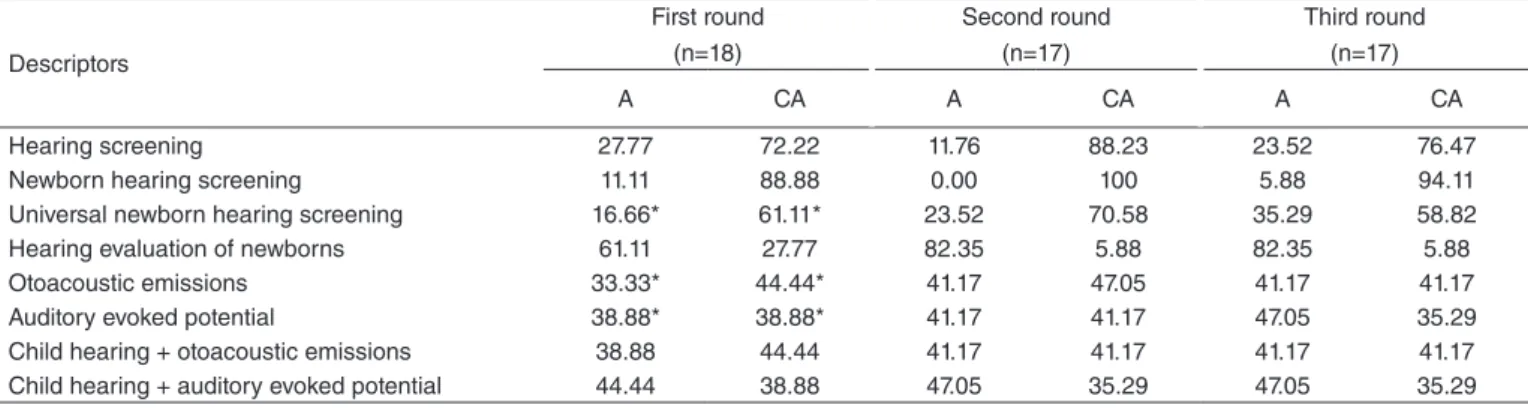
The descriptors considered in consensus by the audiolo-gists and speech therapists for the research of the websites on the NHS are given in Table 1. As the descriptors defined by the professionals included most of the ones obtained in Google Trends, we added to the other ones only the terms “Triagem neonatal”, “Teste da orelhinha”, and “Exame da orelhinha”.
Selection of the websites for evaluation
Nineteen websites were selected for evaluation (Chart 2), the descriptors being “Teste da orelhinha” and “Exame da orel-hinha”, the ones that selected electronic addresses less related to the exclusion criteria. The electronic addresses identiied as iles were the most recurrent ones in the research, followed by websites in general and articles.
Evaluation of the websites
The contents differed in the approached aspects on the subject, considering that only one website addresses all
Chart 1. List of the topics on newborn hearing screening for evaluation of the websites
Topics on newborn hearing screening Objectives
Benefits Protocol
Interpretation of the results — “Pass”/“Do not pass” False-positive result
False-negative result Retest
Hearing diagnosis process Audiologic follow-up
the topics proposed (Table 2). The most approached aspects in the contents of the websites were about the objectives and beneits of the NHS, as well as the process of hearing diag-nosis (Figure 1).
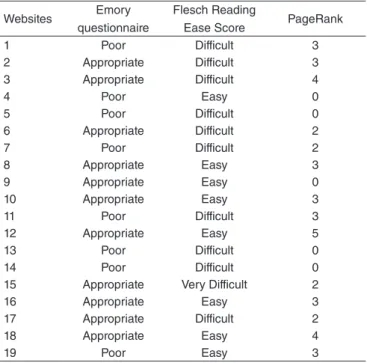
Most websites presented appropriate technical quality. Reading level of the texts considered dificult, few being used as links by other websites(Table 3). Figure 2 emphasizes that the subscales “Precision”, “Authors”, “Updates”, and “Links” were the worst classiied in the websites.
DISCUSSION
The selection of the descriptors by the professionals was important because it enabled a broader range of websites for the evaluation, once that the terms obtained through Google Trends that correspond to the ones used by the population for the research in the Internet were limited and not enough to select all websites. The terms “Teste da orelhinha” and “Exame da orelhinha” were the most assertive ones in the research of the websites,considering that the other ones selected a greater number of electronic addresses classiied according to the exclusion criteria.
When considering that Google(16)prioritizes the results
according to the proximity of the terms searched, the number of times the terms igure in the pages and the quality of the websites, this result shows that the terms proposed in national campaigns aimed at the population have been accepted and are being often used in the Internet. However, the remaining descriptors, technical as they are, enabled the selection of a large number of scientiic materials, such as articles, and web-sites of the companies responsible for the sale of devices and systems used in hearing screening.
In relation to the evaluation of the content of the selected websites, only one of them covered all topics proposed in this study (Table 2), considering that the topics most often present in the websites were the objectives and beneits of the NHS, fol-lowed by the process of hearing diagnosis (Figure 1). The least discussed aspects in the contents were in relation to the negative result, development of hearing and language, false-positive, audiologic follow-up, interpretation of the results (“Pass”; “Do not pass”), retest, and protocol (Figure 1). Such indings were similar to those described in previous works that analyzed the content on the Teste do Pezinho and showed that the orientation materials do not contemplate all aspects on the approached theme(17-19).
The quality of orientation to parents is extremely impor-tant, considering that it may relect in higher adherence in all stages of the process of identiication and intervention in hearing loss(1,3,20). This way, it is noteworthy the
impor-tance of the websites approaching the beneits of the NHS because it is not enough that the parents know this enables
Table 1. Distribution of the results (%) considered a consensus among the participants in three rounds of the Delphi technique
*No consensus established in the Round (<80%) Caption: A = agree; CA = completely agree
Descriptors
First round (n=18)
Second round (n=17)
Third round (n=17)
A CA A CA A CA
Hearing screening 27.77 72.22 11.76 88.23 23.52 76.47
Newborn hearing screening 11.11 88.88 0.00 100 5.88 94.11
Universal newborn hearing screening 16.66* 61.11* 23.52 70.58 35.29 58.82
Hearing evaluation of newborns 61.11 27.77 82.35 5.88 82.35 5.88
Otoacoustic emissions 33.33* 44.44* 41.17 47.05 41.17 41.17
Auditory evoked potential 38.88* 38.88* 41.17 41.17 47.05 35.29
Child hearing + otoacoustic emissions 38.88 44.44 41.17 41.17 41.17 41.17
Child hearing + auditory evoked potential 44.44 38.88 47.05 35.29 47.05 35.29
Chart 2. Relations of the evaluated websites
Selected websites
1 – http://site.climep.com.br/climep/index. php?iCodMenu=3901&sTipo=15
2 – http://www.hear-the-world.com/br/brazil/triagem-auditiva-neonatal.html
3 – http://www.gatanu.org/
4 – http://www.unimed.coop.br/pct/index.jsp?cd_canal=58815&cd_ secao=63013
5 – http://www.otorrinolaringologia.com.br/index.php?option=com_ content&view=article&id=93:triagem
-auditiva-neonatal&catid=11:materias&Itemid=9
6 – http://www.phonak.com/br/b2c/pt/hearing/awareness/discover/ newborn_screening.html
7 – http://www.testedaorelhinha.com.br/
8 – http://guiadobebe.uol.com.br/teste-da-orelhinha/ 9 – http://www.testedaorelhinhars.com.br/
10 – http://otorrinopediatrica.org.br/teste.asp
11 – http://www.uff.br/disicamep/teste_da_orelhinha.htm 12 – http://www.senado.gov.br/senado/campanhas/orelhinha/ default.html
13 – http://testedaorelhinha.com/
14 – http://www.brasilescola.com/fonoaudiologia/a-importancia-teste-orelhinha-nos-bebes-recemnascidos.htm
15 – http://www.sbp.com.br/show_item2.cfm?id_categoria=21&id_ detalhe=1635&tipo_detalhe=s
16 – http://www.abcdasaude.com.br/artigo.php?43 17 – http://www.emissoesotoacusticas.com.br/
18 – http://www.telexbr.com.br/audicao_infantil.php?id=7
Table 2. Relation of the topics on newborn hearing screening in the contents of the websites (n=19)
Caption: (+) = presence of the topic in the content; (-) = absence of the topic in the content
Websites Objectives Benefits Protocol Interpretation of the results
False-positive
result
False-negative
result
Retest
Hearing diagnosis
process
Audiologic follow-up
Hearing and language development
1 + - - - + -
-2 + + + + + - + + + +
3 + + + - - - + + +
-4 + - - -
-5 + + - - + - - + +
-6 + + + + - - + + -
-7 + - - -
-8 + + - - - +
9 + + + + - - + - - +
10 + + + + + + + + + +
11 + - - -
-12 + - - + - - - + -
-13 + + + + - - + + -
-14 + + - - -
-15 + + - - + - - + +
-16 + - - - + - - + -
-17 + - + - - - + + -
-18 + + - - -
-19 + - - -
-Objectives
19
11
12 8
7
13 6
14
18
13
11
14
15 6
8
5
4 5
1 Benefits
Protocol
Interpretation of the results
False-positive result
False-negative result
Retest
Hearing diagnosis process
Audiologic follow-up
Hearing and language development
0 2
Ausente Presente
4 6 8 10 12 14 16 18 20
the early identiication of the disability, but that the irst year of life is considered to be critical for the development of the child, and the best result will be obtained if the intervention begins within this period.
The interpretation of the results, including the possibil-ity of false-positive results, is an important information at the moment of orientation. Parents must know that the result “Do not pass” in the screening may represent the presence of hearing loss as well as also a false-positive result, that is, despite not having passed the screening, the newborn has normal hearing
Table 3. Classification of the websites according to the evaluation tools used
Websites Emory
questionnaire
Flesch Reading
Ease Score PageRank
1 Poor Difficult 3
2 Appropriate Difficult 3
3 Appropriate Difficult 4
4 Poor Easy 0
5 Poor Difficult 0
6 Appropriate Difficult 2
7 Poor Difficult 2
8 Appropriate Easy 3
9 Appropriate Easy 0
10 Appropriate Easy 3
11 Poor Difficult 3
12 Appropriate Easy 5
13 Poor Difficult 0
14 Poor Difficult 0
15 Appropriate Very Difficult 2
16 Appropriate Easy 3
17 Appropriate Difficult 2
18 Appropriate Easy 4
19 Poor Easy 3
and the result was due to factors such as the vernix and noise, among others. Thus, parents would be less apprehensive in the period preceding the hearing diagnosis in the reference service, resulting in less emotional impact, which inluences the fam-ily dynamics. The same way, understanding the result “Pass” does not ensure the absence of hearing loss, being necessary the follow-up of the development of the hearing and language function by the family, which also enables the diagnosis of late onset or acquired hearing losses. Therefore, it is notewor-thy the importance of the contents to approach the develop-ment of hearing and language so that parents may identify an abnormality in the development of the child and search for a health professional.
The protocol used in the program and the possibility of retesting are related to the procedures used in the screening (otoacoustic emissions and auditory brainstem response), associated to the presence or absence of risk indicators for hearing loss. Thus, it is fundamental that the websites are based on the recommendations by the committees and sci-entiic societies so that there is a consensus in the informa-tion provided and the understanding by parents regarding the adopted conduct.
Despite this technical analysis, the fact that the website does not approach all aspects of the subject does not make it inad-equate, considering that the interest aspects by parents change according to the stage experienced in the program. With that only basic information should be provided in the beginning of the process of identiication of alteration and detailing after the result of the screening is concluded(18,22-24).
This vision by the parents is coherent, but it is essential that the website provides links for others, which will allow parents to access all necessary information. In this context, the subscale “Links” takes on an important role in the analy-sis of the quality of the website. In this study, several websites
0
0
1 1
3 3
C
ont
ent
Excellent (≥90%) Appropriate (75%≤x<90%) Poor (<75%)
P
recision Author
s
Updat
es
P
ub
lic
Na
vig
ation Links
Str
uctur
e
Ov
er
all
5 5 5
9 9
9
0 0 0 0 0
2
2 4
4 6
8
8 8
10 12 14
15 15
11 11
19
14 14
16 18 20
were considered poor because they did not use or inadequately used this strategy (Figure 2). This inding was reinforced by the scores obtained in the PageRank (Table 3), showing there is no culture of inserting links in national websites, which made them little relevant in Google.
It is also possible to observe in Table 3 that the texts with Reading level considered as dificult according to the Flesch Reading Ease ScoreFormula were predominant, whose clas-siication is based on the number of syllables contained in the words and on the number of words in the phrases of a text. This level of reading was also predominant among other guidance materials destined to parents(17,23,25,26).
However, the language used regarding the use of technical terms and the level of detailing of the information were classi-ied, predominantly, as excellent and appropriate, as shown in the subscale “Public” (Figure 2). Thus, most websites evaluated in this study worried about developing their contents accord-ing to what is recommended by the literature, with an acces-sible language to the target audience regardless their school-ing level(27-29).
The technical quality of the websites was proven appro-priate in most evaluated websites (Figure 2). However, there were some aspects with unfavorable classiications related to the subscales “Precision”, “Authors”, and “Updates”.
The subscale “Precision” was considered poor in most websites. This means that even the subscale “Content” having been considered appropriate in most websites, it is necessary to review the quality of information.
The subscale “Authors” was considered poor in most of the evaluated websites because the information of contact and cre-dential of the authors were not available. This way, an opportu-nity was not given to parents to clarify their doubts regarding the contents and to verify the accuracy of this information due to the lack of credentials of the authors. This result reinforces the insecurity, the concern, and the disappointment of parents when using as source of knowledge on newborn screening as reported in previous studies(6,30).
A noteworthy fact is that the aspects related to the updates of the contents were classiied as poor in all websites, evidenc-ing the need of providevidenc-ing the publication date of the website and, especially, updating the information to cover the advances in the area. Recently, Law No. 12.303 was approved, which makes mandatory the performance of the NHS at national level. This is an information that should be made available in all web-sites, considering that parents prepared with this knowledge may demand the right of conducting the exam.
The aspects focused on navigation and structure of the websites were well classiied (Figure 2). However, they do not show accessibility resources for people with visual and hear-ing impairments, which is in contrast to the national plan of inclusion of people with disabilities. This characteristic was also identiied in a previous study(12) related to the evaluation
of a website in the area of health, which brought about the need of using strategies to promote accessibility to the con-tents for each different group of people with special needs.
CONCLUSION
In relation to content, the websites differed as for the approached aspects, being the objective of the NHS the most approached one and the possibility of a false-positive result the least approached one. The aspects of technical quality with sat-isfactory classiication were related to content, public, naviga-tion, and structure, and the ones of unfavorable classiication referred to precision and the update of the information, authors, and links. There is the need to review the intelligibility of the texts, considering that the predominant Reading level was con-sidered dificult in the available contents.
ACKNOWLEDGMENTS
We are thankful for the effective participation of the audi-ologists and speech language therapists involved in the irst stage of this process.
*KFA, MM, and JNC were responsible for the design of the study; JNC, ALL, and RSAP were responsible for the collection and tabulation of the data, and writing of the manuscript; KFA was responsible for the project and overall guidance of the stages of execution and elaboration of the manuscript, as well as the review and approval of the inal version.
REFERENCES
1. Alvarenga KF, Bevilaqcua MC, Melo TM, Lopes AC, Moret ALM. Participação das famílias em programas de saúde auditiva: um estudo descritivo. Rev Soc Bras Fonoaudiol. 2011;16(1):49-53.
2. Brasil. Ministério da Saúde. Secretaria de Atenção à Saúde. Departamento de Ações Programáticas Estratégicas. Diretrizes de atenção da triagem auditiva neonatal. Brasília: Mistério da Saúde; 2012. 3. Alvarenga KF, Gadret JM, Araújo ES, Bevilacqua MC. Triagem auditiva
neonatal: motivos da evasão das famílias no processo de detecção precoce. Rev Soc Bras Fonoaudiol. 2012;17(3):241-7.
4. Pacheco LC, Tochetto TM, Checalin MA, Carvalho CDM. Information on neonatal hearing screening from pregnant women of different social classes. Einstein. 2009;7(2):159-62.
5. Hoving C, Visser A, Mullen PD, van den Borne B. A history of patient education by health professionals in Europe and North America: from authority to shared decision making education. Patient Educ Couns. 2010;78(3):275-81. 6. DeLuca JM, Kearney MH, Norton SA, Arnold GL. Internet use by
parents of infants with positive newborn screens. J Inherit Metab Dis. 2012;35(5):879-84.
7. Oliveira JSP, Costa MM, Wille MFC. Introdução ao método Delphi. 1. ed. Curitiba: Mundo Material; 2008.
8. Morettin M. Classiicação internacional de funcionalidade, incapacidade e saúde, versão crianças e jovens (CIF-CJ): elaboração de um checklist
para a avaliação da funcionalidade em usuários de implante coclear [tese]. São Paulo: Universidade de São Paulo; 2012.
9. Eysenbach G, Köhler C. How do consumers search for and appraise health information on the world wide web? Qualitative study using focus groups, usability tests, and in-depth interviews. BMJ. 2002;324(7337):573-7. 10. Laplante-Lévesque A, Brännström KJ, Andersson G, Lunner T. Quality
12. Bastos BG. Telessaúde: avaliação de um website como ferramenta de auxilio ao aconselhamento de pais de crianças usuárias de aparelho de ampliicação sonora individual [dissertação]. Bauru: Universidade de São Paulo; 2011. 13. Martins TBF, Ghiraldelo CM, Nunes MGV, Oliveira Jr. ON. Readability
formulas applied to textbooks in brazilian Portuguese [Internet]. 1996 [citado 23 fevereiro 2014]. Disponível em: http://www.nilc.icmc.usp.br/ nilc/download/Reltec28.pdf
14. Barboza EMF, Nunes EMA. A inteligibilidade dos websites governamentais brasileiros e o acesso para usuários com baixo nível de escolaridade. Inclusão Social. 2007;2(2):19-33.
15. Diaz-Isenrath C. Um estudo sobre Google: questões para uma leitura micropolítica das tecnologias da informação. Liinc em revista. 2005;1(2):96-117.
16. GOOGLE. Por que usar o Google [internet]. [citado 22 fevereiro 2015.] Disponível em: http://www.google.com.br/why_use.html.
17. Fant KE, Clark SJ, Kemper AR. Completeness and complexity of information available to parents from newborn-screening programs. Pediatrics. 2005;115(5):1268-72.
18. Hargreaves KM, Stewart RJ, Oliver SR. Newborn screening information supports public health more than informed choice. Health Educ J. 2005;64(2):110-9.
19. Araia MH, Potter BK. Newborn screening education on the internet: a content analysis of North American newborn screening program websites. J Community Genet. 2011;2(3):127-34.
20. Araia MH, Wilson BJ, Chakraborty P, Gall K, Honeywell C, Milburn J. et al. Factors associated with knowledge of and satisfaction with newborn screening education: a survey of mothers. Genet Med. 2012;14(12):963-70. 21. Hargreaves KM, Stewart RJ, Oliver SR. Informed choice and public
health screening for children: the case of blood spot screening. Health Expect. 2005;8(2):161-71.
22. Davis TC, Humiston SG, Arnold CL, Bocchini JA, Bass PF, Kennen EM, et al. Recommendations for effective newborn screening communication: results of focus groups with parents, providers, and experts. Pediatrics. 2006;117(5 Pt 2):326-40.
23. A r n o l d C L , D av i s T C , H u m i s t o n S G , B o c c h i n i JA , B a s s PF, Bocchini A, et al. Infant hearing screening: stakeholder recommendations for parent-centered communication. Pediatrics. 2006;117(5 Pt 2):341-9.
24. Tluczek A, Orland KM, Nick SW, Brown RL. Newborn screening: an appeal for improved parent education. J Perinat Neonatal Nurs. 2009;23(4):326-34.
25. Williams N, Mughal S, Blair M. “Is my child developing normally?”: a critical review of web-based resources for parents. Dev Med Child Neurol. 2008;50(2):893-7.
26. Antonarakis GS, Kiliaridis S. Internet-derived information on cleft lip and palate for families with affected children. Cleft Palate Craniofac J. 2009;46(1):75-80.
27. [No authors listed]. Serving the family from birth to the medical home: newborn screening: a blueprint for the Future - A call for a national agenda on state newborn screening programs. Pediatrics. 2000;106(2 Pt 2):389-422.
28. DeLuca JM, Kearney MH, Norton SA, Arnold GL. Parents’ experiences of expanded newborn screening evaluations. Pediatrics. 2011;128(1):53-61.
29. MedlinePlus. How to write easy-to-read health materials [Internet]. 2011 [citado 23 fevereiro 2014]. Disponível em: http://www.nlm.nih.gov/ medlineplus/etr.html