Cluster analysis of cognitive
performance in a sample of patients
with Parkinson’s disease
Carolina Pinto Souza1, Guiomar Nascimento Oliveira1, Maria Paula Foss1, Vitor Tumas1
ABSTRACT. Background: Cognitive impairment is a common feature of Parkinson’s disease (PD). The diagnoses of mild cognitive impairment (MCI) in patients with PD implies an increased risk for later development of dementia, however, it is unclear whether a specific type of cognitive loss confers increased risk for faster cognitive decline. Objective: Determine whether it was possible to identify distinct cognitive phenotypes in a sample of patients with PD. Methods: A cross-sectional evaluation of 100 patients with PD recruited from a movement disorders clinic was conducted. The patients were evaluated using the simplified motor score of the UPDRS, the Hoehn and Yahr, Schwab and England, Geriatric Depression Scale, Pfeffer Functional Activities Questionnaire, Clinical Dementia Rating Scale, Mini-Mental State Examination, clock drawing test, digit span, word list battery of CERAD, Frontal Assessment Battery and verbal fluency test. We classified the patients as having normal cognition (PDNC), MCI (PDMCI) or dementia (PDD). Data were analyzed using the chi-square test, non-parametric statistics and cluster analysis. Results: There were 40 patients with PDD, 39 with PDMCI and 21 with PDNC. Patients with PDD were older, had longer disease duration, lower education and lower MMSE scores. Cluster analysis showed 3 general distinct cognitive profiles that represented a continuum from mild to severe impairment of cognition, without distinguishing specific cognitive profiles. Conclusion: Cognitive impairment in PD occurs progressively and heterogeneously in most patients. It is unclear whether the definition of the initial phenotype of cognitive loss can be used to establish the cognitive prognosis of patients.
Key words: Parkinson’s disease, cognitive impairment, dementia, mild cognitive impairment, cluster analysis.
“ANÁLISE DE CLUSTER” DO DESEMPENHO COGNITIVO EM UMA AMOSTRA DE PACIENTES COM DOENÇA DE PARKINSON
RESUMO. Embasamento: O comprometimento cognitivo é um problema comum da doença de Parkinson (DP). O diagnóstico de comprometimento cognitivo leve (CCL) em pacientes com DP implica em risco aumentado para o desenvolvimento posterior de demência, no entanto, não é claro se algum tipo específico de perda cognitiva confere risco para um declínio cognitivo mais rápido. Objetivo: Determinar se seria possível identificar fenótipos cognitivos em uma amostra de pacientes com DP. Métodos: Foi uma avaliação transversal de 100 pacientes com DP recrutados de uma clínica de distúrbios de movimento. Eles foram avaliados utilizando um escore motor simplificado da UPDRS, Hoehn e Yahr, Schwab e England, Escala de Depressão Geriátrica, Questionário de Atividades Funcionais de Pfeffer, Escala CDR, Mini-Exame do Estado Mental, desenho do relógio, extensão de dígitos, lista de palavras da bateria do CERAD, bateria de avaliação frontal e teste de fluência verbal. Nós classificamos os pacientes como tendo cognição normal (PDCN), CCL (PDCCL) ou demência (PDD). Os dados foram analisados por meio do teste do qui-quadrado, estatística não-paramétrica e análise de cluster. Resultados: Havia 40 pacientes com PDD, 39 com PDCCL e 21 com PDCN. Pacientes com PDD eram mais velhos, tinham maior tempo de doença, menor escolaridade e desempenho inferior no MEEM. A análise de
cluster mostrou 3 perfis cognitivos distintos que representariam um continuo entre discreto a grave comprometimento
da cognição, sem distinguir perfis cognitivos específicos. Conclusão: O comprometimento cognitivo na DP ocorre de forma progressiva e heterogênea na maioria dos pacientes. Não é claro se a definição do fenótipo inicial de perda cognitiva poderia ser utilizado para estabelecer o prognóstico cognitivo para o paciente.
Palavras-chave: doença de Parkinson, comprometimento cognitivo, demência, comprometimento cognitivo leve, análise de agrupamento.
This study was conducted at theDepartment of Neuroscience and Behavior, Ribeirão Preto School of Medicine, University of São Paulo, Ribeirão Preto, SP, Brazil.
1Department of Neuroscience and Behavior, Ribeirão Preto School of Medicine, University of São Paulo, Ribeirão Preto, SP, Brazil.
Vitor Tumas. Department of Neuroscience and Behaviour Sciences / Ribeirão Preto School of Medicine – University of São Paulo – Campus Universitário Ribeirão Preto – 14049-900 Ribeirão Preto SP – Brazil. E-mail: [email protected]
Disclosure: The authors report no conflicts of interest.
Received October 06, 2016. Accepted in final form November 17, 2016.
INTRODUCTION
C
ognitive impairment is a common feature of Par-kinson’s disease (PD). Many patients present with mild cognitive impairment (MCI) even at disease onset and most develop dementia during the course of the disease.1,2 Cognitive decline has a negative impact onthe quality of life of patients and caregivers, increases the risk for institutionalization and death, and also sig-niicantly increases the costs of the disease.3-5 here are
many risk factors associated with cognitive decline in PD, including age, duration of disease, severity of motor symptoms and the diagnosis of MCI.6
MCI in patients with PD has a cross-sectional preva-lence of around 25%, and patients with PD may present impairment in many diferent cognitive domains such as attention, memory, visuospatial function, executive function and language.7,8 he clinical presentation of
MCI in PD varies widely, and there is also substantial variation in the progression of cognitive deicits across patients.2
MCI in PD has only recently been more extensively studied. Most studies have shown that the diagnosis of MCI implies an increased risk for later development of dementia, however, it remains unclear whether a spe-ciic type of cognitive loss confers increased risk for faster cognitive decline.2
Observations from diferent studies about this issue are clearly controversial. Janvin et al. suggested that single domain non-memory MCI and multiple domains MCI were associated with later development of demen-tia.9 Hobson et al. linked impairment of memory and
language to increased risk for developing dementia.10
Janvin et al. reported that poor performance on a test sensitive to executive dysfunction predicted later devel-opment of dementia in PD patients,11 while Levy et al
found that impairment in verbal memory and execu-tive function were associated with the development of dementia in patients with PD.12 We can conclude from
these observations that it is not presently possible to deine whether speciic cognitive MCI proiles are asso-ciated with faster development of dementia in patients with PD.
he presentation and evolution of cognitive impair-ment in patients with PD appears to be heterogeneous, and it is important to determine whether MCI pheno-types can be identiied that can characterize speciic sub-groups of patients which are more sensitive to faster conversion to dementia.
he aim of this study was to identify diferent cogni-tive proiles in a Brazilian sample of patients with PD using cluster analysis.
METHODS
We evaluated 100 patients diagnosed with PD according to the United Kingdom Brain Bank diagnostic criteria for PD,13 comprising 58 males, who consecutively attended
the movement disorders outpatient clinic of the Ribeirão Preto School of Medicine. Patients were evalu-ated by 2 neurologists (C. P. S. and G. N. O.) using many clinical tools: a simpliied motor score of the UPDRS (smUPDRS), the Hoehn and Yahr and the Schwab and England scales, as well as the 15-item Geriatric Depres-sion Scale (GDS15). he smUPDRS assessed the same signs evaluated by the Short Parkinson’s Evaluation Scale but with the original 5-point items of the UPDRS.14 his
shortened scale has shown good reliability and validity in Brazilian patients with PD.15 Patients presenting with
delirium, moderate or severe hallucinations, depression, or who did not have best control of motor symptoms were not included in the study. he cognitive and func-tional evaluations were performed using the Pfefer Functional Activities Questionnaire, Clinical Dementia Rating (CDR), Mini-Mental State Examination, the clock drawing test, digit span from the WAIS-III battery, word list battery of the CERAD, Frontal Assessment Battery and semantic verbal luency test. After evalua-tion, patients were classiied as having normal cognition (PDNC), MCI (PDMCI) or dementia (PDD) according to MDS diagnostic criteria.16,17 Patients with motor
luc-tuations were examined while in the “on state”.
Statistical analyses were performed using the SPSS 19 software package and the level of statistical signii-cance was deined as p<0.05. he local research eth-ics committee approved the study and all participants signed the informed consent form.
RESULTS
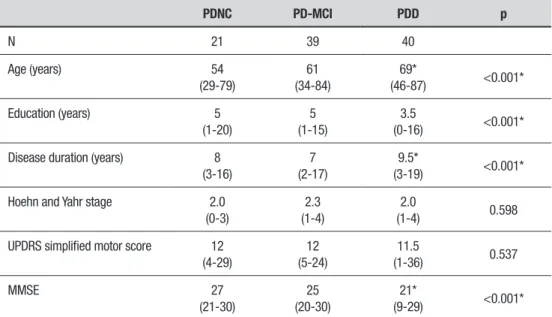
he clinical evaluation led to the diagnosis of PDD in 40 patients (40%), PD-MCI in 39 patients (39%) and PDNC in 21 patients (21%) (Table 1). Patients with PDD were older, had longer disease duration, lower educa-tion and lower MMSE scores than those with PDMCI or PDNC. here were not signiicant diferences among groups according to disease stage and severity of motor symptoms.
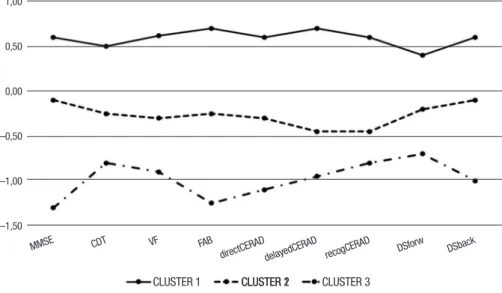
Cluster analysis was perform in order to divide the individuals of the sample into groups that were het-erogeneous between one another, and which included homogeneous subjects within the same group according to individual cognitive performance. his analysis char-acterized three distinct groups in the sample:
– Cluster 1: consisting of 38 subjects: 23 patients with PDD, 13 patients with PD-MCI and 2 patients with PDNC, having a mean age of 67 years, mean education of 4 years and mean CDR of 0.6.
– Cluster 2: consisting of 42 subjects: 17 patients had PDNC, 25 PD-MCI, and none had PDD. his cluster comprised younger subjects (mean age=56 years), with higher education (mean=6.74 years) and lower scores on the CDR scale (mean=0.2). Based on the median
and z-scores, the performance of this group showed a tendency for better results than the other groups on all cognitive tests.
– Cluster 3: consisting of 14 subjects: all patients with PDD. Medians and z-scores were lower on all cogni-tive tests than the other groups, suggesting more severe cognitive loss. he individuals in this cluster were older than those in cluster 1, and had less education (mean 3.6 years) and higher CDR than the two other groups (mean 1.5).
We found no diferences in gender distribution among the three groups. here was a signiicant difer-ence only in age, education and CDR (p<0.001).
Figure 1 depicts the performance of each cluster on each cognitive test, based on its mean z-scores.
DISCUSSION
Cognitive dysfunction is a common feature of patients with PD, as was also shown by the indings of our study. Using simple and relatively short cognitive tests, only 21 out of 100 patients were diagnosed with normal cogni-tion. Patients diagnosed with dementia and MCI corre-sponded to 39% and 40% of all cases from our sample, respectively. hese prevalence igures are similar to those observed in other studies evaluating patients followed in specialized centers and slightly higher than the average expected values.8,18 hese indings were
expected because a specialized clinic usually represents a sample of more complicated cases of the disease.
Many authors agree that the diagnosis of MCI
Table 1. Clinical and demographic data of this sample of 100 patients with PD, represented by medians (min-max).
PDNC PD-MCI PDD p
N 21 39 40
Age (years) 54
(29-79)
61 (34-84)
69*
(46-87) <0.001*
Education (years) 5
(1-20)
5 (1-15)
3.5
(0-16) <0.001*
Disease duration (years) 8 (3-16)
7 (2-17)
9.5*
(3-19) <0.001*
Hoehn and Yahr stage 2.0 (0-3)
2.3 (1-4)
2.0
(1-4) 0.598
UPDRS simplified motor score 12 (4-29)
12 (5-24)
11.5
(1-36) 0.537
MMSE 27
(21-30)
25 (20-30)
21*
(9-29) <0.001*
MMSE: Mini-Mental State Examination; CDT: Clock Drawing Test; VF: Semantic word fluency; FAB: Frontal Assessment Battery; directCERAD: CERAD word list direct recall; delayedCERAD: CERAD word list delayed recall; recogCERAD: Word list recognition; DSforw: Digit span forward; DSback: Digit span backward
Figure 1. Graph illustrating z-score of each cluster in each cognitive test. The black line represents cluster 1, comprising PD-MCI patients (59%) and PDNC (41%) patients. This group had better cognitive performance than the other groups, with z-scores higher than the others on all tests. The dashed line represents cluster 3, comprising only patients with PDD and showing lower z-scores than the other groups on all tests. The dotted line represents cluster 2, comprising patients with PDD (60.5%), PD-MCI (34.2%) and PDNC (5.3%). This group had intermediate z-scores compared to the other 2 groups.
implies a greater risk for developing dementia in patients with PD. However, it seems that the progres-sion of cognitive impairment may be highly heteroge-neous for only the clinical subtype of MCI. In the general population, it is clear that multiple domains MCI and greater involvement of memory are associated with an increased risk for subsequent development of demen-tia.19 In patients with PD, it is possible that factors other
than the cognitive phenotype determine the risk for progression of the cognitive deicit. Cognitive deteriora-tion in PD has several possible pathophysiological mech-anisms, and it may be that the clinical presentation of cognitive deicits does not correlate directly with these. Recently, some authors have suggested that diferent cognitive proiles in PD could indicate distinct patho-physiological mechanisms.20 According to this
hypoth-esis, executive dysfunction would relect abnormalities of the frontostriatal projections due to striatal dopami-nergic deicit while prominent memory and posterior deicits would represent Lewy body pathological deposi-tion in cortical areas and also cortical cholinergic deple-tion.20 However, there are other observations
suggest-ing that the pathophysiology of cognitive impairment in PD may be much more complex and unpredictable than that proposed in this dual syndrome hypothesis.21
More-over, studies describing the clinical characteristics and diferent MCI subtypes in patients with PD have shown highly variable results.22 In order to understand the
main determinants of onset and progression of cogni-tive impairment in patients with PD, larger longitudinal studies monitoring diferent biomarkers are required.
Another objective and simple way of analyzing this in a cross-sectional evaluation is to perform a cluster analysis based on data from cognitive tests. Some stud-ies have used this statistical methodology to determine the existence of diferent clinical subtypes of PD, but this has not frequently been used to analyze the hetero-geneity of the cognitive impairment in these patients. In a study of 40 patients with PD without dementia, McKinlay et al. (2009) determined the presence of three distinct cognitive proiles in this sample.23 hese were
characterized as a group of patients without cognitive impairment, a group with uncertain cognitive pro-ile, and another group with loss in multiple cognitive domains. Dujardin et al. (2013) conducted the same analysis in a sample of 558 patients with PD.24 hey
multiple domains MCI, while patients in cluster 4 and 5 had more severe cognitive impairment in multiple cog-nitive domains. Our indings were very similar to those observed in these two studies. Although the study of Dujardin et al. deined ive diferent clusters,24 the
dif-ferent clusters represent general stages of progressive global cognitive deterioration and do not discriminate between speciic cognitive proiles. It is presently not possible to characterize any particular pattern of cogni-tive impairment potentially associated with a speciic cognitive prognosis. We can conclude from these obser-vations that overall proiles of cognitive performance make up a continuum from normal cognition to demen-tia in patients with PD.
Another explanation for our indings is that patients with PD may be separated into diferent clinical sub-types, especially taking into account non-motor symp-toms. hus, our patients may have been clustered into distinct groups in relation to cognition only because they belonged to distinct clinical subtypes of PD. his way of classifying diferent PD subtypes is based on
evi-dence that neuronal loss can occur diferently in the dif-ferent nuclei afected by the neurodegenerative process. Under these circumstances, the 3 subtypes identiied by us would probably represent distinct subtypes of PD.25
he main limitations of our study were the small number of patients evaluated and the use of a limited battery that included only simple cognitive bedside tests.
In conclusion, cognitive impairment in PD occurs progressively and heterogeneously in most patients, and it is unclear whether the deinition of the initial phenotype of cognitive loss can be used to establish the cognitive prognosis for patients.
Author contribution. Carolina Pinto Souza: acquisition
of data and analysis of results; Guiomar Nascimento Oliveira: acquisition of data and analysis of results; Maria Paula Foss: design of the study and critical review of the manuscript; Vitor Tumas: design of the study, analysis of the results and drafting of the manuscript.
REFERENCES
1. Aarsland D, Bronnick K, Larsen JP, Tysnes OB, Alves G. Cognitive impairment in incident, untreated Parkinson disease: the Norwegian ParkWest study. Neurology. 2009;72(13):1121-6.
2. Goldman JG, Litvan I. Mild cognitive impairment in Parkinson’s disease. Minerva Med.102(6):441-59.
3. Leroi I, McDonald K, Pantula H, Harbishettar V. Cognitive impairment in Parkinson disease: impact on quality of life, disability, and caregiver burden. J Geriatr Psychiatry Neurol. 2012;25(4):208-14.
4. Garcia-Ptacek S, Farahmand B, Kareholt I, Religa D, Cuadrado ML, Eriksdotter M. Mortality risk after dementia diagnosis by dementia type and underlying factors: a cohort of 15,209 patients based on the Swedish Dementia Registry. J Alzheimers Dis. 2014;41(2):467-77. 5. Vossius C, Larsen JP, Janvin C, Aarsland D. The economic impact
of cognitive impairment in Parkinson’s disease. Mov Disord. 2011;26(8):1541-4.
6. Litvan I, Aarsland D, Adler CH, Goldman JG, Kulisevsky J, Mollenhauer B, et al. MDS Task Force on mild cognitive impairment in Parkinson’s disease: critical review of PD-MCI. Mov Disord. 2011;26(10):1814-24. 7. Aarsland D, Bronnick K, Fladby T. Mild cognitive impairment in
Parkin-son’s disease. Curr Neurol Neurosci Rep. 2011;11(4):371-8. 8. Aarsland D, Bronnick K, Williams-Gray C, Weintraub D, Marder K,
Kuli-sevsky J, et al. Mild cognitive impairment in Parkinson disease: a multi-center pooled analysis. Neurology. 2010;75(12):1062-9.
9. Janvin CC, Larsen JP, Aarsland D, Hugdahl K. Subtypes of mild cogni-tive impairment in Parkinson’s disease: progression to dementia. Mov Disord. 2006;21(9):1343-9.
10. Hobson P, Meara J. Risk and incidence of dementia in a cohort of older subjects with Parkinson’s disease in the United Kingdom. Mov Disord. 2004;19(9):1043-9.
11. Janvin CC, Aarsland D, Larsen JP. Cognitive predictors of dementia in Parkinson’s disease: a community-based, 4-year longitudinal study. J Geriatr Psychiatry Neurol. 2005;18(3):149-54.
12. Levy G, Jacobs DM, Tang MX, Cote LJ, Louis ED, Alfaro B, et al. Memory and executive function impairment predict dementia in Parkin-son’s disease. Mov Disord. 2002;17(6):1221-6.
13. Hughes AJ, Daniel SE, Kilford L, Lees AJ. Accuracy of clinical diagnosis of idiopathic Parkinson’s disease: a clinico-pathological study of 100 cases. J Neurol Neurosurg Psychiatry. 1992;55(3):181-4.
14. Rabey JM, Bass H, Bonuccelli U, Brooks D, Klotz P, Korczyn AD, et al. Evaluation of the Short Parkinson’s Evaluation Scale: a new friendly scale for the evaluation of Parkinson’s disease in clinical drug trials. Clin Neuropharmacol. 1997;20(4):322-37.
15. Tumas V UL, Ferreira GM. Utility and reliability of a simplified clinical scale for Parkinson’s disease. Arq Neuropsiquiatr. 2004;62(suppl 2):S220-S1. 16. Emre M, Aarsland D, Brown R, Burn DJ, Duyckaerts C, Mizuno Y, et
al. Clinical diagnostic criteria for dementia associated with Parkinson’s disease. Mov Disord. 2007;22(12):1689-707.
17. Litvan I, Goldman JG, Troster AI, Schmand BA, Weintraub D, Petersen RC, et al. Diagnostic criteria for mild cognitive impairment in Parkinson’s disease: Movement Disorder Society Task Force guidelines. Mov Disord. 2012;27(3):349-56.
18. Aarsland D, Zaccai J, Brayne C. A systematic review of preva-lence studies of dementia in Parkinson’s disease. Mov Disord. 2005;20(10):1255-63.
19. Dickerson BC, Sperling RA, Hyman BT, Albert MS, Blacker D. Clinical prediction of Alzheimer disease dementia across the spectrum of mild cognitive impairment. Arch Gen Psychiatry. 2007;64(12):1443-50. 20. Kehagia AA, Barker RA, Robbins TW. Cognitive impairment in
Parkin-son’s disease: the dual syndrome hypothesis. Neurodegener Dis. 2013;11(2):79-92.
21. Halliday GM, Leverenz JB, Schneider JS, Adler CH. The neurobiolog-ical basis of cognitive impairment in Parkinson’s disease. Mov Disord. 2014;29(5):634-50.
22. Kalbe E, Rehberg SP, Heber I, Kronenbuerger M, Schulz JB, Storch A, et al. Subtypes of mild cognitive impairment in patients with Parkinson’s disease: evidence from the LANDSCAPE study. J Neurol Neurosurg Psychiatry. 2016.87(10):1099-105.
23. McKinlay A, Grace RC, Dalrymple-Alford JC, Roger D. Cognitive char-acteristics associated with mild cognitive impairment in Parkinson’s disease. Dement Geriatr Cogn Disord. 2009;28(2):121-9.
24. Dujardin K, Leentjens AF, Langlois C, Moonen AJ, Duits AA, Carette AS, et al. The spectrum of cognitive disorders in Parkinson’s disease: a data-driven approach. Mov Disord. 2013;28(2):183-9.