© 2012 Dental Press Journal of Orthodontics 6 Dental Press J Orthod. 2012 Mar-Apr;17(2):6
Optimizing time and space
editorial
To sail is necessary; to live is not necessary. (Pompey, Roman general, 106–48 BC)
In my first editorial,1 I made a brief analysis of the
construction of the Dental Press Journal of Orthodon-tics (DPJO). In contrast to the poetic and emotional vein of that first text,1 fruit of the profound gratitude to
those that appointed me captain of this ship, I will use this opportunity to describe, to our readers and other collaborators (publishers, authors and reviewers), some of the adjustments to be made in this journal. These changes begin in this issue and will be completed in the next (17.3), or maybe will never cease, depending on sea winds and our disquiet. The role of the editor is to chart the course of the journal and to steer the helm so that the prow is kept in the direction of the route de-fined by our predecessors.
The main scope of such effort was to reduce the navigating time between manuscript submission and effective publication, as stated at the end of that pre-vious editorial.1 The high incoming of manuscripts is
the main reason why DPJO takes a mean of three years to complete the whole process. Our objective is to reach, by the end of 2012, a maximum time of eighteen months and reduce it further until we manage to navi-gate this route in six to twelve months. Unfortunate-ly, to achieve these goals, some “not so sympathetic” measures should be taken.
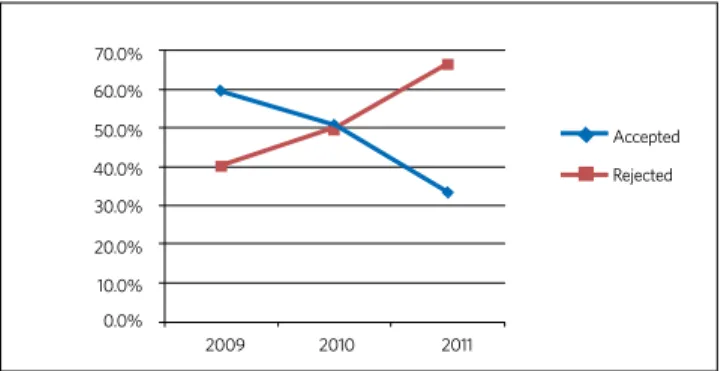
The acceptance rate for manuscripts submitted in 2009 was 60%; it went down to 50% in 2010, and corre-sponded to only 1/3 (34%) of all submissions in 2011 (Fig 1). Although no rigid goal has been defined, the level of re-jection of manuscripts submitted in 2012 is expected to be close to 75%.
The second measure is to increase the number of manuscripts published in each issue of the journal. For that, the number of studies published online will increase, a measure that has started to be delineated in 2010. The perspective for this year is to publish six online articles for each issue. The new layout of the journal, starting with the current number, will also favor the inclusion of four more manuscripts in each journal issue. These measures, in as-sociation with the reduction of articles size, now limited to 3500 words, will lead to more objective manuscripts in which the main information receives intense focus. Therefore, our readers will have more information in each issue and authors will enjoy the pleasure of seeing their production sailing away into the world sooner.
Submissions will also be adjusted. We are conduct-ing a minor restructurconduct-ing of the board of reviewers to increase the number of foreign collaborators and to meet the requirements of international indexing databases. Moreover, the Dental Press Journal of Or-thodontics will soon accept only submissions in Eng-lish. The purpose of this decision is to make it easier to prepare the journal layout. However, the print version in Portuguese will continue being delivered to all sub-scribers; for now, only the English version will remain available online via SciELO.
For a mature journal, the changes suggested actual-ly amount to almost nothing in light of such a well con-ceived and consolidated enterprise. Only a few changes at the helm to prioritize the movement to where the prow is directed. Modest adjustments to make our car-tography more precise and to optimize time and space so that we achieve the aim of consolidating the “neces-sity” so acclaimed by Pompey and that have been part of our lives since before Christ.
Enjoy your reading!
David Normando – Editor-in-chief [email protected]
1. Normando D. A journey, I mean, a journal. Dental Press J Orthod. 2012 Jan-Feb;17(1):6-7.
REFERENCES
Figure 1 - Relative frequency (%) of manuscripts accepted and rejected by the Dental Press Journal of Orthodontics in 2009, 2010 and 2011.
70.0%
50.0%
30.0%
10.0% 60.0%
40.0%
20.0%
0.0%
2009 2010 2011