Profile of the orthodontist practicing in the state of São Paulo - Part 1
Fabio Brandalise Rampon1, Celestino Nóbrega2, José Luiz Gonçalves Bretos3, Franco Arsati4, Sérgio Jakob5, Maria Cristina Jimenez-Pellegrin6
How to cite this article: Rampon FB, Nóbrega C, Bretos JLG, Arsati F, Jacob S, Jimenez-Pellegrin MC. Profile of the orthodontist practicing in the state of São Paulo - Part 1. Dental Press J Orthod. 2012 Nov-Dec;17(6):22.e1-6.
Submitted: June 17, 2009 - Revised and accepted: June 30, 2010
» The author reports no commercial, proprietary or financial interest in the products or companies described in this article.
Contact address: Cristina Jimenez-Pellegrin
Rua José Rocha Junqueira, 13 – Ponte Preta – Campinas/SP – Brazil CEP: 13.045-610 – E-mail: [email protected]
1 MSc in Dentistry, São Leopoldo Mandic School of Dentistry. 2 Specialist in Orthodontics, ABO. MSc in Oral Radiology UNICASTELO. 3 MSc in Orthodontics, UNICASTELO. PhD in Sciences, UNIFESP. 4 MSc and PhD in Dentistry, Unicamp.
5 MSc in Orthodontics, UNICASTELO. PhD in Dentistry, São Leopoldo Mandic School of Dentistry.
6 Professor, São Leopoldo Mandic School of Dentistry. MSc in Orthodontics,São Leopoldo Mandic School of Dentistry. Specialist in Orthodontics, UNICASTELO. PhD in Sciences, USP.
Introdução: a Ortodontia, como toda ciência, é um campo em permanente evolução e desenvolvimento. No panorama atual, devido à oferta de diversos tipos de materiais e das opções biomecânicas existentes, além do desenvolvimento de novos resos de diagnóstico, surgiram novas possibilidades de se abordar o tratamento ortodôntico. Em adição, com o aumento dos cur-sos de pós-graduação, torna-se importante conhecer o perfil do especialista e os recurcur-sos de sua preferência. Objetivo: anali-sar o perfil do ortodontista que atua no estado de São Paulo, por meio de questões elaboradas com o objetivo de avaliar aspectos relacionados à prática ortodôntica. Métodos: foi enviado um questionário a 2.414 especialistas em Ortodontia e Ortopedia Facial inscritos no Conselho Regional de Odontologia do estado de São Paulo. Para avaliar a associação entre as variáveis qua-litativas, foi utilizado o teste de associação Qui-quadrado, ao nível de significância de 5%. Resultados: foram devolvidos 593 (24,65%) questionários preenchidos. O perfil da amostra foi sexo masculino (54,3%), faixa etária entre 41 e 50 anos (40,5%) e com tempo de inscrição no CRO-SP de 6 a 10 anos (29,3%). As três análises cefalométricas mais citadas foram o padrão USP (71,5%), McNamara (59,2%) e Ricketts (52,8%). Conclusões: com base na análise estatística dos dados, pode-se concluir que a técnica Straight-Wire foi a mais empregada (74,5%), a qual está associada a ortodontistas com menos de 10 anos de especiali-dade. A maioria da população pesquisada (52,4%) utiliza, de forma rotineira, recursos ortopédicos funcionais no seu dia a dia.
Palavras-chave: Pesquisa em Odontologia. Distribuição por idade e sexo. Técnicas.
Introduction: Orthodontics is no different from other sciences to the extent that it is a field in constant evolution and develop-ment. Nowadays, given the availability of a wide range of materials and biomechanical resources, as well as the development of new diagnostic capabilities, new methods to manage orthodontic treatment have emerged. Furthermore, due to the prolifera-tion of postgraduate programs, it is increasingly important to gain insight into the profile of these specialists and the resources they use. Objective: Examine the profile of orthodontists practicing in the State of São Paulo. The questions were prepared to evaluate different aspects of orthodontic practice. Methods: A questionnaire was sent to 2.414 specialists in Orthodontics and Dentofacial Orthopedics registered with the Regional Board of Dentistry of São Paulo State (CRO-SP). To assess the as-sociation between qualitative variables, the Chi-square asas-sociation test was employed at 5% significance level. Results: Five hundred ninety-three (24.65%) questionnaires were completed and returned. The sample profile consisted of males (54.3%), aged between 41 and 50 (40.5%), who had been registered with the São Paulo Regional Board of Dentistry (CRO-SP) for 6 to 10 years (29.3%). The three most widely mentioned cephalometric analyses were standard USP (71.5%), McNamara (59.2%) and Ricketts (52.8%). Conclusions: Based on a statistical analysis of the data one can conclude that the Straight-Wire technique was used most often (74.5%), and this technique is associated with orthodontists who have been specialists for less than 10 years. Most people surveyed (52.4%) routinely make use of functional orthopedic resources in their daily practice.
INTRODUCTION
Orthodontics is the oldest dental specialty, as it was the first to organize and establish itself in fact and in law. Increasing interest in this profession leads many to search for information about it in all parts of the world so that knowledge about its origins, precur-sors and pioneers is widespread. Such knowledge is essential to fully understand dentistry’s current
evo-lutionary stage.17
Currently, clinicians are faced with different phi-losophies or approaches to treatment planning and a variety of biomechanical resources. Nevertheless, the supply of different bracket designs with different pre-scriptions and orthodontic wires featuring different properties makes it necessary to choose the resource most suitable to each case.
Every day new research and new technologies are offered to professionals with the purpose of facilitat-ing their practice and providfacilitat-ing comfort to patients. However, knowledge and mastery of these resources are essential.
In parallel, there has been a substantial increase in the number of postgraduate courses that deliver into the market a younger generation of orthodontists whose characteristics are different from those of the older generation.
In this context, it becomes important to shed light on the professional profile of orthodontists who prac-tice in São Paulo, the major Brazilian state,
account-ing for 59.4% of nationwide dental research.4 It is also
apropos to learn about the techniques and resources employed by these health care providers to meet the expectations of their patients.
METHODS
To conduct this research the Regional Board of Dentistry of São Paulo was requested to provide a list of addresses of all specialists in Orthodontics and Facial Orthopedics registered by May 2007, comprising a total of 2,414 professionals. The questionnaire included a prepaid reply envelope and had 20 objective questions, eight of which gave respondents the opportunity to check more than one alternative. In addition, 10 questions allowed professionals to add a written response with a de-scriptive text of their own. Each participant was duly informed about the nature of the research and
assured full confidentiality of all information pro-vided, to be used exclusively in the research pur-suant to a consent form, which was duly signed by all. A prepaid reply service agreement was signed with the Post and Telegraph Company. This service exempted respondents from any expenses. Profes-sionals received the questionnaire at their regis-tered address and all they had to do was answer the questionnaire, fold it and glue it as indicated and mail it from any post office in Brazil. The mail was posted so that it did not reach its destination at the end of the week, but preferably earlier in the week, when prepaid reply letters are more likely to
be returned.11 Based on the responses to the
ques-tionnaires an attempt was made to fully describe and interrelate the information in order to ex-tract as much data as would be required to reach conclusions consistent with the purpose of this
study. Computer software, i.e., Microsoft Excel®
and Microsoft Windows® XP’s graphical wizard,
were used for data entry. Questionnaire responses were analyzed through charts and tables and clas-sified according to either absolute (n) or relative frequency (%). To assess the association between qualitative variables, the Chi-square association test was applied. Where the chi-square test was significant, adjusted residual analysis was used as a complement. Statistical analysis was performed
using software SPSS® version 13.0.
RESULTS
Sample size was set to the number of completed questionnaires received by the researchers. Out of a total of 2414 prepaid reply letters sent to the target population, 593 (24.56%) were returned to the sender with completed questionnaires, 64 (2.65%) were re-turned to the sender by return mail due to insufficient, unknown or change of address, and 1757 (72.78%) were not returned.
Professional profile
The profile of the selected sample comprised: males (54.3%), aged between 41 and 50 (40.5%), who had been registered with the São Paulo Regional Board of Dentistry (CRO-SP) for 6 to 10 years (29.3%).
Table 3 -Distribution of orthodontists according to clinical situations in which a given orthodontic technique was preferred.
Table 2 -Distribution of the major analyses requested by orthodontists.
Multiple response question.
n %
Class III 38 13.4
Class II 26 9.2
Age 23 8.1
Facial pattern 23 8.1
Anchorage control 16 5.6
High complexity 15 5.3
Brackets tipping 5 1.8
Other 53 18.7
Total 284
-Table 1 - Distribution of orthodontists according to gender and age.
χ2 = 21,22; p < 0,001. * Adjusted Residual Analysis: p<0.05.
Age Group
Gender
Total
Male Female
n % n % n %
Up to 40 112 35.1 117 44.2* 229 39.2
41 to 50 121 37.9 117 44.2 238 40.8
Over 50 86 27.0* 31 11.7 117 20.0
Total 319 100 265 100 584 100
n %
USP 424 71.5
McNamara 351 59.2
Ricketts 313 52.8
Jarabak 177 29.8
Tweed 67 11.3
Steiner 64 10.8
Wits 40 6.7
Bimler 37 6.2
Unicamp 15 2.5
Schwars 13 2.2
Trevisi 10 1.7
Profis 8 1.3
Petrovic 6 1.0
Does not request 5 0.8
Other 40 6.4
Total 593
-of São Paulo, out -of 593 respondents, 8.1% had been registered for over 25 years, 8.3% from 21 to 25 years, 9.1 % between 16 and 20 years, 16.2% from 11 to 15 years, 29.3% between 6 to 10 years and 26.8% between 1 and 5 years (2.2% of the sample did not answer this question).
The relationship between respondent gender and
age is detailed in Table 1 where, using χ2 test,
comple-mented by adjusted residual analysis at a 5% signifi-cance, it was found that men’s age group consisted of individuals over 50 years of age, while the women’s age group remained below 40 years.
Analyses
The orthodontists were inquired about which analyses they usually request (Table 2).
Orthodontic techniques
The first part of the question regarded the choice of orthodontic technique, if it was made according to the type of malocclusion, and it became clear that there was no prevailing opinion (Fig 1) and, when the response was affirmative, the second part requested respondents to describe the clinical situation in which this choice was made (Table 3).
Figure 1 -Distribution of orthodontists regarding the choice or not of orthodontic technique according to the type of malocclusion.
No answer
Basis: 593 respondents
No Yes
1.9% 47.9%
Multiple response questions
Among the most commonly used orthodontic
tech-niques (Table 4) it was noted that – by means of the χ2
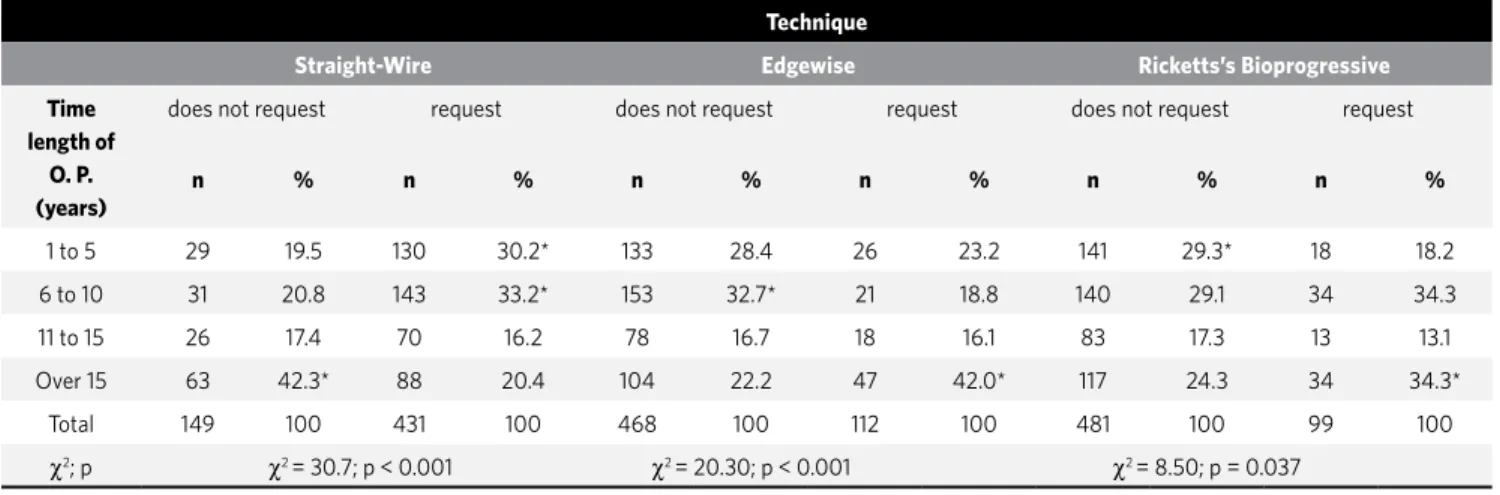
Test, complemented by the adjusted residual analysis at a 5% significance level, the use of the Straight-Wire technique is associated with specialists with less than 10 years practice, while its non-use is associated with a period of over 15 years; the edgewise technique is as-sociated with specialists with over 15 years and its non-use is linked to a range between 6 and 10 years; Ricketts’ bioprogressive technique is associated with more than 15 years of practice (Table 5).
Functional orthopedic resources
One of the questions inquired about the percent-age with which functional orthopedic resources were employed (Fig 2).
DISCUSSION
Knowledge of the professional profile is of para-mount importance in evaluating many factors related to training, continuing education, preferences and needs of those who pursue a specific activity.
This study sought to glean information that might contribute to shedding light on the features of ortho-dontists with practices in São Paulo State, Brazil and, to this end, a survey was conducted through question-naires mailed with prepaid reply envelopes. Out of a total of 2,414 questionnaires 24.56% returned to the
sender, similarly to the studies by Pissetti and Feres13
who received 27.24% of the questionnaires back, Souza
et al,16 with 22.92%, and Soares et al,15 with 27.43%. In
other studies, the rate of return of mail was much lower,
as that of Queiroz Jr and Feres14 (15.65%); Gottlieb et al5
(14%), Gottlieb et al6 (11.2%); Keim et al7 (9%).
Table 5 -Relationship between time length of orthodontic practice and technique used.
* Adjusted Residual Analysis: p < 0.05.
Technique
Straight-Wire Edgewise Ricketts’s Bioprogressive
Time length of
O. P. (years)
does not request request does not request request does not request request
n % n % n % n % n % n %
1 to 5 29 19.5 130 30.2* 133 28.4 26 23.2 141 29.3* 18 18.2
6 to 10 31 20.8 143 33.2* 153 32.7* 21 18.8 140 29.1 34 34.3
11 to 15 26 17.4 70 16.2 78 16.7 18 16.1 83 17.3 13 13.1
Over 15 63 42.3* 88 20.4 104 22.2 47 42.0* 117 24.3 34 34.3*
Total 149 100 431 100 468 100 112 100 481 100 99 100
χ2; p χ2 = 30.7; p < 0.001 χ2 = 20.30; p < 0.001 χ2 = 8.50; p = 0.037
Figure 2 - Distribution of orthodontists according to the use of functional orthopedic resources.
No answer Routinely
Basis: 593 respondents
Never Occasionally 44.1%
2.2%
1.3% 52.4%
Table 4 -Distribution of orthodontists according to the technique most often used in orthodontic practice.
n %
Straight-Wire 442 74.5
Edgewise 112 18.9
Ricketts’ Bioprogressive 101 17.0
Segmented arch 92 15.5
MD3 26 4.4
MBT 15 2.5
Tweed-Merrifield 10 1.7
Begg 4 0.7
Other 24 4.1
Total 593
Fifty-four point three percent of the respondents were male and 44.7% female, similarly to the study
by Smith et al,15 in which 55% of the orthodontists
were male and 45% female, denoting gender balance.
Although Murray1 reported a prevalence of women
in England, he found that job aspirations are chang-ing, that career interruption, part-time jobs, financial pressures, constant stress, job development and satis-faction, are not gender specific.
In this study, the age group that prevailed ranged from 41 to 50 years (40.5%), consistent with the me-dian age of Brazilian orthodontists, which was 42
years13,14 and 41 years,16 and with the median age of
US orthodontists.5,6,7,12 On the other hand, Smith et
al15 and Pantaleão12 found a prevalence of ages 31 to
40 years, with 55.05%. Moreover, the female gen-der was associated with ages below 40 years and the male gender with ages above 50 years,
corroborat-ing Andrade.1
Results concerning the number of years ortho-dontists had been registered with the Regional Board of Dentistry (CRO-SP) disclosed a range of 6 to 10 years (29.3%), followed by 1 to 5 years (26.8%),
similar to the values found by Pantaleão12 and by
Soares et al,15 respectively, indicating that demand
for specialization courses in orthodontics has in-creased in the last ten years.
Regarding preference for different cephalomet-ric analyses, the São Paulo University (USP) stan-dard predominated (71.5%) as well as the study by
Pantaleão.12 On the other hand, Steiner’s was the
most widely used analysis in other studies6,7,13,16 and
ranked sixth (10.8%) in this study.
When asked if they selected the orthodontic tech-nique according to the type of malocclusion, 50.3% gave a negative response while 47.9% reported that the orthodontic technique varied according to the clinical situation to be resolved. Given the descrip-tive nature of this question there was a wide range of replies, with particular emphasis on Class III (13.4%) and Class II (9.2%) cases, age and skeletal character-istics of the patient being treated (both 8.1%). This response highlights the array of philosophies and
biomechanical options currently available.2,8
Assum-ing, however, that any orthodontic technique should provide for the treatment of any type of malocclusion, this outcome seems inconsistent.
The development of new orthodontic materials is undoubtedly one of the most promising fields in the upcoming years. Currently, the edgewise tech-nique is the foundation upon which the orthodon-tic specialty is grounded. Modifications and refine-ments to the original technique impart a new dy-namics to clinical treatment, as represented by the
groundbreaking Straight-Wire technique.8
Among the orthodontic techniques most com-monly used by orthodontists in São Paulo State, the Straight-Wire technique (74.5%) predominated, following the trend of US values found by Gottlieb
et al5 (64.75%), Gottlieb et al6 (76.4%) and Keim et
al7 (94.4%), comprising all preadjusted technique
prescriptions. This trend can also be seen in Brazil
according to Souza et al16 (62.93%) and Pantaleão,12
who reported that over 90% of orthodontic profes-sionals prefer this technique.
Statistical analysis showed an association be-tween the use of the Straight-Wire technique and being a specialist for fewer than 10 years, as well as an association between non-use of this technique and being a specialist for longer than 15 years. In retrospect, percentage increases in the adoption of the Straight-Wire technique in Brazil have been
confirmed by the findings of Queiroz Jr and Feres14
(32.62%); Pissetti and Feres13 (41.14%), Souza et al16
(62.93%) and the present study (74.5%). In the US, the total sum of preadjusted appliances of differ-ent prescriptions relative to the number of years in orthodontic practice has remained consistently and routinely above 90%, such as in the age groups 1-5 years (98.9%), 5 to 10 years (93.4%) and 11-15 years
(99.2%).7
Classical edgewise and Ricketts’ bioprogressive techniques have proven to be more widely employed by more experienced professionals since these tech-niques were associated with specialists who had over 15 years experience, as corroborated by the study of
Keim et al,7 which revealed that respondents with
more than 26 years of orthodontic practice were the ones who more often applied these techniques.
be noted, however, that archwire individualization is an essential factor in properly finishing orthodontic treatment, even when straight wires are utilized, indi-cating that training in wire bending is paramount.
The routine use of functional orthopedic resources by 52.4%, and occasional use by 44% of professionals showed an expressive overall acceptance, which proved
higher than that found by preliminary studies.12,13,16
The joint work of orthodontists, who report their preferences and clinical needs side by side with com-panies, which develop, test and market new materials, seek to impart greater quality to orthodontic products.
Moreover, professional skill and scientific knowledge are the key to a successful treatment.
CONCLUSION
Field research outcomes led the authors to con-clude that the Straight-Wire technique was the most widely used, and that this technique is associated with orthodontists who registered with the São Paulo Re-gional Board of Dentistry (SP-CRO) less than 10 years ago. Most professionals, when questioned, revealed that they use functional orthopedic resources rou-tinely in their practice.
1. Andrade M. A revolução silenciosa. Rev ABO Nac. 1999;7(2):198-201. 2. Brito Júnior VS, Ursi WJS. O aparelho pré-ajustado: sua evolução e suas
prescrições. Rev Dental Press Ortod Ortop Facial. 2006;11(3):104-56. 3. Capelozza Filho L, Silva Filho OG, Ozawa TO, Cavassan AO. Individualização de
braquetes na técnica straight-wire: revisão de conceitos e sugestão de indicações para uso. Rev Dental Press Ortod Ortop Facial. 1999;4(4):87-106.
4. Cavalcanti AL, Melo TRNB, Barroso KMA, Souza FEC, Maia AMA, Silva ALO. Perfil da pesquisa científica em Odontologia realizada no Brasil. Pesq Bras Odontoped Clin Integr. 2004;4(2):99-104.
5. Gottlieb EL, Nelson AH, Vogels DS. 1990 JCO study of orthodontic diagnosis and treatment procedures. 1. Results and trends. J Clin Orthod. 1991;25(3):145-56. 6. Gottlieb EL, Nelson AH, Vogels DS. 1996 JCO Study of orthodontic diagnosis and
treatment procedures. Part 1. Results and trends. J Clin Orthod. 1996;30(11):615-29. 7. Keim RG, Gottlieb EL, Nelson AH, Vogels DS. 2002 JCO study of orthodontic
diagnosis and treatment procedures. Part 1. Results and trends. J Clin Orthod. 2002;36(10):553-68.
8. Mazzieiro ET. Braquetes do sistema Straight-Wire: o que eles realmente significam? J Bras Ortodon Ortop Facial. 2005;10(58):449-59. 9. Mendonça S. Ortodontia nos tempos globalizados. São Paulo: Ed. Univ.
Guarulhos; 2004.
REFERENCES
10. Murray JJ. Better opportunities for women dentists: a review of the contribution of women dentists to the workforce. Br Dent J. 2002;192(4):191-6.
11. Oppenheim AM. Questionnaire design, interviewing and attitude measurement. 1st ed. London: Pinter; 1993.
12. Pantaleão AM. Estudo da prática ortodôntica no Distrito Federal [dissertação]. Campinas (SP): São Leopoldo Mandic; 2007.
13. Pissette AP, Feres MAL. II Estudo sobre a prática ortodôntica no Brasil – 1995. Ortodontia. 1997;30(3):7-15.
14. Queiroz Jr. G, Feres MAL. Estudo sobre a prática ortodôntica no Brasil. Ortodontia. 1994;27(3):67-77.
15. Soares ED, Carvalho AS, Barbosa JA. Relação comercial do ortodontista brasileiro com o seu paciente, natureza obrigacional dos serviços prestados e riscos do tratamento ortodôntico. Rev Dental Press Ortod Ortop Facial. 2007;12(1):94-101. 16. Souza CEV, Feres MAL, Petrelli E. Quem somos e como estamos em relação à
Ortodontia contemporânea no Brasil: terceiro estudo. J Bras Ortodon Ortop Facial. 2003;8(47):401-18.