Segment al hair mercury evaluat ion
of a single family along t he Upper
M adeira Basin, Brazilian Amazon
Avaliaç ão d e me rc úrio e m se g me nto s
d e c ab e lo d o s ind ivíd uo s d e uma únic a
família re sid e nte na Bac ia d o Alto Mad e ira,
Amazô nia Brasile ira
1 Departamento de Ciências Biológicas, Universidade Estadual de Feira de Santana. Av. Universitária s/no, Módulo I.
Feira de Santana, BA 44031- 460, Brasil. 2 Department of Environmental Health, School of Medicine, University of Rochester. 575 Elmwood Avenue, Box EHSC, Rochester, NY 14642, U.S.A.
3 School of Public and Environmental Affairs, Indiana University. Bloomington, IN 47405-2100, U.S.A.
Ana Amélia Peixoto Boischio1 Elsa Cernichiari2
Diane Henshel3
Abst ract Mercury pollution (MeHg) up the aquatic food chains in the Amazonian ecosystems has been a major concern in environmental health. Riverside people (ribeirinhos) along the Up-per Madeira river are heavy fish eaters. Hair is the best biomarker for MeHg exposure. By assum-ing a constant hair growth rate, it is possible to evaluate a temporal profile of Hg exposure over the recent defined past. In this paper we present the segmental total hair Hg concentrations from a single family from which some of the 10 persons investigated had high hair Hg concentrations (peak of 339 ppm). We also presented the hair MeHg content from 4 out of the 10 family members investigated. There was a wide variation in total hair Hg concentrations (8 to 339 ppm) among these individuals, who were mostly sharing their meals; there was also a wide variation in total Hg concentrations in the same individual over time (136 to 274 ppm). Hg speciation showed a mean and standard deviation in the MeHg content of 62% and 6%, respectively. The wide varia-tion in total hair Hg concentravaria-tion strongly indicated that it is possible to mitigate critical Hg exposure levels by conducting a fish advisory.
Key words Mercury; Mercury Poisoning; Fishes; Exposed Population
Resumo A poluição por mercúrio orgânico (MeHg) das cadeias alimentares aquáticas nos ecos-sistemas amazônicos constitui tema de relevância na saúde ambiental. O MeHg pode chegar às populações humanas mediante o consumo de peixe. Os ribeirinhos do Alto Madeira consomem grandes quantidades de peixe. O cabelo é o melhor biomarcador para exposição ao MeHg; é pos-sível também assumir uma taxa constante de crescimento do cabelo, para verificar o comporta-mento das exposições no passado recente. Neste trabalho apresentamos as concentrações de Hg total (máxima de 339 ppm) em segmentos de 3 cm de cabelo de dez pessoas de uma única famí-lia. Apresentamos também os percentuais de MeHg nas amostras de cabelo de quatro pessoas, dentre as dez em estudo. Nessa família, foi observada uma grande variação na concentração de Hg total (8 a 339 ppm) no cabelo de pessoas que repartiam suas refeições no mesmo domicílio. Foi também observada uma grande variação de Hg total (136 a 274 ppm) nos diversos segmentos de cabelo da mesma pessoa. A especiação de Hg mostrou média e desvio padrão do conteúdo de MeHg de 62% e 6%, respectivamente. As variações das concentrações de Hg em cabelo sugerem ser possível prevenir exposições críticas através de recomendações de consumo de peixe.
Int roduct ion
Mercury (Hg) pollution in the Amazonian ecosystems is a major environmental health concern. Hg sources have probably been a combination of soil erosion, gold mining, and forest fires (Roulet et al., 1999). The local Hg cy-cle includes its organification and subsequent bioaccumulation up the aquatic food chain. Fish may be the main source of organic mer-cury (mostly methyl mermer-cury – MeHg) expo-sure for humans (IPCS, 1990). Fish consump-tion is an important feature in the lives of riverside people communities in the Amazon (Goulding, 1980; Moran, 1990). Riverside peo-ple along the Upper Madeira basin may thus be exposed to critical MeHg levels through fish consumption (Boischio & Henshel, 1996).
Hair is the best biomarker for MeHg expo-sure, because hair contains the -SH protein groups for which MeHg cations have high affin-ity. MeHg is bound to hair strands at the time of hair formation in proportion to the MeHg concentration in blood. Once bound to the hair, MeHg concentration remains constant. Hair MeHg measurement is useful because by assuming a constant rate of hair growth (aver-age 1 cm per month), it is possible to recapitu-late a temporal profile of MeHg exposure over the recent defined past. To do so one must ana-lyze Hg in segments of hair measured from the scalp portion (Clarkson et al., 1988).
Critical hair MeHg levels associated with clinical symptoms are different for adult and prenatal life. Observations during the Iraq epi-demic showed that adults increased their risk of developing numbness in the fingers at hair Hg concentrations in the range of 50 to 125 ppm. Other clinical symptoms (including im-pairment of gait, speech, and hearing) and death were observed at hair Hg concentrations in the range of 200 to 1,500 ppm (Clarkson, 1997). From studies among Amazonian river-side people, Lebel et al. (1996) concluded that the test battery used for sensorial and motor performance was useful for detecting subtle adverse effects on the nervous system when hair Hg levels were below 50 ppm.
Infants exposed to high maternal Hg levels may present neurological disorders resembling cerebral palsy, including microcephaly, hyper-reflexia, gross motor and mental impairments, blindness, and deafness. Low maternal MeHg levels may be associated with subtle develop-mental symptoms, such as persistence of peri-natal reflexes, delays in walking and talking, and impairment of cognitive achievements (IPCS, 1990).
Whether maternal MeHg levels in the range of 10 to 20 ppm may be associated with such subtle developmental and cognitive adverse ef-fects in children is a current concern. In the Seychelles Islands (Indian Ocean), a cohort study of 711 mother-child pairs indicated that maternal Hg exposure during pregnancy (mean hair Hg of 7 ppm) was not associated with al-terations in childhood development (when chil-dren were tested up to 66 months old). Mean hair Hg concentration among children was 6 ppm (Davidson et al., 1998). In contrast, in the Faroe Islands (North Atlantic Ocean), a cohort study of 917 pairs of mothers (with geometric mean hair Hg of 4 ppm at time of childbirth) and their children (current geometric mean hair Hg of 3 ppm), indicated that some adverse health effects were occurring in children when they were tested at 7 years old (Grandjean et al., 1997).
Riverside people along t he Upper M adeira river
In this paper we present the total Hg con-centrations in 3-cm hair segments from 10 in-dividuals (out of the 237 sampled in 1991) who were living in the same household and mostly sharing their fish meals (Boischio & Cerni-chiari, 1999). MeHg hair content was analyzed in 4 of these 10 individuals. Our previous data had shown that members of this particular family had a broad variation in total hair Hg concentration, from 7 to 303 ppm (Boischio & Barbosa, 1993). Most of the hair segments ana-lyzed herein were formed during the 6 to 12 months prior to September 1991, when the hair samples were collected; the mother had very long hair, with the distal segment formed in December 1987 (Figure 1a).
M et hods
These hair samples were collected during the field work conducted in 1991 (Boischio & Bar-bosa, 1993; Boischio et al., 1995). Hair samples were cut from the scalp in the occipital area, using a hemostat to keep the strands aligned. Total Hg concentrations were measured in hair segments of 3 cm. Each segment thus corre-sponded to a period of approximately 3 months of Hg exposure.
Hair analysis for total Hg and Hg speciation of the results discussed in this paper was
con-ducted at the Analytical Facility of the Environ-mental Health Sciences Center of the Universi-ty of Rochester (Elsa Cernichiari) by cold vapor atomic absorption according to Magos & Clark-son (1972) and Cernichiari et al. (1995). This Facility routinely implements quality control procedures to ensure accuracy of the analytical results. Internal Quality Control was achieved by use of the Human Hair Reference Material from the Commission of the European Com-munities. The reference sample has a certified value of 12.3 ± 0.5 ppm. The results of 20 labo-ratory determinations showed a mean of 12.35 ± 0.6 ppm. External Quality Control was also achieved by participation in a Hair Mercury In-ter-Laboratory Comparison Program conduct-ed by the Mconduct-edical Services Branch, Ottawa, Canada. Since 1988, 98% of the samples re-ceived for total Hg determination and 100% of the samples received for determination of in-organic Hg were within two standard devia-tions of the target value.
Result s
Peak total Hg concentration in the hair seg-ments was 339 ppm (Figure 1a). Gender and age distribution of high and low total Hg re-sults displayed no apparent pattern. Segmental total Hg results elucidated different variations
0 50 100 150 200 250 300 350
10* – male , 3 ye ars o ld 9 – male , 4 ye ars o ld 8* – male , 5 ye ars o ld 7 – fe male , 6 ye ars o ld 6 – male , 9 ye ars o ld 5 – fe male , 13 ye ars o ld 4* – fe male , 14 ye ars o ld 3* – male , 15 ye ars o ld 2 – mo the r, 31 ye ars o ld 1* – fathe r, 35 ye ars o ld
d e c 87 mar 88 jun 88 se p 88 d e c 88 mar 89 jun 89 se p 89 d e c 89 mar 90 jun 90 se p 90 d e c 90 mar 91 jun 91 se p 91
h
a
ir
t
o
ta
l
H
g
(
p
p
m
)
Fig ure 1a
Hg in hair se g me nts o f 3 c m, analyse d fro m 10 ind ivid uals o f a sing le family alo ng the Up p e r Mad e ira Basin, Amazo n.
De c e mb e r 1987 to Se p te mb e r 1991.
of total hair Hg in the same person over time. For example, cases 3, 4, 8, and 10 had very nar-row variations in their total hair Hg concentra-tion below 31 ppm, whereas cases 2, 5, 6, 7, and 9 had wide variations over time, concentra-tions above 50 ppm.
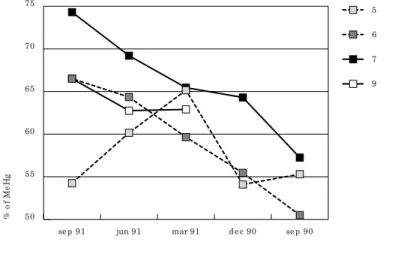
Hg speciation was measured in 18 hair samples of 4 persons. Mean MeHg content and standard deviation were 62% and 6%, respec-tively, within the range of 50 to 74% (Figure 1b). In comparison, Hg speciation conducted in a total of 144 hair samples collected in 1991 showed mean and standard deviation of 82% and 11%, respectively, within the range of 42% to 100%. We learned that the two persons with MeHg content below 50% had been involved previously in gold mining, including burning the amalgam (Boischio, 1996).
Figure 1b shows the variation in the per-centage of hair MeHg content among different individuals and in the same individual over time. Note that even the low MeHg content of 54% (case 5) meant a MeHg hair level of 184 ppm, which strongly indicated a very high level of MeHg exposure through fish consumption. This is probably a consequence of high Hg pol-lution up this aquatic food chain (Boischio & Henshel, in press-b).
Discussion
Wide variation in total hair Hg concentration among riverside people in the Amazon has been observed previously. For example, among inhabitants along the Tapajós river, Akagi et al. (1994) observed total hair Hg concentrations in the range of 1 to 151 ppm, with mean MeHg content above 80%. These authors also investi-gated Hg concentrations in hair segments of 1.5 cm. The widest Hg variation over time in the same individual was in the range of some 30 to 60 ppm. Lebel et al. (1997) observed a log-normal distribution of total hair Hg concentra-tions in the range of 1 to 142 ppm among river-side people in Brasilia Legal, a community on the Tapajós river. Mean MeHg content was around 90%. Among the Brasilia Legal popula-tion, mean segmental (1 cm) total hair Hg con-centration in 26 women varied seasonally from around 11 to 15 ppm. In the Madeira river re-gion, Malm et al. (1998) found a total hair Hg concentration in the range of 0 to 71 ppm.
For this particular family, one reason for these very high hair Hg concentrations may be the fact that the household was located next to the lake from which most of the fish species collected were heavily contaminated. The peak fish Hg concentration of 11 ppm (out of 576 fish samples) from an Aruana specimen (
Os-teoglossum bicirrhosum) was from that lake.
Fish Hg concentration has been observed to be strongly influenced by the trophic level (Bois-chio et al., 1995; Lebet et al., 1997; Bois(Bois-chio & Henshel, in press-b). Therefore, consumption of different fish species may present a very wide range of Hg exposure. Wide variation of total hair Hg concentrations among these members of the same household was probably related to individual fish consumption pat-terns. There was a wide variety of fish species available for consumption in this study area. For example, there were 40 fish species listed in our dietary questionnaire. During the field work, we observed that up to 7 different fish species were included in the same fish meal (Boischio, 1996; Boischio & Henshel, in press-b). Individual preferences and family priorities in fish consumption, among other factors, may explain the fact that people sharing the same meals consisting of many different fish species may have different Hg exposure levels. This is highly relevant for fish advisories.
The observed results on wide variation of total hair Hg concentrations support a policy recommendation that a fish advisory be target-ed to this population to mitigate the risks of critical Hg exposures. Riverside people, who Fig ure 1b
Me Hg c o nte nt in hair se g me nts o f 3 c m, analyse d fro m 4 ind ivid uals o f a sing le
family alo ng the Up p e r Mad e ira Basin, Amazo n.
50 55 60 65 70 75
9 7 6 5
se p 90 d e c 90
mar 91 jun 91
se p 91
%
o
f
M
e
H
are highly familiar with fish ecology, must also be informed about the fate of Hg up the food chain. In addition, information about the toxi-cological risks of Hg ingestion must be provid-ed to these people in order for them to make responsible decisions concerning their Hg ex-posure.
The fish advisory must be conducted from a gender perspective, given that fishing and fish consumption are subject to gender distrib-ution. Men generally go fishing, while women do the cooking. The wide variety of fish species available for consumption, sometimes in a sin-gle meal, strongly indicates that women may be influential in making decisions about Hg risks in fish consumption. In addition, preg-nant women must be a target by the fish advi-sory, since the fetus is extremely vulnerable to Hg effects. The fish advisory should also be based on their fish consumption patterns, along with the perception and preferences of fish in their meals (Boischio & Henshel, in press-b).
Based on the hair Hg results of the Madeira river population, it is strongly recommended that neurobehavioral tests be conducted to evaluate the potential consequences of prior and current Hg exposure (Boischio & Henshel, in press-a).
The mean MeHg content of 62% observed among this family was relatively lower than the
hair MeHg content (of 80% and 90%) observed in other studies mentioned above (Akagi et al., 1994; Lebel et al., 1997). Fish was the main route of Hg exposure in this family, but there were other sources of Hg exposure as well. For example, inorganic Hg could be present through atmospheric deposition of Hg released from gold mining. Inorganic Hg could also have been released through soil erosion (Roulet et al., 1999) and deposited on local crops, espe-cially manioc, which is used for flour produc-tion. In addition, this family might be using the same rug at home that was used during their gold mining work, where it was used to retain the mercury-gold amalgam from the bottom sediments. The rug at home could thus serve as an additional source of inorganic Hg exposure.
This particular family was revisited in 1993, and members were asked about the health ef-fects of MeHg poisoning: numb fingers, im-paired gait, speech, and hearing, and narrow-ing of the visual field. None of them reported any positive symptoms. Total hair Hg results from 8 of these 10 individuals were investigat-ed again in 1993. In terms of hair Hg levels, in 1991, the mean and standard deviation were 84 and 88 ppm, respectively. To compare, mean and standard deviation in 1993 were 10 and 2 ppm, respectively.
References
AKAGI, H.; KINJO, Y.; BRANCHES, F.; MALM, O.; HARADA, M.; PFEIFFER, W. C. & KATO, H., 1994. Methylmercury pollution in the Tapajós river basin, Amazon. Environmental Sciences,3:25-32. BOISCHIO, A. A. P., 1996. Human Ecology of Riverside
People (caboclos or ribeirinhos)along the Upper Madeira River with Focus on Mercury Pollution Through Fish Consumption.Ph.D. Thesis, Bloom-ington: School of Public and Environmental Af-fairs, Indiana University.
BOISCHIO, A. A. P. & BARBOSA, A., 1993. Exposição ao mercúrio orgânico em populações ribeirinhas do Alto Madeira, Rondônia, 1991: Resultados Pre-liminares. Cadernos de Saúde Pública, 9:155-160. BOISCHIO, A. A. P. & CERNICHIARI, E., 1998.
Longi-tudinal hair mercury concentration in riverside mothers along the Upper Madeira River (Brazil).
Environmental Research, 77:79-83.
BOISCHIO, A. A. P. & HENSHEL, D., 1996. Risk assess-ment of mercury exposure through fish consump-tion by the riverside people in the Madeira Basin, Amazon, 1991. Neurotoxicology,17:169-176. BOISCHIO, A. A. P. & HENSHEL, D., in press-a. Linear
regression models of methyl mercury exposure during prenatal and early postnatal life among riverside people along the Upper Madeira river, Amazon. Environmental Research.
BOISCHIO, A. A. P. & HENSHEL, D., in press-b. Fish consumption, fish lore, and mercury pollution – River communication for the Madeira river peo-ple. Environmental Research.
BOISCHIO, A. A. P.; HENSHEL, D. & BARBOSA, A., 1995. Mercury exposure through fish consump-tion by the Upper Madeira River populaconsump-tion, Brazil – 1991.Ecosystem Health,1:177-192. CERNICHIARI, E.; TORIBARA, T. Y.; LIANG, L.;
MARSH, D. O.; BERLIN, M. W.; MYERS, G. J.; COX, C.; SHAMLAYE, C. F.; CHOISY, O.; DAVIDSON, P. & CLARKSON, T. W., 1995. The biological monitor-ing of mercury in the Seychelles study. Neurotoxi-cology, 16:613-628.
CLARKSON, T. W.; HURSH, J. B.; SAGER, P. R. & SY-VERSEN, T. L. M., 1988. Mercury. In: Biological Monitoring of Toxic Metals(T. W. Clarkson, L. Friberg, G. F. Nordberg & P. R. Sager, eds.), pp. 199-246, New York: Plenum Publishing Corporation. CLARKSON, T. W., 1997. The role of biomarkers in
re-productive and developmental toxicology. Envi-ronmental Health Perspectives, 74:103-107. DAVIDSON, P. W.; MYERS, J. G.; COX, C.; AXTELL, C.;
SHAMLAYE, C. F.; SLOANE-REEVES, J. S.; CER-NICHIARI, E.; NEEDHAM, L.; CHOI, A.; WANG, Y.; BERLIN, M.; CLARKSON, T. W., 1998. Effects of prenatal and postnatal methylmercury exposure from fish consumption on neurodevelopment: Outcomes at 66 months of age in the Seychelles Child Development Study.JAMA, 280:701-707.
GOULDING, M., 1980. The Fishes and the Forest.
Berkeley: University of California Press.
GRANDJEAN, P.; WEIHE, P.; WHITE, R. F.; DEBES, F.; AR-ALI, S.; YOKOYAMA, K.; MURATA, K.; SORENSEN, N.; DAHL, R. & JORGENSEN, P. J., 1997. Cognitive deficits in 7-year-old children with prenatal ex-posure to methylmercury. Neurotoxicology and Teratology, 19:417-428.
IPCS (International Program on Chemical Safety), 1990.
Environmental Health Criteria 101: Methylmer-cury. Geneva: World Health Organization. LEBEL, J.; MERGLER, D.; LUCOTTE, M.; AMORIM,
M.; DOLBEC, J.; MIRANDA, D.; ARANTES, G.; RHEAULT, I. & PICHET, P., 1996. Evidence of early nervous system dysfunction in Amazonian popu-lations exposed to low-levels of methylmercury.
Neurotoxicology, 17:157-168.
LEBEL, J.; ROULET, M.; MERGLER, D.; LUCOTTE, M. & LARRIBE, F., 1997. Fish diet and mercury expo-sure in a riparian Amazonian population. Water, Air and Soil Pollution, 97:31-44.
MAGOS, L. & CLARKSON, T. W., 1972. Atomic absorp-tion determinaabsorp-tion of total, inorganic and organ-ic mercury in blood. Journal of the Association of Official Analytical Chemists, 55:966-971. MALM, O., 1998. Gold mining as a source of mercury
exposure in the Brazilian Amazon. Environmen-tal Research,Section A, 77:73-78.
MORAN, E., 1990. Ecologia Humana das Populações da Amazônia.Petrópolis: Editora Vozes.
ROULET, M.; LUCOTTE, M.; FARELLA, N.; SERIQUE, G.; COELHO, H.; SOUSA-PASOS, C. J.; JESUS-DA -SILVA, E.; SCAVONE-DE-ANDRADE, P.; MER-GLER, D.; GUIMARÃES, J. R. D. & AMORIM, M., 1999. Effects of recent human colonization on the presence of mercury in Amazonian ecosystems.