H E R M E S S P E C I A L I S S U E F E AT U R E
B y A N N VA N R E U S E L , A N N C . A N d E R S E N , A N T j E B o E T I U S , d o U g L A S C o N N E L Ly, M A R I N A R . C U N H A , C A R o L E d E C k E R , k AT j A H E E S C H E N , A N A H I L A R I o , k o N S TA N T I N o S A R . k o R M A S , L o ï S M A I g N I E N , k A R I N E o L U , M A R I A PA C H I A d A k I , B E N E d I C T E R I T T, C L A R A R o d R I g U E S , j o z é E S A R R A z I N , PA U L T y L E R , S A S k I A VA N g A E V E R , A N d H E L E E N VA N N E S T EBiodiversity of
Cold Seep Ecosystems
Along the
European Margins
RoV Victor taking a water sample above a bush of Siboglinidae Polychetes in the central Nile deep Sea Fan. Image courtesy of Ifremer/MEDECO 2007
ABSTR ACT
During the European Commission’s Framework Six Programme, HERMES, we investigated three main areas along the
European margin, each characterized by the presence of seep-related structures exhibiting different intensity of
activ-ity and biological diversactiv-ity. These areas are: (1) the Nordic margin with the Håkon Mosby mud volcano and many
pockmarks, (2) the Gulf of Cádiz, and (3) the eastern Mediterranean with its hundreds of mud volcanoes and brine
pool structures. One of the main goals of the HERMES project was to unravel the biodiversity associated with and to
understand the driving forces and functions of these seep-associated ecosystems using an integrated approach. Several
multidisciplinary research cruises to these three areas provided evidence of high variability in ecosystem processes and
associated biodiversity at different spatial scales, illustrating the “hotspot” nature of these deep water systems.
observation of the European continental margins using in situ video and photog-raphy with adapted deep submersibles provided evidence for a wide range of active cold-seep ecosystems associated with fluid, gas, and mud escape struc-tures. These structures include pock-marks (seafloor depressions), brine lakes, and elevated or flat mud volcanoes.
As with hot vents, cold seeps are characterized by the flow of reduced chemical compounds from the sub-surface to the seafloor, but they are not directly associated with high thermal anomalies. Most known cold seeps are associated with reduced environ-ments that are linked indirectly to gas hydrates or to hydrocarbon reservoirs. Hence, in contrast to the majority of marine deep-water ecosystems, which depend on photosynthetically derived food (phytoplankton and plant mate-rial), methane and other hydrocarbon seeps are colonized by specific anaerobic subsurface microbiota; these organisms use hydrocarbons as an energy source
(Sloan, 1990) to transform seawater sulfate, thus producing high fluxes of hydrogen sulfide (Jorgensen and Boetius, 2007). Chemosynthetic microorgan-isms are the primary producers in seep food webs, depending on such reduced chemicals as methane and sulfide as their energy sources.
Similar to their hydrothermal vent counterparts, most cold seeps support highly productive ecosystems (high biomass) that consist of specialized metazoan communities dominated by a few adapted taxa that can cope with elevated concentrations of chemical compounds and low oxygen levels at and below the sediment-water interface. Other harsh conditions, such as high concentrations of hydrocarbons or high-salinity brines, may locally reduce faunal diversity (MacDonald et al., 2004; Bergquist et al., 2005). Among the most remarkable of the fauna exploiting the abundant chemical energy of seeps are the symbiont-bearing invertebrate spe-cies, often similar or related to the fauna
INTRodUCTIoN
Soon after the discovery of the spec-tacular hydrothermal vent communities 30 years ago, other types of chemos-ynthetic assemblages—so-called “cold seeps”—were found along continental margins during submersible dives to the deep Gulf of Mexico (Paull et al., 1984), subduction zones off Oregon in the eastern Pacific (Suess et al., 1985), and trenches off Japan in the western Pacific (Juniper and Sibuet, 1987). Cold seeps are now among the most geologi-cally diverse and widely distributed of the deep-sea reducing environments explored to date, and new sites are still being discovered every year. Since their initial discovery, active seeps have been reported from shallow to hadal (> 6000-m) depths (Sibuet and Olu-Le Roy, 2002; Levin, 2005, and references therein), along other active and passive margins, and from all parts of the global ocean, even Antarctic regions (Domack et al., 2005). It is only during the last decade that more intense
found at hydrothermal vents. These large taxa, such as vesicomyids (clams), bathymodiolids (mussels), and siboglin-ids (formerly known as Pogonophora or tube worms), and some motile species such as shrimps and gastropods, cluster in areas where fluids rich in reduced chemicals reach the seafloor (Sibuet and Olu, 1998; Sibuet and Olu-LeRoy, 2002; Bergquist et al., 2003; Van Dover et al., 2003; Cordes et al., 2007).
During HERMES, three main areas harboring prominent seep ecosystems were investigated, including the Nordic margin and its Håkon Mosby mud vol-cano, the Gulf of Cádiz, and the eastern Mediterranean. After a short introduc-tion of the three main study areas, which are more extensively discussed elsewhere (see Foucher et al., this issue), we pro-vide an overview of the main results from biodiversity studies performed dur-ing HERMES. An integrated approach combined detailed habitat mapping and
characterization of associated fauna. Both symbiont-bearing and associated nonsymbiotic fauna were investigated, as well as different size classes, from fish and large invertebrates (megafauna), to small endofaunal organisms (meio- and macrofauna), including the very specific seep-related microbial communities. In addition to biodiversity patterns in rela-tion to the high habitat heterogeneity within a region, similarities in communi-ties among regions are currently under investigation in order to gain better insight into the biology, biodiversity, and biogeography of seep-associated biota along Europe’s continental margins.
HERMES CoLd SEEP STUdy SITES
Along the Nordic margin, the highly active Håkon Mosby mud volcano (72°N), at 1280-m water depth on the Barents Sea slope south of Svalbard, was the target of several multidisciplinary
cruises (Figures 1A, 2). The Storegga slide at 64°N and associated Nyegga pockmarks were also visited (Figure 1A). Håkon Mosby mud volcano was first observed in 1989 during a side-scan sonar survey (Vogt et al., 1997). An expedition in 1995 measured very high temperature gradients in the sedi-ments, recovered methane hydrate from 2-m subbottom depth and sampled siboglinid polychaetes, suggesting active chemosynthesis (Vogt et al., 1997). The concentric structure of the mud volcano can be divided into several subhabitats characterized by different biogeochemi-cal sediment conditions (de Beer et al., 2006; Niemann et al., 2006b).
The Storegga area is well known for its giant Holocene slide, one of the larg-est ever mapped on continental margins (Paull et al., 2008). On the northeastern flank of the Storegga slide, complex pockmarks are located in the so-called Nyegga area at 740-m water depth. These
Ann Vanreusel ([email protected]) is Professor, Marine Biology Research Group, Universiteit Ghent, Ghent, Belgium. Ann C. Andersen is Professor, Université Pierre et Marie Curie (UPMC), and a researcher in Equipe Ecophysiologie: Adaptation et
Evolution Moléculaires, UMR 7144 - Centre national de la recherche scientifique (CNRS) - UPMC, Station Biologique, Roscoff, France.
Antje Boetius is Head, Microbial Habitat Group, Max Planck Institute for Marine Microbiology, and Professor, Jacobs University Bremen,
Germany. Douglas Connelly is a researcher in the Geology and Geophysics Group, National Oceanography Centre, Southampton, UK. Marina R. Cunha is Professor, Centro de Estudos do Ambiente e do Mar (CESAM), Departemento de Biologia, Universidade de Aveiro,
Campus Universitário de Santiago, Aveiro, Portugal. Carole Decker is PhD Candidate, Deep-Sea Ecoystem Department, Institut français de
recherche pour l’exploitation de la mer (Ifremer), Centre de Brest, Plouzané, France. Katja Heeschen was a researcher in the Geology and
Geophysics Group, National Oceanography Centre, Southampton, UK. Ana Hilario is a postdoctoral researcher at CESAM, Departemento
de Biologia, Universidade de Aveiro, Campus Universitário de Santiago, Aveiro, Portugal. Konstantinos Ar. Kormas is Assistant Professor,
Department of Ichthyology and Aquatic Environment, University of Thessaly, Nea Ionia, Greece. Loïs Maignien is PhD Candidate,
Laboratory of Microbial Ecology and Technology (LabMET) and Renard Center for Marine Geology (RCMG), Universiteit Ghent, Ghent, Belgium. Karine Olu is a researcher in the Deep-Sea Ecoystem Department, Ifremer, Centre de Brest, Plouzané, France. Maria Pachiadaki
is PhD Candidate, Department of Ichthyology and Aquatic Environment, University of Thessaly, Nea Ionia, Greece. Benedicte Ritt is
PhD Candidate, Deep-Sea Ecoystem Department, Ifremer, Centre de Brest, Plouzané, France. Clara Rodrigues is PhD Candidate, CESAM,
Departemento de Biologia, Universidade de Aveiro, Campus Universitário de Santiago, Aveiro, Portugal. Jozée Sarrazin is a researcher in
the Deep-Sea Ecoystem Department, Ifremer, Centre de Brest, Plouzané, France. Paul Tyler is Professor, School of Ocean and Earth Science,
University of Southampton, UK. Saskia Van Gaever is a postdoctoral researcher in the Marine Biology Research Group, Universiteit Ghent,
Figure 1. (top left) overview map. Scale: 500 km. (A) Nordic margin: Håkon Mosby mud volcano, Storegga slide, and Nyegga area in the north identified on the map. VICKING 2006 ©Ifremer (B) gulf of Cádiz: Simplified geological map after Medialdea et al. (2004), showing the locations of known mud volcanoes (compilation of kenyon et al., 2000, 2003, 2006; Akhmetzhanov et al., 2007) with their geochemical characteristics as determined so far (compilation of Somoza et al., 2003; Niemann et al., 2006a; Stadnitskaia et al., 2006; Haeckel et al., 2007; and Hensen et al., 2007). Mud volcano fields: gRd=guadalquivir diapiric Ridge; Tasyo; SPM=Spanish Moroccan Margin; dPM=deep-Portuguese Margin. (C) Eastern Mediterranean Sea: Seep sites visited during the MEdECo cruise in 2007, including the Napoli and Amsterdam mud volcanoes as well as different areas in the Nile deep Sea Fan.
pockmarks are circular in plan view and feature up to 190-m-long ridges of car-bonate rock (Hovland et al., 2005).
The Gulf of Cádiz is located between Iberia and Africa on the Atlantic side, between 9°W and 6°45'W, and 34°N and 37°15'N. The hydrography of the study area is complex, with the influ-ence of Mediterranean outflow water on the shallower eastern mud volcanoes, and evidence for input of high-nutrient Antarctic Intermediate Water in the deeper western regions (Van Aken, 2000). The area has a complex tectonic history and is now dominated by thick sedimentary deposits. Since their initial discovery in the area in 1999 (Kenyon et al., 2000), a large number of mud vol-canoes have been identified, located in four main fields and exhibiting different but generally very localized hydrocarbon
seepage (Niemann et al., 2006b) (Figure 1B). The presence of carbonate chimneys indicates past activity. At most of them, the majority of the methane is consumed within the sediments, and does not reach the hydrosphere.
Different seep sites are also pres-ent in the eastern Mediterranean Sea (Figure 1C), where intense emission of methane occurs from the center of active mud volcanoes and along related faults (MEDINAUT/MEDINETH 2000, Charlou et al., 2003; Dupré et al., 2007). During the last decade, three major areas were the focus of multidisciplinary cruises using submersibles: the Olimpi mud volcano field, located on the Mediterranean Ridge south of Crete (Mascle et al., 1999); the Anaximander Mountains, south of Turkey, caught up in the plate convergence between Africa
and Eurasia (Woodside et al., 1998); and the seafloor of the Nile Deep Sea Fan (Nile delta turbidic system; Loncke et al., 2004). The Olimpi mud volcano field and Anaximander Mountain areas, located at depths between 1700 m and 2000 m, are characterized by strong compressional tectonic processes superimposed by faulting. They harbor large conical mud volcanoes several kilometers across but only a few hundred meters high. Fresh mud flows, brines, clasts, and carbonate crusts were observed on their surface, depending on the current activity of the volcano (Zitter et al., 2005). In a passive margin context, the Nile deep turbidic system displays many fluid-releasing structures on the seafloor, including mud volcanoes, mud pies, and pockmarks (Loncke et al., 2004).
MAPPINg HABITAT HETERogENEITy AT CoLd SEEPS
Cold seeps are characterized by the patchy occurrence of sulfide and/or methane-dependent biota, including microbial mats and symbiont-bearing invertebrates (Bivalvia, Polychaeta) that can form small clusters or spread over large fields in high densities. This high spatial variability at scales of tens to hundreds of meters has been attributed to the magnitude of fluid flow and the correlated chemical depth profile (Henry et al., 1992; Barry et al., 1997; Olu et al. 1997; Sahling et al., 2002; Levin et al., 2003; de Beer et al., 2006). Low net flow rates appear to provide sufficient meth-ane from depth to fuel the near-surface biological communities while still allow-ing downward transport and mixallow-ing of oxygen- and sulfate-rich seawater in the upper few centimeters of the sediment
Figure 2. oTUS image of the Håkon Mosby mud volcano in the north. Area covered by optical survey (oTUS camera), representing 30% of a 400 x 400-m area. Footprints of each photo are georeferenced. VICKING 2006 ©Ifremer
(de Beer et al., 2006). More intense fluid flow is associated with altered pore-water composition and elevated sulfide con-centrations extending to the sediment surface, thus allowing the growth of microbial mats (Tryon and Brown, 2001; Levin et al., 2003).
To understand the spatial and tem-poral scales at which seep ecosystem processes change, a crucial initial phase in seep research is mapping the size and distribution of different habitats and identifying the associated communities (Sibuet and Olu-Le Roy, 2002). A great step forward in the precision of habitat mapping has been achieved in the last few years with use of remotely operated vehicles (ROVs), which allows regular transects over long distances in com-bination with more precise positioning methods. There is also rapid progress in optical camera resolution and data pro-cessing using Geographic Information System (GIS)-supported image analysis. On the Håkon Mosby mud volcano, the concentric distribution of habitats around a central crater, apparently not colonized, was first described from towed video systems and observations by submersibles (Milkov et al., 1999; Gebruk et al., 2003).
The first predictive habitat map was based on ROV video mosaics processed by Jerosch et al. (2007) using geostatisti-cal analysis. These authors estimated the percent coverage for each targeted habitat: mud apparently devoid of life in the center, surrounded by areas densely inhabited by microbial mats, particularly in the south; and hummocky outer parts colonized dominantly by siboglinids. During the HERMES VICKING cruise (2006), a new habitat mapping survey was conducted (Figure 2) by means of
parallel transects at 8-m altitude above the seafloor, using the black and white high sensibility camera OTUS mounted on the ROV Victor 6000 survey module. At this altitude, each picture covers a surface of ~ 64 m2 (Figure 3A, B).
The new habitat map suggests changes in the colonization of mud flows by microbial mats and siboglinids between 2003 (Jerosch et al., 2007) and 2006 (recent work of author Olu, M.C. Fabri, Deep-Sea Ecosystem Department of Ifremer, and others). A similar spatial organization of habitats (central seep area surrounded by microbial mats and siboglinid fields in the external ring) was also observed at small individual pock-marks along the Storegga slide and in the Nyegga area, but at a much smaller scale (decimeter to meter) (recent work of author Olu).
In 2007, the MEDECO cruise aboard RV Pourquoi Pas? visited sev-eral different seep sites in the eastern Mediterranean, four of which were the focus of systematic ecological studies at different spatial scales: the Napoli mud volcano south of Crete, the Amsterdam mud volcano south of Turkey, and a pockmark field and the Cheops mud volcano located in the Nile delta. Five different habitats were recognized by the presence of visible features such as key megafauna species (Bivalvia, Siboglinidae) or microbial mats on the seafloor. More extensive habitat and megafaunal distribution surveys on the Napoli mud volcano (33°43.7777'N, 24°40.9495'E; 1750–1934-m depth) were based on regularly spaced transects at 10-m altitude with each OTUS picture covering a surface of ~ 100 m2. This
survey showed that numerous brine pools characterized the southeast sector
(Figure 3C), corresponding to depres-sions on the microbathymetric map. Small tubeworms were rarely observed. The northern part showed a more disturbed environment, colonized by siboglinids. Abundant empty bivalve shells were lying on the seafloor, possibly indicating the extinction of previous bivalve-dominated communities (recent work of authors Olu and Sarrazin).
ENdoSyMBIoNT-BEARINg CHEMoSyNTHETIC FAUNA
Megafauna species comprise organisms larger than 2 cm that are generally visible on seafloor optical images. Cold seep ecosystems provide niches for chemos-ynthetic communities based on reduced compounds such as methane and sulfide, which are energy sources for CO2-fixing symbiotic bacteria. These symbioses between invertebrates and sulfur-oxidiz-ing and/or methanotrophic bacteria are only found in highly reduced environ-ments, and are an obvious example of how cold seep ecosystems add biodiver-sity to marine deep-water life. During our HERMES research, we were able to identify the dominant chemosynthetic symbioses on Europe’s continental mar-gins, but most likely much more remain to be discovered.
At the Håkon Mosby mud volcano, megafauna are dominated by siboglinids (tubeworms) that lack both mouth and gut and live in symbiosis with sulfur-oxi-dizing bacteria stored inside their bodies (Lösekann et al., 2008). Wide areas in the periphery of this mud volcano are covered with the curled brownish tubes of the species Sclerolinum contortum (Figure 3D), buried up to 70-cm deep in soft sediment. In some areas, clusters of the straight black tubes of Oligobrachia
haakonmosbiensis webbi (Smirnov,
2000) stand erect about 5 cm above the seafloor. Both species are also found fur-ther south on pockmarks at the Storegga slide and at Nyegga, where they sur-round every dark spot of methane seep-age (recent work of author Andersen). Many small symbiont-bearing bivalves belonging to the family Thyasiridae have been sampled on these sites, especially in siboglinid fields at the Håkon Mosby mud volcano, whereas numerous larger Vesicomyidae shells have also been
observed at the Storegga and Nyegga pockmarks (recent work of authors Decker and Olu).
At Nyegga, 1-m-high pillow structures covered with a carpet of siboglinids are known as “submarine pingoes;” they are described by Hovland and Svensen (2006) as local hydrate (ice) accumula-tions. However, during the HERMES VICKING cruise in 2006, observation and sampling by ROV Victor 6000 showed the pingoes to be composed of mud accumulations with entangled
Sclerolinum, soft enough to be sampled
by blade core. In all the explored areas,
Sclerolinum seem to dominate, whereas Oligobrachia has a discrete, highly patchy
distribution (recent work of authors Andersen and Olu). The factors that control the spatial distribution of these two species remain unclear. The local sediment chemistry, the penetration of the worms into the seabed, and some of the worms’ physiological adaptations concerning their hemoglobins seem to differ between the two species, and may
Figure 3. Example of oTUS photos showing (A) microbial mats and zoarcid fishes and (B) a patch of siboglinid polychaetes. Photo size is 64 m2. VICKING 2006 ©Ifremer (C) A brine pool on the summit of the Napoli mud volcano. MEDECO 2007 ©Ifremer (d) View of a wide field of siboglinid polychaetes at Håkon Mosby mud volcano. The curled brownish Sclerolinum
surrounds a large spot of black, straight Oligobrachia tubes. An orange sea star lies in front of a Sclerolinum patch covered by whitish bacterial filaments. VICKING 2006 ©Ifremer
affect their habitat choice (recent work of author Andersen). However, other fac-tors such as their reproduction and dis-persal may also play a role. Filamentous bacteria often cover their tubes and the spaces between tubes provide shelter to a highly diversified macrofauna, particu-larly between the twisted creeping tubes of Sclerolinum. Sclerolinum can therefore be compared to other habitat-providing species such as deep-water corals, as it harbors a great epifaunal biodiversity on the otherwise barren soft sediments of the Norwegian deep margin.
In contrast to the Håkon Mosby mud volcano, where permanently high fluxes of reduced compounds are read-ily indicated by the presence of large aggregations of siboglinids and bacterial mats, the mud volcanoes in the Gulf of Cádiz do not show evidence of dense aggregations of living chemosynthetic megafauna. An initial ROV transect at 1100-m depth on the Darwin mud vol-cano during a sampling campaign with RRS James Cook in 2007 revealed a mass of mytilids identified as Bathymodiolus
mauritanicus (Figure 4A) on the top
of this mud volcano. However, most of this accumulation comprised empty shells. Further along the transect, rock exposures (Figure 4B) and vast carbon-ate outcrops (Figure 4C) were observed with both live and dead mussels within cracks in the carbonates. These obser-vations suggest that the Darwin mud volcano had once been very active and that the release of methane was sufficient to support a considerable population of mytilids. Cessation of seep activity prob-ably leads to the death of the population. This event took place relatively recently as many of the shells remained intact and articulated. A small area (about
100 cm2) of soft, blue-grayish-colored
sediment (Figure 4D) was observed in the northwest corner of the mud volcano that, when disturbed, released considerable quantities of methane, but contained no obvious chemosynthetic fauna. Other megafauna, not directly chemosynthesis-dependent, consisted of stylasterine corals attached to the car-bonate cap (Figure 4E), scavenging crabs (Figure 4F), and corals (Figure 4G).
Aside from the dead mytilid fields, the chemosynthetic species of the Gulf of Cádiz live mostly buried inside the
sediments, a distribution that is probably related to the shallow (< 30 cm) depth of the sulfide/methane gradient. The most common species include siboglinid poly-chaetes (Siboglinum spp.) and solemyid bivalves (Acharax sp., Petrasma sp.), but also other frenulate (Polybrachia,
Spirobrachia, Bobmarleya, Lamellisabella)
(Figure 5) and bivalve taxa (Lucinoma,
Thyasira, Bathymodiolus, Vesicomyidae)
(Génio et al., 2008; Hilário and Cunha, 2008; Rodrigues et al., 2008). The first results of stable isotope analyses (δ13C,
δ15N, δ34S) support the occurrence of
Figure 4. Bathymetry and habitats associated with the darwin mud volcano: (A) Bathymodiolus
mauritanicus, (B) rock exposure, (C) carbonate outcrops, (d) soft, blue-grayish-colored sediment,
(E) stylasterine corals, (F) scavenging crabs, and (g) corals attached to an upturned piece of car-bonate crust.
chemosynthetic production in these species, with thiotrophy (H2S) being the main metabolic pathway in the benthic food web (recent work of author Rodrigues and colleagues).
The first data on Mediterranean cold seep communities were acquired during the French-Dutch MEDINAUT cruise (1998). Chemosynthetic communities from the Olimpi and Anaximander mud fields were mostly concentrated near the summits of the volcanoes, where fluid expulsion is concentrated (Olu-Le Roy et al., 2004). The communities were dominated by small-sized bivalves from four families common to cold seep environments (Mytilidae, Vesicomyidae, Thyasiridae), or to shallower sulfidic-rich habitats (Lucinidae). However, large-size bivalve genera typical of cold seeps (Bathymodiolus and Calyptogena) were absent. Siboglinids of the Obturata group (genus Lamellibrachia) were found nearby or in close relation to carbonate crusts (Figure 6A). Differences in the biological activity can be related to the variability and intensity of fluid expul-sions between the volcanoes (Olu-Le Roy et al., 2004), as supported by variable methane concentrations measured above the seafloor (Charlou et al., 2003). Small
Siboglinidae of the Frenulata group (Siboglinum sp.) were also collected.
During the HERMES BIONIL cruise to the Nile Deep Sea Fan in 2006, new samples from the three dominant symbiont-bearing macrofaunal species were collected. The clam Lucinoma aff.
kazani was found within the sediments,
the mytilid Idas sp. was attached to different hard substrata (crusts, tubes, urchins), and siboglinid tubeworms occurred either on reduced sediments (Amon MUD VOLCANO) or on carbonate crusts (central pockmark area). Symbiotic associations have been described for Lucinoma aff. kazani and for the small mytilid Idas sp., the lat-ter harboring an exceptional number of symbionts in its gills (Duperron et al., 2006, 2007).
“NoNSyMBIoTIC” MEgAFAUNA
The megafauna at seeps also include many nonsymbiont-bearing species, which profit in many different ways from the large biomass and productiv-ity of chemosynthetic megafauna. They are attracted by the heterogeneity of the habitats, the abundance of prey, or pos-sibly to the elevated topographic posi-tion provided by mud volcanoes. At the
Håkon Mosby mud volcano, the most abundant species in the megafaunal size class is the fish of the Zoarcidae family,
Lycodes squamiventer (Gebruk et al.,
2003) (Figure 6B). Image analysis from the VICKING cruise (2006) confirmed previous observations of Gebruk et al. (2003) on the distribution of this zoarcid fish: they show the highest abundances in the most active area of the volcano, and are particularly associated with microbial mats (recent work of authors Olu and Decker). Zoarcidae is the typical fish family encountered at hydrothermal vents and cold seeps, with some endemic species likely having adapted to the toxic environment.
On the Storegga slide and in Nyegga pockmarks, nonsymbiotic megafauna are much more abundant and diverse, probably for two reasons. First, the cold seeps are much smaller compared to the Håkon Mosby mud volcano, they are sparsely distributed, and methane concentrations in seawater are quite low (J.L. Charlou, Marine Geosciences Department, Ifremer, pers. com, 2008). Second, the water depth is shallower (600–1000 m) and the Storegga slide is likely to be a site of high detritus input that favors the presence of suspension and deposit feeders. The very large ophi-urid Gorgonocephalus sp. (Figure 6C), reaching up to 0.5-m diameter, is the most striking species of this background megafauna, but abundant comatules, crinoids, and pedonculate sponges were also observed.
In the Gulf of Cádiz, several nonchemosynthetic species were observed associated with different mud volcanoes at various water depths. In contrast to the shallower mud volca-noes, the Carlos Ribeiro mud volcano
Figure 5. Frenulata collected during TTR17 cruise in the gulf of Cádiz: (a) Siboglinum sp. (from darwin mud volcano), (b) Polybrachia sp. 1 (from Porto mud volcano), (c) Polybrachia sp. 2 (from Sagres mud volcano), and (d) Polybrachia sp. 3 (from Soloviev mud volcano). Photos by Ana Hilário
at 2200-m water depth has a more diverse nonchemosynthetic-dependent megafauna. The mud volcano center consists of series of concentric ridges that support very few megafauna except siboglinid tubeworms (Figure 7A) and a mobile echinothurid sea urchin found close to the “eye” of the volcano (Figure 7I). Most of the more extensive megafauna comprise suspension-feeding cnidarians situated at the periphery of the mud volcano, including poriferans (Figure 6B), the sea pen Umbellula (Figure 7C), and dense gorgonian bushes (Figure 7F, G). Further off the mud volcano the enigmatic athecate hydroid Monocaulus (Figure 7D) was observed. At some time in the past, mud
overflowed the volcano’s crest and slid down its southeast side, where huge numbers of deposit-feeding holothurians were observed (Figure 7H).
In the eastern Mediterranean, poly-chaetes are abundant around the Napoli brine lakes and on the active sites on Amsterdam mud volcano. Other associ-ated species include unusually large specimens of the Suberitidae poriferan
Rhizaxinella pyrifera (Figure 6D) that
was sampled on Napoli mud volcano. Crustaceans such as galatheids, shrimps, and Chaceon mediterraneus crabs were equally abundant at all sites. Large densi-ties of Echinus sp. were observed at active sites, suggesting some sort of depen-dence on fluid emission (Olu-Le Roy
et al. 2004; recent work of authors Ritt, Olu, and Sarrazin).
SMALL-SIzEd ENdoFAUNA
Since their discovery, much seep research has focused on the chemosynthetic megafauna as well as the associated microbiota. Infaunal organisms, usually of smaller size (macro- and meiofauna), such as nematodes, harpacticoid cope-pods, polychaetes, amphicope-pods, tanaids, gastropods, ostracods, and kinorhynchs, have been studied to a much lesser extent. The HERMES project aimed at painting a full picture of seep biodiversity by investigating all size classes of the ben-thos. The macrofaunal and meiofaunal communities at active cold seeps on the
Figure 6. (A) Lamellibrachia from the pockmark area in the Nile deep Sea Fan. MEDECO 2007 ©Ifremer (B) Lycodes
squamiventer (zoarcidae) in a patch with siboglinid tubeworms at the Håkon Mosby mud volcano. ARKXXII cruise ©marum, University of Bremen (C) Richness of the background megafauna on Storrega slide, with the giant
ophi-urid Gorgonocephalus sp. VICKING 2006 ©Ifremer (d) Unusual large specimens of the sponge Rhizaxinella pyrifera on Napoli mud volcano.
Nordic margin and in the Gulf of Cádiz and the eastern Mediterranean were studied for the first time, and analysis of the samples is currently ongoing. Initial results from the Nordic margin, including different habitats found on the Håkon Mosby mud volcano (in its center, microbial mats and siboglinid polychaete fields) as well as the Storegga and Nyegga cold seeps, show that the macrofauna (those between 500 µm and 1–2 cm) are generally dominated by polychaetes. A quantitative analysis revealed highly contrasting densities among the habitats (recent work of authors Decker, Van Gaever, and Olu); the highest abun-dances were associated with siboglinid
fields (from 6700 to 56,000 ind/m2).
Macrofauna were much less abundant in the microbial mats (1000 to 1600 ind/m2)
and even less abundant in the central area (55–170 ind/m2). Great
discrepan-cies among habitats were also observed in the taxonomic diversity, because only a few species are able to colonize the more sulfidic and oxygen-depleted sediments at the microbial mat sites. There, the macrofauna were domi-nated by a polychaete belonging to the genus Capitella (Figure 8A), whose shallow-water species from the Capitella
capitata complex is adapted to organic
and sulfide-rich environments and is used as an indicator of pollution. In
contrast, Siboglinidae fields were colo-nized by a higher taxonomic diversity with at least seven polychaete families (M. Morineaux, Deep-Sea Ecosystem Department, Ifremer, pers. com., 2008) and other groups, including poriferans, molluscs (Bivalvia, Gastropoda), and crustaceans (Amphipoda, Tanaidacea, Isopoda). Similar differences in com-munity structure and dominant taxa among habitats were observed in the Storegga and Nyegga pockmarks (recent work of authors Decker, Van Gaever, and Olu). Ongoing work on dominant taxa will compare Storegga/Nyegga and Håkon Mosby mud volcano communi-ties at higher taxonomic levels to test the influence of geographic patterns compared to habitat influence on the structure of communities.
Significant differences in diversity and abundance of the meiofaunal communities (organisms passing through a 1-mm sieve and retained on a 32-µm sieve) associated with differ-ent habitats were also found. The bare, muddy sediments from the active center yielded the lowest nematode densities, but unusually high benthic copepod abundance (271 ± 37 ind/10 cm2;
Van Gaever et al., 2006). In contrast, one single nematode species, Halomonhystera
disjuncta Bastian 1865 (Figure 8B),
previ-ously described from shallow-water habi-tats, was found in extremely high abun-dances (> 11,000 ind/10 cm2; Van Gaever
et al., 2006) in the bacterial sediment-covering Beggiatoa mats. Biomarker fatty acid and stable carbon isotope analyses of H. disjuncta revealed that this spe-cies was thriving on chemosynthetically derived food sources, in particular, on the Beggiatoa bacteria (recent work of author Van Gaever and colleagues). The
Figure 7. Bathymetry and fauna associated with Carlos Ribeira mud volcano: (A) Siboglinid polychaetes, (B) Porifera, (C) the seapen Umbellula, (d) athecate hydroid Monocaulus, (F, g) gorgonian bushes, (H) holothurians in high numbers, and (I) echinothurid sea urchin.
uncommon ovoviviparous reproduction of H. disjuncta at Håkon Mosby mud vol-cano has been identified as an important adaptation of parents to secure the sur-vival and development of their brood in this anoxic environment. This nematode species was not found on the adjacent Storegga slide or in the Nyegga area, nor in any of the other cold seeps stud-ied in the Gulf of Cádiz or the eastern Mediterranean. Here, the reduced sedi-ments host a very impoverished nema-tode assemblage, in terms of both diver-sity and dendiver-sity, that is dominated by one or two species belonging to the genera
Terschellingia, Thalassomonhystera, Sabatieria or Desmodora (Van Gaever
et al., in press; paper in progress by author Van Gaever and colleagues on fatty acid biomarker isotope evidence of trophic specialization of metazoan meiofauna at the Håkon Mosby mud volcano). At least three of these dominant species (i.e., Halomonhystera disjuncta,
Terschellingia longicaudata De Man 1907,
and Sabatieria mortenseni Ditlevsen 1921) were already described as com-mon inhabitants of intertidal, organically enriched mudflats. Seep sediments that
are strongly affected by reduced fluids and characterized by harsh environmen-tal conditions (such as oxygen depletion, toxic sulfide levels) generate a habitat that is difficult for most of the typical deep-sea nematode species to exploit. Only some oxygen-stress-resistant, shallow-water nematode species with an extensive geographical range are able to thrive in these deep-sea reduced environments. In contrast, the seep sediments colonized by siboglinid poly-chaetes display very diverse nematode communities, highly similar in terms of generic diversity compared to the surrounding background sediments. Siboglinidae are known to strongly affect the geochemical conditions in the sediment surrounding the tube through their intense ventilation activity (Julian et al., 1999; Bergquist et al., 2002). Consequently, well-oxygenated sediment down to 5-cm depth is created (de Beer et al., 2006), providing a suitable habitat for a wide range of nematode species. Siboglinidae fields and “control” samples of deep-sea sediments yield comparable highly diverse nematode assemblages, but a shift in dominant families and genera
was detected (Van Gaever et al., in press). The endobenthic community of the mud volcanoes in the Gulf of Cádiz dis-plays wide variability in species composi-tion and structure. Densities commonly vary from a few hundred to thousands per square meter, but local patches of greater than 20,000 ind/m2 often occur.
The shallower mud volcanoes of the Moroccan field (200–1000-m depth) show higher densities and number of species but a low degree of endemicity, while the few samples taken from the Portuguese field (2000–3000-m depth) show lower densities and species number but suggest that endemicity is clearly higher at these deeper mud volcanoes as many of the species collected (including the chemosynthetic ones) do not match the available descriptions of similar taxa.
In the eastern Mediterranean, differ-ent habitats were selected for systematic sampling (recent work of authors Ritt, Sarrazin, and colleagues). Preliminary results on the Napoli mud volcano show that the “Lamellibrachia habi-tat” has higher macrofaunal densities (5133 ± 3993 ind/m2) than the “bivalve
habitat,” where the highest density
reaches only ~ 2117 ± 226 ind/m2 (recent
work of authors Ritt and Sarrazin). Despite lower faunal density, the lat-ter habitat exhibits a higher taxonomic richness. Characterization of the physico-chemical conditions is not yet finalized but a significant difference in oxygen penetration in the sediments was measured—limited to a few millimeters into the sediment in the “Lamellibrachia habitat” but reaching several tens of mil-limeters in the “bivalve habitat” (recent work of authors Ritt and Sarrazin). At the rim of the Amon mud volcano, a muddy brine flow characterized by blackish sulfidic sediments was sampled. Preliminary results from analyses of the macrofauna from the BIONIL cruise (RV Meteor/Quest, 2006) show that this particular habitat (only fauna > 1 mm have been sorted so far) exhibits a high abundance of polychaetes in addition to the presence of three families of bivalves (Lucinidae, Thyasiridae, Vesicomyidae) typical of chemosynthetic or reduced habitats. Species richness on this prob-ably short-lived habitat appears to be lower than on other seep habitats studied in this region. On the pockmark area (1700 m, Nile Delta), the “reduced sediment” sample contained a high abundance of dorvilleid polychaetes, characteristic of reduced habitats.
Overall, the preliminary results obtained during the BIONIL (2006) and MEDECO cruise (2007) show a vast heterogeneity of habitats and faunal assemblages, even within tens to hundreds of meters within different geological structures. More data need to be analyzed to highlight faunal and con-dition similarities among similar habitats (bivalve, siboglinid) sampled from differ-ent mud volcanoes.
MICRoBIAL CoMMUNITIES AT CoLd SEEPS
Similar to hot vents, cold seeps support an enormous biomass of free-living and symbiotic microbial life that is nourished by the oxidation of methane, higher hydrocarbons, and sulfide. In fact, methane-fueled microbial communities in anoxic sediments above gas hydrates and gas vents have the highest biomass known to occur in marine ecosystems, with up to 1012 cells per cm3 (Boetius
et al., 2000). Because of their distinct metabolic abilities, which are adapted to the exploitation of reduced chemical compounds, methanotrophs, hydro-carbon degraders, and sulfate-reducing and sulfide-oxidizing bacteria are the key functional groups at cold seep eco-systems (Jorgensen and Boetius, 2007). Unfortunately, environmentally relevant representatives of these functionally relevant bacterial and archaeal clades have not yet been isolated, but a variety of nucleic acid and membrane lipid-based molecular identification methods have been instrumental in HERMES investigations of the microbial diversity of European cold seeps. The main groups at cold seeps can be summarized as follows: Hydrocarbon degradation is usually dominated by sulfate-reducing bacteria of the Deltaproteobacteria (Knittel et al., 2003). In contrast to most other seafloor habitats, cold seep sediments host a high proportion of archaea, mainly methanotrophic and methanogenic Euryarchaeota and uncultured Crenarchaeota (Knittel et al., 2005). The microorganism-mediated anaerobic oxidation of methane (AOM) with sulfate is the dominant process at cold seep ecosystems and the cause of the observed high sulfide fluxes. The
organisms mediating AOM are anaerobic methanotrophic (ANME) archaea that form consortia with sulfate-reducing
Deltaproteobacteria of the Desulfosarcina
(Boetius et al., 2000) or Desulfobulbus groups (Lösekann et al., 2007).
A key indicator community of active cold seep ecosystems is microbial mats, some of which cover hundreds of meters of seafloor, for example, at the Håkon Mosby mud volcano (Niemann et al., 2006b). These mats typically consist of giant, vacuolated sulfur-oxidizing bac-teria, such as Beggiatoa, Thioploca and
Thiomargarita spp., which exploit the
high AOM-derived sulfide fluxes at the seafloor (Figure 9). Such bacteria can use internally stored nitrate to oxidize sulfur and fix carbon dioxide for growth, thus coupling the carbon, nitrogen, and sulfur cycles in seep sediments. Their diversity is much higher than anticipated, and each population has distinct adaptations to enable the use of the steep gradients of sulfide, nitrate, and oxygen that develop in the methane-rich sediments (Preisler et al., 2007). Microbial mats at seeps are often very patchy and mainly white (caused by the reflection of the intracel-lular sulfur granules), but they are also found in shades of yellow, orange, or grey. Thiotrophic mats usually comprise a diverse mixture of mostly bacterial taxa, but are dominated by large fila-mentous sulfide-oxidizing bacteria or by small thiotrophic Epsilonproteobacteria such as Arcobacter (Omoregie et al., 2007). Some of these “giant” sulfide-oxidizing microbes, such as the filamen-tous Beggiatoa bacteria, have a gliding movement with which they position themselves within a steep gradient of oxygen and sulfide (Preisler et al., 2007); others depend on a flux of sulfide to the
bottom water interface.
Lösekann et al. (2007) describe in detail the relationship among the bacte-rial mats and the methanotrophic and sulfate-reducing bacteria found at the Håkon Mosby mud volcano. Briefly, in the active volcano center, the main methane-consuming process was bac-terial aerobic oxidation. In this zone, aerobic methanotrophs belonging to three bacterial clades closely affiliated with Methylobacter and Methylophaga species accounted for 56 ± 8% of total cells. In sediments below the Beggiatoa mats encircling the center of the Håkon Mosby mud volcano, methanotrophic archaea of the ANME-3 clade dominated the AOM. They form cell aggregates with sulfate-reducing bacteria of the
Desulfobulbus (DBB) branch,
compris-ing 94% ± 2% of the total microbial biomass at 2–3 cm below the surface.
At the outer rim of the mud volcano, the seafloor is colonized by siboglin-ids. Here, both aerobic and anaerobic methane oxidizers were found in lower abundances, but distributed over a much larger vertical and horizontal zone. Microbial diversity was higher at this site compared to the central and Beggiatoa-covered part of the Håkon Mosby mud volcano. Obviously, microbial diversity and community structure are closely related to different fluid-flow regimes at the Håkon Mosby mud volcano, pro-viding distinct niches for aerobic and anaerobic methanotrophs.
Mud volcanism in the Gulf of Cádiz is characterized by a wide diversity of processes and environmental settings, such as different types of fluid migra-tion pathways, tectonic activity and/or salt diapirism, migration velocity, fluid composition and alteration processes,
depth, sea bottom temperature (from 4°C to 13°C if under the influence of the Mediterranean outflow water), and the presence of gas hydrate. Because these parameters create a wide array of unique ecological niches for the seep microbial communities, the Gulf of Cádiz is an ideal natural laboratory for exploring the diversity and activity of seep microbes in relation to their environment. In the Gulf of Cádiz, overall AOM activity is typical for low to moderately active seeps. For instance, maximum methane turnover is typically around 20 nmol cm3 day
at both Captain Aryutinov and Carlos Ribeiro mud volcanoes (Niemann et al., 2006a; recent work of author Maignien and colleagues). However, some mud volcanoes deviate from this trend: at the Darwin mud volcano, thick carbonate crusts and plates seal methane escape routes. Discrete AOM hotspots have
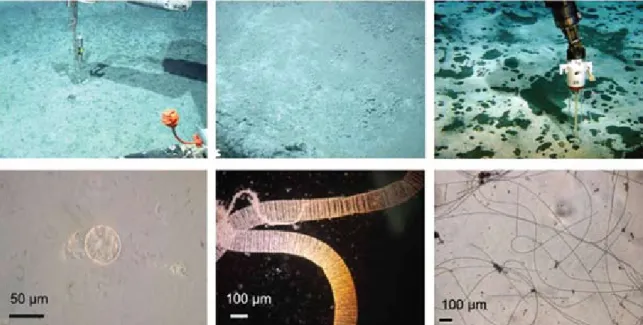
Figure 9. Macroscopic and microscopic images of microbial mats at cold seep ecosystems. (Upper panel, left) Thiomargarita mat in a fault surrounding the Amon mud volcano. ©MARUM/MPI (Middle) Thin filamentous mats at the center of the Amon mud volcano. ©MARUM/MPI (Right) Thick filamentous mats surrounding the center of the Håkon Mosby mud volcano. ©IFREMER/AWI The micrographs in the lower panel show the respective mat-forming thiotrophic bacteria. (Left) Sphere-like vacuolate
Thiomar-garita cell. (Middle) giant filamentous vacuolate gammaproteobacteria. (Right) Thin filamentous vacuolate Beggiatoa cells. ©Stefanie Grünke, MPI/AWI
been observed at the rim of the crater, suggesting a relocalization of seep activ-ity. In these hotspots, AOM activity is one order higher than at Carlos Ribeiro mud volcano and was found to sustain the development of white bacterial mats. In contrast, salt diapir-driven mud volca-noes such as Mercator have hypersaline pore water that probably inhibits micro-bial activity, which was found to be one order of magnitude lower than at Carlos Ribeiro mud volcano, although methane and sulfate are present in large amounts. Interestingly, these environmental setting variations and AOM activity are reflected by diverse microbial community com-positions. Inventories of archaeal and bacterial phylotypes in methane-rich sediments reveal that the three microbial consortia known to perform this reaction (ANME-1, -2, and -3) are active with dif-ferent distribution patterns (Figure 10). Another major feature of mud volcanoes from the Gulf of Cádiz is the very deep origin of migrating fluid and mud reach-ing the surface (Hensen et al., 2007).
HERMES work also shed some light on the bacterial and archaeal diversity of the mud volcanoes at the Anaximander Mountains, eastern Mediterranean Sea.
The Anaximander Mountains comprise a group of three main mountains between the Cyprus and Hellenic arcs (Zitter et al., 2005). The first gas hydrate sampling in the Anaximander Mountains took place in 1996 at the Kula mud volcano (Woodside et al., 1997, 1998). Today, hydrates have also been sampled from four other mud volcanoes in the area. High seafloor methane fluxes are associ-ated with the mud volcanoes as well as with the accompanying cold vents and seeps (Charlou et al., 2003), and the avail-able gas provides energy for rich benthic communities, including chemosynthetic symbiotic fauna (Olu-Le Roy et al., 2004). Carbonate crusts derived from anaerobic oxidation of methane are formed in these environments (Aloisi et al., 2002). Of the five known mud volcanoes in the province, microbial diversity data exist only for prokaryotes (Bacteria and Archaea) from the Amsterdam (ca. 2030 m) and Kazan (ca. 1700 m) mud volcanoes. Based on 16S rRNA gene diversity, the Amsterdam mud volcano harbors a rather diverse bacterial com-munity. Shannon diversity index H’ (a tool for comparing two distinct habitats by combining the quantifiable terms of
species richness and species equitabil-ity; high H values indicate more diverse communities—an H value of 0 indicates a community with one species) varies between 3.33 (carbonate crusts) and 5.93 (sediments) (Heijs et al., 2006, 2008; recent work of author ). The most abun-dant phylotypes in carbonate crusts are related to Actinobacteria, Clostridia, and
Alpha-, Gamma- and Deltaproteobacteria
as previously described (Heijs et al., 2006). Regarding sediments, the major-ity of the phylotypes are closely related to gas hydrate bearing sediments (Knittel et al., 2005). High numbers of Deltaproteobacteria phylotypes are present, as well as Actinobacteria,
Acidobacteria, Alpha-, Gamma-, Epsilon-
and Deltaproteobacteria, Firmicutes,
Cytophaga-Flexibacter group, and
can-didate division WS3. Several phylotypes have also been found from the Chloroflexi and candidate division JS1. More rare phylotypes are related to Planctomycetes,
Firmicutes (Bacilli), Bacteriodetes, and
candidate divisions OD1, OP8, OP11, and GN06. (Heijs et al., 2008; recent work of Pachiadaki and colleagues).
Archaeal communities show lower diversity with H’ (base e) values rang-ing from 2.14 to 2.68 for sediments while in carbonate crusts H’ is 2.93 (Heijs et al., 2006, 2008; recent work of author Pachiadaki and colleagues). Most of the archaeal sequences found in Amsterdam mud volcano carbon-ate crusts belong to the Crenarchaeota, Marine Group I (MGI). The remainder of the crenarchaeal sequences fall into a hitherto unclassified novel group of
Crenarchaeota whose related sequences
have previously been obtained from deep-sea sediments (Vetriani et al., 1999). The euryarchaeal sequences are
Figure 10. diversity of anaerobic oxidation of methane (AoM) communities from the gulf of Cádiz mud volcanoes shown with fluorescent in situ hybridization imaging. (Left) ANME-2 type aggregates with multiple archaeal cores surrounded by bacteria as observed in the Carlos Ribeiro mud volcano AoM zone. (Middle) ANME-2 type clusters with a single archeal core in a shallow microbial commu-nity of the darwin mud volcano. (Right) ANME-1 type of archaeal filaments dominate the Mercator mud volcano microbial community. Microbial cells in a and b are stained with the archaeal specific probe Arch915 and dAPI staining, respectively.
related to novel Thermoplasmata or
Methanosarcinales. The latter are
affili-ated to ANME-2 sequences (Heijs et al., 2008; recent work of author Pachiadaki and colleagues), while all three groups— ANME-1, ANME-2, and ANME-3— have been found in Amsterdam mud volcano sediments. Other sequences are related to Methanomicrobiales, marine benthic group D (MBG-D), and the
Thermoplasmata. In comparison, the
sediments of the Kazan mud volcano harbored less diverse bacterial assem-blages. The H’ index varied between 2.52 and 3.63. The Kazan phylotypes are related to the Acidobacteria,
Actinobacteria, Bacilli, Clostridia, Chloroflexi, Spirochaetes, Nitrospira, Planctomycetes, Alpha-, Gamma- and Deltaproteobacteria, OP11, WS3, and a
few unclassified Bacteria (Heijs et al., 2007; Kormas et al., in press; recent work of author Pachiadaki and colleagues). Archaeal diversity was also lower, vary-ing between 1.63 and 2.57. The occur-ring phylotypes are related to MGI, novel Crenarchaeota, Halobacteriales,
Methanosarcinales, Thermoplasmata,
and unclassified Archaea (Heijs et al., 2007; Kormas et al., in press; recent work of author Pachiadaki and colleagues Further work on the microbial biodiver-sity of eastern Mediterranean mud vol-canoes and pockmarks of the Nile Deep Sea Fan is underway, focusing on the variety of microbial mats and associated communities (Omoregie et al., 2007).
oUTLook
Seeps, vents, and other reduced ecosys-tems contain a variety of organisms with unique functions related to chemoau-totrophy, respiration, detoxification, mineral precipitation and dissolution,
attachment, and sensing (chemotaxis). Among the most remarkable observa-tions regarding different size groups and taxa, from bacteria to fish, are the high heterogeneities from small to large scales. Every seep region along the European margin is different in terms of community composition and biodi-versity, and high patchiness and other differences are observed within regions. However, many questions remain in the quest to unravel the diversity, function-ing, and genomic capacity of chemosyn-thetic organisms, including free-living microbes and symbiotic associations with invertebrates. Chemosynthetic habitats are isolated and highly fractured ecosystems in which the organisms require distinct environmental features and cues to maintain their populations (temperature, presence of sulfide and CH4, hard ground, particle flux). The life history of animals and microbes restricted to chemosynthetic ecosystems and their dispersal remains a key limita-tion in understanding the interconnec-tivity and resilience of these dynamic ecosystems. Interconnectivity can be studied at different geographical scales as well as among vents, seeps and other habitats, which requires a combination of biological, oceanographic, and bio-geographic studies, including population biology using genomic markers to assess gene flow. Furthermore, in a changing ocean it becomes critical to assess varia-tions in biodiversity across all habitats in order to distinguish between natural and anthropogenic effects. The first long-term observatories at cold seeps are planned, and will provide data on the link between environmental fluctuations and the fate of the benthic ecosystem.
ACkNowLEdgEMENTS
Firstly we would like to thank Myriam Sibuet who was one of the initiators of the HERMES project and the first leader of the Cold Seep Workpackage. We also want to thank Phil Weaver and Vikki Gunn, respectively, the coordi-nator and manager of the HERMES project, which was funded under the European Commission’s Framework Six Programme (EC contract no. GOCE-CT-2005-511234). We acknowl-edge the captains, the crews, ROV teams, and chief scientists of the cruises: ARKTIS XIX/3b (2003): Polarstern (Michael Klages); BioNIL (2006) Meteor (Antje Boetius) ; VICKING (2006):
Pourquoi Pas?, Victor 6000 (Hervé
Nouzé); MEDECO (2007) Pourquoi
Pas? Victor 6000 (Jozée Sarrazin and
Catherine Pierre).
REFERENCES
Akhmetzhanov, A.M., M. Ivanov, N.H. Kenyon, and A. Mazzini. 2007. Deep-water cold seeps, sedimentary environments and ecosystems of the Black and Tyrrhenian Sea and the Gulf of Cádiz. Preliminary results of investigations during the TTR-15 cruise, RV Professor Logachev, June–August 2005, Intergovernmental Oceanographic Commission, Paris, 99 pp. plus appendices.
Aloisi, G., I. Bouloubassi, S.K. Heijs, R.D. Pancost, C. Pierre, J.S. Sinninghe Damste, J.C. Gottschal, L.J. Forney, and J.-M. Rouchy. 2002. CH4-consuming
microorganisms and the formation of carbonate crusts at cold seeps. Earth and Planetary Science
Letters 203:195–203.
Barry, J.P., R.E. Kochevar, and C.H. Baxter. 1997. The influence of pore-water chemistry and physiology on the distribution of vesicomyid clams at cold seeps in Monterey Bay: Implications for patterns of chemosynthetic community organization.
Limnology and Oceanography 42:318–328.
Bergquist, D.C., C. Fleckenstein, J. Knisel, B. Begley., I.R. MacDonald, and C.R. Fisher. 2005. Variations in seep mussel bed communities along physical and chemical environmental gradients. Marine
Ecology Progress Series 293:99–108.
Bergquist, D.C., I.A. Urcuyo, and C.R. Fisher. 2002. Establishment and persistence of seep vestimen-tiferan aggregations from the upper Louisiana slope of the Gulf of Mexico. Marine Ecology
Bergquist, D.C., T. Ward, E.E. Cordes, T. McNelis, S. Howlett, R. Koisoff, S. Hourdez, R. Carney, and C.R. Fisher. 2003. Community structure of vesti-mentiferan-generated habitat islands from Gulf of Mexico cold seeps. Journal of Experimental Marine
Biology and Ecology 289:197–222.
Boetius, A., K. Ravenschlag, C. Schubert, D. Rickert, F. Widdel, A. Gieseke, R. Amann, B.B. Jørgensen, U. Witte, and O. Pfannkuche. 2000. A marine micro-bial consortium apparently mediating anaerobic oxidation of methane. Nature 407:623–626. Charlou, J.L., J.P. Donval, T. Zitter, N. Roy, P.
Jean-Baptiste, J.-P. Foucher, J. Woodside, and The MEDINAUT Scientific Party. 2003. Evidence of methane venting and geochemistry of brines on mud volcanoes of the eastern Mediterranean Sea.
Deep-Sea Research Part I 50:941–958.
Cordes, E.E., S.L. Carney, S. Hourdez, R.S. Carney, J.M. Brooks, and C.R. Fisher. 2007. Cold seeps of the deep Gulf of Mexico: Community structure and biogeographic comparisons to Atlantic equato-rial belt seep communities. Deep-Sea Research
Part I 54:637–653.
de Beer, D., E. Sauter, H. Niemann, U. Witte, and A. Boetius. 2006. In situ fluxes and zonation of micro-bial activity in surface sediments of the Håkon Mosby Mud Volcano. Limnology and Oceanography 51:1,315–1,331.
Duperron, S., C. Bergin, F. Zielinski, A. Blazejak, A. Pernthaler, Z.P. McKiness, E. DeChaine, C.M. Cavanaugh, and N. Dubilier. 2006. A dual symbiosis shared by two mussel species,
Bathymodiolus azoricus and Bathymodiolus puteo-serpentis (Bivalvia: Mytilidae), from hydrothermal
vents along the northern Mid-Atlantic Ridge.
Environmental Microbiology 8:1,441–1,447.
Duperron, S., A. Fiala-Medioni, J.C. Caprais, K. Olu, and M. Sibuet. 2007. Evidence for chemoauto-trophic symbiosis in a Mediterranean cold seep clam (Bivalvia: Lucinidae): comparative sequence analysis of bacterial 16S rRNA, APS reductase and RubisCO genes. FEMS Microbiology Ecology 59:64–70.
Dupré, S., J. Woodside, J.-P. Foucher, G. de Lange, J. Mascle, A. Boetius, V. Mastalerz, A. Stadnitskaia, H. Ondreas, C. Huguen, and others. 2007. Seafloor geological studies above active gas chimneys off Egypt (Central Nile Deep Sea Fan). Deep-Sea
Research Part I 54:1,146–1172.
Domack, E., S. Ishman, A. Leventer, S. Sylva, V. Willmott, and B. Huber. 2005. A chemotrophic ecosystem found beneath Antarctic ice shelf.
Eos, Transactions, American Geophysical Union
86:269–276.
Gebruk, A.V., E.M. Krylova, A.Y. Lein, G.M. Vinogradov, E. Anderson, N.V. Pimenov, G.A. Cherkashev, and K. Crane. 2003. Methane seep community of the Håkon Mosby mud volcano (the Norwegian Sea): Composition and trophic aspects.
Sarsia 88:394–403.
Génio, L., S.B. Johnson, R.C. Vrijenhoek, M.R. Cunha, P.A. Tyler, S. Kiel, and C.T.S. Little. 2008. New record of “Bathymodiolus” mauritanicus Cosel
2002 from the Gulf of Cádiz (NE Atlantic) mud volcanoes. Journal of Shellfish Research 27:53–61. Haeckel, M., C. Berndt, V. Liebetrau, P. Linke, A.
Reitzi, J. Schonfield, and H. Vanneste. 2007. Genesis and rates of fluid flow at the Mercator mud volcano, Gulf of Cádiz. Geochimica et
Cosmochimica Acta 71:A367.
Heijs, S.K., G. Aloisi, I. Bouloubassi, R.D. Pancost, C. Pierre, J.S. Sinninghe-Damsté, J.C. Gottschal, J.D. van Elsas, and L.J. Forney. 2006. Microbial commu-nity structure in three deep-sea carbonate crusts.
Microbial Ecology 52:451–462.
Heijs, S.K., R.R. Haese, P.W. van der Wielen, L.J. Forney, and J.D. van Elsas. 2007. Use of 16S rRNA gene based clone libraries to assess microbial com-munities potentially involved in anaerobic methane oxidation in a Mediterranean cold seep. Microbial
Ecology 53:384–398.
Heijs, S.K., A.M. Laverman, L.J. Forney, P.R. Hardoim, and J.D. van Elsas. 2008. Comparison of deep-sea sediment microbial communities in the eastern Mediterranean. FEMS Microbiology Ecology 63:362–377.
Henry, P., J.P. Foucher, X. Le Pichon, M. Sibuet, K. Kobayashi, P. Tarits, N. Chamot-Rooke, T. Furuta, and P. Shultheiss. 1992. Interpretation of tempera-ture measurements from the Kaiko-Nankai Cruise: Modeling of fluid flow in clam colonies. Earth and
Planetary Science Letters 109:355–371.
Hensen, C., M. Nuzzo, E. Hornibrook, L.M. Pinheiro, B. Bock, V.H. Magalhaes, and W. Bruckmann. 2007. Sources of mud volcano fluids in the Gulf of Cádiz: Indications for hydrothermal imprint.
Geochimica et Cosmochimica Acta 71:1,232–1,248.
Hilário, A., and M.R. Cunha. 2008. On some frenulate species (Annelida: Polychaeta: Siboglinidae) from mud volcanoes in the Gulf of Cádiz (Northeast Atlantic). Scientia Marina 72:361–371. Hovland, M., and H. Svensen. 2006. Submarine
pin-goes: Indicators of shallow gas hydrates in a pock-mark at Nyegga, Norwegian Sea. Marine Geology 228:15–23.
Hovland, M., H. Svensen, C.F. Forsberg, H. Johansen, C. Fichler, J.H. Fosså, F. Jonsson, and H. Rueslåtten. 2005. Complex pockmarks with carbonate-ridges off mid-Norway: Products of sediment degassing.
Marine Geology 218:191–206.
Jerosch, K., M. Schlüter, J.-P. Foucher, A.G. Allais, M. Klages, and C. Edy. 2007. Spatial distribution of mud flows, chemoautotrophic communities, and biogeochemical habitats at Håkon Mosby mud volcano. Marine Geology 243:1–17.
Jorgensen, B.B., and A. Boetius. 2007. Feast and famine–Microbial life in the deep-sea bed. Nature
Microbiology Reviews 5:770–781.
Julian, D., F. Gaill, E. Wood, A.J. Arp, and C.R. Fisher. 1999. Roots as a site of hydrogen sulphide uptake in the hydrocarbon seep vestimentiferan
Lamellibrachia sp. Journal of Experimental Biology
202:2,245–2,257.
Juniper, S.K., and M. Sibuet. 1987. Cold seep benthic communities in Japan subduction zones: Spatial organization, trophic strategies and evidence for
temporal evolution. Marine Ecology Progress Series 40:115–126.
Kenyon, N.H., M.K. Ivanov, A.M. Akhmetzhanov, and G.G. Akhmanov. 2000. Multidisciplinary study of geological processes on the North East Atlantic and western Mediterranean margins. Preliminary results of geological and geophysical investigations during the TTR-9 cruise of R/V Professor Logachev, June–July 1999, Intergovernmental Oceanographic Commission, Paris, 102 pp. plus appendices. Kenyon, N.H., M.K. Ivanov, A.M. Akhmetzhanov, and
G.G. Akhmanov. 2003. Interdisciplinary geosci-ence research on the North East Atlantic margin, Mediterranean Sea and Mid-Atlantic Ridge. Preliminary results of investigations during the TTR-12 cruise of RV Professor Logachev, June– August 2002, Intergovernmental Oceanographic Commission, Paris, 112 pp. plus appendices. Kenyon, N.H., M. Ivanov, A.M., Akhmetzhanov,
and E.V. Kozlova. 2006. Interdisciplinary geosci-ence studies of the Gulf of Cádiz and western Mediterranean basins. Preliminary results of inves-tigations during the TTR-14 cruise, RV Professor
Logachev, July–September 2004, Intergovernmental
Oceanographic Commission, Paris, 115 pp. plus appendices.
Knittel, K., A. Boetius, A. Lemke, H. Eilers, K. Lochte, O. Pfannkuche, P. Linke, and R. Amann. 2003. Activity, distribution, and diversity of sulfate reducers and other bacteria above gas hydrate (Cascadia Margin, OR). Geomicrobiology Journal 20:269–294.
Knittel, K., T. Lösekann, A. Boetius, R. Kort, and R. Amann. 2005. Diversity and distribution of methanotrophic archaea at cold seeps. Applied and
Environmental Microbiology 71:467–479.
Kormas, K.A., A. Meziti, A. Dählmann, G.J. de Lange, and V. Lykousis. In press. Characterization of methanogenic and prokaryotic assemblages based on mcrA and 16S rRNA gene diversity in sedi-ments of the Kazan Mud Volcano (Mediterranean Sea). Geobiology.
Levin, L.A. 2005. Ecology of cold seep sediments: Interactions of fauna with flow, chemistry and microbes. Oceanography and Marine Biology–An
Annual Review 43:1–46.
Levin, L.A., W. Ziebis, G.F. Mendoza, V.A. Growney, M.D. Tryon, K.M. Brown, C. Mahn, J.M. Gieskes, and A.E. Rathburn. 2003. Spatial heterogeneity of macrofauna at northern California methane seeps: Influence of sulfide concentration and fluid flow.
Marine Ecology Progress Series 265:123–139.
Loncke, L., and J. Mascle. 2004. Mud volcanoes, gas chimneys, pockmarks and mounds in the Nile deep-sea fan (Eastern Mediterranean): Geophysical evidences. Marine and Petroleum Geology 21:669–689.
Lösekann, T., K. Knittel, T. Nadalig, B. Fuchs, H. Niemann, A. Boetius, and R. Amann. 2007. Diversity and abundance of aerobic and anaerobic methane oxidizers at the Haakon Mosby mud volcano, Barents Sea. Applied and Environmental