On the Use of Thermal Properties for Characterizing
Dimension Stones
Paulo Amaral
1,a, António Correia
1,2,b, Luís Lopes
1,3,c, Paula Rebola
4,d,
António Pinho
3,5,eand José Carrilho Lopes
3,6,f1Centro de Geofísica de Évora, Universidade de Évora, Portugal 2Departamento de Física, Universidade de Évora, Portugal 3Departamento de Geociências, Universidade de Évora¸ Portugal
4Cevalor, LEM, Portugal 5GEOBIOTEC, Portugal
6Centro de Geologia da Universidade de Lisboa, Portugal
a[email protected], b[email protected], c[email protected], d[email protected], e[email protected]f[email protected].
Keywords: Dimension stones, Thermal properties.
Abstract. The use of dimension stones in architecture and civil engineering implies the knowledge
of several mechanical, physical and chemical properties. Even though it has been usual practice to measure physical and mechanical properties of dimension stones the same is not true for thermal properties, such as thermal conductivity, thermal diffusivity, specific heat capacity, and heat production. These properties are particularly important when processes related with heating and cooling of buildings must be considered.Thermal conductivity, thermal diffusivity, and specific heat capacity are related with the way thermal energy is transmitted and accumulated in stones; heat production has to do with the amount of radioactive elements on the rocks and so with the environmental impact of radioactivity and public health problems. It is important to start to measure on a routine basis those four thermal properties in rocks and, in particular, in dimension rocks so that their application can be improved and optimized. With this is mind three sets of different rock types (granites, limestones, and marbles) were collected to measure the thermal conductivity, the thermal diffusivity, and the specific heat capacity with the objective of characterizing them in terms of those properties. Since the same set of rocks has also been studied for other physical properties, a correlation amongst all the measured properties is being attempted. For each rock type several samples were used to measure the thermal conductivity, the thermal diffusivity, and the specific heat capacity, and average values were obtained and will be presented. As an example, for granites the thermal conductivity varies between 2.87 and 3.75 W/mK; for limestones varies between 2.82 and 3.17 W/mK; and for marbles varies between 2.86 and 3.02 W/mK.It is hoped that by measuring thermal properties on dimension stones will help to better adequate them to their use in civil engineering as well as to adequate their use in terms of a CE product.
Introduction
The interaction between mankind and rock is very old. Rocks have been used by men for very distinct purposes such as symbolic artifacts, art, construction, architecture, as well as many others. Characteristics of rocks, such as durability, multi-purpose functionality, and availability make them an indispensable raw material for mankind. As many other countries in the world, Portugal is known for extracting and putting in the global market granitic rocks and marbles. Generally speaking the value of a rock has to do with its visual aspect and texture; however, many other properties have to be studied to fully understand its quality and commercial value; in that respect
the behavior and response to physical, chemical, and mechanical factors is of the greatest importance.
Beyond the simple description of a rock in terms of color, texture and petrography, many other properties are measured for several purposes such as mechanical strength, flexural strength, bulk
density, water absorption, apparentporosity, anchorage strength, coefficient of thermal expansion,
abrasion, and impact strength. Even though it is not usual to measure thermal properties in dimension stones which include thermal conductivity, thermal diffusivity, specific heat (or volumetric heat capacity), and heat production, they are important to define how they can be used for house climatization and energy savings. As a matter of fact, rocks absorb and release thermal energy and, therefore, can be used during different times of the day to increase thermal indoor comfort. In this paper the results of measuring thermal conductivities, thermal diffusivities, and specific heat in several samples of granite, marble, and limestone are presented. No heat production measurements were performed on the samples described in this paper; however, heat production values are of great importance for public health studies since they are related with the concentration of radioactive elements in granitoid rocks such as uranium and thorium which produce radon that can be harmful if in high concentrations inside houses or apartments.
Thermal Properties
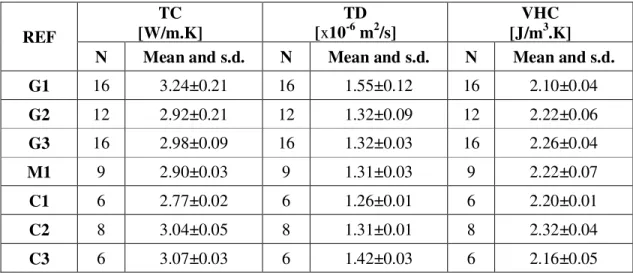
The thermal properties that were measure in seven rock samples are presented in Table 1. Thermal conductivity (W/mK) is a thermal property that quantifies the ability of a rock to allow heat to go through it; it has to do with stationary heat flow and the higher its value the better heat flows
through a rock. Thermal diffusivity (m2/s) reflects the ability of a rock to absorb and release heat; it
has to do with non stationary heat flow and the higher its value the better heat is absorbed or released from it. Specific heat represents the amount of heat a rock can accumulate and the higher its value the bigger the amount of heat it can accumulate.
Table 1: Values of the thermophysical properties measured on granites (G1, G2, and G3), marble (M1), and limestones (C1, C2, and C3) with the ISOMET 2104 using a surface probe (range between 2.00 and 6.00 W/m.K. REF - Sample reference; TC - Thermal conductivity; TD -Thermal diffusivity; VHC - volumetric heat capacity. N – Number of measurements per sample.
REF TC [W/m.K] TD [x10-6 m2/s] VHC [J/m3.K]
N Mean and s.d. N Mean and s.d. N Mean and s.d.
G1 16 3.24±0.21 16 1.55±0.12 16 2.10±0.04 G2 12 2.92±0.21 12 1.32±0.09 12 2.22±0.06 G3 16 2.98±0.09 16 1.32±0.03 16 2.26±0.04 M1 9 2.90±0.03 9 1.31±0.03 9 2.22±0.07 C1 6 2.77±0.02 6 1.26±0.01 6 2.20±0.01 C2 8 3.04±0.05 8 1.31±0.01 8 2.32±0.04 C3 6 3.07±0.03 6 1.42±0.03 6 2.16±0.05
In general terms, the thermal conductivity depends on apparent porosity, bulk density, mineralogy, anisotropy and size of the crystals, pressure, and temperature. Thermal diffusivity (α) depends on
the thermal conductivity (K), the bulk density (ρ), and the specific heat capacity (C) of the rock through the equation [1]:
α =K/ρ.C. (1)
Rock Samples and Measurement Results
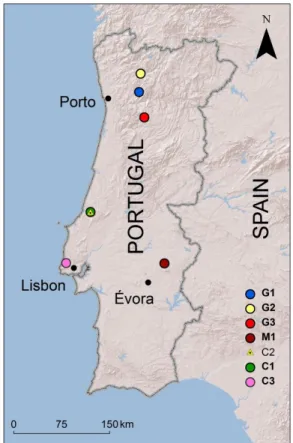
The seven rock samples of this study were collected in seven quarries in Mainland Portugal (Fig.1).
Three of the samples are granites (G1, G2, and G3), one is a marble (M1), and three are limestones
(C1, C2, and C3 (Table 2).
The thermal conductivity, the thermal diffusivity, and specific heat of the seven samples of Table 1 were measured in the Geothermics Laboratory of Geophysical Centre of Évora with an ISOMET 2104 Heat Tranfer Analyser (Fig. 2) whichy allows to measure the three properties simulteaneously. The thermal probe used to perform the measurements has a range between 2.00 W/mK and 6.00 W/mK. The average values for the thermal conductivity, the thermal diffusivity, and specific heat of the seven samples were obtained by placing the probe in different locations on the polished surface of each of the seven samples. The calculated average values are presented in Table 1.
Figure 1 – Location of quarries where the samples of the study were collected.
For completeness, apparent porosities and bulk densities of the seven rock samples were also measured in the CEVALOR laboratories using the European standard EN 1936 [2]. The bulk density and apparent porosity values are presented in Table 2.
Table 2: Mean values and standard deviations (s.d.) of the bulk density and apparent porosity measured on the seven rock samples.
REF
Bulk density [kg/m3]
Apparent porosity [%]
Mean and s.d. Mean and s.d.
G1 2570 ± 7 2.4 ± 0.1 G2 2640 ± 10 0.6 ± 0.1 G3 2620 ± 5 0.8 ± 0.0 M1 2710 ± 5 0.2 ± 0.0 C1 2570 ± 0 4.0 ± 0.1 C2 2660 ± 0 1.6 ± 0.0 C3 2660 ± 14 0.9 ± 0.2
Figure 2 -Heat Tranfer Analyser ISOMET 2104. The measuring probe is the black device on top of the rock sample.
Radioactivity of rocks as a Thermal Property
Dimension stones are a building materials used in civil engineering and architecture. There have been lately reports raising some concerns about radioactivity of the rocks used inside houses and apartments [3,4,5]. As a matter of fact, granitic rocks can present high contents of uranium and
thorium that are the main sources of radon which can be harmful to human health.As a result of the
series radioactive decay from 235U, 238U, and 232Th radon can occur as three natural nuclides
219Rn,222Rn, and 220Rn, respectively. Apparently, because of it half life of 3.82 days, 222Rn is the
only nuclide that can migrate and attain high concentrations in non ventilated closed spaces. Even though it is not a routine practice to measure the concentrations of uranium, thorium and potassium in rocks for civil engineering purposes, it appears that it should be implanted as a routine procedure. The Geophysical Centre of Evora has now the capability of determining the concentrations of uranium, thorium and potassium in rock samples so that estimates of radon produced by radioactive decay can be done.
Discussion and Conclusions
The measurement of thermal properties of rocks in general and dimension stones, in particular, is important to determine the kind of purposes those rocks can be applied to. As a matter of fact, the characteristics of the rocks have to comply with requirements from national and international regulations concerning the quality and safety of building materials. Thermal properties such thermal conductivity, thermal diffusivity, and specific heat are important for thermal comfort inside house and apartments while radon concentration is important in terms of several types of cancer prevention. Furthermore, since there is an increase demand for more efficient use of energy, the fact that a rock can be characterized in terms of its ability to accumulate heat during night hours (when the demand of electricity is low) and release heat (when the demand of electricity is high) suggests that rocks can be used to improve inside climatization with efficiency gains. Besides, dimension stones are also a good source of art work and decoration, and therefore can also be used for visual comfort. This means that rocks can be used as decorating efficient heat exchangers.
However, rocks can also be a source of diseases, in particular related with cancer as a result of high concentrations of radon resulting from radioactive decay of uranium and thorium present in many granites. So, to avoid health problems care should be taken when those rocks are used as building materials and concentrations in those two radioactive elements. With those two aspects in mind, routine measurements of thermal and radioactive properties of rocks should be implemented.
In terms of the measurements presented in this study, it is possible to say, in a qualitative way, that rocks can be classified as good or bad by measuring the thermal conductivity, the bulk density, and the apparent porosity, as shown in Table 3. Since the thermal conductivity values vary little amongst the seven rock samples of this study, comparing the quality values shown in Table 3 with the measured values of Table 2 it is possible to notice that the samples G1and C1 have characteristics less desirable as building material. The bulk density values for G1 and C1 samples within the mean values considered for rock quality for building purposes, whereas the other values are near the values for high quality rocks (Table 3).The apparent porosity values for G1 and C1 are near the mean values of quality, in contrast the other rocks have a low to a very low quality apparent porosity values. As a summary, for the seven rocks of this study the marble presents the best quality based on the physical properties measured. In the same way, G2 and G3 granites present an average quality as well as the limestone C3, which, among the limestones of this study, presents the best quality values for civil construction purposes.
Table 3: Quality ranking of rocks to be used for building purposes in terms of thermal conductivity, bulk density, and apparent porosity. Bulk density and apparent porosity adapted from [2].
Quality trend Thermal conductivity [W/ m.K] Bulk density [kg/m3] Apparent porosity [%]
Very high (> 4.0) Very low (< 2300) Very high (> 10.0)
High (4.0) Low (2300 - 2560) High (10.0 – 6.0)
Mean Mean (2600-2700) Mean (3.0 – 1.0)
low (0.3) High (2700 - 2800) Low (1.0 – 0.5)
Very low (< 0.3) Very high (> 2800) Very low (≤ 0.5)
References
[1] J. H. Schön. Physical properties of rocks: fundamentals and principles of petrophysics. Handbook of geophysical exploration. Section I, Seismic exploration: v 18, Pergamon.(1996). [2] A.M.E. Henriques and J.M.S.N. Tello. Manual da Pedra Natural para a Arquitectura. Lisboa:
Direcção Geral de Geologia e Energia.(2006).
[3] S. Darby, D. Hill, A Auvinen, J. M. Barros-Dios, H. Baysson, F. Bochicchio, H. Deo, R. Falk, F. Forastiere, M. Hakama, I. Heid, L. Kreienbrock, M. Kreuzer, F. Lagarde, I. Mäkeläinen, C. Muirhead, W. Oberaigner, G. Pershagen, A. Ruano-Ravina, E. Ruosteenoja, A. Schaffrath Rosario, M. Tirmarche, L. Tomásek, E. Whitley, H. E. Wichmann, R. Doll. Radon in homes and risk of lung cancer: collaborative analysis of individual data from 13 European case-control studies. Br. Med. J. 330 (7485), 223–226.(2005).
[4] S. D. Krewski, J.H. Lubin, J.M. Zielinski, M. Alavanja, V.S. Catalan, R.W. Field, J.B. Klotz, E.G. Le´tourneau, C.F. Lynch, J.I. Lyon, D.P. Sandler, J.B. Schoenberg, D.J. Steck, J.A. Stolwijk, C. Weinberg, and H.B. Wilcox. Residential radon and risk of lung cancer: a combined analysis of 7 North American case-control studies. Epidemiology 16 (2), 137–145. (2005). [5] L. L. Chyi. Radon Testing of Various Countertop Materials, University of Akron,