www.elsevier.com/locate/procedia
8th International Strategic Management Conference
The strategic approach to the high-performance paradigm: a
European perspective
Pedro Ferreira
a*, Isabel Neira
b, Elvira Vieira
caPortuguese Institute of Marketing Management, Av. da Republica, Matosinhos 4450-238, Portugal bUniversidade de Santiago de Compostela, Av do Burgo, 15782 Santiago de Compostela, Spain bSuperior Institute of Administration and Business, Rua do Campo Alegre, 4150 Porto, Portugal
Abstract
Human Resources Management (HRM) has been viewed in the last decades as a serious competitive advantage capable of create differentiation while contributing to organizational overall performance. In recent years, a growing body of research goes even further and argues the strategic value of human capital to organizations’ performance and success. The high-performance paradigm argues that employee involvement is critical for organizational performance and the set a practices to do so are, according the American approach, universal and should be implemented in as a system. However, recent developments, mainly in Europe, argue that, despite the indisputable importance of human resources to organizational performance, there is no universal or system approach, no definitive set of practices capable of fostering performance. Using data from 30 European countries, this research tries to understand if there is a European approach to the high-performance paradigm, namely a system or a bundle approach. Furthermore, this research tests the relation between the high-performance practices and performance.
© 2011 Published by Elsevier Ltd. Selection and/or peer-review under responsibility [name organizer] Keywords: human resources management; high-performance paradigm; Europe; performance;
*
Corresponding author. Tel. +351.96.7893088; Fax +351.22.9382800 Email: [email protected]
1. Introduction
The relation between high-performance practices and organizational performance has been one of the major concerns of researchers. However there is no consensus on how this relation is to be explained and achieved. In the case of high-performance this is reflected in two interpretations. On the one hand, the universal approach reflects the opinion that the high-performance practices should be the same regardless of the characteristics of the company or the environment. On the other hand, the contingency approach argues that the practices should be adapted to the specificities of the company and the environmental demands. As a consequence, the contingency perspective denies the “one best way” or “best practice” approach.
The universal approach argues that management should implement a set of defined and distinct human resources and work organization practices, which will lead to higher performance (Boxall & Purcell, 2003). However, this approach doesn’t seem to find solid support, due to the absence of consistent and joint contribution of many of those practices – such as teamwork, employee participation and information sharing. According to several studies, the more consistent results emerge where models approximate the real world of work and where measurement and sampling errors are reduced by using special-purpose surveys targeted at workplaces in specific industries (Applebaum et al., 2000; Dunlop & Weil, 1996; Ichniowski et al., 1996).
Considering that an important part of the strategy planning is based on the environment of the company, the debate around the universal vs. contingency approach is also applicable to human resources management and work organization. In fact, the changes in the environment are an important piece of the strategic thinking and planning. More stable or more dynamic environments produce different effects inside the company. This calls for a contingency approach to management in general and to HRM in particular, meaning that every decision and action should be planned taking into account the characteristics of the surrounding environment.
While the universalist or “best practice” approach has its roots in the American research tradition (Brewster, 2003), the contextualist or contingent perspective is more common in Europe. The underlying methodological approaches of these competing conceptual perspectives are also different: the universalist perspective looks for HR practices that are universally applicable and advancements in research and understanding of HRM is deductive; the contextualist approach focus on understanding of differences between and within the various HRM clusters in various contexts. In this perspective, the mode of inquiry is inductive, mainly exploratory and descriptive (Brewster, Mayrhofer & Morley, 2000).
Based on this framework, the goal of this paper is to understand how European companies approach the high-performance paradigm and how effective they are in terms of performance. In more detail, this paper tries to point out the specific HR practices used by European companies, and how they contribute to companies’ performance. The paper starts by framing the main ideas about the high-performance paradigm, the strategic debate and the American vs. European approach to the link high-performance HRM and performance. Then, the methodological guidelines are presented, namely the database and variables used, followed by the results and discussion.
2. Literature Review
2.1. High-performance paradigm
The high-performance approach, with roots in the American tradition of HRM, argues that employee involvement is critical for organizational performance. According to this argument the High-Performance paradigm (Godard, 2004) has been developed as “systems of managerial practices that increase the empowerment of employees and enhance the skills and incentives that enable and motivate them to take
advantage of this greater empowerment” Boxall & Macky, 2007). Although the first references to the High-Performance paradigm date to the mid 1980’s (Lawler, 1986; Walton, 1985), research on this perspective has been growing considerably since the 1990’s. The diversity of approaches and the emphasis on different aspects gave rise to different expression to designate the High-Performance paradigm, such as holistic work models (Lindbeck & Snower, 2000), high performance work systems (Appelbaum & Batt, 1994; Tomer, 2001), high involvement management (Lawler, 1986) or high-commitment employment practices (Walton, 1985).
The main focus of research on the High-Performance paradigm has been the contribution of HRM to the overall companies’ performance (e.g. Huselid, 1995; Guthrie, Spell & Nyamori, 2002; Kintana, Alonso, Olaverri, 2006; Fabling & Grimes, 2010). Nevertheless, the impact of high-performance practices on employees has been growing in interest among researchers (e.g. Ramsay, Scholarios, & Harley, 2000; Harley, 2002; Ollo-Lopez, Bayo-Moriones & Larraza-Kintana, 2010; Harley, Sargent & Alley, 2010).
Despite the growing body of literature on the subject, several discussions remain. One of the most important is related to the practices that reflect the High-Performance paradigm and how they should be measured and combined. In fact, although there is not much discussion on the principles of the High-Performance paradigm, there is not agreement on what practices really reflect them. The span of practices can range from a few (Scotti, Harmon, & Behson, 2007; Takeuchi et al., 2007) to a hundred (Stavrou, Brewster & Charalambous, 2010).
2.2. Strategic debate
Datta et al. (2005) who worked on the two primary perspectives like universal approach and a contingency approach that are used to model the link between HRM and organisational effectiveness (Youndt, 1996), also arrive at the conclusion that both the perspectives are conducive to HRM. However, there is a general impression that those took universal approach have posited a generally positive relationship between "best-practice" HRM and firm performance, and those took contingency approach have suggested that the extent of the effect of HRM on organisation performance depends on the environmental state of the organisation. Datta et al (2005) eventually pointed at the need for finding out the barriers that might influence otherwise benefiting practice HPWS. However, Delery and Shaw (2001) endorse the quality of SHRM research as they suggest that at least two major features distinguish SHRM research from the more traditional HR management – one, SHRM studies have focused on clear explanation regarding what could be the strategic role that it can play in enhancing organisational effectiveness, and two, it analysed the application outcome at organisation level.
Very similar to the concept of “external fit” is what has been called the “matching thesis” (Godard, 2007). According to this thesis, there should be a close relation between the strategy and the HR and work design practices in order to satisfy the strategic goals of the firm. There should be a match between the strategy and the high-performance practices. In one of these studies, Guthrie et al. (2002), based on a survey on New Zealand business organizations with at least 100 employees observed that though intensive use of high involvement work practices enhance firm effectiveness, such effect is dependent on the competitive strategy adopted by the firm (differentiation/cost leader), and thus the use of high involvement work practices has a strong correlation with competitive strategy, which clearly suggests that the implementation of differentiation-oriented competitive strategy may increase the need for a committed and skilled workforce, which in turn enhance the utility of high involvement work practices.
Another similarity follows from the notion of “internal fit” and the “complementarities thesis”, which advocates that in order to produce significant effects, high-performance practices should be implemented in a combined and integrated fashion. This combination should promote a systemic effect and the combined effects of the practices should surpass their results when implemented in isolation.
Earlier research, mainly emanated from the USA, argues that high-performance practices only make sense when combined in one single system made of specific practices. However, recent research seems
not to confirm this argument. In fact, some researchers, mainly European seem to argue that there is little evidence to support the “best practice” or universalist approach, quite the opposite: research, mainly developed in European countries and companies seem to show that several approaches are being made to the high-performance paradigm, without distorting its main principles (Brewster, 2003; Brewster, 2004; Brewster, 2007; Wasti, Poell & Çakar, 2008).
2.3. The contextualist approach
Based on a contextual paradigm, Nikandrou, Apospori and Papalexandris (2005) identified clusters of European countries in which HRM could be seen to take distinctive forms. Using the Cranet-E database, and on the basis of 52 indexes of HR and work organization practices, they applied Ward’s clustering method and the squared Euclidean distance as a measure of dissimilarity between cases. The results grouped the 24 countries in 4 clusters: Central Southern cluster (Germany, Austria, Spain, Czech Republic, Slovenia, Italy and Portugal), Peripheral cluster (Bulgaria, Estonia, Greece, Cyprus, Ireland, Northern Ireland and Turkey), Nordic cluster (Denmark, Finland, Norway and Sweden), and Western cluster (UK, Switzerland, Belgium, the Netherlands and France).
Ignjatovíc & Svetlik (2003) examined HRM strategies and practices across 18 European countries. The study was based on 1995 and 1999 Cranet data, allowing a longitudinal methodological framework. The cluster analysis procedures were based on Ward’s method of clustering and the squared Euclidean distance as a measure of dissimilarity. They found that two major clusters emerged: North-West and South-East clusters. In addition, these two major clusters were divided in two sub-clusters each: the North-West cluster was divided in the western sub-cluster (UK, Switzerland, Sweden, The Netherlands, Belgium, Germany, France and Spain) and the northern sub-cluster (Denmark, Norway and Finland); the South-East cluster was formed by the Eastern Germany, Czechoslovakia and Italy sub-cluster while Turkey, Ireland, Greece and Bulgaria formed the other sub-cluster. Finally they found no evidence of convergence between the two major clusters when looking at 1995 and 1999 data.
Apospori, Nikandrou, Brewster & Paplexandris (2008) looked for the impact of market growth, business strategy formalization and HRM centrality and practices on organizational performance in Europe. Using Cranet data from 1999/2000 for 21 countries, exploratory (hierarchical) cluster analysis was performed based on information covering the personnel human resource function, staffing, employee development, compensation and benefits, employee relations and communication and organizational details. The cluster analysis revealed two clusters: Northern cluster (Austria, Belgium, the Czech Republic, Denmark, Finland, France, Germany, Norway, Spain, Sweden, Switzerland and the UK) and the Southern cluster (Bulgaria, Cyprus, Greece, Italy and Turkey).
3. Methods
3.1. Research Goal
This study has two main goals. On the one hand, assess the European approach to the high-performance paradigm; on the other to test the influence of this approach to the companies’ high-performance. Data used in this research is drawn from the European Company Survey (2009) conducted by the European Foundation for the Improvement of Living and Working Conditions. The unit of analysis of this survey is European companies with, at least, 10 employees, and the respondent is a company representative. The 2009 survey collected data from 30 countries (UE27, plus 3 candidate countries) with a total of 27160 observations). For the purpose of this research, only companies from the production sector were used (leaving out private and public services) with a total of 11221 observations.
The variables used to represent the high-performance approach are based on previous studies that identify several HR practices, such as teamwork (e.g. “Is work in teams an important characteristic of the
work organisation in your establishment”), training (e.g. Is the need for further training periodically checked in a systematic way in your establishment”) and rewards (e.g. “Is there any profit sharing scheme offered in this establishment” or “Is there any share ownership scheme offered in this establishment”). Company performance is measured by the so called subjective performance (“Compared with other establishments in the same sector of activity, how would you assess the labour productivity in your establishment”).
To accomplish the first goal (look for an European approach to the high-performance paradigm), we used data reduction techniques (factor analysis) allowing to test how the 15 selected practices grouped. We computed an exploratory factor analysis and used the “eigenvale greater than one” as criteria for factors’ selection; the interpretation of factors was based on the rotated matrix, which was calculated using the varimax method. Data from the factor analysis was saved as standardized variables and used in countries’ analysis and the regression analysis, to test the impact of the high-performance paradigm on companies’ performance.
4. Data Analysis
4.1. Factor analysis
The first step was to analyze the correlations matrix. This kind of procedure aims to examine the correlation and linear association between variables. If the correlations obtained are high it would indicate that there is redundant information and the dimensionality of the set of variables can be reduced. The Bartlett test of sphericity does not accept the null hypothesis that the correlation matrix is an identity matrix (Chi-square=32300,326; df=105; sig.=,000) and the test of Kaiser-Meyer-Olkin (KMO) with a value of 0.689, points to the presence of common factors. Thus, these results indicate that the sample is adequate for the principal component analysis.
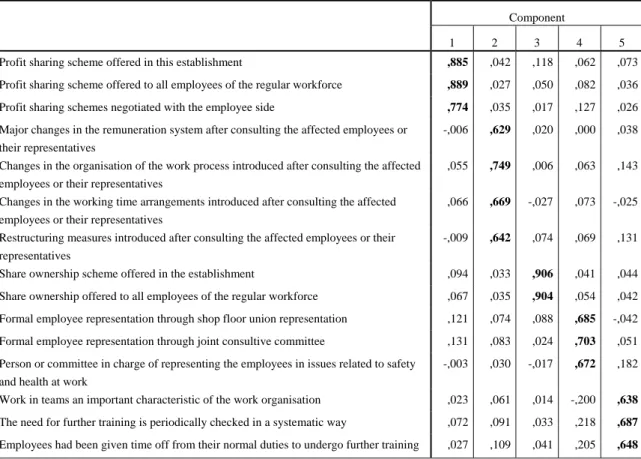
The components were extracted and rotated using varimax rotation method. The rotated component matrix is presented in Table 1.
The results of the factor analysis presented five components with an eigenvalue greater than one. All the variables were kept in the analysis, since all component loading values are above 0,5. The grouping of the variables in five components shows that there is not a “one bundle” approach to the high-performance paradigm in Europe. On the contrary, the results revealed five specific bundles of practices: profit sharing
rewards (factor 1), communication (factor 2), share ownership rewards (factor 3), employee representation (factor 4) and training and team work (factor 5). The results show that there is not a single
bundle that reflects one “system” of work and HR practices. This may question several previous assumptions. For example, the “system” approach in which the practices function as whole, supporting each other in a systemic manner (where the output is greater than the sum of the parts) is not supported by the present data results.
Although the bundles can be found in previous literature, there is not an exact match between these results as a whole and previous research. This means that the data generally supports the assumption of a specific European approach to the high-performance paradigm, with specific practices and combinations different from other geographic areas of the world. This conclusion contradicts the universal perspective (or the one-style-fits-all view), which advocates that high-performance practices should be the same regardless of the characteristics of the company or the environment. Consequently, it is also denied the “one best way” or “best practice” approach.
Table 1. High-performance practices components’ loading
Component
1 2 3 4 5 Profit sharing scheme offered in this establishment ,885 ,042 ,118 ,062 ,073 Profit sharing scheme offered to all employees of the regular workforce ,889 ,027 ,050 ,082 ,036 Profit sharing schemes negotiated with the employee side ,774 ,035 ,017 ,127 ,026 Major changes in the remuneration system after consulting the affected employees or
their representatives
-,006 ,629 ,020 ,000 ,038 Changes in the organisation of the work process introduced after consulting the affected
employees or their representatives
,055 ,749 ,006 ,063 ,143
Changes in the working time arrangements introduced after consulting the affected employees or their representatives
,066 ,669 -,027 ,073 -,025
Restructuring measures introduced after consulting the affected employees or their representatives
-,009 ,642 ,074 ,069 ,131 Share ownership scheme offered in the establishment ,094 ,033 ,906 ,041 ,044 Share ownership offered to all employees of the regular workforce ,067 ,035 ,904 ,054 ,042 Formal employee representation through shop floor union representation ,121 ,074 ,088 ,685 -,042 Formal employee representation through joint consultive committee ,131 ,083 ,024 ,703 ,051 Person or committee in charge of representing the employees in issues related to safety
and health at work
-,003 ,030 -,017 ,672 ,182 Work in teams an important characteristic of the work organisation ,023 ,061 ,014 -,200 ,638
The need for further training is periodically checked in a systematic way ,072 ,091 ,033 ,218 ,687
Employees had been given time off from their normal duties to undergo further training ,027 ,109 ,041 ,205 ,648
4.2. Regression analysis
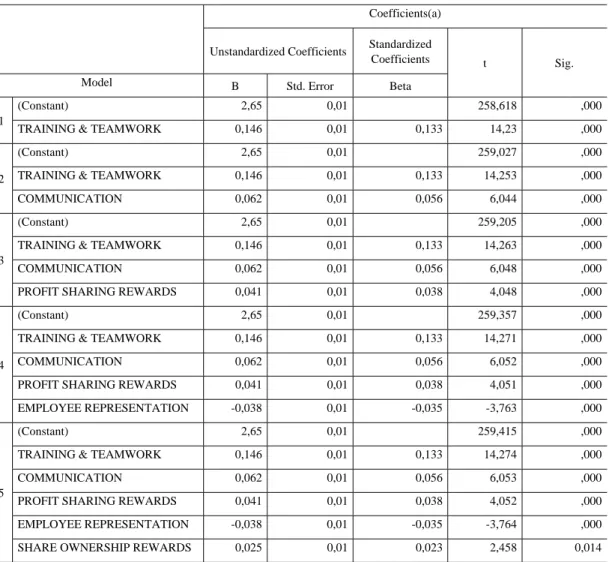
It is widely accepted in the literature that the high-performance paradigm has an impact on companies’ performance. In order to test this assumption for the European context, we conducted a regression analysis using the factor scores as the independent variables and a subjective measure as a proxy of companies’ performance. The results of the regression analysis are presented below.
The regression model shows that all the correlations are significant, with the exception of “share ownership rewards”. In fact, there is not a similar behaviour among the five bundles of high-performance practices. Although the correlation scores are relatively low, “training and teamwork”, “communication” and “profit sharing rewards” have a positive impact on the perceived performance of European companies. On the other hand, “employee representation” has a negative impact on perceived performance, although with a low score. The bundles related with rewards – “share ownership rewards” and “profit sharing ownership rewards” have distinct results. On the on hand, the impact of share ownership doesn’t seem to have no impact whatsoever on performance, whereas profit sharing has a positive impact. These may reveal that not all rewards schemes are capable of foster productivity, because employees don’t value them equally.
Table 2. Regression analysis of companies’ performance and bundles of high-performance practices
Coefficients(a)
Unstandardized Coefficients Standardized
Coefficients t Sig.
Model B Std. Error Beta
1
(Constant) 2,65 0,01 258,618 ,000
TRAINING & TEAMWORK 0,146 0,01 0,133 14,23 ,000
2
(Constant) 2,65 0,01 259,027 ,000
TRAINING & TEAMWORK 0,146 0,01 0,133 14,253 ,000
COMMUNICATION 0,062 0,01 0,056 6,044 ,000
3
(Constant) 2,65 0,01 259,205 ,000
TRAINING & TEAMWORK 0,146 0,01 0,133 14,263 ,000
COMMUNICATION 0,062 0,01 0,056 6,048 ,000
PROFIT SHARING REWARDS 0,041 0,01 0,038 4,048 ,000
4
(Constant) 2,65 0,01 259,357 ,000
TRAINING & TEAMWORK 0,146 0,01 0,133 14,271 ,000
COMMUNICATION 0,062 0,01 0,056 6,052 ,000
PROFIT SHARING REWARDS 0,041 0,01 0,038 4,051 ,000
EMPLOYEE REPRESENTATION -0,038 0,01 -0,035 -3,763 ,000
5
(Constant) 2,65 0,01 259,415 ,000
TRAINING & TEAMWORK 0,146 0,01 0,133 14,274 ,000
COMMUNICATION 0,062 0,01 0,056 6,053 ,000
PROFIT SHARING REWARDS 0,041 0,01 0,038 4,052 ,000
EMPLOYEE REPRESENTATION -0,038 0,01 -0,035 -3,764 ,000
SHARE OWNERSHIP REWARDS 0,025 0,01 0,023 2,458 0,014
a. Dependent Variable: Assessment of the labour productivity in the establishment when compared with other establishments in the same sector of activity (a lot better, somewhat better, about average, below average)
5. Conclusions
The high-performance paradigm has its roots on the American management context and has been introduced in Europe in recent years. However, the universalist approach has been contested by scholars and practioners due to its lack of flexibility and adjustment to different realities. This research shown that the universalist approach is not confirmed by data. On the contrary, the contextualist approach is reinforced since the data shows that there are five main bundles of practices among European companies:
profit sharing rewards, communication, share ownership rewards, employee representation and training and team work.
On the other hand, the so called positive effect of the high-performance paradigm on companies’ performance is not completely confirmed by the present research. In fact, while one type of reward does not have a significant effect on companies’ performance, employee representation presents a negative impact. However, it should be mentioned that important bundles of the high-performance paradigm, such as communication or training and teamwork reveal a positive impact in companies’ performance, supporting previous literature.
Overall, the impact of the high-performance paradigm doesn’t seem to be in dispute. The strategic approach to the human resources management should be fostered. However, this research shows that a universalist approach is to be taken very carefully, since different socio-cultural and economic contexts may dictate different results in terms of performance. In this matter, the contextualist approach seems to be much more useful by allowing some flexibility when planning the strategic management of human resources.
This research intended to contribute to the debate about the strategic management of human resources when seen at a wider context level. Nevertheless, there are some limitations to this research. First, the use of a database not specifically built for this purpose, limiting the human resources practices used. In addition, another limitation that follows the previous one is that this study uses data from employers, which may give only a partial perspective of reality. Information collected at the employee level should be used as complementary to employers’ perspective.
References
Apospori, E.; Nikandrou, I.; Brewster, C. and Papalexandris, N. (2008) HRM and organizational performance in northern and southern Europe, The International Journal of Human Resource Management, 19: 7, pp. 1187-1207
Appelbaum, E., & Batt, R. (1994). The new American workplace: transforming work systems in the United States. Ithaca, New York: ILR Press
Applebaum, E., Bailey, T., Berg, P., and Kalleberg, A. (2000) Manufacturing Advantage: Why high-performance work systems
pay off, Ithaca: ILR Press.
Boxall, P. & Purcell, J. (2003) Strategy and Human Resources Management, London: Palgrave Macmillan.
Boxall, P. & Macky, K. (2007) High-performance work systems and organisational performance: bridging theory and practice,
Asia Pacific Journal of Human Resources, 45:3, pp. 261-270.
Brewster, C. (2004) European perspectives on human resource management, Human Resource Management Review, 14, pp. 365-382.
Brewster, C.; Mayrhofer, W. & Morley, M. (eds) (2000) New challenges for European human resource management. Basingstoke: Macmillan
Brewster. C. (2003) Going our own way: human resource management in the New Europe, Estonian Business Review, 17, pp. 9-17.
Brewster. C. (2007) Comparative HRM: European views and perspectives, The International Journal of Human Resource
Management, 18: 5, pp. 769-787.
Datta, D.K., Gutherie, J.P., and Wright, P.M. (2005) Human resource management and labor productivity: Does industry matter?, Academy of Management Journal, 48: 1, pp. 135–145.
Delery, J. E., and Shaw, J. D. (2001) The strategic management of people in work organizations: Review, synthesis and extension. In K. M. Rowland & G. R. Ferris (Eds). Research in personnel and human resource management, Greenwich, CT: JAI Press, pp. 165–197.
Dunlop, J.T. and Weil, D. (1996) Diffusion and performance of modular production in the US apparel industry. In Casey Ichniowski, David E. Levine, Craig Olson, Georg Strauss (eds.) The American workplace: skills, compensation, and employee
Fabling, R. & Grimes, A. (2010) HR practices and New Zealand firm performance: what matters and who does it?, The
International Journal of Human Resource Management, 21: 4, pp. 488-508.
Godard, J. (2004) A critical assessment of the high-performance paradigm. British Journal of Industrial Relations, 42: 2, pp. 349–378.
Guthrie, J.P., Spell, C.S., & Nyamori, R.O. (2002) Correlates and consequences of high involvement work practices: the role of competitive strategy, International Journal of Human Resource Management, 13: 1, pp. 183–197.
Harley, B. (2002) Employee responses to High-Performance Work System Practices: an analysis of the AWIR95 data, The
Journal of Industrial Relations, 44: 3, pp. 418-434.
Harley, B; Sargent, L. & Alley, B. (2010) Employee responses to 'high performance work system' practices: an empirical test of the disciplined worker thesis, Work Employment and Society, 24 (4), pp. 740-760.
Huselid, M. (1995) The impact of human resource management practices on turnover, productivity, and corporate financial performance. Academy of Management Journal, 38: 3, pp. 635-672.
Ichniowski, C.; Kochan, T.; Levine, D.; Olson, O.; Strauss, G. (1996) What works at work. Industrial Relations, 35, pp. 299– 333.
Ignjatovíc, M. & Svetlik, I. (2003) European HRM Clusters, Estonian Business Review, 17, pp. 25-39.
Kintana, M.L.; Alonso, A.U. & Olaverri, C.G. (2006) High-performance work systems and firms' operational performance: the moderating role of technology, The International Journal of Human Resource Management, 17: 1, pp. 70-85.
Lawler, E. (1986) High-Involvement Management, New Jersey, Jossey-Bass
Lindbeck, A. & Snower, D. J. (2000). Multi-task learning and the reorganization of work: from tayloristic to holistic organization, Journal of Labour Economics, 18: 3, pp. 353-376.
Nikandrou, I.; Apospori, E.; Papalexandris, N. (2005) Changes in HRM in Europe: A longitudinal comparative study among 18 European countries, Journal of European Industrial Training, 29: 7, pp. 541-560.
Ollo-Lopez, A.; Bayo-Moriones, A. and Larraza-Kintana, M. (2010) The Relationship between New Work Practices and Employee Effort, Journal of Industrial Relations, 52: 2, pp. 219-235.
Ramsay, H, Scholarios, D., and Harley, B. (2000) Employees and High-Performance Work Systems: Testing inside the Black Box. British Journal of Industrial Relations, 38: 4, pp. 501-531.
Scotti, D.J.; Harmon, J. & Behson, S.J. (2007) Links Among High-Performance Work Environment, Service Quality, and Customer Satisfaction: An Extension to the Healthcare Sector, Journal of Healthcare Management, 52: 2, pp. 109-124.
Stavrou, E.T.; Brewster, C. and Charalambous, C. (2010) Human resource management and firm performance in Europe through the lens of business systems: best fit, best practice or both?, The International Journal of Human Resource Management, 21: 7, pp. 933-962
Takeuchi, R.; Lepak, D.P.; Wang, H.; Takeuchi, K. (2007) An Empirical Examination of the Mechanisms Mediating Between High-Performance Work Systems and the Performance of Japanese Organizations, Journal of Applied Psychology, 92: 4, pp. 1069-1083.
Tomer, J.F. (2001). Understanding high-performance work systems: The joint contribution of economics and human resource management, Journal of Socio-Economics, 30, pp. 63-73.
Walton, R.A. (1985) From control to commitment in the workplace. Harvard Business Review, 63: 2, pp. 77-84.
Wasti, Poell & Çakar (2008) Oceans and notions apart? An analysis of the US and European human resource development literature, The International Journal of Human Resource Management, 19: 12, pp. 2155-2170.
Youndt, M. A., Snell, S. A., Dean, J. W., & Lepak, D. W. (1996) Human resource management, manufacturing strategy, and firm performance. Academy of Management Journal, 39, pp. 836–865.
Youndt, M. A., Snell, S. A., Dean, J. W., & Lepak, D. W. (1996) Human resource management, manufacturing strategy, and firm performance. Academy of Management Journal, 39, pp. 836–865.